Abstract— Energy generated by laminar natural convection from an inclined bundle of cylinders subjected to a constant heat flux was studied experimentally. The test rig was designed to investigate bundle of five cylinders arranged in a form that the bundle has three cylinders in a column and three cylinders in a row and has constant both longitudinal (flow direction) and traversing cylinders spacing distances equal 5 D. The experiments cover RaL, D range varies from 5.06 x 10⁴ to 1.08 x 10⁵ and five
angles of inclination 0 o (horizontal), 30 o, 45 o, 60 o and 90o. The
variation of local surface temperature Tx, local heat transfer
coefficient hx and average heat transfer coefficient hL with
cylinder length are depicted for all cylinder orientations and empirical formulas for the variation average Nusselt number NuL, D with the Rayleigh number RaL,D are also presented for all bundle
inclination angles and for each individual cylinder in the bundle. Results show that, for all inclination angles with the exception of the vertical and for present cylinders configuration and arrangement as mentioned above, an improvement in the heat transfer rate for second and third cylinders in a bundle column in comparison with first cylinder in the column and other two cylinders in row on the left and right sides of the second cylinder in the column (Three cylinders in the bundle behave as single cylinder showing no interference effect in the bundle). This improvement having a significant ultimate value in horizontal bundle, decreasing in a moderate rate between horizontal to 60o
range and a sharp reduction in heat transfer between 60 o to 90 o
(vertical orientation lowest heat transfer rate). Generally, the heat transfer process improving as the bundle moves from vertical to horizontal even when consider a situation for
single cylinder. For a single horizontal cylinder, heat transfer results show a good agreement with previous work and a contradictory agreement for single vertical cylinder. Heat transfer results also show a good agreement with the available experimental and analytical works for a horizontal inline bundle
Index Term— Electro-Thermal Energy, Inline Powered-Tubes,
Inclined Bundle.
Nomenclature
Symbol Description Unit
As Cylinder outside surface area m 2
b Cylinders separating distance ( surface to surface)
m
Cp Specific heat at constant pressure J/kg oC
D Cylinder diameter m
F Radiation shape factor
g Gravitational acceleration m/s2
h Heat transfer coefficient W/m2.oC
k Thermal conductivity W/m.oC
L Cylinder length m
P Cylinder symbol
q Heat flux density W/m2
q conv. Convection heat flux density W/m2
Q cond. Conduction heat loss W
Q conv. Convection heat loss W
Q rad. Radiation heat loss W
Qtot Total heat input W
S Cylinders center to center spacing m
Greek Symbols
Symbol Description Unit
β Thermal expansion coefficient 1/oK
θ Bank inclination angle Degree
µ Dynamic viscosity Kg/m .s
ν Kinematics viscosity m2 /s
Ψ Bundle Configuration angle Degree
Dimensionless Group
Symbol Group name Formula
Gr Grashof number g β (Ts
-Ta) D3/ ν2
Nu Nusselt number h. D/K
Pr Prandtl number µ. Cp/ K
Ra Rayleigh number Gr Pr
I. INTRODUCTION
Although, the natural convection problem has been solved analytically through the introduction of a number of simplifying assumptions, all our knowledge of transport mechanism of the laws governing the process of heat transfer by natural convection is based mostly on experimental studies. The investigations are distinguished, as a rule, by the fact that they have been accompanied by visual observation of the nature of fluid flow. The parallel study of the quantitative and qualitative aspects of the process offers great advantages, for it permits us to elucidate the physical meaning of the obtained relationship.
Natural convection heat transfer from a single cylinder (horizontal, inclined and vertical) or array of cylinders has many practical applications such as cooling and casing design of electronic equipment, nuclear reactor safety devices, ocean thermal energy conversion, and heat extraction for solar thermal storage devices are some examples of the application of this science. Many investigations were carried out on natural convection heat transfer from the outside surfaces of vertical and horizontal cylinders both in the constant temperature and constant heat flux condition. Morgan [1] and others have determined empirical correlation equations which focus mainly on the area and time-averaged Nusselt number. Popiel et-al [2] experimentally studied heat transfer to air by free convection from a vertical isothermal slender cylinder having a circular cross-section using transient technique. An approximate numerical table data agrees very well with the experimental results and gives more accurate results than other known correlations. The study concluded that for a vertical isothermal cylinder of circular cross-section cannot be treated as a flat plate and the slightest movement of fluid in the vicinity of a vertical cylinder can shift a very sensitive column of rising fluid from the hot cylinder surface to increase the free convective heat
Khalid G. Mohammed, Yasin K. Salman, Taleeah Mohammed Ahmed
transfer. Al-Arabi and Salman [3] investigated experimentally laminar natural convection heat transfer from the outside surface of a uniformly heated copper cylinder of length equal to 950 mm, outside diameter equal to 38 mm and wall thickness equal to 1 mm. The constant heat flux subjected cylinder was tested at five different angles of inclination varied from θ equal to 0o (horizontal) ,30o, 45o, 60o and 90o. They concluded that for the same heat flux, both the local and the average heat transfer coefficients increase with the angle of inclination (from the vertical position) of the cylinder. The minimum value occurs in the vertical position and the maximum value in the horizontal position. The end of the laminar region, expressed as Grx. Pr increases with the cylinder angle of inclination (from the vertical axis). The local and average heat results for all angles of inclination and for a cylinder subjected to a constant heat flux were represented in two empirical formulas Oothuizen [4] performed experiments with four aluminum cylinders to measure the average natural convection heat transfer to air from the cylinder with the cylinders placed at different inclination from the 0° (horizontal) to 90° in the range of Grd varied from 40000 to 90000. The rate of heat transfer was determined by measuring the cooling rate of the cylinders were cooled (to 90 o C). after being uniformly heated (to 100 o C). The cooling time was of the order of 300s which was considered short enough for the calculated heat transfer to be affect equal to that applicable to the steady-state heat transfer.
Reymond, et-al [5] investigated experimentally heat transfer by natural convection from a single and a pair of identical horizontal circular cylinder aligned vertically. The surface circumferential heat transfer was presented for Rayleigh number range from 2x10⁶ - 6x10⁶ while the cylinders spacing were 1.5, 2 and 3 diameters. With a cylinder pairing the lower cylinder is unaffected by the presence of the second cylinder; the same is true of the upper cylinder if the lower one is not heated. Plum rising from the lower cylinder for the pair cylinder situation was found to interact with the upper cylinder and that significantly the cylinder heat transfer distribution. The effect of plume oscillations on the heat transfer process also investigated to reveal an out of phase of the lower cylinder with the flow around the upper cylinder created an increase in the flow mixing and enhancing the overall heat transfer process. Chouikha et-al [6] an experiential study investigated natural convection heat transfer from a two-heated horizontal heated cylinder in a vertical array. The effects of Rayleigh number and cylinder spacing on the heat transfer process and flow behavior around the both cylinders were investigated. The investigation concluded that the heat transfer from the bottom cylinder remains the same as that of a single cylinder while the top cylinder displayed reduced Nusselt numbers at close spacing and enhanced Nusselt numbers as large spacing. The effect of changing the heat flux for same spacing exhibited a heat transfer of the top cylinder increases with increasing the Rayleigh number and this behavior is consistent with the properties of the flow field around the cylinders. The investigation suggested that the investigation result will be sufficiently versatile to permit investigation of an array of several cylinders [7]. Yonco and Batta [8] presented a numerical investigation of
laminar natural convection heat transfer from two horizontal cylinders arranged inline and subjected to constant and equal temperature. A finite difference scheme is used and the effect of center -to-center separation distance has been investigated. A result was compared with experimental work presented in reference [10]. An experimental study has been presented Sparrow and Boessneck [9] studying free convection from an array of two horizontal cylinders with uniform surface temperature, in a range of Rayleigh numbers from 2 104 to 2 105. They have found that the inclination of the array has enhanced the heat transfer of the top cylinder, however, the range of Rayleigh numbers is very much higher than in the practical cases. Sparrow and Niethammer [10] carried out experiments on the heat transfer from a pair of heated horizontal cylinder (d = 37.87 mm) in a vertical line and reported the effect of the vertical separation distance and the cylinder to cylinder temperature imbalance on the upper–cylinder Nusselt number. They found that the upper cylinder Nusselt number takes on a maximum value as a function of separation distance and that the cylinder to cylinder temperature difference has a great effect on the Nusselt number at small separations.
Karvinen and Kauramaki [11] carried out experiments on the heat transfer from a constant temperature cylinder array composed of four horizontal, isothermal cylinders in water. Marsters [12] studied the heat transfer of a vertical array of heated horizontal cylinders (three, five and nine cylinders respectively) in steady state natural convection. Effect of cylinder spacing distance was also presented. Tokura et.al [13] carried out experiments on the free convection heat transfer to air from two, three and five horizontal tubes arranged in a vertical bundle. From these experiments they concluded that for a small separating distance the tube overall heat transfer rate decreases as the tube heat transfer is dominated by the preceding hot tube buoyant flow interference as heat transfer rate increases as separating distance goes beyond 1D. Heat transfer for the entire tube bundle was found depends on factors such as tube diameter, separating distance and the number of tubes in a bundle. Corcione [14] analyzed numerically heat transfer by natural convection from a bank of horizontal isothermal cylinders arranged vertically. A finite difference using SMPLE-C algorithm was used to solve flow governing equations. The result presented an array having 2-6 cylinders with center-to center spacing distance varied from 2 up to 50 and the Grashof number ranged from 5 · 102 to 5 · 105. The analysis concluded that the bottom cylinder behaves as single cylinder. The heat transfer increased with the increased of Grashof number while the cylinders spacing effect depend upon spacing value and the position of the cylinder in the array. For the array in general, heat transfer decreases with spacing of 2 D, remain constant or with a little improvement with spacing of 4 D and with an improvement rate increased with spacing as spacing 8 D and beyond.
carried out as a contribution in this field. The experimental test runs have been determined to study natural convection heat transfer to air flowing through a bundle of circular cylinders which configured inline. All cylinders in the array are subjected to a constant equal heat flux and the range of heat flux covered during the whole experimental test runs varied from 621.58 to 1353.44 W/m 2, while the bundle angle of inclination will change from 0° (horizontal) to 90°. The cylinders arranged with longitudinal and traversing spacing are 5 D and 5 D, respectively.
II. EXPERIMENTAL APPARATUS AND DATA REDUCTION
A. Experimental Apparatus
The experimental apparatus was designed and performed to cover all the ranges of the parameters decided before which affects natural convection process from a bank of cylinders. The parameters include the cylinders surface heat flux, the cylinders bundle orientations, the longitudinal and transverse cylinder spacing distance and bundle configuration either inline or staggered. The experimental setup and the details of heated cylinder is shown diagrammatically in Figs1and 2, respectively. The experimental setup, shown in Fig 1, essentially consists of five identical aluminum heated circular cylinders having same inside, outside diameter and length forming a cylinders bundle (P0 to P4). The bundle held and supported by two identical square aluminum plates (A1, A2), each plate has dimensions (350 mm*350 mm*6 mm thickness).
Fig. 1. General arrangement of apparatus.
The five cylinders bundle with the supporting aluminum plates and the four gripping and tied threaded rods (B) are held firmly with minimum interference to the free convection current and to allow it to rotate through 360 degrees around a horizontal axis using the bundle holder (C) and the cylinder>> orientation control bolt (D). The inclination angle of the bundle was adjusted and recorded on the fixed protractor (E) which gives the bundle orientation (Ө).
Fig. 2. Details of one heated tube.
The cylinders bundle capable to rotate around another axis perpendicular to the previous horizontal axis which represents the axis bundle central cylinder P1. This rotation angle control the bundle configuration (bundle configuration angle Ψ) and it vary from 0 o (inline) to 45 o (staggered). This rotation makes the cylinder P1 during change configuration stationary, while the other cylinders rotate to change the cylinder configuration within the bundle and with the help of configuration control bolt (F). This configuration angle Ψ of the bundle was adjusted and recorded on another fixed protractor (G) .. The whole bundle with the bundle holder is being held firmly with the help of a vertical iron rod as a part of a frame iron heavy base (H).
avoid convection currents in the space between the glass tube and the tube inner surface, this space is filled with magnesium oxides (M). Magnesium oxide was selected as it has relatively high thermal and poor electrical conductance. The ends of the heater wire are connected to porcelain connector pieces (N). The porcelain pieces fit in the holes bored centrally in the Teflon ends and therefore keep the heater concentric in the cylinder. To support and assure centrality of the heater in the cylinder three bolts are used on each cylinder side passing through the Teflon piece and gripping the ceramic end of the heater The temperature of the outside surface of the tube is measured by sixteen 0.2 mm glass covered type K thermocouples fitted along the tube as shown in Fig 2. The measuring junctions were made by fusing the ends of the two wires together by an electric spark in a zone free of oxygen to prevent thermocouples measuring junction oxidation. All Thermocouples calibrated in the laboratory using the boiling point of pure chemical substances. To fix the thermocouple, a hole 1.6 mm in diameter was drilled in the tube wall and the each of the holes chamfered by 2 mm drill to locate the measuring junctions which were then fixed with high temperature Devcon adhesive to the surface. The excess of solder was removed and the surface cleaned carefully by the grinding paper. The air ambient temperature was measured by a thermocouple placed far from the effect of the hot cylinders. Each individual cylinder in the bundle has been power separately using a separate electrical circuit with separate transformer and Wattmeter to facilitate obtaining a constant power supply for all the cylinders in the bundle simultaneously.
To determine the heat loss by conduction from the tube ends to the Teflon pieces, two thermocouples were inserted in each Teflon piece as shown in Fig.2. Knowing the thermal conductivity of Teflon and the distance between the thermocouples, the end conduction could be calculated. The maximum value of this, varied in the experiments between 0.023% and 0.025% of the total heat given. The two aluminum griping plates were machined by cutting in both a cross shape, cut to enable the tubes to be moved with the help of the scale fixed on the plate and change the longitudinal spacing distance in the inline configuration and diagonal spacing distance with staggered configuration. This is possible by releasing the threaded bolts (B), shown in Fig. (1), and adjust the four outside cylinders either inward or outward related to the central cylinder P1 according to the configuration case study, while the central cylinder P1 kept stationary.
In spite of the experimental tests were carried out in a large laboratory volume a further precaution was used to prevent any external air movement during the relatively lengthy experimental test The entire test rig was housed within a transparent shield of about 2 m x 2 m horizontal dimension and about 2.5 m height constructed from a wooden frame with a four vertical sides coved partially with a thick nylon synthetic fabric leaving 200 mm above the ground level uncovered to allow free air movement through from the bottom and top sides of transparent shield during the test period. An access opening through the shield has been cut to facilitate entering to the test rig during the orientation setting time while all the measurement
and control devices has been arranged outside and adjacent to the shield. Radiation heat loses from the aluminum cylinder is partially with other cylinder in the array and the other with the surrounding air. Despite the dissimilarity of the radiation thermal exchange for each individual cylinder in the array (middle compare with the terminal cylinders), the exchange of thermal radiation between the cylinders can be neglected as the aluminum surface emissivity in the worst case is low (approximately 0.25 [15]) and due to the uniformity of the temperature assumed for them. The heat loss by radiation varied in the experiments between 2.6% - 4.3% of the total input heat transfer. To estimate the conduction heat loss through the Teflon end pieces, two thermocouples have been impeded in the Teflon the thermal pieces 10 mm apart along both sides of the heated cylinders. Knowing the Teflon piece thickness and thermal conductivity, the conduction heat loss evaluated and fount vary from 1.8 % to 3.3 %.
B. Experimental Procedure
Daily preparation and checking for the apparatus is required including the whole apparatus level, the thermocouples and electrical circuits for five cylinders and the cylinders configuration and spacing. After that the cylinders bundle inclination angle adjusted as required then the stabilized electric sources were switched-on and the readings of the watt meters adjusted to give the same heat flux each all cylinders. The readings of the cylinders thermocouples were recorded every half an hour using digital electronic thermometer until the steady state condition achievement. The steady state condition for first run was achieved after approximately 4 hours and the steady state determined when the thermocouples temperatures reading remain unchanged or vary no more than 0.5 o C within last 30 min. The final thermocouples readings then recorded for this test run and recorded also with them the ambient temperature, the wattmeter reading and the Teflon end pieces thermocouples reading. The steady state condition was found will be shorter (within 2 hours) after fixing the heaters power and change the cylinders bundle orientation only.
C. Data Reduction
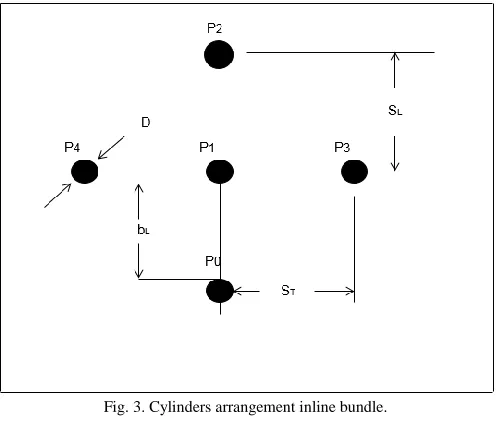
The inline cylinders arrangement in the tested bundle is shown in Fig.3 and with a longitudinal separating distance SL equal to 5 D, traversing separating distance ST equal 2.5 D. This arrangement makes the longitudinal surface to surface separating distance bL equal to 4 D while the diagonal surface to surface separating distance bT equal to 4 D.
The simplified steps were used to analyze the heat transfer process for the natural convection from the outside surface of a cylinder to the surrounding air. The total input power supplied to cylinder is from the reading of watt meter Qt is converted to heat in the consider cylinder. For steady state conditions, the energy balance which takes into consideration all the heat supply and heat losses and the convective heat loss can be written as follows:
Qconv= Qtot. −Qcond− Qrad (1)
Fig. 3. Cylinders arrangement inline bundle.
Qcond= kTeflon. ATeflon. (dTdx ) (2)
Where ATeflon represent the Teflon piece annular cross-sectional area kTeflon represent the Teflon thermal conductivity
and ( dT
dx ) is the Teflon piece axial temperature gradient
evaluated by the measured temperature difference for the 10 mm apart two thermocouples impeded in the Teflon piece. The Qcond calculated for both side of the each heated cylinder which may be similar for the horizontal orientation case but it becomes dissimilar for inclined and vertical cases. The radiation heat transfer loses calculated from the radiation heat transfer equation:
Qrad = A . ϵ . σ . F. (Tav−14 − Tav−2,a4 ) (3)
The shape factor between two long parallel cylinders is given by [15]:
F1−2= F2−1=1π〈(X2− 1)1 2⁄ + sin−1(1X) − X〉 (4)
Where
X = 1 −ST
D (5)
Where: σ is Stephan-Boltzmann constant = 5.669 *10 -8 W/K4 .m2.Where s is the spacing between cylinders centers and D is the diameter of the cylinders. The shape factor between the considered cylinder and the ambient, F1-a evaluated by:
F1-a=F1-2 (6) That gives an appropriate value of F1-a between 0.85 and 0.95 [13]. The heat exchange by radiation between the specific cylinder and the other cylinders or with the ambient calculated separately and as Tav-1 represent the specific cylinder average surface temperature and Tav-2,a represent either other cylinder average surface temperature or ambient temperature. Also the shape factor either F1-a or F1-2. The convective heat flux can be calculated
qconv = QconvA
s (7)
Where: As= π . D . L (8)
On this convective heat flux the local and average heat transfer coefficient and all the local and average Nusselt number
calculated as follow. First the local heat transfer coefficient evaluates from:
hx=( Tqconv
s,x− Ta ) (9) Where Tsx represents the measured local surface temperature. The local Nusselt numberNux depends on the local heat transfer coefficient and surface axial distance and evaluated from.
Nux=hxk. x (10)
While the local Nusselt number Nux,D based on the cylinder diameter calculate as:
Nux,D=hxk. D (11)
The air thermal conductivity k and all the air physical properties come after evaluated at the mean film temperature as reported in [15].
Tf,x = ( Ts,x2 − Ta ) (12)
The local Grashof number based on cylinder axial distance x evaluated as:
Grx=β . g .(Ts,x−Ta). x
3
υ2 (13) The local Grashof number based on cylinder diameter D evaluated as:
Grx,D=β . g .(Ts,x−Ta).D3
υ2 (14) The average heat transfer coefficient calculated for different cylinder length L as follows:
hL=1L∫x=0x=L hx dx (15)
The average Nusselt and Grashof numbers for different cylinder length can be calculated from:
NuL=hLk. L (16)
GrL= β . g .( Ts,L − Ta ). L
3
υ2 (17) The average Nusselt and Grashof numbers based on the cylinder diameter D can be calculated from:
NuL,D=hLk.D (18)
GrL,D = β . g .(Ts,L−Ta). D
3
υ2 (19) The average surface temperature Ts,L for different cylinder length L can be calculated from:
Ts,L=1L∫x=0x=LTs,x dx (20)
All the air physical properties to evaluate Nuav and Grav numbers were evaluated at the mean film temperature Burmeister, [17].
D. Experimental Error Analysis
number, Nusselt number, and Prandtl number were 3.8%, 2.74% and 2.5 %, respectively.
III. RESULTS AND DISCUSSION
In the bundle arrangement, an array of five cylinders symbolized for presentation as P0, - P4 shown in Fig. (3). Cylinders P0, P1 and P2 arranged in a vertical column while cylinders P4, P1 and P3 arranged in a horizontal row. This arrangement makes for the horizontal bundle the cylinders P0, P1 and P2 is directly one above other with P0 the bottom of the series while P4 and P3 respectively the left and right cylinders for the P1 in the adjacent column in the inline bundle. The bundle with constant both cylinders longitudinal (flow direction) and traversing distances of 5 D. Each cylinder is 50 cm length, 25.4 mm inside diameter and outside diameter is 29.4 mm. A total of 20 test runs were carried out on this arrangement covering five bank orientation angles 0o (horizontal), 30o, 45o, 60o and 90o, in each cylinder orientation the heat flux subjected to the surfaces was varied from 621.58 W/m2 to 1353.44 W/m2.
A. Variation of Surface Temperature Along the Cylinder length
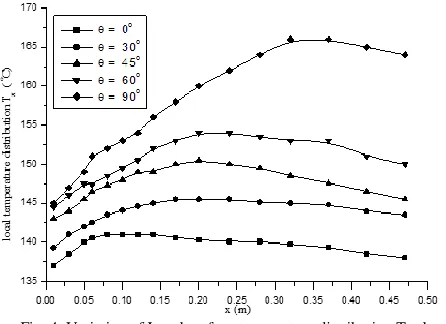
The variation of local surface temperature Tx with the cylinder axial position x, for all bundle orientations 0o(horizontal), 30o, 45o, 60oand 90o, and for maximum heat flux (1353 W/m2) is presented for three cylinders P0, P1 and P2 in Figs.4,5 and 6, respectively.
Fig. 4. Variation of Local surface temperature distribution Tx along
cylinder Po for different inline bundle orientation, q=1353 W/m2.
The temperature distribution for other two cylinders P4 and P3 is similar to that obtained for cylinder P0. The general shape of all surface temperature distributions has approximately repeated itself as the cylinder heat flux changes and this general shape only varies with bundle orientation. With exception of a horizontal orientation, the general shape shows that the surface temperature increases at the lower part of the cylinder until reaches a maximum value then remain approximately constant and then fall down in the last part of the cylinder that indicates
Fig. 5. Variation of Local surface temperature distribution Tx along
cylinder P1 for different inline bundle orientation, q=1353 W/m2.
Fig. 6. Variation of Local surface temperature distribution Tx along
cylinder P2 for different inline bundle orientation, q=1353 W/m2.
temperature of cylinder P2 is lower than surface temperature of cylinder P1. That reduction in surface temperature attributed to the effect of convection current. As cylinder P0 is the lowest in the column so it is not affected with naturally upward free convection current and that makes P0 behave as a single cylinder. The cylinders P3 and P4 have a same result of P0 which can attributed to the cylinder arrangement as 5 D traversing spacing distance deployed in the present investigation make free convection current of the bundle column does not interfere with adjacent columns natural convection. Therefore, cylinder P3 and P4 behave as a single cylinder in the bundle.
B. Variation of Local Heat Transfer Coefficient Along the Tube length
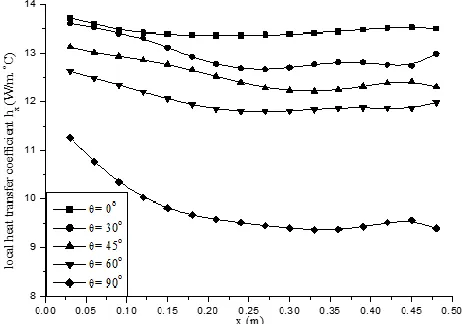
The variation of local heat transfer coefficient hx with cylinder length x for different cylinder orientations is presented for the three cylinders P0, P1 and P2 in Fig.7, Fig.8 and Fig.9, respectively.
Fig. 7. Variation of Local heat transfer coefficient hx along cylinder Po for
different inline bundle orientation, q=1353 W/m2.
Fig. 8. Variation of Local heat transfer coefficient hx along cylinder P1 for
different inline bundle orientation, q=1353 W/m2.
Fig. 9. Variation of Local heat transfer coefficient hx along cylinder P2 for
different inline bundle orientation, q=1353 W/m2.
These figures were depicted in the same runs shown in figures (4-6) which for the same heat flux 1335 W/m2. With the exception of horizontal cylinder, all hx variations shows a fast reduction in hx value to reach approximately constant at a specific point at the middle or even at the last part of the cylinder then it shows a small improvement at the cylinder end . This description is quite clear for vertical cylinder and change gradually as the cylinder inclination angle change to ward a
Horizontal to show approximately constant hx value for a whole cylinder length with a small improvement at both cylinder ends. For the vertical and inclined cylinders, The hz variations with a high value at the cylinder leading edge. (x = 0) as the result of zero thermal boundary layer thickness expected their and the hx value decreases continuously due to developing of thermal boundary layer at the middle and last part of the cylinder. The improvement of hx at cylinder end can be attributed partly to the boundary layer transformation from laminar mode to turbulent mode (transition region) and the other part due to axial condition heat loss via the Teflon piece. For the inclined cylinder, the flow separation can be expected while the flow climb upward and this separation will complicate the boundary layer behavior and prediction. The separation of flow expectation increases with the reduction of the cylinder inclination angle to be climbing along the cylinder circumference of horizontal cylinder and that makes the local heat transfer coefficient does not vary with cylinder length. Results for different heat flux also reveal that the hx values at the same value of x increases, as it should, with the increases of heat flux.
C. Variation of Average Heat Transfer Coefficient Along the Tube length
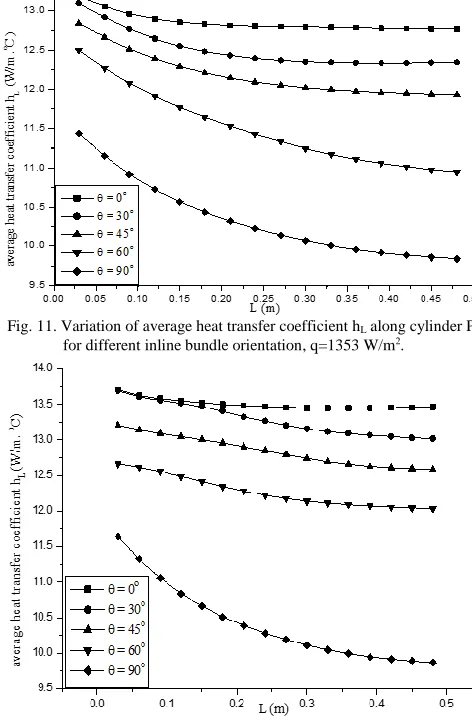
a constant hx values along the cylinder length but hL values increase with increasing of surface heat flux for the separating distance (SL and ST) tested. The results for inclined bank, which are shown in same figures, illustrate a high hL value at tube leading edge and the value decreases gradually to minimum value at tube upper part while the results for all the cylinders in a vertical bank, show hL variation similar to the inclined
Fig. 10. Variation of average heat transfer coefficient hL along cylinder P0
for different inline bundle orientation, q=1353 W/m2.
Fig. 11. Variation of average heat transfer coefficient hL along cylinder P1
for different inline bundle orientation, q=1353 W/m2.
Fig. 12. Variation of average heat transfer coefficient hL along cylinder P2
for different inline bundle orientation, q=1353 W/m2.
cylinder results with hx values become constant and asymptotic with to the x-axis even show some improvement at the upper part of the cylinder as the heat transfer processes expected enter the transition zone between laminar to turbulent. Obviously as L approach zero, hL must approach infinity as zero boundary layer at this position. For inclined and vertical cylinder in the bank, this shape as a whole moves upward as the heat flux increases for same angle of inclination. The last hL values for the five cylinders in the bundle and for 20 runs tested covering four heat flux varies between 630 W/m2 to 1350 W/m2 have been used in the further experimental heat transfer data analysis leading to data correlation as those values represent the complete cylinder length.
D. Correlation of Average Heat Transfer Results
The variation of average Nusselt number (NuL, D) based on the whole cylinder heat transfer coefficient hL is presented for three cylinders in bundle column P0, P1 and P2, for all ranges of heat flux, and from all angles of inclinations in Figs. 13, 14 and 15 respectively.
Fig. 13. variation of Log10 (NuL,D with Log10(GrL,D. Pr) for cylinder Po in an
inline bundle and for different bundle orientations.
Fig. 14. variation of Log10 (NuL,D with Log10(GrL,D. Pr) for cylinder P1 in an
inline bundle and for different bundle orientations.
results for all inclination angles and the present cylinder spacing does not show any flow interference between the three cylinders in a bundle's row. Therefore, the three cylinders behave as single cylinder behavior. The second cylinder in bundle's column heat transfer results shown in Fig (14) demonstrate an improvement in heat transfer process in comparison with a single cylinder result for the present cylinder spacing tested.
Fig. 15. variation of Log10 (NuL,D with Log10(GrL,D. Pr) for cylinder P2 in an
inline bundle and for different bundle orientations.
That can be attributed to the lower cylinders plume which has been mentioned in some previous literature. This ascending plume may enhance or worsen the heat transfer process depend on cylinder spacing and configuration and the enhancement occurs as the plume changes the convective heat transfer regime from a pure natural convection regime to a combined free and forced convection regime. Fig. (15) reveals a further improvement in heat transfer results in comparison with that obtained in Fig. (14) for P1 that mean the intensity of natural convection current having a buildup constructive effect on the bundle current interference process. Natural convection is highly dependent on the geometry of the hot surface, various correlations exist in order to determine the heat transfer coefficient As the experimental analysis should be based on a characteristic length reference weather the characteristic length D (horizontal cylinder) or L (vertical cylinder) or enter either (L/D) or angle θ as a parameter. The average results for the whole cylinder length L presented in Fig’s. (13) to (15) used the dimensionless groups based on cylinder diameter D presented as log (NuL, D ) against log (GrL,D .Pr) and shown as a group of a straight lines each represents an angle of inclination. For cylinders tested diameter, length and applied heat flux range
make our results completely in the laminar region and all previous references mention that the dimensionless group governed by a power function raised to 0.25 in this region. The results in the Fig’s. (13) to (15) plotted on a log-log scale and the power function presented for different bundles orientations shown as a group of straight lines having a slope nearly equal to 0. 25.The general equations of these lines are in the form of (21).
Log10 (NuL,D) = Log10 C∗+ m . Log10(GrL,D . Pr) (21)
Where
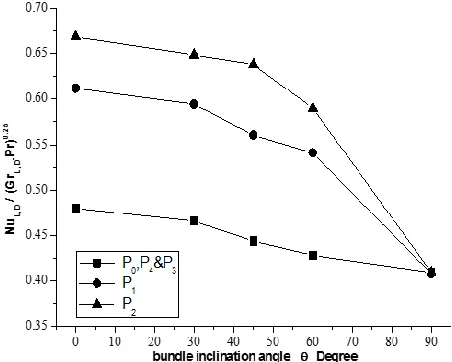
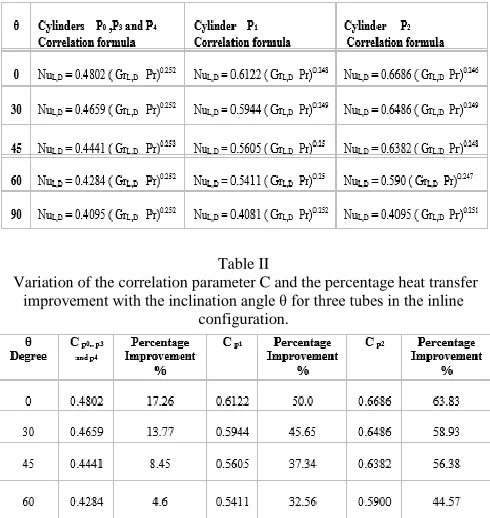
𝐶 = 10𝐿𝑜𝑔10 𝐶∗ (22) The results also reveal that the angle of inclination has a very limited effect on the correlation equations slope (m) value (the power of power function) of equation (21). The experimental results deviate within + 4% from the correlation lines presented and all correlation equations have been presented for different bundle orientations θ in table (1) which evaluated for five cylinders and for a inline bundle having both traversing spacing (ST) and longitudinal spacing (SL) equal to 5 D. For the five cylinders, the effect of bundle inclination is obvious on equations C values. For the single cylinder behavior (P0 , P4 and P3) and for cylinders P1 and P2 results reveal that all cylinders have the same results for the case of vertical bundle and the lowest in comparison with other bundle orientations therefore the results of vertical cylinders used as reference for comparison and to show the improvements in the heat transfer process for different bundle orientations. These improvement values as a percentage improvement and equation (21) C values are tabulated in table (2). Using the same procedure for experimental data analysis to calculate the average heat transfer for the whole cylinder length and for all orientation based on D reveals that the improvement in heat transfer increases to approximately 17% occurs as the single cylinder merely move from vertical to horizontal. To reveal such improvement in heat transfer and the effect of bundle angle of inclination graphically, Fig.(16) depicts the variation of the dimensionless parameter (NuL,D /(GrL,D .Pr )0.25) with bundle inclination angle θ .this figure revels the improvement in P2 and P1 cylinders heat transfer in comparison with a limited improvement in cylinders P0 , P3 and P4 (behave as single cylinder) heat transfer as the bundle moved from vertical to horizontal orientations.
Fig. 16. Variation of parameter NuL,D /(GrL,D. Pr)0.25 with bunde inclination
angle Ө, for inline bundle having separating distance SL and ST equal to 5D.
E. Comparison with Previous Works
The above equation for single horizontal cylinder gives average Nusselt number quiet in a good agreement with correlation proposed by Morgan [1] and equation (23) gives average Nusselt number higher than those [1] by (0.0416%) , The results for all cylinders in vertical situation approximately govern by one equation with C value equal to 0.408 lower than the horizontal situation which it is in contradiction and disagreement with some of previous work It is clear that for the present arrangement and cylinder spacing the vertical bundle does not have a natural convection currents interference.
To show the free convection interactive effect within an horizontal inline bundle, Tokura et.al [13] Results ,for each specific arrangement (b/D), are demonstrated in the form of variation of average Nusselt ratio (Nui/Nus), where i represents the tube number in the array and s represents the results for a single tube (the bottom tube in an array), with the parameter(Si / Smax ), where Si represents center to center the specific tube separating distance measured from the bottom tube while (Smax) represents center to center tube separating distance between the bottom and top tubes in the bundle. The results reveal a reduction in (Nui/Nus) value as (S/Smax) increases for (b/D) less than (1), remain approximately constant for (b/D) equal to ( 1 ) and increases as in (b/D) greater than ( 2 ), for the same Ra number. Present results have a good agreement with Takura result for present result (bL /D) equal 4 and results for cylinders P1 and P2 higher than the result of three in the single cylinders behavior in the bundle P0 , P4 and P3 . Present result also in an acceptable agreement with theoretical result obtained by Corcione [14] as for present work (bL /D) equal 4 give a moderate or limited improvement for same Ra number.
Table I
Shows the correlation results of the three cylinders in line bundle with cylinders spacing ST and SL of 5 D and 5 D ,respectively.
Table II
Variation of the correlation parameter C and the percentage heat transfer improvement with the inclination angle θ for three tubes in the inline
configuration.
IV. CONCLUSION
Heat transfer by natural convection to air from an inclined bundle of five cylinders arranger in staggered shape and subjected all to a constant heat flux investigated experimentally. The staggered bundle with fixed longitudinal spacing SL and traversing spacing ST equal to 5 D and 5 D, respectively. The bundle inclination angles are 0 º (horizontal), 30 º, 45 º, 60 º and 90 º. From the experimental results the following conclusions can be achieve: -
1) The variation of surface temperature for inclined and vertical situation, has the same general shape which increases at the cylinder lower part with a reduced rate as the boundary layer build up to reach a constant temperature at the cylinder upper part. The horizontal cylinder shows approximately constant temperature distribution along the cylinder length. These distributions increase and decrease with increase and decrease the surface heat flux. For the same heat flux and ambient air temperature the distributions show a reduction in surface temperature as the cylinder inclination change from vertical to horizontal. For a horizontal and inclined bundle, the temperature distribution for cylinders P1 and P2 have a lower surface temperature than cylinders P1, P0 and P3 for same inclination angle and same heat flux. Generally, the horizontal bundle has on average lowest surface temperature and better heat transfer dissipation.
2) The variation of local and average heat transfer coefficient for inclined and clearly for vertical bundle show a sharp reduction at the lower part of the cylinder then to be a constant or little improving at cylinder upper part as the laminar boundary layer dominates the flow movement and heat transfer process along the bundle cylinders. Local and average heat transfer coefficient increase with the increase of heat flux for same angle of inclination .and for a specific cylinder in the bundle the local and average heat transfer coefficient decreases as the cylinder orientation change from horizontal to vertical for same heat flux. For the same heat flux and orientation the second and third cylinder in the bundle column show a clear improvement in heat transfer coefficient while the left and right cylinder in the bundle row behave as cylinder P0 ( three as single cylinder) and without current interference effect.
4) A comparison with available previous work studied vertical and horizontal single cylinder show that the heat transfer results in an acceptable agreement with horizontal single cylinder and a contradicted result with vertical case. Comparison with available two cylinders and more in inline arrangement studied also shows a good. Agreement for horizontal bundle with longitudinal separating distance more than 2 D.
V. ACKNOWLEDGEMENT
This work has been performed at the Nuclear Engineering Department, College of Engineering University of Baghdad, Iraq. The authors would truly like to recognize college of engineering for providing technical financial assistance without it this work is difficult to complete successfully.
REFERENCES
[1] Morgan, V.T., (1975) "The Overall Convection Heat Transfer From Circular Cylinders", in Advances in Heat Transfer , Vol.11. Academic Press New York., pp.199–264.
[2] Popiel, C. O., Wojtkowiak, J., and Bober, K. (2007) ,' Laminar free convective heat transfer from isothermal vertical slender cylinder' , Experimental Thermal and Fluid Science , 32 , pp 607–613 [3] Al- Arabi, M. and Salman, Y.K.,( 1980), "Laminar Natural
Convection Heat Transfer From an Inclined Cylinder "Journal of Heat Mass Transfer .pp.45– 51.
[4] Oothuizen, P.H., (1976) "Experimented Study of Free Convection From Inclined Cylinder" ,Journal of Heat Mass Transfer, pp672– 674 ,November
[5] Reymond, O. , Murray, D. B. ,and O’Donovan ,T. S. (2008) ,' Natural convection heat transfer from two horizontal cylinders ', Experimental Thermal and Fluid Science 32 , pp 1702–1709. [6] Chouikha,*R., Guizani, A., El Cafsib, A., Maaleja,M, M. And
Belghith,A. (2000).' Experimental study of the natural convection flow around an array of heated horizontal cylinders'. Renewable Energy 21 PP 65-78.
[7] Chouikh R, Guizani A, Maaà lej M, and Belghith,A A. (1999),'Numerical study of the natural convection flow around an array of two horizontal isothermal cylinders',. Int. Com Heat Mass Transfer; 13(1):77-88.
[8] Yonco, H. and Batta, A. (1994) ' Effect of Vertical Separation Distance on Laminar Natural Convective Heat Transfer over Two Vertically Spaced Equi temperature Horizontal Cylinders', Applied Scientific Research52: 259-277,
[9] Sparrow, E.M and Boessneck, DS. (1983),; Effects of transverse misalignment on natural convection from a pair of horizontal cylinders', J. Heat Transfer105, 241-247 (1083)(Journal Article) [10] Sparrow, E.M. and Niethammer, J.E, (1981) "Effect of Vertical
Separation Distance and Cylinder –to–Cylinder Temperature Imbalance on Natural Convection for a Pair of Horizontal Cylinder " ASME, Journal of Heat Transfer, Vol. 103(4),pp. 638–644 . [11] Karvinen, R. and Kauramaki, T., (1986) "Effect of Orientation on
Natural Convection of a Cylinder Array in Water". INT. Comm. Heat Mass transfer, Vol.13, pp.155–161.
[12] Marsters, G.F., (1972) "Arrays of Heated Horizontal Cylinders in natural Convection” Int.Journal of Heat and Mass Transfer, 15 (5), pp 921-933 .
[13] Tokura, H. Saito, Kiohinami, K. and Muramoto, K.,(1983) "An Experimental Study of Free Convection Heat Transfer From a Horizontal cylinder in a vertical Array Set in Free Space between Parallel Walls" ,Journal of Heat Transfer, Vol. 104 , pp 102-107. [14] Corcione, M (2004) 'Correlating equations for free convection heat
transfer from horizontal isothermal cylinders set in a vertical array', International Journal of Heat and Mass Transfer 48 (2005) 3660– 3673
[15] Lienhard IV, J.H. And Lienhard V, J.H.(2004) 'A Heat Transfer Text Book', Third Edition, published by Phlofiston Press Cambridge Massachusetts USA.
[16] Bejan, A, (1995),' Convection Heat Transfer'. Second Edition. John Wiley & Sons Inc.: New York,
[17] Burmeister, Louis C .(1993),' Convective Heat Transfer'. John Wiley & Sons, Inc.: New York, .
[18] Holman, J.P. (2001) ‘Experimental Methods for Engineers, seventh ed., Mc-Graw Hill International Edition, New York, USA, 2001.
Khalid G. Mohammed PhD researcher in electrical machine design, his interests in power engineering, power electronic drives, heat transfer and energy. He has completed his PhD in University Tenaga National, Kuala-Lumpur, Malaysia. His practical experience for fifteen years is focused on repairing and maintenance different electrical machines and different electrical and mechanical equipments. After that he published two researches in 2007 and 2010 contain many new practical correlations for design single and three phase induction motors. He authored three practical experiment books in electrical circuits and machines have been teaching since 2009 in the college of engineering, University of Diyala, Iraq.
Yasin K. Salman Prof. Dr. and Researcher in Mechanical Engineering, Heat transfer. He has completed his PhD in Manchester UK. He has published his many manuscripts in international journals. He has been teaching since more than three decades in the college of engineering, Baghdad and Basrah universities, Iraq.
Taleeah Mohammed Ahmed M.Sc. in mechanical