International Journal of Computer Science and Software Engineering (IJCSSE), Volume 8, Issue 2, February 2019 ISSN (Online): 2409-4285 www.IJCSSE.org Page: 48-55
Early Child Care and Development (ECCD) Ontological system using
Knowledge Based Pattern Warehouse
Dr. B.S.E.Zoraida M.Phil.,Ph.D1 and Saranya.S M.C.A., M.Tech.,(Ph.D)2
1 Assistant Professor, 2 Research Scholars, Department of Computer Science and Engineering, Bharathidasan University, Trichy-23.
2
ABSTRACT
Ontology plays an important role in semantic web development. Ontologies describe the domain specific knowledge and the relationship between the classes of the domain. In this paper, an ontology based system is proposed and developed for early child care process. To empower the progress of a nation, we have to provide productive and healthy life for a child. In this motive, the ontology based ECCD (Early Child Care and Development system) is constructed for new parent’s to provide responsive parenting. The system has classified the early child development into four age groups. They are Newborn (0-3months), Infant (3-12months), Toddler (1-3.5years), and Preschooler (3.5-5years). This ontology based system describes child development, Healthy foods habits, Risks, Good parenting recommendations and Immunization reminder based on their child personal preferences. In this paper, an ontology based system is developed for an early child care development (ECCD) domain to discover knowledge using protégé tool. Discovered knowledge is extracted using SPARQL. Developed ontology is integrated with .net API system. The Concept of Pattern Warehouse is introduced in ECCD ontological system to reduce massive storage. To enhance the retrieval efficiency, decision making and response time pattern warehouse is used in this paper instead of data warehouse. Finally, Response time of ECCD system using Pattern Warehouse and Data warehouse are compared.
Keywords: Child Care, Knowledge Discovery, Ontology, Pattern Warehouse, Protégé, Semantic Web.
1. INTRODUCTION
Early childhood is the most important and fastest period of development in a human life. The years from conception through birth to eight years of age are critical to the complete and healthy cognitive, emotional and physical growth of children [1]. It is important to recognize the rapid pace of growth and maturation that takes place from birth to age 5, which has multiple implications for assessment and treatment [2]. To provide a healthy life and complete development for a child, parents should have knowledge about proper nutrition, healthy food and stage by stage developments. Child care
International Journal of Computer Science and Software Engineering (IJCSSE), Volume 8, Issue 2, February 2019 Dr. B.S.E.Zoraida and Saranya.S M.C.A.
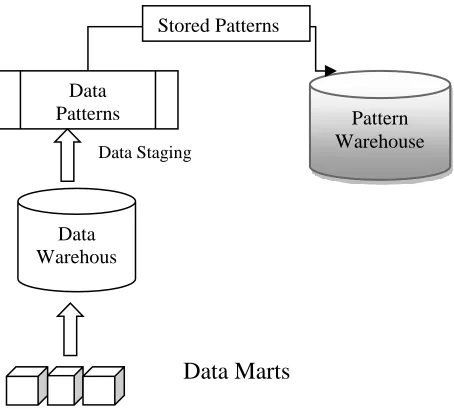
Fig. 1. Pattern Warehouse Environment
2. RELATED WORK
In this section, existing works are reviewed and discussed to study the pros and cons of the works. Many food ontology models are developed in existing system. Food Ontologies [8] are the concepts that used to design more useful and advanced applications by “reason with” we mean “infer and offer intelligent, personalized and context-sensitive dietary recommendations”. Personalized food menu planning system developed particularly useful for weightlifting [9] and diabetic control [10] system. Paper [9 ]describes a food and nutrition ontology working with a rule-based knowledge framework to provide specific menus for different times of the day and different training phases for the athlete’s diary nutritional needs and personal preferences. Paper[10]the rapid prototyping of a food ontology oriented to the nutritional and health care domain that is used to share knowledge between the different stakeholders involved in the PIPS project. Ontology based E-Health care system developed with semantic information retrieval [11] for medical data to analyze the precision and recall value. Foodwiki[12] is developed for pacakaged food products using owl/rdf technologies as mobile application. AGROVOC[13] is a ontology based integrated system with high end comprehensive system for all kinds of food products.FOODS[15] Food Oriented Ontology Driven System specially designed for diabetic patients. A Knowledge-based Framework for Development of Personalized Food Recommender System[16] designed for daily healthy food plan based on nutrition ontology. Literature study shown clearly that many food Ontologies and recommendation systems are developed with some limitations. Some of them
developed based on the rule based system. Others limited to specific domain and lack in knowledge base retrieval system. Few like AGROVOC[14] can use by experts and developed for the particular organizations. Some system may have contain errors and product coverage is not clear . To overcome these limitation this paper proposed and implemented ontology based knowledge on demand system for early child care and development using pattern warehouses.
3. PATTERN WAREHOUSE
Generally Data Warehouse is the place where we can store, retrieve and maintain the data. Likewise Pattern Warehouses store the detected and discovered patterns. Pattern warehouses involving in the process of updating the new patterns and deploying the stored patterns for each search. The main advantage of introducing Pattern warehouse concept is to enhance the decision making quality. Pattern Warehouses are up-to-date which makes effective retrieval by reducing the response time in real time by known pattern and query. Classes of Pattern are divided into three types based on their likelihood or probabilities, association and comparative natures named Influence patterns, Affinity pattern and comparative patterns respectively. Each pattern class has specific rules of inference for the manipulation of patterns [17].
Fig. 2. Classes of Patterns
4. SYSTEM ARCHITECTURE
Architecture of the proposed system is designed based on two important concepts. They are ontology and knowledge based pattern warehousing. Ontology is a technique used for conceptualization of the specific domain. In this paper Early Child Care and Development (ECCD Ontology) is taken as a domain.
Classes
of
Pattern
s
Influence
Patterns
Affinity Patterns
Comparative
Patterns
Data Marts
Data Warehous
e Data
Patterns Pattern
Warehouse Stored Patterns
Dr. B.S.E.Zoraida and Saranya.S M.C.A.
Conceptualization of ECCD domain is done by the ontology development tool protégé. Protégé is a W3c Standard open source tool for developing Ontologies. It supports web ontology languages OWL, RDF, and XML. In this paper, ECCD ontology is developed using OWL/XML languages. Developed Ontologies are stored in the knowledge based repository as meta data (Logics and Facts). Knowledge discovery can be viewed as the process of non-trivial extraction of information from large databases, information that is implicitly presented in the data, previously unknown and potentially useful for users [18].
The Meta data can be queried using SPARQL query language. We can retrieve the processed ECCD ontology which is stored in Knowledge base repository. The developed ECCD ontology document is integrated with a web application environment. The web is a natural medium for delivering knowledge. As more and more corporations deploy intranets, it has become an essential vehicle for information sharing. The Pattern Warehouse should naturally be supported on the corporate intranet and can easily reach out to the Internet[17]. In this paper web application is developed in C#.net framework. The system gets the details from user profile registry. The information is retrieved from user profile registry using data mining techniques based on the user information.
Fig. 3. ECCD System Architecture
SPARQL Knowledge base Repositories (meta data)
Ontology Development for ECCD
Conceptualization of the Domain (ECCD)
OWL/XML
Query Results
Pattern Warehouse
WEB
User Profile
Incremental Updates Document Generator
C#.net ,HTML
Documents
Mining Techniques
Pattern query Language
User Interface
International Journal of Computer Science and Software Engineering (IJCSSE), Volume 8, Issue 2, February 2019 Dr. B.S.E.Zoraida and Saranya.S M.C.A.
Generally the data analysis paradigm[17] works on data to discover based on user query. This paradigm is called as “analysis on demand”. In this paper “Knowledge Access Paradigm” is implemented in system architecture. i.e. the analysis is automatically done beforehand, refined patterns are pregenerated and users just get knowledge when needed. This approach is known as "knowledge on demand". For implementing this knowledge on demand approach, pattern warehouse concept is implemented in the system. Pattern Warehouse contains the pregenerated refined patterns. The patterns can be retrieve using pattern query language like SQL. The newly updated information is also added to pattern warehouse frequently from user profile for any incremental update of a user query. The retrieved patterns are used for document
generation to display appropriate and relevant information to the user interface.
5. ONTOLOGY DEVELOPMENT
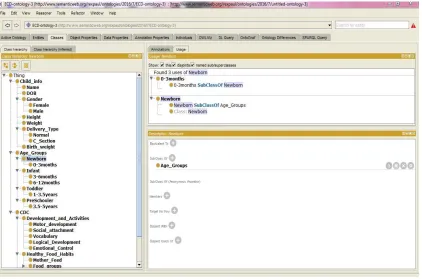
Ontology is used to capture the knowledge about some domain of interest [19]. Ontology describes the explicit specification of the conceptualization. Ontology defines the relationship among the classes of an object. Ontology has important components like individuals, properties and classes. In this paper Early child Care and Development ontology is created using Protégé tool. Active ECCD ontology is created and ontology annotations are added. The main building blocks of Ontologies are classes. The Classes hierarchy is created for ECCD ontology using protégé is shown in figure4.
Fig. 4. ECCD Ontology Development using protégé
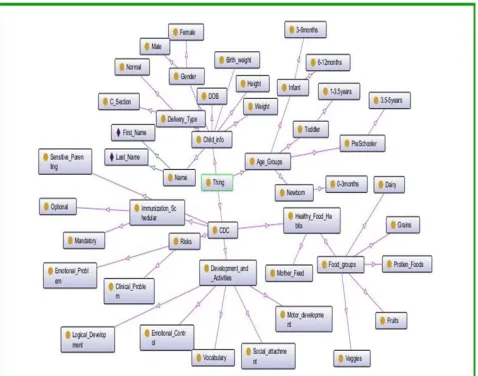
The class “thing “represents the ECCD set containing all individuals. Using the class hierarchy wizard classes and sub classes are created for ECCD Ontology. Class Child_info created with the sub classes of Name, DOB, Gender , Height, Weight, Birth-weight, Delivery_type. The ECCD has other class Age_Groups , CDC, and
International Journal of Computer Science and Software Engineering (IJCSSE), Volume 8, Issue 2, February 2019 ISSN (Online): 2409-4285 www.IJCSSE.org Page: 48-55
Fig. 5. Ontograf of ECCD
ECCD ontology implementation of disjointWith is shown below,
Gender is a subClassOf child_info. There are two types of Gender, Male and Female.
<rdfs:Class rdf:ID="Male">
<rdfs:subClassOf rdf:resource="#Gender"/> </rdfs:Class>
Male - is a subclass of its object and the resource identified by #Gender.
<rdfs:Class rdf:ID="Female">
<rdfs:subClassOf rdf:resource="#Gender"/> <owl:disjointWith rdf:resource="#Male"/> </rdfs:Class>
In Child-info some child gender are Female, too, but nothing can be both Male and Female (in this ontology) because these two classes are disjoint (using the disjointWith tag).
6. SYSTEM IMPLEMENTATION AND
RESULTS
The knowledge based ontology system for Early Child Care and Development (ECCD) using Pattern Warehouse implemented for child care on clinical dataset(100). The motivation of ECCD system development is to recommend positive and responsive parenting for new parents to provide healthy life for their child. The System has the following functionalities.
International Journal of Computer Science and Software Engineering (IJCSSE), Volume 8, Issue 2, February 2019 Dr. B.S.E.Zoraida and Saranya.S M.C.A.
Fig. 6. ECCD Login View
New parents should register their child name, DOB, Gender, Birth weight, Delivery type , current weight and height as shown in the registration form. After their registration, the details will be stored in the user profile for the future use. Every registered parent has the personal account for their child with all given details. ECCD Registration form for the new parents is shown in figure 7.
Fig. 7. ECCD Registration Form
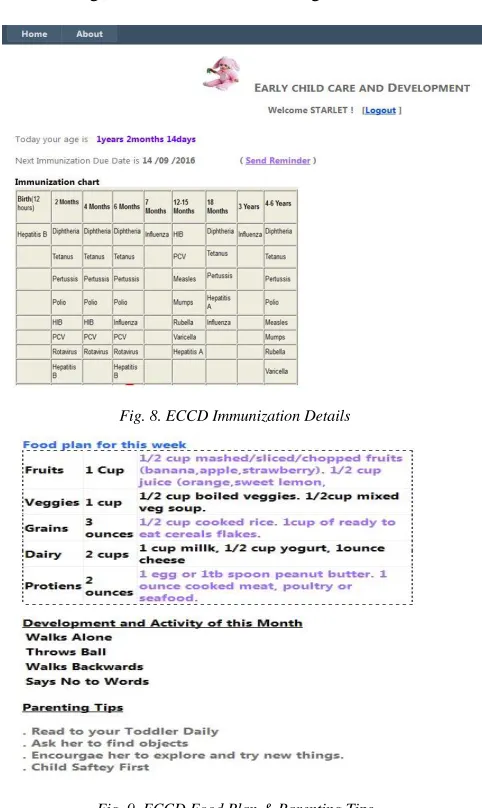
Based on the given details, pattern warehouse pregenerated and stored the details from user profile registry. By implementing the knowledge on demand approach the application will display the accurate age of the child as on date by retrieving appropriate pattern from system. And the ECCD will give the details about
immunization due date. And the system will send reminder periodically to the parent’s mail id. An age and immunization detail of a registered child is shown in figure 8.
Fig. 8. ECCD Immunization Details
Fig. 9. ECCD Food Plan & Parenting Tips
Dr. B.S.E.Zoraida and Saranya.S M.C.A.
also display. ECCD system will suggest some positive personalized parenting tips for the users to develop the activities of their child.
7. DATA WAREHOUSE VS PATTERN
WAREHOUSE
Data are a set of facts (for example, cases in a database), and pattern is an expression in some language describing a subset of the data or a model applicable to the subset [20]. In 1980’s [17] the concept of Data warehouse was developed for enterprise data management. In 1990’s [17] Decision making problem is not addressed by data warehousing technique. So the concepts of data mining techniques are introduced to enhance the decision making quality. Now due to the evolution of the web and user demand on knowledge the concept of pattern management is introduced. The pattern warehouse is used to obtain refined knowledge. Data Warehouse concept is inconsistent in decision making for large data and the speed of retrieval process is slow down when the size of database increased. To address the response time and decision making problem, the concept of pattern warehouse is used with ontology.
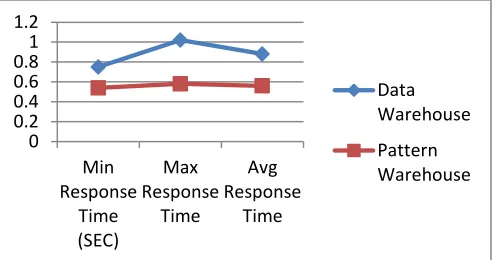
A Pattern Warehouse is a repository that holds historical patterns rather than historical data [17]. In Current trend users don’t want data as massive storage. They are likely to store data as condensed information in form of patterns. So pattern warehouse contains up-to-date and condensed information, which is efficient for retrieval process. Moreover knowledge (patterns) is so compact to store, which occupy only one third of space than data warehouse. So user can store knowledge as pattern for many years (Historical Patterns). Pattern Warehouse concept provides minimum response time for knowledge mining process. In this paper the Early Child Care Development process is developed using the Pattern Warehouse and Ontology concepts. The pattern mining will hide the method of retrieval and runs behind the process. ECCD performance is measured using the response time. The response time of ECCD API using Pattern warehouse and data warehouse is evaluated using load balancing tool. The Response time of Data Warehouse and Patten Warehouse concepts is shown below(Table 1).
Table 1: Data Warehouse Vs Pattern Warehouse
Response Time (Seconds)
Data Warehouse
Pattern Warehouse
Min 0.75 0.54
Max 1.02 0.58
Avg 0.88 0.56
Fig. 10. ECCD Data Warehouse VS Pattern Warehouse
Response time is the time taken by the server/API to respond for the user query. For efficient performance response time should be minimum as possible. Generally response time between 0.1- 1 second is known as ideal response time. The response time of ECCD pattern warehouse results are compared with the traditional data warehouse results. By comparing the response time of Data Warehouse concepts and Pattern Warehouse Concepts, Pattern Warehouse technology provides minimum response time for the user query.
8. CONCLUSION
In this paper development of an early child care system based on combination of “pattern warehouse”, “data mining for user profiling”, and ontology development has been done. Domain specific ontology is developed for Early Child Care (ECCD) domain. An ECCD ontology framework and data mining for user profiling is constructed using a software tool Protégé to discover knowledge. Discovered knowledge is stored in knowledge repository as patterns and extracted using SPARQL. Developed ECCD ontological system is integrated with .NET API. Instead of Data Warehouse, the concept of Pattern Warehouse is newly introduced to reduce massive storage of data. Further, the response time of ECCD using Pattern warehouse and Data warehouse are compared. From the results and findings of the Pattern Warehouse, user can obtain consistent results in minimum response time. The active ECCD system provides useful knowledge discovery for child development, Healthy foods habits, Risks, Good parenting recommendations and Immunization reminder based on their child personalized information.
International Journal of Computer Science and Software Engineering (IJCSSE), Volume 8, Issue 2, February 2019 Dr. B.S.E.Zoraida and Saranya.S M.C.A.
REFERENCES
[1] Early Childhood Development: The key to a full and productive life” https://www.unicef.org/
[2] “Behavioral Problems of Infancy and Preschool Children (0–5)” Frances Gardner and Daniel S. Shaw. [3] “Nutrition and Menu Planning for Children in the Child
Care Food Program” Florida Department of Health Bureau of Child Care Food Programs,2013.
[4] “Information Systems Development: Challenges in Practice, Theory, and Education , Vol2” Chris Barry Kieran Conboy Michael LangGregory Wojtkowski . [5] “Ontology Matching” Jérôme Euzenat Pavel Shvaiko,
15 June 2007, Springer Science & Business Media.
[6] “Patterns-based Real-Time Data Warehouse
Architecture”, Djillali Nora, Mohammed Mahieddine, Oukid Salyha.
[7] “The Concept of Pattern Warehouse and Contemplate an Application in Integrated Network Data Ware” , Jaesoon Park, Youngwok Kim, Youngmin Cha, Seongbum Kim.
[8] “Towards an “Internet of Food”: Food Ontologies for the Internet of Things”, Maged N. Kamel Boulos , Abdulslam Yassine , Shervin Shirmohammadi ,Chakkrit Snae Namahoot and Michael Brückner ISSN 1999-5903
[9] “Ontology-Based Personalized Dietary
Recommendation for Weightlifting”, Piyaporn Tumnark, Leandro Oliveira, Nonchai Santibutr. [10] “An example of food ontology for diabetes control”,
Jaime Cantais, David Dominguez, Valeria Gigante. [11] “Ontology Based E-Healthcare Information Retrieval
System: A Semantic Approach” Michael Raj T.F, Priya Govindarajan, Ravichandran. K.S, Gayathri.M, Uma ISSN: 2321-8169
[12] “FoodWiki: a Mobile App Examines Side Effects of Food Additives Via Semantic Web” Duygu Çelik Ertuğrul springer
[13] “ Reengineering thesauri for new applications: The AGROVOC example.” Soergel, D.; Lauser, B.; Liang, A.; Fisseha, F.; Keizer, J.; Katz, J. Digit. Inf. JODI 2004, 4, 1–23. [Google Scholar]
[14] Caracciolo, C.; Stellato, A.; Rajbahndari, S.; Morshed, A.; Johannsen, G.; Keizer, J.; Jaques, Y. Thesaurus maintenance, alignment and publication as linked data: The AGROVOC use case. Int. J. Metadata Semant. Ontol. 2012, 7, 65–75.
[15] Snae, C.; Bruckner, M. FOODS: A Food-Oriented Ontology-Driven System. In Proceedings of the 2nd IEEE International Conference on Digital Ecosystems and Technologies (DEST 2008),Phitsanulok, Thailand, 26–29 February 2008; pp. 168–176.
[16] N. Suksom, Buranarach, M., Thein, Y.M., Supnithi, T., and Netisopakul, P., " A Knowledge-based Framework for Development of Personalized Food Recommender System," in the 5th International Conference on Knowledge, Information and Creativity Support Systems (KICSS2010), 2010
[17] Jaesoon Park, Youngwok Kim, Youngmin Cha, Seongbum Kim, “The Concept of Pattern Warehouse
and Contemplate an Application in Integrated Network Data Ware”
[18] A. Nandhini , I.Berin Jeba Jingle,”A Study on discovering pattern in textmining ”, 2016
[19] http://protege.stanford.edu/publications/ontology_devel opment/ontology101-noy-mcguinness.html