Design and Implementing an Efficient Expert Assistance System for
Car Evaluation via Fuzzy Logic Controller
Mazin Abed Mohammed
Planning and Follow Up Department, University Headquarter, University of Anbar, ALKhaladeh, Anbar, Iraq
ABSTRACT
Applications of experts Assistance Systems for Car Evaluation are continuously being implemented to serve different sectors. Car evaluation has been considered as a significant segment in the logistic handling. Thus, a proper choosing of Car evaluation plays a considerable part in order to ameliorate the economic interests and suitability of logistics projects. In this paper, The Expert System (ES) is one of the most important Artificial Intelligence (AI) techniques that have been adopted to handle with Car Evaluation task. This paper presents the role of ES in developing car evaluation, detection model and the requirements of constructing successful Knowledge-Based Systems (KBS) for such model. In addition, it exhibits the adaptation of the ES in the development of Car evaluation Assistance System via Fuzzy logic (CEASFL). However, CEASFL development faces including many challenges such as collecting the required data for building the knowledge base and performing the inferencing. Furthermore, determine of car evaluation requires skills and experienced mechanics to get a good car. Thus, systems such as CEASFL can be highly useful in assisting mechanics for car evaluation detection and training purposes.
Keywords: Expert system (ES), Artificial Intelligence (AI), car Evaluation, Fuzzy logic, Knowledge-Based System (KBS), Inference engine.
1. INTRODUCTION
Nowadays, the car technology is very important and significant to any car manufacturing companies as car specifications are changing rapidly stimulated by environmental and economic factors[1][10]. This issue presents a challenge to both car mechanics and drivers or users in handling car evaluation. With the advent of new technologies like the hybrid engine, new shapes, GPS system, and the sensors electric mirror in the car . There are many changes that need to be learned in car evaluation. In fact, in a normal situation, car evaluation identification is still a challenging task, especially for the inexperienced mechanics and drivers. Consequently, the success of finding good car is extremely dependent on the expertise of the individual. However, the dependence on the experts
can be minimized if the expertise is captured, documented, and retained in some computer applications [1].
Different types of AI techniques have been successfully applied in the car evaluation systems such as those presented in [1], [4] and [5]. The required AI techniques for such domain have to be capable of emulating the human brain’s evaluation processes [6]. The Expert System (ES) is one of the well-known reasoning techniques that are utilized in the evaluations applications domain. In ES, human knowledge about a particular expertise to accomplish a particular task is represented as facts and rules in its knowledge base [7]. It seeks and uses the information provided by a user. Reasoning process is then performed over the represented knowledge using heuristic approaches to formulate a solution [11].
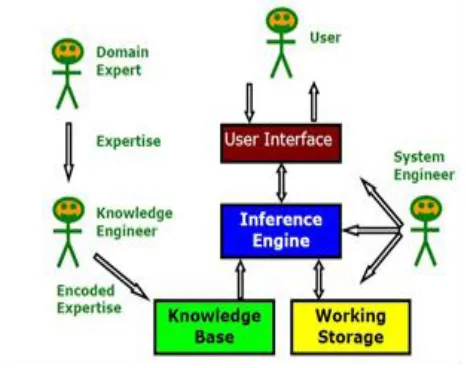
The definition of an ES as proposed by [8] is: an interactive computer based decision tool that uses both facts and rules to solve difficult problems [9]. The ES is a knowledge-based system that consists of two main modules: the knowledge base and the inference engine. It usually has a knowledge acquisition module and an explanation module as extra components. A typical expert system is as shown in Figure 1, and tables are not prescribed, although the various table text styles are provided. The formatter will need to create these components, incorporating the applicable criteria that follow. Systems that utilize the knowledge base approach are more straightforward than the conventional approach. Knowledge is represented explicitly in the knowledge base so that it can be altered with relative ease. This representation often takes the form of rules. The inference engine utilizes the knowledge base contents to solve a particular problem according to the user responses through an interface (e.g. enter the conditions of the car evaluation). The inference module exploits the knowledge to apply that knowledge to the given problem [7].
steps are the Knowledge base represented by (if-then rules) and inference engine such as Mamdani and Takagi-Sugeno models.
Fig. 1. Expert system main components
In this paper ,we used fuzzy Logic(FL) is a problem-solving control system methodology that lends itself to implementation in systems ranging from simple, small, data acquisition and control systems
2. RESEARCH OBJECTIVES
The main objective of the research is to develop Car evaluation Assistance System via Fuzzy logic (CEASFL). The aim of the proposed CEASFL is to provide quick and precise expert guidance to car evaluation. Additionally, for training purposes, it helps in reducing the knowledge gap between different individuals in car evaluation system. The specific objectives of the research are as follows:
• To design an efficient fuzzy logic controller for car evaluation problem by using Matlap tool-box. The fuzzy logic controller will cover all the probabilities that could be presented to evaluate the cars.
• To develop an ES that supports the implement-ation of the proposed system’s functionality to get good results.
• To design appropriate representation architect-ture to the proposed Car Evaluation Assista-nce System via Fuzzy logic (CEASFL).
• To evaluate the usability of the car evaluation system.
• To investigate the studies on car evaluation and Expert System (ES) domains.
• To test and validate the CEASFL performance.
3. SIGNIFICANCE OF THE RESEARCH
From the view point of Car Evaluation Assistance System via Fuzzy logic (CEASFL), our system is the first implementation of using expert system with fuzzy logic, it appeared from the studies on ES and CEASFL it has no system for evaluation the car . From application aspect, in addition to solve real problem in optimizing buy the cars. We also develop software package for solving Car evaluation Assistance System. The results of this research will be presented the fuzzy logic controller will cover all the probabilities that could be presented to evaluate the cars. Along the recent increase in the demand for an efficient management system for evaluating the cars, our focus would be to work on the problem related such as buy car or evaluating about the price ,size ,speed, and conditions of cars.
4. CEASFL PROTOTYPE MODELING
Car Evolution problem consists of five levels it represented by the age of the car, size of the car, cost of the car, speed of the car and finally conditions of the car. Car Evolution is the task of investigating the conditions that identify the system components that are functioning or not as intended. A wide range of Car Evolution applications in different domains exploits the rule-based expert system’s approach [1]. It is believed to be very convenient in situations where expertise and experience availability rate is high and the system’s understandability rate is either low or costly to obtain [6].
4.1
CEASFL Architecture
Fig. 2. CEASFL architecture
The fuzzy logic controlling system consists of five steps. These five steps can be structured as preprocessing, fuzzification, rules base, defuzzification and finally post processing as illustrated in figure 3.
Fig. 3. The structure of FL control System
At the preprocessing step the inputs are most often hard or crisp measurement from some measuring equipment rather than linguistic. The fuzzification converts each piece of input data to degrees of membership by lookup in one or more membership functions. The fuzzification block matches the input data with the conditions of the rules to determine. There is degree of membership for each linguistic then that applies to the input variable [2][5]. After fuzzification, collection of rules is called a rule base are designed. The rules are in "If Then" format and formally the If side is called the conditions and the Then side is called the conclusion. The prototype is able to execute the rules and compute a control signal depending on the measured inputs error (e) and change in error. (dE). A rule base controller is easy to understand and easy to maintain for a non- specialist end user[3][4]. In defuzzification all actions that have been activated are
combined and converted into a single non-fuzzy output which is the control signal of the system [2]. Finally, the post processing block often contains an output gain that can be tuned and also become as an integrator.
4.2
The Inference Engine Specifications
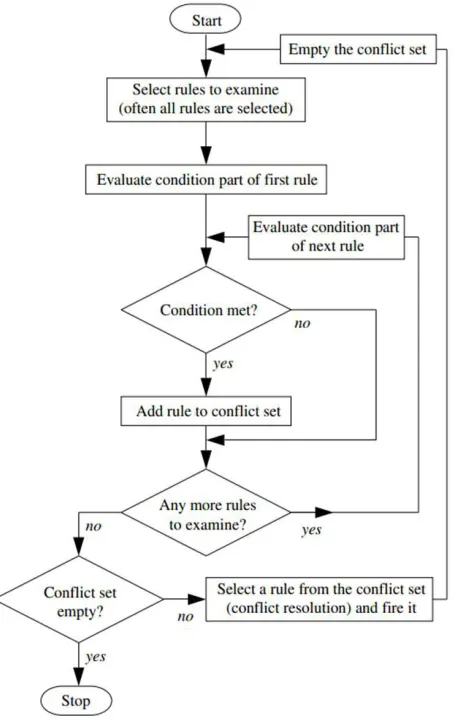
The inference engine traces the applicable facts that represent the corresponding symptoms (i.e. the observed variables or behavior) and apply them to the tagged rules. In the proposed CEASFL, production-rules is chosen form for knowledge representation. Additionally, the inference engine is the forward-chaining type (data driven mode) as shown in Figure 4.
Forward-chaining inference engine has the advantages of producing solutions for the unformulated problems. In this type of engine, the satisfactory facts that meet the rules conditions are promoted to be triggered [1]. All the applicable rules resulting from the previous process make up the conflict set of rules to be implemented according to specific order that enables solution generation.
4.3 CEASFL Main Processes
The CEASFL is an evaluating system with multi-tasking capabilities that is directive for develop Car evaluation Assistance System via Fuzzy logic. It provides information sources and knowledge interaction and evaluation regarding the technical process to be tackled. Such tasks are type select, the price, and customer advising that requires it to adopt various types of modules (see Figure 5).
Fig. 5. CEASFL Main Processes
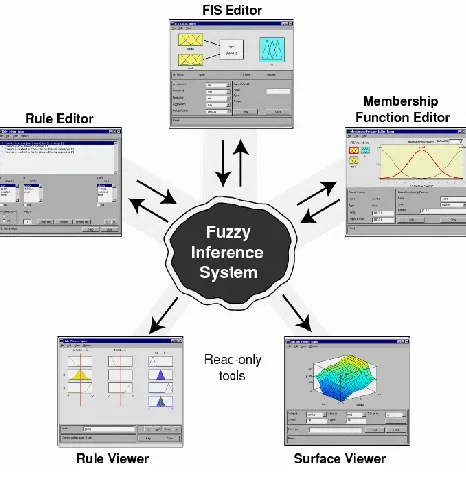
Each module’s goal is achieved by applying a number of processes. Figure 5 shows the system components in a process level. One of the main characteristics of the CEASFL is Fuzzy Inference System to be in parallel with the system’s knowledge base. Fuzzy Inference System designed to be Building, editing and observing fuzzy inference systems such as:
• Fuzzy Inference System (FIS) editor • Membership Function editor • Rule Editor
• Rule Viewer • Surface Viewer
These functions are dynamically linked and if the changes make to the FIS to the one of the toolbox, the effect can be seen in other GUIs. In addition to these five primary GUIs, the toolbox includes the graphical ANFIS Editor GUI, which is used for building and analyzing Sugeno-types adaptive neural fuzzy inference systems [3].
5. CEASFL IMPLEMENTATION AND
RESULTS
To implement the CEASFL model, by using MATLAB is a high-performance language for technical computing. It integrates computation, visualization, and programming in an easy-to-use environment where problems and solutions are expressed in familiar mathematical notation.it is used as a general purpose tool for system concept development and prototyping. We consider the main states for car evaluation system, in each of these states the expert system can determine and give a step by step explanation of what the options is to the user. The system also has two features; help and advice. The system consist of 5 inputs represented by Age, Size, Cost, Speed and Air Condition of Car and one output represented by suitability of the Car. In our work, we try to deal with a non-expert user and benefit from simple and clever ideas to diagnose the car. If the user did not succeed in to evaluating the car, the application gives the user advice on what should do. The Graphical User Interface (GUI) performs as a communication tool that connects the user with the system. It displays the questions about type and conditions of car to be answered by the user and shows the corresponding results. Figure 6 illustrate the inputs and output respectively Matlap Toolbox.
Fig. 6. shows illustrates the inputs and output respectively
5.1
System Functionality
car in any country and who are yet to familiarize themselves to where they can get help when they have problems when buy or evaluating their cars. The proposed CEASFL provides the following functions:
• The system poses a set of advantages to the user to be answered and system decomposition is made based on user questions.
• The processes and the collected data for each task are retained in the system to be analyzed and exploited in enhancing the knowledge base and constructing new rules for any use in the future.
• The proposed CEASFL is provided to help and guide the user in the diagnostic how to buy and evaluating the cars.
The system has the feature for evaluating cars and guide that provides information about the car options such as Age, Speed, Cost, Size, Conditions and Suitability of Car.
5.2
The Prototype
The proposed of expert system utilizes a combination of qualitative and quantitative procedures for Car evaluation Assistance System via Fuzzy logic. The mixture of both provides reliability to the technical process and facilitates knowledge interaction and analysis. An executable prototype of the proposed Car evaluation Assistance System via Fuzzy logic (CEASFL) has been successfully implemented and validated. The results show that basic diagnostic procedures are very satisfactory and the processing ability is acceptable and gives the required information about any car evaluation. CEASFL implementation and samples of the user interface along with the results are described in the following paragraphs.
CEASFL starts by displaying its main window, which contains the main car states of the system as shown in Figure 7.
Fig. 7. Show main window of the system
Fig. 8. Show run the suitability of the car
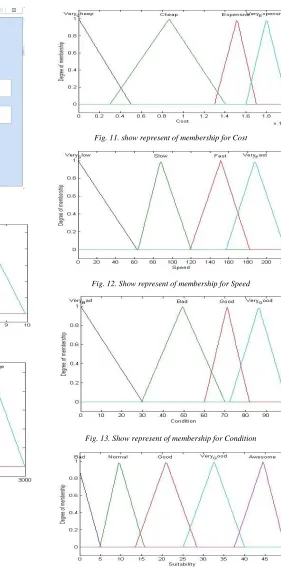
Fig. 9. Show represent of membership for Age
Fig. 10. Show represent of membership for size
Fig. 11. show represent of membership for Cost
Fig. 12. Show represent of membership for Speed
Fig. 13. Show represent of membership for Condition
The relationship between the inputs and outputs is illustrating 3d relationship between the inputs and outputs for displaying Fuzzy system surface viewer figures 15,16,17,18 respectively.
Fig. 15. Show 3d relationship between cost, age and suitability of the car
Fig. 16. Show 3d relationship between cost, size and suitability of the car
Fig. 17. Show 3d relationship between cost, speed and suitability of the car
Fig. 18. Show 3d relationship between cost, condition and suitability of the car
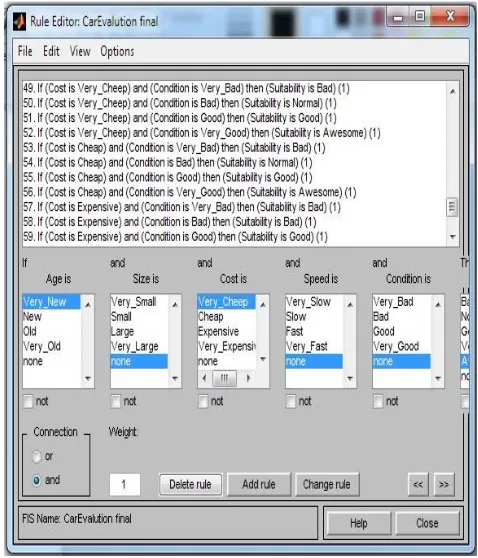
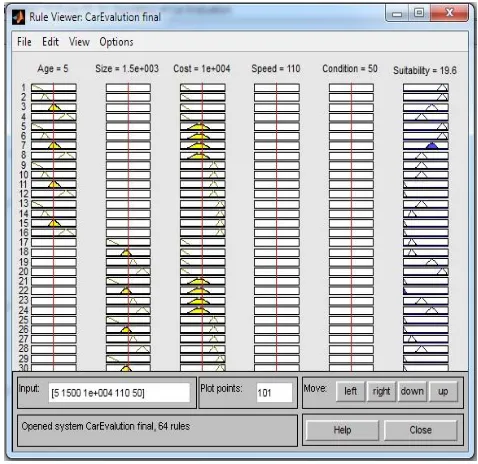
The proposed CEASFL use Matlab rule editor illustrated in figure 19. The CEASFL will consist of 64 rules. In rule editor we use logical And connection to connect between several inputs. These rules will be used by inference engine (Mamdani Model) in order to gain suitable output. The Inference engine that used in our CEASFL is Mamdani model. This model draws membership function for each antecedent and conclusion of each rule that have been built in rules base see figure 20.
Fig. 20. Show rule viewer
5.3
AnalysisThe parallelism of the knowledge base and inference engine improves system performance [7]. The advantage behind this procedure is to overcome the repetition of incorrect decisions during the questions about options of the car by changing the sequence of the applicable rules in the conflict set. However, in such system where a diagnostic result is based on system reliability and it is user reliability dependent, inaccurately provided data to the system is more likely to cause inappropriate diagnostic result. However, the results of the proposed system showed reliability of the system to give the user best solution about car evaluation. Furthermore, diagnosis of car evaluation requires skills and experienced mechanics to get a good car. Thus, systems such as CEASFL can be highly useful in assisting mechanics for car evaluation detection and training purposes.
6. Computational Results
The system has been run on 20 instances of car offers. The offers are taken in different forms such as car has age=1.5 year, size of engine is small =750, cost of car =9636$, speed=214 and Air condition 95, any experience one will take in mind these variable and begin by inferenecing, in this case he will say: this car is very new it has 1.5 year but size of engine is small its 750 while the cost of car is not very expensive its 9636$, speed and air condition is very good so he will think as say: in spite of engine size of car is small but it has another good specification so he will decide that this offer is good and the customer can buy it.
The CEASFL is use the same expertise in producing the suitable output.
Table 4.1 contains the 20 offers that have been inputs to the CEASFL and the system provide the appropriate output..
Table 1: contains the 20 offers that have been inputs to the CEASFL and
the system provide the appropriate output.
7. CONCLUSION AND FUTURE WORK
In this paper, a Knowledge-Based System (KBS) for Car evaluation Assistance System via Fuzzy logic (CEASFL), is presented. The proposed CEASFL is utilized to assist inexperienced mechanics, drivers or anyone want buy car or evaluation it and to provide decision support system. In addition, CEASFL is considered as an interactive training tool that can provide expert guidance in car evaluation system by Using Fuzzy logic. System implementation results indicate that the system has significance in places where work productivity is improved by fuzzy logic and increasing users understanding. More so, it can be considered as a successful alternative to the highly skilled mechanics. Further improvement to the system domain knowledge specifications is required to enhance domain knowledge representation. Furthermore, adopting another AI technique to work in system rules revision to add more effectiveness to the diagnosis process will be considered.
REFERENCES
[2] Mahdi, O.A., Mohammed, M.A. and Mohamed, A.J., 2012. Implementing a novel approach an convert audio compression to text coding via hybrid technique. International Journal of Computer Science Issues, 9(6), pp.53-59.
[3] Ketata, R., D. De Geest, and A. Titli. "Fuzzy controller: design, evaluation, parallel and hierarchial combination with a pid controller." Fuzzy Sets and Systems 71, no. 1 (1995): 113-129.
[4] Ferdinando, H. "The implementation of low cost Fuzzy Logic Controller for PLC TSX 37-21." In Intelligent and Advanced Systems, 2007. ICIAS 2007. International Conference on, pp. 1081-1086. IEEE, 2007.
[5] Kandel, Abraham. Fuzzy expert systems. CRC press, 1991. [6] Lee, Chuen-Chien. "Fuzzy logic in control systems: fuzzy
logic controller. II."Systems, Man and Cybernetics, IEEE Transactions on 20, no. 2 (1990): 419-435.
[7] Mohammed, M.A., Ahmad, M.S. and Mostafa, S.A., 2012, June. Using genetic algorithm in implementing capacitated vehicle routing problem. In Computer & Information Science (ICCIS), 2012 International Conference on (Vol. 1, pp. 257-262). IEEE.
[8] K. S. E. Ricardo Nurzal, “A Decision Support System for Car Fault Diagnosis Using Expert System”, International Journal of Information Sciences for Decision Making, N 2, 1998. [9] D. D. Milanović, M. Misita, D. Tadić and D. L. Milanović,
“The Design of Hybrid System for Servicing Process Support in Small Businesses, FME Transactions”, 2010, 38, 143-149. [10] P. Santosh, K. Patra, D. P. Sahu and I. Mandal, “An Expert
System for Diagnosis of Human Diseases”, International Journal of Computer Applications, (0975–8887) Volume 1– No. 13, 2010.
[11] Obaid, O.I., Ahmad, M., Mostafa, S.A. and Mohammed, M.A., 2012. Comparing performance of genetic algorithm with varying crossover in solving examination timetabling problem. J. Emerg. Trends Comput. Inf. Sci, 3(10), pp.1427-1434.
[12] J. G. Rolim and M. Moreto, “An Expert System Based Approach for Diagnosis of Occurrences in Power Generating Units”, Expert Systems for Human, Materials and Automation, 2011, ISBN 978-953-307-334-7.
[13] C. Angeli, “Diagnostic Expert Systems: From Expert’s Knowledge to Real-Time Systems, in Advanced Knowledge Based Systems”, Model, Applications & Research, Eds. Sajja & Akerkar, Vol. 1, ch. 4, pp 50 – 73, 2010.
[14] Hameed, A.H., Mostafa, S.A. and Mohammed, M.A., 2013. Simulation and evaluation of WIMAX handover over homogeneous and heterogeneous networks. American Journal of Networks and Communications, 2(3), pp.73-80.
[15] A. A. Hopgood, Intelligent Systems for Engineers and Scientists (2nd Edition): CRC Press, 2001.
AUTHOR PROFILES:
Mr. Mazin Abed Mohammed received his Master of IT degree