121
Optimizing the Management and Use of Energy in the
Greenhouse by Modeling the Associated Heating
and Cooling Systems and Implemented
by an Intelligent Controller
1
Didi Faouzi,
2N. Bibi-Triki,
2N. Benmoussa,
3A. Bouhdjar,
4A. Abène
1,2Materials and Renewable Energy Research Unit M.R.E.R.U University of Abou-bakr Belkaïd,
B.P. 119, Tlemcen, Algeria
3Center for the Development of Renewable Energies BP. 62,
Bouzarea Observatory Road-Algiers, Algeria
4Euro-Mediterranean Institute of Environment and Renewable Energies,
University of Valenciennes, France
Abstract
In Algeria, greenhouse cultivation is undergoing significant
development. To meet an increasingly competitive market and conditioned by increasingly stringent quality standards, “Greenhouse” production systems (heating and air-conditioning systems) Become considerably sophisticated and then disproportionately expensive. That is why locks who want to remain competitive must optimize their investment by controlling production conditions. The aim of our work is to model heating and air conditioning systems whose goal of heating and cooling the air inside our model and implemented in our application of climate control are due to the fuzzy logic that Has the role of optimizing the cost of the energy supplied using MATLAB software.
Keywords
Optimization, Modelling, Simulation, Heater systems, Intelligent control, Fuzzy logic, Greenhouse, Cooling pads.
I. Introduction
The greenhouse originally conceived as an enclosure bounded by a wall transparent to solar radiation, as is the case with the conventional greenhouse, which is widely used in our country,
amplifies certain parameters of the surrounding climate and shows
conditions that are not favorable to Growth and the development of protected crops. This type of traditional greenhouses answered fairly well in the countries of the Mediterranean basin, is confronted to the intense nocturnal cooling, which sometimes results in the reversal of the internal temperatures and complications of overheating and hygrometric variations According to the seasons. Extreme variations in these parameters, often observed within shelters, constitute a nuisance that can hinder growth and crop development and, at best, penalize yield and product quality. To meet this equation of supply and demand, greenhouse systems have developed over time, thus imposing a great mastery of management and knowledge to achieve a better production [4]. This type of greenhouse, equipped and materialized by climate support; Are a means of transforming local conditions into an operational microclimate favorable to the growth and development of sheltered crops [1].
Technological progress has made considerable progress in the development of agricultural greenhouses. They become very sophisticated (heating systems, air conditioning, accessories and accompanying technical equipment, control computer etc.). New climate control techniques have emerged, including the use of control devices, ranging from the classical to the application of
artificial intelligence, now known as neural networks and / or fuzzy
logic [2]. The air conditioning of modern greenhouses, allows to keep the crops under shelters under conditions compatible with the agronomic and economic objectives. Serrists opt for competitiveness. They must optimize their investments, the cost of which is becoming more and more expensive [3]. The
agricultural greenhouse can be profitable insofar as its structure
is improved, the materials of the well chosen walls, depending on the nature and type of production, the technical installations
and accompanying equipment must be judiciously defined. Many
equipment and accessories have appeared to regulate and control the state variables [6] such as temperature relative humidity, CO2 concentration etc ... At present the climatic computers of the greenhouses, solve the problems of regulation and ensure the observance of the climatic constraints Required by plants. From now on, the climate computer is a tool for dynamic production management, able to choose the most appropriate climate route, to meet the targets set, while minimizing inputs.
Physiological aspect; This relatively complex and
•
insufficiently developed field requires total management and extensive scientific and experimental treatment. This
allows us to characterize the behavior of the plant during its
evolution, from growth to final development; This allows us
to establish an operational model
Technical aspects: The greenhouse system is subject to a
•
large number of data, decisions and actions to be taken on the immediate climatic environment of the plant (temperature, hygrometry, CO2 enrichment, misting, etc.). The complexity of managing this environment requires an analytical, operational, numerical and computer-based approach to the system
Socio-economic aspect: The social evolution, will be
•
legitimated by a demanding and pressing demand of fresh products throughout the year; This state of affairs, involves
all socio-economic operators [5], to be part of a scientific,
technological and kitchen dynamics. This dynamic demands high professionalism.
New techniques have emerged, including the use of climate control devices in a greenhouse (temperature, humidity, CO2
concentration, etc.). Up to the exploitation of artificial intelligence That the neural networks and / or fuzzy logic.
The application of artificial intelligence in the industry has grown considerably, which is not the case in the field of agricultural
greenhouses, where its application remains timid. It is from this
out a modeling based on meteorological data through MATLAB
Simulink (Didi Faouzi, et al., 2016), to finally analyze The thermo
- energy behavior of the greenhouse microclimate. In our work we have modeled greenhouse systems (heating and cooling system
and optimized the use of energy in a greenhouse by a defined
intelligent controller such as fuzzy logic (FLC) using the method of Mamdani (Didi Faouzi , Et al, 2016).
II. Modeling of the Greenhouse
Our model is parameterized (state variables), meaning that spatial
heterogeneity is ignored and that the internal content of flows at the
boundary of the system boundary is uniformly distributed [1].
The model consists of a set of differential equations formulated as follows [4]:
(1)
Where :
T : Is the temperature of the element under consideration (C°). (J K-1) : Is its thermal capacity and the incoming and outgoing thermal power are expressed in watts.
III. Modeling of Heating and Cooling Systems
A. Modeling of Heating Systems
The modeled heating system consists of two independent heating pipes: one under the canopy (lower pipes) and the other in the canopy (upper pipes).
The heating system located under the canopy; Whose pipes are installed beneath the benches and on the sides of the walking paths must be dimensioned correctly, in order to contribute effectively to the internal climate of the greenhouse.
Due to the importance of this heating system, it was modeled with a proportional controller described by [8]:
(2)
Qfournie_tuyaux: : Is the thermal power entering the pipes [W].
Kp_tuyaux= 125 [W K-1 m-2] : Is the constant of proportionality.
Asol: Is the ground surface of the greenhouse [m2].
Tair [°C] : Is the parameter controlled and Tref [°C] is the desired value of the controlled variable.
The term in parentheses is limited to a value between zero
and 250 [W m-2]. This limitation is made using the “Saturation Simulink®” block, which indicates the maximum and minimum power, That the generator can supply per square meter.
The desired temperature Tref is 20°C during the day period and 18°C during the night period.
B. Modeling of Cooling Systems
There are three common methods for cooling greenhouses: (1) natural ventilation (2) mechanical ventilation (3) mist cooling (misting). In our work mechanical ventilation is used [8]: The control system selected is described by:
(3)
Kp_brouillard = 1 [m s-1] : Is the minimum air flow.
Kp_ouverture = 0,5 [m4 s-1 kg-1] : Is the constant of proportionality. C_H2Oair [Kg m-3]: Is the concentration of water vapor in air. And C_H2Oref, is the desired moisture.
IV. Organization of the Model
Our model was developed using a form of organization according to the model proposed by (Jamisson M. Hill, 2006) [7]. The model
of the plant used was set for Douglas fir planting. [7] The plants
were started at 0.57 g dry weight and harvested at 1.67 g dry weight; A new growing season was recorded at each harvest. So after we got a complete list of equations that can show the relationships between quantities, it does not tell me how these equations need to be solved numerically on the computer. And even less, how they should be expressed and organized as part of the global model software. Mathematical equations must be translated into computer code, which, when compiled and executed, translates the raw input data into meaningful data.
In our model, each block is defined by three sets of variable sets:
inputs, state variables that describe the state of behavior and output that are directly dependent on that state. At each time step, the block may be called to execute the following commands [7]:
1. Initialization / reset of outputs and states.
2. Calculation of state derivatives.
3. Integrate the state derivatives to calculate the next state. 4. Calculates outputs according to the current state.
This methodology is robust and simple and can be applied to a wide range of processes, particularly those involving weighted
parameters (mass / energy balance) or transfer functions, so it is very
sensitive to crop models . The main impetus for using Simulink is that this methodology is built into the program structure, allowing the user to focus on the side of the model diagram.
% GUESS.m
% Core routine GUESS model
% GUESS (Greenhouse Use of Energy Seedling Simulation) % GUESS is a dynamic lumped parameter process based model of a Douglas Fir
% seedling production greenhouse. GUESS models the dynamics of
% photosynthesis, and carbon allocation, climate control, and energy use.
t1 = cputime; orgpath=path; try
path(orgpath,genpath(‘Subfunctions’));
guessinit; % User Defined Parameters
guessread; % Load, and process weather data guessmodel; % Execute Simulink model guessoutput; % Display results
t2 = cputime; t3 = t2-t1; catch err path(orgpath); rethrow(err); end
path(orgpath);
123
V. Modeling of the Fuzzy ControllerThe fuzzy logic control (FLC) is very robust, it is a flexible method that can be easily modified, and can use several inputs and
outputs. It is much simpler than its predecessors (linear algebraic equations), and still very fast And less costly to implement. Then the controllers by fuzzy logic are very simple and easy to use. This method basically consists of three parts: an input, a processing part and an output part [2]:
The first part is an input: Indeed, it is represented in the
1.
membership functions.
The second part is a part of treatment, so-called rules of 2.
decisions.
The third and final part, is the exit step. The controller converts
3.
the results into specific values, which can be managed by
another system.
One of the first questions to ask when designing a Fuzzy Logic
Controller (FLC) is: What are my inputs and outputs? Once this issue is resolved, the next item to deal with is the range of inputs and outputs. When we speak of fuzzy sets, this range is called universal space [4].
An output value controlled by the fuzzy logic theoretical (FLC) is developed using the MATLAB Simulink software.
FLC is widely used when modeling the system implies that information is scarce and inaccurate, or when the system is described by a complex mathematical model. An example of this type of structure is the agricultural greenhouse and its variables
such as the internal temperature. This state variable influences and
activates the dynamic behavior of the greenhouse, it is non-linear. The internal temperature is one of the important and even main variables in the control and modeling of greenhouses.
In addition, a FLC is efficient to deal with continuous functions
using the membership function (MF) and the IF-THEN rules. In
general, a FLC contains four parts: fuzzifier, rules of decisions. ,
Fuzzy inference engine and defuzzify.
First, a set of input data is gathered and converted to a fuzzy set using fuzzy linguistic variables, fuzzy linguistic terms, and
membership functions. This step is known as Fuzzification. Then,
an inference is made on the basis of a set of rules. Finally, the resulting fuzzy output is matched to a net output using the MF
(membership functions) in the defuzzification step.
Mamdani is method of fuzzy inference. Is the method we used and applied in our work to optimize the management of the microclimate of our agricultural greenhouse model. This method has fuzzy rules of form (IF-THEN) that have been used to implement the Modeling of the fuzzy controller (FLC).
In many fuzzy applications, membership functions (MF) have been arbitrarily chosen as trapezoidal, triangular or Gaussian curves depending on the selected ranges.
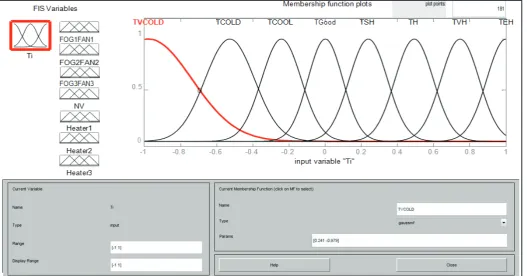
In our model, the sigmoid membership function is considered to
define the input and triangular variables for the output variables
(Figure 2).
All membership functions are defined on the normalized domain
[-1, 1] in the discourse universe. With eight linguistic values, as
shown in fig. 1,
This figure illustrates the fuzzy sets of membership functions
that contain seven fuzzy sets. The linguistic values of the fuzzy sets used are:
Very cold (TVCOLD), COLD (TCOLD), Uncooked (TCOOL), OK (TGOOD), Low warm (TSH), Warm (TH), Very hot (HST) Designed on the basis of expert knowledge and in specialized literature.
We added to our model of the greenhouse an intelligent regulator using the fuzzy logic and we chose the Mamdani method with
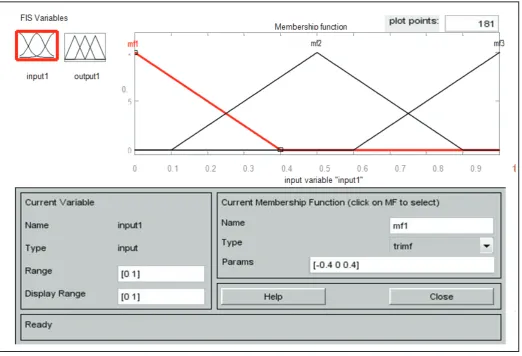
a single input, we started by first defining the input data and the
Fig. 1: Creating Input and Output
Then the range of variations (the fuzzy sets) and the membership functions for the input and the output were defined, and each part of the membership function was called by a significant name.
125
Fig. 3: Membership Functions for Input and Output Variables
After defining the membership functions, the inference rules have
been implemented in such a way as to achieve optimum control as desired, for example if the climate inside the greenhouse becomes lime the regulator will automatically Lowering the temperature by closing a heating system or opening a cooling system or by any other means and in order to keep the required instruction which will be translated by the following command [5]:
If (Ti is TVCOLD) then (FOG1FAN1 is OFF)(FOG2FAN2 1.
is OFF)(FOG3FAN3 is OFF)(NV is OFF)(Heater1 is ON) (Heater2 is ON)(Heater3 is ON) (1)
If (Ti is TCOLD) then (FOG1FAN1 is OFF)(FOG2FAN2 2.
is OFF)(FOG3FAN3 is OFF)(NV is OFF)(Heater1 is ON) (Heater2 is ON)(Heater3 is OFF) (1)
If (Ti is TCOOL) then (FOG1FAN1 is OFF)(FOG2FAN2 3.
is OFF)(FOG3FAN3 is OFF)(NV is OFF)(Heater1 is ON) (Heater2 is OFF)(Heater3 is OFF) (1)
If (Ti is TGood) then (FOG1FAN1 is OFF)(FOG2FAN2 is 4.
OFF)(FOG3FAN3 is OFF)(NV is OFF)(Heater1 is OFF) (Heater2 is OFF)(Heater3 is OFF) (1)
If (Ti is TSH) then (FOG1FAN1 is OFF)(FOG2FAN2 is OFF) 5.
(FOG3FAN3 is OFF)(NV is ON)(Heater1 is OFF)(Heater2 is OFF)(Heater3 is OFF) (1)
If (Ti is TH) then (FOG1FAN1 is ON)(FOG2FAN2 is OFF) 6.
(FOG3FAN3 is OFF)(NV is OFF)(Heater1 is OFF)(Heater2 is OFF)(Heater3 is OFF) (1)
If (Ti is TVH) then (FOG1FAN1 is ON)(FOG2FAN2 is ON) 7.
(FOG3FAN3 is OFF)(NV is OFF)(Heater1 is OFF)(Heater2 is OFF)(Heater3 is OFF) (1)
If (Ti is TEH) then (FOG1FAN1 is ON)(FOG2FAN2 is ON) 8.
(FOG3FAN3 is ON)(NV is OFF)(Heater1 is OFF)(Heater2 is OFF)(Heater3 is OFF) (1)
We save the file (.fis) to load it into the workspace and retrieve it
in the Simulink Fuzzy block under the same name of the saved
file.
The simulation of our system was done by MATLAB SIMULINK.
The results of the MATLAB / SIMULINK software indicate the
high capacity of the proposed technique to control the internal temperature of the greenhouse even in the event of a rapid change
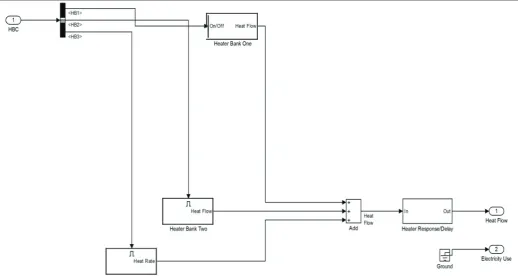
of atmospheric conditions. The modeling of the system Is defined
in the form of this block diagram introduced in our Simulink shown in Figure (4 and 5). Its goal is to achieve the set temperature of 20 ° C required by the internal environment of our greenhouse.
Indeed, by varying the ranges of inferences, the efficiency of
the regulator has been increased around this set point. It would also be possible to modify the inference rules or the forms of the membership functions used.
For the validation of our model we used the full Windows version of MATLAB Simulink R2012b (8.0.0.783), 64bit (win64). The simulation was performed on a TOSHIBA laptop. The latter is equipped with a 700 GB hard drive, and 5 GB of RAM. Simulink parts of the model were performed in “Accelerator” mode which
first generated a compact representation of C code in the diagram,
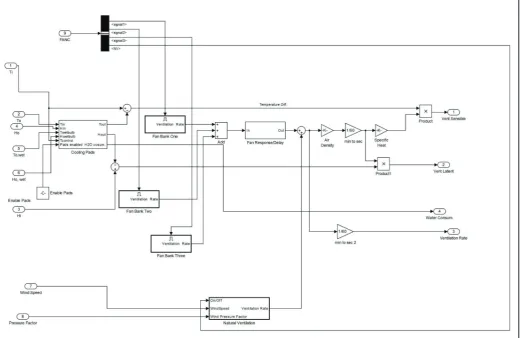
then compiled and executed. Simulink diagrams are obtained in the form of a sub-model integrated into blocks, thus decomposing the global model. Our model is validated independently. Simulink diagrams resulting from the implementation and validation of our greenhouse model and its systems (heating, ventilation, cooling
Fig. 4: Schéma Simulink Représente Notre Contrôleur Flou
127
Fig. 6. Simulink Representation of the Ventilation and Cooling Systems Model
A. Simulation Results
Fig. 7: The Evolution of the Indoor and Outdoor Temperature in the Form of Scoop
Fig. 8: Evolution of indoor and outdoor moisture in the form of scoop
B. Discussions on Figures
The simulation results demonstrate the capabilities and performance of the intelligent controller, as well as the robustness of the fuzzy control. They illustrate in FIG (7) the stability of the variation of internal temperatures during the day and at night ranging from 15 ° C. to 25 ° C. and a relative humidity ranging from 50 % To 80% in the greenhouses of the two regions of Dar El Beida (wetland) and Biskra (arid zone). The temperature gradient due to the greenhouse effect recorded between the interior and the external environment was positive and varied from + 2 ° C to + 14 ° C. It should be noted that the external moisture content of the Dar El Beida zone, varying from 50% to 95%, was higher than that of Biskra, which varies from 35% to 80%. Temperature disturbances were recorded
during the fifth season from mid-autumn to early winter, between 20 November and 20 January of the year. This was reflected in
peaks in water temperatures and saturations due mainly to heat losses and signal noise caused by repeated cyclic activation and deactivation of heating and ventilation systems and equipment. On the whole, the application of the fuzzy method presents rather satisfactory results.
The need to improve the thermal insulation of the greenhouse is essential to reduce the heat losses that generally occur during this cold season in the greenhouse. Improving the greenhouse effect means stabilizing the microclimate and reducing the number of activations and deactivations of the accompanying systems that partly pose the problem of climate management.
In the figure (8), the moisture content within the greenhouse in
V. Conclusion
The research work was initiated by a rich and interesting bibliographical study, which allowed us to discover this area of current affairs. A description of the types and models of agricultural greenhouses has been developed. Thermo hydric interactions, which occur within the greenhouse have been approached. The biophysical and physiological state of the plants through photosynthesis, respiration and evapotranspiration were exposed
while taking into account their influences on the immediate
environment and the mode of air conditioning. The models of regulation and climatic control have been approached from the
use of conventional equipment to the use of artificial intelligence and / or fuzzy logic. Knowledge models and computer techniques have been established with a well-defined approach and hierarchy
for optimal climate management of greenhouse systems, while naturally adopting the Mamdani method.
The aim is to develop a robust and robust air-conditioning control technology to deal with disturbances that may occur in the external and internal environments of the greenhouse system
Our assignments are:
To define the functioning of the complex system of the
1.
greenhouse with its various components (culture-immediate environment) using control models that optimally regulate the climate inside the greenhouse and reproduce the essential Of the properties, mechanisms and interactions between culture and its environment
To solve the problem of follow-up by the modeling, design 2.
and development of an intelligent controller able to regulate the system by following a desired reference trajectory and a hierarchy of control and regulation of the couplings between
The different inputs and / or outputs
In this work we develop a climatic control by the Mamdani method based on multi-variable models in line for an adaptive neural
model structure. The influence of random perturbations on system
performance and optimization must be supported.
We have conceptualized, modeled, configured and developed an
intelligent controller by fuzzy logic based on the Mamdani method. The simulation of the optimal climate management of the indoor environment of the agricultural greenhouse was carried out for two different regions, one wet, and this is Dar El Beida in ALGER; The other arid and concerns the region of BISKRA.
The simulation results highlight the capabilities and performance of the intelligent controller, as well as the robustness of the fuzzy control. They also illustrate the intelligibility of this control for optimal management during the four production seasons. We have
also noted deficiencies that have arisen during the operation of the system during the fifth season, from mid-autumn to early winter
(from 20 November to 20 January) .This is mainly due to heat losses and Signaling caused by repeated cyclic activation and deactivation of air conditioning equipment (heating and ventilation). This is
because these state variables are highly correlated and influenced
by the external environment, Solar radiation in the visible and infrared and the physiological response of the culture, a reaction quite natural and implicit.
The use of conventional controllers, the configuration of which no
longer meets our expectations, nor the optimum climate regulation,
but rather to some extent to the artificial intelligence technique,
easily handled, to the serrists Characterized by its reliability and robustness in optimal climate management
human experience, systems mastery, model realism, configuration
mode, and the robustness of the control method for predictive performance.
It should be noted that building robust models and practical, robust
control methods are not limited by computer and / or digital tools,
but rather by our knowledge and control of the dynamics of the ecosystem and its impact on the environment. Optimal climatic management of the greenhouse system. This implies that it is rather limited by the nature and quality of information on the ecosystem and its environment and by the faithful reproduction of this information for decision-making.
We remain optimistic in the near future, as regards the use of
artificial intelligence technique and its fuzzy logic branch, which
is indicated by:
Optimum climate control and regulation. 1.
The operating efficiency of the energy reserve due to the
2.
greenhouse effect.
Optimal management of the energy input necessary for the 3.
operation of the accompanying systems and equipment. Better productivity of sheltered crops.
4.
A significant decrease in human intervention.
5.
In the same way, it is necessary to point out the insufficiencies
which may arise in the application of the fuzzy logic method and
which are due at the moment to a misunderstanding or insufficient
information of the ecosystems and their environments, Signal noise problems, the robustness of the fuzzy control, the peaks of the dominant variables; But for the moment all these interference
problems and deficiencies can be solved by a realistic approach
of the system.
As for the prospects, they are numerous. The application of
Artificial Intelligence was reserved mainly in the fields of industry,
robotics and especially in the Agri-food industry, whereas it can intervene in the management of several systems and processes
not or can be tackled up to this day. We propose in our field to
promote these techniques to multiply the harvest seasons and to
make the exploitation of our agricultural land profitable.
References
[1] Didi Faouzi, N. Bibi Triki, A. Chermitti, (2016). Optimizing the greenhouse micro-climate management by the introduction
of artificial intelligence using fuzzy logic. Int. J. Computer
Eng. Technology, 7: 78-92 , Volume 7, Issue 3, May-June 2016, pp. 78–92.
[2] Didi Faouzi, N. Bibi-Triki, B. Draoui, A. Abène, "Modeling, Simulation and Optimization of agricultural greenhouse
microclimate by the application of-artificial intelligence and/or fuzzy logic", International journal of scientific &
engineering research, Vol. 7, Issue 8, August-2016.
[3] Didi Faouzi , N. Bibi-Triki, B. Draoui, A. Abène, "Comparison of modeling and simulation results management micro climate of the greenhouse by fuzzy logic between a wetland and arid region, International Journal of Multidisciplinary Research and Modern Education (IJMRME) ISSN (Online): 2454 - 6119, Volume 2, Issue 2, 2016 .
129
SIMULINK", Computer Technology and Application 7 (2016) pp. 273-286.
[6] Didi Faouzi, N. Bibi-Triki, B. Draoui, A. Abène,"The Optimal Management of the Micro Climate of the Agricultural Greenhouse through the Modeling of a Fuzzy Logic Controller", International Knowledge Press, Journal of Global Agriculture and Ecology (JOGAE), 7(1): 1-15, 2017.
[7] Jamisson M.Hill,"Dynamic modeling of tree growth and energy use in a nursery greenhouse using MTLAB and
Simulink", Cornell University, 7/31/2006.
[8] Marco Binotto,“Greenhouse climate model an aid to estimate
the influence of supplemental lighting on greenhouse climate",
School of Science and Engineering at Reykjavík University, 2014.