Teacher Perceptions of Project Based
Learning in the Secondary Classroom
Sheryl MacMath, Awneet Sivia, Vandy Britton
University of the Fraser Valley
This study examines teacher perceptions of their experiences with Project Based Learning (PBL) at a secondary school in Western Canada. This PBL initiative included English language arts, mathematics, science, and digital literacy courses and all the grade nines at this large secondary school. This article reports on two teacher focus group interviews that were part of a larger mixed-methods study (Creswell & Plano Clark, 2007). Results provide specific details regarding conditions for the successful implementation of PBL, challenges and support for current research into PBL, and areas of additional needed research.
Cette étude se penche sur les perceptions qu’ont les enseignants de leurs expériences avec l’apprentissage axé sur les projets (PBL—project based learning) dans une grande école secondaire dans l’Ouest canadien. Cette initiative d’apprentissage actif par les projets impliquait les cours d’anglais, de mathématiques, de sciences et de littératie numérique, ainsi que les tous les élèves de la 9e année. Cet article porte sur un élément de cette étude à méthodologie mixte (Creswell & Plano Clark, 2007), soit deux groupes de discussion/entrevues avec des enseignants. Les résultats fournissent des détails sur les conditions nécessaires à la mise en œuvre réussie du PBL, les défis qui en découlent, l’appui pour la recherche actuelle et les domaines qui restent à étudier plus en profondeur.
We can often refer to PBL as project-based or problem-based learning, but maybe a better acronym for it, or definition, is partnership based learning because you become a partner with the students as opposed to just simply a leader of them. (ITI, Marcus, p11)1
In Canada, each province or territory is responsible for all levels of education. In British Columbia (BC), the Ministry of Education has proposed a comprehensive reform of the current Kindergarten (K) to Grade 12 curriculum (ages 5 to 17), with intended implementation of the new curriculum over the 2016-2018 school years. The redesign of BC’s K to Grade 12 curriculum involves three key shifts:
• New curriculum is organized to include three elements—Content (Know); Curricular Competencies (Do); and Big Ideas (Understand)—as well as six core competencies supporting thinking, communication, and personal and social responsibility.
• New curriculum includes flexible learning environments with continuous progress
assessment, multi-grade classrooms, and technologically-enhanced teaching and learning. Teachers are encouraged to consider curriculum in a trans-disciplinary manner in order to heighten student interest and intentionally integrate Indigenous perspectives and knowledge into the backbone of each subject and grade.
In response to this third shift, administration and teachers at one secondary school (ages 14 to 17) expressed an interest in implementing and evaluating the use of Project Based Learning (PBL). This investigation into PBL was supported by a modest grant from the BC Ministry of Education for staff changes to support a culture of PBL. Given the relationship that already existed between our teacher education department and this secondary school, we were brought on to evaluate teacher and student perceptions of PBL. The PBL investigation was designed with several critical features:
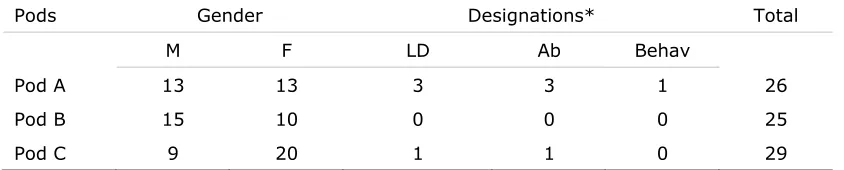
• Classes were podded where all students worked together through their grade 9 courses (see Table 1 for a student demographics related to these pods);
• The trans-disciplinary PBL units involved courses in science, English, math, and digital literacies; and,
• These “projects” were planned, taught, and assessed by all four content area teachers.
The four teachers were given monthly collaboration blocks and all teachers involved in the PBL implementation completed professional development training in September with the Buck Institute. The PBL implementation in these grade 9 classes is part of a four-year vision to continue PBL in grades 10, 11 and 12. This article reports on what was learned regarding teacher perceptions based on their work with PBL.
Literature Review
Introducing PBL
PBL is an instructional strategy grounded in the progressive education movement that called for student-centred and experiential learning in the late 19th century. The first evidence of a project method of study was described in an essay written by William Heard Kilpatrick in 1918. Kilpatrick used this method to “foster student motivation by encouraging students to freely decide the ‘purposes’ they wanted to pursue” (Larmer, Mergendoller, & Boss, 2015, p. 27).
Table 1
Demographic information for the three pods of students
Pods Gender Designations* Total
M F LD Ab Behav
Pod A 13 13 3 3 1 26
Pod B 15 10 0 0 0 25
Pod C 9 20 1 1 0 29
PBL, as described by Larmer et al. (2015) of the Buck Institute of Education, is an instructional strategy “vital for preparing young people for the modern world” (p. xi) that provides opportunities for students to develop:
• problem-solving and critical-thinking skills;
• communication and collaboration skills;
• the ability to work independently, work effectively, and manage time; and,
• overall confidence and responsibility.
For example, PBL was found to help students demonstrate the depth and breadth of their understanding and knowledge about a particular subject, better preparing them for their future educational and career opportunities. The authors also promote it as a way for schools and school districts to connect with the larger community.
A large number of studies have been completed by researchers around the world. Given the amount of available literature, two comprehensive literature reviews have been completed by researchers in order to better understand the history, benefits, and challenges associated with PBL: (a) a report by John W. Thomas (2000) examining literature related to PBL approaches, including implementation and effectiveness, in K-12 settings; and, (b) a working paper by Condliffe, Visher, Bangster, Drohojowska, and Saco (2015) reviewing relevant literature from 2000 onward recommending that more research needs to be conducted. Some of the key points from these studies and reviews are included to provide a review of findings and questions related to PBL.
Benefits and Challenges of PBL
The literature reviews conducted by Thomas (2000) and Condliffe et al. (2015) suggest that PBL supports student learning in ways that go beyond more traditional models of instruction. These include:
• Cognitive learning: research suggests strong student development of knowledge and
cognitive skills, particularly in science and the humanities. There is inconclusive evidence as to PBL’s effectiveness in math due to study control measures, though this also appears promising.
• Intra-interpersonal competencies: communicative, collaborative, meta-cognitive, and self-regulatory skill-sets (also referred to as soft skills) are reinforced by PBL and appear to be clearly represented in the literature. There is evidence that PBL positively impacts student attendance, independence, and attitudes towards learning in most students, regardless of socio-economic background. Additionally, studies show the effectiveness of PBL when supporting students with special needs, with one study highlighting that English language learners are also positively affected.
related to PBL implementation is key to its successful operation in the classroom; in particular, when the professional development involves exposing teachers to genuine PBL learning
experiences.
Teacher practice. There are multiple aspects related to teacher practice.
• Planning: it is speculated that individual PBL units of study are challenging to plan, though there is currently no research in this area. In cases where teachers have attempted to adapt pre-packaged PBL curriculum for their classrooms, the challenges of designing relevant units have had mixed results in relation to student experiences. Research by Brush and Saye (2000), Jonassen (2011), and Tamil and Grant (2013) suggests that scaffolding that
gradually fades over time is more effective in building student independence; however, more research needs to be conducted in this area.
• Classroom interactions: because students work collaboratively or independently for extended periods of time, student misbehaviour and/or disengagement can be an issue. Another challenge relates to the discomfort that some students feel due to the cognitive and social demands placed upon them by PBL, leading to frustration and anxiety—particularly for higher-achieving students.
• Facilitating student inquiry: teachers have reported challenges in a range of areas including initiating the inquiry process, facilitating dialogue, and supporting students with time and resources.
• Technology: ChanLin (2008), Grant (2002), and Krajik and Shin (2014) note that
technology use is important to PBL but that successful integration is challenging for teachers as they are reliant on computer access for their students, support in integrating technology, and must devote class time to technology instruction.
• Assessment: there is a perceived tension between the learning assessed on standardized tests and the performance-based assessment typically taking place in PBL classrooms. As well, Grant and Branch (2005) and Krajcik and Shin (2014) reveal additional problems in that teachers do not always have the time nor the ability to provide constructive feedback to students and/or engage them in self-assessment.
Context. Factors outside the teacher’s locus of control can impact PBL implementation (e.g. school culture, educational policy, confines of standardized tests, staffing changes at school and district levels, and maintenance of technology). As a result, implementation is most effective when supported by school administration, utilized by other teachers within the same school, and is part of a school culture that is student-centred.
Introduction to the Allen (2015) PBL Design Model
• Academic learning outcomes—students are taught and achieve measurable results in subject-specific disciplines;
• Incorporation of 21st Century Competencies—students are taught and assessed on competencies including creativity, communication, collaboration, and critical thinking;
• Tangible outcomes—students develop final products with value and use that extend beyond the classroom setting;
• Focused inquiry—students examine the issue using the method that would be used in the “adult world”;
• Focusing question(s)—one or more questions that drive the inquiry and are answerable by students at the end of the project;
• Engaging context—there is an authentic issue, of interest to students, that is pondered;
• Student voice & choice—multiple opportunities for students to have input in the decision-making;
• Drafting & critique—organized opportunities provided for students to reflect and refine their individual and collective work; and,
• Adult world connections—students work with experts in the field and primary resources. (p. 27)
Allen (2015) lays out a four-phase process for her workshop participants by which they develop a unit of study in PBL through a PBL method of study:
• Big Picture Planning;
• Feedback & Revision;
• In-depth Planning; and,
• Feedback & Revision.
These phases ask participants to create a unit skeleton, gain feedback on it, do more detailed planning, and receive further feedback. The “Big Picture Planning” later becomes the process by which teachers make decisions regarding PBL for their classrooms/courses: they choose learning outcomes, consider how to link these learning outcomes to the “real world,” develop their focusing question(s), decide how the students will demonstrate their learning through a “major deliverable” and consider who in “the adult world” will be the students’ contacts throughout the PBL process (Allen, 2015, p. 29). This format of professional development supports the research by providing the teachers with an authentic PBL experience. Consequently, for this study we will be focusing on teacher perceptions of the Allen (2015) or Buck Institute design model focusing specifically on benefits and challenges.
Methodology
derived from the teacher focus group interviews. To attend to Lincoln and Guba’s (1985) concept of trustworthiness, we used specific strategies such as member checking and thick descriptions.
Data Sources
Teacher interviews. Four teachers were involved in the initial (occurring before the first project-based unit) and final (after the completion of the semester) focus group interviews. These teachers varied in terms of subject specialty and years of experience in teaching. The digital literacy teacher (pseudonym: Marcus) had taught for 17 years with students aged 6 to 18 with 4 additional years as a District Helping Teacher in the area of technology. The math teacher (pseudonym: Jonathan) had taught for two years working with students aged 13 to 18. The science teacher (pseudonym: Janine), the only female teacher, had also taught for two years working with students aged 13 to 18. Finally, the English teacher (pseudonym: Ted) had taught for twenty years in both the English language arts and special education areas. Table 1 provides a breakdown of the student demographics these teachers were working with throughout this study.
Once each interview was transcribed, we sent the transcription to all four teachers for a member check. We provided them with the opportunity to revise or add comments to clarify any comments they had made. No changes were made and all teachers confirmed the accuracy of the transcriptions.
Data Analysis
The teacher interview transcripts were read through by all three researchers together to identify key points for each of the questions. All three researchers then independently mined those key points for themes worthy of reporting. We then brought our mining back together as a type of triangulation, reporting out on themes all three researchers came to agreement on. Themes not identified by all three researchers were reviewed and added to ensure both prevalent and salient points were included. These key themes are reported in the results section below.
Results
The results from the teacher focus group interviews are presented below. Implications of these results in relation to existing literature on PBL will be explored in the discussion.
Teacher Interviews
Initial Interview
Key aspects of PBL. When describing high student engagement, the four teachers we interviewed focused on the quality of peer-to-peer interactions. The teachers agreed with Marcus when he referenced the physical orientation of students: “when students are engaging they’re… involved with each other, they’re pushing in as opposed to pulling back” (ITI, p2). The volume of the classroom was also described as a “buzz… you really can’t hear what each group is talking about; whereas if they’re not, if they’re off task…they’re all trying to yell over top ofeach other” (ITI, Ted, p3). All four teachers agreed that students who were engaged had a great deal of ownership of their work and that the teacher’s role was to guide and review expectations.
When asked to describe PBL in their own words these teachers agreed on the importance of soft skills related to communication and collaboration: content may be what students were using, but the soft skills were the focus for learning. We categorize this as competency over content.
It’s… about developing communication skills, about developing collaboration skills, and developing group-working skills. You know it’s all about those intangibles that we all want students to have that doesn’t always necessarily come when we we’re talking to them about punctuation or scientific concepts or math concepts or whatever. (ITI, Marcus, p5)
The driving question was described as the overarching question that “umbrellas all of our courses, and then sometimes …there will be a modified question for that particular course” (ITI, Marcus, p7). When asked about what makes a strong driving question, there was agreement with Jonathan’s comment that:
… the formulation of the driving question is so important and some of the things they [the Buck
institute] mentioned is that you can’t just have a question that’s google-able; it needs to be something that the kids need to interact with the content and then sort of formulate their own answer. (ITI, p6)
As illustrated by Janine’s comment, all four teachers thought it essential to emphasize that PBL was not just about the final product; it occurred throughout the entire unit.
The thing that stuck out the most was thinking about the project as the tool for learning and as something that you do throughout an entire unit as opposed to thinking about it as something you do at the end, as kind of a dessert of a unit, or just the final assessment. (ITI, p5)
Finally, these teachers each took turns discussing the importance of making connections to life outside of the classroom. For example, Ted described PBL as taking “the scaffoldings of what we traditionally taught and then extending them onto real life situations” (ITI, p5). Not surprisingly, these comments connected to the strengths and challenges they experienced with PBL.
Benefits and challenges of PBL. Many of the benefits and challenges that emerged with PBL were intertwined. Our teachers valued that PBL focused on the development of students’ collaboration skills and their rediscovery of curiosity; however, the arrangement of groups and decisions around grouping generated some discomfort. For example, Janine was explicit in how important it was for her to control group membership.
because we wanted to challenge certain students and also create a balance amongst the group and fit people together who would balance each other out. (ITI, p9)
We talk oftentimes about the evolution of students is that when they’re in elementary school they’re inquisitive, and they’re creative, and then we beat it out of them in middle school…one of the benefits
of PBL is you move back to that sense of ownership and creativity that students inherently have and that we want them to have to be self-directed learners. (ITI, Ted, p9)
All four teachers agreed that the students’ maturity developed through the projects, increasing their ownership over their own learning; however, some students were frustrated because of the changing roles of the student and the teacher. Our teachers described how high achieving-students found PBL far more challenging than other classroom activities because they were responsible for their own learning and not just doing what they were told. These included comments such as: “Some were like, I don’t like this process you kind of just need to give me this information, I’ll fill in the worksheet and I’ll get my A+… there was definitely some pushback in my class” (ITI, Jonathan, p10). This placed students outside of their comfort zone.
Another benefit/challenge emerged when using real world examples. As noted by Marcus, PBL enabled “students to be self-learners. We want them to be initiators and we want them to be…real world contributors, as opposed to artificial which sometimes education can be founded on” (ITI, p12). However, this real-world aspect was also viewed as messy when compared to the pre-packaged examples and questions found in a textbook. “You know, we need to go out and get the actual data and the numbers aren’t nice anymore, and maybe it doesn’t just work out to a round number” (ITI, Jonathan, p10). To handle this messiness, and to support students as they worked through their projects, our teachers emphasized the need to have regular check-ins with students while they worked. It was not about just marking an end-product; it was about assessing and giving feedback throughout the process. For example, Janine noted that:
I had to design a way to assess students throughout and when we—through training they called it checkpoints—and we actually had students come up with a list of need to know or essential questions after they hear the driving question so they design what do I need to know to get to that driving question, and then we use those as steps to progress along the way to create smaller pieces or to do smaller
portions that contribute to the final project. So I think it’s important to check in every couple of days… so that they’re getting that formative feedback. (ITI, p7)
Our four teachers commented on how beneficial it was to have the whole school onboard with PBL. Rather than working on their own, they had the support of the school.
There’s a common goal here, so there’s a common understanding. Not only just amongst ourselves as
grade nine teachers, but also right amongst the entire staff so you’re not battling an uphill stream
already … [You need] a cohesive degree of support in a building ….We’d like to think that we’re very much isolated and insulated when we’re in our classrooms but that’s not the truth because students
don’t stick with us, they move around to other classrooms, so… one of the challenges is overcoming that mental change that has to happen amongst the adults in the building. (ITI, Marcus, p12)
understanding about what PBL is” (ITI, Janine, p5). They also met prior to the start of the term to identify commonalities in curriculum, flush out the driving questions and final projects,2 and ensure relevance to the lives of their students. After this collaborative beginning, regularly scheduled meetings needed to be set to keep track of both student and teacher progress (i.e., how each teacher was making it through their units). As the culminating activities all occurred at the same time and involved multiple subject areas, all four teachers needed to keep each other informed.
At the secondary level, where we’re working, you know, cohesively and collaboratively with each other,
the other thing … that has been very important for us is communication amongst ourselves. Even just a quick email with, this is what I’m doing right now or this is where my kids are at, really provides each
of us with some sense of benchmark ….It’s really important for me to know [what’s going on in the
other classroom] because then I can interject something, or I can introduce something that can then
benefit the students no matter what course they’re in; so it’s a really unusual animal that we have here in that we’re not just dealing with PBL in our classes, but we’re also dealing with PBL across classes.
(ITI, Marcus, p8)
Not only were there changes in communication and collaboration, there were additional needs that required the support of the administration.
They provided us with release time, they’ve provided us with financial…support, our classrooms are different, we don’t have desks anymore, we have tables….There’s been quite a significant degree that they’ve had to invest in as well to really make this be a success. (ITI, Marcus, p13)
As a result, the success of PBL was not solely reliant upon the teachers and students, but the school and administration as well.
Some of the additional constraints that our four teachers flagged included the need for ongoing, smaller, formative assessments; the need to work with the school on scheduling across subject areas; the additional time needed, especially when teachers were working across subject areas; and the challenges they experienced having to let go of some content to make room for PBL as there were “certain things you don’t have the luxury to spend as much time on when you just sort of need to move on” (ITI, Jonathan, p23). In addition, consideration needs to be given to supporting students with learning disabilities when using PBL.
I don’t think PBL fits every student…. We had some students … who were absolutely challenged by it. It was just overwhelming and the overwhelming happened like five minutes into the class. You could
see it in their face, just, I can’t do all that. (ITI, Ted, p25)
As illustrated by Janine’s comment below, they found that a great deal of one-on-one support was needed to assist these students with the openness of PBL.
All of this additional time was considered worthwhile for these teachers given the benefits they observed beyond student knowledge of curriculum. Ted referred to their students as becoming “world life smart” (ITI, p18). By connecting what they were learning to life outside the classroom, by developing their communication and collaborative skills, and by transferring skills they learned across multiple subject areas, students matured throughout the project: they became more self-directed; more aware of life outside of themselves; and, more engaged in their own learning. These benefits were valued enough that our teachers were looking at extending PBL into other courses they taught. For example, “I’m going to be doing the PBL unit for the whole semester [in Communications 12] …I’m going to use all of the scaffolding” (ITI, Ted, p26).
In summary, some key themes that repeatedly emerged throughout this initial interview focused on the importance of the driving question and regularly scheduled check-ins with students (and each other) as the unit progresses. Emphasis was repeatedly placed on the value of connections outside of the classroom, the development of communication and collaborative skills, and the maturity that accompanies the inclusion of student-directed inquiry.
I can confidently say that I saw growth in the students and I saw them really begin, at least, to understand the concepts of learning on their own and by pursuing the projects they did at the end I saw them take on topics and questions that were sometimes huge. But the real successful ones I think were the students who took on a topic that might have been a very broad social, cultural issue, apply it to a very localized situation, and be able to effectively and confidently express their ideas about that. (ITI, Marcus, p19)
Final Interview
In the final interview, all previous key aspects were reinforced; however, three concepts were expanded upon in great detail: change over time, school culture, and the long-term benefits of PBL for students as perceived by the teachers.
Change over time. During the final interview, all four teachers discussed different aspects of how their work with PBL changed over the course of the year. As stated by one teacher,
Change is always difficult and I don’t think that you’ll ever be ready…. If you continually just want to
plan out and have every single thing laid out before you start I think you’re potentially setting yourself
up for failure because, hopefully, the project can be fluid and you have that adaptability. (FTI, Jonathan, p9)
Ted commented that implementing PBL “made what we do in the classroom more of a learning process for us which was exciting and challenging” (FTI, p6). The beginning of the year required that significant time be spent planning, organizing, and collaborating.
If you are willing to set aside some time at the beginning it feels like you’ve saved time later on because
once students are immersed in the unit, you’re not having to spend a lot of time, just when you’re
assessing pieces throughout and it takes a little bit more time but it cuts down a lot on your instructional
time. So, if you’re willing to put in the effort in the beginning, it will pay off in the end. (FTI, Janine, p9)
yourself with that amount again” (FTI, Ted, p9).
An additional benefit came when teaching these units the second time around (to different students) as the teachers were able to implement changes to improve student learning. Janine provides a strong example of how these changes were implemented:
I think first semester one of the weaknesses in students was their ability to research properly. We didn’t realize that they didn’t have really any research skills, so second semester and I think towards the end of first semester we all focused a little bit more on teaching students how to take notes and how to find credible sources, how to properly cite their information, and after we did that I think that’s why the
quality of the work improved because they were able to understand how to compile their information properly. (FTI, p12)
This improved student performance. “I think if you were to compare the quality of work, side by side, from one semester to another, the second semester the quality of work was a lot higher” (FTI, Janine, p10). In addition, as these teachers became more comfortable with the PBL model, they found that they were able to provide more time to individual students. Janine provided a specific example to illustrate:
I learned maybe how to break things down a little bit better into steps for the students and to—and I think I had more time to sit down one-on-one with students that needed help because I had gone through it the semester before so that this semester I knew what I was doing so I could spend some more one-on-one time with the students. (FTI, p18)
This additional time with individual students had a substantial positive impact on supporting students with learning disabilities. It “frees us up to actually then be helping kids learn” (FTI, Marcus, p5). This provides an interesting contrast to the comments brought up in the initial interview regarding concerns when supporting students with particular learning needs. Ted shared how working with PBL over the past year had changed his perception of how to foster strong connections with students: “the time that you’re not on stage delivering to everybody is an opportunity to develop a lot better individual relationships with the kids too” (FTI, p15). Marcus commented, “I think we end up reaching more kids, I think we end up engaging more kids, I think we end up … educating more kids on a grander scale than I think if we were doing this independently on our own” (FTI, p18). The change these teachers experienced over time was felt by the rest of the school.
School culture. When reflecting on this year of PBL, all four teachers discussed how the implementation of this model relied heavily on whole school support that was provided in a variety of ways. Unique to this situation, the administrators of the school mandated a change to focus on PBL with an emphasis on specific subject areas3. This involved a dramatic change in staffing at the school.
I think the culture of our staff has shifted immensely this year because last year there was the announcement that we were going to go through a huge change and there was a lot of apprehension from staff, and staff were given the decision to choose to stay or to go to a different school. So we did have a big shift in staff this year but the benefit of that is that everybody that is here currently has really
chosen to be here and there’s nobody that’s stuck here or is just here by chance…So I think there’s a
These alterations in staffing were then sustained by incorporating key questions in the school’s interview process. Questions included: “where do they stand with things like PBL, where do they stand with things like collaboration, [or] with interdisciplinary approaches” (FTI, Marcus, p20)?
Throughout the year, concerted effort was put into supporting connections amongst all staff, not just the four teachers engaged in the Grade 9 PBL activities. Collaboration time was given to all teachers in the school to enable this pollination of ideas to occur. The administrators had “little emails that were sent out, not just about us but about other teachers that were doing things in their classroom as well. I think [this] was very motivational for everybody. It’s a good culture” (FTI, Ted, p11). This positive atmosphere supported a great deal more collaboration amongst all teachers at the school.
I see much more openness here, not just amongst ourselves which is really kind of cool but also with other teachers as well. There’s much more communication going on, interdisciplinary and across subject areas, across grade areas, and so I think that’s a testament to the goal of the school being
established right across with everybody and, as a result of that, I think there’s much more openness as
a result because we all know that we have a common goal. (FTI, Marcus, p23)
This collaboration supported an overall school culture that even positively impacted students’ readiness for working in the Grade 9 PBL pods.
The students that we didn’t have in first semester were…introduced to some components of our courses
in the sense of the technology … so as a result of that, when they came into our classrooms they were a bit more familiar … [This] freed me up to do some things that I wasn’t able to do in first semester
because they were a little more aware, they were a little more conscious …. So it did help that other teachers in the school, even though they may not have been part of our pod, they were intimating the philosophy elsewhere. (FTI, Marcus, p5)
This overall supportive school culture created an environment whereby these four teachers expressed how they were able to take risks or fail forward.
We sometimes challenge students to take risks, and sometimes as professionals we are very
apprehensive to take risks and to, you know, what we refer to as “fail forward”, and I just really think
that as educators if we really are going to transform our practice to meet the current needs of students when they go beyond this place—in the workforce and elsewhere, I think if we’re willing to take chances
and fall flat on our faces and then pick ourselves up and then move forward with that and make the changes that we need to, I think that we can achieve our ultimate goal which is educating these kids. (FTI, Marcus, p19)
Marcus shared that: “We were never told what PBL looks like; we were never told how to collaborate with each other; we were just encouraged …. That gave us great freedom to negotiate amongst ourselves” (FTI, p22). In effect, the teachers themselves were engaging in their own PBL experience through the process of developing and implementing this model in their classrooms.
in supporting the development of critical thinking, presentation and research skills, and creating an environment that enables a variety of student talents and abilities to be recognized.
Jonathan commented that:
… if the question, the driving question, is designed properly … it can create critical thinkers which I think is really important as far as the type of student that … will be successful when they leave high school, regardless of what their career path will be. (FTI, p5)
An important aspect of critical thinking development in PBL is the use of student inquiry:
They’re learning how to be inquirers, and how to investigate, and that carries over then into the English
classes as far as … what kind of information are they retaining and is it verifiable? And then reinforcing
that in the context of what I’m doing because we look specifically at websites and what websites are validated or verifiable or hoaxes or whatever it is that they might be considering with that, and so that skill of inquiry and investigation and analysis, that carries over right across the border. (FTI, Marcus, p18)
These four teachers also discussed the improvements students made in their presentation skills. For example, Janine shared that:
We really wanted them to become strong presenters because we feel like that’s important in any career
that you go into in life. And, I think from the beginning of the semester to the end, in both semesters, we saw a huge improvement in their ability to present their findings and their ability to articulate themselves well, but also just in their ability to have confidence when they’re in front of a group, make eye contact and speak clearly which are simple skills but they’re very important skills. (FTI, p12)
Working with PBL not only enabled teachers to focus on the development of student presentation and research skills, it provided opportunities to reveal where those weaknesses existed, as mentioned earlier in relation to improvements in student learning.
Overall, these teachers described a very positive learning environment when working with PBL. They described times when student perceptions of the value of what they were learning increased. For example,
One student in particular … started his first two vlogs off with …I don’t really know how this is going
to help me in real life. He said that for his first two vlogs, and by the time he got to the end it seemed
like that wasn’t what his driving force was…it wasn’t just about let’s talk about food…it was good to see
that sort of evolution as well in some of the students. (FTI, Jonathan, p2)
When questioning students about how they were finding PBL, Marcus shared: “It predominantly does interest and engage the students. When I did my follow-ups to the different projects that I did, students oftentimes reflected consistently that they liked doing project work” (FTI, p3). However, one of the most salient and unforeseen successes experienced with PBL was the opportunity to showcase the skills of particular students who often went unseen.
I think one of the things that’s good about PBL…is that it’s not just about writing, or reading, or
a student that comes into one of our classes now as a group of thirty, who might have been in the back row talking to so-and-so about what’s going on, might find something in one of these classes where they
can become one of the leaders in the class ….You don’t have to be a strong reader anymore. Like in
English it used to be if you’re a strong reader, the hand goes up, “I want to read”, and the weak readers are like, “Don’t ask me to read”, and that’s still important; but there’s the other areas where… we need people to edit video and show video in front of the class, be a speaker in front of the class. There was a girl at the end of the semester in one of the vlogs who was a 60% student but had a really great speaking
voice and I was like, “Wow, you could be a newscaster or a reporter on the news.” (FTI, Ted, p8)
PBL moved students, not teachers, to the forefront, and this resulted in benefits beyond the classroom that made the work worthy of the time these teachers invested in it.
I would choose to do PBL as the primary teaching methodology and mainly because of things that we’ve
already mentioned: high engagement, the real-world application, and one that we didn’t talk about yet
is that I feel like when students do projects that are meaningful, they remember what they learned there.
They’re not trying to memorize something, spit it out, and then forget it a week later. I think they walk away actually having learned and they hold onto that so for me that’s a big driving force behind why I
would continue to do it. (FTI, Janine, p16)
Discussion
The bulk of the data collected for this project came from teacher focus group interviews. This data provides support for the successful implementation of PBL, perceived benefits of PBL, and questions for further investigation.
Successful Implementation of PBL
All four teachers viewed their work with PBL as a success; they were eager to continue working with their grade 9 students and were planning to incorporate PBL into their other classes. They were trained by the Buck Institute (Allen, 2015) and followed that planning guide closely. In contrast to the speculation that planning with PBL is challenging (Thomas, 2000; Condliffe et al., 2015), the four teachers in this study did not discuss challenges. Instead, during both interviews, they focused on what was critical for the successful implementation of PBL. Pulling from both interviews, their key recommendations included:
1. Start planning early as the bulk of the work should happen before your unit starts. 2. Have a strong driving question that is open-ended and not “Google-able.” This driving
question should be referred to throughout the unit and promote critical thinking and problem solving. The driving question needs to connect to problems that exist beyond the classroom to develop students’ “world life smarts.”
3. Plan regular checkpoints to formatively assess student work. Rather than think of the final product/project as the only assessment, see PBL as the process, not just the product. 4. Work collaboratively with other teachers and regularly connect with them throughout the
unit.
5. Be prepared to “let go” of content or activities taught in the past.
from) the students with PBL.
7. “Don’t wait. Just start.” Expect the first PBL unit to have some challenges. Keep with it. With time, PBL becomes easier for everyone.
Consistent with Thomas (2000) and Condliffe et al. (2015), these four teachers reinforced the importance of working within a supportive school culture. The actions of the administrators were critical to developing this culture and included: (a) acquiring staff that were on-board with PBL and removing those who were not; (b) regular email updates on PBL activities happening in classrooms throughout the school, cross-disciplinary or otherwise; (c) PBL training for all staff; and, (d) release time for collaboration both at the beginning of the unit and regularly throughout. Also critical to the successful implementation of PBL, is a culture that supports teacher risk-taking or “failing forward” as our teachers referred to it. Just as students stumble when they are learning something new, so do teachers.
Perceived Benefits of PBL
All four teachers viewed their work with PBL as a success; however, it is important to remember that our data are perceptions that have been gathered from teachers only. Future research into PBL needs to include some concrete evidence measuring success such as pre- and post-measures of student learning or measured levels of engagement throughout the course of the unit. That being said, the teachers perceived a number of benefits to working with PBL.
1. The ability to focus on the soft skills such as communication and collaboration improved students’ abilities in these areas. Specifically, these teachers noted dramatic improvements in students’ presentation and research skills. By the end of the unit students were perceived as valuing peer feedback and seemed to move into and out of groups as needed while working on their own projects.
2. An increase in students’ self-regulation skills, confidence, and their ability to work independently were observed by these teachers.
3. An increase in students’ critical thinking skills and ability to transfer those skills across subject areas was also observed by these teachers.
4. All four teachers perceived an increase in student engagement and enjoyment when working with the PBL units.
All of the perceived benefits reported above are consistent with research by Larmer et al. (2015), Thomas (2000) and Condliffe et al. (2015).
Questions for Further Investigation
As already noted, research involving concrete measures of student performance and engagement are needed to build on this report of teacher perceptions. Some additional questions arose from this study.
PBL challenging. However, by the final interview at the end of the second term (after these teachers had taught these PBL units twice), all four teachers reported an improvement in their ability to meet the needs of learners with specific needs. They found that the decrease in time spent “at the front of the room” gave them more time to work individually with students who needed extra attention. Additional research into potential benefits for students with special learning needs, recognizing the impact of teacher experience with PBL, needs to occur.
2. Both existent literature (Condliffe, 2015; Thomas, 2000) and the teachers involved in this study report increased anxiety for typically high-achieving students when working in a PBL environment. It is speculated that this anxiety is a result of a shift in roles (with students taking more ownership over learning); however, investigation into whether this anxiety remains at a constant level throughout a unit and which particular aspects of PBL seemingly cause the anxiety needs to be undertaken. As well, further research into whether this anxiety is beneficial or harmful to the student in the long run should also occur.
3. While Larmer et al. (2015) espouse PBL for its ability to prepare students for working in today’s world, our teachers reported some challenges when working with the “messiness” of real world problems. While they saw great value in connecting students with the real world, it posed some challenges for students, especially in mathematics. When students have to apply concepts to real life situations, those problems often do not work as neatly as
questions or problems found in a text book. Condliffe et al. (2015) and Thomas (2000) both report benefits for learning in science and in the humanities, but reveal that limited work has been done in the area of mathematics. As such, additional research into PBL and mathematics specifically is needed.
Final Thoughts
The strengths of this study exist in the use of multiple researchers, detailed focus group interviews that occurred before and after the completion of multiple PBL units, and the involvement of teachers working with PBL over an extended period of time. Given these strengths, the benefits and recommendations reported here are of substantial value for anyone wanting to work with or implement PBL in their classrooms. Cautions have to be given as this study was limited to grade 9 (ages 14-15) and, as a result, may only be applicable to secondary school environments. In addition, it is important to reiterate that the teachers involved in this study worked solely with the training and model of PBL from the Buck Institute (Allen, 2015). As a result, recommendations may not be applicable to other PBL models. Finally, the focus of this study was the gathering of perceptions. Additional concrete measures to compare these results with would be of great value. Regardless, the results reported above reveal PBL to be a model of instruction worthy of additional research and implementation.
Acknowledgement
References
Allen, C. (2015). PBL planning guide: A planning, resource and reference companion to the Intro to PBL workshop. Seattle: PBL Consulting, Inc.
Brush, T., & Saye, J. (2000). Implementation and evaluation of a student-centered learning unit: A case study. Educational Technology Research and Development, 48(3), 79-100.
ChanLin, L-J. (2008). Technology integration applied to project-based learning in science. Innovations in Education and Teaching International, 45(1), 55-65.
Condliffe, B., Visher, M., Bangser, M., Drohojowska, S., & Saco, L. (2016). Project-based learning: A literature review. New York: Manpower Demonstration Research Corporation (MDRC).
Creswell, J. W., & Plano Clark, V. L. (2007). Designing and conducting mixed-methods research (2nd
edition). Thousand Oaks, CA: Sage.
Ertmer, P. A., & Simons, K. D. (2006). Jumping the PBL implementation hurdle: Supporting the efforts of K-12 teachers. Interdisciplinary Journal of Problem-Based Learning, 1(1), 40-54.
Grant, M. M. (2002). Getting a grip on project-based learning: Theory, cases, and recommendations.
Meridian: A Middle School Computer Technologies Journal, 5(1), 1-17.
Grant, M. M., & Branch, R. B. (2005). Project-based learning in a middle-school: Tracing abilities through the artifacts of learning. Journal of Research on Technology in Education, 38(1), 65-98.
Jonassen, D. (2011). Supporting problem solving in PBL. Interdisciplinary Journal of Problem-Based Learning, 5(2), 95-119.
Kolodner, J. L., Camp, P. J., Crismond, D., Fasse, B., Gray, J., Holbrook, J., Ryan, M. (2003). Problem-based learning meets case-Problem-based reasoning in the middle-school science classroom: Putting learning by design into practice. Journal of the Learning Sciences, 12(4), 495-547.
Krajcik, J. S., & Shin, N. (2014). Project-based learning. In R. K. Sawyer (Ed.), The Cambridge handbook of the learning sciences (2nd ed.) (pp. 275-297). New York: Cambridge University Press.
Larmer, J., Mergendoller, J., & Boss, S. (2015). Setting the standard for project-based learning: A proven approach to rigorous classroom instruction. Alexandria, VA: ASCD.
Lincoln, Y. S., & Guba, E. G. (1985). Naturalistic inquiry. Beverley Hills, CA: Sage. Maxwell, J. A. (1996). Qualitative research design. Thousand Oaks, CA: Sage.
Tamil, S. R., & Grant, M. M. (2013). Definitions and uses: Case study of teachers implementing project-based learning. Interdisciplinary Journal of Problem-Based Learning, 7(2), 72-101.
Thomas, J. W. (2000). A review of research on project-based learning. San Rafael, CA: The Autodesk Foundation.
Notes
1 ITI: Initial Teacher Interview; FTI: Final Teacher Interview; (pseudonyms) Marcus: Digital literacy teacher; Jonathan: Math teacher; Janine: Science teacher; Ted: English teacher
2 There were three final projects for this unit: a rehabilitative program for a person with a spinal cord injury, a presentation on how the view of disability had changed over time, and a detailing of the route taken by Rick Hansen. All three projects contained evidence related to the four subject areas. As a result, the teachers were marking the same projects, but were marking different aspects of those projects. 3 Specific subject areas not included to ensure anonymity of the school and participants.
social studies methods. Her scholarship interests include curriculum integration, planning through assessment, effective rubric development, developing conceptual understanding in mathematics, critical thinking in social studies, and curriculum mapping in teacher education.
Awneet Sivia is an Associate Professor in the University of the Fraser Valley's Teacher Education Department. She currently teaches courses in diversity education, elementary and secondary science methods, action research, reflective practice, school reform and integrating technology across curriculum. Awneet continues to build her scholarship in the areas of self-study of teacher education practices (S-STEP), teacher identity and transformative learning, student teacher epistemologies and inquiry in science education, diversity-centered pedagogies, and the thirdspace between teacher education programs and practicum contexts.
Vandy Britton is the Department Head for the University of the Fraser Valley's Teacher Education Department. Her curricular interests include teacher education, language/literacy education, arts-based education, social justice, international education, and inclusive pedagogy. She is particularly interested in how teacher candidates construct their identities and is engaged in developing different arts-based avenues by which this exploration can occur. Vandy currently teaches courses in Elementary and