DOI 10.1007/s13173-011-0052-4 O R I G I N A L PA P E R
Package level cohesion measurement in object-oriented software
Varun Gupta·Jitender Kumar Chhabra
Received: 25 December 2010 / Accepted: 6 December 2011 / Published online: 22 December 2011 © The Brazilian Computer Society 2011
Abstract Packages are re-usable components for most of oriented systems. To promote reuse in object-oriented systems and to make deployment and maintenance tasks easy, packages in object-oriented systems must be co-hesive. Quantification of cohesion of packages can be very useful in assessing their reusability, quality etc. In this pa-per, a new measure for the measurement of package cohe-sion is proposed. The cohecohe-sion of a package is measured in terms of the degree of intra-package dependencies among its elements. The hierarchical structure of packages has also been taken into account during the measurement. The pro-posed measure has been validated theoretically as well as empirically. An empirical study has been conducted using 25 packages taken from six open-source software projects developed in Java. The proposed package cohesion measure is found to be a useful indicator of external quality factors such as the reusability of packages. The proposed metric is also established as a better predictor of code reusability than the existing cohesion measures.
Keywords Cohesion·Metrics·Quality·Reusability· Packages·Object-oriented software
1 Introduction
Major cost of a software system is devoted to its main-tenance [49]. During maintenance, software professionals
V. Gupta (
)·J.K. ChhabraDepartment of Computer Engineering, National Institute of Technology, Kurukshetra 136119, India
e-mail:[email protected] J.K. Chhabra
e-mail:[email protected]
spend at least half their time reading and analyzing software in order to understand it [8, 28]. Classes contain abstrac-tions of code elements that are essential for understanding and maintaining the system. However, they are too small to gain understanding of a system. Maintenance can be facili-tated by organizing classes into highly modular groups, i.e., where the group contains only related classes and coupling between groups is minimized. In such groups it is easier to retrieve related items, and they facilitate understanding of the system. Such groups are termed as packages in mod-ern object-oriented systems [60]. Packages consist of ele-ments such as classes or interfaces which are conceptually interrelated to each other. The relations among elements of a package determine the cohesion of a package [58]. Co-hesive packages provide a modular structure in which fine-grained classes can be assembled to provide coarse-fine-grained functionality and thus, ease the maintenance and promote the reusability [59]. Packages are important because they are units of organization for object-oriented software sys-tems [51] and are widely used in object-oriented languages such as Java [37], C# [64].
have to import classes from many packages to provide full functionality, resulting into more efforts, and difficult main-tenance. Another repercussion of this will be a more com-plex deployment or re-deployment of application services because multiple packages must be re-compiled, tested, and distributed. Thus, a good system design should consist of packages with high cohesion and low coupling among pack-ages [63]. Still, only a few quantitative studies of the con-crete use of cohesion and coupling have been conducted at the package level. In this paper, a new metric is proposed for measuring cohesion at the package-level in order to achieve good quality packages.
This paper first provides some basic definitions and prop-erties regarding object-oriented systems containing pack-ages and then defines cohesion measure at package level for object-oriented systems. While defining the metric for co-hesion at package level, hierarchical structure of the pack-ages has also been taken into consideration. The proposed measure is validated theoretically using Briand et al.’s eval-uation criteria [13] and usefulness of the proposed metric is also established by correlating this metric with the external quality factor-reusability. This paper is organized as follows. In Sect.2, the previous related works are reviewed and Sect. 3provides the theoretical framework for package cohesion measurement. Section 4contains the definition of the pro-posed measure and Sect.5 presents the theoretical valida-tion of the proposed measure. Secvalida-tion6 validates the pro-posed measure through experimental evaluation conducted using open-source software projects and Sect.7presents the conclusions and future work directions.
2 Related work
In literature, cohesion metrics have been defined for mod-ules in structured programming and for classes in object-oriented systems [10–12, 14, 23–26, 30, 32, 34, 40, 56, 57,72,73]. The metrics exist in literature for the measure-ment of cohesion at the higher levels of abstraction also [1,3,35,38,47,50,51,54,58,63,70,74]. The approaches taken to measure cohesiveness of procedural programs have generally tried to evaluate cohesion on a procedure (func-tion). Emerson proposed a measure to compute cohesion ap-plicable to modules in the sense of Pascal procedures [34]. This measure was based on a graph theoretic property that quantified the relationship between control flow paths and references to variables. Bieman and Kang provided intra-module cohesion measures for cohesion based on the design-level information [11]. Another approach for mod-ule cohesion measurement using the slice abstraction of a program based on data slices was proposed by Bieman and Ott [12].
Most existing approaches for class cohesion measure-ment consider interactions between methods and/or at-tributes in a class. Chidamber and Kemerer defined cohesion of a class as the degree of similarity of its methods [25,26]. They presented a measure for class cohesion named Lack of Cohesion in Methods (LCOM), improved by Henderson-Sellers’s LCOM∗[39]. Eder et al. [32] adapted the existing frameworks for cohesion in the procedural and object-based paradigm to the specifics of the object-oriented paradigm. They distinguished between three types of cohesion in an object-oriented system: method, class and inheritance cohe-sion and various degrees of cohecohe-sion were defined for each type of cohesion. Ott et al. adapted the approach of module cohesion measurement based on data slices for the cohesion measurement of a class in object-oriented systems [56,57]. Bieman and Kang measured cohesion for classes using the number of pairs of methods in a class that access common instance variables [10]. They defined Tight Class Cohesion (TCC) and Loose Class Cohesion (LCC) measures based on the concept of direct and indirect common attribute usage by the public methods of the class. Bansiya and Davis came up with another metric, Cohesion Among Methods of Classes (CAMC) which evaluated the relatedness of methods in the interface of a class using the parameter lists defined for the methods [4,5]. A significant advantage of the CAMC met-ric over other traditional metmet-rics was that the new metmet-ric was not dependent on the implementation of the methods of a class and thus could be used during the design phase to measure the cohesiveness of methods in a class. Using a different approach, Counsell et al. proposed a metric based on the Hamming distance to demonstrate problems in cohe-sion measurement and concluded that cohecohe-sion and coupling measurement are interrelated [29]. Briand et al. defined a cohesive interaction graph to represent the design-level in-teractions and proposed a cohesion metric suite based on the graph [16,73].
Metrics have been proposed for the measurement of co-hesion at the higher levels of abstraction such as package, sub-systems and systems levels. Music measured the cohe-sion of a package as an external property of a module [52] and claimed that the internal organization of a module is not enough to determine its cohesion. Morris followed this line by computing module cohesion considering the fan-in of the contained objects [54]. Similarly, Anquetil and Lethbridge proposed Modularization Quality (MQ) [2] which used the dependencies between modules of two distinct subsystems and the ones between the modules of the same subsystem to determine the cohesion of clusters. Also, Brito e Abreu and Goulão [19] used cluster analysis techniques to obtain better modularization solutions as far as coupling and cohesion are concerned.
be the average of the similarity measures over distinct pairs of subprograms of Ada programs. Xu et al. [70] also pro-posed cohesion measures for packages in language Ada95. Martin proposed a package level metric set including Re-lational Cohesion (RC) which is defined as the ratio of the number of data relations in a package to the number of com-ponents in the package [51]. Using the package level met-rics given by Martin, Atole and Kale assessed the quality of object-oriented design [3]. As opposed to counting, Allen et al. proposed an information-theory-based metric to eval-uate module cohesion [1]. They first used a graph to rep-resent the relations between elements in a module. Then, they regarded such a graph as an information source and modeled the pattern of edges incident to each node as a random variable. Finally, module cohesion was defined as excess entropy (EEC) [1]. It is easy for EEC to be applied to package, since it only requires intramodule-edges graph. However, both RC and EEC only consider intra-package data dependences, thereby not being adapted to the pack-ages not having such kind of dependence. Lee and Liang proposed a cohesion measure, Information-based cohesion, (ICH) for a set of classes based on information flow through method invocations within classes [47]. They defined cohe-sion of a set of classes as the sum of the cohecohe-sion of the classes in the set. Using a similar approach, Gui and Scott [38] proposed system level cohesion measures for evalua-tion of component reusability and defined cohesion of the system as mean cohesion of all the classes of the system. Further, Tagoug [63] proposed cohesion measures for sub-jects (which are quite similar to the packages) and defined subject cohesion on the basis of interactions among classes within a subject. However, the author did not consider the hierarchy of subjects while defining the cohesion measure. Besides this, Ponisio et al. proposed an approach to measure package cohesion based on client usage rather than explicit dependencies within a package [59,60]. Following a similar approach, Zhou et al. proposed a new measure called SCC for measuring semantic cohesion of a package by consider-ing the fact that two components of a package are related tightly if they have similar contexts [73].
Software cohesion metrics proposed for object-oriented software do not cover the abstractions and complexity di-mensions introduced by the aspect paradigm. As a conse-quence, some measures [20,21,36,46,61,71] have been proposed for cohesion measurement for aspect-oriented software systems. Zhao and Xu approach [71] is the first proposal in the field of aspect cohesion measurement. It is based on a dependency model for aspect-oriented software that consists of a group of dependency graphs. According to the Zhao and Xu approach, cohesion is defined as the de-gree of relatedness between attributes and modules. Zhao and Xu presented an approach for measuring aspect cohe-sion based on inter-attributes, inter-modules and module-attribute dependencies. However, Sant’Anna et al. proposed
in [61] an extension of the well-known LCOM (Lack of Co-hesion in Methods) metric [26]. The proposed metric LCOO (Lack of Cohesion in Operations) measures the amount of method/advice pairs that do not access to the same instance variables. This metric measures the lack of cohesion of a component. Afterwards, Gélinas et al. proposed an approach for aspect cohesion measurement based on dependencies analysis [36]. They introduced several cohesion criteria tak-ing into account aspects’ features and capturtak-ing various de-pendencies between their members. They also proposed new aspect cohesion metric and compared it with other existing aspect cohesion metrics.
The proposed package level cohesion metrics in this pa-per define cohesion of a package in terms of the degree of intra-package dependencies among its classes not as the sum of the cohesion of the classes in the package as done by the existing measures such as ICH metric proposed by Lee and Liang [47] and metrics given by Gui and Scott [38]. Moreover, the hierarchical structure of a package has also been taken into account during cohesion measurement of the package which has been ignored by the existing cohesion measures such as metrics proposed by Tagoug [63]. Further, in Sect.6.6, the proposed metric has been compared exper-imentally with the existing cohesion metrics LCOM [25, 26], LCOM∗[39], TCC [10], CAMC [4,5], RC [51], EEC [1], ICH [47], and SCC [74] using Karl Pearson correlation method [27,45] to compute the correlation coefficients be-tween the package reusability ratings given by a team of de-velopers (as given in Table4) and the values produced by the various cohesion measures. From the results of the study, it is found that the proposed measure produced the high-est magnitude of correlation with the package reusability in comparison to the various cohesion measures. These results suggest that the proposed package level cohesion measure is a better indicator of reusability than the existing cohesion measures.
3 Theoretical framework for measurement
In this section, we provide basic definitions and properties related to packages, which are required to lay foundation of a rigorous framework for measurement of package cohesion. First, definitions related to the concept of packages are given and then, relationships between elements of a package are defined.
3.1 Definition of packages
the package. A package at hierarchical levelican be repre-sented aspi = Ei+1, Ri+1, whereEi+1represents the set of elements of a package pi at level i+1, which may be classes, interfaces or packages, andRi+1is a set of relations onEi+1at hierarchical leveli+1 i.e.Ri+1⊆Ei+1×Ei+1. The relations on set of elements represent binary directed connections or relations between pairs of elements of the package. A package is used “to group elements and to pro-vide a namespace for the grouped elements” [55].
Subpackage: For any package pi in a system, subP(pi) denotes an element ofpi which is a package itself and is present at level i+1 in the hierarchy. A package pi1+1= E1i+2, R1i+2 is said to be a subpackage of package p2i = E2i+1, R2i+1ifp1i+1∈E2i+1i.e.,pi1+1=subP(pi
2). The top
level in the package hierarchy in a software system consists of packages, which are not subpackages of any other pack-age and the lowest level is occupied by the atomic members, which do not contain any subpackages.
Disjoint packages: All packages of a system are struc-tured into a number of non-overlapping hierarchical levels, such that for any two packagesp1i, pi2 at the same leveli, E1i+1∩E2i+1= ∅. Then, packagesp1i andpi2are said to be disjoint packages. Thus, packages defined at the same hi-erarchical level are always disjoint. This means, packages defined at the same level never share classes (or interfaces) among them. In other words, a single class (or interface) al-ways belongs to a single package at a particular level of the package hierarchy.
Empty package:A package having no elements, and hence no relations, is termed an empty package. It is represented as∅,∅.
3.2 Definitions of relations
The relation between a pair of elements of a package can be of the type inheritance relation, aggregation relation, refer-ence relation, etc. [15]. This type of relation between a pair of elementsei1andei2of a package present at hierarchical level i is represented byr(ei1, ei2). The presence of a rela-tion between these elements is also denoted byr(ei1, ei2)=1 or e1i →e2i. These relations are asymmetric in nature i.e. ei1→e2i does not imply thatei2→ei1. The presence of dif-ferent types of element in a package such as classes, in-terfaces or subpackages causes different types of relation among package elements. However, interfaces are quite sim-ilar to abstract classes in structure as well as in behavior, as far as package level cohesion measurement is concerned. Thus, in this paper, interfaces have been treated just as a special type of class. By following the above discussion, the possible types of relation among package elements are de-scribed as follows.
Class–Class relation:This type of relation exists between a pair of classes (or interfaces) of a package due to the pres-ence of different types of relation between them such as ag-gregation, inheritance, reference relations etc. [15]. This re-lation between a pair of elements of a package, pi (pi = Ei+1, Ri+1 where r(ei1+1, e2i+1)∈Ri+1 & e1i+1, ei2+1 ∈ Ei+1)is represented asr(ei1+1, e2i+1)=1|(r(ci1+1, ci2+1)= 1∧c1i+1=ei1+1∧ci2+1=ei2+1) or it can be said that if there is a relation between two classes of a package, then there exists a relation between package elements i.e.ci1+1→ c2i+1⇒ei1+1→e2i+1, where (c1i+1=ei1+1∧c2i+1=ei2+1). The relations of the type Interface–Class, Class–Interface or Interface–Interface are covered in Class–Class relation as in-terfaces have been considered as a special type of class dur-ing package cohesion measurement.
Package–Package relation:This type of relation exists be-tween two subpackages of a package. Such types of rela-tion are recursively defined. One package is said to have a relation with the other package if elements of one package have got one or more relations with the elements of the other package. This type of relation between a pair of elements of a packagepi (pi= Ei+1, Ri+1 wherer(ei1+1, ei2+1)∈ Ri+1 & e1i+1, ei2+1 ∈ Ei+1) is given as r(ei1+1, e2i+1)= 1|r(c≥1i+2, c≥2i+2)=1 ∧c1≥i+2 ∈ ei1+1∧ c2≥i+2 ∈ ei2+1 ∧ e1i+1 =subP(pi)∧ ei2+1 =subP(pi). In other words, if classes (or interfaces) present at next or higher levels be-longing to a pair of subpackage elements of a package are related, then these subpackage elements of package are also related i.e.c≥1i+2→c2≥i+2⇒e1i+1→e2i+1, where(c≥1i+2∈ e1i+1∧c≥2i+2∈e2i+1∧ei1+1=subP(pi)∧ei+1
2 =subP(pi)).
Subpackage–Class relation: This type of relation origi-nates from a subpackage to a class (or interface) of a pack-age at the other end. A subpackpack-age (at level i+1) of a package (at leveli) is said to be related to a class (or in-terface) at leveli+1 of the package, if any class or inter-face (present ati+2 or higher levels) of the subpackage has got a relation with the class or interface of the package. This type of relation in a package pi (pi = Ei+1, Ri+1 where r(ei1+1, e2i+1)∈Ri+1 & e1i+1, e2i+1∈Ei+1) can be denoted asr(ei1+1, e2i+1)=1|r(c1≥i+2, c2i+1)=1∧c≥1i+2∈ e1i+1∧c2i+1=ei2+1∧e1i+1=subP(pi)∧e2i+1∈Ei+1. This type of relation can also be represented asc≥1i+2→c2i+1⇒ e1i+1→e2i+1, where(c≥1i+2∈e1i+1∧ci2+1=e2i+1∧ei1+1= subP(pi)∧e2i+1∈Ei+1).
i+2 or higher levels of the subpackage (at leveli+1) of the packagepi (pi = Ei+1, Ri+1 wherer(ei1+1, ei2+1)∈ Ri+1 & ei1+1, ei2+1∈Ei+1). This type of relation can be denoted as r(ei1+1, e2i+1)=1|r(c1i+1, c≥2i+2)=1∧ci1+1= e1i+1∧c2≥i+2∈e2i+1∧ei1+1∈Ei+1∧e2i+1=subP(pi). Al-ternatively, this type of relation can be specified asci1+1→ c2≥i+2⇒e1i+1→ei2+1, where(c1i+1=e1i+1∧c2≥i+2∈ei2+1∧ ei1+1∈Ei+1∧ei2+1=subP(pi)).
4 Package cohesion measurement
As defined above, a package is a set of classes, interfaces and subpackages leading to a hierarchical structure of the object-oriented system. At a particular hierarchical level, a package can be viewed as a set of elements (classes, inter-faces or subpackages) and relations between pairs of these elements at the next hierarchical level. Different possible types of these relations have already been described in the previous section. These relations among elements of a pack-age lead to the intra-packpack-age dependency in a packpack-age and this dependency among elements of a package can effec-tively represent cohesion of the package. During measure-ment of cohesion of a package, we consider only the co-hesiveness among its elements (classes, interfaces or sub-packages) present at next hierarchy level and do not take into account the individual cohesions of the elements. The count of above described relations among package elements determine how much cohesive a package is. The degree of cohesiveness among elements of a package is measured as the ratio of the actual number of relations between ordered and unique pairs of package elements and maximum possi-ble number of relations between ordered and unique pairs of elements of a package. Thus, cohesion of a package pi (pi = Ei+1, Ri+1)present at hierarchical level ‘i’ having nelements is defined as
PCoh(pi)= ⎧ ⎪ ⎪ ⎪ ⎨ ⎪ ⎪ ⎪ ⎩
0 if(n=0)
n
x=1
n−1
y=1∧y=xr(exi+1,eyi+1)
n(n−1) if(n >1)
1 if(n=1)
where n is the number of elements (classes, interfaces or subpackages) at hierarchical level i+1 in a package pi (pi = Ei+1, Ri+1) defined at level i and eix+1 and eiy+1 together make a pair of elements of package pi. As discussed earlier, relations between these elements is de-noted by r(eix+1, eiy+1), where r(exi+1, eiy+1)∈ Ri+1 and eix+1, eyi+1∈Ei+1. Also, r(exi+1, eyi+1)represents a rela-tion (as defined above) between a pair of package elements. Two package elements are said to be related only if there exists at least one relation between them and the relations
can be one of the types as explained in the previous section. n
x=1
n−1
y=1∧y=xr(exi+1, eyi+1)represents number of bi-nary directed relations (at hierarchical leveli+1) between all ordered and unique pairs ofn elements of the package pi, wherer(exi+1, eyi+1)denotes a relation between a pair of package elements at leveli+1 and also in accordance with the above discussions,r(exi+1, eyi+1)may or may not be equal to r(eyi+1, exi+1). Further, cohesion of a pack-age pi (pi = Ei+1, Ri+1), PCoh(pi) has been defined in terms of relations between its elements i.e.exi+1∈Ei+1 andeiy+1∈Ei+1. Thus,exi+1andeyi+1are siblings present at the same hierarchical level. Hence, for calculating cohesion of a package, elements of a package which are siblings and present only at immediate next hierarchical level are consid-ered and belong to the same tree structure.
There are a total ofnelements in a package and each el-ement of the package may be at the most connected to all othern−1 elements of the package. Thus the maximum possible number of relations amongnelements isn∗(n−1), which represents count of maximum possible intra-package dependency for a package. The ratio of the number of bi-nary relations and the maximum possible number of bibi-nary relations gives us a normalized value for the proposed mea-sure [18]. The cohesion value for a package will be 0, if there is no relation among its elements and 1 if every ele-ment of the package is related to all other eleele-ments. Here 0 represents the minimum and 1 indicates the maximum co-hesion. The value of our proposed measure will always lie between a baseline value, 0 and a ceiling value, 1. This nor-malized value of the measure makes the proposed package cohesion metric independent of the size of the package for which cohesion is to be measured and allows meaningful comparisons between the cohesions of the packages of dif-ferent sizes.
Other cases: If n=0, there is no element and hence no relation is possible in packagepi. Thus, packagepi is an empty package∅,∅and the value of cohesion measure for an empty package is always zero. Thus,PCoh(pi)=0.
Ifn=1, it means packagepi contains a single element then, cohesion of packagepi with only one element is 1, because it contains all the relations it can possibly contain i.e.PCoh(pi)=1.
Illustration of package cohesion measurement:
package myshapes; package myshapes.round;
import myshapes.Drawable;
public interface Drawable { public class Circle {
public void draw(Graphics g); public void findArea( ) {
} . . .// find area of circle
}
class Line implements Drawable { . . .// other methods and variables
public void draw(Graphics g) { }
. . .// do something – presumably, Class FilledCircle extends Circle implements
draw a line Drawable{
} public void draw(Graphics g) {
. . .// other methods and variables . . .// do something – draw a filled Circle
} }
void findArea( ) {
. . .// find area of filled circle }
. . .// other methods and variables }
A package is cohesive when its elements have high number of relations among them. Thus, cohesion of a package can be defined in terms of coupling among elements of the pack-age.
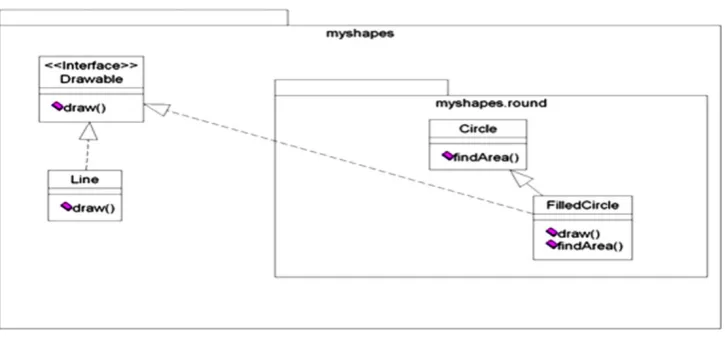
The above example of code can be represented using a UML diagram [55] as shown in Fig.1. The relations in this diagram are shown as directed arrows from one element to the other.
According to the definitions of packages in Sect.3, pack-age ‘myshapes’ has got three elements and two relations between different pairs of its elements. These elements in-clude interface ‘Drawable’, class ‘Line’ and subpackage ‘round’. There exists one relation from class ‘Line’ to inter-face ‘Drawable’, because class ‘Line’ implements interinter-face ‘Drawable’ and the other relation is between subpackage ‘round’ and interface ‘Drawable’ due to the existence of a relation between class-element ‘FilledCircle’ of subpackage ‘round’ and interface ‘Drawable’. If package ‘myshapes’ is supposed to be at the hierarchical level 0, then its ele-ments are at hierarchical level 1. Thus, package ‘round’ is at level 1 and its elements and relations among its elements are at level 2, which are encapsulated within the package ‘round’ and are not visible outside. Thus, during measure-ment of cohesion of a package ‘myshapes’, the relation be-tween ‘FilledCircle’ (element of subpackage ‘round’) and interface ‘Drawable’ (element of package ‘myshapes’) is considered as the relation between subpackage ‘round’ and interface ‘Drawable’.
According to the definition of the measure, n=3 and n
x=1
n
y=1∧y=xr(exi+1, eyi+1)=2.
Thus, Cohesion of the package ‘myshapes’ at hierarchi-cal level 0 is given by the proposed measure as
PCoh(myshapes0)= 2
3∗(3−1)=0.334.
5 Theoretical validation of package cohesion measure
The purpose of this section is to provide the theoretical soundness to the proposed measure, i.e., the fact that it really measures the software characteristic it is supposed to mea-sure, which is an obvious prerequisite for its acceptability and use [13,67]. The proposed measure is evaluated the-oretically by using the four properties given by Briand et al. [13]. We reviewed different validation frameworks avail-able in literature before choosing Briand et al. validation framework. Weyuker’s framework [68] has been defined and mainly used for evaluation of complexity measures. Some other evaluation frameworks such as Zuse framework [75] and Tian & Zelkowitz [66] axioms are also used for valida-tion of complexity measures. The four cohesion properties defined by Briand et al. framework are one of the more re-cent proposals to characterize cohesion in a reasonably in-tuitive and rigorous manner. While these properties are not sufficient to say that a measure which fulfills them all will be useful, it is likely that a measure which does not fulfill them all is ill-defined.
Fig. 1 Graphical representation for the above example
According to the above given definition of the proposed measure, cohesion of a packagepiin an object-oriented sys-tem belongs to a specified interval i.e. PCoh(pi)∈ [0,1]. Thus, the value of package cohesion given by the proposed measure will always be non-negative and normalized.
Property 2 Null Value and Maximum Value.
As discussed above, if a package, pi = Ei+1, Ri+1 is empty i.e.pi = ∅,∅means if there is no element and no relation within a package i.e.Ei+1= ∅andRi+1= ∅, then cohesion of packagepi,PCoh(pi)=null i.e.pi= ∅,∅ ⇒ PCoh(pi)=0 (Null value).
Cohesion of a package,pi= Ei+1, Ri+1where num-ber of elements, Ei+1 is nand number of relations, Ri+1 isn∗(n−1)i.e. each element of packagepi is connected to each other element of the package, thenPCoh(pi)=1 or in case package pi contains single element (n=1), then as discussed above, PCoh(pi)=1 i.e. n=1 or Ri+1= n∗(n−1)⇒PCoh(pi)=1 (maximum value).
The proposed measure has got the null value and the maximum value of cohesion for a package in well defined situations. Thus, the proposed measure satisfies Property2.
Property 3 Monotonicity.
As per Briand et al.’s framework, cohesion Property 3 of monotonicity requires that adding relationships must not de-crease cohesion [13]. This property requires addition of re-lations not the elements to prove its compliance.
Letpbe a package with relationsRin an object-oriented system. Package p is modified to form a new package p with relationsR, which is identical topexcept thatR⊂R, i.e., some relations are added in p. Then, according to the above given definition of the measure, the numerator value will only increase or will remain the same but will never decrease.
For packagep= E, Randp= E, R.
IfR⊂RthenPCoh(p)≤PCoh(p).
Thus, the proposed measure satisfies this property as well. The additional internal relations in a package will never decrease its cohesion.
Property 4 Merging of Unconnected Packages.
This property states that merging of two unconnected pack-ages must not increase cohesion of the resulting package. When two or more packages having no relations between them are merged, cohesion should not increase because ap-parently unrelated elements are being encapsulated together in a single package.
Letp1andp2be two packages in an object-oriented
sys-tem S. Let p be the package, which is the union of p1
andp2. LetSbe the object-oriented system, which is
identi-cal toSexcept that packagesp1andp2are replaced byp. If
no relations exist between packagesp1andp2, then
accord-ing to the above given definition of the measure, increase in value of the numerator will be less in comparison to the value of the denominator as unified package will contain el-ements as well as relations of both packages. Thus, cohe-sion of unified package may decrease i.e. max{PCoh(p1),
PCoh(p2)} ≥PCoh(p).
Hence, the proposed measure satisfies this property very well.
6 Experimental validation of proposed measure
6.1 Experiment goal
The goal of this experimental study is to analyze experi-mentally the proposed metric for the purpose of evaluat-ing whether or not this metric is useful for indicatevaluat-ing the reusability of the packages. We used the Goal/Question/ Metric (GQM) paradigm [6,7,17,62] which provide a tem-plate as well as guidelines to define measurement goals in a systematic manner. The measurement goal of our experi-mental study is defined as follows:
• Object of study: package. • Purpose: analysis.
• Quality focus: effort required to reuse a package (Package Reusability).
• Viewpoint: software developer.
• Environment: open-source software projects developed in Java.
These five goal dimensions have a direct impact on the remaining steps of the experimental validation of the mea-sure [17]. The object of study helps to determine the soft-ware artifacts that must be modeled so that they are ana-lyzable. It also helps in defining the hypotheses that may be relevant because they are directly related to the object of study. The purpose helps to determine the type and amount of data to be collected. The quality focus facilitates in deter-mining the dependent attribute(s) against which the defined metric is going to be experimentally evaluated. The view-point assists to determine the view-point in time at which analysis should be carried out. The environment helps to determine the context in which the study is being carried out.
6.2 Empirical hypotheses
An empirical hypothesis is a statement believed to be true about the relation between one or more attributes of the ob-ject of study and the quality focus [17]. In this case, the hypotheses are about the relationship between cohesion of a package (object of study) and reusability of the package (quality focus).
The analysis is based on the hypotheses:
H0:p=0 (Null hypothesis)—There is no significant
cor-relation between the proposed package cohesion metric and package reusability.
H1:p=0 (Alternative hypothesis)—There is significant
correlation between the proposed package cohesion metric and package reusability.
6.3 Experimental environment
Open-source software projects are widely available on web for both use and research. These projects offer a diverse set
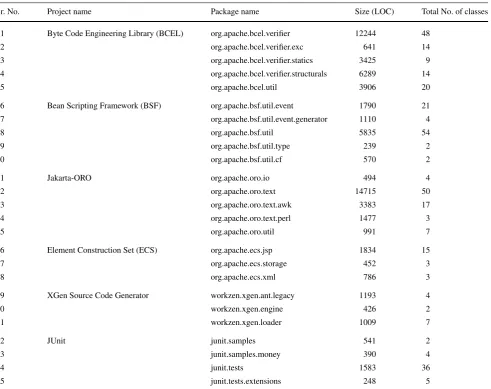
of solutions which encourage a collaborative, consensus-based development process under open software licenses. The sample used for this experimental study was taken from six open-source software projects whose source code was readily available for use. The major reason behind selection of these projects was that these software projects were de-veloped in Java and were organized using packages. The presence of packages in these projects made it possible to apply package level metrics on them. Twenty-five pack-ages taken from six open-source projects were used in or-der to experimentally evaluate the proposed metric. Out of these six projects, four belonged to the Apache soft-ware foundation and eighteen packages belonging to these four projects were downloaded from Apache Jakarta web-site [65]. The Apache project Byte Code Engineering Li-brary (BCEL) is intended to give users a convenient pos-sibility to analyze, create, and manipulate Java class files, and classes are represented by objects which contain all the symbolic information of the given class like methods, fields and byte code instructions [22]. The Apache project Bean Scripting Framework (BSF) is a set of Java classes which provides scripting language support within Java ap-plications, and access to Java objects and methods from scripting languages. BSF allows one to write JSPs in lan-guages other than Java while providing access to the Java class library [9]. The Apache project Jakarta-ORO is a set of text-processing Java classes that provide Perl5 compati-ble regular expressions, AWK-like regular expressions, glob expressions, and utility classes for performing substitutions, splits, filtering filenames, etc. [42]. The Apache project El-ement Construction Set (ECS) is a Java API for generat-ing elements for various markup languages such as HTML 4.0 and XML and can easily be extended to create tags for any markup language [33]. The XGen Source Code Gen-erator [69] creates a Java source code from a simple XML document. Its primary function is to generate JDBC com-pliant beans that allow object level persistence to relational databases. The other project used in this study is JUnit [43] which is a simple framework to write repeatable tests. It is an instance of the xUnit architecture for unit testing frame-works. Table 1 shows the projects and the corresponding packages used from these projects for experimental study in this work. This table also provides general details about each package used in the experimental study in terms of size (in LOC) and the total number of classes contained in the package.
6.4 Analysis methodology
Table 1 Description of packages used in the study
Sr. No. Project name Package name Size (LOC) Total No. of classes
1 Byte Code Engineering Library (BCEL) org.apache.bcel.verifier 12244 48
2 org.apache.bcel.verifier.exc 641 14
3 org.apache.bcel.verifier.statics 3425 9
4 org.apache.bcel.verifier.structurals 6289 14
5 org.apache.bcel.util 3906 20
6 Bean Scripting Framework (BSF) org.apache.bsf.util.event 1790 21
7 org.apache.bsf.util.event.generator 1110 4
8 org.apache.bsf.util 5835 54
9 org.apache.bsf.util.type 239 2
10 org.apache.bsf.util.cf 570 2
11 Jakarta-ORO org.apache.oro.io 494 4
12 org.apache.oro.text 14715 50
13 org.apache.oro.text.awk 3383 17
14 org.apache.oro.text.perl 1477 3
15 org.apache.oro.util 991 7
16 Element Construction Set (ECS) org.apache.ecs.jsp 1834 15
17 org.apache.ecs.storage 452 3
18 org.apache.ecs.xml 786 3
19 XGen Source Code Generator workzen.xgen.ant.legacy 1193 4
20 workzen.xgen.engine 426 2
21 workzen.xgen.loader 1009 7
22 JUnit junit.samples 541 2
23 junit.samples.money 390 4
24 junit.tests 1583 36
25 junit.tests.extensions 248 5
research method for empirically validation of the metrics. For example, Kabaili et al. [44] used this statistical method to evaluate cohesion metrics as changeability indicators. Mitchell and Power [53] used this method to examine the usefulness of the run time coupling metrics. Li and Henry [48] examined correlations between various metrics in order to determine their usefulness.
Correlation is measured using the standard Karl Pear-son Product-Moment correlation coefficient r, which mea-sures the degree and direction of the linear relationship be-tween the two variables. Karl Pearson’s coefficient is the most widely used method of measuring correlation. This method assumes that there is a linear relationship between two variables and one of the variables is independent while the other is dependent. Karl Pearson’s coefficient of correla-tion is given by [45]:
r=
(Xi−X)(Y i−Y ) n∗σ x∗σ y
whereXi =ith value of X variable, Yi =ith value of Y variable,X=mean ofX,Y =mean ofY,n=number of pairs of observations ofX andY,σx=standard deviation ofX,σy=standard deviation ofY.
The value of correlation coefficient (r) lies between−1 and+1 through 0, where 1 represents a perfect positive cor-relation between the variables;−1 denotes a perfect nega-tive correlation; and 0 indicates that there is no linear rela-tionship between the variables. The degree of the correlation is determined by the magnitude of the coefficient. Adjective ratings of correlation strength follow the definitions devel-oped by Cohen [27]:
Table 2 Package cohesion measurement
Sr. No. Package name No. of elements No. of relations Package cohesion metric (PCoh)
1 org.apache.bcel.verifier 14 56 0.30
2 org.apache.bcel.verifier.exc 14 10 0.15
3 org.apache.bcel.verifier.statics 9 1 0.013
4 org.apache.bcel.verifier.structurals 14 10 0.054
5 org.apache.bcel.util 20 10 0.026
6 org.apache.bsf.util.event 6 18 0.60
7 org.apache.bsf.util.event.generator 4 4 0.33
8 org.apache.bsf.util 20 30 0.078
9 org.apache.bsf.util.type 2 1 0.50
10 org.apache.bsf.util.cf 2 1 0.50
11 org.apache.oro.io 4 3 0.25
12 org.apache.oro.text 15 34 0.16
13 org.apache.oro.text.awk 17 41 0.15
14 org.apache.oro.text.perl 3 0 0
15 org.apache.oro.util 7 11 0.26
16 org.apache.ecs.jsp 15 14 0.067
17 org.apache.ecs.storage 3 3 0.50
18 org.apache.ecs.xml 3 2 0.33
19 workzen.xgen.ant.legacy 4 3 0.25
20 workzen.xgen.engine 2 1 0.50
21 workzen.xgen.loader 7 7 0.167
22 junit.samples 4 1 0.08
23 junit.samples.money 4 9 0.75
24 junit.tests 5 4 0.20
25 junit.tests.extensions 5 4 0.20
Any relationship between two variables should be assessed for its strength as well as its significance. The significance of the correlation results is assessed by thep-value. The p-value corresponds to the probability that the measured cor-relation could be due to purely random effects. The smaller thep-level, the more significant is the relationship between the variables.
However, correlation study can only establish a relation-ship between two variables (in our case, package cohesion and package reusability) but could not establish a cause-effect relationship between the two.
6.5 Analysis of experimental results
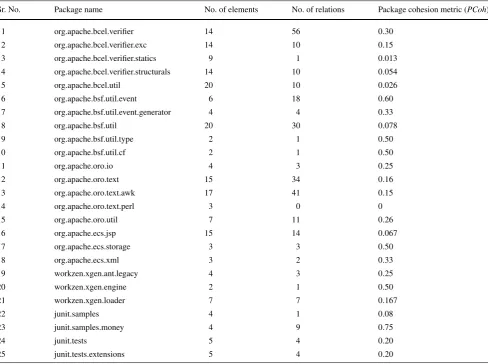
Table2shows the number of elements (present at the next hierarchical level) and the number of relations among el-ements of each package and the corresponding values of the package cohesion metric (PCoh) for each package un-der study.
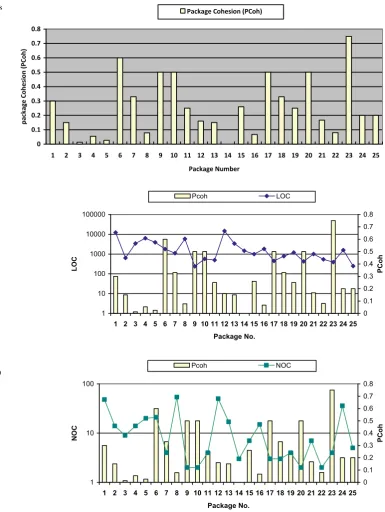
In Fig.2, we show the measured values of the Package cohesion metric for all 25 packages graphically. In this
fig-Table 3 Descriptive statistics of the analyzed package cohesion metric Statistical parameter Package cohesion metric (PCoh)
Maximum value 0.75
Minimum value 0
Median 0.20
Mean 0.26
Standard deviation 0.20
ure, Packages Sr. Nos. as given in Table2are taken on the X-axis and their corresponding package cohesion values are plotted on theY-axis.
Fig. 2 Package cohesion values for all packages
Fig. 3 Relationship between
PCohand LOC
Fig. 4 Relationship between
PCohand No. of classes (NOC)
6.5.1 Relationship between package cohesion and package size
Figure3shows the relationship between package cohesion (PCoh) and package size in lines of code (LOC) for all 25 packages under study.
Figure 4 shows the relationship between cohesion of a package (PCoh) and number of classes (NOC) in the pack-age.
From Figs. 3 and 4, it can be easily observed that the cohesion value measured by the proposed package
pack-Table 4 Ratings of reusability
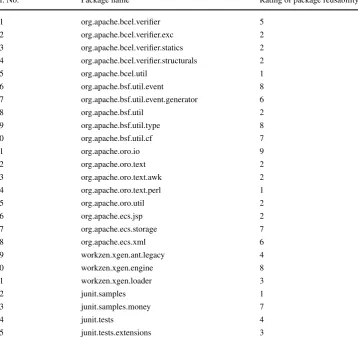
assigned to each package Sr. No. Package name Rating of package reusability
1 org.apache.bcel.verifier 5
2 org.apache.bcel.verifier.exc 2
3 org.apache.bcel.verifier.statics 2
4 org.apache.bcel.verifier.structurals 2
5 org.apache.bcel.util 1
6 org.apache.bsf.util.event 8
7 org.apache.bsf.util.event.generator 6
8 org.apache.bsf.util 2
9 org.apache.bsf.util.type 8
10 org.apache.bsf.util.cf 7
11 org.apache.oro.io 9
12 org.apache.oro.text 2
13 org.apache.oro.text.awk 2
14 org.apache.oro.text.perl 1
15 org.apache.oro.util 2
16 org.apache.ecs.jsp 2
17 org.apache.ecs.storage 7
18 org.apache.ecs.xml 6
19 workzen.xgen.ant.legacy 4
20 workzen.xgen.engine 8
21 workzen.xgen.loader 3
22 junit.samples 1
23 junit.samples.money 7
24 junit.tests 4
25 junit.tests.extensions 3
ages. These low values of correlation coefficients indicate that the proposed package cohesion measure (PCoh) is inde-pendent of the size of the package (in terms of LOC as well as NOC) for which cohesion is being measured. Thus, the proposed measure (PCoh) allows meaningful comparisons between cohesion values of different packages of different sizes.
6.5.2 Relationship between package cohesion and package reusability
An evaluation team consisting of five software developers was assigned the task of evaluating the reusability of 25 packages. These software developers were computer engi-neering graduates working in my organization. All software developers had about three years of work experience in com-mercial software development, and have been working on development of many Java-based projects. The team of de-velopers was required to use each package to complete an unfinished application. The task of each developer was to choose the required classes from a given package and inte-grate them to the application. The team was free to mod-ify these packages to reuse them. The team assessed the
ef-fort required to reuse the package and rated the reusability of each package on a numerical scale from 1 (low) to 10 (high). The more the effort required reusing a package, the less is the reusability of the package. A package with low reusability rating such as 1 means the more effort required to reuse the package, and a package with high rating such as 10 means the less effort required to reuse the package. To rate the reusability of a package, the team of developers considered the following effort in reusing it:
• The effort to select the right classes from the package for reuse.
• The effort to modify the reused classes if needed. • The effort to find and integrate all required classes. • The effort to test the correctness of the integration.
Table4shows the ratings of reusability of each package assigned by the team of software developers depending on the effort required to reuse the corresponding package.
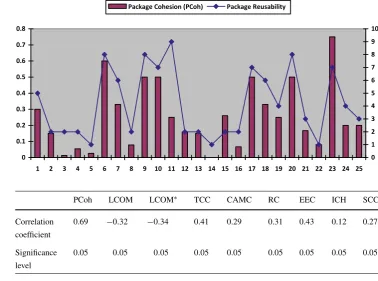
Fig. 5 Relationship between package cohesion & package reusability
Table 5 Correlation values for
cohesion measures PCoh LCOM LCOM∗ TCC CAMC RC EEC ICH SCC
Correlation 0.69 −0.32 −0.34 0.41 0.29 0.31 0.43 0.12 0.27 coefficient
Significance 0.05 0.05 0.05 0.05 0.05 0.05 0.05 0.05 0.05 level
(PCoh) values have a strong positive correlation with the package reusability ratings.
As stated above, the Karl Pearson Product-Moment cor-relation method [27,45] was used to quantify the correlation between the proposed package cohesion metric and package reusability as rated by the team of software developers. The computed value of the correlation coefficient (r) between the proposed metric and team’s reusability ratings comes out to be 0.69 at the significance level 0.05. Such a high value of correlation coefficient shows a strong positive cor-relation between the proposed package cohesion metric and the package reusability. Therefore, we reject the null hypoth-esis and accept the alternative hypothhypoth-esis (as stated above) and conclude that there is a significant correlation between the proposed package cohesion metric and package reusabil-ity. The strong correlation between the proposed metric and reusability signify that the proposed package cohesion met-ric is a good indicator of the external quality attributes of the package.
6.6 Comparison of proposed measure with existing measures
The proposed metric was compared experimentally with the related cohesion metrics reviewed in Sect.2using 25 pack-ages listed above. For this purpose, we used Karl Pearson correlation method [27,45] to compute the correlation co-efficients between the package reusability ratings given by team of developers (as given in Table4) and the values pro-duced by the various cohesion measures such as LCOM
[25,26], LCOM∗ [39], TCC [10], CAMC [4,5], RC [51], EEC [1], ICH [47], SCC [74]. The Lack of Cohesion in Methods (LCOM) metric [25, 26] was proposed by Chi-damber and Kemerer to measure lack of cohesion in a class and LCOM∗[39] metric was an improved version of LCOM [25,26] given by Henderson-Sellers. The Tight Class Co-hesion (TCC) metric proposed by Bieman and Kang mea-sures the percentage of pairs of the public methods of the class which have direct common attribute usage [10]. The Cohesion Among Methods of Classes (CAMC) metric was proposed by Bansiya et al., which evaluated the relatedness of methods in the interface of a class using the parameter lists defined for the methods [4,5]. The Relational Cohe-sion (RC) metric proposed by Martin is defined as the ratio of the number of data relations in a package to the number of components in the package [51]. Allen et al. proposed an information-theory-based metric named excess entropy cohesion (EEC) metric [1]. Lee and Liang proposed a cohe-sion measure, Information-based cohecohe-sion, (ICH) for a set of classes based on information flow through method invo-cations within classes [47]. They defined cohesion of a set of classes as the sum of the cohesion of the classes in the set. Zhou et al. [74] proposed a measure called SCC for measur-ing semantic cohesion of a package by considermeasur-ing the fact that two components of a package are related tightly if they have similar contexts.
high-est magnitude of correlation with the package reusability among the various cohesion measures. Some of the cohe-sion measures such as LCOM [25, 26] and LCOM∗ [39] produced negative correlation coefficients as these metrics measure lack of cohesion. These results suggest that the pro-posed package level cohesion measure is a better indicator of reusability than the other existing cohesion measures.
6.7 Threats to validity
As with other empirical experiments, there are threats to the validity of this study. The build threat is the reuse effort may not represent the quality of the package. The quality of a package is dependent on many other factors such as under-standability, maintainability. To reduce this threat in the fu-ture, other measures of quality such as maintenance effort could be used to validate the proposed metric. The internal threat is the measurement of reuse effort. In our study, a team of five developers worked on all packages. The number of developers taking part in the experiment is very small which is a threat to validity of the experiment and the ratings of package reusability may depend on expertise and prior ex-perience of software developers which is also a major threat to its validity. To reduce these threats, various teams hav-ing a specific number of software developers can be con-structed and then average value of the ratings assigned by these different teams can be taken to reduce the bias being caused by the personal experiences of the software develop-ers. The threats to external validity mainly include the sub-ject software as these packages may not be representative of other software products. Also, the number of packages (25 no. packages) taken from open-source software used in the current study is too small which is a threat to the va-lidity of the experiment. To reduce these threats, a large set of packages can be used in future studies and more stud-ies can be conducted using commercial software systems. Another threat to validity of this study is that correlation analysis has been performed between package cohesion and package reusability. However, correlation study is able to es-tablish relationship between package cohesion and package reusability but could not establish cause-effect relationship between the two. Further, correlation study performed in the paper requires a number of assumptions such as normality, linearity, and homoscedasticity need to be verified.
7 Conclusions and future work
In this paper, we have proposed a new approach to mea-sure the cohesion of packages based on formal definitions and properties of the packages. The proposed measures are based on the relations present between pairs of package ele-ments, which can be classes, interfaces or subpackages. The
cohesion of a package is measured as the number of binary directed relations between all ordered and unique pairs of the package elements, divided by the maximum possible number of relations between them. The hierarchical struc-ture of packages has also been taken into consideration dur-ing the measurement of package cohesion. The proposed measure is validated theoretically with the help of the four well-established properties given by Briand et al. [13] and an experimental study has been conducted using 25 packages taken from six open-source software projects developed in Java. The usefulness of proposed measure is proved by em-pirically validating the proposed measure as the indicator of external quality attribute of packages such as reusability. The proposed measure for package cohesion is also a bet-ter predictor of code reusability than the existing cohesion measures as shown in the experimental study.
The proposed package level cohesion measurement pro-cess described in this research is an important step toward designing high quality software. We believe that the study presented herein should encourage other researchers and de-velopers to adapt and use this metric in combination with other design principles to develop more package level met-rics for the measurement of other software quality attributes. In addition, there is need of further empirical investigations of the proposed package level metric in order to establish its relations with other external software quality factors such as maintainability, adaptability.
References
1. Allen E, Khoshgoftaar T, Chen Y (2001) Measuring coupling and cohesion of software modules: an information theory approach. In: Proceedings of the seventh international software metrics sym-posium, 2001
2. Anquetil N, Lethbridge T (1999) Experiments with clustering as a software remodularization method. In: Proceedings of WCRE ’99 (6th working conference on reverse engineering), Louis Pasteur, University of Ottawa, Ottawa, Canada, 1999, pp 235–255 3. Atole CS, Kale KV (2006) Assessment of package cohesion and
coupling principles for predicting the quality of object oriented de-sign. In: Proceedings of the 1st international conference on digital information management, Dec 2006, pp 1–5
4. Bansiya J, Davis C (1999) Class cohesion metric for object-oriented designs. J Object-Oriented Program 11(8):47–52 5. Bansiya J, Davis C (2002) A hierarchical model for
object-oriented design quality assessment. IEEE Trans Softw Eng 28(1):4–17
6. Basili VR, Weiss D (1984) A methodology for collecting valid software engineering data. IEEE Trans Softw Eng 10(11):728– 738
7. Basili VR, Rombach DH (1988) The tame project: towards improvement-oriented software environments. IEEE Trans Softw Eng 14(6):758–773
8. Basili VR (1997) Evolving and packaging reading technologies. J Syst Softw 38(1):3–12
10. Bieman JM, Kang BK (1995) Cohesion and reuse in an object-oriented system. In: Proceedings of the symposium on software reusability (SSR’95), Seattle, WA, 1995, pp 259–262
11. Bieman JM, Kang BK (1998) Measuring design-level cohesion. IEEE Trans Softw Eng 24(2):111–124
12. Bieman JM, Ott LM (1994) Measuring functional cohesion. IEEE Trans Softw Eng 20(8):644–658
13. Briand L, Morasca S, Basili V (1996) Property-based software en-gineering measurement. IEEE Trans Softw Eng 22(1):68–86 14. Briand LC, Daly JW, Wust J (1998) A unified framework for
co-hesion measurement in object-oriented systems. Empir Softw Eng 3(1):65–117
15. Briand LC, Daly JW, Wust JK (1999) A unified framework for coupling measurement in object-oriented systems. IEEE Trans Softw Eng 25(1):91–121
16. Briand LC, Morasca S, Basili VR (1999) Defining and validating measures for object-based high-level design. IEEE Trans Softw Eng 25(5):722–743
17. Briand L, Morasca S, Basili V (2002) An operational process for goal-driven definition of measures. IEEE Trans Softw Eng 28(12):1106–1125
18. Brito e Abreu F (1995) The MOOD metrics set. In: Proceedings of the ninth European conf object-oriented programming workshop metrics workshop on metrics, Aarhus, Denmark, 1995
19. Brito e Abreu F, Goulão M (2001) Coupling and cohesion as mod-ularization drivers: are we being over-persuaded? In: Proceed-ings of the 5th European conference on software maintenance and reengineering (CSMR’2001), Lisboa, Portugal, March 2001. IEEE Computer Society Press, Los Alamitos
20. Bryton S (2008) Modularity improvements with aspect-oriented programming. MSc Thesis (F. Brito e Abreu, supervisor), FCT/ UNL
21. Bryton S, Brito e Abreu F (2007) Towards paradigm-independent software assessment. In: Proceedings of 6th international confer-ence on the quality of information and communications technol-ogy (QUATIC), 2007. IEEE Computer Society Press, Los Alami-tos
22. Byte Code Engineering Library (BCEL) (2011) http://jakarta. apache.org/bcel/index.html
23. Chae HS, Kwon YR, Bae DH (2000) A cohesion measure for object-oriented classes. Softw Pract Exp 30(12):1405–1431 24. Chae HS, Kwon YR, Bae DH (2004) Improving cohesion
met-rics for classes by considering dependent instance variables. IEEE Trans Softw Eng 30(11):826–832
25. Chidamber SR, Kemerer CF (1991) Towards a metrics suite for object oriented design. In: Proceedings of OOPSLA’91, ACM SIGPLAN Notices, 26 Nov 1991, pp 197–211
26. Chidamber SR, Kemerer CF (1994) A metrics suite for object ori-ented design. IEEE Trans Softw Eng 20(6):476–493
27. Cohen J (1988) Statistical power analysis for the behavioral sci-ences, 2nd edn. Lawrence Erlbaum, Mahwah
28. Corbi TA (1989) Program understanding: challenge for the 1990’s. IBM Syst J 28(2):294–306
29. Counsell S, Mendes E, Swift S (2002) Comprehension of object-oriented software cohesion: the empirical quagmire. In: Proceed-ings of the 10th international workshop on program comprehen-sion, 2002, pp 33–42
30. Counsell S, Swift S (2006) The interpretation and utility of three cohesion metrics for object-oriented design. ACM Trans Softw Eng Methodol 15(2):123–149
31. DeMarco T (1982) Controlling software projects. Yourdon Press, New York
32. Eder J, Kappel G, Schre M (1992) Coupling and cohesion in object-oriented systems. In: Proceedings of the conference on in-formation and knowledge. ACM Press, New York
33. Element Construction Set (ECS) (2011)http://jakarta.apache.org/ ecs/index.html
34. Emerson T (1984) A discriminant metric for module cohesion. In: Proceedings of the 7th international conference on software engineering (ICSE), 1984
35. Fenton N, Pfleeger SL (1996) Software metrics: a rigorous and practical approach, 2nd edn. International Thomson Computer Press, London
36. Gélinas JF, Badri M, Badri L (2006) A cohesion measure for as-pects, J Object Technol 5:97–114
37. Gosling J, Yellin F (1996) The Java application programming in-terface, Vol #1 (Core packages)/#2 (window toolkit and applets). Addison-Wesley, Reading
38. Gui G, Scott PD (2006) Coupling and cohesion measures for evaluation of component reusability. In: Proceedings of the in-ternational workshop on mining software repositories, Shanghai, China, 2006, pp 18–21
39. Henderson-Sellers B (1996) Object-oriented metrics: measures of complexity. Prentice-Hall, New York
40. Hitz M, Montazeri B (1995) Measuring coupling and cohesion in object-oriented systems. In: Proceedings of the third international symposium on applied corporate computing (ISACC’95), Monter-rey, Mexico, 1995, pp 25–27
41. ISO/IEC 9126-1 (2000) Software product quality, Part 1: Quality model
42. Jakarta-ORO (2011)http://jakarta.apache.org/oro/index.html 43. JUnit (2011)http://sourceforge.net/projects/junit/
44. Kabaili H, Keller R, Lustman F (2001) Cohesion as changeabil-ity indicator in object-oriented systems. In: Proceedings of IEEE conference on software maintenance and reengineering (CSRM), 2001, pp 39–46
45. Kothari CR (2007) Research methodology: methods & techniques, revised second edn. New Age International, New Delhi, pp 139– 141
46. Kumar A, Kumar R, Grover PS (2008) Towards a unified frame-work for cohesion measurement in aspect-oriented systems. In: Proceedings of the 19th Australian conference on software engi-neering (ASWEC ’08), 2008
47. Lee YS, Liang BS (1995) Measuring the coupling and cohesion of an object-oriented program based on information flow. In: Pro-ceedings of the international conference on software quality, Mari-bor, Slovenia, 1995, pp 81–90
48. Li W, Henry S (1993) Object oriented metrics that predict main-tainability. J Syst Softw 23(2):111–122
49. Lientz B, Swanson B (1980) Software maintenance management. Addison-Wesley, Boston
50. Mancoridis S, Mitchell BS, Chen Y, Gansner ER (1999) Bunch: a clustering tool for the recovery and maintenance of software sys-tem structures. In: Proceedings of ICSM ’99 (international confer-ence on software maintenance), Oxford, England, 1999
51. Martin R (2002) Agile software development, principles, patterns, and practices. Prentice-Hall, New York
52. Miši´c VB (2001) Cohesion is structural, coherence is functional: Different views, different measures. In: Proceedings of the seventh international software metrics symposium (METRICS-01), 2001. IEEE Press, New York
53. Mitchell A, Power J (2004) An empirical investigation into the dimensions of run time coupling in Java programs. In: Proceedings of the 3rd international conference on principles and programming in Java (PPPJ’04), Las Vegas, Nevada, 2004, pp 9–14
54. Morris K (1989) Metrics for object-oriented software development environments. Master’s thesis, Sloan School of Management MIT 55. OMG Unified Modeling Language (OMG UML) (2011)
Infras-tructure, V2.1.1, p 158
57. Ott LM, Bieman JM (1998) Program slices as an abstraction for cohesion measurement. Inf Softw Technol 40(11–12):691–699 58. Patel S, Chu WC, Baxter R (1992) A measure for composite
mod-ule cohesion. In: Proceedings of the 14th international conference on software engineering, 1992, pp 38–48
59. Ponisio L, Nierstrasz O (2006) Using contextual information to as-sess package cohesion. Technical Report No. IAM-06-002, 2006, Institute of Applied Mathematics and Computer Sciences, Univer-sity of Berne
60. Ponisio L (2006) Exploiting client usage to manage program mod-ularity. University of Berne, Ph.D. Thesis
61. Sant’Anna C, Garcia A, Chavez C, Lucena C, von Staa A (2003) On the reuse and maintenance of aspect-oriented software: an as-sessment framework. In: XXIII Brazilian symposium on software engineering, Manaus, Brazil, October 2003
62. Van Solingen R (2002) The goal/question/metric approach, ency-clopedia of software engineering—2 volume set, pp 578–583 63. Tagoug N (2002) Object-oriented system decomposition quality.
In: Proceedings of 7th IEEE international symposium on high as-surance systems engineering (HASE ’02), 2002, pp 230–235 64. Telles M (2001) C# Black Book, The Coriolis Group, Nov 2001 65. The Apache Jakarta Project (2011)http://jakarta.apache.org 66. Tian J, Zelkowitz MV (1992) A formal program complexity model
and its application. J Syst Softw 17:253–266
67. Wang J, Zhou Y, Wen L, Chen Y, Lu H, Xu B (2005) DMC: a more precise cohesion measure for classes. Inf Softw Technol 47(3):167–180
68. Weyuker EJ (1988) Evaluating software complexity measures. IEEE Trans Softw Eng 14(9):1357–1365
69. XGen Source Code Generator (2011) http://sourceforge.net/ projects/xgen/
70. Xu B, Chen Z, Zhao J (2003) Measuring cohesion of packages in Ada95. In: Proceedings of the 2003 annual ACM SIGAda interna-tional conference on Ada: the engineering of correct and reliable software for real-time & distributed systems using Ada and related technologies, San Diego, California, USA, 2003, pp 62–67 71. Zhao J, Xu B (2004) Measuring aspect cohesion, presented at
in-ternational conference on fundamental approaches to software en-gineering (FASE’2004)
72. Zhou Y, Wen L, Wang J, Chen Y (2003) DRC: a dependence relationships based cohesion measure for classes. In: Proceed-ings of the tenth Asia–Pacific software engineering conference (APSEC’03), 2003, pp 215–223
73. Zhou Y, Lu J, Lu H, Xu B (2004) A comparative study of graph theory-based class cohesion measures. Softw Eng Notes 29(2):13 74. Zhou T, Xu B, Shi L, Zhou Y, Chen L (2008) Measuring package
cohesion based on context. In: Proceedings of the IEEE interna-tional workshop on semantic computing and systems, 2008, pp 127–132