DOI 10.1007/s13174-010-0011-x
S P E C I A L I S S U E : M I D D L E WA R E
Unifying divergence bounding and locality awareness in replicated
systems with vector-field consistency
Luís Veiga·André Negrão·Nuno Santos· Paulo Ferreira
Received: 2 March 2010 / Accepted: 21 July 2010 / Published online: 21 August 2010 © The Brazilian Computer Society 2010
Abstract Data replication is a very relevant technique for improving performance, availability, and scalability. These are requirements of many applications such as multiplayer distributed games, cooperative software tools, etc. However, consistency of the replicated shared state is hard to ensure. Current consistency models and middleware systems lack the required adaptability and efficiency. Thus, developing such robust applications is still a daunting task.
We propose a new consistency model, named Vector-Field Consistency (VFC) that unifies (i) several forms of consistency enforcement and a multidimensional criteria (time, sequence, and value) to limit replica divergence with (ii) techniques based on locality-awareness (w.r.t. players position).
Based on the VFC model, we propose a generic meta-architecture that can be easily instantiated both to central-ized and (dynamically) partitioned architectures: (i) a sin-gle central server in which the VFC algorithm runs or (ii) a set of servers in which each one is responsible for a slice of the data being shared. The first approach is clearly more adapted to ad hoc networks of resource-constrained devices, while the second, being more scalable, is well adapted to large-scale networks. We developed and evaluated two pro-totypes of VFC (for ad hoc and large-scale networks) with very good performance results.
Keywords Consistency management·Replicated objects· Locality-awareness·Multiplayer games
L. Veiga (
)·A. Negrão·N. Santos·P. FerreiraINESC ID/Technical University of Lisbon, Rua Alves Redol, 9, 1000 Lisboa, Portugal
e-mail:[email protected] N. Santos
MPI-SWS, 66123 Saarbruecken, Germany
1 Introduction
Replication is a fundamental technique employed in dis-tributed systems to improve reliability, scalability, and per-formance and to support disconnected operation. Replica-tion has been widely applied in different contexts such as cooperative work, replicated databases and services, and more recently, distributed multiplayer games, both in ad hoc, mobile and large-scale networks. However, replication also entails the issue of maintaining consistency among the replicas of an object. Consistency has been addressed both with traditional pessimistic (lock-based) and optimistic ap-proaches [27].
Optimistic approaches essentially trade increased avail-ability, reduced latency, and bandwidth usage, in exchange for some discrepancy or divergence among replicas, albeit only temporarily. Hence, applications may allow data in-consistencies up to a certain limit defined by application programmers according to the semantics of applications. The criteria for relaxing consistency vary: by divergence be-tween the values of replicas, on a time-basis [1], by applying application-based predicates on replica values [15,30], se-quential ordering [14], or with hybrid approaches [30,31]. Nonetheless, these proposals are inadequate to cope with the dynamics of distributed multiplayer games: consistency re-quirements change often and quickly throughout the game execution, namely w.r.t. the players’ position in the vir-tual world. On the other hand, current middleware for mul-tiplayer games embodies the notion of locality-awareness (traceable to [20,28]) but employs very limited consistency models [3] (e.g., strict consistency in part of the game world and none on the rest of it), or uses it just to drive load-balancing [8] and network traffic between servers [11].
Everquest, World of Warcraft). Employing a network of multiple servers is a common approach to improve the per-formance of commercial games, with the game state (e.g., player positions, maps, scores) being shared among the net-work nodes. Enforcing data consistency requires additional communication for update propagation and synchroniza-tion operasynchroniza-tions. To mitigate negative impacts on latency and bandwidth and to ensure scalability, two classes of ap-proaches are followed, frequently combined. First, a game’s virtual world is either duplicated or statically partitioned into several miniworlds [23], each assigned to a different, inde-pendent server. Thus, users are confined to a single server at each moment and are unable to interact with players handled by other servers. Partitioned schemes do allow users to move to other partitions but force them to cross some form of arti-ficial boundary (e.g., portals, tunnels) specially designed for that purpose. Scalability is, therefore, achieved at the cost of interactivity and, possibly, designing freedom. Second, programmers tend to use programming tweaks, low-level optimizations and error-prone message-passing approaches to keep the shared data consistent. As a side effect, software becomes harder to manage and less reliable.
In this paper, we propose and evaluate a new consis-tency model for replicated objects calledVector-Field Con-sistency (VFC) that unifies optimistic consistency (diver-gence bounding) with locality-awareness techniques. It al-lows players to maintain a global vision of the complete game world, without resorting to artificial boundaries (such as portals), while ensuring interactivity through graceful (and bounded) degradation of data consistency. Metaphor-ically, it operates as a dolphin or submarine sonar using higher frequencies for increased accuracy limited to short ranges and lower frequencies for wider range scans but with lower precision.
VFC selectively and dynamically strengthens/weakens replica consistency based on the ongoing game state while elegantly managing (i) how the consistency degreechanges throughout game execution w.r.t. each player and (ii) how the consistency requirements are specified. First, by em-ploying locality-awareness techniques, VFC considers that throughout the game execution, there are certain “observa-tion points” that we callpivots(e.g., the player’s position) around which the consistency is required to be strong and weakens as the distance from the pivot increases. Since piv-ots can change with time (e.g., if the player moves), objects’ consistency needs can also change with time. Second, it pro-vides a three-dimensional vector for specifying consistency degrees, where each dimension bounds the replica diver-gence intime(delay),sequence(number of operations), and value(magnitude of modifications) constraints. Game pro-grammers (or even game designers) can parameterize VFC by specifying both the pivots and the consistency degrees according to game logic.
The advantages of VFC are manyfold. First, it is flexi-ble and easily perceived by programmers: pivots and consis-tency degrees are intuitive settings allowing game program-mers to specify consistency requirements for a wide range of game scenarios. Second, VFC allows user experience to proceed within acceptable parameters in the sense that, to the players, game rules are being abided to, and users are provided with complete and relevant information (e.g., im-mediate surroundings, opponents’ scores) to make sensible game decisions. Also, by intelligently selecting the critical updates to send and postponing the less critical ones, VFC is efficient in the utilization of resources, and it reduces net-work bandwidth usage and masquerades latency. Thus, for each particular game, programmers are able to specify the consistency requirements that enable a more efficient use of the network by tolerating bounded inconsistencies that do not jeopardize the overall game state and the players’ expe-rience.
This paper is organized as follows. Section2describes the VFC consistency model. Section 3 presents a meta-architecture to enforce the VFC model and its instantiation in two architectures, centralized and distributed with parti-tioning. Section4describes the main implementation details of two prototypes (for ad hoc and large-scale networks). Section 5 presents and discusses the experimental results obtained. Section6 surveys the relevant related work, and Sect.7closes with some conclusions.
2 Consistency model
In VFC, objects are positioned within a virtual world, an abstraction of anN-dimensional space. Without loss of gen-erality, we consider the virtual world to be two-dimensional. In many games these abstractions map immediately to the game semantics; for example, in the Pac-Man game, the vir-tual world is a two-dimensional maze populated with objects such as avatars, ghosts, and dots. Each node of the network has a localviewconsisting of a full local replica of the vir-tual world. Each view may have bounded inconsistencies. VFC characterizes how these inconsistencies are managed.
Fig. 1 Consistency zones centered on a pivot within a virtual world
time.” Strict consistency requires global synchronism or pes-simistic locking regarding data reads with severe perfor-mance and scalability penalties. VFC is by design an op-timistic approach, while ensuring that lasting or unbounded divergence, among data replicas, never takes place.
The remainder of this section describes the two main ideas underlying the VFC model:consistency zonesdescribe how the consistency of object replicas varies in each view (see Sect.2.1), andconsistency vectorscharacterize the con-sistency degrees (see Sect. 2.2). Section2.3 proposes two generalizations of the basic VFC model and systematizes the parameters for setting VFC from the game programmers’ viewpoint.
2.1 Field-generated consistency zones
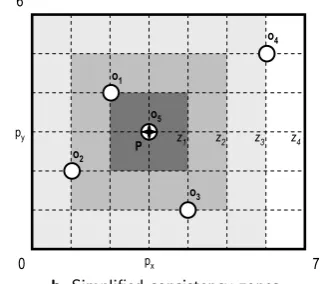
Within a particular view, object consistency depends on its distance to apivot(P). The pivot is characterized by a posi-tion in the virtual world, and it can move over time. A pivot can be an object (e.g., the Pac-Man player) or just a function (e.g., an editor cursor). Figure1a illustrates a virtual world populated with objectso1, o2, o3, o4, ando5. The pivot (o5) is highlighted with a star.
By analogy with the electric (E) and the gravitational (G) fields, a pivot generates a “consistency field” determin-ing the consistency of each object as a function of the dis-tance between the object and the pivot. Thus, pivots generate consistency zones, isosurfaces, ring-shaped, concentric ar-eas around them, such that the objects positioned within the same consistency zone are enforced the same consistency degree. For example, in Fig.1a, pivotP is in the center of four consistency zones labeledzi, where 0≤i≤4. Objects
o2 ando3 are enforced the same consistency degree since they are in zonez3.
Each consistency zone maps to aconsistency degree(ci) of aconsistency scale. A consistency scaleC= c1, . . . , cn is an ordered set of ci, each specifying the consistency to be enforced within zone zi. The property ci > ci+1
holds, meaning thatci enforces stronger consistency than
ci+1. Thus, consistency zones are arranged monotonically; consistency degrees become weaker as the distance to P
increases. In Fig. 1a, darker consistency zones impose stronger consistency requirements. For example, ifP rep-resents the player and the other objects are ghosts of the Pac-Man game, each ghost’s consistency weakens as it is farther from the player. Specification of consistency degrees is detailed in Sect.2.2.
Considerλi the radius of the outer circumference ofzi. We definezi as follows: (i) ifi=1, thenz1is the circle of radiusλ1; (ii) ifi >1, thenzi refers to the area enclosed be-tweenzi andzi−1(a ring). Thus, if a pivotP is surrounded bynconsistency zones, it is necessary and sufficient to spec-ifyλi to all i where 1≤i < n. The consistency zone zn refers to the area beyond the circumference of radiusλn−1. This is represented by vectorZ= [λ1, . . . , λn−1]. Since it is computationally more expensive to determine if an object is within a radial surface, we define consistency zones as con-centric squares instead of concon-centric circles, as depicted in Fig.1b. Also,λrepresents not the radius of the outer circum-ference, but half the side of the outer square (or its apothem). For example, consistency zones of Fig. 1b are defined by
Z= [1,2,3], and objects are distributed by the following zones:{o1, o5} →z1,{o2, o3} →z2, and{o4} →z3.
Determining the consistency degree of an object depends on its relative position w.r.t. the pivots. Thus, the same object may have different consistency degrees in different views. Figure2illustrates this by depicting the views of two nodes, A (Fig.2a) and B (Fig.2b), respectively, with pivotsPAand
PB. Both pivots generate the consistency zone patternZ= [1,2,3]. Hence, for example,o2→z2, in A, whileo2→z4 in B. This implies thato2consistency is stronger in A than in B, which is expected sinceo2is closest to a pivot in A.
Fig. 2 Two views of the same virtual world
player, have their outer consistency zones with very small intersection, this may lead each player to observe slight in-termittence (e.g., interaction or battles among nonplayer en-tities), although no differences in outcome. Depending on their relative distances and movement, each player may ob-serve such interactions (individual actions) with different lag/delay, with different detail (e.g., number of shots), but without lasting divergence and, therefore, no significant im-pact in player’s decisions and game semantics. This can be prevented with a consistency zone definition (and consis-tency degrees) that takes into account the game semantics.
2.2 Consistency degree vectors
VFC describes the consistency degrees as three-dimensional consistency vectors κ= [θ, σ, ν]. κ bounds the maximum objects divergence in a particular view, i.e., between the ob-jects latest updates and their replicas in that view. In short, for each objecto,κ bounds the staleness ofoin a particu-lar view. Each dimension is a numerical scaparticu-lar defining the maximum divergence of the orthogonal constraintstime(θ), sequence(σ), andvalue(ν),1respectively.
• Time: Specifies the maximum time a replica can be with-out being refreshed with its latest value, irrespective of the number of updates performed in-between. Consider that θ (o)provides the time passed from the last replica update. Thetimeconstraintκθ enforces that, at any time,
θ (o) < κθ. This scalar (not necessarily integer) quantity measures time in seconds.
• Sequence: Specifies the maximum number of lost replica updates, i.e., updates that were not applied to a replica. Similarly, consider thatσ (o)indicates the number of lost updates. The sequence constraintκσ enforces that, at any time,σ (o) < κσ. The unit is the number of lost updates.
1Although in modern Greek, theveesound is written using the letterβ, we prefer to
use the letterν, for its resemblance with the latin v.
• Value: Specifies the maximum relative difference between replica contents or against a constant (e.g., top-value). Consider that ν(o) provides this difference. The value constraintκν enforces that, at any time,ν(o) < κν. The unit of variation is a percentage. It captures the effects of updates (i.e., their impact or importance) on the ob-ject’s internal state and is implementation dependent (e.g., it may reflect a drift or discrepancy regarding the player’s score or the player’s life charge/energy).
The overall maximum divergence is obtained by the dis-junction of all theκ vector dimensions. For example, con-sider the consistency vectorκ= [0.1,6,20]. Hence, at max-imum, replicas are outdated inκθ=0.1 seconds orκσ =6 lost updates or with aκν=20% variation in the replica inter-nal state. To indicate the least possible requirements, i.e., no requirements on that dimension, we use “.” (mathematically, this symbol represents ‘‘∞”). For example,κ = [0.1,6, .]
imposes no consistency constraints whatsoever regarding the replica internal state.
In VFC, consistency degrees are specified byκ vectors. In order to specify a consistency scale obeying ci > ci+1 with κi and κi+1 vectors, the condition κi+1 > κi must hold, i.e., for every u, κi+1u ≥κiu, and there is at least onev such thatκi+1v > κiv,u, v∈ {θ, σ, ν}. For example,
C= [0.2,2,10],[0.2,5,10] is a valid consistency scale: [0.2,2,10] stands for a stronger consistency degree than [0.2,5,10]because the number of admitted lost updates is higher in the latter (5) than in the former (2) and the other dimensions are equal. Also, we defineκM= [., ., .] as the highest consistency degree andκm= [0,0,0]as the lowest consistency degree such thatκm≤κi≤κM.
2.3 VFC generalization
Fig. 3 Multi-pivot generalization
Fig. 4 Multizones generalization
more than one pivot per view. Figure 3 illustrates such a case, with two pivotsP1andP2in the same view. Objects are assigned the consistency degree w.r.t. the closest pivot.
In other words, VFC supports game semantics usually employed in somerole-playing gamesandreal-time strategy games, where a (human) player may have multiple avatars by controlling several game entities (e.g., characters, sol-diers), turning their locations into important points in the vir-tual world; each one would be a pivot around which stronger consistency may be required (when compared to other areas of the virtual world).
The multizones generalization allows different sets of ob-jects to be characterized differently w.r.t. their consistency requirements. For example, in Pac-Man, objects standing for ghosts and for rooms may be characterized with differ-ent consistency requiremdiffer-ents. Thus, nsets of objects may be assigned specifically: (i) consistency zones, (ii) consis-tency degrees, and (iii) pivots. Specification of each set is designated byφi, where 1≤ i≤ n;φrefers to allφi. Fig-ure4 shows an example of two object set specific settings
φ1andφ2. The former characterizes objects{o1, o2, o4, o5}. The latter characterizes objects {o3, o6, o7, o8}. Both have the same pivot but different consistency zone specifications.
Summary In order to specify the consistency
require-ments, game programmers need to provide the VFCφ
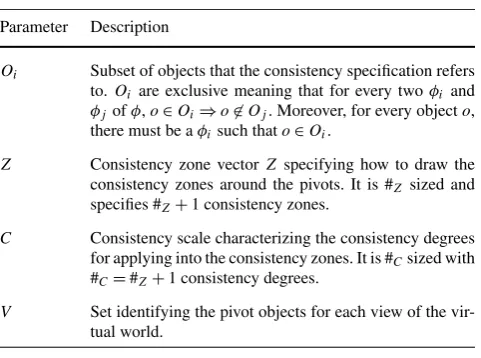
set-Table 1 Table describing theφparameters of VFC Parameter Description
Oi Subset of objects that the consistency specification refers
to.Oi are exclusive meaning that for every twoφi and φjofφ,o∈Oi⇒o∈Oj. Moreover, for every objecto,
there must be aφisuch thato∈Oi.
Z Consistency zone vectorZspecifying how to draw the consistency zones around the pivots. It is #Z sized and
specifies #Z+1 consistency zones.
C Consistency scale characterizing the consistency degrees for applying into the consistency zones. It is #Csized with
#C=#Z+1 consistency degrees.
V Set identifying the pivot objects for each view of the vir-tual world.
tings by describing individual object setsφi. Eachφi set-ting is described by φi = [Oi, Z, C, V], where Oi⊆O. Table 1 summarizes these parameters. As an example, the φ settings relative to Fig. 2 can be described by
φ1= [O, Z, C, P], whereO= {o1, o2, o3, o4, o5, o6},Z= [1,2,3], C = κm,[.,1, .],[.,2, .], κM, and, finally, V = {A→ {o6}, B → {o5}}. In this example, there is a single object setφ1.
3 Architecture
VFC is aimed at supporting the design of multiplayer dis-tributed games both for ad hoc and for large-scale networks. Based on the model previously described, we present a generic meta-architecture that can be instantiated in these two scenarios according to their specific characteristics. Both specific architectures enforce VFC by managing the game state between the network nodes and provides pro-grammers with the adequate means to parameterize VFC ac-cording to game semantics.
3.1 Generic VFC meta-architecture
Fig. 5 VFC generic meta-architecture
Thus, for ad hoc networks, the solution follows a single-server multiple-client architecture.2Upon the establishment of the ad hoc network, one of the nodes becomes the server which is responsible for enforcing VFC. Naturally, the server device may also act as a client allowing all nodes to participate in the game.
For large-scale networks, the virtual world is partitioned into different, but not independent, regions handled by dis-tinct servers. Players can move freely around the virtual world, transparently switching between regions of differ-ent servers, and are able to seamlessly interact with play-ers located in other regions. Each server enforces VFC for the region under its responsibility. In addition, each server communicates, through a subscription protocol, with other servers to apply VFC for players located in others, contigu-ous or not, regions. This solution is particularly suited to massively multiplayer online games (MMOG) in which a large number of players interact through an extensive vir-tual world, shared over a wide area network. Players con-trol an entity (the avatar) that represents them in the game’s virtual world. Avatars can move across the game map and interact with each other according to the instructions given by the human player through some input device (e.g., a key-board or a mouse). Players can also find several objects (e.g., health items, food, weapons,. . .) and computer controlled characters (e.g., NPCs, nonplayer characters). Each avatar has its own state that comprises several properties like po-sition, health, abilities, and owned items. Interactions with other avatars or objects may change both its state and the others’.
2The rationale for this choice is mainly due to the limitations of
wire-less communication technology (e.g., Bluetooth) that imposes a single node of the network to relay all messages between any two nodes.
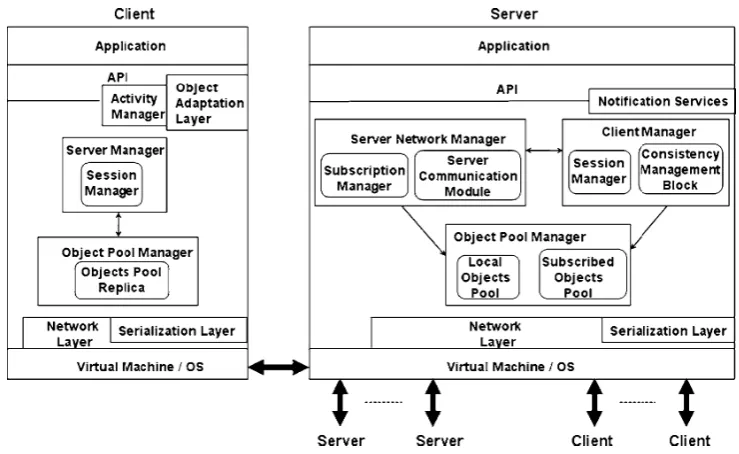
Thus, in both architectures, the server (in a centralized solution) or the servers (in a partitioned solution) have a co-ordinating role regarding data management: write-lock man-agement, update propagation, and VFC enforcement. The client–server protocol is orchestrated by the Session Man-ager components of each server. Communication is per-formed between clients and the corresponding server on a star like topology using the services of components Net-work Layer and Serialization Layer. The Client Manager in the server administers client data and enforces the consis-tency model through two components, the Session Manager and the Consistency Management Block (CMB). The Object Pool Manager manages the game objects and encapsulates the stored data, performing every operation on it on behalf of the other components.
We now describe in more detail the VFC aspects that are common to any architecture: first, reading/writing objects (Sect.3.2) and, secondly, how VFC is enforced (Sect.3.3). Then, we focus on the architectural aspects that result from having the virtual world partitioned among several servers, each handling a region (Sect.3.4). Note that in the follow-ing two sections (addressfollow-ing common VFC aspects), when referring to a server, we mean a single server in an ad hoc architecture, and, when in a large-scale partitioned architec-ture, a server means one of the several servers, each one handling a specific region of the virtual world. The com-munication that exists among such servers to ensure VFC in multiple regions of the virtual world (i.e., the subscription protocol) is addressed in Sect.3.4.
3.2 Read & write objects
con-tainer. The server maintains a primary copy of the object pool while the clients keep replicas of such objects. From the architectural viewpoint, there is no restriction whatso-ever w.r.t. the representation of data (e.g., object graphs, tu-ples, relations). Also, the Object Adaptation Layer maps the application data representation to the architectural specific internal data representation.
Clients read and write objects through a VFC API. Read operations are performed on the local replicas without lock-ing requirements (clients may read stale data). Write opera-tions need to acquire locks in order to prevent the loss of up-dates. The server manages locks centrally; clients exchange messages with the server to acquire and release them. Ob-ject updates are sent to the server when clients release locks. The server propagates the new object versions to the other nodes according to the VFC specification.
With the exception of lock messages (for obtaining and releasing locks), nodes operate periodically w.r.t. the inter-actions between them. The server, periodically, sends a mes-sage to all clients defining around. This has a twofold im-plication. In each round, the server sends round messages to the clients; updates are piggybacked on the round mes-sages and merged at client object pools at reception time. On the other hand, it enables the execution of synchronized application handler functions (activities) at the client side. Whenever a round message is received, the Activity Man-ager executes client activities. This feature may be used by many games based on turns. For example, activities may be used to update players locations, scores, or other game state information. Since updates are received and merged before executing activities, the game programmers know that lo-cal replicas are stable when their activities execute (albeit possibly stale within the bounds defined by corresponding consistencyκvectors).
3.3 Enforcement of the VFC model
The Consistency Management Block (CMB) at the server side enforces the VFC model. The CMB coordinates the propagation of updates to clients according to the VFC con-sistency parameters specified by each client. There are two phases, the setup phase and theactive phase. During the setup phase, clients register the objects to be shared and send their consistency parameters (VFC φ settings) to the server; the CMB aggregates all the clients φ settings. The active phase is when clients may access the registered ob-jects. In this phase, the server processes: (1) write requests (sent asynchronously by the clients piggybacked in lock release messages) and (2) round events (triggered periodi-cally). The CMB is involved in handling both these events. It provides two functions that are called by the Session Man-ager (SM): CMB-UPDATE-RECEIVEDand CMB-ROUND-TRIGGERED. As both functions are called, the CMB accu-mulates and computes the required information to build the
clients’ consistency views according to the previously spec-ifiedφsettings. When called by the SM, the CMB-ROUND-TRIGGEREDfunction returns the updates to be sent to each client, which the SM piggybacks in the round messages.
Besides supporting VFC, the CMB module offers a generic interface allowing the support of different consis-tency models. The remainder of this section describes the internals of CMB that enforce VFC: update sending obeys theφsettings specified by clients. For each step, we describe the algorithms underlying CMB-UPDATE-RECEIVEDand CMB-ROUND-TRIGGEREDfunctions.
Consistency management block In order to guarantee that
all updates received since the last round event are taken into account when sending updates to clients in the next round, the CMB keeps track of which objects became dirty mean-while in a bidimensional arrayD: each element corresponds to an object of the object pool regarding a particular client’s view. In each particular client’s view, an object is considered dirty if, according to the VFC requirement, its data should be propagated to the client.
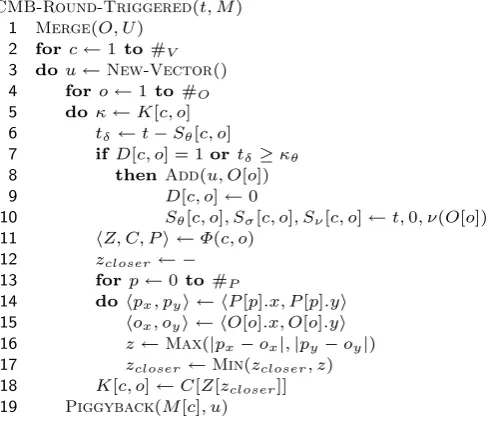
Figure6presents the pseudocode of the algorithms im-plementing this semantics. Whenever the server receives an update from a client, CMB-UPDATE-RECEIVEDis invoked and, if appropriate regarding the correspondingκvector, the object is marked as dirty in D’s corresponding entry and the update is inserted in the queue of pending updatesU. At each round event, CMB-ROUND-TRIGGERED is exe-cuted: it merges the pending updates in the object pool and sends all pending updates piggybacked in round messages to each client after testing the respectiveDdirty flags. Each
Dflag is then cleared meaning that the new versions were sent to the corresponding client.
The following data structures are also required:Z,C,P, andK.Z,C, and P refer to the data structures related to the clientsφsettings (see Sect.2.2).K is a matrix storing per objectκvectors of each view that are valid during a time slot.κ vectors are computed per object, per view, according to clientsφsettings. Aκ vector is a consistency array that specifies when and which updates must be propagated to a client. Eachκconsistency vector expresses three orthogonal dimensions: time, sequence, and value. Each dimension is evaluated independently and auxiliary data structures (S ar-rays) are kept for each dimension. Each dimension of each
κconsistency vector is evaluated as follows:
• Time:Sθkeeps the time of the last sent update. Whenever this time exceeds the one specified byκθ, the update is sent (see Fig.6b, lines 6–7), and the CMB internal state (DandS arrays) is reset. The time is approximated to a multiple of the round period.
Fig. 6 Pseudocode of CMB
received, this counter is incremented. When the counter exceeds the value κσ, the object is set to dirty in D in order to send the update in the next round (see Fig. 6a, lines 5–8).
• Value: This qualitative dimension implies querying the object state to test when the difference to the last prop-agated version exceedsκν. This query is evaluated by a function ν, provided by the game programmer and de-pendent of the game semantics.Sνkeeps the query result of the last propagated version and does the test of Fig.6a, line 7, whenever an update is received.
Calculating κ vectors is straightforward (see Fig. 6b, lines 11–18). The function (c, o)→ Z, C, P retrieves the φ settings referring too for each client view s: Z,C, andP. The algorithm proceeds as follows: (1) determines in which consistency zonezcloserthe object is, and (2) resolves and stores inKthe object consistency degreeκ. Regarding the first step, since the object may be positioned in more than one consistency zone, each one belonging to a pivot, it is necessary to know which of these consistency zones imposes strongest consistency requirements. This is found by detecting which pivot is closer to the object, hence the
zvariable to evaluate the distance to a pivot and zcloser to keep the shortest one. Finding the distance from objectoto a pivotP = px, py implies discovering in whichP cen-tered square of sidelthe objectox, oyis positioned such thatz=l/2=Max(|px−ox|,|py−oy|). Since consistency zones are delimited by squares centered inP, it is enough to comparezwith half the length of the squares that bound a certain consistency zone (e.g.,s1for the inner square and
s2 for the outer square). Thus, the object is ensured to be in a determined consistency zone ifs1< z≤s2. The opera-tion that provides the number of the consistency zone based onzcloserisZ[zcloser]in line 18. After determining which is the consistency zone of the closest pivot, determining which is the corresponding consistency degree is simply done by consulting theCtable.
3.4 Inter-server subscription protocol
As previously mentioned, each partition of the virtual world is assigned to one server of a distributed server network. Players are assigned to one of the servers based on the posi-tion of their avatars in the virtual world.
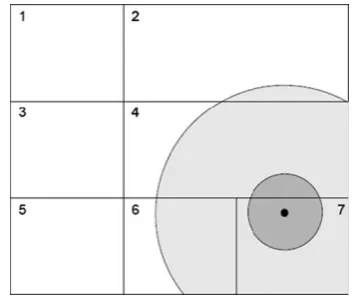
Because thearea-of-interest(AOI) of a player may cross partitions handled by a different server (including nonadja-cent partitions, as depicted by Fig.7), servers may need to share information with each other in order to enforce the consistency model and, thus, allow inter-partition interac-tion. To do so while minimizing server synchronization re-quirements, we designed a subscription protocol in which each server only knows about the nonadjacent servers it ac-tually needs to be aware of (i.e., those whose partition may be crossed by one of its players’ AOI). Furthermore, the pro-tocol also ensures that an update from a player is received only by the servers whose objects may be affected by it. As a result, the protocol requires having only apartial viewof the network (each server knows only a subset of the com-plete server set), which favors the scalability of the system.
Fig. 7 Partitions with different dimension
(CAN [25]). Like in a CAN, each peer (in this case, a server) is responsible for one partition of the virtual space and, con-sequently, for the objects (i.e., avatars, other game items) located on it. Each server has only a partial view of the network, i.e., it knows only a subset of the total number of servers of the network. Thepartial viewalways contains the servers responsible for its adjacent partitions, and it may also contain a dynamic number of other servers, added to the partial viewas a result of the subscription protocol.
The partitioning of the virtual world is defined as servers join the network. Like in a CAN, a joining server chooses one of the existing servers and splits its partition in half, becoming responsible for one of the halves. Choosing with which server to split depends on the actual goal of the join: if the server is joining to relieve the load on one of the servers, it has to know about that server beforehand (e.g., from a load monitor) and splits with it; if the goal is to improve the overall performance of the network, the system simply follows the CAN node join protocol, i.e., the server chooses a random position of the virtual world and joins that server.
3.4.1 Inter-partition interaction
Two players may potentially interact when one is within the other’s AOI. Thus, interpartition interaction occurs when two interacting players are located on different partitions, adjacent or not. This means that theviewof a given player may require information from multiple servers. Interparti-tion interacInterparti-tion is supported by a player subscripInterparti-tion proto-col that gathers the information each server needs to know in order to enforce the consistency model. The protocol is di-vided into three parts (performed at independent times) and runs as follows.
Partition Subscription When a server joins the network, it immediately identifies and connects to those servers whose partition its objects’ AOI may cross. To do so, it inspects the objects located on its newly defined partition to find the one
with the largest AOI radiusR. It then publishes to the net-work the dimensions of the areapartition outsetdefined by addingRto each side of the partition. Publication consists in broadcasting the publication message to the server’s neigh-bors: the server sends the message to its direct neighbors, who, in turn, forward it to their neighbors, and so forth, un-til every server whose partition is crossed (or contained) by thepartition outset receives it; forwarding stops as soon as it reaches a server whose partition is not crossed (nor con-tained) by theoutset. As a result of this publication, every server whose region is crossed by the partition outset in-forms the publishing server of its existence and is added to itspartial view.
Object Subscription The main task of the Subscription
Manager(see Fig.5) consists in subscribing its own player objects (pivot objects) to servers that may contain informa-tion required by its players. It does so by executing an object subscription protocol when relevant changes occur that runs as follows:
1. The protocol starts by checking if any of its player’s AOI crosses the partition of any server on itspartial view. If it finds one such object, it adds the mapping “server↔ player object” to asubscription queueto be processed in the next step.
2. Then, thesubscription queue of step 1 is used to pub-lish the list of objects to the corresponding servers, deter-mined in that step. Publication is performed by directly sending, to each server, the list of objects whose AOI crosses its partition and, thus, requires information about objects only known by it.
3. After the subscription process is finished, the mappings “object↔subscribed server” are stored in asubscription table.
Server Synchronization The second part of the protocol
consists in synchronizing objects between the servers ac-cording to the subscription results. Synchronization consists in forwarding/propagating the contents of each object’s pri-mary replica to the subscribing nodes. It is performed, con-servatively, every time a player submits an update, although with an optimistic approach: when an update is received, the server consults itssubscription tableand retrieves from it the entry of the subscription table corresponding to the object to update; then, if necessary, it forwards the received update to the servers on that list.
3.4.2 Ensuring VFC across partitions
As a result of the subscription protocol, each server has two disjoint sets of players: a set ofowned playerscomprising the players that are located at the server’s partition; and a set ofsubscribed playerscomposed of the players that are located at partitions handled by a different server, but whose AOI crosses the server’s partition.
Obviously, a player must receive updates from every game object that is within his AOI, even those located at dif-ferent partitions. This is achieved by having each server up-dating both itsownedandsubscribedplayers with the infor-mation about the objects located on its partition. This means that each server enforces VFC only for the slice of a player’s AOI that crosses its partitions. As a result, the responsibility of enforcing VFC for a given player is distributed between the servers whose partitions are intersected by the player’s AOI. Considering Fig. 7, consistency for the playerp rep-resented by the solid (black) circle would be enforced com-plementarily by the four servers: S1 would be responsible for updating p with the information about its four owned objects,S2would update it considering only its twoowned objects, and so forth.
The enforcement of the consistency model requires servers to keep information about the state of each players’ local copy of an object regarding the object’s latest state. For this purpose, each server stores aconsistency tablethat keeps, for eachownedandsubscribedplayerpand for each objecto that is within the server’s partition (i.e., for each owned object), the data related to the three metrics of con-sistency of the model:
• The time elapsed since the last timeo was refreshed at playerp;
• The number of updates toothat were not sent top, since the last time it was refreshed witho;
• Thevaluethat objectohad the last time it was sent top. With this information, VFC is able to enforce consistency on its players by executing the following tasks:
(1) Update processing To update players according to
their VFC specification, servers monitor the updates to their (owned and subscribed) objects. For that purpose, every time a server receives an update, it executes one of the fol-lowing actions, depending on the origin of the update: • If the update is received from a player, then it concerns
an owned object. Hence, the server updates its consis-tency tableby updating, for each player (ownedand sub-scribed), the entry corresponding to the updated object. This includes updating, for each player, the time elapsed since the object was refreshed and the number of lost up-dates of the object.
• If the update is received from a server as a result of server synchronization, then it concerns asubscribed object cor-responding to a playerpowned by a different server. As
such, the information received is only necessary (as far as VFC is concerned) to update the object’s position, so that, when enforcing the consistency model top, VFC can correctly identify which objects are withinp’s AOI.
(2)Client updatingVFC propagates updates to clients pe-riodically, according to their consistency specification and the information gathered in theupdate processingstep. The process of updating clients is as follows:
1. First, the server identifies, for each player (owned and subscribed)p, which of the objectsownedby the server (i.e., those that are located on its partition) are within p’s AOI. Then, for each objectopreviously identified, it checks in whichconsistency zoneofp’s AOI objectois located. Finally, it verifies ifois in violation of the con-sistency degreeassociated with that consistency zone. If so, that object is queued, and, after verifying the remain-ing objects, the server sends it to the playerp.
2. After verifying consistency for every player (owned and subscribed), the server sends them the objects identified in the previous step.
As a result of these steps, VFC achieves a distributed and decentralized consistency management algorithm in which the consistency of a single player is enforced not by a sin-gle server but by the complementary work of a group of servers. Having the load and the responsibility of enforcing consistency partitioned between the servers of the network improves the flexibility of the system and promotes scalabil-ity.
In this distributed setting with partitioning, serializabil-ity is ensured at each server. For each client, causalserializabil-ity re-garding its updates is ensured since FIFO order is enforced when sending updates to the servers. Asynchronism among servers is necessary for scalability, performance, and playa-bility. Thus, servers neither globally relay nor acknowledge each round (i.e., there is no distributed consensus). It is wor-thy to note that such synchronized rounds could be enforced within clusters, not in wide area. Therefore, updates per-formed by a given client to several objects owned by dif-ferent servers, sent in the same round, may not arrive in the same exact round to each of the other clients (nonetheless, updates to individual objects are always propagated in total order). In this sense, interpartition causality is temporarily relaxed, although recovered in the next round, as updates arrive. This allows preservation of intent, a reasonable mea-sure of causality assurance: the user sees a wider portion of the game world, observes interaction outcomes correctly, temporarily with lower detail or some lag/delay.
3.4.3 Player transfer
Fig. 8 Client and server Session Manager state machines
on remote servers to transfer a player’s data before the player actually moves to a new partition. When a serverSi sends a subscription message directly to another serverSj, it piggy-backs the player’s data on that message. WhenSj receives the message, it gets all the information it needs about the player from the piggybacked data.
The actual transfer of a player from his current desig-nated serverSi to his new designated serverSd occurs only when the player’s avatar moves to that server’s partition. The transfer is triggered bySiafter it receives an update from the player that positions its avatar on an adjacent region. After finding out (by analyzing the entry of thesubscription table corresponding to the object) which serverSd is responsible for that region,Si issues the transfer request to it. Because the player’s data has previously been transferred fromSi to
Sd, the latter needs no additional information. As such, the transfer request is, in fact, a simple one-way asynchronous transfer notification.
4 Implementation
VFC has been implemented mainly as middleware proto-types for the two targeted architectures: ad hoc (VFC-hoc) and large-scale networks (VFCLS). In this section we de-scribe the essential implementation details, in addition to the detailed architectures explained earlier, regarding the main aspects of VFC core implementation, and the VFC-hoc and VFCLS prototypes. Additionally, we have implemented a multiplayer ad hoc game using VFC and a simulating en-gine to compare VFCLS with competing approaches. As a more sophisticated proof-of-concept of application of the VFC model, we are currently extending an open-source dis-tributed first-person shootermultiplayer game, in order to make use of VFC. We provide more details of this ongoing work in the next section.
The relevant core of VFC implementation consists of the Consistency Management Block (CMB) and the Session
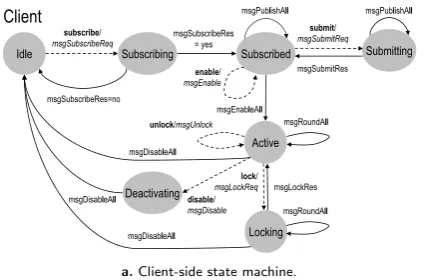
Manager components. The CMB internals implement the al-gorithms presented in Fig.6, regarding both the functional-ity and the data structures. The Session Managers of both the client and server sides execute the protocol that provides the VFC services to the game programmers. Each implements its own state machine (see Fig.8). Shaded circles represent the states, and arrows between the states represent state tran-sitions. State transitions are triggered by events. Each arrow description has two parts separated by a slash: the left side is the event name, and the right side is the outgoing message sent to the remote peer. Straight arrows represent incoming messages, and dashed ones represent API requests or inter-nal events.
Session Managers coordinate in order to enforce the two phases already presented in Sect.3, thesetupand theactive phases. Broadly speaking, first, the server declares its inten-tion to accept client connecinten-tions and enters the SETUPstate. Then, clients connect to the server and subscribe to its ser-vices. Clients may now submit to the server the objects to be shared, which the server forwards to every client. When the server receives anenablerequest, it switches to the AC-TIVE state, and the system enters theactivephase. While in this state, the server sends periodic round messages and handles lock and release requests. Updates are received by the server piggybacked with the release messages. The sys-tem leaves this phase when clients send the server adisable request causing the server to switch to the IDLEstate.
VFC-hoc internals A prototype of VFC-hoc was imple-mented in Java and deployed on J2ME MIDP 2.0 CLDC 1.0 compliant devices (Nokia 6600 phones), according to the meta-architecture described in Fig.5. We use Bluetooth to support communication between the devices. The Net-work Layer uses JSR 82, the J2ME Bluetooth API, for dis-covery of nearby devices and services, management of ac-tive connections, and sending/receiving data. Note that inter-nally, the Network Layer is multithreaded in order to prevent blocking and increase parallelism. All messages exchanged between devices are implemented as Java objects.
Game state can be represented as Java object graphs with individual objects registered in Objects Pool. Due to the lack of binary object serialization support in J2ME, a Serializa-tion Layer was implemented in order to (un)marshal objects (see Fig.5). It requires objects to implement a specific in-terface allowing the middleware to read and write the object fields. The game programmer does not have to implement this code; a code enhancer was developed to transparently extend the application source code accordingly.
VFCLS prototype internals The VFCLS prototype was
de-veloped in Java with Sun J2SE 6.0 development kit (JDK) and runtime environment. VFCLS was developed using only the standard Java libraries provided by JDK. We used Java Remote Method Invocation (RMI) to support communica-tion between the nodes of the system.
Integration with applications and programming languages For a consistency model to be widely used, it should be seamlessly integrated with popular programming lan-guages, such as Java and C#. We describe how program-mers can programmatically specify VFC φ settings. Piv-ots are registered by name, and objects are associated with them using the overloaded methods defined by VFC
setPivot(String, Object),setPivot(String,
Object[]). Sets of objects are selected by applying VFC declarative tags to object classes in source code, represented as Javaannotations(@VFCPlane{}, @VFCZone{}) or
.NET attributes ([VFCPlane()],[VFCZone()]) with
parameters stating zone ranges and κ-tuple components
(e.g., @VFCZone{int range, float time, int
seq, float vDiff}).
Java support for annotations is limited. In J2SE, it dis-allows multiple applications of the same annotation (even with different parameters) to the same class. Therefore, we make use of composite annotations (e.g., @VFCPlane{}
that encapsulates the parameters of multiple@VFCZone{}
annotations). In J2ME, there is no support for annotations whatsoever. Therefore, they are parsed as source code com-ments and classes extended to bear annotation parameters as private static fields.
Games must register objects in order for VFC to man-age them. The VFC middleware can make use of reflec-tion to allow registrareflec-tion of object graphs. At the client-side, the game client must register the players’ avatar with VFC. Likewise, at the server-side, the game server applica-tion may (depending on the game’s design) register objects corresponding to nonplayer computer controlled characters. To allow inspection of objects by VFC, classes must im-plement theIVFCConsistencyinterface that describes three methods:getPositionfor objects to provide their current coordinates in the virtual world,getValueto pro-vide their internal data to be propagated, andvDiffto pro-vide an application-dependent measure (in percentage) of difference w.r.t. contents of another object.
After registration, objects can also be updated accord-ing to game logics. When an object is locally updated by a client, the game client (either explicitly or via enhanced source code) informs VFC via a UserUpdate notification. As a result, the update can be sent to the client’s designated server.
If desired, game clients and server applications can be informed when a state update message is received from a server. For this purpose, when the application starts, they must register themselves asupdate listenersusing a
Regis-terStateUpdateListenerfunction provided by VFC.
VFC also provides functions for applications to query the local object pool. This allows, for example, game servers to perform validation and anticheating periodically, instead of every time an update is received.
5 Evaluation
In this section, we present the main results relative to VFC evaluation, regarding its suitability and flexibility for gaming experience, and its performance resorting to mi-crobenchmarks. The evaluation of VFC takes into account the two architecture instantiations proposed, ad hoc and large-scale networks.
5.1 VFC-hoc: VFC for ad hoc and mobile networks
Fig. 9 Game view in one phone
Fig. 10 Evaluation of CMB round handler
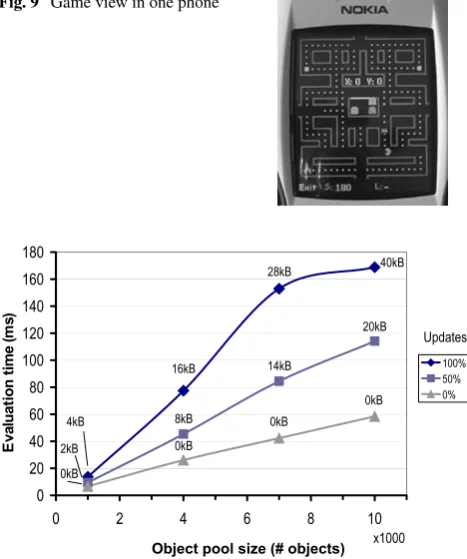
The quantitative evaluation studies the impact of VFC enforcement on overall VFC-hoc performance. Our micro-benchmarks focus on the most costly operation, the CMB-ROUND-TRIGGERED function, described in the CMB al-gorithm (see Fig.6), and on network delays. This function not only performs intensive computations, but it is also ex-ecuted periodically, once per round. From the algorithm we can see that, disregarding the cost of the merging operation in line 1, the overall cost is proportional to the number of clients. Thus, we evaluated the algorithm cost for a single client.
We continuously ran this microbenchmark on phones and measured the execution time of the CMB-ROUND-TRIGGERED function (at the server side) by varying two factors: (i) the number of objects in the pool (between 1000 and 10000 objects) and (ii) the percentage of updates piggy-backed in the round messages to the client (0%, 50%, and 100% simulated update percentages).3Additionally,
exper-iments were conducted with the following fixed conditions: (i) the simulated φ settings included 1 pivot and small C
andZ (arrays with 3 positions), (ii) object payload was 4 bytes (e.g., 2 small integers for space coordinates). Figure10 presents the performance measurements. Each result is
an-3Updates are piggybacked in the round message if the test of line 7 of
Fig.6b is true. The microbenchmark simulated this setting according to the update percentage provided as input.
Fig. 11 Evaluation of message propagation delays
notated with the corresponding volume of data to be sent to the client.
In order to measure the cost of wireless communica-tion, a second microbenchmark was executed on the phones to measure network propagation time using Bluetooth. The size of the messages varied from 1 to 10000 bytes. Figure11 presents the obtained propagation times, which allows us to establish a comparison w.r.t. the VFC evaluation result.
Results show that VFC performance is influenced by the number of updates sent to clients and therefore influenced by the VFC parameterization: weak consistency requirements cause less updates to be sent, increasing efficiency. Also, for a reasonable number of objects, the computation time is less than the corresponding transmission time in the network. Hence, the VFC computation costs can be masqueraded if they are performed in parallel with the transmission of the updates to clients and there is still time to attend game logic and rendering on the clients. Further, since the propagation time is nearly stable for messages below 200 bytes, the CMB may be enhanced to adapt the number of updates in order to increase efficiency.
5.2 VFCLS: VFC for large-scale networks
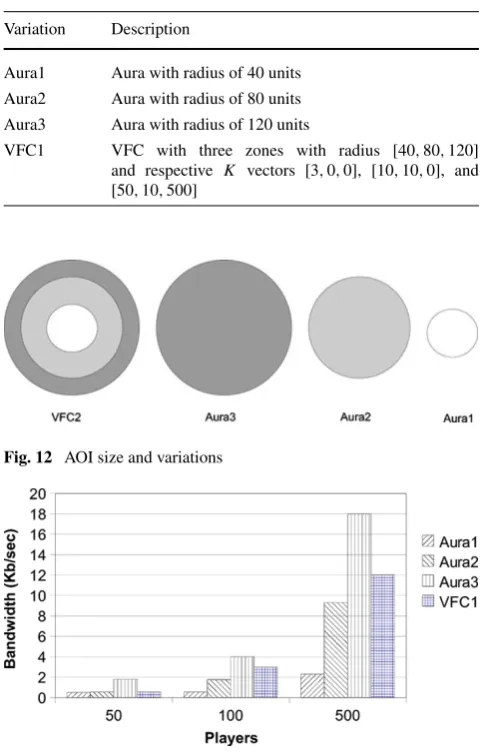
Table 2 Description of the different parameter variations Variation Description
Aura1 Aura with radius of 40 units Aura2 Aura with radius of 80 units Aura3 Aura with radius of 120 units
VFC1 VFC with three zones with radius [40,80,120] and respective K vectors [3,0,0], [10,10,0], and [50,10,500]
Fig. 12 AOI size and variations
Fig. 13 Client-side usage requirements: auras versus VFC
Locality-awareness To compare the VFC consistency
model with aura-based IM regarding the bandwidth require-ments imposed on players, we employed the parameter vari-ations described in Table 2, and illustrated in Fig.12. The results in Fig. 13show the measured bandwidth in a con-text with variable number of players (50, 100, and 500) in a 1000×1000 virtual world. As expected, the performance of auras decreases as their radius increases, as the number of objects inside the AOI is higher. In VFC1, on the other hand, varying the radius of consistency zones does not nec-essarily mean that the bandwidth spent will increase. Since VFC has other configurable parameters, it is possible to in-crease the range covered by VFC zones while maintaining, or even reducing, bandwidth. This way, it is possible to en-large player’s visibility with little or no impact on band-width, although at the cost of fidelity (that decreases pro-gressively or gracefully, nonetheless).
Although VFC1 only performs better than Aura3, to fully understand the meaning of these results, we have to analyze
Table 3 Description of the evaluated architectures
Name Description
VFC Single server centralized architecture Rep4s Replicated architecture with four servers. Rep9s Replicated architecture with nine servers.
VFCLS4s Four servers VFCLS
VFCLS9s Nine servers VFCLS
Fig. 14 Execution times of function round-trigger for different archi-tectures: VFCLS and replicated architecture highlight
them in light of Fig.12. Aura1 corresponds to the inner zone of VFC1. Hence, it is natural that VFC1 uses more band-width than Aura1. However, VFC1 corresponds only to an example VFC consistency vector defined by us. A differ-ent consistency vector could perform better than VFC1 and possibly yield bandwidth results similar to Aura1. Finally, we can see that the resulting bandwidth of Aura3 is higher than VFC1. More importantly, these results happen despite the fact that Aura3 and VFC1 cover the same exact area of the virtual world, a more relevant comparison. This is due to the high flexibility that VFC exhibits.
Architecture We compared VFCLS with the centralized
Fig. 15 Per-server bandwidth usage of different architectures
With 500 players, VFCLS4s only outperforms the equiv-alent Rep4s, while Rep9s achieves better results, but still worse than VFCLS9s. With 1000 players, both VFCLS4s and VFCLS9s outperform the two replicated architectures, with each reducing by more than half the execution times of their replicated equivalent (Rep4s and Rep9s, respectively). Moreover, both can provide a highly interactive experience to its users, as the execution times are low. We can also see that the difference between execution times of VFCLS9s with 500 and 1000 players is not meaningful, indicating good potential for scalability in VFCLS.
Server-to-client bandwidth Figure 15 shows results
re-garding bandwidth. At first glance, it looks like VFCLS not always saves bandwidth (500 players, VFCLS4s tops; with 1000 players, it is VFCLS9s). However, to fully understand this, we need to also take into account the results of the pre-vious performance analysis. Since VFCLS is able to issue a higher number of round messages per second, it performs consistency enforcement more often than the other (slower) architectures. For instance, Rep4s can only perform consis-tency enforcement about once per second in the 1000 play-ers context, while VFCLS9s does it almost five times more (considering that rounds are issued every 100 milliseconds, as was the case of our testing). Therefore, VFCLS is able to send messages more often to its players, which results in the higher bandwidth requirements. However, this is a false drawback, since it means that VFCLS can provide a highly interactive experience that the replicated architecture can-not.
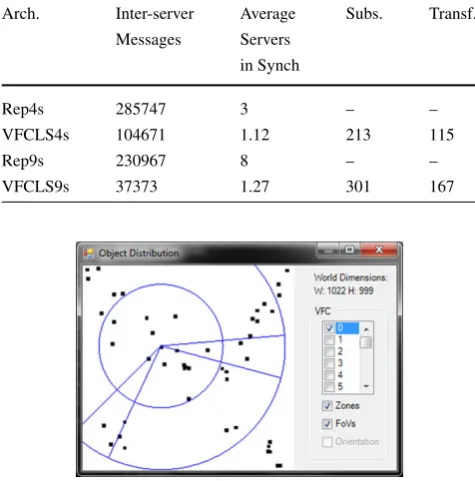
Interserver communication Table 4 shows the average
number of messages exchanged between servers in a game context with 100 players. The results were obtained by re-playing the traces obtained during a 5-minute simulation. We can see that VFCLS, due to its partitioning approach and the subscription protocol, limits the propagation of player update messages between servers. In particular, considering the nine server configurations, VFCLS9s exchanges more than six times less messages than Rep9s. Even with a small
Table 4 Server communication in VFCLS
Arch. Inter-server Average Subs. Transf. Messages Servers
in Synch
Rep4s 285747 3 – –
VFCLS4s 104671 1.12 213 115
Rep9s 230967 8 – –
VFCLS9s 37373 1.27 301 167
Fig. 16 Sky view of game world observed by client with object distribution across consistency zones (with indication of player’s field-of-view)
number of servers, VFCLS4s reduces the number of syn-chronization messages to less than half, regarding Rep4s. Furthermore, the network overhead caused by transfer and subscription messages is not meaningful, which favors scal-ability. Even more relevant is that the difference between VFCLS4s and VFCLS9s, regarding those two types of mes-sages, is relatively low. This indicates that the addition of servers has a small impact on synchronization, which also strongly favors scalability. Regarding server synchroniza-tion, in Rep4s and Rep9s, a server exchanges synchro-nization messages with every other server (three and eight servers, respectively). VFCLS, on the other, limits the num-ber of synchronizing servers to a small set. Not only this reduces the network load, it also means that if a conflict-ing update occurs, the number of servers (and, as a result, players) affected by it is limited.
VFC-enabledFirst-Person Shootergame We are currently
extending an open-source first-person shooter distributed multiplayer game to make use of VFC: Cube 2: Sauer-braten.4In Fig.16, we illustrate how a client perceives the game world, depicting three consistency zones and, accord-ing to player’s orientation, its field-of-view.
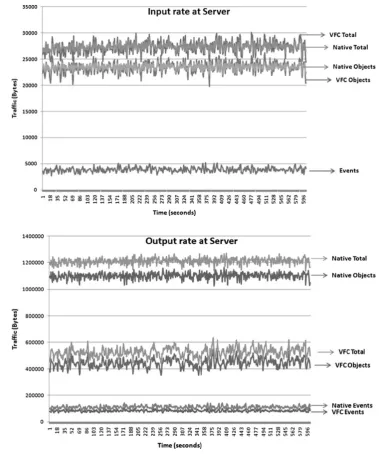
Currently, this game employs only one server. For the purpose of evaluating VFC performance w.r.t. bandwidth usage (both inbound and outbound) by the server, we tested
Fig. 17 Input bandwidth usage rate (B/s) at the server
Fig. 18 Output bandwidth usage rate (B/s) at the server
Cube2-VFC with three Intel Quad-Core machines with 8 GB RAM each, connected via 1 Gigabit LAN. One exe-cutes the server, and two others execute 48 simulated players (i.e., bots employing the game’s very own artificial intel-ligence engine), 24 in each. During 10-minute runs, bots move around the game world in search of weapons and en-ergy, while looking for enemies and shooting each other on sight.
Figures17and18evaluate bandwidth usage by employ-ing VFC when compared with the game’s original imple-mentation. We measured bandwidth usage rate necessary to propagate: (i) objects (i.e., player’s object contents due to player’s movements with consequent modification in posi-tion), (ii) so-calledevents(shooting, triggering of sound ef-fects, in-game messaging, etc.), and (iii) total bandwidth
us-age (sum of the previous two, albeit dominated by object propagation).
applying VFC consistency requirements and thus filtering events (namely shooting and triggered sound effects) that are taking place too far from the player or, at least, propagat-ing them less often (e.g., the player perceives farther shoot-ings as delayed, and with fewer shots but still, he/she knows some other farther player is over there and shooting). Thus, it requires sending fewer messages to each of the clients.
In summary, although there is still a centralized server, VFC clearly introduces relevant bandwidth savings that im-prove game scalability w.r.t. the number of supported play-ers, while ensuring the game experience’s playability.
6 Related work
In this section, we discuss and compare related work ad-dressing relevant aspects in common with our work. VFC is a consistency model protocol that unifies optimistic consis-tency (divergence bounding) with locality-awareness tech-niques (traditionally employed in multiplayer games, but also applicable to cooperative editing). The meta-architec-ture proposed has been instantiated in two architecmeta-architec-tures for different scenarios (ad hoc and large-scale networks). The implemented prototypes aim at providing middleware sup-port to ease the adoption of VFC in the development and deployment of multiplayer games. Therefore, due to space limitations, we focus mainly on the following: (i) work on optimistic consistency in distributed systems with replicated data, (ii) techniques specifically employed to improve the performance and scalability of multiplayer games, resorting to middleware leveraginglocality-awareness, and (iii) other middleware and network architectures for large-scale multi-player gaming.
Optimistic consistency with replicated data Optimistic
consistency techniques [27] (and divergence bounding in particular) are traditionally used in loosely coupled scenar-ios, such as cooperative work, mobile computing, and repli-cated databases. They are also suited to multiplayer games, as they may be employed to reduce bandwidth usage and masquerade latency.
Real-time guarantees [1] allow an object replica to re-main in use while stale (i.e., without being refreshed) for a specified maximum time, before the replica must be made consistent.Order bounding [14] limits the number of un-committed updates that may be applied to a replica. Trans-actions proceed faster because they can ignore the effects of a bounded number of other transactions preceding them.
Numeric bounding, as described in TACT [30,31], is a multidimensional consistency model proposing its combi-nation with order bounding. Divergence bounds are applied toconits(i.e., physical or logical units of consistency) de-fined by the programmer. Numeric bounding defines max-imum quotas (number or weight) for allowable updates to
each replica (e.g., $100 for a number of replicas of a $1000 bank balance). A given replica cannot be further updated until it is made consistent w.r.t. operations performed on the other replicas, when its quota has been exhausted (e.g., by money withdrawals). While TACT proposes a multidi-mensional model for consistency enforcement and limiting replica divergence, it does not take locality-awareness into account. There is no notion of spacial relation neither among individual data objects nor among users. The middleware is oblivious to them. State is simply represented as individual database records or shared/replicated variables in servers. Therefore, it cannot be used in game scenarios where the consistency degree required for an object varies with player position and correspondingsensingandactingranges. Nu-meric bounding is related withescrow techniques [15] on updates to data performed by mobile databases during dis-connection periods, such asreservationsin Mobisnap [24].
In VFC, we clearly extend optimistic consistency tech-niques by introducing support for locality-awareness. Fur-thermore, we can leverage the fact that, in our meta-archi-tecture, each part of the game scenario is under the control of an assigned server. By monitoring all object updates, we extend escrow and numeric bounding techniques, allowing application programmers to define limits on thevalue diver-genceresulting from updates performed by other nodes (in-stead of simply limiting their own updates in a conservative manner).
Locality-awareness in multiplayer games and simulation
environments The notions of locality-awareness can be
traced back tointerest-management(or IM [20]), used to fil-ter routing massive volumes of data in large-scale distributed simulations. It is motivated by the observation that players (or simulated entities) are not equally interested in (or af-fected by) every object (e.g., other players, entities, items). Instead, they are more concerned about objects located near them (e.g., their AOI), and, as the proximity to objects de-creases, so does the player’s interest in them. This obser-vation is typically materialized by two different approaches and their variations, region based and user based (e.g., auras, orientation, line-of-sight). Regions are contiguous partitions (either static or dynamic) of the game scenario defined by servers [3,29]. Players in the same region receive updates from each other, but not from others in different regions, which is not the case with VFC.
entities in line of sight, regardless of distance. A3 [4] re-duces updates further by combining auras with player ori-entation in a two-level consistency approach: a 180-degrees field-of-view hides all updates behind the user, but a small radius aura ensures that in case of fast rotations, close play-ers and objects appear without delay. Auras have a tradi-tional problem with objects whose distance to the player os-cillates around the aura radius: they keep on appearing and disappearing abruptly, which does not happen with VFC. Leveraging knowledge about user orientation, aiming, and line-of-sight is specially relevant in some classes of games (first-person-shooters) but not applicable to, e.g.,real-time strategygames. Moreover, they require additional informa-tion and possibly interveninforma-tion, regarding game logic and scenario geometry.
Locality-awareness was proposed in [8] to perform load balancing on massive multiplayer games, with an adaptable mechanism to partition vast virtual worlds into regions han-dled by a cluster of dedicated servers to ensure scalability. Based on their locations, players are redirected to servers in charge of the corresponding partition. To handle hot-spots (e.g., crowding, player flocking), heuristics determine when to reduce server load (by splitting highly populated parti-tions) and leverage idle resources (coalescing empty par-titions in the same server). VFC can extend such mecha-nisms to allow interactions between users handled by differ-ent servers.
Matrix [3] proposes the use of locality-awareness by per-ceiving a multiplayer game as adecomposable system[28] with stronger interaction within each givensubsystem(e.g., a room, a game level) than among differentsubsystems(e.g., across rooms). Based on this premise, aradiusorzone of vis-ibilitycan be identified for each event in the game, outside of which, the corresponding updates need not be propagated (e.g., a shot in another room). Thus, the system enforces pockets of locally-consistent state. While already offering an approach based on localized consistency, Matrix still ad-heres to an overly limitative approach ofall-or-nothing con-sistency, with no method of stating maximum replica diver-gence. Furthermore, it makes use of a global consistency ra-dius instead of multiple and dynamic zones of consistency with different divergence bounds, as we propose in VFC.
The work in Donnybrook [6] employs a more aggressive version of locality awareness by restricting interest manage-ment to a limited number of entities (i.e., players) regard-less of their spatial distribution and density. It is specifically tailored to reduce traffic offirst-person shootersin P2P sce-narios. It leverages the notion that (human) players can only keep up with a limited number of simultaneous opponents (an interest set of five); therefore, they only receive updates from five users regardless of player density. This set is re-calculated at every frame w.r.t. proximity and aim of other players, and interaction recency with a fine-tuned weight-ing. It is very effective in a relevant game (Quake III), but
this (even more) strict all-or-nothing approach targets only this class of games in P2P architectures (interest set may not apply in others). It also requires extensive information from and intervention to game logic.
The work in [17] describes how the usage of the MMASS (Multilayered Multi-Agent Situated System Approach) model can help to design, simulate, manage, and deploy large-scale collaborative environments where people (or in fact agents) may move around a specific scenery and interact. Agents’ decisional information and interactions are enriched with contextual awareness (in particular location-awareness) tar-geting a ubiquitous computing scenario where external sen-sors may also be employed. Although in a different context, we observe parallelism between the MMASS and VFC ap-proaches, while highlighting their differences.
In the MMASS model, the spatial structure (therefore, agents’ location) is represented resorting to general adja-cency or undirected connectivity multilayered graphs. Ver-texes hold information that may exist at interconnected multilayers, possibly corresponding to different types or levels-of-detail of data. VFC makes usage of a cartesianN -dimensional space that is more suited to gaming, and re-quires less modifications on game code since it needs no additional information regarding, for instance, specific geo-metrical information of the game world and/or modifications to game logic. In MMASS, however, graphs are more suited to effectively quickly decide if two agents may or may not interact, albeit this requires additional specific code to main-tain adjacency information as agents roam around.
Regarding event (in MMASS) and update (in VFC) prop-agation, both are inspired by the fundamental notion offield, although, embodied in very different ways and with differ-ent goals. In MASS, evdiffer-ents comprise information regarding interaction among agents and are propagated across graph edges, subject to possible composition, where custom agent-specificdiffusionfunctions rule event amplification or atten-uation, i.e., if an event should be propagated or not to adja-cent agents. This equates to the diffusion of a field, with a very important example being the presence field (for prox-imity perception) that is emitted by agents on the move. Therefore, the presence of an agent is perceived by the agents where its presence field is propagated before atten-uation threshold is reached.