R E S E A R C H
Open Access
Implications of E-learning systems and
self-efficiency on students outcomes:
a model approach
Tanzila Saba
Correspondence: [email protected] Faculty of Computer Science and Information Systems, Universiti Teknologi Malaysia, Johor Bahru, Johor, Malaysia
Abstract
Background:This paper presents a model approach to examine the relationships
among e-learning systems, self-efficacy, and students’ apparent learning results for
university online courses.
Methods:Independent variables included in this study are e-learning system quality, information quality, computer self-efficacy, system-use, self-regulated learning behavior and user satisfaction as prospective determinants of online learning results. An aggregate of 674 responses of students completing at least one online course from Wawasan Open University (WOU) Malaysia were used to fit the path analysis model.
Results:The results indicated that system quality, information quality, and computer self-efficacy all affected system use, user satisfaction, and self-managed learning behavior of students.
Conclusion:Proposed path analytical model suggests that hypothesized variables are useful to forecast e-learning results
Keywords:E-learning systems, System quality, Information quality, User-satisfaction, Self-regulated learning behavior
Background
An important goal of e-learning systems is to deliver instructions that can produce equal or better outcomes than face-to-face learning systems. To achieve the goal, an increasing number of empirical studies have been conducted over the past decades to
address the issue of what antecedent variables affect students’satisfaction and learning
outcomes and to examine potential predictors of e-learning outcomes [1,2]. A primary theme of e-learning systems research has been empirical studies of the effects of infor-mation technology, instructional strategies, and psychological processes of students and instructors on the student satisfaction and e-learning outcomes in university online education.
The research model we developed is a blend of a management information systems (MIS) success model [3], a conceptual model of Piccoli et al., [4], and an e-learning success model of Holsapple and Lee-Post [5]. Based on the review of 180 empirical studies, DeLone and McLean presented a more integrated view of the concept of infor-mation systems (IS) success and formulated a more comprehensive model of IS
© 2012 Saba; licensee Springer. This is an Open Access article distributed under the terms of the Creative Commons Attribution License (http://creativecommons.org/licenses/by/2.0), which permits unrestricted use, distribution, and reproduction in any medium, provided the original work is properly cited.
RETRACTED
15
JUNE
2013
doi:
success. Their IS success model identified six constructs that are interrelated and inter-dependent: system quality, information quality, use, user satisfaction, individual impact,
and organizational impact. DeLone and McLean’s [6] model is further extended and
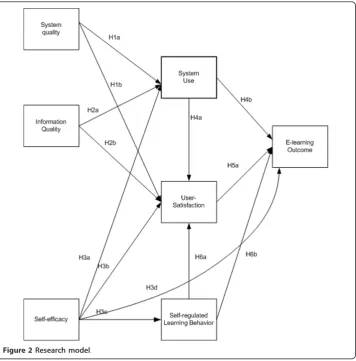
adapted to e-learning settings by many e-learning systems research. Holsapple and Lee-Post [5] adapted the DeLone and McLean model to propose e-learning success model (Figure 1). The proposed e-learning success model consists of three antecedents constructs (system quality, information quality, service quality) and two intervening constructs (system use and user satisfaction) and system outcome measuring academic success and systems efficiency and effectiveness (Figure 2). The primary objective of
this study is to investigate the determinants of students’perceived learning outcomes
and satisfaction in university online education using e-learning systems. Using the extant literature, we begin by introducing and discussing a research model illustrating variables affecting e-learning systems outcomes and user satisfaction. We follow this with a description of the cross-sectional survey that was used to collect data and the results from a path analysis model. In the final section, we outline the implications of the results for higher educational institutions.
E-learning systems and outcomes
The e-learning systems literature has accumulated a considerable body of literature over the past decade [1,7,8]. Nevertheless, little empirical research exists to understand the relationships among e-learning systems quality, the quality of information pro-duced by e-learning systems and e-learning systems outcomes. E-learning systems comprised of a myriad of subsystems that interacts each other. They include human factors and design factors. Human factors include personality Characteristics [9,10],
learning styles [11-14], and instructor’s attributes [15]). Design factors include a wide
range of constructs that affect effectiveness of e-learning systems such as technology [5,16-18], learner control, learning model [19,20], course contents and structure [21-23], and interaction [23-26].
Figure 1E-learning success model and sample matrix. Source: [5].
RETRACTED
15
JUNE
2013
doi:
In a study of Eom et al. [13], structural equation modeling is applied to examine the
determinants of students’satisfaction and their perceived learning outcomes in the
context of university online courses. Independent variables included in the study are course structure, instructor feedback, self-motivation, learning style, interaction, and instructor facilitation as potential determinants of online learning. A total of 397 valid unduplicated responses from students who have completed at least one online course at a university in the Midwest were used to examine the structural model. The results
indicated that all of the antecedent variables significantly affect students’satisfaction.
Of the six antecedent variables hypothesized to affect the perceived learning outcomes, only instructor feedback and learning style are significant. The structural model results also reveal that user satisfaction is a significant predictor of learning outcomes. The findings suggest online education can be a superior mode of instruction if it is targeted to learners with specific learning styles (visual and read/write learning styles), and with timely, meaningful instructor feedback of various types. Eom et al. [13] found that all six factors: course structure, self-motivation, learning styles, instructor knowledge and
facilitation, interaction, and instructor feedback, significantly influenced students’
satis-faction. This is in accordance with the findings and conclusions discussed in the litera-ture on student satisfaction.
Figure 2Research model.
RETRACTED
15
JUNE
2013
doi:
Of the six factors hypothesized to affect perceived learning outcomes, only two (learning styles and instructor feedback) were supported. Contrary to previous research [27], Eom et al., [13,28] found no support for a positive relationship between interac-tion and perceived learning outcomes. One possible explanainterac-tion for this finding is that the study did not account for the quality or purpose of the interactions. Although a
student’s perception of interaction with instructors and other students is important in
his/her level of satisfaction with the overall online learning experience, when the pur-pose of online interaction is to create a sense of personalization and customization of learning and help students overcome feelings of remoteness, it may have little effect on perceived learning outcomes. Furthermore, a well-designed online course delivery sys-tem is likely to reduce the need of interactions between instructors and students. The university under study has a very friendly online e-learning system and strong technical support system. Every class Web site follows the similar design structure which reduces the learning curve. Contrary to other research findings, no significant
relation-ships were found between students’self-motivation and perceived learning outcomes.
Theoretically, self-motivation can lead students to go beyond the scope and require-ments of an educational course because they are seeking to learn about the subject, not just fulfill a limited set of requirements. Self-motivation should also encourage learning even when there is little or no external reinforcement to learn and even in the face of obstacles and setbacks to learning.
This research further extends the study of Eom et al. [13] which did not include sev-eral constructs on which this study focuses. This research addresses the effects of system quality, information quality, self-regulated learning, and self-efficacy on the e-learning system use, user satisfaction, and e-learning outcomes. An e-learning system typically consists of learning management systems (LMS) and authoring systems. The LMS is a system for storing and delivering the course content, and tracks student access and pro-gress. The authoring systems allow the instructors to develop the contents for e-learners.
Related research and hypothesis development
System quality and information quality
The IS success model [3,6] and the e-learning success model [5] posit that the success of IS and e-learning systems is dependent on the intervening variables (user satisfac-tion and system use), which are in turn dependent on the quality of informasatisfac-tion, sys-tem, and service. Technology acceptance model (TAM) developed in the IS area has emerged as a useful model for explaining e-learning system usage and satisfaction [29]. The TAM defines the relationships between systems use (dependent constructs) and perceived usefulness and perceived ease of use (two independent constructs). There-fore, the TAM theorizes that system use is determined by perceived usefulness and perceived ease of use. The TAM model has been extended by many other researchers. The unified theory of acceptance and use of technology (UTAUT) is an extension of the TAM model. The TAM postulates that perceived usefulness and ease of use
deter-mine an individual’s intention to use a system, which in turn, determines actual system
use. The theory posits that the four key constructs directly determine usage intention and behavior [30]. Moreover, gender, age, experience, and voluntariness of use are pos-ited to mediate the impact of the four key constructs on usage intention and behavior [30]. Arbaugh [31] found that perceived usefulness and ease of use of Blackboard
RETRACTED
15
JUNE
2013
doi:
significantly predicted student satisfaction with the Internet as an educational delivery medium. Thus, I hypothesized:
H1a: e-learning system quality will lead to a higher level of system use. H1b: e-learning system quality will lead to a higher level of user satisfaction. H2a: Information quality will lead to a higher level of system use.
H2b: Information quality will lead to a higher level of user satisfaction.
Computer self-efficacy
A goal of e-learning empirical research includes the identification and effective man-agement of factors that influence e-learning outcomes [32]. One of such factors is computer self-efficacy of e-learners. Numerous e-learning empirical studies have been
conducted to examine the relationships between e-learners’computer self-efficacy and
other construct such as student satisfaction and e-learning outcomes.
Self-efficacy and e-learning system use
Significant positive relationships were found between self-efficacy and e-learning sys-tem use intention. Computer self-efficacy, attainment value, utility value, and intrinsic
value were significant predictors of individuals’intentions to continue using
Web-based learning [33].
Therefore, I hypothesize the following.
H3a: Computer self-efficacy will lead to a higher level of system use.
Self-efficacy and e-learner satisfaction
Johnson et al., [34] found that student self-efficacy and perceived usefulness of the sys-tem predicted perceived content value, satisfaction, and learning performance. Other system-related studies have examined attitudes and behaviors influencing course man-agement system usage. Significant positive correlations were found among the three e-learning variables (Self-efficacy, e-learner satisfaction and perceived usefulness [35].
Thus, I hypothesized:
H4a: Computer self-efficacy will be positively related to e-learner satisfaction.
Self-efficacy and e-learning outcome
Computer self-efficacy was positively linked to learning outcomes measured by the average test scores in e-learning [36] and in the training literature [37].
Thus, I hypothesized:
H5a: Computer self-efficacy will be positively related to online learning outcomes.
User satisfaction and e-learning outcomes
A study of Eom et al. [13] examined the determinants of students’ satisfaction and
their perceived learning outcomes in the context of university online courses. Their
RETRACTED
15
JUNE
2013
doi:
study found that all of the antecedent variables (course structure, instructor feedback, self-motivation, learning style, interaction, and instructor facilitation) significantly affect
students’satisfaction. Their structural model results also reveal that user satisfaction is
a significant predictor of learning outcomes. Thus, I hypothesized:
H6a: User satisfaction will lead to higher levels of student agreement that the learn-ing outcomes of online course are equal to or better than in face-to-face courses.
Thus, I hypothesized:
H6b: Self-regulated learning behavior of e-learners will be positively related to online learning outcomes, which is equal to the quality of traditional classroom learning.
Survey instrument
The survey instrument consisted of 35 questions addressed using a seven point Likert
scale ranging from “strongly disagree”to“strongly agree.” In addition, students were
asked six demographic-type questions. The survey was administered online in the fall semester of 2009 at a Wawasan Open University (WOU) Malaysia. A total of 2,156 online students were invited to reply to the survey. Of those students invited, 809 stu-dents responded with 674 surveys being complete and usable for a response rate of 31.3%. Appendix A summarizes the characteristics of the student sample. To conduct a path analysis, we only used the following 7 questions to represent our variables.
◦System Quality: The system is user-friendly.
◦ Information Quality: The system provides information that is exactly what you
need.
◦System Use: Items I frequently use the system.
◦User Satisfaction: Overall, I am satisfied with the system.
◦Learning Outcome: I feel that online learning is equal to the quality of traditional
classroom learning.
◦Self-managed learning Behavior: In my studies, I am self-disciplined and find it
easy to set aside reading and homework time.
◦E-learning System Self-efficacy: I feel confident using a web browser.
Research model and data
The research model (Figure 2) was tested using path analysis. LISREL 8.70 was used to do path analysis. It is a technique to assess the causal contribution of directly an obser-vable variable to other directly obserobser-vable variables. The model consists of three inde-pendent variables (system quality, information quality, and self-efficacy) and 4 dependent variables (system use, user satisfaction, self-regulated learning behavior and e-learning Outcomes). A total of 674 valid unduplicated responses from students who have completed at least one online course at a university in the Wawasan Open Uni-versity Malaysia were used to fit the path analysis model.
RETRACTED
15
JUNE
2013
doi:
Model testing and evaluation of goodness of fit statistics
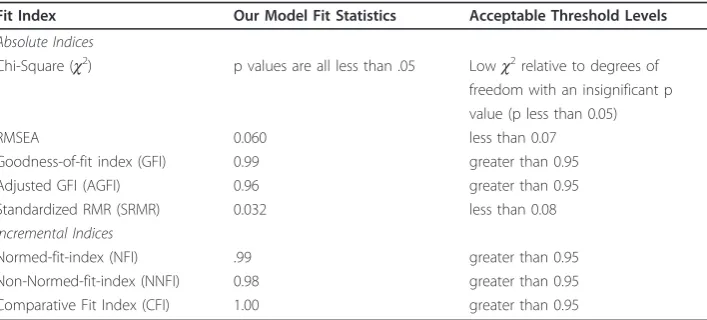
Model testing is to test the fit of the correlation matrix of sample data against the the-oretical causal model built by researchers based on the extant literature [38]. Goodness of fit statistics includes an extensive array of fit indices that can be categorized into six different subgroups of statistics that may be used to determine model fit. For a very good overview of LISREL goodness- of-fit statistics, readers are referred to [39]. There seems to be an agreement among SEM researchers that it is not necessary to report every goodness of fit statistics from path analysis output. Although there are no golden rules that can be agreed upon, Table 1 includes a set of indices that have been fre-quently reported and suggested to be reported in the literature [39,40]. Table 1 includes our model fit statistics of various fit indices and corresponding acceptable threshold levels of each corresponding fit index. Considering all indices together, the specified model (Figure 2) seems to be supported by the sample data. Since our model is tested bas on sample size of 674, Chi-Square statistic is not a good measure of good-ness of fit, since Chi-Square statistic nearly always rejects the model when large sam-ples are used [41]. The RMSEA is the second fit statistic reported in the LISREL program. A cut-off value close to .069 indicates a close fit and the values up to 0.08 are considered to represent reasonable error of approximation.
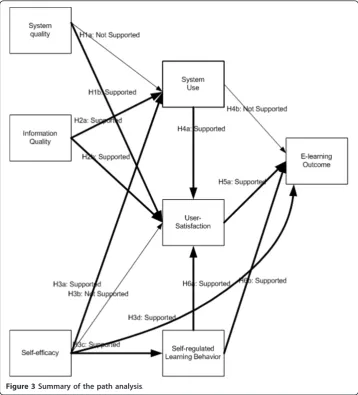
Figure 3 shows the summary of path analysis. The bold lines indicate 10 supported hypotheses and the other lines indicated 5 hypotheses that were not supported.
Discussion and analysis
According to the latest industry statistics, “the e-learning market in the Malaysia is
growing approximately 43 percent a year and is expected to reach well beyond $27
bil-lion within the next several years”[42]. Higher educational institutions have invested
heavily to constantly update their e-learning management systems. The findings from the current study have significant implications for the distance educators, students, and administrators. We have focused on the effect of e-learning management systems on user satisfaction, and the relationship between user satisfaction and e-learning out-come. E-learner satisfaction is an important predictor of e-learning outout-come. On the other hand, system quality, information quality, and self-regulated learning behavior have significant direct impacts on the perceived satisfaction of e-learners. Self-efficacy does not show a direct effect on user satisfaction, but it shows indirect effect on
user-Table 1 The results of the model
Fit Index Our Model Fit Statistics Acceptable Threshold Levels
Absolute Indices
Chi-Square (c2) p values are all less than .05 Lowc2relative to degrees of
freedom with an insignificant p value (p less than 0.05)
RMSEA 0.060 less than 0.07
Goodness-of-fit index (GFI) 0.99 greater than 0.95
Adjusted GFI (AGFI) 0.96 greater than 0.95
Standardized RMR (SRMR) 0.032 less than 0.08
Incremental Indices
Normed-fit-index (NFI) .99 greater than 0.95
Non-Normed-fit-index (NNFI) 0.98 greater than 0.95
Comparative Fit Index (CFI) 1.00 greater than 0.95
RETRACTED
15
JUNE
2013
doi:
satisfaction via self-regulated learning behavior. It is conceivable that, through this type of research, online learning will be enhanced when there is a better understanding of critical success factors for e-learning management systems.
Learning is a complex process of acquiring knowledge or skills involving a learner’s
biological characteristics/senses (physiological dimension); personality characteristics such as attention, emotion, motivation, and curiosity (affective dimension); information processing styles such as logical analysis or gut feelings (cognitive dimension); and psy-chological/individual differences (psychological dimension) [43]. Moreover, e-learning outcomes are the results of dynamic interactions among learners, instructors, and e-learning systems. This study may be useful as a pedagogical tool for all entities involved in the dynamic learning process. First, university administrators must continu-ously invest to upgrade the systems so that e-learning systems exhibit faster response time, better systems accessibility, higher system reliability and flexibility, and ease of learning. By doing so, e-learning systems can provide e-learners with the information that are accurate, precise, current, reliable, dependable, and useful. This study provided a basis for justifying technological expenditures at the administrative level.
Figure 3Summary of the path analysis.
RETRACTED
15
JUNE
2013
doi:
Second, e-learners must be able to self-manage the entire learning process including self-regulation of behavior, motivation, and cognition, proactively and deliberately. The core of self-regulated learning is self-motivation.
Students’motivation is a major factor that affects the completion rates in the
Web-based course and a lack of motivation is also linked to high dropout rates [44]. The instructor in e-learning courses should facilitate, stimulate, guide, and challenge his/ her students via empowering them with freedom and responsibility. Instructor feed-back to students can improve learner affective responses, increase cognitive skills and knowledge, and activate meta-cognition, which refers to the awareness and control of cognition through planning, monitoring, and regulating cognitive activities [12].
Third, In order for the e-learning system to be successful, it should provide e-lear-ners with the information and knowledge they need. As this study indicates,
Information quality has positive effects on user satisfaction. Information quality has also positive effects on system use, which in turn positively contributes user satisfac-tion. However, the information quality in e-learning is not dependent on only
e-learn-ing management systems’software and hardware. It is the instructor who creates the
contents of e-learning material that are useful and essential for gaining necessary knowledge for the future success of students. In information systems, the roles of instructors as a contents creator are even more critical when assembling daily/weekly reading assignments for each semester by selecting chapters, topics within a chapter, project assignments, and creating power point files and supplementary files, due to the fact that the nature of information systems are constantly changing with a fast speed. Information systems educators are continuously witnessing the emergence of a host of disruptive technologies such as virtualization and cloud computing. According to the ranking of technologies Chief Information Officers (CIOs) selected as their top priories in 2010, virtualization and cloud computing were the number one and number two priorities. Cloud computing was not on the radar in 2007 and 2008. It was a distant 14 in 2009. Cloud can help firms do more with less. Moreover, the technologies that CIOs are prioritizing in 2010 are technologies that could be implemented quickly and without significant upfront expense [28]. However, some introductory information sys-tems textbooks even did not mention these topics at all. For this reason, the instructor must play a pivotal role to create and enhance the quality of information for e-learners.
Conclusion
Abundant e-learning empirical research points out those superior e-learning outcomes are one of the critical objectives of e-learning research. Our path analytical model sug-gests that of these six variables I hypothesized, all of them are useful predictor of e-learning outcomes, except the following three unsupported hypotheses. The paths from system quality and information quality to user satisfaction, system use to user satisfaction, and user satisfaction to e-learning outcomes were significant as hypothe-sized by the DeLone-McLean model. On the other hand, the paths from system quality to system use, system use to e-learning outcome, and self-efficacy to user satisfaction were not significant. This negative finding may be explained by the mandatory nature of the e-learning system. This is in accordance with the findings of the study of Livari [45], which tested the DM model in a mandatory city government information system context. System use is the pivot of the DM model. System use, either actual or
RETRACTED
15
JUNE
2013
doi:
perceived, is one of the most frequently reported and the most objective measure of MIS success or the MIS success measure of choice in MIS empirical research [3] in a voluntary IS use context. The DM model has been empirically tested using structural equation modeling in a quasi-voluntary IS use context [46] and in a mandatory infor-mation system context [45]. Nevertheless, the usage of inforinfor-mation and systems, as repeatedly pointed out by DeLone and McLean [3], is only relevant when such use is voluntary. Needless to say, e-learning systems are mandatory systems. Regardless of the quality of the e-learning management system, e-learners must use the system. We
suggest that future e-learning empirical studies exclude “system use” construct in the
model.
Acknowledgements
This research is supported by TWAS Research and Advanced Training fellowship (2010) cycle conducted in UTM Malaysia. Special thanks to Faculty of Computer Science and Information Systems Universiti Teknologi Malaysia (UTM) for facilities, research guidance and comments about the material and structure of this research.
Competing interests
Dr. Tanzila Saba has obtained PhD degree from Faculty of Computer Science and Information systems Universiti Teknologi Malaysia. Her research interest are in document management, information security and E-learning. She is eminent researcher and her more than 30 research articles are published in journals of international repute. She won international research awards and is selected in who’s who for the year 2012.
Received: 12 November 2011 Accepted: 15 March 2012 Published: 15 March 2012
References
1. Ahmed HMS (2010) Hybrid E-Learning acceptance model: learner perceptions. Decis Sci J Innov Educ 8(2):313–346. 2011. doi:10.1111/j.1540-4609.2010.00259.x.
2. Saba T, Rehman A, Sulong G (2009) ITS: Using A.I. to Improve Character Recognition of Students with Intellectual Disabilities. Int Conf Softw Eng Comput Syst, UMP Malaysia 1:6–9
3. DeLone WH, McLean ER (1992) Information system success: the quest for the dependent variable. Inf Syst Res 3(1):60–95. doi:10.1287/isre.3.1.60.
4. Piccoli G, Ahmad R, Ives B (2001) Web-Based virtual learning environments: a research framework and a preliminary assessment of effectiveness in basic IT skills training. MIS Q 25(4):401–426. doi:10.2307/3250989.
5. Holsapple CW, Lee-Post A (2006) Defining, assessing, and promoting E-Learning Success: an information systems perspective. Decis Sci J Innov Educ 4(1):67–85. doi:10.1111/j.1540-4609.2006.00102.x.
6. DeLone WH, McLean ER (2003) The DeLone and McLean model of information systems success: a ten-year update. J Manag Inf Syst 194(4):9–30
7. Elarbi-Boudihir M, Rehman A, Saba T (2011) Video motion perception using operation gabor filter. Int J Phys Sci 6(12):2799–2806
8. Haron H, Rehman A, Adi DIS, Lim SP, Saba T (2012) Parameterization method on B-Spline curve. Math Probl Eng. doi:10.1155/2012/640472
9. Rahim MSM, Rehman A, Faizal-Ab-Jabal M, Saba T (2011) Close spanning tree approach for error detection and correction for 2D CAD drawing. Int J Acad Res 3(4):525–535
10. Schniederjans MJ, Kim EB (2005) Relationship of student undergraduate achievement and personality characteristics in a total web-based environment: an empirical study. Decis Sci J Innov Educ 3(2):205–221.
doi:10.1111/j.1540-4609.2005.00067.x.
11. Bekhti S, Rehman A, Al-Harbi M, Saba T (2011) AQuASys an Arabic question-answering system based on extensive question analysis and answer relevance scoring. Int J Acad Res 3(4):45–54
12. Drago WA, Wagner RJ (2004) Vark preferred learning styles and online education. Manage Res News 27(7):1–13. doi:10.1108/01409170410784211.
13. Eom SB, Ashill N, Wen HJ (2006) The determinants of students’perceived learning outcome and satisfaction in university online education: an empirical investigation. Decis Sci J Innov Educ 4(2):215–236. doi:10.1111/j.1540-4609.2006.00114.x.
14. Haron H, Rehman A, Wulandhari LA, Saba T (2011) Improved Vertex chain code algorithm for curve length estimation. J Comput Sci 7(5):736–743. doi:10.3844/jcssp.2011.736.743.
15. Rehman A, Mohamad D (2008) A simple segmentation approach for unconstrained cursive handwritten words in conjunction of neural network. Int J Image Process 2(3):29–35
16. Phetchanchai C, Selamat A, Rehman A, Saba T (2010) Index financial time series based on zigzag-perceptually important points. J Comput Sci 6(12):1389–1395. doi:10.3844/jcssp.2010.1389.1395.
17. Rehman A, Saba T, Sulong G (2010) An intelligent approach to image denoising. J Theor Appl Inf Technol 17(1):32–36 18. Saba T, Rehman A (2012) Effects of artificially intelligent tools on pattern recognition. Int J Mach Learn Cybern.
doi:10.1007/s13042-012-0082-z
19. Kurniawan F, Rahim MSM, Daman D, Rehman A, Mohamad D, Mariyam S (2011) Region-based touched character segmentation in handwritten words. Int J Innovative Comput Inf Control 7(6):3107–3120
RETRACTED
15
JUNE
2013
doi:
20. Leidner DE, Jarvenpaa SL (1995) The use of information technology to enhance management school education: a theoretical view. MIS Q 19(3):265–291. doi:10.2307/249596.
21. Moore MG (1991) Editorial: distance education theory. Am J Distance Educ 5(3):1–6. doi:10.1080/08923649109526758. 22. Rahim MSM, Rehman A, Sholihah N, Kurniawan F, Saba T, Mohamad D (2012) Region-based features extraction in ear
biometrics. Int J A Res 4(1):37–42
23. Rehman A, Saba T (2011) Performance analysis of segmentation approach for cursive handwritten word recognition on benchmark database. Digit Signal Process (Elsevier) 21:486–490. doi:10.1016/j.dsp.2011.01.016.
24. Moore MG (1989) Three types of interaction. Am J Distance Educ 3(2):1–6. doi:10.1080/08923648909526659. 25. Northrup PT (2002) Online learners’preferences for interaction. Quart Rev Distance Educ 3(2):219–226
26. Swan K (2001) Virtual interaction: design factors affecting student satisfaction and perceived learning in asynchronous online courses. Distance Educ 22(2):306–331. doi:10.1080/0158791010220208.
27. LaPointe DK, Gunawardena CN (2004) Developing, testing and refining of a model to understand the relationship between peer interaction and learning outcomes in computer-mediated conferencing. Distance Educ 25(1):83–106. doi:10.1080/0158791042000212477.
28. Saba T, Rehman A, Sulong G (2011) Cursive script segmentation with neural confidence. Int J Innov Comput Inf Control (IJICIC) 7(7):1–10
29. Landry BJL, Griffeth R, Hartman S (2006) Measuring student perceptions of blackboard using the technology acceptance model. Decis Sci J Innov Educ 4(1):87–99. doi:10.1111/j.1540-4609.2006.00103.x.
30. Venkatesh V, Morris MG, Davis GB, Davis FD (2003) User acceptance of information technology: toward a unified view. MIS Q 27(3):425–478
31. Arbaugh JB (2005) Is there an optimal design for on-line MBA courses? Acad Manag Learn Educ 4:135–149
32. Saba T, Rehman A, Danial H (2010) Proficiency and approach of mathematics teachers in the application of computers as instructional tool in Pakistani schools. J Educ Res Islamia Univ Bahawalpur Pak 3(2):153–170
33. Chiu CM, Wang ETG (2008) Understanding web-based learning continuance intention: the role of subjective task value. Inf Manag 45:194–201. doi:10.1016/j.im.2008.02.003.
34. Johnson RD, Hornik S, Salas E (2008) An empirical examination of factors contributing to the creation of successful e-learning environments. Int J Hum Comput Stud 66:356–369. doi:10.1016/j.ijhcs.2007.11.003.
35. Womble J (2008) E-Learning: the relationship among learner satisfaction, self-efficacy, and usefulness. Bus Rev 10(1):182–188
36. Simmering MJ, Posey C, Piccoli G (2009) Computer self-efficacy and motivation to learn in a self-directed online course. Decis Sci J Innov Educ 7(1):99–121. doi:10.1111/j.1540-4609.2008.00207.x.
37. Colquitt JA, LePine JA, Noe RA (2000) Toward an integrative theory of training motivation: a meta-analytic path analysis of 20 years of research. J Appl Psychol 85(5):678–707
38. Saba T, Rehman A (2012) Blinds Children Education and Their Perceptions towards First Institute of Blinds in Pakistan. Int J Mod Educ Comput Sci 4(1):50–60. doi:10.5815/ijmecs.2012.01.07.
39. Hooper D, Coughlan J, Mullen MR (2008) Structural equation modeling: guidelines for determining model fit. Electron J Bus Res Methods 6(1):53–60
40. Hayduk L, Cummings GG, Boadu K, Pazderka-Robinson H, Boulianne S (2007) Testing! Testing! One, Two Three - Testing the theory in structural equation models! Personal Individ Differ 42(2):841–850
41. Bentler PM, Bonnet DC (1980) Significance tests and goodness of fit in the analysis of covariance structures. Psychol Bull 88(3):588–606
42. Saba T, Rehman A, Elarbi-Boudihir M (2011) Methods and strategies on off-line cursive touched characters segmentation: a directional review. Artif Intell Rev. doi:10.1007/s10462-011-9271-5
43. Dunn R, Beaudry J, Klavas A (1989) Survey research on learning styles. Educ Leadersh 46:50–58 44. Frankola K (2001) Why online learners drop out. Workforce 80(10):53–60
45. Livari J (2005) An empirical test of the DeLone-McLean model of information system success. DATA BASE Adv Inf Syst 36(2):8–27. doi:10.1145/1066149.1066152.
46. Rai A, Lang SS, Welker RB (2002) Assessing the validity of is success models: an empirical test and theoretical analysis. Inf Syst Res 13(1):50–69. doi:10.1287/isre.13.1.50.96.
doi:10.1186/2192-1962-2-6
Cite this article as:Saba:Implications of E-learning systems and self-efficiency on students outcomes: a model approach.Human-centric Computing and Information Sciences20122:6.
Submit your manuscript to a
journal and benefi t from:
7Convenient online submission
7Rigorous peer review
7Immediate publication on acceptance
7Open access: articles freely available online
7High visibility within the fi eld
7Retaining the copyright to your article
Submit your next manuscript at 7 springeropen.com
RETRACTED
15
JUNE
2013
doi:
![Figure 1 E-learning success model and sample matrix. Source: [5].](https://thumb-us.123doks.com/thumbv2/123dok_us/854965.1583128/2.595.116.478.87.302/figure-e-learning-success-model-sample-matrix-source.webp)