R E S E A R C H
Open Access
On the identification of design problems
in stinky code: experiences and tool support
Willian Oizumi
1,2*, Leonardo Sousa
1, Anderson Oliveira
1, Alessandro Garcia
1,
Anne Benedicte Agbachi
1, Roberto Oliveira
1,3and Carlos Lucena
1Abstract
Background: Developers often have to locate design problems in the source code. Several types of design problems may manifest as code smells in the program. A code smell is a source code structure that may reveal a partial hint about the manifestation of a design problem. Recent studies suggest that developers should ignore smells occurring in isolation in a program location. Instead, they should focus on analyzing stinkier code, i.e., program locations—e.g., a class or a hierarchy—affected by multiple smells. There is evidence that the stinkier a program location is, the more likely it contains a design problem. However, there is no empirical evidence on whether developers can effectively identify a design problem in stinkier code. Developers may struggle to make an analysis of inter-related smells affecting the same program location. Besides that, the analysis of stinkier code may require proper tool support due to its analysis complexity. However, there is little knowledge on what are the requirements for a tool that helps developers in revealing stinkier program locations. As a result, developers may not be able to identify design problems due to tool issues.
Method: To address this matter, we aimed at achieving three goals. In the first case, we proposed Organic—a tool supporting the analysis of stinky code. In the second case, we applied a mixed-method approach to analyze if and how developers can effectively find design problems when reflecting upon stinky code—i.e., a program location affected by multiple smells. We conducted a study with 11 software professionals. Finally, in the third case, we aimed at understanding if Organic could be used by developers to identify design problems. To achieve this goal, we used a method from the Semiotic Engineering theory. This method enabled us to evaluate what are the tool issues that may hinder the identification of design problems in stinky code.
Result: Our study revealed that only 36.36% of the developers found more design problems when explicitly reasoning about multiple smells as compared to single smells. Moreover, 63.63% of the developers reported much lesser false positives when using the first approach as compared to the latter. The second study, in its turn, showed that most developers may be unable to identify design problems in stinky code without proper tool support. Conclusion: Our experiences, in particular the second study, helped us to refine the features of Organic for better supporting developers in reflecting upon stinkier code. For example, analyses of stinky code scattered in class hierarchies or packages is often difficult, time-consuming, and requires proper visualization support. Moreover, without effective support, it remains time-consuming to discard stinky program locations that do not represent design problems.
Keywords: Design problem, Software design, Code smell, Agglomeration
*Correspondence:[email protected]
1Opus Research Group, Informatics Department, PUC-Rio, Rio de Janeiro, RJ,
Brazil
2IFPR, Campus Paranavai, Paranavai, PR, Brazil
Full list of author information is available at the end of the article
Introduction
The identification of design problems in the source code is not a trivial task [1,2]. Developers usually need to find hints, as code smells, in the source code that can lead to a design problem. A code smell is a structure in the source code that may provide developers with a partial indication about the manifestation of a design problem [3]. A classi-cal example of code smell is theGod Class, which occurs when a class is long and complex, centralizing a consid-erable amount of intelligence of the system. However, the occurrence of a single smell in isolation in a program often does not represent a design problem [4,5]. A design problem is a design characteristic that negatively impacts maintainability [2]. Recent studies reveal that design prob-lems are much more often located in stinkier program locations (i.e., a class, a hierarchy, or a package) affected by multiple smells [4–8]. For instance, aFat Interface[9] is a design problem that often manifests as multiple smells in a program, affecting various classes that implement, extend, and use the interface in a program [5].
The stinkier a program location is, the more likely it contains a design problem [5, 10]. In fact, developers tend to focus on refactoring program locations with a high density of code smells and ignore those locations affected by a single smell [11,12]. However, there is lim-ited understanding if developers can effectively identify design problems in stinkier code, i.e., program locations affected by multiple smells. Indeed, existing techniques tend to focus on the detection and visualization of each single smell [13–16]. They do not offer a summarized view of inter-related smells affecting a program location [5]. Moreover, previous studies focus on simply analyzing the correlation between design problems and code smells [5,17]. They have not investigated if and how developers are indeed effective in the task of finding design problems in stinkier code.
Therefore, we do not know whether the analysis of multiple smells actually provides better precision for the identification of design problems. Developers may strug-gle to make a meaning out of inter-related smells affecting the same program location. Additionally, the analysis of stinkier code may require proper tool support due to its analytic complexity. However, there is limited knowledge on what are the requirements for a tool that supports the analysis of stinkier code. This is important because developers may not be able to identify design problems due to tool support issues. To address these matters, we defined three goals for our research: (1) provide proper support for the analysis of stinkier code, (2) assess to what extent developers are able to identify design problems in stinkier code, and (3) identify tool issues that may hinder the identification of design problems.
To achieve our first goal, we designed and implemented Organic—a tool supporting the analysis of stinky code. We
used findings from previous studies [4,5,17–20] as a start point for defining the requirements of Organic. In a nut-shell, Organic supports the analysis of multiple forms of stinkier code, provides detailed information about code smells, supports the analysis of dependencies between stinky elements, provides a visualization for stinkier code, provides historical information about stinkier code, and allows developers to specify the thresholds that should be considered when identifying stinkier code. In the context of Organic, the threshold defines the minimum number of smells that a program location should have to be consid-ered stinkier. Those features will be presented in detail in the “Organic: a tool for the analysis of stinky code” section. For achieving the second goal, we applied a mixed-method approach to analyze if and how developers can effectively find design problems when reflecting upon stinky code. This study comprised both quantitative and qualitative analyses. For the quantitative analysis, we com-pared the precision of the developers with a baseline, i.e., situations where only single smells were given to them. As we want to assess if multiple smells can help develop-ers to reveal more design problems than single smells, we divided the developers into two groups. In the first group, we asked them to identify design problems through the analysis of stinky program locations. In the second group, we asked them to identify design problems with the analy-sis of single smells. After that, we inverted the groups, and we asked them to repeat the identification of design prob-lems in a second system. In each identification task, we used the group that identified design problems with single smells as the control group. Thus, we could use the con-trol group to measure if the analysis of stinkier program locations can improve the precision of design problem identification.
In the qualitative analysis, we performed a systematic evaluation through the careful observation of participants during the study execution and the application of a follow-up questionnaire. The objective of this analysis was to identify the main barriers of reflecting upon multiple smells along the task of identifying design problems. The outcomes of this analysis helped us to better understand ways to improve support for the identification of design problems in stinky code.
with higher precision. However, this study also showed that developers need better support to analyze stinky pro-gram locations to reveal design problems. We observed that the analysis of stinky code may be difficult and time consuming. For instance, a prioritization algorithm is required so that developers do not waste time analyz-ing many stinky program locations not related to design problems.
Finally, to achieve our third goal, we evaluated Organic with the Communicability Evaluation Method (CEM) [22]. CEM is a method from the Semiotic Engineering theory, which is intended to reveal ruptures of com-munication when a user interacts a system, i.e., in our case when the developer interacts with the Organic tool. This method enabled us to identify issues in the Organic tool that may hinder the identification of design problems.
By conducting the communicability evaluation of Organic, we observed three major issues. First, although the tool detects stinkier program locations, it often fails to provide a concise message that facilitates the rea-soning about the possible design problem (affecting the stinky program location). Second, the terms used in the tool are not adequate to certain software developers. Third, Organic uses ambiguous static symbols for repre-senting different types of information. During the eval-uation, we noted that, the aforementioned issues may often hinder the identification of design problems in stinky code.
Contextualization
This section, which is organized into two subsections, provides background information to support the under-standing of this paper. The “Basic concepts” section outlines basic concepts. The “Identifying design prob-lem in stinky code” section brings up an illustrative example of analyzing stinky code to identify design problems.
Basic concepts Design problem
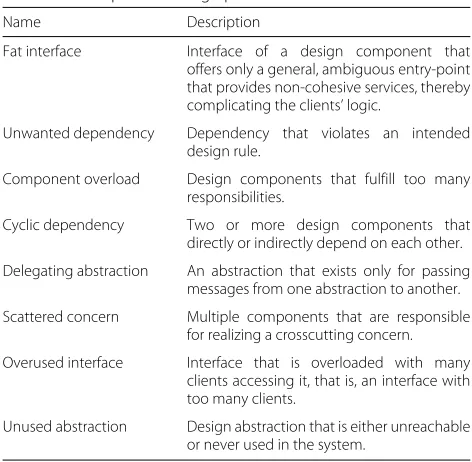
A design problem is a characteristic in the software design that leads to negative impact on maintainability [2]. Design problems affect program locations such as pack-ages, interfaces, hierarchies, classes, and other structures that are relevant for the design of the system [23]. Exam-ples of design problems include Scattered Concern [21] andFat Interface[9]. The description of the eight types of design problems considered in our study is presented in Table1. We opted by selecting these design problems since (i) they are often considered as critical in the sys-tems [5] chosen in our study and (ii) other studies have shown the relation between such design problems and code smells [4,5,17,18,24].
Table 1Description of design problems
Name Description
Fat interface Interface of a design component that offers only a general, ambiguous entry-point that provides non-cohesive services, thereby complicating the clients’ logic.
Unwanted dependency Dependency that violates an intended design rule.
Component overload Design components that fulfill too many responsibilities.
Cyclic dependency Two or more design components that directly or indirectly depend on each other.
Delegating abstraction An abstraction that exists only for passing messages from one abstraction to another.
Scattered concern Multiple components that are responsible for realizing a crosscutting concern.
Overused interface Interface that is overloaded with many clients accessing it, that is, an interface with too many clients.
Unused abstraction Design abstraction that is either unreachable or never used in the system.
Smelly code
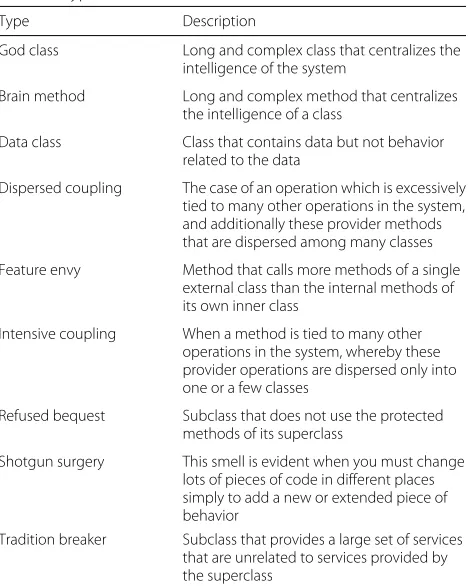
Code smell is a recurring micro-structure in the source code that may indicate the manifestation of a design prob-lem [3]. A design problem can manifest itself in a program by affecting multiple source code locations. Each of these locations are called heresmelly code. Thus, the developers can analyze the smelly code to identify a design problem. There are several types of code smell, which may affect a method, a class, or a hierarchy. In this paper, we used nine types of code smell, which areGod Class,Brain Method,
Data Class, Dispersed Coupling, Feature Envy, Intensive Coupling, Refused Bequest, Shotgun Surgery, and Tradi-tion Breaker. These types of smell were considered in this study as they occur in the target systems used in this work. The description of each type of smell is presented in Table2.
Code smells and design problems
Developers can rely on the analysis of code smells to identify design problems [17, 25, 26]. The use of code smells to identify design problems is possible because some instances of code smells manifest in the source due to the presence of a design problem. Consequently, code smells tend to co-occur in elements affected by design problems [5, 8, 10, 18], which make them indicators of design problems. Unfortunately, not all (instance of ) code smells are related to a design problem [17].
Table 2Types of code smell
Type Description
God class Long and complex class that centralizes the intelligence of the system
Brain method Long and complex method that centralizes the intelligence of a class
Data class Class that contains data but not behavior related to the data
Dispersed coupling The case of an operation which is excessively tied to many other operations in the system, and additionally these provider methods that are dispersed among many classes
Feature envy Method that calls more methods of a single external class than the internal methods of its own inner class
Intensive coupling When a method is tied to many other operations in the system, whereby these provider operations are dispersed only into one or a few classes
Refused bequest Subclass that does not use the protected methods of its superclass
Shotgun surgery This smell is evident when you must change lots of pieces of code in different places simply to add a new or extended piece of behavior
Tradition breaker Subclass that provides a large set of services that are unrelated to services provided by the superclass
a few elements. Often, elements that implement the scat-tered functionality contain code smells such as God Class, Feature Envy, Intensive Coupling, Divergent Change, and the like. As the code elements implement a scattered func-tionality, these elements are likely of realizing at least two functionalities: their predominant functionality and another one, in which the predominant functionality can be either the scattered one or not. Either way, the elements implement more than one functionality, which leads them to the appearance of a God Class. Additionally, the meth-ods in the class have to communicate with other classes that also implement the scattered functionality. Thus, these methods can contain instances of Feature Envy, leading to the appearance of an Intensive Coupling smell. Furthermore, every chance in the functionality will impact the elements that implement it; thus, these elements will have the Shotgun Surgery and Divergent Change. In sum-mary, these code smells could appear in the elements due to the scattered functionality, i.e., due to the Scattered Concern.
Stinky program location
Indeed, code smells can be indicators of design prob-lems. In fact, recent studies [4–6, 8] suggest that the stinkier a program location is, the more likely it is to be affected by a design problem. Stinky code is the mani-festation of multiple code smells in a program location. In this paper, we are especially interested in stinky code
indicated by smell agglomerations [5]. A smell agglom-eration is a group of inter-related code smells affecting the same program location, such as a method, a class, a hierarchy, or a package [5]. Thus, the agglomeration is determined in the program by the co-occurrence of two or more code smells in the same method, class, hierarchy, or package (or component). For code smells that co-occur in the last three cases, we only consider they are part of an agglomeration if they are syntacti-cally related [5]. For instance, two classes can be related through structural relationships in the program, such as method calls and inheritance relationships. In this paper, we considered four categories of agglomeration, which are presented below.
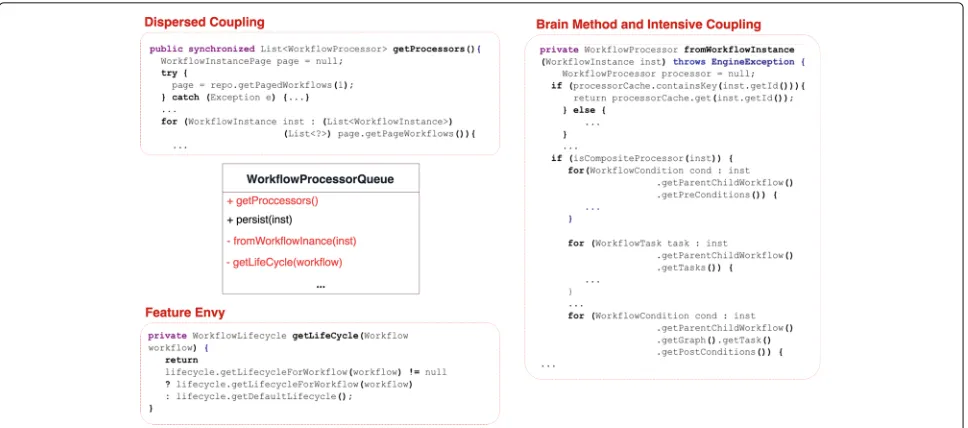
Anintra-method smell agglomerationconsists of multi-ple code smells that are located in a single method. The minimum number of code smells required to characterize an intra-method smell agglomeration is arbitrarily defined by the developers through a threshold. Figure1presents an example of intra-method agglomeration extracted from the Apache OODT (Object Oriented Data Technology) system. OODT is a distributed system aimed at support-ing the management and integration of processes, data, and metadata [27]. The agglomeration of Fig.1occurs in thefromWorkflowInstancemethod, which is implemented by the WorkflowProcessorQueue class. This method is affected by two code smells: Brain Method and Inten-sive Coupling. The smelly method is the source of a Brain Method because fromWorkflowInstance performs several operations related to pre-conditions, tasks, and pos-conditions. All these operations make the method difficult to read and, consequently, to maintain. More-over, this method suffers fromIntensive Couplingbecause it is tightly coupled to a few classes, namely Work-flowInstance,WorkflowProcessor,WorkflowCondition, and
WorkflowTask. These two smells together indicate the method is complicated, addresses multiple responsibil-ities, and is intensively coupled to a few classes in the system.
Fig. 1Intra-method and intra-class agglomerations in the WorkflowProcessorQueue class
A hierarchical agglomeration follows two conditions. First, all code elements have to be affected by the same type of code smells. Second, these elements have to imple-ment the same interface or inherit from the same code element. Figure 2 illustrates an example of hierarchical agglomeration affecting the Apache OODT system. The Versioner class is an abstraction affected by a Fat Interface instance due to the high number of responsibilities imple-mented into it, which realize different design concerns. Besides that, the Versioner class is inherited by other classes, namely SingleFileBasicVersioner, BasicVersioner,
DateTimeVersioner, andMetadataBasedFileVersioner. All implementations are affected by Feature Envy, because they have too many dependencies with multiple classes of the system. Thus, all these Feature Envy instances together form an agglomeration that reifies the Fat Interface design problem affecting Versioner.
Anintra-component smell agglomerationoccurs inside of a single design component. This agglomeration com-prises multiple code smells affecting different code ele-ments that are located within the same component. The minimum number of code smells required to character-ize an intra-component smell agglomeration is arbitrarily defined by the developer. Note that, for characterizing this type of smell agglomeration, all code elements have to (i) be affected by the same type of code smell and (ii) be connected by method calls or type references. The “ Iden-tifying design problem in stinky code” section presents a detailed example involving an intra-component smell agglomeration.
The concept of smell agglomeration is not limited to the categories presented above. There are other categories that we did not consider in this study. An example is the
concern-overload category [5], which is provided by the Organic tool—as described in the “Organic: a tool for the analysis of stinky code” section. In this paper, our focus was to analyze the identification of design problems in stinky program locations. Therefore, we considered only categories that represent common program locations, such as methods and classes.
Identifying design problem in stinky code
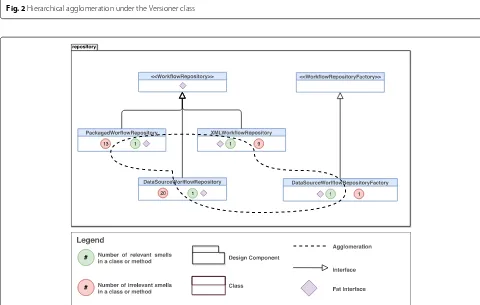
Fig. 2Hierarchical agglomeration under the Versioner class
is, the smells in the agglomeration are indicating that (the corresponding method in) the interface may con-tain a design problem. In fact, this “forced implemen-tation” becomes a problem because these methods are implementing a concern that should not have been imple-mented in their hosting classes. That happens because of the fact that theWorkflowRepositoryinterface processes multiple services; thus, any class that implements this interface needs to handle more services than it actually should have.
In this example, the developer knows that the code smells in the agglomeration have the same type (Feature Envy). Also, she knows that three classes affected by the code smells implement the same interface, as rei-fied in ahierarchicalagglomeration. This interface, in its turn, seems to provide non-cohesive services. Thus, the developer can infer that a design problem, called Fat Inter-face, is affecting theWorkflowRepositoryinterface. On the other hand, if she did not reflect upon the code smell agglomeration, it would be harder to her to identify the same design problem. One of the reasons is the number of code smells spread over the six classes and two interfaces within the package. Although the package contains only eight classes (Fig.3only shows some of them), it has more than 50 code smells, many of which are irrelevant for the identification of a Fat Interface. Thus, she has to analyze many smelly code snippets in order to discard, postpone, or further consider them in the identification of design problems.
Let us assume that the developer only reasons about each code smell in isolation to identify the design prob-lem, i.e., without taking into consideration smell relation-ships in an agglomeration. Thus, she can choose to analyze theDataSourceWorkflowRepositoryclass first because the class contains the highest number of smells in the pack-age. Analyzing the 21 instances of code smells in the class, the developer will notice that the class has smells related to high coupling with other classes (Intensive Coupling and Dispersed Coupling), low cohesion (Feature Envy), and overload of responsibilities (God Class). However, all these smells may indicate different problems. Thus, she has to extend the analysis to other classes in order to gather more information that can potentially indicate a design problem. Unfortunately, the other classes also have different instances of code smells, and these instances may not be related to any design problem. Therefore, the developer can face difficulties to find the relevant code smells that can help her to identify a design problem. Thus, the analysis of stinky program locations, as revealed by agglomerations, seems to be a better strategy. How-ever, there is little empirical understanding about this phenomenon. Existing studies are limited to investigat-ing only if there is a correlation of design problems with stinky code.
Organic: a tool for the analysis of stinky code
In this section, we present the Organic tool1. Organic is a plug-in developed for the Eclipse IDE. The essen-tial objective of Organic is to enable its users to identify and reason about design problems. To fulfill its role, Organic detects and groups code smells into agglomera-tions of code smells. The detection of smells is performed with the conventional detection strategies proposed by Marinescu [28]. Each conventional detection strategy is a heuristic that detects code elements that possi-bly suffer from a particular type of code smell. The heuristic of a detection strategy is based on a set of metrics and thresholds, which are combined into logi-cal expressions [28]. After the detection of code smells, Organic explores different forms of relationship between smells in order to search for smell agglomerations. The smell agglomerations are identified through information extracted from different artifacts of the analyzed software. Finally, for each agglomeration, Organic extracts informa-tion that may be helpful for the identificainforma-tion of design problems.
We developed and evolved Organic’s features based on findings from related work [4, 5, 17–20]. We used their findings as a start point for defining a preliminary set of requirements for supporting the identification of design problems in stinky code. Next, we present the requirements along with the corresponding features of Organic. The requirements are made explicit in the title of each paragraph below, followed by the description of Organic features that implement the corresponding requirement.
Supporting multiple categories of agglomeration. Our prior work [10, 19] provided evidence that design prob-lems may be reified in the source code by different forms of agglomeration. Therefore, a tool for the analysis of stinky code must support multiple categories of agglom-eration. Thus, to support this requirement, Organic pro-vides five categories of agglomerations: (i)intra-method, (ii)intra-class, (iii)intra-component, (iv)hierarchical, and (v)concern-overload.
Before searching for agglomerations, Organic uses the source code model provided by Eclipse—through the org.eclipse.jdt.core.dom package—to compute met-rics such as Access to Data, Number of Lines of Code, McCabe Complexity, and the like. After that, the met-rics are combined into heuristics for the detection of code smells. Organic uses the heuristics defined by the conventional detection strategies of Marinescu [28]. Below, we present an example of detection strategy for Long Method smells:
Detection strategy above determines that a Long Method occurs when the method (1) has more lines of code than the number defined by a given threshold (VERY HIGH) and (2) has cyclomatic complexity higher than a given threshold (HIGH).
After detecting all code smells, Organic uses different algorithms to search for different categories of agglomer-ation. Algorithm 1 shows a pseudo-code illustrating the algorithm used by Organic to search for intra-method agglomerations. For each method in the source code, Organic computes the number of smells. When a method has more code smells than a given threshold, Organic considers that there is an intra-method agglomeration.
Algorithm 1:Pseudo-code of the algorithm to search for intra-method agglomerations
Data: Set M of methods
Result: Set A of intra-method agglomerations initialization;
foreach method m in Mdo
ifnumberOfSmells(m)>THRESHOLDthen A.add(agglomerationOf(m))
end end
The different categories are shown by Organic in the
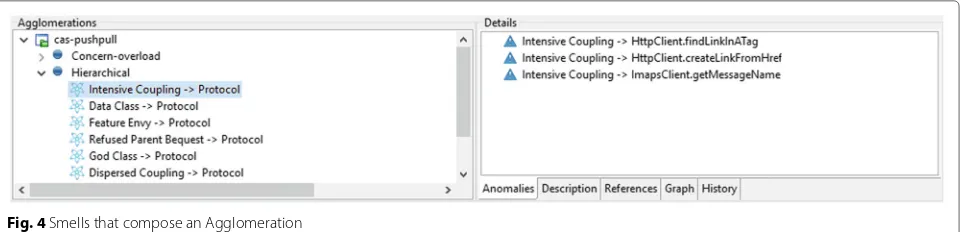
Agglomerations View. This is the main view of the tool, and it provides features to support the identification of design problems. Figure 4 shows a screenshot of the Agglomerations View. As one can observe, this view is separated in two parts: the first part is called Agglomer-ations, which is shown on the left side; the second part is called Details, which is shown on the right side. The Agglomerations part shows the agglomerations found in one or more projects according to their category. For instance, Fig. 4 shows two categories of agglomerations detected in a project calledcas-pushpull.
By clicking on an agglomeration category, one more subitem level is expanded. This new level displays all agglomerations in the selected category. For example, in Fig.4, all the hierarchical agglomerations that were found in thecas-pushpullproject are displayed. Thus, develop-ers can use these Organic features to select the category and/or the specific agglomeration they want to focus.
Providing detailed information about code smells. Many developers have little to no knowledge about the concept of code smells. In a survey conducted by Yamashita and Moonen [29], for example, only 18% of par-ticipants reported a good or strong understanding about code smells. As a result, most developers may fail short in the analysis of stink code when using a tool that do not
provide enough information. Hence, to overcome this lim-itation, Organic provides detailed information about each agglomeration of code smells.
When the user selects an agglomeration, Organic dis-plays all the smells that compose the agglomeration on the right side of the screen (in the Anomalies tab). One can see in Fig. 4 that the first agglomeration in the Hierar-chicalcategory contains threeIntensive Couplingsmells. The second tab (Fig.5) presents a textual description with information about the agglomeration according to the cat-egory. As one can observe in Fig. 5, the description of aHierarchicalagglomeration displays information about the number of smells that compose the agglomeration with a textual description of each type of smell.
Supporting the analysis of surrounding code elements.
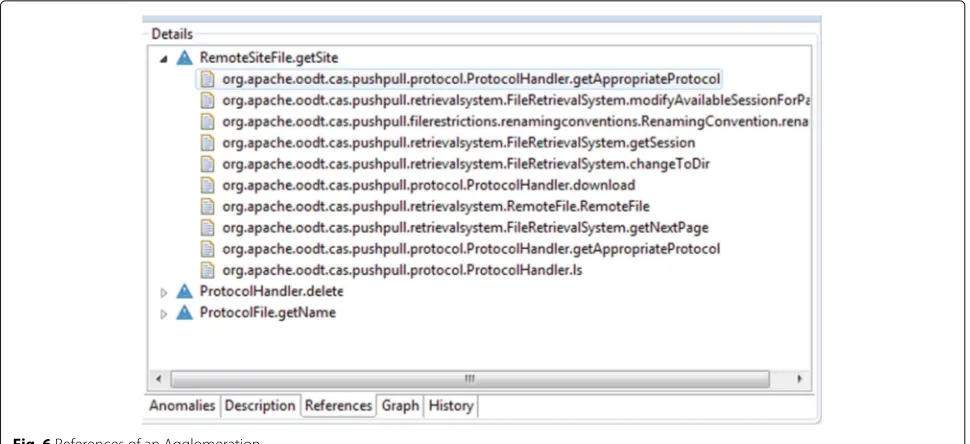
In our previous work [5,10], we observed that a design problem may involve the surrounding code elements of an agglomeration. For instance, we found agglomerations in which one or more surrounding elements were the main cause for the design problem manifestation. Thus, to sup-port the analysis of surrounding code elements, Organic provides a tab called References. This tab displays all ref-erences involving smelly code elements. For instance, in Fig. 6, thegetSite method of the RemoteSiteFile class is referenced by 10 other methods. This Organic feature enables developers to reason about the external impact of an agglomeration and further help for the search of a design problem associated with the agglomeration. For example, a high number of references involving agglom-erated element(s) and their surrounding elements may suggest the occurrence of a scattered functionality and/or an overly coupled component.
Fig. 4Smells that compose an Agglomeration
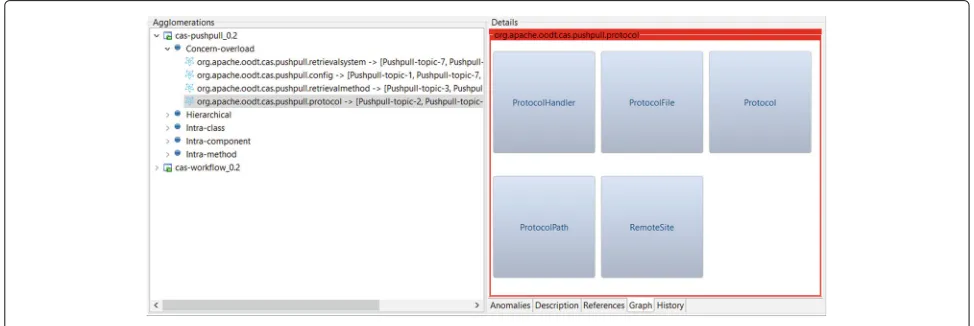
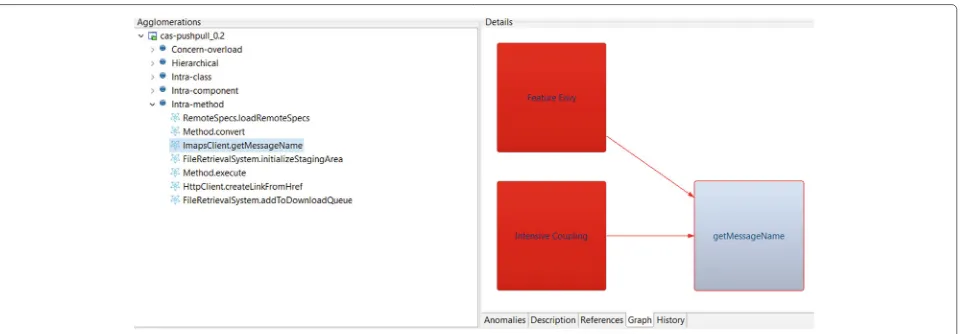
representing the classes. The intra-class agglomeration graph (Fig. 10) shows a blue node that represents the agglomerated class, while the gray nodes represent the smelly methods of the class. Finally, the intra-method
agglomeration graph (Fig. 11) shows a blue node rep-resenting the agglomerated method and red nodes to represent the name of smells affecting the method.
Providing historical information. During the analysis of an agglomeration, developers may benefit from infor-mation about the evolution of an agglomeration across the source code history [30]. Therefore, the fifth tab of Organic displays historical information about the selected agglomeration. By historical information, we mean infor-mation about the agglomeration in previous versions of the software. Thus, this historical information is orga-nized by versions. For example, in the Fig.12, information about the agglomeration is displayed in two previous ver-sions: “0.2” and “0.5.” Each version shows the code smells that were members of the agglomeration.
The objective of this tab is to assist the analysis of the evolution of each agglomeration throughout the differ-ent versions of the system. This tab shows the history of code smells that progressively composed the agglom-eration along the versions of the software. As one can
be observe in Fig. 12, in version 0.2, the agglomeration was composed by four smells (1 Dispersed Coupling, 2 Feature Envy, and 1 Intensive Coupling). On the other hand, the same agglomeration was composed of three smells (1 Dispersed Coupling, 1 Feature Envy, and 1 Intensive Coupling) in version 0.5. Using this feature, developers can identify agglomerations that are growing or shrinking along the system’s evolution. The analysis of this phenomenon can help developers identify cer-tain design problems. For example, a developer can check (i) if the number of smelly clients of a specific inter-face (all taking part in the agglomeration) is growing (or not) along the project history and (ii) if the agglom-eration started from a smell affecting an interface in the program. These observations will help the devel-oper to confirm if the design problem is located in that interface.
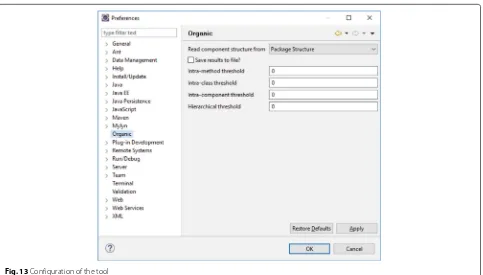
Allowing flexible thresholds. Similarly to conventional detection strategies for code smells [28], the detec-tion of agglomeradetec-tions also requires flexible thresh-olds. Therefore, to satisfy this requirement, Organic has a configuration screen (Fig. 13) that can be accessed through theWindow→ Preferencesmenu. The purpose of this screen is to allow users to define the threshold
Fig. 6References of an Agglomeration
for each agglomeration category. The threshold defines the minimum number of code smell that should be in a program location before being considered as an agglomeration. For example, if we configure the intra-method category with threshold 2, Organic will only find agglomerations in methods that contain 3 or more code smells.
Study I: Quasi-experiment
This work is intended to address three main goals, which are to (1) provide proper support for the analysis of stinkier code, (2) assess to what extent developers are able to identify design problems in stinkier code, and (3) iden-tify tool issues that may hinder the identification of design problems.
In the previous section, we proposed the Organic tool, attending to our first goal. The “Study II: Communicabi-lity evaluation of Organic” section presents a study that addresses our third goal. Thus, aiming at achieving our second goal, in this section, we present aquasi-experiment
with professional software developers. Quasi-experiment is an empirical interventional study in which the sub-jects are not randomly assigned to certain conditions [31]. In this study, we investigated whether the use of smell agglomerations improves the precision of developers in identifying design problems.
Study design
A previous study suggests that code smell agglomera-tions are related to occurrences of design problems [5].
Fig. 8Graph representation of an intra-component agglomeration
This study only analyzed the correlation between agglom-erated smelly elements and code elements affected by design problems. However, such study did not show evi-dence that developers indeed identify design problems when exploring information about agglomerations. Thus, there is a need to investigate whether developers can, by themselves, identify design problems when exploring smell agglomerations. In order to address this matter, we defined two research questions. The first one is presented as follow:
RQ1. Does the use of agglomerations improve the precision of developers in identifying design problems?
Research question RQ1 allows us to analyze whether code smell agglomerations help developers to identify design problems. To answer this question, we conducted a
quasi-experimentwith 11 professional developers. In this quasi-experiment, we measured the precision of develop-ers using agglomerations to identify design problems. Pre-cision in our context is measured based on the percentage
of true positives indicated by the developers— i.e., the per-centage of correctly identified design problems (against a ground truth, as explained later). We have used precision since it is an important aspect of the identification task.
Through the precise identification of design problems, developers are able to optimize their work by solving problems that really impact design. On the other hand, the lack of precision would lead software development teams to spend time and budget with irrelevant refac-toring tasks. Refacrefac-toring is a transformation used for improving the structural quality of a system while pre-serving its observable behavior [3]. In companies adept of code review practices [32], the lack of precision in identi-fying design problems can lead developers to waste time on refactorings that do not contribute to improving soft-ware maintainability, or even refactorings that are harmful to the software design [12]. The precise identification of design problems is also important in open source projects. For instance, the contributions of eventual collaborators are often rejected by core developers due to the pres-ence of design problems [33]. Therefore, in this case, lack
Fig. 10Graph representation of an intra-class agglomeration
of precision could lead core developers to reject relevant contributions due to “false design problems.”
Someone could wonder why we have not measured recall. Although we agree to the relevance of measuring recall, we did not measure it. The reason is because the analyzed systems have a high number of design problems unfeasible to be identified during the quasi-experiment, which should not last (in total) for more than 90 min. Therefore, the consideration of recall would not be feasi-ble in a quasi-experiment as the developers have limited time to search for some design problems only. Together with the system’s original developers, we created a ground truth of design problems with more than 150 instances of design problems. Hence, it would be impracticable for participants to find all the design problems in the system due to the time constraints in the study (45 min). Con-sequently, they were expected to reach a low recall value. Therefore, we focused on the precision.
In order to measure whether precision improved or not, we compared the participants using agglomerations with a control group. The control group comprises of partici-pants identifying design problems with a flat list of smells,
i.e., code smells presented individually without showing their connection with other smells in the program. In the comparison, we used a ground truth to confirm or refute each design problem indicated by participants. Then, we compared the number of false positives and true positives produced with the code smell agglomerations against the number of false and true positives produced by the con-trol group. In the context of this study, a false positive occurs when a participant reports a design problem that is not confirmed by our ground truth analysis. On the other hand, a true positive occurs when the design problem is confirmed during the ground truth analysis.
Someone could assume that developers would often benefit from the use of agglomerations in their quest for design problems. However, we do not have evidence about such benefit. Hence, we need to address RQ1 to verify if developers can correctly identify more design problems using smell agglomerations. Regardless of RQ1 results, another question involves the understanding of how to better support developers in exploring smell agglomer-ations. The success of developers on identifying design problems through agglomerations may strongly depend
Fig. 12Historical information of an agglomeration
on additional support for this task. Even though a pre-vious study [5] has shown the strong relation between design problems and code smells within an agglomera-tion, we do not know whether and how the identification of design problems with agglomerations can be improved with additional support. The following question addresses this matter:
RQ2. How can the identification of design problems with code smell agglomerations be improved?
We conducted a qualitative analysis to address RQ2. This analysis was based on the observation of par-ticipants during the quasi-experiment and a follow-up questionnaire. As reported in the “Results and analysis”
section, the combination of quantitative and qualita-tive analyses helped us to draw more well grounded conclusions. Thus, RQ1 can inform us if developers become (or not) more precise on identifying design problems when they use agglomeration, while RQ2 can provide a complementary perspective to explain why developers succedded or struggled to precisely iden-tify design problems. For instance, RQ2 can reveal the benefits and barriers associated with the use of smell agglomerations.
Experimental procedure
We had to define a set of requirements in order to answer our research questions. Thus, we opted for conducting a quasi-experiment [31]. A quasi-experiment is an empiri-cal study in which the units or groups are not assigned to conditions randomly. This allowed us to assign each par-ticipant to different treatments during the experimental steps. The experimental procedure was conducted indi-vidually with each participant. They had to perform the quasi-experiment in two steps with four tasks in each one. Both steps comprise the same set of tasks the only dif-ference between them was regarding the treatment, i.e., usage of agglomerations or non-agglomerated smells.
As explained before, we compare developers using agglomeration with a control group using non-agglomerated smells. Thus, we divided the participants into two groups. The first group would identify design problems using agglomerations in the first step. After that, they would identify design problems using non-agglomerated smells in the second step. The second group of participants would make the identification inversely: using the non-agglomerated smells in the first step and, then, using the agglomerations in the second step. Thus, in each step, we have two groups of participants: a group using agglomerations and a control group.
As each participant identifies design problems twice (first and second step), we had to select two software projects. Thus, each participant could identify design problems using a different project in both steps. Another reason for providing two software projects is to avoid bias with the learning curve. For example, supposing that the participant uses the same project in both steps, she could find more problems in the second step than in the first step. That could happen because she can identify in the second step the same problems that she identified in the first step, plus other design problems identified only in the second step. This increase in the number of design problems found in the second step would not be due to the use of agglomerations, but rather due to the knowledge acquired by the participant.
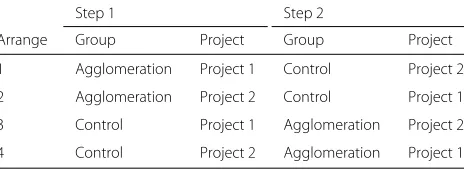
There are four possible combinations with the par-ticipants based on the distribution between steps and software projects. Therefore, all participants were divided
Table 3Combinations of groups, projects and steps
Step 1 Step 2
Arrange Group Project Group Project
1 Agglomeration Project 1 Control Project 2
2 Agglomeration Project 2 Control Project 1
3 Control Project 1 Agglomeration Project 2
4 Control Project 2 Agglomeration Project 1
into four mutually exclusive arranges. Table 3 presents the cross design for the four arranges. The agglomeration group represents the group of participants that identi-fied design problems using the agglomerations, and the control group comprises the participants that identified design problems using the list of non-agglomerated code smells.
The study was composed by a set of six activities distributed into three phases, as represented in Fig. 14
described as follows.
Activity 1: Apply the questionnaire for subjects’ char-acterization.The subjects’ characterization questionnaire is composed of questions to characterize each partici-pant, including academic degree, professional experience with Java programming, background on code smells, and Eclipse IDE.
Activity 2: Training session.After defining the order of execution of each step, the next step was to provide a training session for the participants. The main objective of the training session was to level the participant at the same background required to understand and properly execute the experimental tasks. Thus, they received training about basic concepts and terminologies. This training was given only once for each participant before the first steps of the quasi-experiment. The training consisted of a 15-min presentation that covered the following topics: software design, code smells, and design problems. The training session took approximately 15 min, and the participants could make any question throughout it.
Fig. 14The experimental design
design problems. As it often occurs in practice, the anal-ysis of the source code is inevitably required to identify a design problem.
Activity 3: System introduction. We asked the partici-pants to read the document containing the description of the project in which they would identify design problems. They had 20 min to read the description and the design blueprint of the system. Thus, they could start the identi-fication with a certain level of familiarity with the software project.
Activity 4: Understanding the task.In this activity, we explained how the participant could use the Organic tool to collect either the list of agglomerations or the list of (non-agglomerated) code smells. As the Organic tool was developed as an Eclipse plug-in, we explained each one of the sections displayed in the Eclipse IDE and that was related to the Organic tool. This activity lasted approximately 10 min.
Activity 5: Identification of design problems. In this activity, the participant had 45 min to identify design problems in the project. We emphasized to the partici-pant the importance of achieving the key goal of finding design problems. For each identified design problem, the participant was asked to provide the following informa-tion: (i) short description of the problem, (ii) possible consequences caused by the problem, (iii) classes, meth-ods, or packages realizing the design problem in the
source code, and (iv) the category(s) of agglomerations— described in “Basic concepts” section—that helped him to identify the design problems. If the participant was identifying design problems as part of the control group, she needed to provide almost the same information; the difference was that instead of providing the agglomera-tion (and its category), she needed to provide the code smells that she used to identify the design problem. For conducting this task, participants were instructed to use only the information provided by Organic in the current phase. This means that, neither the con-trol group had access to the list of agglomerations, nor the agglomeration group had access to the list of non-agglomerated smells. This was guaranteed by providing different versions of Organic for each group—that is, one version for agglomerations and another version for non-agglomerated code smells. Nevertheless, both the project source code and the information provided by Organic (agglomerated or non-agglomerated smells) could be freely explored and analyzed during the design problem identification.
After the sixth activity had been completed, we asked the same participant to repeat all tasks in the second phase.
Software projects and participant selection
In order to conduct the quasi-experiment as explained in the previous section, we selected two software sys-tems in which developers had to identify design problems. We selected two programs that represent components of the Apache OODT project [27]:Push PullandWorkflow Manager. We selected subsystems of the OODT project since it is a large heterogeneous system; then, we could choose subsystems based on their diversity. Also, the Apache OODT project has a well-defined set of design problems previously identified by developers who actually implemented the systems [5], thus avoiding the intro-duction of false positive design problems in the ground truth. In addition, the OODT project was developed for NASA, used in other studies [4, 5, 17,18, 24] and with a global community involved in its development. Table4
presents the characteristics of each project. The columns of this table are organized as follows. The second column shows the project size in Source Lines of Code (SLOC), the third column presents the number of classes, and the fourth column contains the number of agglomerations in the project. A brief description of the project systems is presented as follows:
• Push Pull: it is the OODT component responsible for downloading remote content (pull) or accepting the delivery of remote content (push) to a local staging area.
• Workflow Manager: it is a component that is part of the OODT client-server system. It is responsible for describing, executing, and monitoring workflows.
After choosing the projects, our next step was to recruit developers for the study. Thus, we sent a characterization questionnaire for a group of developers of our network. Their answers were analyzed to determine which of them were eligible to participate in the study based on the following requirements:
• Four years or more of experience with software development and maintenance. We have chosen four years because this is the average time used by companies such as Yahoo [34] and Twitter [35] to classify a developer as experienced.
Table 4Characteristics of software projects
Project Size (SLOC) # Classes # Agglomerations
Push pull 11213 133 49
Workflow 18505 150 111
Table 5Knowledge classification
Classification Description
None I have never heard about it
Minimum I have heard about it, but I do not use it
Basic I have a general understanding,
but almost never use it
Intermediary I have a good understanding,
and use basic features sometimes
Advanced I have a deep understanding,
and often use advanced features
Expert I am a specialist in this topic,
and I use many features almost every day
• No previous knowledge about Push Pull and Workflow Manager.
• At least with basic knowledge about code smells.
• At least with intermediary knowledge on Java programming and Eclipse IDE.
We defined the knowledge in each topic based on a scale composed of six levels: none, minimum, basic, intermedi-ary, advanced, and expert. Table5presents the description of such classification. We included in the questionnaire a description of each level, allowing the subjects to have a similar interpretation of the answers. Table6summarizes the characteristics of each selected developer.
Quantitative analysis procedure
In order to answer research question RQ1, we asked the study participants to analyze two systems with the aim of identifying design problems as described above. For each
Table 6Characterization of the participants
ID Experience in years
Education level
Knowledge
Java Code smells Eclipse
P1 5 PhD Advanced Advanced Advanced
P2 6 Graduate Advanced Basic Advanced
P3 8 Master Advanced Intermediary Advanced
P4 4 Graduate Intermediary Basic Basic
P5 5 Master Advanced Intermediary Intermediary
P6 5 Graduate Intermediary Intermediary Intermediary
P7 12 Graduate Expert Advanced Expert
P8 5 Graduate Advanced Advanced Advanced
P9 10 Graduate Intermediary Intermediary Intermediary
P10 4 PhD Advanced Intermediary Advanced
system, we analyzed the precision of participants regard-ing the identification of design problems. The precision of participants was measured based ontrue positives(TP) and false positives (FP). In this context, a true positive is a candidate of design problem, as indicated by the participant, that was confirmed by a ground truth anal-ysis. On the other hand, a false positive is a candidate of design problem that was not confirmed in the ground truth analysis. Thus, the precision is calculated using the following formula:
Precision= TP
TP+FP (1)
We had to validate the identified design problems as true positive or false positive for each one of the ana-lyzed systems. However, we could not argue that a design problem was correct or not since we were not involved with the design of each system. Thus, we relied on the knowledge of the systems’ original designers and devel-opers to help us in validating the design problems. We certified they were the people who had the deepest knowl-edge of the design of the investigated projects. We high-light these designers and developers were not subjects of this study.
We performed two steps to incrementally develop the ground truth. First, we asked original OODT design-ers and developdesign-ers to provide us a list of design prob-lems affecting the systems. They listed the probprob-lems and explained the relevance of each one through a question-naire. They also described which code elements were contributing to the realization of each design problem. Second, we identified some design problems using a suite of design recovery tools [36]. We asked the developers of the systems to validate and combine our additional design problems with their list. The procedure for the additional identification was the following: (i) an initial list of design problems was identified using a method pre-sented by Macia and colleagues [18], (ii) the developers had to confirm, refute, or expand the list, (iii) the develop-ers provided a brief explanation of the relevance of each design problem, and (iv) when we suspected there was still inaccuracies in the list of design problems, we dis-cussed with them. In the end, we had the ground truth of design problems validated by the original designers and developers.
Qualitative analysis procedure
Our first research question aims to investigate the preci-sion of developers in the identification of design problems with agglomerations. Answer for such question will indi-cate whether developers benefit or not of using agglomer-ations. However, answering this questions is not enough
for revealing the reasons why agglomerations may ben-efit developers. Moreover, we will not know how to improve the use of agglomerations to identify design problems. Therefore, we conducted a qualitative analysis to investigate what should be improved from the perspec-tive of professional software developers. Besides identi-fying possible improvements, this analysis also helped us to understand what are the main strengths of exploring agglomerations for design problem identification.
As described in the “Experimental procedure” section, we asked the participants to provide us feedback about the identification of design problems. They answered a follow-up questionnaire, and we use their answers to conduct a qualitative analysis. The objective of the ques-tionnaire was to gather participant’s opinion regarding (i) the (dis)advantages of using the agglomerations or code smells to identify design problems, (ii) whether the pro-vided information could be easily understood, (iii) which types of information were fundamental to identify design problems, (iv) what she believes that should be done to improve the identification of design problems, (v) what she thought about the use of the code smells for the identification of design problems, (vi) how the visualiza-tion mechanism provided by the Organic tool affected her performance, and (vii) which types of code smell and categories of agglomeration were the most useful for iden-tifying design problems. The results of this questionnaire helped us to answer research question RQ2.
By applying the questionnaire, we were able to gather the opinion of developers regarding the use of code smell agglomerations. However, as reported by Easterbrook and colleagues [37], what is reported in the questionnaire may not be what actually happens in practice. Therefore, to obtain more reliable results, we also observed the par-ticipants of our study during the identification of design problems. This observation was performed during the study and also in analyses after it, through video and audio recorded during the quasi-experiement. This anal-ysis allowed us to look at code smell agglomerations from the standpoint of professional software developers. It is important to note that the observation of participants dur-ing the quasi-experiment does not replace nor invalidate the questionnaire responses. In fact, the combination of observations and responses helped us to obtain a deeper understanding and interpretation on the results observed in the study.
Results and analysis
Table 7Precision
ID Agglomeration group Control group
TP FP Precision (%) TP FP Precision (%)
1 2 1 66.67 1 1 50
2 0 3 0 1 4 20
3 3 2 60 1 4 20
4 2 0 100 1 3 25
5 4 0 100 3 1 75
6 1 0 100 1 0 100
7 1 1 50 1 1 50
8 3 0 100 3 0 100
9 0 1 0 0 6 0
10 0 0 – 1 1 50
11 0 1 0 0 0 –
All 16 9 64 13 21 38.24
Do agglomerations improve precision?
As described in “Quantitative analysis procedure” section, we conducted a quantitative analysis to answer our first research question:Does the use of agglomerations improve the precision of developers in identifying design problems?
Table 7 presents the precision results for each partici-pant (rows). The first column (ID) shows the identification number of each participant. The second column (Agglom-eration group) presents the true positives (TP), false positives (FP), and precision for the participants when they were provided with agglomerations to identify design problems. Similarly, the third column (Control group) presents the true positives (TP), false positives (FP), and precision for the participants in the control group, i.e., when they were provided with non-agglomerated smells.
Agglomeration led to a slight increase of true positives. We can see in Table 7 that the developers identified a few more design problems (TPs) when they were in the agglomeration group (16 TP design problems) than when they were in the control group (13 TP design problems). As far as the per-subject analysis is concerned, four devel-opers (light gray rows) identified more true positives when they used agglomerations than when they used the list of code smells in the control group. The use of agglomera-tions outperformed the use of smells in these four cases. On the other hand, two participants (2, 10) did not identify any true positive using the agglomerations, but they iden-tified a true positive each in the control group. The other participants (6, 7, 8, 9, and 11) identified the same num-ber of true positives (5 TP design problems) regardless the group.
Upon qualitative analysis, we were able to reveal the main reason why the four developers in the light gray rows identified more true positive design problems in the agglomeration group than in the control group. As
illustrated in the example in Fig. 3 (“Identifying design problem in stinky code” section), these four participants systematically used each agglomeration’s smell as an indi-cator of the presence of a design problem. They analyzed each one of the code smells as a complementary symp-tom of the presence of a design problem, which gave them increasing confidence to confirm the occurrence of the design problem. Surprisingly, we noticed the same behav-ior for the participant 8 even when she was in the control group. She was capable of agglomerating the code smells on her own, starting from the individual smells given in the flat list. Then, she used such agglomerations to iden-tify design problems in the control group. This may be the reason why she reached a precision value of 100% in both groups.
Agglomerations help developers to avoid false positives. In general, developers identified less false positives when they used agglomerations (9 FP design problems) than when they used the list of code smells (21 FP design prob-lems). As presented in our qualitative analysis (“How to improve design problem identification?” section), with the exception of participant 11, who analyzed several irrel-evant agglomerations—i.e., agglomerations that do not reveal any design problem—all others identified either less or equal number of false positives when they were in the agglomeration group than when they were in the con-trol group. When we analyze the concon-trol group, we can notice that more than half of the identified design prob-lems are false positives (61.76%) while the agglomeration group identified only 36% of false positives.
Agglomerations improve the precision. Even though we cannot claim a statistical significance in our results due to the sample size of this study, we can notice that devel-opers achieve a higher precision (64%) when they use agglomerations than when they use code smells (38.24%). Therefore, this result suggests that agglomerations may improve the precision of developers in identifying design problems, answering our first research question. How-ever, someone could expect that all developers using agglomerations would significantly outperform the con-trol group. As a matter of fact, we noticed some factors that explain, at least partially, why developers did not find much more design problems when they were in the agglomeration group than when they were in the con-trol group. These factors are presented next, and they are useful to discover improvements for the identifica-tion of design problem with the analysis of stinky program locations.
How to improve design problem identification?
This section presents the answer for our second research question: How can the identification of design problems with code smell agglomerations be improved? We con-ducted a qualitative analysis to answer this question. As described in the “Qualitative analysis procedure” section, this analysis was based on the observation of participants during the identification of design problems as well as the analysis of responses to our follow-up questionnaire.
Where to start from? As discussed in the previous section, the participants identified few more true posi-tives using agglomerations. Someone could expect thatall
developers using agglomerations would significantly out-perform the control group. However, we observed that participants spent much more time analyzing the agglom-erations than analyzing the smells in the control group. That happened because they analyzed each code smell in the stinky program location as previously explained in the “Do agglomerations improve precision?” section. Fur-thermore, sometimes the participants analyzed agglomer-ations that were not related to any design problem, which is a key factor that explains the almost same number of true positives between both groups.
Unfortunately, almost all the participants analyzed irrel-evant agglomerations. Participants 6, 9, 10, and 11 were the ones that suffered the most from the analysis of irrel-evant agglomerations. Since these four participants faced this issue, they suggested in our follow-up questionnaire that the Organic tool should provide means to priori-tize (or, at least, rank) potentially relevant agglomerations. This feature would help to further reduce the time spent with the analysis of irrelevant stinky code. Thus, this issue also helps us to explain why they fell short in identify-ing additional design problems through the analysis of agglomerations.
Need for prioritizing agglomerations. The aforemen-tioned need for agglomeration prioritization shows that the time and effort required to identify design problems is a key factor for developers; thus, prioritization should be taken into consideration. As a matter of fact, the prioriti-zation of smelly code has been the focus of recent research [38–40]. The work of Vidal et al. [40], for example, pro-posed and assessed a set of criteria for prioritizing smell agglomerations. As they have observed, the prioritized list of agglomerations would help a developer to progres-sively analyze the agglomerations that are more likely to represent design problems, discarding the irrelevant ones. This would be especially useful in large legacy systems, in which thousands of agglomerations may be detected. Nev-ertheless, they observed there is no prioritization criterion that is always the most effective one for all the analyzed systems [40]. They provided some hints on how a devel-oper could choose a promising prioritization criterion for her project.
Based on our qualitative analysis, we noticed that exist-ing criteria for prioritization should select agglomerations that are cohesive. In our context, an agglomeration is considered to be cohesive whenever all its code smells are related to the same design problem. If there is one code smell that is not related to the design problem (i) in the best case, the developer will spend time analyzing a code smell that is useless to identify the design prob-lem or (ii) in the worst case, such smell may direct the developer away from the design problem. This fact sug-gests that developers need accurate algorithms to find cohesive agglomerations and to discard the less cohesive ones. However, prioritization algorithms based on exist-ing criteria are unable to do this as far we are concerned. Consequently, the prioritization of stinky program loca-tions still poses as a challenging research topic. Therefore, after this study, we decided to not incorporate existing prioritization criteria into Organic. Before including any prioritization feature into Organic, we intend to propose and evaluate improvements for the existing prioritization criteria.
Consequently, developers will have more code to analyze, which increases the complexity of the analysis.
Need for proper visualization mechanisms.In order to alleviate the analysis of stinky code, some participants suggested the adoption of better visualization mecha-nisms. For instance, participant number 8 suggested the visualization of agglomerations through a graph-based representation [41]. She mentioned that such visualization would provide an abstract and general view of agglomera-tions. The main advantage of this form of visualization is that the more abstract a representation is, the less details will be displayed for analysis. Consequently, the develop-ers would not be overloaded with details. At the same time, an abstract representation like the graph-based visu-alization would help developers to see the full extent of an agglomeration. After providing an abstract view, a visu-alization mechanism could allow developers to progres-sively explore the agglomeration details such as the types of smells, location of stinky code, and relationships among smells. In order to address this matter, we incorporated a graph-based visualization mechanism into Organic.
Identification of the design problem type. The diffi-culty in analyzing agglomerations also raised the need for recommendations on which types of design prob-lem each smell agglomeration is more likely to indicate. These recommendations would reduce the effort required to decide whether the elements are affected by a spe-cific design problem. For example, the agglomeration of Fig. 3 occurs in classes of the same hierarchy that are implementing the WorkflowRepository interface. All smelly elements of this stinky program location mani-fest the same type of smell, which is the Feature Envy. The occurrence of multiple Feature Envies in a single hierarchy suggests that there is a problem, in a root abstract class or a root interface, which is spreading through all the subclasses of the hierarchy. Therefore, to help developers to decide whether there is a prob-lem or not, the Organic tool could suggest the analysis of this hierarchical agglomeration trying to identify prob-lems like Ambiguous Interface [21] and Fat Interface [9], for example.
Suggestions of design problem types can help develop-ers to focus their attention in specific characteristics of the suggested design problems. However, this kind of recom-mendation algorithm requires multiple empirical studies to understand how and when each form of agglomera-tion may consistently represent specific types of design problem. This is indeed a challenging research topic to be addressed in the future and, therefore, we are unable to provide this recommendation feature in the Organic tool.
Threats to validity
This section presents some threats that could limit the validity of our main findings. For each threat, we present
the actions taken to mitigate its impact on the research results.
The first two threats to validity are related to the num-ber of participants in the study and to the convenience approach used to find participants. We have selected a sample of 11 participants, which may not be enough to achieve conclusive results. However, instead of drawing conclusions based on the quantitative results, we com-plemented our analysis with a qualitative analysis. In addition, we defined a set of requirements to selecting par-ticipants suitable for this study. Also, we conducted train-ing sessions with all participants. Such sections aimed to resolve any gaps in the participants’ knowledge and any terminology conflicts, allowing us to increase our confidence in the results.
The third threat is related to possible misunderstand-ings during the study. As we asked developers to conduct a specific software engineering task and to answer a ques-tionnaire, they could have conducted the study different from what we asked. To mitigate this threat, we assisted the participants during the entire study, and we make sure of helping them to understand the experimental tasks and the questionnaire. We highlighted that our help was lim-ited to only clarify the study in order to avoid some bias on our results.
Next threat concerns the ground truth used to confirm or to refute the design problems reported by participants. Since our ground truth was built manually, it is possi-ble that some design propossi-blems are missing in the ground truth, which would impact the precision measure. To mit-igate this threat, we built the ground truth with the help of original OODT designers and developers. Moreover, we relied on a suite of design recovery tools to identify possi-ble design propossi-blems that were not reported by the original designers and developers of OODT.
There is another threat that is related to the amount of information we asked participants to provide for each design problem reported. Providing all information dur-ing the experiment may slow down the participants, and as a consequence, some participants may report fewer design problems than they would be able to do during the 45-min time frame. We mitigated this threat by asking the same amount of information for both the agglomeration group and the control group.