Open Access
Review
Glanzmann thrombasthenia
Alan T Nurden*
Address: IFR N°4/CRPP, Laboratoire d'Hématologie, Hôpital Cardiologique, 33604 Pessac, France
Email: Alan T Nurden* - [email protected] * Corresponding author
Abstract
Glanzmann thrombasthenia (GT) is a rare autosomal recessive bleeding syndrome affecting the megakaryocyte lineage and characterized by lack of platelet aggregation. The molecular basis is linked to quantitative and/or qualitative abnormalities of αIIbβ3 integrin. This receptor mediates the binding of adhesive proteins that attach aggregating platelets and ensure thrombus formation at sites of injury in blood vessels. GT is associated with clinical variability: some patients have only minimal bruising while others have frequent, severe and potentially fatal hemorrhages. The site of bleeding in GT is clearly defined: purpura, epistaxis, gingival hemorrhage, and menorrhagia are nearly constant features; gastrointestinal bleeding and hematuria are less common. In most cases, bleeding symptoms manifest rapidly after birth, even if GT is occasionally only diagnosed in later life. Diagnosis should be suspected in patients with mucocutaneous bleeding with absent platelet aggregation in response to all physiologic stimuli, and a normal platelet count and morphology. Platelet αIIbβ3 deficiency or nonfunction should always be confirmed, for example by flow cytometry. In order to avoid platelet alloimmunisation, therapeutic management must include, if possible, local hemostatic procedures and/or desmopressin (DDAVP) administration. Transfusion of HLA-compatible platelet concentrates may be necessary if these measures are ineffective, or to prevent bleeding during surgery. Administration of recombinant factor VIIa is an increasingly used therapeutic alternative. GT can be a severe hemorrhagic disease, however the prognosis is excellent with careful supportive care.
Disease name
Glanzmann thrombasthenia (GT)
Definition/diagnostic criteria
GT is an autosomal recessive bleeding syndrome affecting the megakaryocyte lineage and characterized by a lack of platelet aggregation. It is a moderate to severe hemor-rhagic disorder with mainly mucocutaneous bleeding. The molecular basis is linked to quantitative and/or qual-itative abnormalities of αIIbβ3 integrin, the receptor that mediates the incorporation of platelets into an aggregate or thrombus at sites of vessel injury.
Glanzmann first described this disease in 1918 as "hered-itary hemorrhagic thrombasthenia" [1]. A prolonged bleeding time and an isolated, rather than clumped, appearance of platelets on a peripheral blood smear were early diagnostic criteria. In 1956, Braunsteiner and Pake-sch reviewed disorders of platelet function and described thrombasthenia as an inherited disease characterized by platelets of normal size that failed to spread onto a surface and did not support clot retraction [2]. The diagnostic fea-tures of GT including the absence of platelet aggregation as the primary feature were clearly established in 1964 by the classic report on 15 French patients by Caen et al. [3].
Published: 06 April 2006
Orphanet Journal of Rare Diseases 2006, 1:10 doi:10.1186/1750-1172-1-10
Received: 17 March 2006 Accepted: 06 April 2006
This article is available from: http://www.OJRD.com/content/1/1/10
© 2006 Nurden; licensee BioMed Central Ltd.
Those patients with absent platelet aggregation and absent clot retraction were subsequently termed as having type I disease; those with absent aggregation but residual clot retraction, type II disease; while variant disease was first established in 1987 (reviewed in ref [4]).
Differential diagnosis
Platelet aggregation defects specific to adenosine diphos-phate (ADP) or collagen, imply abnormalities of their pri-mary receptors or of signaling pathways. Defects in the second wave of aggregation to ADP or in the response to collagen can imply storage pool disease and an absence of the secretory stores of ADP in dense granules. Deficiencies in the platelet response to arachidonic acid can point either to an inherited abnormality in thromboxane A2 formation or a platelet function defect temporarily acquired through aspirin ingestion. GT is the only disease in which platelet aggregation is defective to all agonists, while absent clot retraction is another frequent character-istic.
Normal ristocetin-induced platelet agglutination and nor-mal platelet size clearly rule out the Bernard-Soulier syn-drome, a disorder of platelet adhesion. Inherited thrombocytopenias are eliminated by a normal platelet count. Normal coagulation parameters rule out clotting disorders that can also affect platelet function such as con-genital afibrinogenemia and von Willebrand disease. Acquired thrombasthenia must be eliminated in the absence of a family history of the disease. Platelet αIIbβ3 deficiency and abnormal platelet aggregation have been reported in patients with acute promyelocytic leukemia [5]; the etiology of this acquired disorder is probably a chromosome 15–17 translocation. Although the break-point region on chromosome 17 is heterogeneous in acute promyelocytic leukemia, in some patients it occurs at 17q21, and this is the location of the genes for αIIb and
β3 [6]. Another problem in diagnosing GT is to eliminate patients with acquired autoantibodies that block aggrega-tion, although these patients would often be thrombocy-topenic [7]. These antibodies can be detected immunologically by their binding to αIIbβ3 of control platelets during incubation with the patient's serum [8].
Etiology
Cell biologyMegakaryocytes are found in the bone marrow and when mature, liberate large numbers of platelets into the blood circulation. In GT, platelets fail to aggregate in response to all natural agonists, including ADP, thrombin and colla-gen, despite their undergoing a normal shape change. Thrombasthenic platelets can also adhere to exposed sub-endothelial tissue and secretion from storage granules is initiated. However, the subsequent reactions of platelet spreading on the exposed surface and thrombus build-up
are defective [9]. In the 1970s, Nurden and Caen demon-strated that platelets from patients with GT had selective abnormalities in their membrane glycoprotein (GP) com-position [10]. This led to the recognition that the disease was provoked by specific deficiencies of GPIIb and GPIIIa. It was later established that (i) GPIIb and GPIIIa were present in the platelet membrane as a heterodimeric mol-ecule and (ii) like αIIbβ3, the complex was a member of the ubiquitous integrin family of cell surface receptors [11,12]. Significantly, GT is now generally recognized as the most frequent inherited integrin disorder.
In man, expression of the αIIb gene (ITGA2B) (and there-fore of αIIbβ3 integrin) is restricted to cells of the meg-akaryocytic cell lineage. Expression of the β3 gene (ITGB3) is more widespread, with the vitronectin receptor (αvβ3) being expressed in many cell types, including endothelial cells, osteoblasts, smooth muscle cells, and leukocytes [12]. Despite this, patients with β3 gene defects appear not to have a more severe form of the disease (dis-cussed below). In the platelet, αvβ3 is a rare component, approximately 50 copies being found at the surface, com-pared to over 50,000 copies of αIIbβ3 [13]. In the seconds following binding of stimuli to platelets, αIIbβ3 straight-ens from a bent conformation and demonstrates receptor activity for fibrinogen [14]. Although fibrinogen is the predominant ligand in plasma, the role of von Willebrand factor (VWF) in conditions of high shear should be emphasized, while fibronectin, vitronectin and CD40L may also participate [15-17]. The inability to bind adhe-sive proteins when stimulated explains the platelet phe-notype in GT. Fibrin binding to αIIbβ3 allows some hemostatic function when residual integrin is present [18]. Furthermore, GT platelets appear able to attach to fibrin (independently of activated αIIbβ3) under flow, suggesting the presence of an alternative platelet receptor for fibrin [19].
Genetic basis
mutations are common causes of GT. Splice site defects and frameshifts are also widespread. Large deletions are rare.
As shown in Figure 1, the αIIb gene is composed of 30 exons. In an early and classic study, three Israeli-Arab kin-dreds were shown to possess a 13-bp deletion leading to a six-amino acid deletion in the αIIb protein [22]. The affected region, including Cys107, was postulated to be
critical for posttranslational processing of αIIb. Missense mutations in exons encoding the extracellular β– propel-ler region of αIIb [23] have shown how the extracellular calcium-binding domains of αIIb are essential for αIIbβ3 biogenesis [24-26]. Site-directed mutagenesis involving various amino acid substitutions at position 324 of αIIb,
illustrated to what extent the GT phenotype depended on both the nature of the substituted amino acid and its replacement [26]. Mutations affecting the membrane-proximal calf-2 domain showed that while this region was not essential for complex formation in the ER, it was nec-essary for transport into and/or through the Golgi appara-tus [21,27]. These are but a few selected examples of αIIb defects.
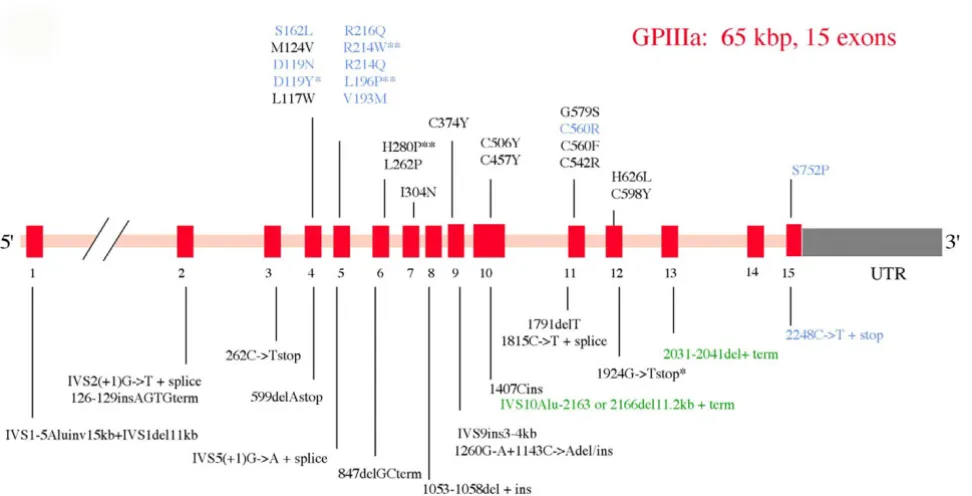
The organization of the β3 gene is shown in Figure 2. It is composed of 15 exons and mutations are again widely distributed within the gene. An 11 bp deletion leading to protein termination shortly before the transmembrane domain of β3 was first described in six Iraqi Jews with type I disease [22]. This defect prevented normal membrane
Schematic representation of the structure of the GPIIb (aIIb) gene (ITGA2B) together with a representative spectrum of the types of genetic abnormalities that give rise to Glanzmann thrombasthenia (GT)
Figure 1
insertion of the integrin and also αvβ3 expression, both in platelets and other cells. Although most β3 mutations affect αIIbβ3 and αvβ3 expression, rare mutations allow
αvβ3 expression while preventing αIIbβ3 processing [28].
Patients with mutations allowing αIIbβ3 to be processed, but in whom integrin function is abolished, are of partic-ular interest. In most of these patients, it is the β3 gene that is affected. In brief, many of the variants have plate-lets with sufficient αIIbβ3 to normally allow aggregation, but the activation-dependent expression of adhesive pro-tein binding sites on the integrin does not occur [29,30]. As well as providing information on the ligand-binding pocket on the extracellular domains, variant molecules have highlighted the role of the αIIb and β3 intracellular tails in integrin signaling and even for integrin trafficking [31-33]. For some variants, clot retraction can occur even if aggregation is prevented [34]. Finally, recent studies on two patients have revealed that disruption of disulfide
bridges in the β3 Epidermal Growth Factor (EGF) extracel-lular domains gives rise to a constitutively active integrin, able to spontaneously bind fibrinogen [35,36]. Here, aggregation fails to occur because of the absence of free counter receptors allowing platelet to platelet bridging. The recent application of mutation screening on a national basis, first in Italy and then in India, has re-emphasized how a wide array of mutations can be found in GT patients within a single country. Interestingly, while 17 out of 21 candidate mutations were in the αIIb gene of the Italian patients, β3 mutations with emphasis on exon 4 appear to characterize the Indian patients [37,38].
Clinical description
Early reports emphasized the clinical variability of this bleeding syndrome: some patients had only minimal bruising, while others had frequent, severe and potentially fatal hemorrhages. Hemorrhagic symptoms occur only in
Sematic representation of the structure of the GPIIIa (β3) gene (ITGB3) together with a representative spectrum of the types of genetic abnormalities that give rise to Glanzmann thrombasthenia (GT)
Figure 2
patients homozygous for mutations causing GT; the heter-ozygous condition is mostly asymptomatic, even though these subjects have only a half-normal concentration of platelet αIIbβ3 [4]. The sites of bleeding in GT are clearly defined: purpura, epistaxis, gingival hemorrhage, and menorrhagia are nearly constant features; gastrointestinal bleeding and hematuria are less common but can cause serious complications [39,40]. It is important to note that deep visceral hematomas, a characteristic of coagulation disorders such as hemophilia, are not usually seen. In most cases, bleeding symptoms manifest rapidly after birth, even if occasionally GT is only diagnosed later in life. Epistaxis is a common cause of severe bleeding, and is typically more severe in childhood. In general, the bleeding tendency in GT decreases with age. The rare co-existence of GT with other inherited diseases, such as mild von Willebrand disease, may accentuate the clinical sever-ity of bleeding [27,39].
Although GT can be a severe hemorrhagic disease, the prognosis is excellent with careful supportive care. Most adult patients are in good health and their disease has a limited effect on their daily lives. Death from hemorrhage in diagnosed patients is rare unless associated with trauma or other disease (e.g. cancer). In contrast, families often report deceased siblings on diagnosis of GT.
Correlation of clinical disease with the molecular platelet abnormality
Clinical observations suggest little or no correlation between the amount of residual platelet αIIbβ3 and the severity of hemorrhagic disease [4,39]. Among the patients studied over many years in Paris [4], some with negligible bleeding symptoms have virtually no detecta-ble αIIbβ3, while others who have 10%–15% of the nor-mal level of functional platelet αIIbβ3 have experienced severe hemorrhage. It can be postulated that the absence of αvβ3 function in vascular cells may contribute to the hemorrhagic tendency. However, even among families in whom β3 is undetectable, bleeding ranges from severe to moderate and sporadic. Since therapeutic inhibition of platelet αIIbβ3 function prevents arterial thrombosis [41], patients are empirically protected from this disease. It has been speculated that patients with GT may also be pro-tected from atherosclerotic disease. However, studies within ethnic groups in Israel have suggested that this is not so [42]. Patients with GT also are not protected against venous thrombosis, where plasma coagulation factors are of primary importance [43].
Mice lacking β3 integrins develop thickened bones because of dysfunctional osteoclasts [44]. However, upregulation of α2β1 integrin compensates for lack of
αvβ3 in osteoclasts from Iraqi-Jewish patients and so this feature may not translate to humans [45]. Other studies
with β3 knockout mice show increased expression of Flk-1 on β3-null endothelial cells with increased vascular EGF (VEGF) signaling and enhanced angiogenesis and tumor growth [46]. How this or an observed decreased fertility translate to GT patients with β3 gene defects are topics for urgent study.
Epidemiology
A review of 177 patients with GT (of which 113 were liter-ature reports and 64 were seen at the Hôpital Lariboisière, Paris) showed that 102 (58%) of the patients were female [4]. This finding may reflect the added problem of menor-rhagia. The average age of the 113 patients for whom age was given was only 20. This may reflect improvements in diagnostic procedures. The frequency of consanguinity in affected families is noticeable, and GT has an increased incidence in populations in whom marriage among close relatives is an accepted custom. For example, in the review of 177 patients [4], only 12 were from the United States. In contrast, 55 patients were from Israel and Jordan, and 42 were from South India. In certain ethnic groups, such as South Indian Hindus, Iraqi Jews, French gypsies and Jordanian nomadic tribes, thrombasthenia may actually be a common hereditary hemorrhagic disorder. This has recently been borne out by a report of 382 patients in Iran [47]. For these reasons, it would be imprudent to give an estimation of worldwide prevalence.
Diagnostic methods
Mucocutaneous bleeding with absent platelet aggregation in response to all physiologic stimuli is pathognomonic for GT, and abnormal clot retraction is rarely observed in other disorders [39]. When these two signs are associated with a normal platelet count and morphology, the diag-nosis of GT is clear-cut. Use of the PFA-100 system (Dade-Behring, Miami, USA) can replace bleeding time tests for GT [48]. The PFA-100 measures the closure time when blood is passed through collagen-based filters under flow; blood from GT patients fails to plug the filter. Platelet
αIIbβ3 deficiency should always be confirmed in new patients, and this can be done with monoclonal antibod-ies and flow cytometry [24,35]. The detection of trace amounts of intracellular αIIb or β3 in a patient's platelets by western blotting [27,28], can give clues to the identity of the affected gene, while the presence of nonprocessed precursor pro-αIIb will suggest a block in integrin biosyn-thesis [25,26].
In the detailed analysis of experience gained at Hôpital Lar-iboisière in Paris, 50 out of 64 patients (78%) had type I disease, nine patients (14%) had type II disease with residual αIIbβ3, and five patients (8%) were classified as variant GT [4], a subgroup diagnosed by the inability of
antibod-ies, such as PAC-1 or FITC-fibrinogen, in flow cytometry) [29-34].
Procedures permitting the rapid screening of given muta-tions can only be used in ethnic groups with high consan-guinity. This is the case for the Iraqi-Jewish and Arab groups in Israel and for a Manouche gypsy population in France [49-51]. Here, rapid screening procedures include allele-specific restriction enzyme analysis (ASRA) [51]. Otherwise, the patient needs to be referred to a specialist laboratory, for direct sequencing of the relevant genes.
Carrier analysis, prenatal diagnosis and genetic
counseling
Initial studies attempted to diagnose carriers of GT by measuring the number of αIIbβ3 receptors on platelets. However, an occasional overlap between obligate hetero-zygotes and ostensibly normal donors, whose platelets had a low αIIbβ3 expression, made interpretation of the results difficult. Prenatal diagnosis performed by measur-ing αIIbβ3 on platelets isolated from cord blood has been attempted, but is accompanied by a high risk of bleeding and of spontaneous abortion [52]. It is therefore best to first identify the genetic lesion within the family in ques-tion. Carrier diagnosis can then be determined with rela-tive ease particularly if sites are created (or lost) for restriction enzymes. Restriction digest analysis of polymerase chain reaction (PCR)-amplified fragments from DNA isolated from blood or urine was first used to screen subjects for the Iraqi-Jewish and Arab mutations [49]. The presence of these mutations could also be con-firmed in prenatal diagnosis using DNA extracted from chorionic villi (discussed by French [20]). Carriers have also been detected within the French gypsy populations using ASRA methodology [51]. Finally, prenatal diagnosis in GT has been achieved using the polymorphic markers BRCA1 and THRA1 on chromosome 17 [53].
Genetic counseling can be given with the following reser-vations: (i) when screening is followed for a single muta-tion within an ethnic populamuta-tion, the presence of a second Glanzmann's defect may go undetected and (ii) that indi-viduals with the same mutation may differ widely in the frequency and severity of bleeding.
Management including treatment
Despite variations in the severity and frequency of bleed-ing episodes, most GT patients receive blood transfusions [39,40]. Local bleeding can be treated by local measures, such as fibrin sealants. Epistaxis and gingival bleeding are successfully controlled in most patients by nasal packing or the application of gel foam soaked in topical thrombin. Regular dental care is essential to prevent gingival bleed-ing. For teeth extractions, or for hemorrhage accompany-ing the loss of deciduous teeth, hemostasis can be
significantly improved by the application of individually prepared plastic splints that provide physical support for hemostasis.
Severe menorrhagia is a frequent clinical problem and is usually associated with an excessively proliferative endometrium caused by estrogen dominance. It can be effectively treated with high doses of progesterone. Main-tenance treatment with birth control pills should follow. Severe gastrointestinal bleeding is a problem in isolated cases. Iron deficiency anemia, which can develop insidi-ously with gingival oozing or minor menorrhagia, is a fre-quent problem.
Bleeding following trauma or surgical procedures can be severe and transfusions are often given by precaution or should be available on standby. Pregnancy and in partic-ular, delivery, represent a particularly severe hemorrhagic risk. Platelet transfusions are required not only prior to delivery, but sometimes should be continued for at least a week [39]. Successful delivery by Cesarean section, with platelet transfusions, has been reported. Note that if plate-let transfusions are required, the most HLA-compatible platelet concentrates must be chosen in order to avoid platelet anti-HLA alloimmunization.
The fact that most patients receive red cell and/or platelet transfusions on more than one occasion, makes the pro-duction of isoantibodies reactive with αIIbβ3 likely [4,39]. Such antibodies are antigen-driven and are pro-duced against different epitopes on the integrin [54]. They may block platelet aggregation, and lead to the rapid removal of transfused platelets by immune mechanisms. Whether a particular category of patient is more likely to form isoantibodies is as yet unknown. When present at high titer, the antibodies cause patients to become refrac-tory to further transfusions. Antibodies have been success-fully removed prior to surgery by immunoadsorption on Protein A Sepharose, although this is a complex procedure whose use is restricted to specialized centers [55]. Recently, recombinant factor VIIa (NovoSeven®; Novo
been thought to be sufficiently serious for allogeneic bone-marrow transplantation to be performed [39,59]. In the first report, donors were siblings and the transplanta-tion was successful [59].
Unresolved questions
Awaiting discovery, perhaps, are abnormalities of the cyto-plasmic proteins now thought to regulate the activation state of αIIbβ3 for adhesive proteins [60]. The observation that a series of platelet receptor gene haplotypes can mark-edly affect bleeding severity and bleeding times in patients with von Willebrand disease type I [61], points to the bleeding tendency in congenital disorders being governed by the score of an ensemble of risk factors. As well as gene polymorphisms affecting platelet receptors, those influ-encing coagulation factors and the functioning of vascular cells may also be involved. The application of proteomic and gene microarray technologies to platelet disorders such as GT may help determine whether bleeding risk in individual patients can be predicted. Although the work is at an early stage, animal models of gene therapy show that GT may be an appropriate disease for such an approach and research is progressing in this direction [62].
Finally, as national and international networks are set up, and sequencing centers become involved in genotyping, especially among ethnic groups and third world countries, healthcare of GT will improve on a worldwide basis.
Acknowledgements
The author acknowledges the support provided by GIS-Maladies Rares to the French National Network on "Inherited Diseases of Platelet Production and Function".
References
1. Glanzmann E: Hereditare hamorrhagische thrombasthenie. Ein Beitrag zur Pathologie der Blutplattchen. J Kinderkranken 1918, 88:113.
2. Braunsteiner H, Pakesch F: Thrombocytoasthenia and thrombo-cytopathia. Old names and new diseases. Blood 1956, 11:965-976.
3. Caen JP, Castaldi PA, Lecrec JC, Inceman S, Larrieu MJ, Probst M, Ber-nard J: Glanzmann's thrombasthenia. I. Congenital bleeding disorders with long bleeding time and normal platelet count. Am J Med 1966, 44:4.
4. George JN, Caen J-P, Nurden AT: Glanzmann's thrombasthenia: The spectrum of clinical disease. Blood 1990, 75:1383-1395. 5. Chen Y, Wu QY, Wang Z, et al.: Abnormalities of platelet
mem-brane glycoproteins in acute nonlymphoblastic leukemia [abstract]. Thromb Haemost 1989, 62:176.
6. Wilhide CC, Jin Y, Guo Q, Li L, Li SX, Rubin E, Bray PF: The human integrin β3 gene is 63 kb and contains a 5'-UTR sequence regulating expression. Blood 1997, 90:3951-3961.
7. Tholouli E, Hay CRM, O'Gorman P, Makris M: Acquired Glanz-mann's thrombasthenia without thrombocytopenia: a severe acquired autoimmune bleeding disorder. Br J Haematol 2004, 127:209-213.
8. Macchi L, Nurden P, Marit G, Bihour C, Clofent-Sanchez G, Combrie R, Nurden AT: Autoimmune thrombocytopenic purpura (AITP) and acquired thrombasthenia due to autoantibodies to GP IIb-IIIa in a patient with an unusual platelet membrane glycoprotein composition. Am J Hematol 1998, 157:164-175. 9. Patel D, Väänänen H, Jirouskova M, Hoffmann T, Bodian C, Coller BS:
Dynamics of GPIIb/IIIa-mediated platelet-platelet
interac-tions in platelet adhesion/thrombus formation on collagen in vitro as revealed by videomicroscopy. Blood 2003, 101:929-936. 10. Nurden AT, Caen JP: Specific roles for surface membrane
glyc-oproteins in platelet function. Nature 1975, 255:720-722. 11. Kunicki TJ, Pidard D, Rosa JP, Nurden AT: The formation of
Ca2+-dependent complexes of platelet membrane glycoproteins IIb and IIIa in solution as determined by crossed immunoe-lectrophoresis. Blood 1981, 58:268-278.
12. Hynes RO: Integrins: versatility, modulation, and signaling in cell adhesion. Cell 1992, 69:11-25.
13. Coller BS, Cheresh DA, Asch E, Seligsohn U: Platelet vitronectin receptor expression differentiates Iraqi-Jewish from Arab patients with Glanzmann thrombasthenia in Israel. Blood 1991, 77:75-83.
14. Xiao T, Takagi J, Coller BS, Wang J-H, Springer TA: Structural basis for allostery in integrins and binding to fibrinogen-mimetic therapeutics. Nature 2004, 432:59-67.
15. Savage B, Almus-Jacobs F, Ruggeri ZM: Specific synergy of multi-ple substrate-receptor interactions in platelet-thrombus for-mation under flow. Cell 1998, 94:657-666.
16. Ni H, Denis CV, Subbarao S, Degen JL, Sato TN, Hynes RO, Wagner DD: Persistence of platelet thrombus formation in arterioles of mice lacking both von Willebrand factor and fibrinogen. J Clin Invest 2000, 106:385-392.
17. Andre P, Prasad KS, Denis CV, He M, Papalia JM, Hynes RO, Phillips DR, Wagner DD: CD40L stabilizes arterial thrombi by a β3 integrin-dependent mechanism. Nature Med 2002, 8:247-252. 18. Hainaud P, Brouland JP, Andre P, Simoneau G, Bal Dit Sollier C,
Drouet L, Caen J, Bellucci S: Dissociation between fibrinogen and fibrin interaction with platelets in patients with different subtypes of Glanzmann's thrombasthenia: studies in an ex vivo perfusion chamber model. Br J Haematol 2002, 119:998-1004.
19. Lisman T, Moschatsis S, Adelmeijer J, Nieuwenhuis HK, De Groot PG: Recombinant factor VIIa enhances deposition of platelets with congenital or acquired αIIbβ3 deficiency to endothelial cell matrix and collagen under flow via tissue factor-inde-pendent thrombin generation. Blood 2003, 101:1864-1870. 20. French DL: The molecular genetics of Glanzmann's
throm-basthenia. Platelets 1998, 9:5-20.
21. Rosenberg N, Yatuv R, Sobolev V, Peretz H, Zivelin A, Seligsohn U: Major mutations in calf-1 and calf-2 domains of glycoprotein IIb in patients with Glanzmann thrombasthenia enable GPIIb/IIIa complex formation, but impair its transport from the endoplasmic reticulum to the Golgi apparatus. Blood 2003, 101:4808-4815.
22. Newman PJ, Seligsohn U, Lyman S, Coller BS: The molecular genetic basis of Glanzmann thrombasthenia in the Iraqi-Jew-ish and Arab populations in Israel. Proc Natl Acad Sci USA 1991, 88:3160-3164.
23. Springer TA: Folding of the N-terminal, ligand-binding region of integrin α-subunits into a β – propeller domain. Proc Natl Acad Sci USA 1997, 94:65-72.
24. Wilcox DA, Wauthier JL, Pidard D, Newman PJ: A single amino acid substitution flanking the fourth calcium binding domain of αIIb prevents maturation of the αIIbβ3 complex. J Biol Chem 1994, 269:4450-4457.
25. Mitchell WB, Li JH, Singh F, Michelson AD, Bussel J, Coller BS, French DL: Two novel mutations in the αIIb calcium-binding domains identify hydrophobic regions essential for αIIbβ3 biogenesis. Blood 2003, 101:2268-2276.
26. Milet-Marsal S, Breillat C, Peyruchaud O, Nurden P, Combrie R, Nur-den AT, Bourre F: Analysis of the amino acid requirement for a normal αIIbβ3 maturation at αIIbGlu324 commonly mutated in Glanzmann thrombasthenia. Thromb Haemost 2002, 88:655-662.
27. Nurden AT, Breillat C, Jacquelin B, Combrie R, Freedman J, Blan-chette VS, Schmugge M, Rand ML: Triple heterozygosity in the integrin αIIb subunit in a patient with Glanzmann throm-basthenia. J Thromb Haemost 2004, 2:813-819.
28. Tadokoro S, Tomiyama Y, Honda S, Kashiwagi H, Kosugi S, Shiraga M, Kiyoi T, Kurata Y, Matsuzawa Y: Missense mutations in the β3 subunit have a different impact on the expression and func-tion between αIIbβ3 and αvβ3. Blood 2002, 99:931-938. 29. Loftus JC, O'Toole TE, Plow EF, Glass A, Frelinger AL 3rd, Ginsberg
alters divalent cation-dependent conformation. Science 1990, 249:915-918.
30. Lanza F, Stierle A, Fournier D, Morales M, Andre G, Nurden AT, Cazenave JP: A new variant of Glanzmann's thrombasthenia (Strasbourg I). Platelets with functionally defective glyco-protein IIb-IIIa complexes and a glycoglyco-protein IIIa 214Arg->Trp mutation. J Clin Invest 1992, 89:1995-2004.
31. Chen YP, Djaffar I, Pidard D, Steiner B, Cieutat AM, Caen JP, Rosa JP: Ser752->Pro mutation in the cytoplasmic domain of integrin β3 subunit and defective activation of platelet integrin αIIbβ3 (glycoprotein IIb-IIIa) in a variant of Glanzmann's throm-basthenia. Proc Natl Acad Sci USA 1992, 89:10169-10173. 32. Wang R, Shattil SJ, Ambruso DR, Newman PJ: Truncation of the
cytoplasmic domain of β3 in a variant form of Glanzmann thrombasthenia abrogates signaling through the integrin αIIbβ3 complex. J Clin Invest 1997, 100:2393-2403.
33. Peyruchaud O, Nurden AT, Milet S, Macchi L, Pannochia A, Bray PF, Kieffer N, Bourre F: R to Q aminoacid substitution in the GFFKR sequence of the cytoplasmic domain of the integrin αIIb subunit in a patient with a Glanzmann's thrombasthe-nia-like syndrome. Blood 1998, 92:4178-4187.
34. Kiyoi T, Tomiyama Y, Honda S, Tadokoro S, Arai M, Kashiwagi H, Kosugi S, Kato H, Kurata Y, Matsuzawa Y: A naturally occurring Tyr143HisαIIb mutation abolishes αIIbβ3 function for solu-ble ligands but retains its ability for mediating cell adhesion and clot retraction: comparison with other mutations caus-ing ligand bindcaus-ing defects. Blood 2003, 101:3485-3491. 35. Ruiz C, Liu CY, Sun QH, Sigaud-Fiks M, Fressinaud E, Muller JY,
Nur-den P, NurNur-den AT, Newman PJ, Valentin N: A point mutation in the cysteine-rich domain of glycoprotein (GP) IIIa results in the expression of a GPIIb-IIIa (αIIbβ3) integrin receptor locked in a high affinity state and a Glanzmann thrombasthe-nia-like phenotype. Blood 2001, 98:2432-2441.
36. Chen P, Melchior C, Brons NH, Schlegel N, Caen J, Kieffer N: Prob-ing conformational changes in the I-domain and the cysteine-rich repeat of human β3 integrins following disulfide bond disruption by cysteine mutations: identification of cysteine 598 involved in αIIbβ3 activation. J Biol Chem 2001, 276:38628-38635.
37. D'Andrea G, Colaizzo D, Vecchione G, Grandone E, Di Minno G, Margaglione M: GLAnzmann's Thrombasthenia Italian Team (GLATIT): Glanzmann's thrombasthenia: Identification of 19 new mutations in 30 patients. Thromb Haemost 2002, 87:1034-1042.
38. Nair S, Ghosh K, Shetty S, Mohanty D: Mutations in GPIIIa mole-cule as a cause for Glanzmann thrombasthenia in Indian patients. J Thromb Haemost 2005, 3:482-428.
39. Nurden AT, George JN: Inherited abnormalities of the platelet membrane: Glanzmann thrombasthenia, Bernard-Soulier syndrome, and other disorders. In "Hemostasis and Thrombosis, Basic Principles and Clinical Practice" VI edition. Edited by: RW Colman, VJ Marder, AW Clowes, JN George, SZ Goldhaber. Lippincott, Wil-liams & Wilkins, Philadelphia; 2005:987-1010.
40. Bellucci S, Caen J: Molecular basis of Glanzmann's throm-basthenia and current strategies in treatment. Blood Rev 2002, 16:193-202.
41. Nurden AT, Poujol C, Durrieu-Jais C, Nurden P: Platelet glycopro-tein IIb/IIIa inhibitors: Basic and clinical aspects. Arterioscler Thromb Vasc Biol 1999, 19:2835-2840.
42. Shpilberg O, Rabi I, Schiller K, Walden R, Harats D, Tyrrell KS, Coller B, Seligsohn U: Patients with Glanzmann thrombasthenia lack-ing platelet glycoprotein αIIbβ3 (GPIIb/IIIa) and αvβ3 recep-tors are not protected from atherosclerosis. Circulation 2002, 105:1044-1048.
43. Ten Cate H, Brandjes DPM, Smits PHM, Van Mourik JA: The role of platelets in venous thrombosis: a patient with Glanzmann's thrombasthenia and a factor V Leiden mutation suffering from deep venous thrombosis. J Thromb Haemost 2003, 1:394-395.
44. McHugh KP, Hodivala-Dilke K, Zheng MH, Namba N, Lam J, Novack D, Feng X, Ross FP, Hynes RO, Teitelbaum SL: Mice lacking β3 integrins are osteosclerotic because of dysfunctional osteo-clasts. J Clin Invest 2000, 105:433-440.
45. Horton MA, Massey HM, Rosenberg N, Nicholls B, Seligsohn U, Flan-aghan AM: Upregulation of osteoclast α2β1 integrin compen-sates for lack of αvβ3 vitronectin receptor in
Iraqi-Jewish-type Glanzmann thrombasthenia. Br J Haematol 2003, 122:950-957.
46. Reynolds AR, Reynolds LE, Nagel TE, Lively JC, Robinson SD, Hicklin DJ, Bodary SC, Hodivala-Dilke KM: Elevated Flk1 (vascular endothelial growth factor receptor 2) signaling mediates enhanced angiogenesis in β3-integrin-deficient mice. Cancer Res 2004, 64:8643-8650.
47. Toogeh G, Sharifian R, Lak M, Safaee R, Artoni A, Peyvandi F: Pres-entation and pattern of symptoms in 382 patients with Glanzmann thrombasthenia in Iran. Am J Hematol 2004, 77:198-199.
48. Buyukasik Y, Karakus S, Goker H, Haznedaroglu IC, Ozatli D, Sayinalp N, Ozcebe OI, Dundar SV, Kirazli S: Rational use of the PFA-100 device for screening of platelet function disorders and von Willebrand disease. Blood Coag Fibrinolysis 2002, 13:349-353. 49. Peretz H, Seligsohn U, Zwang E, Coller BS, Newman PJ: Detection
of the Glanzmann's thrombasthenia mutations in Arab and Iraqi-Jewish patients by polymerase chain reaction and restriction analysis of blood and urine samples. Thromb Hae-most 1991, 616:500-504.
50. Schlegel N, Gayet O, Morel-Kopp MC, Wyler B, Hurtaud-Roux MF, Kaplan C, McGregor J: The molecular genetic basis of Glanz-mann's thrombasthenia in a gypsy population in France: Identification of a new mutation on the αIIb gene. Blood 1986, 86:977-982.
51. Ruan J, Peyruchaud O, Nurden P, Cazes E, Combrie R, Bourre F, Nur-den AT: Family screening for a Glanzmann's thrombasthenia mutation using PCR-SSCP. Platelets 1998, 9:129-136.
52. Seligsohn U, Mibashan RS, Rodeck CH, Nicolaides KH, Millar DS, Coller BS: Prenatal diagnosis in Glanzmann's thrombasthe-nia. Lancet 1985, 2:1419.
53. French DL, Coller BS, Usher S, Berkowitz R, Eng C, Seligsohn U, Peretz H: Prenatal diagnosis of Glanzmann thrombasthenia using the polymorphic markers BRCA1 and THRAI on chro-mosome 17. Br J Haematol 1998, 102:582-587.
54. Jacobin MJ, Laroche-Traineau J, Little M, Keller A, Peter K, Welschof M, Nurden A, Clofent-Sanchez G: Human IgG monoclonal anti-αIIbβ3-binding fragments derived from immunized donors using phage display. J Immunol 2002, 168:2035-2045.
55. Martin I, Kriaa F, Proulle V, Guillet B, Kaplan C, D'Oiron R, Debre M, Fressinaud E, Laurian Y, Tchernia G, Charpentier B, Lambert T, Drey-fus M: Protein A Sepharose immunoadsorption can restore the efficacy of platelet concentrates in most patients with Glanzmann's thrombasthenia and anti-glycoprotein IIb-IIIa antibodies. Br J Haematol 2002, 119:991-997.
56. Poon MC, D'Oiron R, Von Depka M, Khair K, Negrier C, Karafou-lidou A, Huth-Kuehne A, Morfini M: International Data Collec-tion on Recombinant Factor VIIa and Congenital Platelet Disorders Study Group: Prophylactic and therapeutic recombinant factor VIIa administration to patients with Glanzmann's thrombasthenia: results of an international survey. J Thromb Haemost 2004, 2:1096-1103.
57. He S, Jacobsson Ekman G, Hedner U: The effect of platelets on fibrin gel structure formed in the presence of recombinant factor VIIa in hemophilia plasma and in plasma from a patient with Glanzmann thrombasthenia. J Thromb Haemost 2005, 3:272-279.
58. Almeida AM, Khair K, Hann I, Liesner RI: The use of recombinant factor VIIa in children with inherited platelet function disor-ders. Br J Haematol 2003, 121:477-481.
59. Bellucci S, Devergie A, Gluckman E, Tobelem G, Lethielleux P, Ben-bunan M, Schaison G, Boiron M: Complete correction of Glanz-mann's thrombasthenia by allogeneic bone-marrow transplantation. Br J Haematol 1985, 59:635-641.
60. Shattil SJ, Newman PJ: Integrins: dynamic scaffolds for adhesion and signaling in platelets. Blood 2004, 104:1606-1615.
61. Kunicki TJ, Federici AB, Salomon DR, Koziol JA, Head SR, Mondala TS, Chismar JD, Baronciani L, Canciani MT, Peake IR: An associa-tion of candidate gene haplotypes and bleeding severity in von Willebrand disease (VWD) type I pedigrees. Blood 2004, 104:2359-2367.