R E S E A R C H A R T I C L E
Open Access
Using brain-computer interfaces: a scoping
review of studies employing social research
methods
Johannes Kögel
*, Jennifer R. Schmid, Ralf J. Jox and Orsolya Friedrich
Abstract
Background:The rapid expansion of research on Brain-Computer Interfaces (BCIs) is not only due to the promising solutions offered for persons with physical impairments. There is also a heightened need for understanding BCIs due to the challenges regarding ethics presented by new technology, especially in its impact on the relationship between man and machine. Here we endeavor to present a scoping review of current studies in the field to gain insight into the complexity of BCI use. By examining studies related to BCIs that employ social research methods, we seek to demonstrate the multitude of approaches and concerns from various angles in considering the social and human impact of BCI technology.
Methods:For this scoping review of research on BCIs’social and ethical implications, we systematically analyzed six databases, encompassing the fields of medicine, psychology, and the social sciences, in order to identify empirical studies on BCIs. The search yielded 73 publications that employ quantitative, qualitative, or mixed methods.
Results:Of the 73 publications, 71 studies address the user perspective. Some studies extend to consideration of other BCI stakeholders such as medical technology experts, caregivers, or health care professionals. The majority of the studies employ quantitative methods. Recurring themes across the studies examined were general user opinion towards BCI, central technical or social issues reported, requests/demands made by users of the technology, the potential/future of BCIs, and ethical aspects of BCIs.
Conclusions:Our findings indicate that while technical aspects of BCIs such as usability or feasibility are being studied extensively, comparatively little in-depth research has been done on the self-image and self-experience of the BCI user. In general there is also a lack of focus or examination of the caregiver’s perspective.
Keywords:Brain-computer interfaces, Neuroethics, Empirical research, Quantitative methods, Qualitative methods, User experience
Background
Research on Brain-Computer Interfaces (BCIs) has seen a rapid development in the last 10 years [1]. A BCI is defined as a device that measures activity of the brain or central nervous system and converts these signals into artificial output [2]. BCIs thus detect and process brain and nervous system activity in order to control and direct external devices, such as personal computers, robotic arms, wheelchairs, or to activate a person’s own muscles [3–8]. A large area of application is in the use
of BCIs in combination with medical devices, in order to increase communication or motor control for persons with physical impairments. BCIs have also been imple-mented in neuro-rehabilitation to improve neurological conditions such as motor paralysis after stroke or spinal cord injury [9,10], as well as epilepsy [11]. Research has demonstrated that there are many uses for BCIs, inclu-ding medical uses such as the treatment of psychiatric conditions, as well as non-medical uses such as neuro-enhancement or in gaming products [12–14].
Relevant brain activity from BCI users can be detected either with non-invasive (mostly with electroencephalo-graphy (EEG)) or invasive methods [6,9, 15–17]. Three
* Correspondence:[email protected]
Institute of Ethics, History and Theory of Medicine, LMU Munich, Lessingstr. 2, D-80336 Munich, Germany
types of brain activity production and use by the tech-nology can be distinguished [18]. (1) Passive BCIs use brain activity not voluntarily produced by the person, such as mental workload or affective states [18]. (2)
Reactive BCIs are based on changes in brain activity
which occur as a result of an individual’s voluntarily focused attention on a specific external stimulus (mostly visual, but also auditory or somatosensory) among a multitude of irrelevant stimuli [5, 18]. (3)
Active BCIs require that the user applies a certain
mental strategy (e.g. imagining moving a limb) [5, 18]. In virtually all BCI types, users receive real-time feedback on their brain activity output, through visual (most common), auditory, tactile, vestibular, or pro-prioceptive feedback [5]. Certain closed-loop applica-tions of BCIs also apply stimulation to the brain by using electrodes which have been implanted in the brain, for instance in the treatment of epilepsy, or psychiatric disorders [19].
To understand BCI beyond its technical components and medical applications, significant social research is needed to grasp BCI in its practical and human dimen-sion. Insights into the use of BCI and its impact on the user are necessary to develop the relevant knowledge and tools for ethical and legal evaluation.
The manner in which subjectivity or identity is molded by technology is an important issue for many different human-machine interactions, but especially in BCI applications (e.g. [20–22]). Entirely new char-acteristics involved in BCI, for instance incorporated technologies such as implants, or self-reliant and
environment co-creating technologies, have the
potential to influence the future of human-machine
interaction. BCIs often employ these breaking
threshold technologies and therefore present a
crucial area of research in the molding of
subjectiv-ity through mediation with technology, and in
human-machine interactions. Thus, it is clearly an essential matter to understand the first person per-spective of BCI users, as well as the outlook of po-tential users and other BCI stakeholders.
In the interest of gaining an overview of existing studies, we have conducted a scoping review of pub-lished studies related to BCI that make use of social research methods. This scoping review is “aimed at mapping key concepts, types of evidence, and gaps in research related to” the field of BCI research “by sys-tematically searching, selecting and synthesizing exist-ing knowledge” [23]. The following paper should serve as a basis for future empirical studies and in-form conceptual and ethical deliberations. We include studies considering various BCI stakeholders as well as quantitative and qualitative methods of social research.
Methods
A comprehensive review of the literature regarding brain-computer-interfaces and social research methods was conducted by following the five stages outlined by Arksey and O’Malley [24]. According to Levac et al. [25], we integrated further aspects such as a tabularly summaries and qualitative thematic analysis.
We aim to identify and characterize key social aspects of BCI use. In particular, the intent of the paper is to retrieve and synthesize existing scientific data on the perspective of BCI users. The focus of the review is not on technological and medical issues, but on psycho-so-cial, personal, and ethical aspects of BCI use. For that purpose we turn to studies that employ social research methods as these methods can be regarded as a standard for reliable research outcomes with respect to societal and psycho-social practices. Hence, we selected the method of a scoping review with the intent of exploring the extent of research on the topic, summarizing findings and identifying research gaps. Given that the body of literature available is quite extensive and heterogeneous, a scoping review of the social and human implications of BCI use helps create a comprehensible overview for future research in this area of emerging and urgent relevance. This means, at the same time, that the body of literature is “not amenable to a more precise systematic review”[26].
Sources
Six databases were systematically searched and analyzed, namely PubMed, EMBASE, PSYCINFO, PSYNDEX, Sowiport, and SocINDEX due to the wide coverage offered in BCI-oriented research (across fields of medi-cine, psychology, and social sciences.) From March 1st to May 3rd 2017, two researchers performed the search. Publications dated later than May 3rd 2017 were not included in the systematic research, but may be referred to in the discussion section of the paper. All existing articles which met our research criteria were screened. In light of the novelty of BCI technology we expected further forms of publications and thus identified additional literature through searches in local university libraries, other internet sources, and by cross-referencing. We have drafted an internal review protocol which was not registered.
Inclusion/Exclusion criteria
Following a research consultation, we agreed on the following rationale for searching the databases. Two pri-mary search terms and seven cross-references were used:
Search terms:
○brain-computer* OR brain-machine*
○case study OR empirical OR interview OR qualitative OR quantitative OR questionnaire OR survey.
The cross-references were used to identify research on BCI that utilise social research methods. The search was performed on “all search terms” or “MeSH” terms (Pubmed).
“Methods of social research are the technical practices used to identify research questions, collect and analyze data, and present findings” [27]. Social research methods can be differentiated into quantitative and qualitative methods. The latter aim at the interpretation of meanings people assign to their actions, the former seeks to discover regularities in social phenomena. Quantitative methods are associated with surveys, experimental methods and the use of statistics. Qualitative methods often make use of interviews, focus groups, case studies or ethnographies, as well as methods of coding, theme, discourse or narra-tive analysis [27].
We limited the search in this case to the most relevant terms for the review. General key terms that cover the broad spectrum of research methods (empirical, quanti-tative, qualitative) were combined with specific terms to prioritize data gathering methods (i.e. case studies, inter-views, questionnaires, and surveys).
The search was limited to literature published in English or German, two major scientific languages spoken by researchers in the field. No restriction was applied regar-ding the date of publication up to the date of the search.
To illustrate this procedure, one electronic search strategy conducted via PSYCINFO we will describe here in detail. The primary search term‘brain-computer*’was combined with the cross-reference ‘empirical’ using the AND-function. No specific field was selected. Further-more, the search options were adjusted by choosing the search mode‘Find all my search terms’and selecting the publication type ‘All’. Initiating the search resulted in 25 hits. This procedure was repeated for each search term (brain-computer* and brain-machine*) and each of the seven cross-references separately. In total the research in PSYCINFO yielded 188 hits.
Analysis
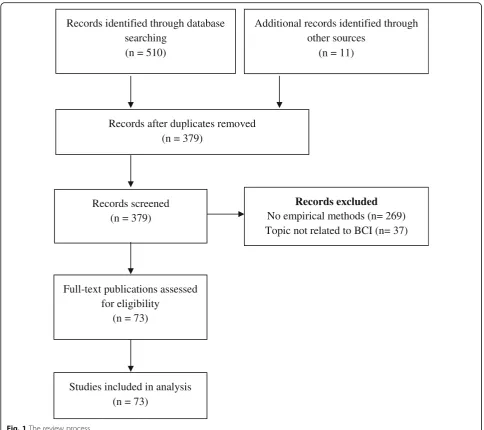
Figure 1 provides an overview of the review procedure according to the PRISMA flow diagram [28]. The initial database research yielded 510 records. In addition, further publications found online or via a snow-balling method were manually added (n= 11) at the first stage of the research process. After removing duplicates and applying the inclusion/exclusion criteria, we identified 73 relevant publications. All of these publications were retrieved as full texts and analyzed using thematic ana-lysis. The results were summarized in an Excel file. Each
selected publication has been summarized and listed in tabular form (see Additional file1).1We assessed risk of bias through evaluating and discussing our findings within a team of researchers at regular intervals.
The studies were categorized according to subgroups, reflecting the different groups of study participants (potential users, actual users, professionals, caregivers). Due to the amount of studies with potential and actual users, these groups each were divided further into two subgroups according to the methods used in the studies (namely quantitative and qualitative methods). This process allowed for a comprehensible display of the results and a more concise comparison within and among the various groups. In a second step, themes were identified by means of inductive reasoning in the style of the Qualitative Research Synthesis approach from Claire H. Major and Maggi Savin-Baden [29]. The themes are displayed either as columns in the tables or as bullet points.
Results
The final synthesis of the search undertaken contains a total of 73 publications of which 45 report quantitative studies, and ten refer to qualitative studies. Eighteen studies used a mixed-methods approach encompassing both quantitative and qualitative methods. Of the 73 publications, 13 report on the perspectives of potential users, i.e. persons who may have had a particular interest in using BCIs, but had no actual experience with BCIs. Fifty-eight publications focus on persons who have expe-rienced BCIs either before or during the very study of the respective publication. Five studies additionally encompass caregivers/relatives. Seven studies address experts/professionals.
Seventy-one of the 73 publications are focused on (potential or actual) BCI users. Two studies address BCI experts only. However, many of these 71 studies also encompass caregivers, experts, health care professionals or other BCI stakeholders.
Potential users
Research studies which have been conducted with potential users of BCIs mainly focus on assessing expec-tations that this particular group has about BCI as a so-called “assistive technology” device. These studies thus mostly limit these expectations to the question of the usability of the technology. The objective of such studies is to obtain information about the profile of the end-users for whom BCIs are being developed. The intent implicit therein is also to draw the developers’
attention to aspects deemed important by potential users, in order to meet user demand and adapt the tech-nology accordingly.
Quantitative studies
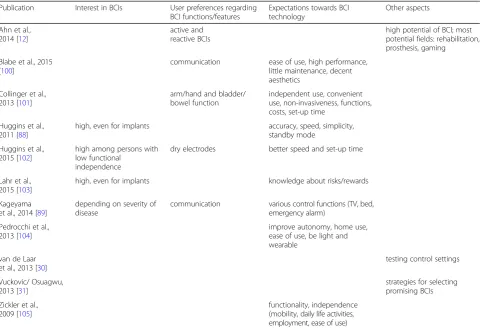
There are 11 studies included in the review which assess the opinion of potential BCI users by means of quanti-tative methods (surveys/questionnaires) (Table1). Three of the included quantitative studies evaluate non-im-paired participants. They assess preferences of gamers [12], test for control aspects in gaming [30], and work on selection strategies for BCI use [31]. Eight studies in contrast focused on the needs of persons with physical impairments. The impairment- or medically-focused studies evaluated the interest in BCIs among potential users, marking their preferences regarding different
Records excluded
No empirical methods (n= 269)
Topic not related to BCI (n= 37)
Records identified through database
searching
(n = 510)
Additional records identified through
other sources
(n = 11)
Records after duplicates removed
(n = 379)
Records screened
(n = 379)
Full-text publications assessed
for eligibility
(n = 73)
Studies included in analysis
(n = 73)
features and functions, and requirements the technology is supposed to meet.
Qualitative studies
Only two studies assessed the opinions of potential users by means ofqualitative methods. Klein et al. [32] set up a focus group and conducted telephone interviews with a total of 15 persons with implanted (open-loop) deep brain stimulation devices. The idea of BCI controlled closed-loop brain stimulation is met with acceptance among some potential users, while others feel ambiva-lent or opposed to the concept in principle. Comparing this hypothetical setting with the experiences of the study participants with open-loop brain stimulation, some participants welcomed the prospect of a self-con-trolled brain stimulation device while other participants maintained reservations. Some study participants ex-pected an improved level of self-expression while others feared a distortion of their sense of self. The new brain stimulation device might also further restrain the user’s sense of accountability, in the case that others would hold the device responsible for their behavior or expres-sions. Furthermore, this application would require more
trust in researchers to keep their data secure and confidential. This last point concerns the issue of mea-ningful consent. Participants mentioned difficulty in understanding all risks and implications of a closed-loop device both for themselves and for individuals with cognitive impairments.
Schicktanz, Amelung and Rieger [33] conducted
open interviews with ten persons with various
chronic conditions (e.g. amyotrophic lateral sclerosis (ALS), muscle atrophy, para−/tetraplegia), to whom they presented a video about a motor-readout BCI that controls a robotic arm. Participants hoped for more independence, self-control, privacy/intimacy, and better communication. Some were concerned about data protection and abuse. Additional con-cerns raised include the creation of self-transcending human-machine hybrids, as well as the fear for fur-ther dependencies, as the BCI necessitates service support and technological maintenance.
Actual users
For this review, 58 studies focused on actual or real life BCI users and their experiences with the technology,
Table 1Studies with potential users employing quantitative research methods
Publication Interest in BCIs User preferences regarding BCI functions/features
Expectations towards BCI technology
Other aspects
Ahn et al., 2014 [12]
active and reactive BCIs
high potential of BCI; most potential fields: rehabilitation, prosthesis, gaming
Blabe et al., 2015 [100]
communication ease of use, high performance, little maintenance, decent aesthetics
Collinger et al., 2013 [101]
arm/hand and bladder/ bowel function
independent use, convenient use, non-invasiveness, functions, costs, set-up time
Huggins et al., 2011 [88]
high, even for implants accuracy, speed, simplicity, standby mode
Huggins et al., 2015 [102]
high among persons with low functional
independence
dry electrodes better speed and set-up time
Lahr et al., 2015 [103]
high, even for implants knowledge about risks/rewards
Kageyama et al., 2014 [89]
depending on severity of disease
communication various control functions (TV, bed, emergency alarm)
Pedrocchi et al., 2013 [104]
improve autonomy, home use, ease of use, be light and wearable
van de Laar et al., 2013 [30]
testing control settings
Vuckovic/ Osuagwu, 2013 [31]
strategies for selecting promising BCIs Zickler et al.,
2009 [105]
functionality, independence (mobility, daily life activities, employment, ease of use)
usually stemming from experimental BCI studies that tested various BCI models in terms of their functionality and feasibility. The feedback from the study participants was largely limited to usability aspects. In most studies, the objective was to assess the opinion of the parti-cipants regarding the tested model and to gain infor-mation about what improvements need to be made.
Quantitative studies
Forty-eight studies evaluated the users' opinions or assessed various personal factors of BCI users by employing quantitative methods (mostly in the form of questionnaires). Twenty studies employed BCIs in non-impaired individuals, 17 studies tested BCIs in in-dividuals with various physical impairments, and ten studies included participants from both groups. Most of these studies were concerned with the usability and feasibility of the technology. The performance of BCIs for users was assessed in aspects such as efficiency, ef-fectiveness, and satisfaction. Furthermore, popular as-pects assessed included cognitive or psychological factors, such as memory, attention, fatigue, mood, motiv-ation, depression, and quality of life. Frequently applied tests were the NASA Task Load Index (NASA-TLX) for assessing subjective workload, the Quebec User Evaluation of Satisfaction with assistive Technology, Version 2.0 (QUEST 2.0) for measuring satisfaction, the Schedule for the Evaluation of Individual Quality of Life (SeiQol) for assessing the subjective quality of life, and the Question-naire for Current Motivation (QCM) for testing the level of motivation. Performance was measured by the accuracy of the tasks, by the number of successful trials per session, or by means of the information transfer rate (ITR). Satis-faction was assessed via QUEST 2.0, visual analog scales (VAS) or the Assistive Technology Device Predisposition Assessment (ATD-PA) scale. Thematic aspects that were covered by the quantitative studies with actual users included:
Usability[34–53] in terms of ease of use/difficulty [34,41–43,47,51], fatigue/exhaustion [34,35,39,41], usefulness [38,40,43], acceptance [36,44,45], comfort [48,51], or safety [44,45].
Performance[11,36–43,48,49,51,52,54–73] measured as accuracy [36,41–43,48,52,54,59–62,70], ITR [42,48,73], subjective level of control [58], number of successful trials [63], or skill development [67].
Satisfaction[38–40,48,51,56,58,61–66,69–72, 74] mostly assessed via VAS, QUEST 2.0, and/or ATD-PA.
Psychological factorssuch as motivation [38,42, 47,50,55,57,63,66,75,76], mood [11,32,50,63, 66,68], depression [38,50,52,63], memory and
attention [42,44,45], concentration [42,77], or motor/kinesthetic imagery [68,69,75].
Workloadevaluated as efficiency via ITR and NASA-TLX [38,40,56,61,62,71,72], NASA-TLX only [39,47,53,57,58,63–66,78,79], Repeatable Battery for Neuropsychological Status (RBANS) score [44,45], or VAS [51].
Quality of lifemeasured via SEIQol [38,50,56], the Anamnestic Comparative Self-Assessment (ACSA) [38,56] or the Psychosocial Impact of Assistive Devices Scale (PIADS) [39,40] (some use PIADS for measuring user satisfaction, not quality of life, e.g. Vansteensel et al. [74]).
Other aspects addressed were presence [54,55,70], knowledge, purpose of use, and future visions [80], plasticity and body projection [54], control/self-regulation [59,73], comfort of (dry) electrodes [60], engagement [53], novelty [48], and physical state [11].
These aspects were assessed for non-impaired partici-pants as well as for participartici-pants with physical impair-ments. Quality of life was measured among the latter only.
Qualitative studies
Altogether from the qualitative studies evaluating BCI users’ perspectives, 21 studies emerged. Most of the qualitative studies used interview studies or focus groups. Several also opted for observations [81, 82] or
discourse analysis [33]. One study focused on
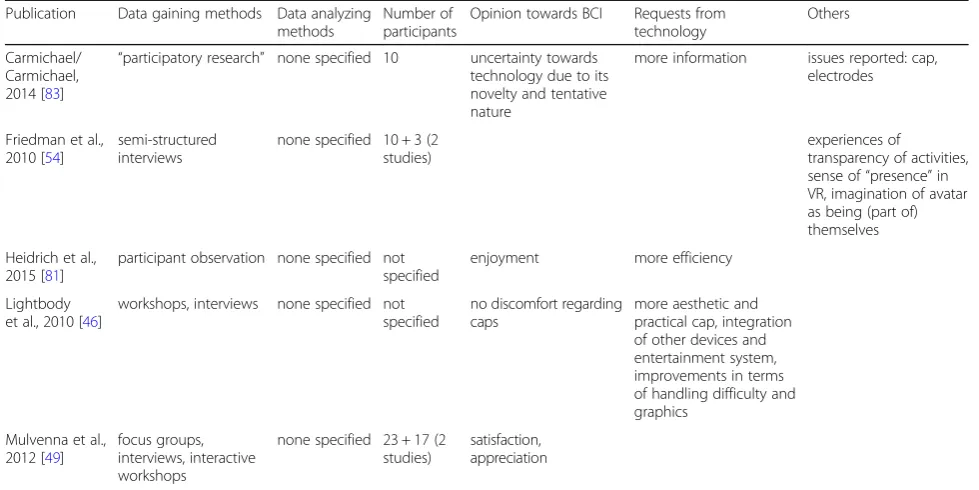
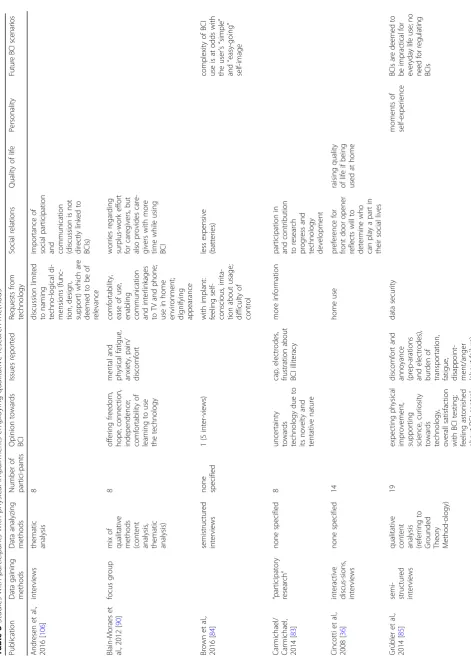
non-impaired participants only [54], 16 studies on par-ticipants with physical impairments, and four studies on a mixed population. In the breakdown of mixed methods studies, there are five studies including non--impaired participants (Table2) and 20 studies with par-ticipants with physical impairments (Table 3). The objective of such qualitative studies was to improve and develop the technology of BCI as well as to embrace a medico-technological approach. Hence, quali-tative data gaining methods were used for this purpose only. The studies which did not specify any qualitative data analyzing methods mostly ran statistical analyses and addressed the qualitative data as secondary [10, 36, 38,40,46,49,54,56, 61, 62, 71, 72, 81, 83, 84]. Certain studies aimed also to address ethical aspects related to BCIs [83,85–87].Şahinol [82] researched BCIs as part of a genuine sociological study including elaborated sections about the methods employed in the technol-ogy’s use. Her study describes the mutual adaptation process between human and machine, resulting in the figure of a techno-cerebral subject.
technology itself, such as aspects regarding social relations, quality of life, personality, and future BCI use.
Unlike non-impaired participants, persons with phys-ical impairments have certain expectations of BCIs. Those affected by physical impairment tend to hope for more independence and social participation and expect from BCI use an increased quality of life. Some studies recognized the potential of BCI use to contrib-ute to the user’s self-esteem and self-expression. BCIs are reported as bringing satisfaction and enjoyment, al-though space for improvement certainly remains in this area.
Other BCI stakeholders
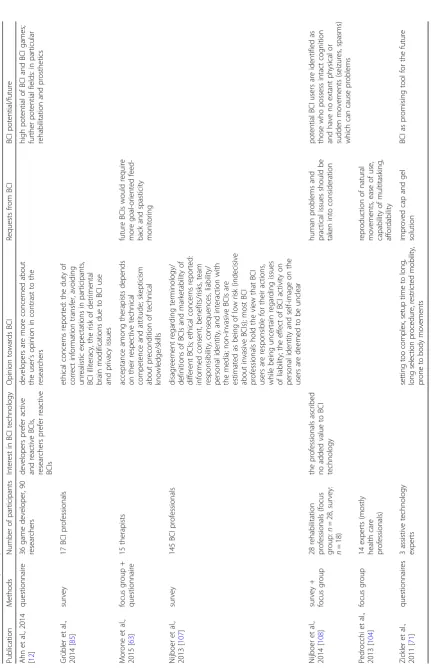
Aside from the users themselves, BCI studies also often feature inquiries into the experience of relatives, care-givers, assistants, BCI professionals, developers, health care professionals or company representatives. Expert studies consisting of BCI professionals, game developers, and therapists/health care professionals are either focused on the potential and ethical aspects of BCI (BCI profes-sionals) or on requests and concerns regarding BCI (ther-apists/health care professionals) (Table4). These external stakeholder opinions are often addressed only marginally and sometimes are not displayed separately from the users’perspective. A recurring group of stakeholders are caregivers (and/or relatives/assistants). Their participation forms part of focus groups or compliment the user’s per-spective (Table 5). Their opinions hardly are presented separately from other results.
Discussion
The systematic search presented in this review offers an outline of BCI research which employs social research methods (in all of its methodological and thematic variety.) The occurrence of empty boxes in the tabular displays above indicates the heterogeneity of the BCI studies found. Some studies focus upon and include specific aspects studied, while others concentrate on divergent aspects.
Prominent topics within BCI research have been highlighted and research gaps identified. The majority of the studies addressed are concerned with the usability and feasibility of BCIs. This provides valuable and neces-sary knowledge for BCI professionals to improve and optimize use of the technology. Potential users in the studies examined point out requirements they would ex-pect of BCIs, such as standards of speed, efficiency, and ease of use. BCI use should improve their overall situ-ation and not place an extra burden on relatives or care-givers. The general level of satisfaction that BCIs experience among actual users proves that current technological development is likely on the right track. Actual users are able to pinpoint more specific aspects which may inspire further innovation. Besides the several points addressed by potential users, there was additional mention of a more appealing design of EEG caps, a pre-ference for dry electrodes, the integration of particular devices (e.g. TV, phone), and a stress placed on the importance of home-based use.
Apart from the conceptual disparities between the dif-ferent studies mentioned above, further difficulties arise
Table 2Studies with non-impaired participants employing qualitative research methods
Publication Data gaining methods Data analyzing methods
Number of participants
Opinion towards BCI Requests from technology
Others
Carmichael/ Carmichael, 2014 [83]
“participatory research” none specified 10 uncertainty towards technology due to its novelty and tentative nature
more information issues reported: cap, electrodes
Friedman et al., 2010 [54]
semi-structured interviews
none specified 10 + 3 (2 studies)
experiences of
transparency of activities, sense of“presence”in VR, imagination of avatar as being (part of) themselves Heidrich et al.,
2015 [81]
participant observation none specified not specified
enjoyment more efficiency
Lightbody et al., 2010 [46]
workshops, interviews none specified not specified
no discomfort regarding caps
more aesthetic and practical cap, integration of other devices and entertainment system, improvements in terms of handling difficulty and graphics
Mulvenna et al., 2012 [49]
focus groups, interviews, interactive workshops
none specified 23 + 17 (2 studies)
Table 3 Studies with participants with physical impairments employing qualitative research methods Publication Data gaining methods Data analyzing methods Number of partici-pants Opinion towards BCI Issues reported Reques ts from technology Social relations Quality of life Personality Fu tu re B C Is ce n ar io s Andresen et al., 2016 [ 106 ] interviews thematic analysis 8 discussion limite d to naming techno-logical di-mensions (func-tion, design, support) whic h are deeme d to be of relevance importance of social participation
and communication (discussion
is no t directly linked to BCIs) Blain-Moraes et al., 2012 [ 90 ] focus group mix of
qualitative methods (content analysis, thematic analysis)
8 offer ing freedom , hope, con nection, independence; comfor tability of learning to use the technology mental and physical fatigue, anxiety, pain/ discomfort comfortability, ease of use,
enabling communication and
interlinkages to TV and phone; use in home
environment; dignifying appearance
worries regarding surplus-work ef fort for car egivers, but also provides care-givers with more time while using BCI Brown et al., 2016 [ 84 ] semistructured interviews none specified 1 (5 inter-views) with implan t: feeling self-conscious, irrita-tion about usage; difficulty of control less expensive (batteries) complexity of BCI use is at odds with the user ’ s “ simple ” and “ easy-going ” self-image
Carmichael/ Carmichael, 2014
[ 83 ] “ participatory research ” none specified 8 uncert ainty towards technology due to its novelty and tentative nature cap, electrodes, frustration about BCI illiteracy more information participation in and contribution to research progress and technology development Cincotti et al., 2008 [ 36 ]
interactive discus-sions, interviews
none specified 14 home use preference for front door opener reflects will to determine who can play a part in their social lives raising quality of life if being used at h ome Grübler et al., 2014 [ 85 ]
semi- structured interviews qualitative content analysis (referring
to
Grounded Theory Method-ology)
19
expecting
physical
improvement, supporting science,
curiosity towards technology , overall satisfaction with BC I testing; feeling astonished about BCI control discomfort and
annoyance (prep-arations and
electrodes),
burden
of
transportation, fatigue, disappoint- ment/
Table 3 Studies with participants with physical impairments employing qualitative research methods (Continued) Publication Data gaining methods Data analyzing methods Number of partici-pants Opinion towards BCI Issues reported Reques ts from technology Social relations Quality of life Personality Fu tu re B C Is ce n ar io s Grübler/Hildt, 2014 [ 87 ]
semi- structured interviews
(same as in Grübler et al. 2014) 19 (same as in Grübler et al. 2014)
varying opinions regarding
(1) forming a functional unit with the BCI and (2) being able to forget about the technology while using it Heidrich et al., 2015 [ 81 ] participant obser-vation none specified not specified enjoym ent more efficiency Hildt, 2014 [ 86 ]
semi- structured interviews
(same as in Grübler et al. 2014) same as in Grübler et al. 2014
varying opinions regarding
(1) forming a functional unit with the BCI and (2) being able to forget about the technology while using it Holz, 2015 [ 38 ]
semi- structured interviews
none specified 4 + 4 + 2
(three different studies)
provides
joy
and
happine
ss
provides opportunities for
creativity and self-expression Holz et al., 2013 [ 56 ]
semi- structured interviews, focus
Table 3 Studies with participants with physical impairments employing qualitative research methods (Continued) Publication Data gaining methods Data analyzing methods Number of partici-pants Opinion towards BCI Issues reported Reques ts from technology Social relations Quality of life Personality Fu tu re B C Is ce n ar io s imperatives for daily BCI u se Lightbody et al., 2010 [ 46 ] workshop, interviews none specified 15 satisfaction, preferenc e for testing communi-cation functions disconten t with phone function control of technical devices (especially TV), better ease of use being part of research team potential for providing more engagement and participation Mulvenna et al., 2012 [ 49 ] focus groups,
interviews, interactive workshops
none specified 20 + 11 satisfaction, appreciation Ş ahinol, 2016 [ 82 ] ethno-graphic field work (passive and
participant obser-vations, video
and audio mate-rials, in-depth interviews) Grounded Theory Metho-dology 6 (inter-views with
study partici- pants)
physical
and
mental
strains,
frustration, belied expectations, pain
participation in studies as a pastime on the one hand: sense of
agency, cooperation with
machine;
on
the
other
hand: uncertainty about
causes of actions (self or machine), feeling of objectifycation due to being a study participant Salisbury et al., 2016 [ 10 ]
semi- structured qualitative questions
none specified 25 enjoym ent Zickler et al., 2011 [ 71 ] open interviews none specified 4 control of wheelcha ir and other devices daily use would require improve-men ts regarding the cap, the ease of use, the size o f the hardware, speed, and additional con trol oppo rtunities Zickler et al., 2013 [ 72 ]
semi- structured qualitative questions
when considering the huge variety of participant groups, not only between non-impaired and impaired individ-uals, but also with regard to the multitude of conditions seen among the participants with physical impairments. As the majority of studies contained a mixed sample of participants with various physical impairments, specific conclusions hardly can be drawn for BCI use for parti-cular conditions. Only a handful of studies examined persons with a singular type of impairment (often in case studies with a single participant). These impair-ments included stroke [57, 63], cerebral palsy [67, 81], and essential tremor [84]. The exception thus is a total of 12 studies solely (or in combination with non-im-paired participants) conducted with persons having ALS
[37,39–41,50, 58,59, 74, 88–91]. These results do not
differ significantly from the other studies. One difference might be that persons with ALS (especially those in ad-vanced stages) show a higher degree of interest in BCIs. This may be explained by the dismal outlook for mobil-ity from this disease, which gradually robs patients of the ability to move their limbs, communicate verbally and interact with their environment, approaching a state of locked-in syndrome. In other conditions, patients may retain certain motor functions of their body that may allow them to use other technological devices, such as peripheral neuroprostheses. Few studies have been con-ducted with BCI professionals.
Very little interest has been placed so far on the ex-periential dimension of BCI users beyond usability as-pects. Where the BCI literature examines “user experience” - sometimes simply called “UX” [47] - or pursues a user-centred approach, the respective studies apply psychological factors like mood, motivation, or de-pression, the participants’ quality of life, satisfaction, their opinions, judgements, and requests to BCI use. In
contrast to the user’s experience with BCI, the user’s ex-perience of BCI has been hardly researched. This out-look would comprise questions towards BCI use from the point of view of philosophy and social sciences, broadly describable as the What is it like? – perspec-tive. What is it like to use a BCI? What is it like to act by using a BCI? And therefore: What is it like to act without using my body? What is it like to be hooked up to a machine or computer? Is it (still) me that is acting within this BCI system or is it some kind of human-machine hybrid? These are questions that address topics like agency, autonomy, responsibil-ity, accountabilresponsibil-ity, self-image, identresponsibil-ity, hybridization, or artificial intelligence.
Dealing with these questions will be of major rele-vance, not only because the BCI relies on a new form of connection between human and machine, but also be-cause the technology produces bodily experiences the user would not have otherwise. For example, performing an action without moving a body part opposes our com-mon understanding and sensation of being an agent and can manifest itself as a new experience.
First attempts in this direction have been made by Grübler and Hildt [85–87]. Their research study raised the question of transparency, i.e. the ability to operate a tool without having to consciously apply its operating in-structions. Applied to the example of BCIs, this would mean operating a BCI without focusing on a mental strategy. The study in question also asked participants whether they felt themselves to be a part of a functional unit with the computer. Some participants reported ex-periencing transparency, but fewer participants reported having felt being a part of a functional unit with the computer. The authors postulate a discrepancy between these two judgements.
Table 5Studies with caregivers/relatives
Publication Methods Number of participants Points addressed Andresen et al., 2016 [106] qualitative interviews 7 caregivers (paid und unpaid/
family caregivers)
esp. Quality of Life and AT-use emerged as major themes (results not separate from user study, see also Table3) Blain-Moraes et al., 2012 [90] focus group (with
users)
9 caregivers BCI is regarded as an opportunity to maintain
communication between caregivers and caretakers; caregivers would appreciate the opportunity of“back communication” (i.e. informing their caretakers, e.g. letting them know that they are on their way); caregivers also see an additional burden in dealing with the BCI (see also Table3) Geronimo et al., 2015 [37] surveys (before and
after testing)
41 caregivers caregivers ranked BCI functions similar to their caretakers: priority of accuracy, variety of functions, standby reliability, wheelchair and computer control (results not separate from user study, see also Table3)
Holz et al., 2013 [56] focus group 3 caregivers (only featured) focus group describes barriers for BCI use (physical,
psychological, social) and its potential (freedom, independence) Liberati et al., 2015 [91] focus group 2 relatives + 6 caregivers and/
or health professionals
Şahinol [82] points to several aspects related to the sense of agency and shared agency with the computer, revealing uncertainties among the users about how to make sense of BCI activities. The objective of Şahinol’s study, however, is about the adaptation process between humans and machines and therefore does not elaborate on the subjective user perspective regarding these as-pects. Two studies published after the completion of our data collection and review, specifically by Gilbert et al., questioned users with implanted BCIs for the treatment of epilepsy. These studies yielded valuable insights re-garding control and self-perception [92] as well as au-tonomy and deliberation processes [93]. This step would be crucial in working to close the research gap outlined above.
Among studies with BCI professionals, the focus lies on ethics. Crucial areas of inquiry like informed consent, managing users’ expectations, and psycho-social conse-quences of BCI use are explored. Another recent study, conducted by Specker Sullivan et al. with neural engineers [94], was directed towards an improved sensitization of the inclusion of users in the develop-ment process of BCIs. The user-centred design endorsed in the paper is present among various studies of this re-view’s body of literature [38, 57, 58, 62, 72, 91]. Thera-pists and health care professionals are skeptical about BCIs and require certain improvements of the technol-ogy. Caregivers’perspectives resemble users’opinions. A study focusing on caregivers only, however, has not been conducted so far.
As most of the studies discussed in this article are guided by a medico-technological approach, ethical issues are hardly being addressed and under-researched. This ob-servation about the field of inquiry in BCIs is discussed in detail by Specker Sullivan and Illes [95]. When ethical pects are addressed, it is in accordance with the ethical as-pects addressed in the ethics literature, as shown by Burwell et al. [96]. Matters such as autonomy, agency, per-sonality, safety or privacy are comprised.
Our own team of researchers encourages more empir-ical work on these matters. While philosophempir-ical in nature, matters such as agency, autonomy and responsibility are also highly relevant for legal and policy-making affairs. This particularly depends on the part the user plays within the loop of the BCI, and its data collection. Particular closed-loop neuro devices such as closed-loop DBS modu-late stimulations outside the awareness of the user and therefore cause moral and legal issues of accountability [97]. In BCIs the user receives feedback in some form (vis-ual, auditory or haptic). She usually is nominally aware of this feedback and is given the opportunity to react to it de-liberatively. The user “stays in the loop” even at least partly when connected to some autonomous system and hence gives rise to a different situation of accountability
[98]. To evaluate these aspects in practice would yield im-portant insights to inform moral, legal and political debates.
Limitations
This study has several limitations. First of all, a scoping re-view cannot guarantee that all scientific literature is ex-haustively found and analyzed. The literature output is confined to studies that explicitly study brain-computer-or brain-machine-interfaces brain-computer-or imply one of the terms as a key term. Some technologies that are labelled under “neu-rofeedback”, “closed-loop” or “predictive brain devices” may also qualify as brain-computer-interfaces. However, as not all of these are de facto brain-computer-interfaces and to keep the task at hand feasible, we confined our
search to the search terms brain-computer* and
brain-machine*. For the same reason we disregarded com-parisons to other technologies such as open-loop deep brain stimulation which may render comparable results (e.g. [99]). Among the studies examined, we added manu-ally some publications (books and book chapters) which are not peer-reviewed publications.
In order to manage the total search outcome of 73 publications, various differentiations have been neglected and need further examination: BCI varies widely in terms of its technical set-up, of which each applica-tion and model would require particular attenapplica-tion, e.g. in terms of measurement (invasive - non-invasive, EEG, NIRS, fMRT, ECoG, or others), mental strategy (selective attention, motor imagery), stimuli set-up (visual, auditory, haptic), application (communication program, prostheses, computer game, or others), or type of neurofeedback (displayed on monitor, success-ful movements, or others). Also comparisons between non-impaired participants and participants with phys-ical impairments as well as between different impair-ments deserve more detailed attention. The scoping review method is a useful tool to map and synthesis large bodies of literature which comes at the expense of a detailed analysis of the results. The various themes identified in this review therefore deserve a further, elaborated examination.
Conclusion
A great deal of research has been conducted on the perspectives of potential and actual BCI users. These opinions, and emerging social research data, are key in advancing the development of user-appropriate, hu-mane, and successful BCI technology. BCIs have much to offer: the ability to increase quality of life, enhance social life, and contribute to a higher level of self-determination and independence for persons with
technology can lead to impingements on human au-tonomy, psychological frustration, the creation of de-pendency, and the causing of confusion regarding user self-perception. The qualitative self-experience of BCI users, i.e. aspects related to personal identity, agency, and responsibility, has hardly been examined thoroughly. This is due to the delicate and demanding nature of this research as well as a limited number of study participants until now. Nonetheless, as ques-tions regarding the experience of BCI users are cru-cial for evaluating ethical and societal aspects of an emerging technology, more empirical research on these matters is deeply encouraged by researchers involved.
Endnotes
1
The list in the Additional File is categorized according to research interest, methods, number of participants, BCI testing, BCI type, and results. These categories have been chosen to render a comprehensible overview of the body of literature. The purpose of the categorization is to serve as a helpful tool to the researchers, it is not part of the analyzing method applied and outlined in the review.
Additional file
Additional file 1:List of all 73 studies examining BCIs by means of social research methods. Studies are listed regarding research interest, methods, number of participants, BCI testing, BCI type, and results. (DOCX 44 kb)
Abbreviation
BCI:Brain-computer interface
Acknowledgements
We would like to thank our colleagues from the Institute of Ethics, History and Theory of Medicine of the LMU Munich for providing helpful comments on a previous version of this manuscript. We are thankful to Rose Richards for proofreading and commenting on a previous version and to Mary Clare
O’Donnell for proofreading on the final version of this article.
Funding
Funding for this study was obtained from the German Federal Ministry of Education and Research (01GP1622A) within the ERA-NET Neuron programme. Jennifer R. Schmid is supported by a Hanns Seidel Foundation studentship.
The funders were not involved in data collection or analysis or writing of this article.
Availability of data and materials
All data generated or analyzed during this study are included in this published article and its supplementary information files.
Authors’contributions
All authors contributed to study design and planning. JK and JS conducted the literature searches, organized and analyzed collected references. JK, JS and OF wrote different sections of the article. RJ and OF provided review of analysis results and suggested revisions for the write-up. All authors reviewed and approved the manuscript.
Ethics approval and consent to participate Not applicable.
Consent for publication Not applicable.
Competing interests
JK, JS and OF declare that they have no competing interests. RJ is member of the Editorial Board for BMC Medical Ethics.
Publisher’s Note
Springer Nature remains neutral with regard to jurisdictional claims in published maps and institutional affiliations.
Received: 30 March 2018 Accepted: 22 February 2019
References
1. Shih JJ, Krusienski DJ, Wolpaw JR. Brain-computer interfaces in
medicine. Mayo Clin Proc. 2012;87(3):268–79.https://doi.org/10.1016/j.
mayocp.2011.12.008.
2. Brunner C, Birbaumer N, Blankertz B, Guger D, Kübler A, Mattia D, et al. BNCI
Horizon 2020: towards a roadmap for the BCI community. Brain-Comput
Interfaces. 2015.https://doi.org/10.1080/2326263X.2015.1008956e-pub 10
Feb 2015.
3. Bouton CE, Shaikhouni A, Annetta NV, Bockbrader MA, Friedenberg DA,
Nielson DM, et al. Restoring cortical control of functional movement in a
human with quadriplegia. Nature. 2016;533(7602):247–50.
4. Daly JJ, Wolpaw JR. Brain–computer interfaces in neurological rehabilitation.
Lancet Neurol. 2008;7(11):1032–43.
5. Graimann B, Allison B, Pfurtscheller G. Brain–Computer Interfaces: A Gentle
Introduction. In: Graimann B, Pfurtscheller G, Allison B, editors. Brain-Computer Interfaces. Berlin, Heidelberg: Heidelberg: Springer; 2009.
6. Mak JN, Wolpaw JR. Clinical applications of brain-computer interfaces:
current state and future prospects. IEEE Rev Biomed Eng. 2009;2:187–99.
https://doi.org/10.1109/rbme.2009.2035356.
7. Marchetti M, Priftis K. Brain–computer interfaces in amyotrophic lateral
sclerosis: a metanalysis. Clin Neurophysiol. 2015;126(6):1255–63.https://doi.
org/10.1016/j.clinph.2014.09.017.
8. Wolpaw JR, Birbaumer N, McFarland DJ, Pfurtscheller G, Vaughan TM. Brain–
computer interfaces for communication and control. Clin Neurophysiol.
2002;113(6):767–91.
9. Chaudhary U, Birbaumer N, Ramos-Murguialday A. Brain-computer interfaces
for communication and rehabilitation. Nat Rev Neurol. 2016;12(9):513–25.
https://doi.org/10.1038/nrneurol.2016.113.
10. Salisbury DB, Parsons TD, Monden KR, Trost Z, Driver SJ. Brain-computer
interface for individuals after spinal cord injury. Rehabil Psychol. 2016;61(4): 435–41.https://doi.org/10.1037/rep0000099.
11. Maksimenko VA, van Heukelum S, Makarov VV, Kelderhuis J, Lüttjohann A,
Koronovskii AA, et al. Absence seizure control by a brain computer interface. Sci Rep. 2017;7:2487.
12. Ahn M, Lee M, Choi J, Jun SC. A review of brain-computer interface games
and an opinion survey from researchers, developers and users. Sensors
(Basel, Switzerland). 2014;14(8):14601–33.https://doi.org/10.3390/
s140814601.
13. McFarland DJ, Daly J, Boulay C, Parvaz MA. Therapeutic applications of BCI
technologies. Brain-Comput Interfaces. 2017;4(1–2):37–52.
14. Zafar MB, Shah KA, Malik HA. Prospects of sustainable ADHD treatment
through Brain-Computer Interface systems. 2017 International Conference on Innovations in Electrical Engineering and Computational Technologies
(ICIEECT). IEEE. 2017.https://doi.org/10.1109/ICIEECT.2017.7916532.
15. Lebedev MA, Nicolelis MA. Brain-machine interfaces: past, present and
future. Trends Neurosci. 2006;29(9):536–46.https://doi.org/10.1016/j.tins.
2006.07.004.
16. Schalk G. Can electrocorticography (ECoG) support robust and powerful
brain-computer interfaces? Front Neuroeng. 2010;3:9.https://doi.org/10.
3389/fneng.2010.00009.
17. Yuan H, He B. Brain-computer interfaces using sensorimotor rhythms:
18. Zander TO, Krol LR. Team PhyPA: brain-computer interfacing for everyday human-computer interaction. Periodica Polytechnica Electr Eng Comput Sci. 2017;61(2):209.
19. Goering S, Klein E, Dougherty DD, Widge AS. Staying in the loop: relational
agency and identity in next-generation DBS for psychiatry. AJOB Neurosci.
2017;8(2):59–70.
20. Kiran AH, Verbeek P-P. Trusting our selves to technology. Knowl Technol
Policy. 2010;23(3–4):409–27.
21. Van Den Eede Y. Tracing the tracker: A postphenomenological inquiry into
self-tracking technologies. In: Rosenberger R, Verbeek P-P, editors. Postphenomenological investigations: Essays on human technology
relations. Lanham: Lexington Books; 2015. p. 143–58.
22. Verbeek P-P. Subject to technology: on autonomic computing and human
autonomy. In: MH AR, editor. Law, Human Agency, and Autonomic Computing. The Philosophy of Law meets the Philosophy of Technology.
London: Routledge; 2011. p. 27–45.
23. Colquhoun HLLD, O'Brien KK, Straus S, Tricco AC, Perrier L, Kastner M, Moher
D. Scoping reviews: time for clarity in definition, methods, and reporting. J
Clin Epidemiol. 2014;67(12):1291–4.
24. Arksey H, O’Malley L. Scoping studies: towards a methodological framework.
Int J Soc Res Methodol. 2005;8(1):19–32.
25. Levac D, Colquhoun H, O'Brien KK. Scoping studies: advancing the
methodology. Implement Sci. 2010;5.https://doi.org/10.1186/1748-5908-5-69.
26. Peters M, Godfrey C, Khalil H, McInerney P, Parker D, Soares CB. Guidance
for conducting systematic scoping reviews. Int J Evid Based Healthc. 2015;
13(3):141–6.
27. Payne G, Payne J. Key concepts in social research. London: Routledge; 2004.
28. Moher D, Liberati A, Tetzlaff J, Altman DG. The PRISMA statement. PLoS
Med. 2009;6(7):e1000097.https://doi.org/10.1371/journal.pmed1000097.
29. Major CH, Savin-Baden M. An introduction to qualitative research synthesis.
Managing the inforrmation explosion in social science research. Oxon: Routledge; 2010.
30. van de Laar B, Plass-Oude Bos D, Reuderink B, Poel M, Nijholt A. How much
control is enough? Influence of unreliable input on user experience. IEEE
Transact Cybern. 2013;43(6):1584–92.https://doi.org/10.1109/tcyb.2013.
2282279.
31. Vuckovic A, Osuagwu BA. Using a motor imagery questionnaire to estimate
the performance of a brain-computer Interface based on object oriented
motor imagery. Clin Neurophysiol. 2013;124(8):1586–95.https://doi.org/10.
1016/j.clinph.2013.02.016.
32. Klein E, Goering S, Gagne J, Shea CV, Franklin R, Zorowitz S, et al.
Brain-computer interface-based control of closed-loop brain stimulation: attitudes
and ethical considerations. Brain-Comput Interfaces. 2016;3(3):140–8.https://
doi.org/10.1080/2326263X.2016.1207497.
33. Schicktanz S, Amelung T, Rieger JW. Qualitative assessment of patients’
attitudes and expectations toward BCIs and implications for future
technology development. Front Syst Neurosci. 2015;9:64.https://doi.org/10.
3389/fnsys.2015.00064.
34. Allison B, Jin J, Zhang Y, Wang X. A four-choice hybrid P300/SSVEP BCI for
improved accuracy. Brain-Comput Interfaces. 2014;1(1):17–26.https://doi.
org/10.1080/2326263X.2013.869003.
35. Cao T, Wan F, Wong CM, da Cruz JN, Hu Y. Objective evaluation of fatigue
by EEG spectral analysis in steady-state visual evoked potential-based
brain-computer interfaces. Biomed Eng Online. 2014;13(1):28.https://doi.org/10.
1186/1475-925x-13-28.
36. Cincotti F, Mattia D, Aloise F, Bufalari S, Schalk G, Oriolo G, et al.
Non-invasive brain-computer interface system: towards its application as assistive
technology. Brain Res Bull. 2008;75(6):796–803.https://doi.org/10.1016/j.
brainresbull.2008.01.007.
37. Geronimo A, Stephens HE, Schiff SJ, Simmons Z. Acceptance of
brain-computer interfaces in amyotrophic lateral sclerosis. Amyotroph Lateral
Scler Frontotemporal Degen. 2015;16(3–4):258–64.https://doi.org/10.3109/
21678421.2014.969275.
38. Holz E. Systematic evaluation of non-invasive brain-computer interfaces as
assistive devices for persons with severe motor impairment based on a
user-centred approach–in controlled settings and independent use.
Würzburg: Universität Würzburg; 2015.
39. Holz EM, Botrel L, Kaufmann T, Kubler A. Long-term independent
brain-computer interface home use improves quality of life of a patient in the
locked-in state: a case study. Arch Phys Med Rehabil. 2015;96(3 Suppl):S16–
26.https://doi.org/10.1016/j.apmr.2014.03.035.
40. Holz EM, Botrel L, Kübler A. Independent home use of brain painting
improves quality of life of two artists in the locked-in state diagnosed with
amyotrophic lateral sclerosis. Brain-Comput Interfaces. 2015;2(2–3):117–34.
https://doi.org/10.1080/2326263X.2015.1100048.
41. Kathner I, Kubler A, Halder S. Comparison of eye tracking,
electrooculography and an auditory brain-computer interface for binary communication: a case study with a participant in the locked-in state. J
Neuroeng Rehabil. 2015;12:76.https://doi.org/10.1186/s12984-015-0071-z.
42. Kleih SC, Herweg A, Kaufmann T, Staiger-Salzer P, Gerstner N, Kubler A. The
WIN-speller: A new intuitive auditory brain-computer interface spelling
application. Front Neurosci. 2015;9:346.https://doi.org/10.3389/fnins.2015.
00346.
43. Kosmyna N, Tarpin-Bernard F, Bonnefond N, Rivet B. Feasibility of BCI
control in a realistic smart home environment. Front Hum Neurosci. 2016;
10:10.https://doi.org/10.3389/fnhum.2016.00416.
44. Lee TS, Goh SJ, Quek SY, Phillips R, Guan C, Cheung YB, et al. A
brain-computer interface based cognitive training system for healthy elderly: a randomized control pilot study for usability and preliminary efficacy. PLoS
One. 2013;8(11):e79419.https://doi.org/10.1371/journal.pone.0079419.
45. Lee TS, Quek SY, Goh SJ, Phillips R, Guan C, Cheung YB, et al. A pilot
randomized controlled trial using EEG-based brain-computer interface training for a Chinese-speaking group of healthy elderly. Clin Interv Aging.
2015;10:217–27.https://doi.org/10.2147/cia.s73955.
46. Lightbody G, Ware M, McCullagh P, Mulvenna MD, Thomson E, Martin S et al. A
user centred approach for developing Brain-Computer Interfaces. Conference: 4th International Conference on Pervasive Computing Technologies for Healthcare, PervasiveHealth 2010, Munich, Germany, 22-25 March, 2010.
47. Lorenz R, Pascual J, Blankertz B, Vidaurre C. Towards a holistic assessment of
the user experience with hybrid BCIs. J Neural Eng. 2014;11(3):035007.
https://doi.org/10.1088/1741-2560/11/3/035007.
48. Mayaud L, Cabanilles S, Van Langhenhove A, Congedo M, Barachant A,
Pouplin S, et al. Brain-computer interface for the communication of acute patients: a feasibility study and a randomized controlled trial comparing performance with healthy participants and a traditional assistive device.
Brain-Comput Interfaces. 2016;3(4):197–215.https://doi.org/10.1080/
2326263x.2016.1254403.
49. Mulvenna M, Lightbody G, Thomson E, McCullagh P, Ware M, Martin S.
Realistic expectations with brain computer interfaces. J Assist Technol. 2012;
6(4):233–44.
50. Nijboer F, Birbaumer N, Kubler A. The influence of psychological state and
motivation on brain-computer interface performance in patients with amyotrophic lateral sclerosis - a longitudinal study. Front Neurosci. 2010;4.
https://doi.org/10.3389/fnins.2010.00055.
51. Peters B, Mooney A, Oken B, Fried-Oken M. Soliciting BCI user experience
feedback from people with severe speech and physical impairments.
Brain-Comput Interfaces. 2016;3(1):47–58.https://doi.org/10.1080/2326263X.2015.
1138056.
52. Poletti B, Carelli L, Solca F, Lafronza A, Pedroli E, Faini A, et al. Cognitive
assessment in amyotrophic lateral sclerosis by means of P300-brain computer Interface: a preliminary study. Amyotroph Lateral Scler
Frontotemporal Degen. 2016;17(7–8):473–81.https://doi.org/10.1080/
21678421.2016.1181182.
53. Gürkök H, Hakvoort G, Poel M. Evaluating User Experience in a Selection Based
Brain-Computer Interface Game A Comparative Study. In: Anacleto JC, Fels S, Graham N, Kapralos B, Saif El-Nasr M, Stanley K, editors. Entertainment
Computing–ICEC 2011: 10th International Conference, ICEC 2011, Vancouver,
Canada, October 5–8, 2011. Proceedings. Berlin: Springer; 2011. p. 77–88.
54. Friedman D, Leeb R, Pfurtscheller G, Slater M. Human-computer Interface
issues in controlling virtual reality with brain-computer Interface.
Human-Comput Interaction. 2010;25(1):67–94.https://doi.org/10.1080/
07370020903586688.
55. Friedrich EVC, Scherer R, Neuper C. Long-term evaluation of a 4-class
imagery-based brain–computer interface. Clinical Neurophysiology. 2013;
124:916–27.http://dx.doi.org/10.1016/j.clinph.2012.11.010.
56. Holz EM, Hohne J, Staiger-Salzer P, Tangermann M, Kubler A.
Brain-computer interface controlled gaming: evaluation of usability by severely
motor restricted end-users. Artif Intell Med. 2013;59(2):111–20.https://doi.
org/10.1016/j.artmed.2013.08.001.
57. Schreuder M, Riccio A, Risetti M, Dahne S, Ramsay A, Williamson J, et al.
User-centered design in brain-computer interfaces-a case study. Artif Intell
58. Botrel L, Holz EM, Kübler A. Brain painting V2: evaluation of P300-based brain-computer interface for creative expression by an end-user following
the user-centered design. Brain-Comput Interfaces. 2015;2:135–49.
59. Grosse-Wentrup M, Schölkopf B. A brain-computer interface based on
self-regulation of gamma-oscillations in the superior parietal cortex. J Neural
Eng. 2014;11(5):056015.https://doi.org/10.1088/1741-2560/11/5/056015.
60. Guger C, Krausz G, Allison BZ, Edlinger G. Comparison of dry and gel based
electrodes for P300 brain-computer interfaces. Front Neurosci. 2012:60.
https://doi.org/10.3389/fnins.2012.00060.
61. Kübler A, Holz E, Kaufmann T, Zickler C. A User Centred Approach for
Bringing BCI Controlled Applications to End-Users. 2013.https://doi.org/10.
5772/55802.
62. Kubler A, Holz EM, Riccio A, Zickler C, Kaufmann T, Kleih SC, et al. The
user-centered design as novel perspective for evaluating the usability of
BCI-controlled applications. PLoS One. 2014;9(12):e112392.https://doi.org/10.
1371/journal.pone.0112392.
63. Morone G, Pisotta I, Pichiorri F, Kleih S, Paolucci S, Molinari M, et al. Proof of
principle of a brain-computer interface approach to support poststroke arm rehabilitation in hospitalized patients: design, acceptability, and usability.
Arch Phys Med Rehabil. 2015;96:71–8.
64. Riccio A, Leotta F, Bianchi L, Aloise F, Zickler C, Hoogerwerf EJ, et al.
Workload measurement in a communication application operated through a P300-based brain-computer interface. J Neural Eng. 2011;8(2):025028.
https://doi.org/10.1088/1741-2560/8/2/025028.
65. Riccio A, Holz EM, Arico P, Leotta F, Aloise F, Desideri L, et al. Hybrid
P300-based brain-computer interface to improve usability for people with severe motor disability: electromyographic signals for error correction during a
spelling task. Arch Phys Med Rehabil. 2015;96:54–61.
66. Rohm M, Schneiders M, Muller C, Kreilinger A, Kaiser V, Muller-Putz GR, et al.
Hybrid brain-computer interfaces and hybrid neuroprostheses for restoration of upper limb functions in individuals with high-level spinal cord injury. Artif
Intell Med. 2013;59(2):133–42.https://doi.org/10.1016/j.artmed.2013.07.004.
67. Taherian S, Selitskiy D, Pau J, Davies TC, Owens RG. Training to use a
commercial brain-computer interface as access technology: a case study.
Disabil Rehabil Assist Technol. 2016;11(4):345–50.https://doi.org/10.3109/
17483107.2014.967313.
68. Vasilyev A, Liburkina S, Yakovlev L, Perepelkina O, Kaplan A. Assessing motor
imagery in brain-computer interface training: psychological and
neurophysiological correlates. Neuropsychologia. 2017;97:56–65.https://doi.
org/10.1016/j.neuropsychologia.2017.02.005.
69. Vourvopoulos A, Bermudezi BS. Motor priming in virtual reality can
augment motor-imagery training efficacy in restorative brain-computer interaction: A within-subject analysis. J neuroeng Rehabil. 2016;13(1):69.
https://doi.org/10.1186/s12984-016-0173-2.
70. Won DO, Hwang HJ, Dahne S, Muller KR, Lee SW. Effect of higher frequency
on the classification of steady-state visual evoked potentials. J Neural Eng.
2016;13(1):016014.https://doi.org/10.1088/1741-2560/13/1/016014.
71. Zickler C, Riccio A, Leotta F, Hillian-Tress S, Halder S, Holz E, et al. A
brain-computer interface as input channel for a standard assistive technology
software. Clin EEG Neurosci. 2011;42:236–44.
72. Zickler C, Halder S, Kleih SC, Herbert C, Kubler A. Brain painting: usability
testing according to the user-centered design in end users with severe
motor paralysis. Artif Intell Med. 2013;59(2):99–110.https://doi.org/10.1016/j.
artmed.2013.08.003.
73. van de Laar B, Reuderink B, Bos DPO, Heylen D. Evaluating user experience
of actual and imagined movement in BCI gaming. Int J Gaming
Computer-Mediated Simul. 2010;2:33–47.
74. Vansteensel MJ, Pels EG, Bleichner MG, Branco MP, Denison T, Freudenburg
ZV, et al. Fully implanted brain-computer Interface in a locked-in patient
with ALS. N Engl J Med. 2016;375(21):2060–6.https://doi.org/10.1056/
NEJMoa1608085.
75. Hammer EM, Halder S, Blankertz B, Sannelli C, Dickhaus T, Kleih S, et al.
Psychological predictors of SMR-BCI performance. Biol Psychol. 2012;89:
80–6.
76. Kleih SC, Nijboer F, Halder S, Kübler A. Motivation modulates the P300
amplitude during brain-computer interface use. Clin Neurophysiol. 2010;121:
1023–31.
77. da Silva-Sauer L, Valero-Aguayo L, de la Torre-Luque A, Ron-Angevin R,
Varona-Moya S. Concentration on performance with P300-based BCI
systems: a matter of interface features. Appl Ergon. 2016;52:325–32.https://
doi.org/10.1016/j.apergo.2015.08.002.
78. Felton EA, Williams JC, Vanderheiden GC, Radwin RG. Mental workload
during brain-computer interface training. Ergonomics. 2012;55:526–37.
79. Hortal E, Ubeda A, Ianez E, Azorin JM. Control of a 2 DoF robot using a
brain-machine interface. Comput Methods Prog Biomed. 2014;116(2):169–
76.https://doi.org/10.1016/j.cmpb.2014.02.018.
80. Cloyd TD. (r)evolution in brain-computer Interface Technologies for Play:
(non)users in mind. Virginia Tech: Balcksburg; 2014.
81. Heidrich RO, Jensen E, Rebelo F, Oliveira T. A comparative study: use of a
brain-computer Interface (BCI) device by people with cerebral palsy in interaction with computers. Anais da Academia Brasileira de Ciencias. 2015;
87(4):1929–37.https://doi.org/10.1590/0001-3765201520130413.
82. Şahinol M. Das techno-zerebrale Subjekt: Zur Symbiose von Mensch und
Maschine in den Neurowissenschaften. Bielefeld: transcript Verlag; 2016.
83. Carmichael C, Carmichael P. BNCI systems as a potential assistive
technology: ethical issues and participatory research in the BrainAble
project. Disabil Rehabil Assist Technol. 2014;9(1):41–7.https://doi.org/10.
3109/17483107.2013.867372.
84. Brown T, Thompson MC, Herron J, Ko A, Chizeck H, Goering S. Controlling
our brains–a case study on the implications of brain-computer
interface-triggered deep brain stimulation for essential tremor. Brain-Comput
Interfaces. 2016;3:165–70.
85. Grübler G, Al-Khodairy A, Leeb R, Pisotta I, Riccio A, Rohm M, et al.
Psychosocial and ethical aspects in non-invasive EEG-based BCI research—a
survey among BCI users and BCI professionals. Neuroethics. 2014;7(1):29–41.
86. Hildt E. Interaktion per Gehirn mit einem Computer. In: Friedrich O, Michael
Z, editors. Persönlichkeit: Neurowissenschaftliche und neurophilosophische
Fragestellungen. Münster: mentis; 2014. p. 323–45.
87. Grübler G, Hildt E. Brain-computer-interfaces in their ethical, social and
cultural contexts. The international library of ethics, law and technology. Dordrecht: Springer; 2014.
88. Huggins JE, Wren PA, Gruis KL. What would brain-computer interface users
want? Opinions and priorities of potential users with amyotrophic lateral
sclerosis. Amyotroph Lateral Scler. 2011;12(5):318–24.https://doi.org/10.
3109/17482968.2011.572978.
89. Kageyama Y, Hirata M, Yanagisawa T, Shimokawa T, Sawada J, Morris S, et al.
Severely affected ALS patients have broad and high expectations for brain-machine interfaces. Amyotroph Lateral Scler Frontotemporal Degener. 2014;
15(7–8):513–9.https://doi.org/10.3109/21678421.2014.951943.
90. Blain-Moraes S, Schaff R, Gruis KL, Huggins JE, Wren PA. Barriers to and
mediators of brain-computer interface user acceptance: focus group
findings. Ergonomics. 2012;55:516–25.
91. Liberati G, Pizzimenti A, Simione L, Riccio A, Schettini F, Inghilleri M, et al.
Developing brain-computer interfaces from a user-centered perspective: assessing the needs of persons with amyotrophic lateral sclerosis,
caregivers, and professionals. Appl Ergon. 2015;50:139–46.
92. Gilbert F, Cook M, O'Brien T, Illes J. Embodiment and estrangement: results
from a first-in-human“intelligent BCI”trial. Sci Eng Ethics. 2017.https://doi.
org/10.1007/s11948-017-0001-5.
93. Gilbert F, O'Brien T, Cook M. The effects of closed-loop brain implants on
autonomy and deliberation: what are the risks of being kept in the loop?
Camb Q Healthc Ethics. 2018;27(2):316–25.
94. Specker Sullivan L, Klein E, Brown T, Sample M, Pham M, Tubig P, et al.
Keeping disability in mind: a case study in implantable brain–computer
Interface research. Sci Eng Ethics. 2018;24(2):479–504.
95. Specker Sullivan L, Illes J. Ethics in published brain-computer interface
research. J Neural Eng. 2018;15(1):013001.
https://doi.org/10.1088/1741-2552/aa8e05.
96. Burwell S, Sample M, Racine E. Ethical aspects of brain computer interfaces:
a scoping review. BMC Med Ethics. 2017;18:60.https://doi.org/10.1186/
s12910-017-0220-y.
97. Glannon W, Ineichen C. Philosophical aspects of closed-loop neuroscience.
In: El Hady A, editor. Closed loop neuroscience. London: Elsevier; 2016. p.
259–70.
98. Kellmeyer P, Cochrane T, Mueller O, Mitchell C, Ball T, Fins JJ, et al. The
effects of closed-loop medical devices on the autonomy and accountability
of persons and systems. Camb Q Healthc Ethics. 2016;25(4):623–33.
99. Gilbert F, Goddard E, Viaña JNM, Carter A, Horne M. I miss being me:
phenomenological effects of deep brain stimulation. Am J Bioeth Neurosci.
2017;8(2):96–109.
with paralysis. J Neural Eng. 2015;12(4):043002. https://doi.org/10.1088/1741-2560/12/4/043002.
101. Collinger JL, Boninger ML, Bruns TM, Curley K, Wang W, Weber DJ. Functional priorities, assistive technology, and brain-computer interfaces
after spinal cord injury. J Rehabil Res Dev. 2013;50(2):145–60.
102. Huggins JE, Moinuddin AA, Chiodo AE, Wren PA. What would brain-computer interface users want: opinions and priorities of potential users
with spinal cord injury. Arch Phys Med Rehab. 2015;96(3 Suppl):S38–45 e1–
5.https://doi.org/10.1016/j.apmr.2014.05.028.
103. Lahr J, Schwartz C, Heimbach B, Aertsen A, Rickert J, Ball T. Invasive
brain-machine interfaces: a survey of paralyzed patients’attitudes, knowledge and
methods of information retrieval. J Neural Eng. 2015;12(4):043001.https://
doi.org/10.1088/1741-2560/12/4/043001.
104. Pedrocchi A, Ferrante S, Ambrosini E, Gandolla M, Casellato C, Schauer T, et al. MUNDUS project: MUltimodal neuroprosthesis for daily upper
limb support. J Neuroeng Rehabil. 2013;10:66.https://doi.org/10.1186/
1743-0003-10-.
105. Zickler C, Di Donna V, Kaiser V, Al-Khodairy A, Kleih S, Kübler A, Hoogerwerf EJ. BCI Applications for People with Disabilities: Defining User Needs and User Requirements. In: 10th European Conference for the Advancement of Assistive Technology; 2009.
106. Andresen EM, Fried-Oken M, Peters B, Patrick DL. Initial constructs for patient-centered outcome measures to evaluate brain-computer interfaces.
Disabil Rehabil Assist Technol. 2016;11:548–57.
107. Nijboer F, Clausen J, Allison BZ, Haselager P. The Asilomar survey:
Stakeholders’opinions on ethical issues related to brain-computer
interfacing. Neuroethics. 2013;6:541–78.
https://doi.org/10.1007/s12152-011-9132-6.
108. Nijboer F, Plass-Oude Bos D, Blokland Y, van Wijk R, Farquhar J. Design
requirements and potential target users for brain-computer interfaces–
recommendations from rehabilitation professionals. Brain-Comput