O R I G I N A L R E S E A R C H A R T I C L E
Open Access
Fiber-optic endoscopic evaluation of swallowing
to assess swallowing outcomes as a function of
head position in a normal population
Lucas A Badenduck
1, T Wayne Matthews
1,2,4*, Alanna McDonough
2, Joseph C Dort
1,2, Kristin Wiens
3,
Rachelle Kettner
1, Susan Crawford
3and Bonnie J Kaplan
1,3Abstract
Background:Head position practice has been shown to influence pill-swallowing ability, but the impact of head position on measures of swallowing outcomes has not yet been studied with fiber-optic endoscopic evaluation of swallowing (FEES). The primary purpose of this study was to determine whether head position impacts penetration-aspiration scale scores and/or post-swallow pharyngeal residue as assessed by FEES. Documenting the incidence of pharyngeal residue and laryngeal penetration and aspiration in a normal population was a secondary goal.
Methods:Adults without swallowing difficulties (N = 84) were taught a pill swallowing technique based on learning five head positions and were asked to practice with small, hard candies (e.g., TicTacs) for two weeks. Then they demonstrated swallowing in each of the head positions for two conditions, liquid and purée, while undergoing FEES.
Results:Out of 840 examined swallows, one event of aspiration and 5 events of penetration occurred. During practice >50% participants found positions they preferred over the center position for swallowing but head position was not associated with penetration-aspiration scores assessed by FEES. Significant associations and non-significant trends were found between pharyngeal residue and three variables: age, most preferred head position, and least preferred head position.
Conclusion:Head position during swallowing (head up) and age greater than 40 years may result in increased
pharyngeal residue but not laryngeal penetration or aspiration.
Keywords:Deglutition, Dysphagia, FEES, Penetration, Aspiration
Level of evidence: 4 (case series)
Fiber-optic Endoscopic Evaluation of Swallowing (FEES) is commonly employed in the office by otolaryngologist – head and neck surgeons and speech language pathologists, and yet a description of office-based FEES findings in a normal population has not been described. Previous re-search has found that head position can influence the process of swallowing. Ohmae reported that lateral rota-tion of the head (left or right) significantly decreased upper esophageal sphincter (UES) pressure while also in-creasing the length of time that the UES remains open [1].
In addition, they found that the bolus was directed to-wards the opposite side of the head rotation. A study by Logemann et al. [2] showed that the UES opening diam-eter increased with lateral head rotation. Other research has also found that the chin down, otherwise known as the chin tuck, head position can have a positive effect on swallowing with patients after head and neck surgery [3]. Physical changes, such as the narrowing of the airway en-trance, are associated with the head flexed position and can aid in the protection of the airway during swallowing [4]. Head extension has been found to decrease UES re-laxation time, increase UES residual pressure and narrow the pharyngoesophageal junction [5].
Based on the knowledge that head position can alter swallowing dynamics, Kaplan and colleagues investigated * Correspondence:[email protected]
1
Faculty of Medicine, University of Calgary, Calgary, Alberta, Canada 2Foothills Medical Centre, Calgary, Alberta, Canada
Full list of author information is available at the end of the article
the effect of different head positions on ease of pill swal-lowing [6]. The behavioral technique they eventually de-veloped involves the teaching and practicing of five different head positions for swallowing: center, chin tilted up, chin tilted down, head rotated left and head rotated right. The various head positions were explored because, for instance, it was thought that the decreased UES pressure and extended opening time reported by Ohmae et al. [1] and Logemann et al. [2] might provide for easier passage of pills into the esophagus.
The first study by Kaplan et al. [6] involved 106 male and female participants aged 8–40 years with no pill swallowing difficulties. The participants were taught the five head positions and asked to report on how each of the head positions felt. Because the majority of those in-dividuals reported discomfort in positions never previ-ously attempted, all subsequent studies (including the one reported herein) required two weeks of daily prac-tice in all positions to promote habituation to the new sensations. Generally, the practice session data have not been collected or analyzed. The second study investi-gated the effect of daily practice of the different head po-sitions for a two-week period of time in 134 male and female adults with no identified pill swallowing difficul-ties. These adults, aged 18–30 years, were taught the five different head positions; they practiced for two weeks while rating each position in terms of comfort. After in-corporating the process of two weeks of practice, the third study involved 108 male and female participants aged 18–30 with self-reported swallowing difficulties.
The protocol that was developed from working with >300 participants in these three studies was then applied to 33 clinically referred children who had lifetime histor-ies of being unable to swallow pill-form medications. Each child was able to learn how to swallow pills suc-cessfully within two weeks. Importantly, the total time for the intervention was only about two hours (initial train-ing meettrain-ing of 45 minutes, the 5 minutes of practice a day for two weeks and a final meeting of 10 minutes), in com-parison to previous interventions using classical behavioral techniques (e.g., stimulus shaping and reinforcement), some which required as much as 10 hours [7] or others that required less time but also were less successful [8,9]. As a result of these four studies, an educational video was created (www.research4kids.ucalgary.ca/pillswallowing).
The successful application of head position training to this clinical problem led to the question of whether head position was associated with differences in swallowing function in normal subjects that would be detectable with physiological investigations. FEES was selected as the method of objectively investigating important swallowing outcomes. The procedure allows direct visualization of pharyngeal residue and laryngeal penetration of foods of different consistencies immediately after swallowing. This
office procedure, commonly used by otolaryngologist – head and neck surgeons and speech language pathologists, compares favorably to modified barium swallow in the ability to detect pharyngeal residue and laryngeal pene-tration and aspiration [10]. The clinician investigators perform FEES without requiring access to imaging de-partment resources. Exploring the relationship between head position and swallowing function assessed by FEES in a population of normal adults is the primary ob-jective of the current study. Our secondary obob-jective is to describe the incidence of pharyngeal residue, penetration and aspiration in this population overall and when strati-fied by age, gender and preferred head position.
Methods
Participants
The study cohort consisted of males and females aged 18 and over that did not have difficulty swallowing pills. Subjects were recruited using flyers, advertisements, and word of mouth as well as through a University under-graduate program in Psychology where students received a small amount of bonus credit for participating in ap-proved research. Eighty-five adults volunteered, but one participant withdrew partway through the FEES proced-ure. Although she was not choking, the scope appeared to trigger a gag reflex that made it impossible for her to continue.
Procedure
When a volunteer subject responded to an advertise-ment, a research assistant arranged a first appointadvertise-ment, at which the study was explained, consent forms were signed, the five head positions (head centre, chin up, chin down, rotated left and right) were demonstrated and practiced, and a supply of small hard candies was provided. The volunteer was asked to practice each of the five positions with the candies once/day for 14 days prior to a FEES appointment. They were also asked to complete a daily report on a record sheet. As mentioned, the purpose of practice was to habituate to swallowing in all head positions prior to the FEES appointment, so that when the flexible laryngoscope was inserted, per-forming the task of swallowing in various head positions would be sufficiently automatic that the FEES procedure could be completed quickly.
Germany) without the application of topical anaesthesia. The video capture system consisted of an analog camera (Karl Storz) connected to a Medicapture USB 200 digital image recorder (Medicapture, Plymouth Meeting, PA, USA). The images were digitized by the imaging system. All video sessions were recorded and saved in mpeg2 for-mat on an external hard drive allowing for post hoc review by the investigators.
The fiberoptic endoscope, lubricated with a non-anaesthetic gel, was passed trans-nasally until the larynx and hypopharynx were visualized. The examining oto-laryngologist usually began with the right nostril, but if endoscope passage was difficult, the left nostril was used. The nostril selected for the endoscope was recorded for each participant.
Once the endoscope was in place, participants were taken through ten swallows. Each of the five head positions had two distinct swallow conditions using two textures: 5-mL thin liquid (milk) and 5-5-mL purée (applesauce). Both the milk and applesauce were dyed with green food color-ing to aid in visualization and were delivered with a 5-mL teaspoon. Participants were asked to hold the liquid or purée in their mouth until instructed to swallow. When participants were instructed to swallow, during each condition, they were told to swallow as if they were swallowing a pill. During the swallow, the tip of the endoscope was positioned in the posterior nasophar-ynx. Immediately after the swallow, the endoscope was advanced forward into the oropharynx and supraglottic larynx to assess penetration and aspiration, and residue. Other than the single subject who withdrew from the study, there were no adverse events associated with the FEES procedure.
Measures
Penetration-Aspiration was evaluated by consensus be-tween two individuals, an otolaryngologist (either TWM or JCD) and a speech-language pathologist (AM), for each swallow, using the 8-point Penetration-Aspiration Scale developed by Rosenbek et al. [11]. Post-swallow pharyngeal residue was scored in the same way, using an adapted 4-point residue scale developed by Butler and colleagues [12]. Thus, each swallow was assigned a score from 1 to 8 for penetration/aspiration, as well as a score from 0 to 3 for residue. After completing the FEES pro-cedure, when the information could not bias the scores, participants were asked which head position (or posi-tions) had been the most- and least-preferred during the 14 days of practice with candies.
Analysis
Data were analyzed using SPSS 15.0.1. All analyses that included most (or least) preferred head positions utilized the first-order Rao-Scott corrected chi-square, which
allowed us to account for multiple participant responses [13]. In total, 12 participants did select multiple options for their most preferred head position and 2 selected multiple options for their least preferred position, all of which required the Rao-Scott correction. Other ana-lyses used the chi square test. For residue, scores were categorized as per Butler et al. [12], with scores of 0 and 1 (defined as normal) as well as 2 and 3 (defined as abnormal). Statistical significance was set at p < .05.
Results
Participants
In total, there were 84 participants aged 18 – 72 years (32 males, 52 females; average age 32.2 years, SD = 15.7). The majority (82.1%) had the endoscope passed through their right nostril. No one reported having difficulties swallowing. Fifty-two were in the pre-defined ‘younger’ age group` of 18–39, and 27 in the ‘older’ age group (40 years and above).
The reports on most- and least-preferred head posi-tions after two weeks of practice with candies revealed that many participants maintained preference for swal-lowing with the head in a neutral horizontal plane (70.3% (N = 59)), (with a head center being the most com-monly preferred position (N = 29 (34.5%)). (see Table 1). Head positions above or below the horizontal plane were “least preferred”by 91.7% (N = 77) participants. More than half reported head down as being their least preferred head position. There were no associations between age or gender and either most- or least-preferred head position.
Penetration-aspiration scale (PAS) scores
In the milk condition, no associations were found be-tween head position and PAS scores overall, for head position and gender, or for head position and age groups. There was only one episode of aspiration (with a score of 8 on the PA scale in the up head position) in the milk condition in the younger age group. The woman seemed unaware of the event, and when the swallow was repeated, she scored a PAS of 1 with no residue. This repeat swallow was not included in our analysis.
final participant had episodes for both the right and up positions.
Residue scores
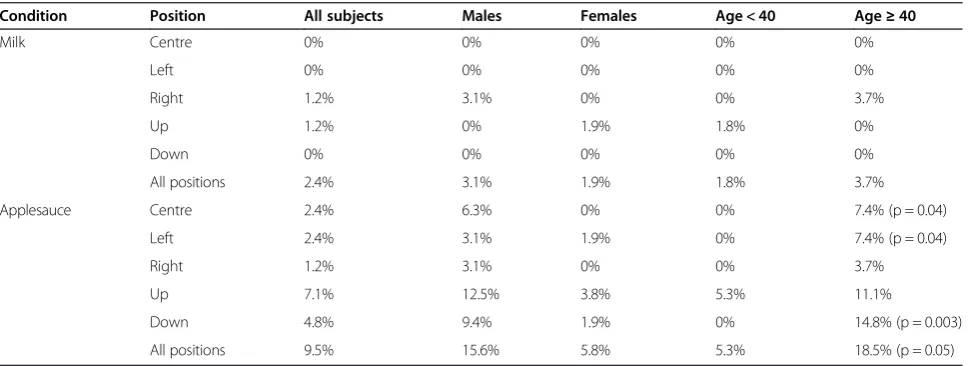
No significant associations emerged between residue and gender (see Table 2). There was, however, a significant association between residue score and age group for the applesauce condition for the head down position: 14.8% of older participants had abnormal residue scores com-pared to 0% of the younger individuals (X2(1, N = 84) = 8.87, p = 0.003). There was also a significant association between residue and age group for the applesauce condi-tion in the center posicondi-tion (X2(1, N = 84) = 4.33, p = 0.04), as well as for the left head position (X2(1, N = 84) = 4.33, p = 0.04). For each of these positions, 7.4% of older partici-pants had abnormal residue scores compared to 0% of younger individuals. Overall there was a trend towards an association between abnormal residue with puree and age
greater than 40 regardless of gender or head position (X2(1, N = 84) =3.74, p = .053). No other significant as-sociations emerged.
A final exploratory analysis of residue scores stratified by age group and gender was performed (see Table 3). The significant age group effects mentioned above were particularly apparent for males in the older age group, especially for applesauce for the center position (X2(1, N = 52) = 4.69, p = .03), and for applesauce for the down position (X2(1, N = 52) = 7.28, p = .007). No males in the younger age group had abnormal residue scores for applesauce for center or down. In contrast, 20% (n = 2) of older males had abnormal residue scores for apple-sauce for center and 30% (n = 3) had abnormal scores for applesauce for the down position. The age group ef-fect for the left head position did not remain significant when gender was included as one of the stratification variables.
Residue scores and preferred head position
A significant association was found for residue scores in the applesauce condition with the head up position (X2corrected(4) = 11.84, p < 0.05). It was found that 17.6% of participants who preferred left, 15.8% of those who preferred right, and 12.5% of those who preferred down had abnormal residue scores in the head up swallowing position. Those participants who preferred center or up all had normal residue scores for this position. No other significant associations emerged.
Discussion
The primary purpose of this study was to determine whether head position was associated with differences in measures of swallowing function that would be detect-able with FEES, especially differences that might explain the previously reported clinical findings. In over 300 Table 1 Most and least preferred head positions
Head positions
Most preferred: Least preferred:
Frequency (N = 84)
Percent Frequency (N = 84)
Percent
Centre 29 34.5 1 1.2
Centre or Down 1 1.2 0 0
Centre or Left 3 3.6 0 0
Centre or Up 2 2.4 0 0
Down 7 8.3 46 54.8
Left 9 10.7 2 2.4
Left or Right 4 4.8 2 2.4
Right 14 16.7 2 2.4
Right or Up 1 1.2 0 0
Up 13 15.5 31 36.9
Up or Left 1 1.2 0 0
Table 2 Prevalence of abnormal residue by condition
Condition Position All subjects Males Females Age < 40 Age≥40
Milk Centre 0% 0% 0% 0% 0%
Left 0% 0% 0% 0% 0%
Right 1.2% 3.1% 0% 0% 3.7%
Up 1.2% 0% 1.9% 1.8% 0%
Down 0% 0% 0% 0% 0%
All positions 2.4% 3.1% 1.9% 1.8% 3.7%
Applesauce Centre 2.4% 6.3% 0% 0% 7.4% (p = 0.04)
Left 2.4% 3.1% 1.9% 0% 7.4% (p = 0.04)
Right 1.2% 3.1% 0% 0% 3.7%
Up 7.1% 12.5% 3.8% 5.3% 11.1%
Down 4.8% 9.4% 1.9% 0% 14.8% (p = 0.003)
All positions 9.5% 15.6% 5.8% 5.3% 18.5% (p = 0.05)
participants, teaching the five head positions had previ-ously resulted in improved ease of pill swallowing. Employing FEES methodology allowed us to better understand the physiological basis for these observa-tions. The secondary goal of our research was to deter-mine whether people without swallowing problems would have a normal FEES examination as reflected by the absence of pharyngeal residue, penetration and aspir-ation. We observed occasional episodes of pharyngeal residue and minor penetration of liquids above the vocal folds that is sensed and expelled even in some normal subjects. This study, however, failed to demonstrate de-tectable differences in PAS scores or residue for the five head positions, which is reassuring because it suggests that head-position training, at least in normal subjects, is not harmful. There was some evidence of position-sensitive effects as a function of age particularly pharyngeal residue with purees in subjects older than 40 years. In addition, there was a third, unexpected, as-sociation between residue scores and non-preferred pos-ition, in that a significant proportion of those who preferred left, right, or down had abnormal residue scores in the head up position. In contrast, the people who preferred center or up all had normal residue scores for that position. These findings suggest a tendency for people to prefer positions associated with lesser residue.
Interestingly, 14.8% of older participants had residue in the head down position that is often taught to pa-tients with severe dysphagia and inadequate airway pro-tection. The purpose of employing that method is to anatomically position the larynx under the tongue base to minimize the risk of aspiration, which is more likely to occur when swallowing in other positions. However, the use of head down for patients in that category does not mean that it is a comfortable or efficient position, or that people with pathology would prefer it.
One of the study’s limitations involves the FEES meth-odology itself, as it is not possible with FEES to observe or measure the oral phase of swallowing, nor some spe-cific pharyngeal phase swallowing dynamics such as transit time, laryngeal elevation and cricopharyngeal
relaxation. These specific aspects of swallowing are quantifiable with modified barium swallow (MBS) tech-niques; however the end products of dysphagia (residue, penetration, aspiration) are equally well evaluated using either procedure [10]. Subtler abnormalities of swallow-ing may have been detectable by MBS, but it is challen-ging to access MBS for research purposes due to radiation exposure associated with MBS. Another design limitation of the current study was a small proportion of participants were in the older age group, particularly age greater than 65 years. One future research project might be to examine the effects of head position on swallowing dynamics in those who are struggling to learn to swallow pills, especially in childhood. However, if this were to be done, techniques other than FEES should be explored, particularly ones that would permit quantitative meas-urement of swallowing dynamics.
This study has several strengths. Standardized training for head position was employed, requiring two weeks of practice for all participants. The FEES procedure was standardized. One of two otolaryngologists and one Speech Language Pathologist, each in practice almost 20 years, scored all swallows by consensus. The study was an objective evaluation of the effects of head pos-ition on swallowing not previously studied or reported. The methodology permitted an examination of both subjective (preferred position) and objective (residue and PAS scores) information, both of which were associated with subsets of participants. Finally, the sample included a broad age range and both genders.
In conclusion, our study shows that a normal FEES examination can be interpreted and reported in an office setting with confidence. Pharyngeal residue is associated with swallowing in the head up position. The incidence of pharyngeal residue may increase in middle aged and older adults. Laryngeal penetration and aspiration were not related to head position. These data provide support for the safety of head position training in normal adults who are using the method to improve their pill swallowing.
Abbreviations
FEES:Fiber-optic endoscopic evaluation of swallowing; PAS: Penetration– Aspiration Scale (Rosenbek).
Competing interests
The authors declare they have no conflict of interests.
Authors’contributions
LAB: study design, subject recruitment and training, data collection. TWM: study design, subject evaluation and data collection, manuscript preparation. AM: subject evaluation and data collection. JCD: study design, subject evaluation and data collection, data analysis. KW: subject recruitment and training, data collection. RK: subject recruitment and training, data collection. SC: data analysis. BJK: study design, draft manuscript, data analysis. All authors read, critiqued and approved the manuscript.
Acknowledgements
We thank the Alberta Children’s Hospital Foundation Research Institute (ACHRI) for ongoing support.
Table 3 Prevalence of abnormal residue with puree Head position Abnormal pharyngeal residue with puree
Male Female
< Age 40 ≥Age 40 < Age 40 ≥Age 40 Centre 0% 20% (p = 0.03) 0% 0%
Left 0% 10% 0% 5.9%
Right 0% 10% 0% 0%
Up 9.1% 20% 2.9% 5.9%
Down 0% 30% (p = 0.007) 0% 5.9%
Any Position 9.1% 30% 2.9% 11.8%
Author details 1
Faculty of Medicine, University of Calgary, Calgary, Alberta, Canada.
2Foothills Medical Centre, Calgary, Alberta, Canada.3Alberta Children’s
Hospital, Calgary, Alberta, Canada.4Department of Surgery, University of Calgary, Suite 602 South Tower, Foothills Medical Centre, 1403 29th St. NW, Calgary, Alberta T2N T29, Canada.
Received: 19 September 2013 Accepted: 5 April 2014 Published: 22 April 2014
References
1. Ohmae Y, Ogura M, Kitahara S, Karaho T, Inouye T:Effects of head rotation on pharyngeal function during normal swallow.Ann Otol Rhinol Laryngol
1998,4:344–348.
2. Logemann J, Kahrilas P, Kobara M, Vakil N:The benefit of head rotation on pharyngoesophageal dysphagia.Arch Phys Med Rehabil1989,10:767–771. 3. Logemann J, Rademaker A, Pauloski B, Kahrilas P:Effects of postural
change on aspiration in head and neck surgical patients.Otolaryngol Head Neck Surg1994,2:222–227.
4. Tsukada T, Taniguchi H, Ootaki S, Yamada Y, Inoue M:Effects of food texture and head posture on oropharyngeal swallowing.J Appl Physiol
2009,6:1848–1857.
5. Castell JA, Castell DO, Schultz AR, Georgeson S:Effect of head position on the dynamics of the upper esophageal sphincter and pharynx.Dysphagia
1993,1:1–6.
6. Kaplan BJ, Steiger RA, Pope J, Marsh A, Sharp M, Crawford SG:Successful treatment of pill-swallowing difficulties with head posture practice. Paediatr Child Health (online)2010,15:1–5. Available from: Pulsus Group Inc. (www.pulsus.com) Accessed January 31, 2013.
7. Babbitt R, Parrish J, Brierley P, Kohr M:Teaching developmentally disabled children with chronic illness to swallow prescribed capsules.J Dev Behav Pediatr1991,4:229–235.
8. Czyzewski DI, Runyan RD, Lopez MA, Calles NR:Teaching and maintaining pill-swallowing in HIV-infected children.AIDS Read2000,2:88–94. 9. Meltzer E, Welch M, Ostrom N:Pill swallowing ability and training in
children 6 to 11 years of age.Clin Pediatr2006,8:725–733.
10. Aviv JE:Prospective, randomized outcome study of endoscopy versus modified barium swallow in patients with dysphagia.Laryngoscope2000, 4:563–574.
11. Rosenbek JC, Robbins JA, Roecker EB, Coyle JL, Wood JL:A penetration-aspiration scale.Dysphagia1996,2:93–98.
12. Butler SG, Stuart A, Kemp S:Flexible endoscopic evaluation of swallowing in healthy young and older adults.Ann Otol Rhinol Laryngol2009, 2:99–106.
13. Decady YJ, Thomas DR:A simple test of association for contingency tables with multiple column responses.Biometrics2000,3:893–896.
doi:10.1186/1916-0216-43-9
Cite this article as:Badenducket al.:Fiber-optic endoscopic evaluation of swallowing to assess swallowing outcomes as a function of head position in a normal population.Journal of Otolaryngology - Head and Neck Surgery201443:9.
Submit your next manuscript to BioMed Central and take full advantage of:
• Convenient online submission
• Thorough peer review
• No space constraints or color figure charges
• Immediate publication on acceptance
• Inclusion in PubMed, CAS, Scopus and Google Scholar
• Research which is freely available for redistribution