R E S E A R C H
Open Access
Secure Multi-pArty Computation Grid
LOgistic REgression (SMAC-GLORE)
Haoyi Shi
1,2, Chao Jiang
1,3, Wenrui Dai
1, Xiaoqian Jiang
1, Yuzhe Tang
2, Lucila Ohno-Machado
1and Shuang Wang
1*From
The 5th Translational Bioinformatics Conference (TBC 2015)
Tokyo, Japan. 7-9 November 2015
Abstract
Background:In biomedical research, data sharing and information exchange are very important for improving quality of care, accelerating discovery, and promoting the meaningful secondary use of clinical data. A big concern in biomedical data sharing is the protection of patient privacy because inappropriate information leakage can put patient privacy at risk. Methods:In this study, we deployed a grid logistic regression framework based on Secure Multi-party Computation (SMAC-GLORE). Unlike our previous work in GLORE, SMAC-GLORE protects not only patient-level data, but also all the intermediary information exchanged during the model-learning phase.
Results:The experimental results demonstrate the feasibility of secure distributed logistic regression across multiple institutions without sharing patient-level data.
Conclusions:In this study, we developed a circuit-based SMAC-GLORE framework. The proposed framework provides a practical solution for secure distributed logistic regression model learning.
Background
Biomedical research can benefit from data sharing from distributed sources. For example, comparative effectiveness research requires data comparison among different data sources to determine which existing health care interventions work best for certain patients. This requires a large amount of data to be harmonized. Big biomedical data networks, such as the patient-centered SCAlable National Network for Effect-iveness Research (pSCANNER) clinical data research network (CDRN) [1], the Scalable Architecture for Federated Transla-tional Inquiries Network (SAFTINet) [2] and the Electronic Medical Records and Genomics (eMERGE) Network [3] have been established to enable cross-institutional biomedical stud-ies. However, information exchange of biomedical data (e.g., genome sequences, diagnoses, medication information, etc.) can put patient privacy at risk, where the potential risks in-clude, but are not limited to, denial of certain types of insur-ance [4]. As a result, research participants may lose trust in research institutions, which may have an adverse impact on
biomedical research. Privacy risks in biomedical studies have been demonstrated in many recent studies. For example, Vai-dya demonstrated the possibility to re-identifying individuals from the public query system of the Healthcare Cost and Utilization Project (HCUP) [5]. Sweeney’s study successfully identified participants of the Personal Genome Project (PGP) [6]. In addition, with some background information, an at-tacker can even identify sensitive information of a participant using“anonymized”biomedical data [7–9]. The study in [10] demonstrated that aggregated genome statistics (e.g., allele frequencies) can present privacy risks. Therefore, it is impera-tive to develop privacy-preserving techniques to facilitate bio-medical research. For this purpose, many distributed model learning frameworks [11–18] have been proposed for building a global model involving multiple participants, but without sharing sensitive patient-level information.
In this paper, we consider the scenario of horizontally parti-tioned data, where different institutions possess data from dif-ferent patients, but with the same variables. Our previous work, Grid binary LOgistic REgression model (GLORE [11]) was developed to allow sharing models without necessarily sharing patient data in a distributed manner. It leveraged the
* Correspondence:[email protected]
1Department of Biomedical Informatics, University of California, San Diego,
CA 92093, USA
Full list of author information is available at the end of the article
aggregation of non-sensitive decomposable intermediary re-sults to build a shared model. Its Bayesian extension, EX-PLORER [19], proposed online learning to update the model with incremental data. It enabled asynchronous communi-cation to alleviate probable service breakdown when coord-inating multiple participants. Recently, grid ordinal and multinomial logistic regressions [13] were developed to deal with multi-center modeling with multiple categorical values for response variables. Remarkably, distributed modeling learning can also be employed in Cox regression for survival analysis [20–22].
Existing privacy-preserving solutions to multi-site regression [23, 24] can guarantee the precision of model learning. However, patient information could leak in these so-lutions due to disclosure of the information matrix and score vectors during iterative model learning [25, 26]. To protect these exchanged data, many secure multi-party computation (SMC) methods [18, 27–33] have been developed for distrib-uted model learning. Unfortunately, existing SMC-based methods would still suffer from inappropriate disclosure under certain conditions due to the secure sum protocol. Therefore, El-Eman et al. [15] proposed the SPARK protocol that utilized different secure blocks to build a secure distrib-uted logistic regression, which aims to offer stronger privacy protection for patient data. Although, homomorphic encryp-tion based systems [34–36] can protect secure outsourcing, they need to assign the same public keys in the case of multi-party computation, which may leak intermediary results dur-ing communications among participants.
In this paper, we propose a secret-sharing circuit-based se-cure multi-party computation framework for grid logistic re-gression (SMAC-GLORE). Inheriting the distributed model learning framework from GLORE, SMAC-GLORE protects not only patient-level data, but also all the intermediary infor-mation exchanged during the model learning phase. Introdu-cing secure multi-party computation to build boolean circuits for private data in learning, the proposed framework prevents participants from interpreting arbitrary intermediary informa-tion, such as aggregation of summary statistics, and only re-leases the final learned model parameters.
Methods
To securely evaluate the logistic function, we introduced secret-sharing circuits-based Secure Multi-party Computation (SMC) into procedure of calculation. SMC provides a method for parties to jointly compute a function over their data while keeping the data private in semi-honest scenarios, where all the participants are those who are honest in running pro-grams and algorithms correctly, but might be curious about the information transferred among entities.
Garbled circuits
The key idea of circuit based computation is based on the fact that operations in almost all modern digital
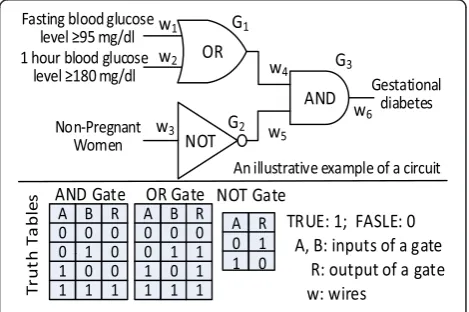
computers are implemented by circuits combining basic logic gates such as AND, OR, NOT etc., where inputs and outputs of a gate may be TRUE or FALSE for cer-tain propositions. One can design a garbled circuit coun-terpart [37–40] to protect the data and the computation. Figure 1 shows an example of diagnosing gestational dia-betes based on blood glucose level (BGL) in a standard cir-cuit representation, which consists of three gates (i.e., Gi
with i= 1,2,3) and six wires (i.e., wj with j= 1, 2,…, 6).
Using Boolean algebra [41] and truth tables of the three basic gates shown in the figure, the circuit can calculate (Gestational diabetes) = (NOT (Non-Pregnant Women)) AND ((Fasting BGL≥95 mg/dl) OR (1 h BGL≥180 mg/ dl)). In theory, one can build circuits of any complexity using basic logical gates to evaluate functions (e.g., secure distributed logarithm, exponent, etc.) or algorithms (e.g., secure distributed logistic regression models in this paper).
A garbled circuit [37, 39] is a specially designed circuit, which enables two (or more) parties to securely compute a functionf(xA,xB) without exposing their
pri-vate secrets (e.g.,xAandxBare inputs from party A and
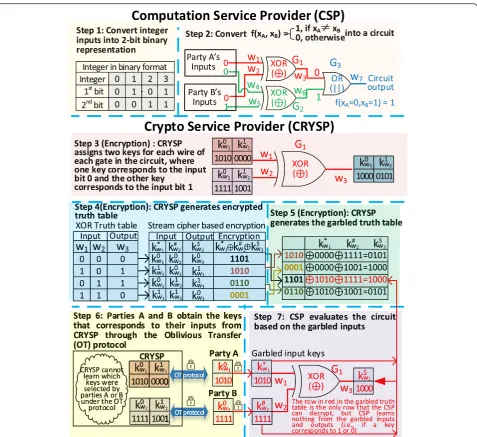
party B, respectively). All parties here are assumed to be semi-honest collaborators, which means that they follow the protocol honestly, but may try to deduce additional information from the received messages during the protocols’execution. Figure 2 illustrates several key steps to securely compare two integers using a garbled com-parison circuit (GCC), where the comcom-parison function
can be formulated as f xð A; xBÞ ¼ 1; if xA≠xB 0; otherwise
with
xA,xB∈{0, 1, 2, 3}. The first step is to convert the integer
inputs into a binary representation, where we use 2 bits to encode 4 different integers, i.e., {0 = 00; 1 = 01; 2 = 10, 3 = 11}. In the second step, a computation service provider (CSP) needs to build a circuit to implement the comparison function. The circuit consists of two XOR gates (i.e., G1 and G2) and performs bitwise compari-sons betweenxA and xB, where a XOR gate outputs 1 if
its inputs are different, otherwise it outputs 0. The circuit utilizes an OR gate (i.e., G3) to compute whether any output of the two XOR gates is 1. For example, given inputs xA=0 and xB=1, the circuit outputs 1 in
step 2 of Fig. 2 (i.e., xA≠xB). In the third step, a crypto
service provider (CRYSP) generates two encryption keys for each wire of each gate in the circuit, where one key corresponds to bit 0 and the other to bit 1. Step 3 in Fig. 2 shows an example of assigning six keys for the XOR gate G1 with two input wires and one output wire. For the output wire w3, k0w3 and k1w3 are the randomly assigned keys (e.g., 1000 and 0101 in Fig. 2), which correspond to the wire outputs 0 and 1, respectively. Both keys were randomly chosen by the Crypto Service
Provider (CRYSP) during the circuit initialization phase. In step 4, CRYSP will substitute the truth table of each gate with the encryption keys generated in step 3 and encrypt the outputs through a stream cipher based en-cryption scheme [42]. In step 5, CRYSP will generate a garbled truth table by randomly permuting rows of the encrypted truth table and sending it to the CSP for garbled circuit evaluation. In step 6, parties A and B will securely obtain the corresponding keys of their inputs (e.g., k0ð Þw2 ¼1111 for input bit 0 of wire w2) from CRYSP through the oblivious transfer (OT) protocol [43], by which CRYSP cannot learn the actual selections of keys from the parties. In step 7, parties A and B will send their
garbled keys (e.g., kw1 ¼1010 and kw2 ¼1111 ) to CSP, but without disclosing whether they refer to bit 1 or bit 0. Therefore, given the two garbled input keys, CSP can only
decrypt one row (i.e.,k¼w31000) in the garbled truth table (as shown in red) without learning the underlying true value. Following the same protocol, CSP can evaluate the entire garbled circuit without learning any intermediary information. Finally, CSP sends the garbled key of the final output to CRYSP to find out whether it corresponds to 0 (unmatched) or 1 (matched). For garbled circuit based application, we can consider the circuit initialization phase as the encryption procedure, where encrypted truth table for each gate is created and distributed between two parties through the OT protocol.
In the case in which there is no trusted CRYSP, party A could, for example, serve as the CRYSP and party B could be CSP to avoid potential collusion risk between CSP and CRYSP. Moreover, one can choose more advanced encryp-tion algorithms (other than the streaming cipher used in this example) to achieve a better protected OT protocol. The above example demonstrates how a secure integer comparison function can be achieved using garbled circuit-based SMC. In practice, advanced circuits are required to handle more complicated tasks, such as secure distributed logistic regression, where only the learned model parame-ters are allowed to be released as circuit outputs.
However, Yao’s garbled circuit is only secure in 2-party semi-honest scenarios, which is not sufficient for practical use. Usually, there are more than 2 parties or participants engaged in the same computing task. We based our model on the GMW project developed by Choi [44], who implemented the classical SMC protocols of Goldreich, Micali, and Wigderson (the GMW proto-col) [45]. The GMW protocol uses secret-sharing rather than garbled truth tables to implement the secure com-putation, which enables the computation among more than 2 parties. In GMW, all the variables are represented as binary numbers and the protocol itself is able to protect against a semi-honest adversary with any num-ber of corrupted parties. All the functions should be interpreted as boolean-circuits and each participant feeds the encrypted private data as input to the circuits. During the process of computing, none of the partici-pants can interpret any temporary values except the final output. However, the GMW project only supports non-negative integers. We established our own encoding for-mat, enabling the support for real number arithmetic, and built libraries for secure matrix operation primitives, which made it possible to solve the practical problems of building a secure distributed logistic regression model.
The proposed framework is based on the well-developed GMW protocol [44] for SMC. We overcame
the limitations of GMW protocol and built several secure computation primitives to support SMAC-GLORE. As discussed in the original GMW implementation paper [44], the Naor-Pinkas OT was implemented as the encryp-tion scheme to secure the computaencryp-tion. The mathematical definitions and proofs of security of the Naor-Pinkas OT protocol for GMW have been discussed in [46].
Platform preparation
In our project, all the floating values are represented by bin-ary vectors in 28-bits fixed-point format, in which 11 bits are assigned for the fractional part and the other 17 bits for the integer part. The highest bit of the integer part is re-served as a sign of positive or negative value. The two’s complement [47] method is adopted to represent negative values. Thus, all possible values under the proposed fixed-point format are ranging from−(228−1) × 2−11 to (227− 1) × 2−11. The proposed platform extends the integer addition and multiplication to support floating number arithmetic. Here, we describe methods for implementing subtraction and multiplication.
Subtraction
When doing subtractions, we need to iteratively compare bits of minuend and subtrahend. If the bit in minuend is smaller than the corresponding bit in the subtrahend, we may need to borrow a bit leftwards. However, in circuits, it is very difficult and expensive to implement borrowing bits. Therefore, we choose to use two’s complement. To calcu-late the subtraction, we first calcucalcu-late the two’s complement of the subtrahend, where we invert or flip all the bits of subtrahend and then add 1 to the least significant bit. After that, we add the calculated value to the minuend.
Multiplication
In multiplication, the result may, at most, double the number of required bits to represent the product. For example, the product of twon-bits numbers should have at most 2nbits. However, the GMW project requires the two factors involved in a multiplication to have the same number of bits, and allocates the same number of bits for the product. So, if we still use 28 bits for multiplica-tion, we will suffer from significant precision loss or computing error. To solve this problem, we double the size of all the values when doing multiplication. In an-other word, we expand the 28-bits values to 56-bits values before multiplication and use the 56-bits values for the multiplication. As the calculated result will also have 56 bits, we need to drop 28 bits. Even though, in this procedure, we may waste a lot of bits and computing effort, we can secure the computing precision.
matrix operations, including matrix addition, matrix subtraction and matrix multiplication, which are elabo-rated in detail later in this section.
Problem definition
For clarity, in the remainder of this paper, we reserve regular symbols to scalar variables and bold symbols to vectors or matrices. Logistic regression is widely used in biomedical decision support applications, including fea-ture selection, survival analysis, etc. Suppose there is a training dataset D ¼fðX;yÞg ¼fðx1;y1Þ;⋯ðxn;ynÞg of
n records for patients, where yi∈{0, 1} is the observed
binary outcome and xi corresponds to the m
-dimen-sional covariates for the i-th patient. In the logistic re-gression model, the likelihood function of yi=1 givenxi
can be expressed as follows,
P yð i¼1jxi;βÞ ¼ 1
1þe−βTxi; ð1Þ
where β is a parameter vector that measures the rela-tionship between the response variable yiand covariates
xi. Note that P(yi= 0|xi,β) = 1−P(yi= 1|xi,β) for binary
response variableyi. Given the training dataset D,βcan
be estimated through maximization of the following log likelihood function
^
β¼argmaxβ lð Þ ¼β −Xni¼
1log 1þe −βTx
i
: ð2Þ
Here, we usel(β) to represent the log-likelihood func-tion. Since there is no closed-form solution forβ, iterative numerical solutions are required to obtain the optimal pa-rameters. In a centralized model, the Newton-Raphson method is widely used to find β^ . The iterative maximization is achieved by calculating the first and sec-ond derivatives of the log-likelihood functionl(β). In the
t-th iteration, current estimationβ(t)is updated by
In Eq. (3), W(t) is the diagonal matrix with elements
p(yi= 1|xi,β(t))p(yi= 0|xi,β(t)) and μ(t) is the vector of
probabilities p(yi= 1|xi,β(t)). Since the Hessian matrix
H=XTW(t)X is a square matrix of second partial derivatives l' '(β), the iterative procedure can be rewritten as
βðtþ1Þ¼βð Þt −H−1l0βð Þt: ð4Þ
In this study, we consider a distributed model learning problem, where D is horizontally partitioned by h parties as D ¼X1; ;y1;⋯;Xh; ;yh. For the
j-th party pj, Xj¼ xj1x j 2⋯xjnj
is a m×nj matrix
representing the subset of nj covariates from pj, and
yj¼ yj 1;y
j 2;⋯;yjnj
is the vector of nj corresponding
binary response variables. Consequently, the inter-mediary results for the logistic regression model in Eq. (3) can be linearly decomposed [11] as
XTWð Þt X¼Xh j¼1
Xj TWjð ÞtXj
XTy−μð Þt¼Xh j¼1
Xj T
yj−ð Þμj ð Þt
ð5Þ
Equation (5) shows that each party can calculate its own intermediary results conditioned on its local data (Xj
,yj), and share them for the combined results. However, this method requires a trusted server [11] to exchange local statistics. In this paper, we will build a decentralized framework for logistic regression using secret-sharing cir-cuits based on secure multi-party communication. The proposed framework protects the intermediary statistics (Xj
)T(Wj)(t)Xjand (Xj)T(yj−(μj)(t)) with a joint function for all the parties without disclosing any private information.
Algorithm 1 (A1) summarizes the key steps in the proposed SMAC-GLORE framework. Each participant provides encrypted data Xj as input. The only output of the algorithm is the learned model coefficientsβ. All the intermediary information exchange is protected by the OT protocol and secret-sharing circuits. In A1: line 1, each party can locally calculate its own part of the fixed-Hessian matrixH~i(see Eq. (7)) and feed it as part of input to the circuit, while within the circuit, the fixed-Hessian matrix is securely constructed asH~ ¼Xhi¼
1H~i based on Eq. (7). In A1 line 2, we apply the proposed secure
matrix inversion algorithm (see Secure Hessian
Secure Hessian matrix inversion
In this study, the distributed Newton-Raphson method [11, 12] is adopted to compute the coefficients β across multiple parties. Since the Hessian matrix H represents the matrix of the second partial derivatives of maximum likelihood functionl(β), it has to be updated with the most up-to-date β(t) and inverted for each iteration. However, calculating the inversion ofHwould significantly increase the computational burden and could be unfeasible for our secret-sharing, circuit-based method. One workaround to reduce the complexity is to replace the varying Hessian Matrix with a fixed matrix. According to Böhning [48], the true Hessian matrix can be approximated by
H¼−1 4X
TX ð6Þ
where X= [X1 X2⋯Xh]. Consequently, the approxi-mated Hessian Matrix can be rewritten as
~ H ¼−1
4
Xh
j¼1
Xj TXj ð7Þ
Equation (7) implies that each party pj can locally
calculate its own part of a partial Hessian matrixH~i¼−
Xj TXj=4, and feed H~
j as part of the input to the cir-cuit. While in the circuit, the approximated Hessian matrix is constructed by aggregating all the partial Hessian matrices asH~ ¼Xhj¼
1H~j.
To further reduce the computational complexity of inverting H~, we use the approximating method intro-duced by Nardi [49]. The numerical approximation method iteratively computesH~−1according to Eq. (8).
Ntþ1¼2Nt−NtMt; N0¼c−1I;
Mtþ1¼2Mt−Mt2; M0¼c−1H~; ð8Þ
where Mt ¼NtH~, andcis constant. After convergence (e.g., in ~10 to 15 iterations),Ntwill provide an accurate
approximation to the inversion ofH~.
Matrix multiplication
We transfer the matrix inversion problem into an itera-tive procedure of matrix multiplication and addition. Therefore, optimizing the implementation of matrix multiplication can improve the efficiency of the proposed framework. In this subsection, we adopted the Strassen algorithm for matrix multiplication.
Let us denoteA and Btwo squaren×nmatrices and
C=AB their matrix product. Here, n is recommended to be a power of 2, namelyn= 2k,k∈ℕ. A,Band Ccan be partitioned into equally sized block matrices as where Ai,j, Bi,j, and Ci,j, are all (n/2) × (n/2) matrices.
According to the definition of block matrix multiplica-tion,Ci,j,can be represented byAi,j,andBi,j,fori,j= 1, 2.
C1;1¼A1;1B1;1þA1;2B2;1; C1;2¼A1;1B1;2þA1;2B2;2;
C2;1¼A2;1B1;1þA2;2B2;1; C2;2¼A2;1B1;2þA2;2B2;2: ð10Þ
According to Eq. (10), the calculation of C requires the same number of multiplications as the standard definition of matrix multiplication C=AB. To reduce the number of multiplications, we introduce the Strassen algorithm which defines some new matrices based on Ai,j,andBi,j,.
M1¼A1;1 B1;2−B2;2
; M2¼ A1;1þA1;2
B2;2; M3¼ A2;1þA2;2
B1;1; M4¼A2;2 B2;1−B1;1
;
M5¼ A1;1þA2;2
B1;1þB2;2
; M6¼ A1;2−A2;2
B2;1þB2;2
;
M7¼ A1;1−A2;1
B1;1þB1;2
ð11Þ
Equation (11) requires only 7 matrix multiplications be-tween (n/2) × (n/2) square matrices (one for eachMl,l=
1,⋯, 7) to calculateC=AB, which reduces the number of A¼ A1;1 A1;2
A2;1 A2;2
;B¼ B1;1 B1;2 B2;1 B2;2
; C¼ C1;1 C1;2 C2;1 C2;2
;
multiplications by n3/8. The productCcan be recovered fromMl,l= 1,⋯, 7 by
C1;1¼M5þM4−M2þM6; C1;2¼M1þM2; C2;1¼M3þM4; C2;2¼M5þM1−M3−M7:
ð12Þ
The matrices can be iteratively partitioned k times, when n= 2k. Thus, the Strassen algorithm can reduce the complexity of matrix multiplication from O(n3) to
O(n2.8).
In this work, the Strassen algorithm is implemented for matrix inversion, which has a significant effect on computational complexity. For other ordinary matrix multiplications, we still use the standard method. How-ever, it is also possible to extend the Strassen algorithm to employ it in ordinary matrix multiplication, e.g. multiplication between non-square matrices.
The first derivative of the maximum likelihood function
In thet-th iteration, the first derivativel' (β) of the max-imum likelihood function has to be updated with the current β(t). The k-th element of l' (β) can be obtained in a distributed manner.
∂l
∂βð Þk jβ¼βð Þt ¼ Xh
j¼1 Xni
i¼1
yji−P xji; βð Þt
xjið Þk ; ð13Þ
where xij(k) andβ(k) are the k-th element of xijand β(t),
respectively. Equation (13) shows that we can allow each party to separately compute its own part of first deriva-tive based on local data and we add these results [11]. However, such approach will leak the information ofβ(t) at each iteration. Therefore, we need to securely evaluate Eq. (13) without releasing any intermediary β(t). As a result, we need to securely evaluate the exponential function ex in the boolean circuits. In the proposed framework, we use the Taylor series to approximate the evaluation ofex, such that we only need to handle multi-plication and addition operations.
ex¼X∞ i¼1
xn
n!¼1þxþ x2
2!þ
x3
3!þ
x4
4!þ… ð14Þ
To simplify computation and avoid overflow, we set a filter to bound the exponential within the interval be-tween−5 and 5. When the exponentials are greater than 5 or smaller than −5, the evaluation results of the logit function (i.e., 1/(1 +ex)) would be smaller than 6.7 × 10⁻² according to Eq. (1). Thus, we will not lose much accur-acy by using this bound.
Simulations in MATLAB shows that the Taylor series could achieve an approximated result with an error less than 10−2, when the maximal order for the expansion is
set to 15. To reduce the number of multiplications, we transform the Taylor series to a recursive algorithm.
ex≈1þx 1þx
2 … 1þ
x
14 1þ
x
15
: ð15Þ
We built a look-up table storing the inversion of inte-gers from 1 to 15, to avoid divisions and to speed up the calculation. For the other divisions involved in the logistic function, we treat them as a matrix of size 1.
It is worth mentioning that all the computations in this section are carried out in a customized Boolean cir-cuit, where all the inputs and intermediary information exchange are protected by the OT protocol and the circuits. The only outputs in plaintext are the learned model parameterβin the proposed SMAC-GLORE.
Results
In this section, we first describe computational perform-ance evaluations for fundamental operations, including matrix addition, matrix multiplication and matrix inver-sion. We then describe accuracy evaluations over real datasets with three features, including the Edinburgh dataset, which contains T wave inversion, Sweating and
Pain in right arm features, and three genome datasets [50], where the first two features are ethnicity groups and the third feature is a SNP. The last column for each dataset is the intercept.
Computational performance evaluation
We first evaluated the performance of matrix addition, matrix multiplication and matrix inversion under a 2-party setup. We varied the size of matrices from 1 × 1 to 20 × 20 for each party. We simulated both parties on a 64-bit Ubuntu 14.04 platform with an Intel Xeon CPU at 3.10GHz and 256GB RAM, under the 28-bit fixed-point encoding, where both parties were connected by a 1GB network.
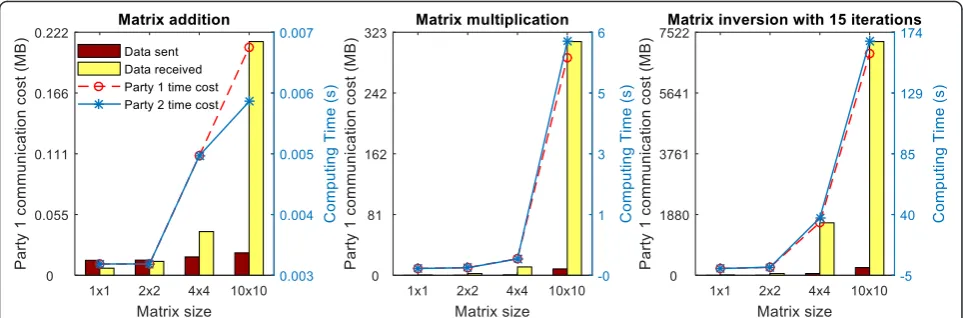
Table 1 shows the computational performance in terms of number of OT and total time cost (including both OT and circuit evaluation costs) for the operations of matrix addition, matrix multiplication and matrix inversion with different matrix sizes in a 2-party setup. For matrix inversion, we measure all the computational performance with 15 iterations. We also included the size of the circuits for different setups in the terms of the total number of gates and the number of AND gates in Table 1, as the evaluation of AND gates is expensive due to the invocations of OT. We can see that the total time increases linearly with the increase of matrix size for matrix addition operations, while the total time increases exponentially for matrix multiplication and matrix inversion operations. This is because the number of AND gates increases exponentially in matrix multiplication and matrix inversion. In the GMW project, where the XOR gates are “free”, only AND gates need secret-sharing evaluations. Therefore, the computing time in matrix multiplication and matrix inversion increases exponentially. Oblivious transfer (OT) is the most computationally expensive part and is the only part which relies on public-key techniques and encryption. During the OT initialization phase, for each wire indexed by w in the circuit, GMW generates a secret share swi of the input value vw for each party Pi, i=
1,…,h for a total of h parties, and transfers each share to the corresponding party. During the gate-computation procedure, given a wire w to be evalu-ated, all the secret shares swi will be re-collected to
securely evaluate the gate. Therefore, we can consider the OT initialization as the encryption time and con-sider the circuit evaluation part or gate- computation part as the decryption time. We also find that in matrix multiplication and inversion, it takes more time for party 2. The bar plots in Fig. 3 show that party 1 receives much more data than it sends out,
which is due to the fact that party 2 serves as the sender in OT while party 1 serves as the receiver.
Accuracy evaluation
In this section, we perform accuracy evaluation of the proposed framework. As we introduced several approxi-mation schemes (e.g., fixed-point encoding format, Tay-lor expansion for exponential function, division-free matrix inversion, etc.), the accuracy evaluation intends to measure how the results of the proposed framework differ from those of ordinary methods.
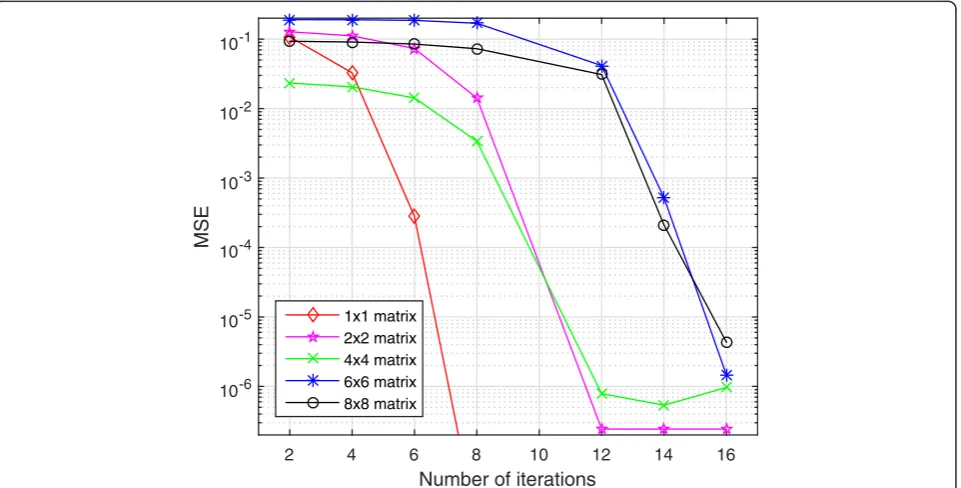
Under the same 2-party settings, we first evaluated the accuracy in terms of mean squared error (MSE) between the secure matrix inversion and ordinary matrix inver-sion operations. The observed MSEs are mainly due to the use of the fixed-point encoding format and the division-free matrix inversion algorithm. Figure 4 depicts the MSE performance with different matrix inversion iterations using 2 × 2, 4 × 4, 6 × 6, 8 × 8 and 10 × 10 matrices. We find that as the number of iterations increases, the MSEs decrease for all these matrices, and the MSE can get under 10−5.
We also evaluated the accuracy of learned coefficients
βin secure distributed logistic regression using different data sets. Our experiments were carried out under two setups: a local setting (simulated on a single server, which is the same as the one used in the Computational performance evaluation section) and a remote setting (on three different machines). In theremotesetting, we ex-ecuted the program on three servers, including the server in the local setting and two other 64-bits Ubuntu servers with Intel Xeon CPUs at 2.40GHz and 96 GB RAM.
In thelocal setting, we simulated both 2-party and 3-party setups. In the remote setting with four parties, we hosted the first two parties on a server with 256 GB memory and deployed the other two parties on the remaining two servers. We used the same simulated
Table 1Computational performance for different matrix sizes in terms of number of gates, OT and total time cost for matrix addition, matrix multiplication and matrix inversion in a 2-party setup
Matrix addition operation
Matrix size # of AND gates # of total gates
OT time (s) Total time (s)
Party 1 Party 2 Party 1 Party 2
1 × 1 27 250 0.346 0.194 0.354 0.202
2 × 2 108 994 0.348 0.194 0.357 0.20
4 × 4 432 2,850 0.343 0.202 0.353 0.212
10 × 10 2,700 24,802 0.369 0.230 0.387 0.247
Matrix multiplication operation
Matrix size # of AND gates # of total gates OT time (s) Total time (s)
Party 1 Party 2 Party 1 Party 2
1 × 1 4,621 21,594 0.367 0.245 0.384 0.262
2 × 2 37,076 273,034 0.518 0.609 0.577 0.660
4 × 4 580,325 2,707,002 2.135 3.636 2.603 4.060
10 × 10 4,645,300 21,664,002 21.174 50.413 29.646 58.769
Matrix inversion operation (15 iterations)
Matrix size # of AND gates # of total gates OT time (s) Total time (s)
Party 1 Party 2 Party 1 Party 2
2 × 2 1,030,869 4,872,479 4.864 10.908 6.519 12.472
4 × 4 8,027,793 37,694,207 36.503 85.848 49.619 98.314
6 × 6 26,847,253 125,771,967 121.266 296.780 170.634 349.398
8 × 8 63,345,729 296,412,479 281.653 676.747 405.865 810.214
10 × 10 123,379,701 576,922,463 528.062 1286.500 751.421 1519.897
Number of iterations
2 4 6 8 10 12 14 16
MSE
10-6 10-5 10-4 10-3 10-2 10-1
1x1 matrix 2x2 matrix 4x4 matrix 6x6 matrix 8x8 matrix
dataset for all setups, which contains 60 records and 3 binary features. Table 2 compares the results of the learned coefficients, Wald test and two-sample Z test be-tween the proposed SMAC-GLORE and the ordinary lo-gistic regression model. We can see that the proposed SMAC-GLORE framework achieved similar perfor-mances as those of ordinary logistic regression, as the outputs are very close, with coefficient differences between 10−3 and 10−2. Table 3 illustrates the results among 2-party, 3-party and 4-party setups with the same datasets. We can see in Table 3 that all these setups generated exactly the same outcomes. The experimental results demonstrated that the proposed SMAC-GLORE framework enables secure collaboration across multiple parties with high computation precision under different settings.
In addition, Table 4 shows the performance differences in terms of OT time, circuit computing time and total time for 2-party, 3-party and 4-party setups. We can see that, for different setups, the total number of AND gates are roughly the same. However, the OT and total time costs increase significantly as the number of parties increases. This is because the GWM project requires pairwise OT communication among parties. The circuit computing time is similar between 2-party and 3-party setups under the local settings. However, the circuit computing time becomes much larger under the 4-party
remotesetting. This is due to the fact that the servers in the remote setting are located under different networks, while the servers in thelocal setting are under the same network. Therefore, the communication cost in remote setting becomes more significant in cross-network setups.
In Table 5, we performed the comparison of models learned from SMAC-GLORE and ordinary logistic
regression, based on four real data sets. All the datasets consist of 3 features. Dataset 1 is the Edinburgh dataset and Datasets 2–4 are genome datasets [50]. We can see that our SMAC-GLORE produced very close results to those produced by ordinary logistic regression.
Limitations and discussion
Our project, which is in part based on the GMW project, developed secure fixed-point algorithms to handle floating number computation and constructed pipelines for se-curely building a distributed logistic regression model. The experimental results demonstrated the feasibility of the proposed framework, but there are still some limitations.
First, all the variables are represented in a 28-bit fixed-point format, where we allocate 1 bit for the sign (i.e., positive or negative numbers) and 11 bits for fractional part of a floating number. Therefore, the proposed framework cannot handle a number that is larger than 216 or has precision higher than 1
211. Although the range and precision of a floating number can be improved by adding more bits in the fixed-point format, it will result in a significant increase of circuit size. Another potential workaround is to replace the fixed-point format with a floating-point format, which will require further investi-gation. In addition, during fixed-point multiplication, results may end up taking twice the number of bits, where the intermediary product results have 56 bits. In order to maintain a consistent 28-bit fixed-point encoding format, we need to truncate the intermediary product re-sults, which may also result in precision loss. Based on our simulation, we need at least an 80-bit fixed point rep-resentation to achieve precision of a single precision float-ing point encodfloat-ing format.
Table 3Model parametersβlearned in local 2-party, 3-party scenarios, and remote 4-party scenarios
β 2-party 3-party 4-party (remote)
Value Wald test Value Wald test Value Wald test
SE Zvalue p-value SE Zvalue p-value SE Zvalue p-value
β1 −0.6182 0.7759 −0.7968 0.4256 −0.6182 0.7759 −0.7968 0.4256 −0.6182 0.7759 −0.7968 0.4256
β2 2.5454 0.8461 3.0084 0.0026 2.5454 0.8461 3.0084 0.0026 2.5454 0.8461 3.0084 0.0026
β3 1.2246 1.1226 1.0909 0.2753 1.2246 1.1226 1.0909 0.2753 1.2246 1.1226 1.0909 0.2753
β4 0.6177 0.8283 0.7457 0.4558 0.6177 0.8283 0.7457 0.4558 0.6177 0.8283 0.7457 0.4558
Table 2Model parametersβlearned in SMAC-GLORE and ordinary logistic regression model
β 2 parties Ordinary logistic regression Two-sampleZtest
Value Wald test Value Wald test Test statistic p-value
SE Zvalue p-value SE Zvalue p-value
β1 −0.6182 0.7759 −0.7968 0.4256 −0.6274 0.7779 −0.8065 0.4199 0.0084 0.9933
β2 2.5454 0.8461 3.0084 0.0026 2.5767 0.8511 3.0275 0.0025 −0.0261 0.9792
β3 1.2246 1.1226 1.0909 0.2753 1.2407 1.1369 1.0913 0.2751 −0.0101 0.9920
Second, to handle secure distributed exponential and logit function evaluations, we implemented a secure Taylor expansion algorithm up to a 15 order and trun-cated the input range (i.e.,−5 to 5). The output precision of both functions can be further improved by increasing the order of expansion and of the truncated input range, but this results in additional computational costs. Similarly, we also developed a secure matrix inversion protocol based on an iterative algorithm [41], which only requires multiplication and addition operations. This secure matrix inversion protocol may also introduce precision loss in the final results.
Third, the current implication of the secure multiplica-tion primitive is partially based on the Strassen algorithm, which requires several levels of block-wise decompositions of the input matrix to achieve maximum performance gain. However, we only perform a one-level decompos-ition rather than repeating the procedure in the whole multiplication. As matrix multiplication is one of the most time-consuming operations, we may need to fully utilize the Strassen algorithm to improve the performance in our future work.
In addition, based on our experiments, we find that the OT phase contributes the most to the computa-tional time, due to the limitations of the GMW pro-ject which uses only a single thread for each pair’s OT procedure. To reduce the time for OT and im-prove performance, we can resort to parallel compu-tation in the OT procedure. The GMW project was developed for a 32-bit computing environment, which means that the total number of gates cannot exceed 231. Therefore, in our future work, we plan to extend GMW to support a 64-bit address space, in which we can handle larger data sets. Another limitation is that the GMW project needs to preload the entire circuit
into memory during the computation, which requires a very large amount of memory for a complex circuit. In our future work, we will investigate the possibility of dynamically generating a part of a circuit that will be required for the next execution to reduce memory consumption.
Although the proposed framework can protect the entire model learning phase, there is still no protection of the final output of the learned model parameter. Differential privacy has emerged as one of the strongest privacy guarantees for statistical data release [51]. Roughly speaking, it ensures (to a pre-defined extent, and quantifiably) that no risk is incurred when data from in-dividual patients are entered in a particular database. It will be useful to integrate an optional component to enable dif-ferentially private model learning [52] in our future work.
Conclusion
In this study, we developed a secret-sharing, circuit-based SMAC-GLORE framework. To overcome the limi-tation of GMW, which only supports integer operations, we designed a fixed-point encoding format to support floating number arithmetic in SMAC-GLORE. We also implemented several secure matrix-operation primitives and built a pipeline for secure distributed logistic regres-sion calculation. SMAC-GLORE is able to build a shared model without sharing each party’s private data. To the best of the authors’ knowledge, the proposed SMAC-GLORE is the first attempt to enable secret-sharing cir-cuit based secure distributed logistic regression model learning for biomedical research studies. The experimen-tal results show that our framework is reliable and can be used to solve practical problems in secure distributed logistic regression model learning.
Table 5Differences between models learned from SMAC-GLORE and Ordinary Logistic Regression (LR) for Datasets 1-5
β Dataset 1 Dataset 2 Dataset 3 Dataset 4
2-party SMAC-GLORE Ordinary LR 2-party SMAC-GLORE Ordinary LR 2-party SMAC-GLORE Ordinary LR 2-party SMAC-GLORE Ordinary LR
β1 1.7632 1.7647 −0.6592 −0.6567 −0.5093 −0.5066 −1.5126 −1.5168
β2 0.3369 0.3374 0.3174 0.3179 0.5767 0.5777 −0.3516 −0.3488
β3 1.1885 1.1902 −0.2212 −0.2195 0.4102 0.4138 0.2822 0.2855
β4 −1.6514 −1.6500 −1.3115 −1.3098 −1.8940 −1.8939 −1.4873 −1.4873
Table 4Computing performances in local 2-party, 3-party scenarios, and remote 4-party scenarios
2-party 3-party 4-party (remote)
Party 1 Party 2 Party 1 Party 2 Party 3 Party 1 Party 2 Party 3 Party 4
OT time (s) 1,785.51 4,021.83 5,075.79 5,192.17 5,168.24 7,225.62 15,927.10 10,051.50 9,929.10
Computing time (s) 601.76 625.59 538.79 659.43 612.51 650.65 1288.07 1011.14 857.72
Total time (s) 2,607.11 4,683.56 5,822.17 6,064.08 5,976.22 8123.55 17,556.40 11,412.60 11,026.5
Abbreviations
CSP, computation service provider; CRYSP, crypto service provider; GMW, Goldreich, Micali, and Wigderson; MSE, mean squared error; OT, oblivious transfer; SMC, secure multi-party computation; SMAC-GLORE, secure multi-pArty computation grid logistic regression
Declaration
Publication of this article has been funded by the NIH grants R00HG008175, K99HG008175, R01HG007078, R00LM011392, R21LM012060, and
U54HL108460. This article has been published as part of BMC Medical Informatics and Decision Making Volume 16 Supplement 3, 2016. Selected articles from the 5th Translational Bioinformatics Conference (TBC 2015): medical genomics. The full contents of the supplement are available online https://bmcmedgenomics.biomedcentral.com/articles/supplements/volume-16-supplement-3.
Availability of data and materials
http://research.ucsd-dbmi.org/SMAC_GLORE.
Authors’contributions
The authors HS, CJ, and SW contributed the majority of the writing and conducted major parts of the methodology and experiments. WD wrote a part of this paper and provided detailed edits. YT and XJ provided helpful comments on both methods and presentation. LO-M provided the motiv-ation for this work, detailed edits and critical suggestions. All authors read and approved the final manuscript.
Competing interests
The authors declare that they have no competing interests.
Consent for publication
Not applicable.
Ethics approval and consent to participate
Not applicable.
Author details
1Department of Biomedical Informatics, University of California, San Diego,
CA 92093, USA.2Department of Electrical Engineering and Computer Science, Syracuse University, Syracuse, NY 13210, USA.3School of Electrical
and Computer Engineering, University of Oklahoma, Tulsa, OK 74135, USA.
Published: 25 July 2016
References
1. Ohno-Machado L, Agha Z, Bell DS, Dahm L, Day ME, Doctor JN, et al. pSCANNER: patient-centered Scalable National Network for Effectiveness Research. J Am Med Inform Assoc. 2014;21(4):621–6.
2. Schilling LM, Kwan BM, Drolshagen CT, Hosokawa PW, Brandt E. Scalable Architecture for Federated Translational Inquiries Network (SAFTINet) Technology Infrastructure for a Distributed Data Network. eGEMs. 2013;1(1):1–13. 3. McCarty CA, Chisholm RL, Chute CG, Kullo IJ, Jarvik GP, Larson EB, et al. The
eMERGE Network: a consortium of biorepositories linked to electronic medical records data for conducting genomic studies. BMC Med Genomics. 2011;4(1):1–13.
4. Naveed M, Ayday E, Clayton EW, Fellay J, Gunter CA, Hubaux J-P, Malin BA, Wang X. Privacy and Security in the Genomic Era; 2014. arXiv preprint arXiv: 1405.1891.
5. Vaidya J, Shafiq B, Jiang X, Ohno-Machado L. Identifying inference attacks against healthcare data repositories. AMIA Summits Transl Sci Proc. 2013;2013:262–6.
6. Sweeney L, Abu A, Winn J. Identifying Participants in the Personal Genome Project by Name (A Re-identification Experiment); 2013. arXiv preprint arXiv: 1304.7605.
7. Gymrek M, McGuire AL, Golan D, Halperin E, Erlich Y. Identifying personal genomes by surname inference. Science. 2013;339(6117):321–4.
8. Wang R, Li YF, Wang X, Tang H, Zhou X. Learning your identity and disease from research papers. In: Proceedings of the 16th ACM conference on Computer and communications security - CCS’09. 2009. p. 534–44. 9. Erlich Y, Narayanan A. Routes for breaching and protecting genetic privacy.
Nat Rev Genet. 2014;15(6):409–21.
10. Homer N, Szelinger S, Redman M, Duggan D, Tembe W, Muehling J, et al. “Resolving individuals contributing trace amounts of DNA to highly complex mixtures using high-density SNP genotyping microarrays,”. PLoS Genet. 2008;4(8):e1000167.
11. Wu Y, Jiang X, Kim J, Ohno-Machado L. Grid Binary LOgistic REgression (GLORE): building shared models without sharing data. J Am Med Inform Assoc. 2012;2012(5):758–64.
12. Lu C-L, Wang S, Ji Z, Wu Y, Xiong L, Jiang X, Ohno-Machado L, Li X, Jiang X, Ohno-Machado L, Xiong L, Jiang X, Ohno-Machado L. WebDISCO: A web service for distributed cox model learning without patient-level data sharing. J Am Med Inform Assoc. The Oxford University Press; 2015;22(6):1212-1219. 13. Wu Y, Jiang X, Wang S, Jiang W, Li P, Ohno-Machado L. Grid multi-category
response logistic models. BMC Med Inform Decis Mak. 2015;15(1):1–10. 14. Jiang W, Li P, Wang S, Wu Y, Xue M, Ohno-Machado L, Jiang X.
WebGLORE: a web service for Grid LOgistic REgression. Bioinformatics. 2013;29(24):3238–40.
15. El Emam K, Samet S, Arbuckle L, Tamblyn R, Earle C, Kantarcioglu M. A secure distributed logistic regression protocol for the detection of rare adverse drug events. J Am Med Inform Assoc. 2013;20(3):453–61. 16. Slavkovic AB, Nardi Y, Tibbits MM.“Secure" Logistic Regression of
Horizontally and Vertically Partitioned Distributed Databases. Data Mining Workshops, 2007. ICDM Workshops 2007. Seventh IEEE International Conference on. IEEE; 2007. pp. 723-728.
17. Li Y, Jiang X, Wang S, Xiong H, Ohno-Machado L. "VERTIcal Grid lOgistic regression (VERTIGO)". J Am Med Inform Assoc. 2016;23(3):570–9. 18. Fienberg S, Fulp W, Slavkovic A, Wrobel T. Secure Log-Linear and Logistic
Regression Analysis of Distributed Databases. In: Privacy in Statistical Databases. 2006. p. 277–90.
19. Wang S, Jiang X, Wu Y, Cui L, Cheng S, Ohno-Machado L. EXpectation Propagation LOgistic REgRession (EXPLORER): Distributed Privacy-Preserving Online Model Learning. J Biomed Inform. 2013;46(3):1–50.
20. Yu S, Fung G, Rosales R, Krishnan S, Rao RB, Dehing-Oberije C, Lambin P. Privacy-preserving cox regression for survival analysis. In: Proceedings of the 14th ACM SIGKDD international conference on Knowledge discovery and data mining. 2008. p. 1034–42.
21. O’Keefe CM, Sparks RS, McAullay D, Loong B. Confidentialising Survival Analysis Output in a Remote Data Access System. J Priv Confidentiality. 2012;4(1):6. 22. Lu C-L, Wang S, Ji Z, Wu Y, Xiong L, Jiang X, Ohno-Machado L. WebDISCO:
a Web service for DIStributed COx model learning without patient-level data sharing. In: Translational Bioinformatics Conference. 2014. 23. Du W, Han YS, Chen S. Privacy-preserving multivariate statistical analysis:
Linear regression and classification. In: Proceedings of the 4th SIAM International Conference on Data Mining. 2004. p. 222–33.
24. Wolfson M, Wallace SE, Masca N, Rowe G, Sheehan NA, Ferretti V, et al. DataSHIELD: resolving a conflict in contemporary bioscience performing a pooled analysis of individual-level data without sharing the data. Int J Epidemiol. 2010;39(5):1372–82.
25. Sparks R, Carter C, Donnelly JB, Keefe CMO, Duncan J, Keighley T, McAullay D. Remote access methods for exploratory data analysis and statistical modelling: Privacy-Preserving Analytics. Comput Methods Programs Biomed. 2008;91(3):208–22.
26. Fienberg S, Nardi Y, SlavkovićA.“Valid statistical analysis for logistic regression with multiple sources. Prot Pers While Prot People. 2009;5661:82–94. 27. Karr AF, Lin X, Sanil AP, Reiter JP. Analysis of integrated data without data
integration. Chance. 2004;17(3):26–9.
28. Karr AF, Feng J, Lin X, Sanil AP, Young SS, Reiter JP. Secure analysis of distributed chemical databases without data integration. J Comput Aided Mol Des. 2005;19(9):739–47.
29. Karr AF, Fulp WJ, Vera F, Young SS, Lin X, Reiter JP. Secure, privacy-preserving analysis of distributed databases. Technometrics. 2007;49(3):335–45.
30. Karr AF. Secure Statistical Analysis of Distributed Databases, Emphasizing What We Don’t Know. J Priv Confidentiality. 2009;1:197–211.
31. Tang Y, Liu L, Iyengar A, Lee K, Zhang Q. e-PPI: Locator Service in Information Networks with Personalized Privacy Preservation. In: IEEE 34th International Conference on Distributed Computing Systems, ICDCS 2014, Madrid, Spain, June 30 - July 3, 2014. 2014. p. 186–97. 32. Tang Y, Liu L. Privacy-preserving multi-keyword search in information
networks. IEEE Trans Knowl Data Eng. IEEE; 2015;27(9):2424–2437. 33. Tang Y, Wang T, Liu L, Meng S, Palanisamy B. Privacy preserving indexing
international conference on Information and knowledge management. 2011. p. 905–14.
34. Wang S, Zhang Y, Dai W, Lauter K, Kim M, Tang Y, Xiong H, Jiang X. HEALER: Homomorphic computation of ExAct Logistic rEgRession for secure rare disease variants analysis in GWAS. Bioinformatics. Oxford Univ Press. 2016; 32(2):211–218.
35. Zhang Y, Dai W, Wang S, Kim M, Lauter K, Sakuma J, et al. SECRET: Secure Edit-distance Computation over homomoRphic Encrypted daTa. In: 5th Annual Translational Bioinformatics Conference (accepted). 2015. 36. Zhang Y, Dai W, Jiang X, Xiong H Wang S. FORESEE: Fully Outsourced
secuRe gEnome Study basEd on homomorphic Encryption. BMC Med Inform Decis Mak. BioMed Central Ltd; 2015;15(Suppl5):S5.
37. Yao AC. Protocols for secure computations. In: 23rd Annual Symposium on Foundations of Computer Science (sfcs 1982). 1982. p. 160–4.
38. Lindell Y, Pinkas B. A proof of security of yao’s protocol for two-party computation. J Cryptol. 2009;22(2):161–88.
39. Bellare M, Hoang VT, Rogaway P. Foundations of Garbled Circuits. In: Proceedings of the 2012 ACM conference on Computer and communications security - CCS’12. 2012. p. 784–96.
40. Chen F, Wang S, Mohammed N, Cheng S, Jiang X. PRECISE:PRivacy-prEserving Cloud-assisted quality Improvement Service in hEalthcare. In: Translational Bioinformatics Conference. 2014.
41. G. Boolos, J. P. Burgess, and R. C. Jeffrey, Computability and logic. Cambridge: Cambridge university press; 2002.
42. GolićJD. Cryptanalysis of alleged A5 stream cipher. In: Advances in Cryptology—EUROCRYPT’97. 1997. p. 239–55.
43. Even S, Goldreich O, Lempel A. A randomized protocol for signing contracts. Commun ACM. 1985;28(6):637–47.
44. S. G. Choi, K.-W. Hwang, J. Katz, T. Malkin, and D. Rubenstein,“Secure multi-party computation of boolean circuits with applications to privacy in on-line marketplaces,”inTopics in Cryptology–CT-RSA 2012. Berlin Heidelberg: Springer; 2012. pp. 416–432.
45. Goldreich O, Micali S, Wigderson A. How to play any mental game - a completeness theorem for protocols with honest majority. In: Proceedings of the 19th ACM Symposium on Theory of Computing (STOC). 1987. p. 218–29. 46. Naor M, Pinkas B. Computationally secure oblivious transfer. J Cryptol.
2005;18(1):1–35.
47. J. Von Neumann,“First Draft of a Report on the EDVAC,”inThe Origins of
Digital Computers. Berlin Heidelberg: Springer; 1982. pp. 383–392.
48. Böhning D. The lower bound method in probit regression. Comput Stat Data Anal. 1999;30(1):13–7.
49. Nardi Y, Fienberg SE, Hall RJ. Achieving both valid and secure logistic regression analysis on aggregated data from different private sources. J Priv Confidentiality. 2012;4(1):9.
50. “Sample genotype data for analysis of case–control studies in in genetic epidemiology.”[Online]. Available: http://artax.karlin.mff.cuni.cz/r-help/ library/CGEN/html/SNPdata.html. [Accessed: 01 Sept 2015]. 51. Dwork C. Differential Privacy: A Survey of Results. In: Theory and
Applications of Models of Computation. 2008. p. 1–19.
52. Ji Z, Jiang X, Wang S, Xiong L, Ohno-Machado L. Differentially private distributed logistic regression using private and public data. BMC Med Genomics. 2014;7 Suppl 1:S14.
• We accept pre-submission inquiries
• Our selector tool helps you to find the most relevant journal
• We provide round the clock customer support
• Convenient online submission
• Thorough peer review
• Inclusion in PubMed and all major indexing services
• Maximum visibility for your research
Submit your manuscript at www.biomedcentral.com/submit