ISSN (e): 2250-3021, ISSN (p): 2278-8719
Vol. 08, Issue 6 (June. 2018), ||V (III) || PP 58-65
Evaluation of user selection schemes with low computational
complexity and best effort interference
*Rajinder Kaur **Dr. Dinesh Kumar
M.Tech Scholar-CSE Associate Professor
Corresponding author: Rajinder Kaur
ABSTRACT:
A MIMO system is a wireless system, which employs multiple antennas at the transmitter and the receiver. MIMO is an acronym for "multiple-input multiple-output". Its main objective is the transmission and reception of signals at the physical layer of the wireless stack. Currently, MIMO have been made commercial, with examples being WiMAX and LTE, as well as WiFi and 802.11n. However, there is significant research to be undertaken with respect to handling interference.. Interference has been neglected in point-to-point MIMO as far as concurrent transmissions are concerned; thus, we are given the facts that MIMO offered the possibility of increased reliability through diversity and combination of gains. A technique to handle concurrent transmissions id cognitive radio, where nodes are separated to primary and secondary users competing for the channel medium. In this work, we tend to consider client decision courses for a various information different yield (MIMO) Cognitive radio (CR) downlink arrange, wherever the r-reception apparatus underlay CR auxiliary clients (SUs) exist with an essential client (PU), and each one terminals territory unit outfitted with numerous recieving wires. The Cognitive Radio Networks are composed of cognitive, spectrum devices capable of changing their configurations by spectral environment. The Spectrum sensing technique is the technique which optimize the sensing time, sensing threshold, and transmit power of a input multi-output (MIMO) Cognitive Radio system for maximization of the opportunistic system throughput under transmit power, probability of false alarm, and probability of missed detection constraints. This work focuses on the problem in optimization for the optimal choice of the sensing threshold, sensing times, & transmits power in each spatial sub channel for both single-band and multi-band MIMO Cognitive Radio System. The author have a tendency to also consider helpful range detecting by abuse the FPT strategy in MU-MIMO CR framework. Helpful range detecting will enhance the execution of gathering. Moreover, with the particular agreeable range detecting approach, high probability of location will be accomplished once the framework is underneath notice requirement. This work entirely unexpected issues territory unit settled with the help of different destinations and getting diverse parameters.K
EYWORDS:
Cognitive radio, spectrum underlay, user selection, MIMO broadcast channel.--- --- Date of Submission: 01-06-2018 Date of acceptance: 16-06-2018 --- ---
I. INTRODUCTION
detector. Subsequently we also present the allied relaxed robust detector (RRD) and multicriterion robust detector (MRD) for PU detection in adverse deep fade and CSI uncertainty scenarios. Simulation results demonstrate that the proposed robust cooperative detectors have a significantly superior performance compared to the conventional matched filter (MF) detector. The rest of the letter is organized as follows. Section II describes the system model for cooperative spectrum sensing in MIMO CR wireless networks followed by the uncertainty model for the channel estimates .
II. COMMUNICATIONCHANNEL,MIMOANDMU-MIMO
In 1948, Claude Shannon [C. E. Shannon, 1948] pioneered the mathematical theory of communication which is based on the concept of mutual information between the input and output of a channel. It is evident that the theory has formed a basis for analyzing the performance of both wired and wireless communication systems. The essence of the theory is the concept of channel capacity which is defined as the maximum data rate over a channel with asymptotically small error probability. In a typical communication system with the additive white Gaussian noise (AWGN) channel as shown in Figure 1.1, the relationship between the output signal and input signal can be expressed as [10]
y = x + n, (1.1)
Where y denotes the output signal, x denotes the input signal and n denotes the AWGN noise. That is, the output of the system is the summation of input x and AWGN noise n. Assume that the signal-to-noise ratio (SNR) is the ratio of the power of the output signal in Watts to the power of the noise in Watts, and B is the channel bandwidth in Hz, Shannon capacity in bits per second (bps) of such a channel is given below [11]
C = Blog2 (1 + SNR). (1.2)
Since Shannon capacity is the maximum data rate that a communication system can achieve with near zero error probability, the data rate achieved in a practical system is inevitable lower than the Shannon capacity due to the limitation of channel bandwidth and signal power. In other words, Shannon capacity is generally used as an upper bound on the achievable data rate in a real system.
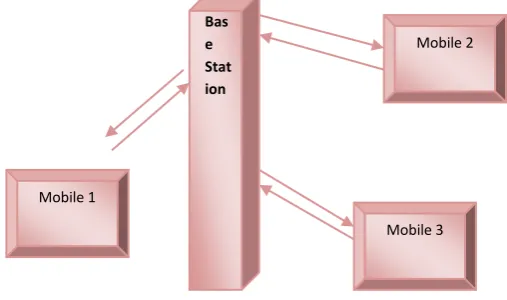
Shannon capacity limit can be applied as the upper bound of a wireless system, such as a cellular system shown in Figure 1.
Figure 1. Wireless cellular system
III. MULTIPLE-INPUTMULTIPLE-OUTPUTSYSTEMS
Where there are more than one antenna at either end of the radio link, this is termed MIMO - Multiple Input Multiple Output. MIMO can be used to provide improvements in both channel robustness as well as channel throughput.
MIMO - Multiple Input Multiple Output
In order to be able to benefit from MIMO fully it is necessary to be able to utilise coding on the channels to separate the data from the different paths. This requires processing, but provides additional channel robustness / data throughput capacity.
There are many formats of MIMO that can be used from SISO, through SIMO and MISO to the full MIMO systems. These are all able to provide significant improvements of performance, but generally at the cost of additional processing and the number of antennas used. Balances of performance against costs, size, processing available and the resulting battery life need to be made when choosing the correct option.
IV. RESULT&DISCUSSION
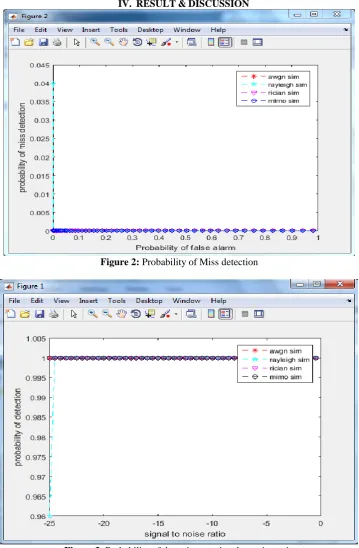
Figure 2: Probability of Miss detection
Figure 3: Probability of detection vs. signal to noise ratio
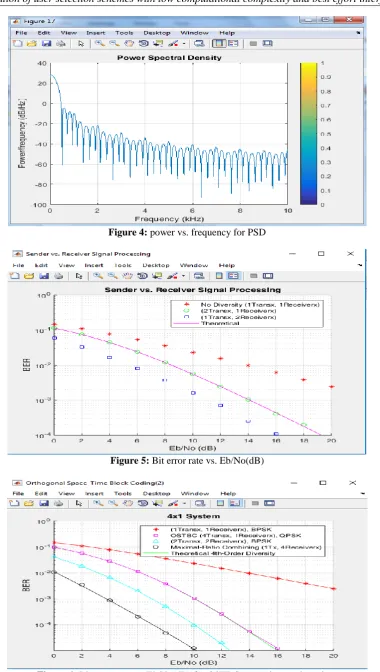
Figure 4: power vs. frequency for PSD
Figure 5: Bit error rate vs. Eb/No(dB)
The figure 4 defines the power spectral density for power and frequency . The figure 5 defines the bit error rate along with Eb/No. It is the transmitter and receiver processing bit error rate . But the figure 6 is the transmitter and receiver BPSK and OSTBC processing along with bit error rate and Eb/No.
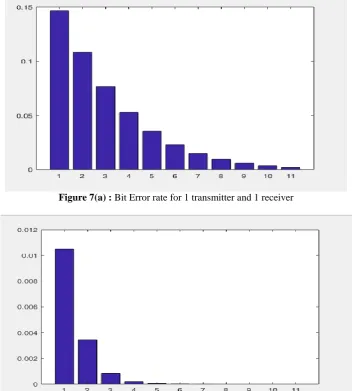
Figure 7(a) : Bit Error rate for 1 transmitter and 1 receiver
The figure 7(a) : Bit Error rate for 1 transmitter and 1 receiver , the figure 7(b) : Bit Error rate for 1 transmitter and 4 receiver and the figure 7(c) : Bit Error rate for 2 transmitter and 2 receiver . In this figures different values are coming along with bit error rate 1 , 2 and 4 transmitter and receiver.
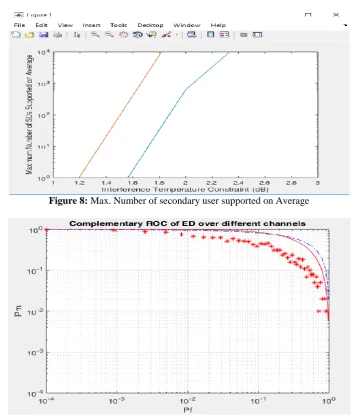
Figure 8: Max. Number of secondary user supported on Average
Figure 9: Complementary ROC of ED over different Channels
The figure 10 is the processing of snr1, Pd_sim_awgn, Pd_theory_rayleigh, Pd_appm_awgn, Pd_theory_awgn and Pd_sim_rician. Here different color line displays the different values of SNR.
V. CONCLUSION
A cooperative game is formulated to solve the spectrum sharing problem for multiple secondary users in a MIMO cognitive radio network. Each secondary transmitter adjusts its transmit covariance matrix to increase the utility under both transmit-power and total interference-power constraints. In this paper, we have considered the sum rate maximization problem for downlink transmission of MIMO CR networks in the presence of multiple SUs and PUs. The design problem is subject to per-antenna power constraints at the secondary BS and interference constraints at the PUs.The proposed algorithm was numerically shown to have a superlinear convergence behavior which is almost independent of the problem size. Through numerical experiments, we have illustrated how the performances of the secondary and the primary systems vary with the type of the interference constraints considered in the paper. In particular, we have shown that the performance of the secondary system degrades significantly and reaches a saturated value when either the number of primary users or the number of antennas at the primary user is large. Also, we have discussed different ways of controlling amount of the interference caused by the secondary system. Specifically, we have concluded that using the trace of the interference matrix may reflect the interference situation better, compared to using the largest eigenvalue.
In this work totally extraordinary issues are settled with Frequency and PU's and SU's. Amid this work totally extraordinary diagrams are ascertained with the help of different parameters and that we are turning into the 80% exactness of transmission of PU's and SU's with intellectual radio recurrence.
FUTURESCOPE
An interesting topic for future research is the extension of the proposed approach to simultaneous CR data transmission and spectrum sensing to systems comprising multiple CR MIMO transmitters, multiple CR MIMO receivers, and multiple PUs.
REFERENCES
[1]. Karama Hamdi et.al. “Opportunistic Spectrum Sharing in Cognitive MIMO Wireless Networks” IEEE Transactions On Wireless Communications, Vol. 8, No. 8, August 2009.
[2]. Lu Yang et.al. “Opportunistic User Scheduling In Mimo Cognitive Radio Networks” IEEE International Conference on Acoustic, Speech and Signal Processing (ICASSP)- 2014.
[3]. Lu Yang et.al. “Underlay MIMO Cognitive Radio Downlink Scheduling with Multiple Primary Users and no CSI” .semanticscholar.org-2015.
[4]. Duoying Zhang et.al. “Rank-Constrained Beam forming for MIMO Cognitive Interference Channel” Hindawi Publishing Corporation Mobile Information Systems Volume 2016.
[5]. Wenhao Xiong et.al. “MIMO Cognitive Radio User Selection with and without Primary Channel State Information” IEEE-2016.
[6]. 802.22 Working Group, “IEEE 802.22 D1: draft standard for wireless regional area networks,” March 2008. [Online]. Available: http://grouper.ieee.org/groups/802/22/.
[7]. A. Ghasemi and E. S. Sousa, “Collaborative spectrum sensing for opportunistic access in fading environments,” in IEEE Int. Symp. New Frontiers Dyn. Spectrum Access Netw (DySPAN 2005), Baltimore, Md, USA, pp. 131-136, Nov. 2005.
[8]. A. Goldsmith, Wireless Communications, Cambridge University Press, New York, USA, 2005.
[9]. A. Goldsmith, S. Jafar, I Maric and S. Srinivasa, “Breaking Spectrum Gridlock with Cognitive Radios: An Information Theoretic Perspective,” in Proc. IEEE, Vol. 97, No. 5, pp. 894-914, May 2009.
[10]. A. Goldsmith, S. Jafar, N. Jindal, and S. Vishwanath, “Capacity limits of MIMO channels,” IEEE J. Sel. Areas Commun., Vol. 21, No. 5, pp. 684–702, Jun. 2003.
[11]. A. J. Paulraj, D. A. Gore, R. U. Nabar and H. Bölcskei, “An overview of MIMO communications-A key to gigabit wireless,” in Proc. IEEE, Vol. 92, No. 2, pp. 198-218, Feb. 2004.
[12]. A. M. Tulino and S. Verdo, Random Matrix Theory and Wireless connections (2004). [Online]. Available: www.nowpublishers.com.
[13]. A. Narula, N. J. Lopez, M.D. Trott, and G.W. Wornell, “Efficient use of side information in multiple-antenna data transmission over fading,” IEEE J. Sel. Areas Commun., Vol. 16, No 8, pp. 1423-1436, Oct. 1998.
[14]. A. Nica and R. Speicher, Lectures on the Combinatorics of Free Probability, Cambridge University Press, 2006.
International organization of Scientific Research 65 | Page
[16]. A. Sahai and D. Cabric, “Spectrum sensing: fundamental limits and practical challenges,” in IEEEInternational Symposium on New Frontiers in Dynamic Spectrum Access Networks (DySPAN ’05), Baltimore, Md, USA, Nov. 2005.
[17]. A. Sahai, N. Hoven, S. M. Mishra, and R. Tandra, Fundamental tradeoffs in robust spectrum sensing for opportunistic frequency reuse (Mar.2006). [Online]. Available: http://www.eecs.berkeley.edu/ ~sahai/Papers/CognitiveTechReport06.pdf.
[18]. B. Song, F. Roemer, and M. Haardt, “Efficient channel quantization scheme for multi-user MIMO broadcast channels with RBD precoding,” in Proc. IEEE Int. Conf. Acoust., Speech and Sig. Proc. (ICASSP 2008), Las Vegas, NV, pp. 2389-2392, March- April 2008.
[19]. B. Suard, G. Xu, H. Liu, and T. Kailath, “Uplink Channel Capacity of Space-Division-Multiple-Access Schemes,” IEEE Trans. Info. Theory, Vol. 44, No. 4, pp.1468-1476, Jul. 1998.
[20]. C. D. Meyer, Matrix Analysis and Applied Linear Algebra, (SIAM, 2000).
[21]. C. E. Shannon, “A mathematical theory of communication,” Bell System Technical Journal, Vol. 27, pp. 379-423 and 623-656, Jul. and Oct. 1948.