IJSTE - International Journal of Science Technology & Engineering | Volume 1 | Issue 12 | June 2015 ISSN (online): 2349-784X
Enhanced and Efficient K-Means Clustering
Algorithm with New Technique of Initialization
Sejal Patel Ankita Shah
Student Assistant Professor
Department of Computer Science & Engineering Department of Computer Science & Engineering Narnarayan Shastri Institute of Technology, Jetalpur,
Ahmedabad, Gujarat
Narnarayan Shastri Institute of Technology, Jetalpur, Ahmedabad, Gujarat
Abstract
Document clustering is a more specific technique for unsupervised document organization. Clustering methods can be used to automatically group the retrieved documents into a list of meaningful categories. This paper gives an overview of some of the mostly used document clustering techniques. Further, It explains the Enhanced K-means algorithm which is initialized properly to overcome the drawback of converging of it to local optimum.
Keywords: Document Clustering, K-means, Enhanced Approach, pre-processing, centroid
________________________________________________________________________________________________________
I.
I
NTRODUCTIONData mining is a technology used in different disciplines to search for significant relationships among variables in large data sets. Clustering is a data mining technique of grouping set of data objects into multiple groups or clusters so that objects within the cluster have high similarity, but are very dissimilar to objects in the other clusters [1]. Dissimilarities and similarities are assessed based on the attribute values describing the objects. Clustering algorithms are used to organize data, categorize data, for data compression and model construction, for detection of outliers etc. Common approach for all clustering techniques is to find clusters centre that will represent each cluster. Cluster centre will represent with input vector can tell which cluster this vector belong to by measuring a similarity metric between input vector and all cluster centre and determining which cluster is nearest or most similar one [2].
Cluster analysis can be used as a standalone data mining tool to gain insight into the data distribution, or as a pre-processing step for other data mining algorithms operating on the detected clusters [3]. Many clustering algorithms have been developed and are categorized from several aspects such as partitioning methods, hierarchical methods, density-based methods, and grid-based methods [4].
II.
C
LUSTERING METHODOLOGYClustering of documents consists of some important steps to follow. These steps are as follows :
Datasets A.
There are different data files are included in datasets. They consist of the relevant data about the subject. There Should be variety of documents like animals.txt, badminton.txt, basketball.txt, carom.txt, chemical.txt, chess.txt, disease.txt, element.txt, plant.txt, plant.txt etc. On this text files, the algorithm is applied. Thereafter, the result of clustering algorithm can be found.
Document Pre-processing B.
Preprocessing consists of steps that take as input a plain text document and output a set of tokens to be included in the vector model.
Removal of Stopwords:
A stopword is defined as a term which is not thought to convey any meaning as a dimension in the vector space [5]. This Removes words that appear with very low frequency throughout the datasets. There are standard stopword-lists available but in most of the applications these are modified depending on the quality of the dataset.
Stemming:
Fig. 1: Steps of Pre-processing Methodology
Dimensionality Reduction C.
High dimension is the greatest challenge of document clustering, so dimension reduction became major issue of clustering. It can increase both the effectiveness and efficiency of clustering algorithms [6].
Vector Space model D.
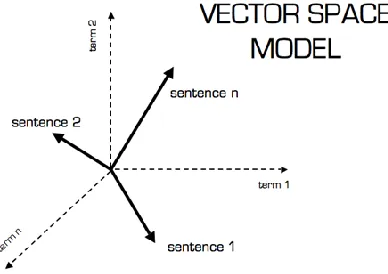
In order to reduce the complexity of the documents and make them easier to handle, the document have to be transformed from the full text version to a document vector which describes the contents of the document [6]. A definition of a document is that it is made of a joint membership of terms which have various patterns of occurrence. The vector space model procedure can be divided in to three stages. The first stage is the document indexing where content bearing terms are extracted from the document text. The second stage is the weighting of the indexed terms to enhance retrieval of document relevant to the user. The last stage ranks the document with respect to the query according to a similarity measure.
Fig. 2: Vector Space Model
III.
C
LUSTERING ALGORITHMSStandard K-means Algorithm A.
Enhanced and Efficient K-Means Clustering Algorithm with New Technique of Initialization (IJSTE/ Volume 1 / Issue 12 / 027)
1) Step 1:
- Choose the number of clusters ("K" in the K-means) required.
- Choose the centroids for the clusters randomly from among the given set of elements. 2) Step 2:
- Compute the distance of each of the element from the centroids.
- Assign the element to the cluster with the closest centroid. 3) Step 3:
- Re-compute the cluster centroids based on the assignments done in step2. 4) Step 4:
- Repeat Step 2 and Step 3 until the algorithm converges.
Considering the partitional algorithms, it is widely known that both K-means and K-medoids are sensitive to initialization and usually converge to solutions that represent local minima. Although k-means has the great advantage of being easy to implement, it has some drawbacks. The quality of the final clustering results of the k-means algorithm highly depends on the arbitrary selection of the initial centroids. In the original k-means algorithm, the initial centroids are chosen randomly and hence we get different clusters for different runs for the same input data. The k-means algorithm is computationally very expensive also. Trying to minimize these problems, we proposed one approach to select the initial cenrotids by applying one proposed method here.
Enhanced K-means Algorithm (Proposed) B.
Steps of improved method are listed below:
- Input: D = {d1, d2, d3,..., di,..., dn } //set of documents di = { x1, x2, x3,..., xi,..., xm }
k // Number of desired clusters.
- Output: A set of k clusters. Working Procedure:
1) Calculate distance for each document or data point from the origin 2) Arrange the distance (obtained in step 1) in ascending order.
3) Split the sorted list in K equal size sub sets. Also the middle point of each sub set is taken as the centroid of that set. 4) repeat this step for all data points. Now the distance between each data point & all the centroids is calculated. Then the
data set is assigned to the closest cluster.
5) in this step, the centroids of all the clusters are recalculated.
6) If this distance is less than or equal to the present nearest distance then the data point stays in the same cluster. Else it is shifted to the nearest new cluster.
IV.
S
IMILARITY/
DISTANCE MEASUREMENTSimilarity/distance measures map the distance or similarity between the symbolic description of two objects into a single numeric value, which depends on two factors : the properties of the two objects and the measure itself.
Euclidean Distance: A.
Euclidean distance [7] is widely used in clustering problems, including clustering text. It satisfies all the above four conditions and therefore is a true metric. It is also the default distance measure used with the K-means algorithm.
According to the Euclidean distance formula, the distance between two points in the plane with coordinates (x, y) and(a, b) is given by
Cosine Distance: B.
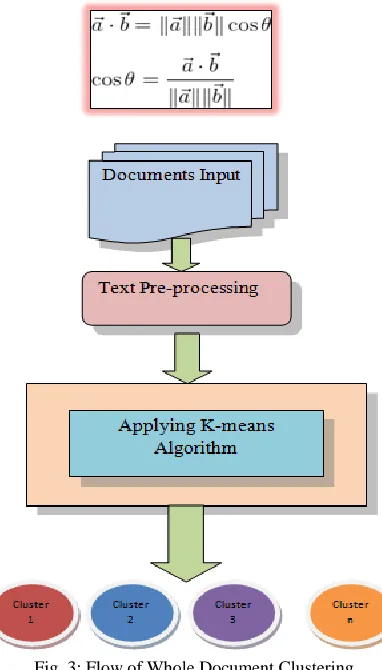
The cosine similarity [5] between two vectors (or two documents on the Vector Space) is a measure that calculates the cosine of the angle between them. This metric is a measurement of orientation and not magnitude, it can be seen as a comparison between documents on a normalized space because we’re not taking into the consideration only the magnitude of each word count (tf-idf)
Fig. 3: Flow of Whole Document Clustering
V.
E
VALUATION MEASUREMENTThe quality of a clustering result was evaluated using two evaluation measures—purity and entropy, which are widely used to evaluate the performance of unsupervised learning algorithms.
Purity: A.
The purity [3] measure evaluates the coherence of a cluster, that is, the degree to which a cluster contains documents from a single category. Purity can be interpreted as the classification rate under the assumption that all samples of the cluster are predicted to be members of the actual dominant class for the cluster. For an ideal cluster, which only contains documents from a single category, its purity value is 1. In general, the higher the purity value, the better the quality of the cluster is.
Entropy: B.
The entropy [3] measure evaluates the distribution of categories in a given cluster. The entropy measure is more comprehensive than purity because rather than just considering the number of objects in and not in the dominant category, it considers the overall distribution of all the categories in a given cluster.
VI.
E
XPERIMENTAL RESULTSEnhanced and Efficient K-Means Clustering Algorithm with New Technique of Initialization (IJSTE/ Volume 1 / Issue 12 / 027)
VII.
C
ONCLUSIONThis paper analyzed Document Clustering. The experimental results of Document Clustering Approaches on dataset shows. By this analysis we can easily understand the various conditions responsible for the various Clustering used. This analysis also shows that this method works efficiently, for large text data.
R
EFERENCES[1] Anna Huang, "Similarity Measures for Text Document Clustering," in NZCSRSC 2008, Christchurch, New Zealand., 2008, p. 8.
[2] Luís Filipe da Cruz Nassif and Eduardo Raul Hruschka, "Document Clustering for Forensic Analysis: An Approach for Improving Computer Inspection,"
IEEE TRANSACTIONS ON INFORMATION FORENSICS AND SECURITY, vol. 8, no. 1, p. 9, JANUARY 2013.
[3] K. Premalatha and A. M. Natarajan, "A Literature Review on Document Clustering," Information Technology Journal, p. 10, 2010.
[4] Neha Aggarwal and Kirti Aggarwal, "A Mid – Point based k-mean Clustering Algorithm for Data mining," International Journal on Computer Science and
Engineering (IJCSE), vol. 4, no. 6, p. 7, june 2012.
[5] Pavel Berkhin, "Survey of Clustering Data Mining Techniques," San Jose, CA, Survey Report.
[6] Sumit Goswami and Mayank Singh Shishodia, "A FUZZY BASED APPROACH TO TEXT MINING AND DOCUMENT CLUSTERING," Indian
Institute of Technology-Kharagpur, Kharagpur, India, Research Paper.
[7] Pankaj Jajoo, "Document Clustering," Indian Institute of Technology, Kharagpur, Thesis 2008.
[8] Muhammad Rafi and Mohammad Shahid Shaikh, "A Dynamic Programming Approach To Document Clustering Based On Term Sequence Alignment," in
The International Arab Conference on Information Technology (ACIT’2013), December 2013, p. 7.
[9] Neepa Shah and Sunita Mahajan, "Document Clustering with Cluto," in National Conference on New Horizons in IT - NCNHIT 2013, 2013, p. 5.
[10] Michael Steinbach, George Karypis, and Vipin Kumar, "A Comparison of Document Clustering Techniques," Department of Computer Science and