~ 73 ~ WWJMRD 2018; 4(7): 73-77
www.wwjmrd.com International Journal Peer Reviewed Journal Refereed Journal Indexed Journal
Impact Factor MJIF: 4.25 E-ISSN: 2454-6615
NARTEY George
School of Information Engineering, Zhengzhou University, Zhengzhou 450001, China
ZHANG Duanjin
School of Information Engineering, Zhengzhou University, Zhengzhou 450001, China
Correspondence:
NARTEY George
School of Information Engineering, Zhengzhou University, Zhengzhou 450001, China
Effective Adaptive Kalman Filter for Network Control
Systems with Network Delay Influence
NARTEY George, ZHANG Duanjin
Abstract
In this paper, we consider an Effective adaptive Kalman filter for network control systems with network delay influence. By concerning network delays with random transmission delays, while modeled a residual signal in which fault free is hypothetical to stability and identically zero. In the real world, these conditions are not satisfied due to various factors such as parameter uncertain systems with stochastic packet dropout, noise measurements, and induced delay. Effective performance analysis of fault diagnosis is illustrated. An effective adaptive Kalman filter, which is with a time-varying, is designed to minimize the outcome of the network.
Keywords:Network control systems, Time-varying, residual signal
Introduction
Network control system (NCS), or control over the network is a network-based system with a closed-loop which the sensor, actuator, and controller are connected in a form of information packets through a network. NCS has become a widely used technology in control areas and has attracted significant attention in the past few years[1]. Different from the traditional point-to-point control systems, NSC possesses many advantages that communication networks have, such as low cost, reduced weight and power requirements, simple installation, simple maintenance and shared information. Despite many advantages, when data is transmitted over the communication networks with infinite bandwidth, random delay, and packet dropout
will inevitably deteriorate the performance of NCS and even lead to losing stability [2]. NCS has been applied in various areas such as automotive, traffic systems, medical treatments, advanced aircraft and so on [3].
The study on filters and controller design for networked control systems with the consideration of various uncertainties in data transmission in the network has received a lot of attention in recent years [4-5]. Packet dropout can be traced back to Nahi[6] and Hadidi[7] where the phenomenon of packet loss is described as uncertainties by scalar binary random variables. Recently, this problems has been studied using erratic observations models, Such as optimal filtering in network control systems with multiple packet dropout, Sun and xie have reprented multiple packet dropout modelling method, robust filtering and nonlinear filtering are designed for the multiple missing measurement via linear matrix inequality (LMI) respectively[8-11].
This paper is prearranged as follows. In section 2, we present the problem formulation and preliminaries in network control systems. Section 3, Effective adaptive Kalman filter is designed for residual generation
Problem Formulation and Preliminaries
By considering the following linear time-invariant system:
{ ( ) ( ) ( ) ( ) ( )
( ) ( ) (1)
Where ( ) , ( ) , ( ) denote the system
state vector and output vector, respectively. ( ) is the external disturbance which belongs to , ) ( ) is the fault signal. are real matrices of the appropriate dimensions.
Fig.1 shows the structure of the mentioned NCS.
Fig.1: Structure of NCS with random delay and packet dropout
The measurement ( ) is time-stamp and transmitted through a digital communication network (DCN), Whose goal line is to transport packet from source to destination. The DCNs are very complex, and thus sensor -controller delay or controller-actuator delay is unavoidable between the senders and the receiver. Since the networks, Induced delays depends severely on variable networks conditions[12], They are usually time-varying, random and unknown but upperbounded.
The discretization model of the network-induced delay and the control input (Zero holds is assumed) over a sampling interval , ( ) - :
={
, -
, ( ) -
By reasonable assumption, the noise vector components are affected by slow dynamic, meaning:
, ( ) - (2)
The discretization of plant model (1) over one sample period is given as:
{
(3)
Where:
= ,
=∫
=∫
( ) ∫ ,
( ) ∫
By property of definite integral from equation (4), we get
{
( )
With the following definition:
∫ Bds (5)There exist a time-varying term
in the stateevolution equation of system (4) which makes it usual sampled-data system. Therefore, the traditional strategies of detecting and isolating multiple faults must be re-eveluated for the NCS. When the sampling period is suffient small compared with the system’s time constant, by using the Taylor approximation of we get:
( )=∫Bds
= , -
(6)Finally, the discrete-time model of the Networked control System is given by:
{
(
)
( )
The goal of the failure diagnosis System is to design a residual which is zero in the fault-free case and nonzero when a fault has occurred. The problem to deal with is to design a linear filter whose inputs are the measurable outputs and control inputs which generates certain outputs called residual signals, one for each possible fault, not affected by other faults and not affected by disturbances. Therefore, our aim is to find an observer for the system (1) of the form:
{ ̂
̂
( ̌ )̌ ̌ ( )
From (8) and (3), the state estimation error
̆ Propagate as:
.
/
( )The term
, which is due to the influence of the network, will have an impact on the quality of residuals.Design of Effective Residual Generator
In this section, our goal is to design an effective residual generator similar to the one described in equation (9). Yue and Ding suggest considering a time-varying space-based residual generator in [13-16], where robustness is achieved thanks to a decoupling procedure.
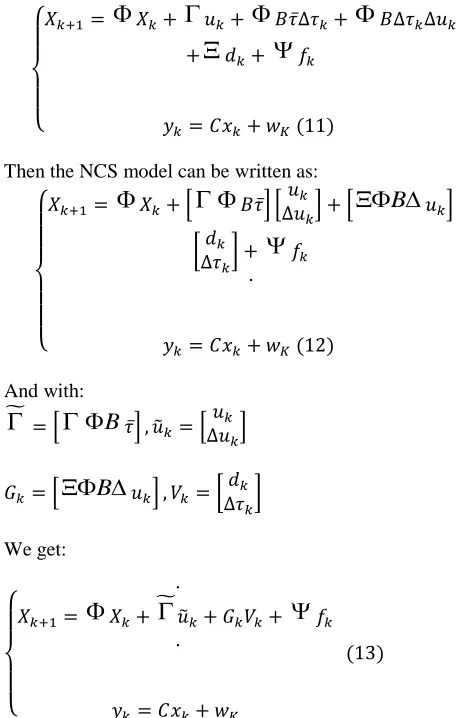
By assuming that the network delay can be disintegrated into a deterministic and stochastic part
̅ (10)
Where the stochastic parts belong to Zero mean white Gaussian sequence with well know variance var( ) from (10) and according to (7)
~ 75 ~
{
̅
( )
Then the NCS model can be written as:
{
0
̅1 0 1 0
B
1[ ]
( )
And with:
̃
0
B
̅1 ̃ 0 10
B
1 [ ]We get:
{
̃
̃
( )
With the following indicator i= are two discrete
gaussian white noise such as
, -
, -And:
[ ]Q
[ ] ̃̃ 0 1
ii= * + refered as measurement noise sequence and { } refered as to system noise sequence are not correlated :
[ ]Iii: The initial state is the random gaussina variable of mean and matra ix of covariance and
, -
,( )( ) -iv: The initial state and noise are not correlated
[ ]
, -V= the matric
, ̃ C, G are certain [17-18]With the model of NCS, given by (Eq….) and for the residual generation, it is proposed to generate residual using the effective adaptive Kalman filter given by the recursive algorithm:
{
̂
̂ ̃ ̃
( ̂ )
( )
̃
}From () and () the state estimation error ̂ is propagating as:
.
/
The proposed residual generator is effective as long as we can fix the threshold detection in function of the term
Numerical Example
Table 1: System Parameters
Conclusion
In this paper a proposed designed effective adaptive Kalmar filter for residual to minimize the impact of data delays. The main problem address is the robustness against network delays. The validation and comparison to classical Leuenberger state observer result show how the effectiveness of the designed system.
References
1. G. C. Walsh and H. Yet, “Scheduling of networked control systems,” IEEE Control Systems Magazine, vol. 21, no. 1, pp. 57-85, 2001.
2. J. Xiong, J. Lam, "Stabilization of linear systems over networks with bounded packet loss", Automatica, Vol.43, pp. 80–87, 2006.
3. P. Zhang, S. Ding, G. Wang, and D. Zhou, "Fault detection of linear discrete-time periodic systems",
IEEE Transactions on Automatic Control, vol. 50(2),
pp. 239–244, 2005.
4. D. Sauter, T. Boukhobza, F. Hamelin, "Adaptive thresholding for fault diagnosis of Networked Control Systems robust gainst communication delays", In proceeding of Networked Distributed Systems for
Intelligent Sensing and Control, Kalamata Greece, pp.
222-240, June, 2007.
5. H. Chen, J. Gao, T. Shi, and R. Lu, “H-infinity control for networked control systems with time delay, data packet dropout and disorder,” Neurocomputing, vol. 179, pp. 211-218, 2016.
6. N. E. Nahi, Optimal recursive estimation with uncertain observation, IEEE Trans. Inf. Theory, 15(4):457-462, 1969.
7. M. T. Hadidi and C. S. Schwartz, Linear recursive state estimators under uncertain observations, IEEE Trans. Automat. Control, 24(6):944-948, 1979. 8. H. Gao, T. Chen, and J. Lam, “A new delay system
approach to networkbased control,” Automatica, vol. 44, no. 1, pp. 39–52, 2008.
~ 77 ~
10. M. Yu, L. Wang, T. Chu, and F. Hao, "An LMI approach to networked control systems with data packet dropout and transmission delays", Journal of
Hybrid System, 3, 2004.
11. Y. Tipsuwan and M.Y.Chow, "Control Methodologies in networked control systems", Control Engineering
Practice, vol. 11, pp. 1099–1111, June 2003.
12. H. Xu, S. Jagannathan, and F. L. Lewis, “Stochastic optimal control of unknown linear networked control system in the presence of random delays and packet losses,” Automatica, vol. 48, no. 6, pp. 1017–1030,Jun. 2012.
13. S.-S. Hu and Q.-X. Zhu, "Stochastic optimal control and analysis of stability of networked control systems with long delay", Automatica, 39(11):1877–1884, 2003.
14. P. Zhang, S. Ding, G. Wang, and D. Zhou, "Observer-based approaches to fault detection in multirate sampled-data systems", In Proceedings of the 4th
Asian Control Conference, Singapore, pp.1367–1372,
2002.
15. H. Ye, G.Z. Wang and S.X. Ding, "A New Parity Space Approach for Fault Detection Based on Stationary Wavelet Transform", IEEE Transactions on
Automatic Control 49(2), pp. 281-287, 2004.
16. H. Fang, H. Ye, and M. Zhong, "Fault Diagnosis of Networked Control Systems", 6th IFAC Symposium on Fault Detection, Supervision and Safety of Technical
Processes, Beijing P.B. China, 2006.
17. H. Fang, H. Ye, and M. Zhong, "Fault Diagnosis of Networked Control Systems", 6th IFAC Symposium on Fault Detection, Supervision and Safety of Technical Processes, Beijing P.B. China, 2006. 18. D. Williamson, "Finite wordlength design of digital
kalman filters for state estimation", IEEE Transactions on Automatic Control 30, 930-939, 1990.