47 | P a g e
HEURISTIC OPTIMIZATION FOR DEMAND SIDE MANAGEMENT IN
SMART GRID
MANOJ D. PATIL
Department of Electrical Engineering, ADCET,
Ashta, Sangli, Maharashtra, India, [email protected]
ANAND BHUPAL KUMBHAR
Department of Electrical Engineering, SGI, Atigre,
Kolhapur, Maharashtra, India, [email protected]
ABSTRACT:
Demand side management (DSM) is major aspects in a smart grid which allows customers to take decision based on information for their consumed energy, which also helps in reduction of peak load demand for the energy producers which enables the reshaping of the load profile. Advantage of doing this will increase the sustainability of the smart grid and benefits in reduction of operational cost and lower production of green house gases. The various strategies available for demand side management uses an traditional energy management system which possesses and certain disadvantages related to algorithms. Moreover the existing strategies can handle only a limited number of controllable loads with limited types. In this paper presentation related to demand side management is implemented and explained for future grid, termed as smart grid. Load shifting technique before 24 hour was implemented and explained in this paper. Heuristic evolutionary algorithm(EA) is used for solving the minimization problem.
KEYWORDS: Demand side management, heuristic evolutionary algorithm, smart grids, a day ahead forecasting.
INTRODUCTION:
Smart grids are future of electrical grid, integrating advanced sensing technologies,, communication technologies and communication technologies will be employed for give more power to the smart and make capable of storing historical database, so that control operator will be adequate with knowledge to take decisions. Based on the US data the main characteristic of smart grid will be consumer friendliness, self healing property, resistance for attach and it can accommodate all types of loads, storage units, and generation, much better power quality. Smart pricing [1][2]is one of the important characteristic of smart grid, this tasks is accomplished by using the smart metering devices in the automatic metering infrastructure. If this system is employed it may lead to
cost reflective based on the entire transmission network of electricity at a certain location, quantity and period. If we use smart pricing then demand side management is under control of the customers and any beyond energy usage will be influenced by real time penalty.
There are various demand side management techniques are available and many techniques had been listed in the literature [4][5][6]. Most of them are system specific strategies, and worst part is some of which may not be applicable to practical systems that includes wide variety of independent devices.
DEMAND SIDE MANAGEMENT TECHNIQUES:
The advantage of using demand side management changes the electricity consumption patterns for reproducing the desired result in terms of load profiles. Many times it is observed that actual consumption profile will largely dependent on the planning objectives of the distribution companies. Demand side management is based on the utilization of power saving technologies [8], savings based on utilization vector, monetary incentives and various other government policies for mitigating the peak loads. If mitigation of peak load is made possible then huge saving in terms of generating plant set up cost can be avoided also transmission and distribution cost is saved. For demand side management various load patterns should be considered as shown in fig. no.1.
Fig.No.1. Demand side management techniques.
48 | P a g e
implement the demand side management techniquesutmost care must be taken to handle communication infrastructure amongst the central controller and certain controllable loads. The very important thing is deciding the optimal load consumption as it can vary widely and it could based on the environment and seasonal changes.
IMPLEMENTED DEMAND SIDE MANAGEMENT STRATEGY:
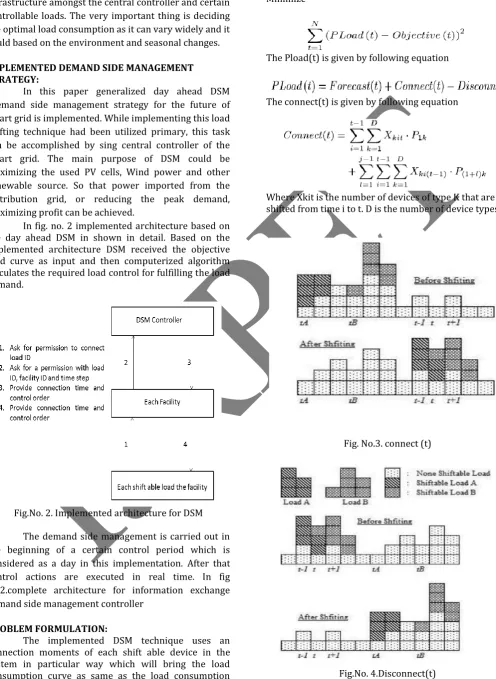
In this paper generalized day ahead DSM (demand side management strategy for the future of smart grid is implemented. While implementing this load shifting technique had been utilized primary, this task can be accomplished by sing central controller of the smart grid. The main purpose of DSM could be maximizing the used PV cells, Wind power and other renewable source. So that power imported from the distribution grid, or reducing the peak demand, maximizing profit can be achieved.
In fig. no. 2 implemented architecture based on the day ahead DSM in shown in detail. Based on the implemented architecture DSM received the objective load curve as input and then computerized algorithm calculates the required load control for fulfilling the load demand.
Fig.No. 2. Implemented architecture for DSM
The demand side management is carried out in the beginning of a certain control period which is considered as a day in this implementation. After that control actions are executed in real time. In fig no.2.complete architecture for information exchange demand side management controller
PROBLEM FORMULATION:
The implemented DSM technique uses an connection moments of each shift able device in the system in particular way which will bring the load consumption curve as same as the load consumption
cure. Mathematical formulation of the implemented system is presented as follows.
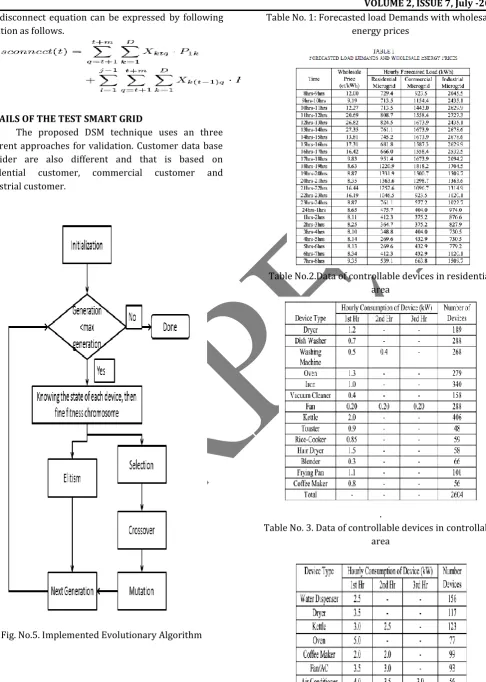
Minimize
The Pload(t) is given by following equation
The connect(t) is given by following equation
Where Xkit is the number of devices of type K that are shifted from time i to t. D is the number of device types.
Fig. No.3. connect (t)
49 | P a g e
The disconnect equation can be expressed by followingequation as follows.
DETAILS OF THE TEST SMART GRID
The proposed DSM technique uses an three different approaches for validation. Customer data base consider are also different and that is based on residential customer, commercial customer and industrial customer.
Fig. No.5. Implemented Evolutionary Algorithm
Table No. 1: Forecasted load Demands with wholesale energy prices
Table No.2.Data of controllable devices in residential area
.
50 | P a g e
Table No.4. Data of controllable devices in industrial areaSIMULATION RESUTS AND DISCUSSION:
From simulation results it has been seen that proposed demand side management strategy has emerge as an cost saving algorithm and objective to bring it near the final condition its been managed to bring the final consumption close predefined load curve. The implemented algorithm has efficiently found useful in reducing the operational cost and peak demand as well as presented in table no. 5 and table no.6.
Table No. 5. Operational cost reduction
Table No.6. Peak demand reduction
Table No.7. Additional saving by generation scheduling
CONCLUSION:
Demand side management is having great potential and by using it one can avail many benefits for the utility as well as smart grid, most importantly at distribution network level. In this paper demand side management strategy with load shifting technique is ben used, mathematical formulation of the same is also been presented in this paper. A heuristic algorithm was been developed for solving the problem. All required simulations were carried out with a developed program and costing in done on dollar basis. And it has been found that if proposed algorithm is calculated then operational cost and peak demand various other benefits can be achieved.
REFERENCES:
1) Q. Li and M. Zhou, “The future-oriented grid-smart grid,” J. Comput., vol. 6, no. 1, pp. 98–105, 2011. 2) P. Agrawal, “Overview of DOE microgrid activities,” in
Proc. Symp. Microgrid, Montreal,QC, Canada,
2006[Online].
3) S. Rahman and Rinaldy, “An efficient load model for
analyzing demand side management impacts,” IEEE
Trans. Power Syst., vol. 8, no. 3, pp. 1219–1226, Aug. 1993.
4) A. I. Cohen and C. C. Wang, “An optimization method
for load management scheduling,” IEEE Trans. Power
Syst., vol. 3, no. 2, pp. 612–618, May 1988.
5) K.-H. Ng and G. B. Sheblé, “Direct load control-A profit-based load management using linear programming,” IEEE Trans. Power Syst., vol. 13, no. 2, pp. 688–694, May 1998.
6) F. C. Schweppe, B. Daryanian, and R. D. Tabors, “Algorithms for a spot price responding residential load controller,” IEEE Trans. Power Syst., vol. 4, no. 2, pp. 507–516, May 1989.
7) M. Shahidehpour, H. Yamin, and Z. Li, Market Operations in Electric Power Systems: Forecasting,
Scheduling, and Risk Management. New York: Wiley–
IEEE Press, 2002.
8) Z. N. Popovic and D. S. Popovic, “Direct load control as a market-based program in deregulated power industries,” in Proc. IEEE Bologna Power Tech Conf., Jun. 23–26, 2003, vol. 3, p. 4.
9) H. Lee and C. L.Wilkins, “A practical approach to appliance load control analysis:A water heater case study,” IEEE Trans. Power App. Syst., vol. PAS-102, no. 4, pp. 1007–1013, Apr. 1983.
10) C. N. Kurucz, D. Brandt, and S. Sim, “A linear programming model for reducing system peak through customer load control programs,” IEEE Trans. Power Syst., vol. 11, no. 4, pp. 1817–1824, Nov. 1996.
11) W. C. Chu, B. K. Chen, and C. K. Fu, “Scheduling of direct load control to minimize load reduction for a utility suffering from generation shortage,” IEEE Trans. Power Syst., vol. 8, no. 4, pp. 1525–1530, Nov. 1993.
12) H. G. Weller, “Managing the instantaneous load shape impacts caused by the operation of a large-scale direct load control system,” IEEE Trans. Power Syst., vol. 3, no. 1, pp. 197–199, Feb. 1988.
13) Y. Y. Hsu and C. C. Su, “Dispatch of direct load control using dynamic programming,” IEEE Trans. Power Syst., vol. 6, no. 3, pp. 1056–1061, Aug. 1991.
51 | P a g e
programming,” IEEE Trans. Power Syst., vol. 13, no. 2,pp. 688–694, May 1998.
15) L. Yao, W. C. Chang, and R. L. Yen, “An iterative deepening genetic algorithm for scheduling of direct load control,” IEEE Trans. Power Syst., vol. 20, no. 3, pp. 1414–1421, Aug. 2005.
16) T. Logenthiran, D. Srinivasan, and A.M. Khambadkone, “Multi-agent system for energy resource scheduling of integratedmicrogrids in a distributed system,” Electr. Power Syst. Res., vol. 81, no. 1, pp. 138–148, 2011.
17) T. Back, D. Fogel, and Z. Michalewicz, Handbook of
Evolutionary Computation. New York: IOP Publ. and
Oxford Univ. Press, 1997.
18) I. K. Maharjan, Demand Side Management: Load Management, Load Profiling, Load Shifting, Residential and Industrial Consumer, Energy Audit, Reliability, Urban, Semi-Urban and Rural Setting. Saarbrücken, Germany: LAP (Lambert Acad. Publ.), 2010.
19) ] D. P. Kothari, Modern Power System Analysis. New Delhi, India: Tata McGraw-Hill, 2003.
20) C. W. Gellings, Demand-Side Management: Concepts
and Methods.Liburn, GA: Fairmont, 1988.
21) T. Logenthiran, D. Srinivasan, A. M. Khambadkone, and H. N. Aung, “Scalable multi-agent system (MAS) for operation of a microgrid in islanded mode,” in Proc. Joint Int. Conf. PEDES & Power India, Dec. 20– 23, 2010, pp. 1–6.
22) T. Logenthiran and D. Srinivasan, “Short term generation scheduling of a microgrid,” in Proc.
TENCON IEEE Region 10 Conf., Jan. 23–26, 2009, pp.
1–6.
23) T. Logenthiran and D. Srinivasan, “Management of distributed energy resources using intelligent multi-agent system,” in Multi-Agent Applications With Evolutionary Computation and Biologically Inspired Technologies: Intelligent Techniques for Ubiquity and Optimization,S.-H. Chen, Ed. et al. Hershey, PA: IGI Global, 2011, pp. 208–231.
24) Manoj D. Patil and Rohit G. Ramteke, “L-C Filter Design Implementation and Comparative Study with Various PWM
25) Techniques for DCMLI,” in IEEE Xplore Digital Library & International Conference on Energy Systems and Applications (ICESA-2015), 2015, no. Icesa 2015, pp. 347–352.
26) Manoj D. Patil, Mithun Aush, and K. Vadirajacharya, “Grid Tied Solar Inverter at Distribution Level with Power Quality Improvement,” Int. J. Appl. Eng. Res., vol. 10, no. 9, pp. 8741–8745, 2015.
27) Manoj D. Patil, Mithun Aush, R. H. Madhavi “New Approaches for Harmonics Reduction in solar inverters,” Int. J. Adv. Found. Res. Sci. Eng., vol. 1, no. Special Issue, Vivruti-2015, pp. 1–7, 2015.
28) Manoj D. Patil, K. Vadirajacharya “Grid Tied Solar Using 3-Phase Cascaded H-Bridge Multilevel Inverter at Distribution Level with Power Quality Improvement,” Int. J. Adv. Found. Res. Sci. Eng., vol. 2, no. Special Issue, pp. 178–191, 2016.
29) Manoj D. Patil, K.Vadirayacharya“A New Solution to Improve Power Quality of Renewable Energy Sources Smart Grid by Considering Carbon Foot Printing as a New Element,” IOSR J. Electr. Electron. Eng. Ver. I, vol. 10, no. 6, pp. 103–111 2015.
30) Manoj D. Patil, “Power Quality Improvement for Energy Saving,” Novat. Publ. Int. J. Innov. Eng. Res. Technol., vol. 3, no.5, pp. 89–94, 2016.
31) Mithun Aush, Manoj D. Patil, K.Vadirajacharya “Performance Analysis of Multilevel Inverter for Grid Connected System,” Int. J. Appl. Eng. Res., vol. 10, no. 9, pp. 8762–8764, 2015.
32) Mithun Aush, Manoj D. Patil,