ISSN (Online): 2320-9364, ISSN (Print): 2320-9356
www.ijres.org Volume 5 Issue 4 ǁ Apr. 2017 ǁ PP.16-28
Simulation Analysis of Single Column Plate Phononic Crystals
At Low Frequency Band Gap Characteristics
Yi Wang, Jiang Lv, ZhiJianXu
Shanghai University of Engineering Science, Shanghai 201620, China
ABSTRACT:
In this paper, locally resonant single side column plate phononic crystals are studied. Based on the
finite element method, the material properties of the scatterer and the effect of the plate shape on the band gapcharacteristics of the locally resonant single side column plate phononic crystals are calculated and analyzed by
use of the multi-physics software COMSOL. Based on the analysis on the effects of the density, the elastic
modulus, the poisson ratio and the shape of the scatterer, it is shown that the density, the elastic modulus and the
shape of the scatterer can obviously affect the band gaps of phononiccrystals .
Keywords:
phononiccrystals, the band gap characteristics, the material properties, simulationI.
INTRODUCTION
The concept of Phononic Crystals by analogy photonic crystal[1-3].The composed of elastic constants and density of Phononic crystal material or structure distributed into a cycle .Elastic wave transmission in the periodic materials constitute the phononic crystal would produce the elastic wave band gaps similar to photons band gap. So according to the concept of photonic crystal puts forward the concept of phononic crystal. A certain frequency of elastic wave propagation banned in certain frequency range due to the different material properties and cycle type structure. This frequency band called band gap. And the same frequency of elastic wave can pass without prejudice in the other frequency range, the frequency band is called the passing band[4-8].When a main structure of phononic crystal lattice constant, when compared with the incident wavelength is proposed to produce better scattering effect, this is called Bragg model. When a single scatterer resonance characteristics of phononic crystal plays a leading role ,it called local resonance type. According to the phonon crystal structure, can be divided into one-dimensional, two-dimensional and three-dimensional phononic crystals. A one-dimensional phononic crystal is mainly used to transfer matrix method is used to solve , 2d and 3d are more complicated, main calculation method of plane wave expansion method, finite difference time domain method, multiple scattering method and other methods[9-15]. On the calculation method is similar to the calculation method of photonic crystals.
1993,Kushwaha et al firstly puts forward the concept of phononic crystal, and USES the scatterer nickel column and forms a composite material of aluminum alloy matrix, using the plane wave expansion method to calculate the elastic wave band structure of the shear direction.
1995,R.Martinez-Sala et al research in Madrid in a sculpture called "The flowing melody" with a history of more than 200 years, and carried out the acoustic characteristics test, the first time confirmed the existence of the elastic wave band gaps from an experiment. 2000,Liu et al[16]found that the phonon crystal has the local resonance mechanism of band gap when study with a shot coated with viscoelasticity of soft materials constitute a simple cubic crystal, and buried in epoxy resin to form three dimensional three component phononic crystal, At present, the study of Phononic crystal is concentrated in the band gap characteristics and applications.
II.
CALCULATE BAND GAP OF PERIOD STRUCTURE BY THE FINITE ELEMENT
METHOD
Online elasticity, anisotropy, excluding damping and physical strength of the infinite medium, the control
of the elastic wave equation[17] is described as
2
( ( ) :
C
)
( )
r
u(r)
r
u(r)
(1)respectively,
is the angular frequency of harmonic elastic, ":" is the two point multiplication symbol. For isotropic inhomogeneous medium, the elastic wave equation (1) can be simplified to [18]2 2
(
) (
)
u(r)
u(r)
u(r)
(2)Among them,
( /
x
, /
y
, /
z
)
is the vector differential operator,
and
are the lame constantsfor dielectric materials.
By using the numerical solution of wave equation with finite element method, according to the Bloch
theorem, the eigenvalue equation of the infinite periodic structure (2) can hold down to a representative unit cell
relying on its symmetry. The equation can be turned into generalized eigenvalue equation of a discrete form.
Ku
2Mu
(3)Among them,
Κ
andM
are the whole stiffness matrix and the whole mass matrix of the structure respectively,u
is the feature vector. In a two-dimensional periodic structure, for example, suppose that there areN
periodic unit structure along the direction of the wave vector of the incident wave, and meet Born - von Karman boundary conditions on the border:( )
(
)
f
r
f
r
N
a
(4)a
is the lattice vector,f
( )
r
is any periodic function with the cycle ofa
along the direction of the wavevector,
N
can be desirable for arbitrary integer.u
can also be written as made up of all substructure characteristic vector ordinal arrangement form:T T
1 2 N
[u] = [u , u , ..., u ]
(5)The whole stiffness matrix
K
and the whole mass matrixM
can be written in block form:11 12 1 11 12 1
21 22 2 21 22 2
1 2 1 2
,
N N
N N
N N NN N N NN
K
K
K
M
M
M
K
K
K
M
M
Μ
K
M
K
K
K
M
M
M
(6)
Every sub-matrix is made of
n n
matrix,n
is corresponding to the substructure of the degrees of freedom. According to the Bloch theorem [19], when a wave travels in the cycle structure, the displacement fieldhas the following form:
( )
( )
e
ik r ku r
u (r)
(7)k
u (r)
is the periodic functions same as the system;
k
is the wave vector, it’s limit values in the first brillouinzone.( tetragonal lattice corresponding brillouin zone as shown in figure 2.1).Then, unit cell's outer boundary should satisfy the following conditions:
( ) i
e
k aU(r + a)
u(r)
(8)Among them,
a
is the lattice vector. Simultaneous equations (3) and (8) can solve the characteristic frequency of a given under the wave vectork
.Substitute the characteristic frequency into the equation (3), thenirreducible brillouin zone boundaries, the full band structure can be obtained.
Fig.2.1 Irreducible brillouinarea(shaded part)
Ⅲ
. CALCULATION AND ANALYSIS OF SINGLE COLUMN PLATE PHONONIC
CRYSTALS AT LOW-FREQUENCY BAND GAP CHARACTERISTICS
Single column plate phononic crystals has excellent low-frequency band gap characteristics, which can
be widely used in low-frequency vibration and noise reduction in the engineering practice. But the low frequency
band gap characteristics of research about this important structure also is not very perfect, this paper to further
improve the calculation of in-depth analysis, not only is conducive to single column plate phononic crystals in the
low-frequency large-scale application in the field of elastic wave, can also for other types of phononic crystal
structure design and application to provide the reference.This paper will discuss the change rule and the physical
mechanism of psingle column plate phononic crystals at low-frequency band gap characteristics, and made a
project case with its the optimal scheme and frequency response analysis.
3.1 Rule and the physical mechanism of band gap characteristics along with the change of elastic constants 3.1.1 Accuracy verification of band gap calculation
First of all, in this paper, the calculation results compare with literature [20] to verify the accuracy of
calculation method in this paper.As shown in figure 3.1, single cell matrix underside (square) a = 10 mm in length, substrate thickness of e = 2 mm,scattering body height is h = 10 mm, cylinder scatterer radius r = 4.5 mm.Among them, material of the substrate is used in rubber, material of the scattering body is used in steel, material
parameters as shown in table 3.1
Tab. 3.1 Material properties of the phononic crystal
Using COMSOL/Multiphysics of multiple physical fields software calculated band gap properties of
phononic crystals as shown infigure 3.2:
Fig. 3.2 Band gap of the cylindrical scattering phononic crystal
To calculate the first gap data of the phonon crystal unit cell compared with literature[20], as shown in
table 3.2, you can see that the of first gap center frequency, bandwidth and cut-off frequency is very small, it is verified the accuracy of the calculation model in this paper, the result is credible.
Table 3.2 Comparison of computational results and the literature[20]
CylindricScatter
Radius(mm)
The first gapstart
Frequency(Hz)
The first gap end
Frequency(Hz)
Thefirstgapcentre
Frequency(Hz)
Bandwidth
(Hz)
4.5( Literature) 205.4 542 373.7 336.6
4.5(This text) 185.3 528.4 356.9 343.1
error 9.8% 2.5% 4.5% 1.9%
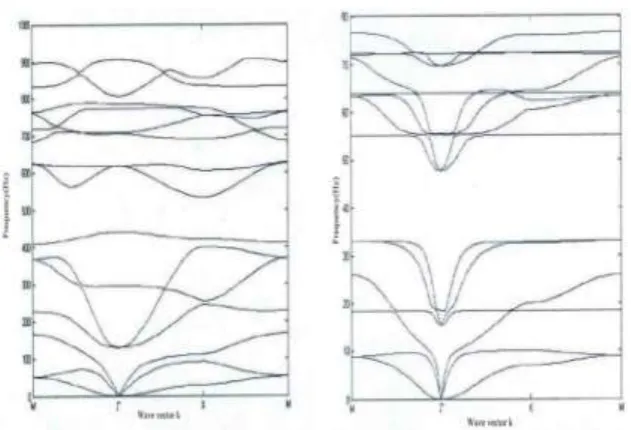
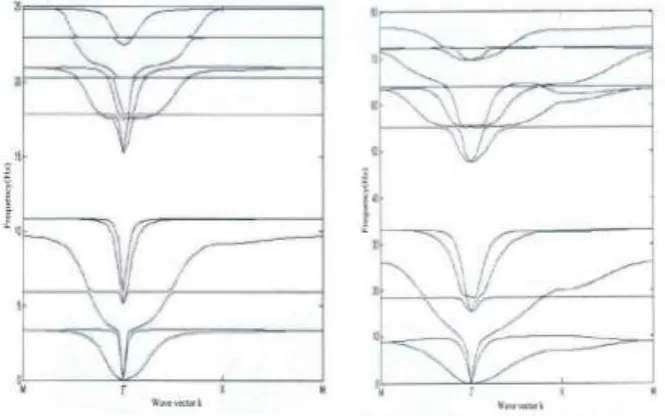
3.1.2 Rule and the physical mechanism of band gap with the changing of the scatterer density
Take unit cell scatterer of phononic crystal with a single column plate’s radius for r = 4 mm, other geometry of unit cell model size remains the same. The body material of unit cell is always for the rubber, the
scattering body is based on steel material, and changing the density of scatterer materials, calculating and
analyzing the change rule and the physical mechanism of band gap properties of single column plate
phononiccrystals.The density value of phononic crystal band gap as shown in figure 3.3, the density change rule of the first gap with the scatterer as shown in figure 3.4.
Material name Densityρ(kg/m3) GpaΕ(Pa) Poisson ratioν
rubber 1300 1.175e5 0.47
a. Band gap with density is 1000kg/m3b. Band gap with density is 3000kg/m3
c. Band gap with density is 5000kg/m3d. Band gap with density is 11000kg/m3
e. Band gap with density is 15000kg/m3f. Band gap with density is 19000kg/m3
Fig. 3.4 Effect of the scatterer density on band gap properties
The scatterer density is changed, other remain unchanged. As you can see, the effects of the scatterer
density on the first gap cut-off frequency almost can be ignored, but had a great influence on the first gap starting
frequency. When the scatterer density is very small, almost no band gap.Scatterer density is large enough, it will
produce obvious band gap, and scatterer density is greater than 7000 kg/m3, after the decrease of the first gap’s
start frequency flattens out slowly ,then to stabilize the low-frequency band gap bandwidth.
3.1.3 Rule and the physical mechanism of band gap characteristics with the changing of the scattering body’s elastic modulus
When scattering elastic modulus of a single column plate phononic crystal unit cell changes, other
remains the same, then elastic modulus, respectively, take 1.175×10³Pa,1.175×104Pa, 1.175×10⁵Pa,1.175×106Pa.
1.175×10⁷Pa, 1.175×10⁸Pa, the calculation results of phononic crystals bandgap are shown infigure 3.5:
c. Band gap with the modulus is 1.175×10⁵Pad. Band gap with the modulus is 1.175×10⁶Pa
e. Band gap with the modulus is 1.175×10⁷Paf. Band gap with the modulus is 1.175×10⁸Pa
Fig. 3.5 Band gaps of phononic crystals with different elastic modulus of the scatterer
The elastic modulus of the scatterer is changed, and other remains the same, then the first gap starting
frequency and cut-off frequency increases gradually with the increase of elastic modulus. When the elastic
modulus of scatterer is greater than the elastic modulus of rubber matrix after 1.175× 10⁵Pa, apparently, speeding
up bigger rate of cutoff frequency, generating low-frequency band gap and bandwidth become bigger obviously
larger.When the elastic modulus of scattering is greater than 1.175×10⁷ Pa, band gap tends to be stable, as shown
Fig. 3.6 Effect of the elastic modules of the scatterer on band gap properties
3.1.4 Rule of band gap characteristics with the changing of scattererpoisson ratio
When scattering material poisson's ratio of single column plate phononic crystal unit cell changes, the other parameters remain the same, material poisson’s ratio of the unit cell scattering, respectively, take different values, calculated the change rule of phononic crystals band gap properties in the first part of the gap as shown
infigure 3.7.
Fig. 3.7 Effect of the poisson ratio of the scatterer on band gap properties
It can be seen that change poisson’s ratio of unit cell scattering material and other remains the same, the
initial frequency of the first gap and cut-off frequency have little change, the influence between poisson’s ratio and
band gap characteristic of single column plate phononic crystals can be neglected.
3.2 The rule and the physical mechanism of band gap characteristics with the change of scatterer shape. In addition to the documents[20] referred to the geometrical size (cylinder scatterer radius and height) in
the cylinder scatterer and the calculation of the scattering body material properties (density, modulus of elasticity)
in this paper can affect the single column plate phononic crystals band gap properties, Scatterer geometry may also
have important influence on phononic crystals band gap properties. To this end, change the scattering body
Fig. 3.8 Finite element model of the cell of the cubic phononic crystal
Fig.3.9 Effect of the scatterer length on band gap properties
Fig. 3.10 Comparison of band gaps of phononic crystals with cylindrical and cubic scatterers
same. But the first area gap cutoff frequency of the rectangular scattererphononic crystal is bigger than the cylindrical scattererphononic crystal. Rectangular scattererphononic crystals have better low -frequency band gap characteristics than cylinder scattererphnoonic crystal.
3.3 A acoustic application of single column plate structure Phononic crystal.
Comprehensive the above research conclusion, Choose the optimal combination of materials in the actual common materials. Use appropriate phononic crystal unit cell structure, get the low-frequency band gap properties of the optimal phononic crystal plate structure that used in acoustic noise reduction.。The sound energy density of Chinese is generally focused on 200 Hz to 700 Hz, actual commonly used materials such as shown in table 3.3
Tab.3.3 Parameter of commonly used materials
In order to get low frequency elastic wave band gaps, substrate material choose rubber, choose different crane, copper, steel, lead, as the scatter material;On the premise of scattering body size is bigger,Phononic crystal
unit cell using rectangular scatter unit cell structure with a better low frequency band gap characteristics.(As shown in figure 3.8),The scattering body bottom off for b=9 mm length, other geometric parameters unchanged.
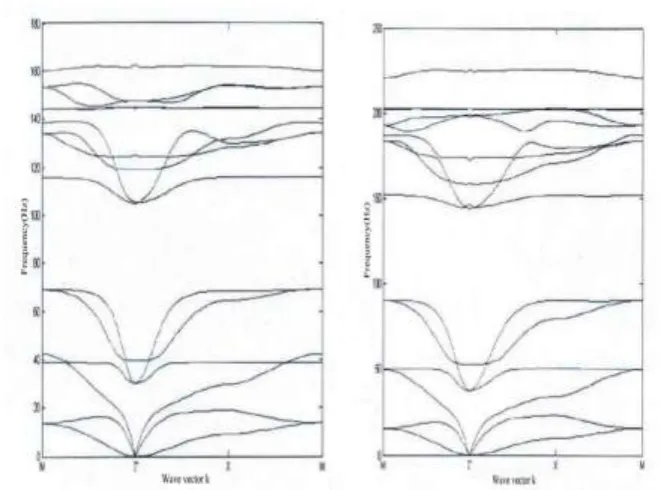
The calculation of the phonon crystal band gap characteristics as shown in figure 3.11:
A. Band gap of the tungsten scatterer B. Band gap of the copper scatterer
Material name Densityρ(kg/m3) GpaΕ(Pa) Poisson ratioν
tungsten 19100 35.41e10 0.35
lead 11600 4.08e10 0.37
copper 8960 12.71e10 0.35
steel 7850 2.0e11 0.33
Aluminum oxide 3986 40.27e10 0.23
Aluminum 2730 7.76e10 0.35
rubber 1300 1.175e5 0.47
C. Band gap of the steel scatterer D. Band gap of the aluminum scatterer Fig. 3.11 Band gap of the scatterer material is tungsten, copper, steel or aluminum
Four kinds of combinations of materials, calculated phononic crystals band gap properties for such as shown in
table 3.4:
Tab. 3.4 Compare of band gap properties of photonic crystals
Scattermaterial The first gapstart
Frequency(Hz)
The first gap
end
Frequency(Hz)
Thefirstgapcentre
Frequency(Hz)
Bandwidt
h
(Hz)
tungsten 136.3 695.5 415.9 559.2
copper 196.7 708.8 452.3 512.1
steel 209.6 712.3 461 502.7
Aluminum 339.1 745.8 542.5 4.6.7
By comparison, Aluminum scatterer phonon crystal unit cell band gap characteristics of materials are significantly than the other three kinds of materials; when tungsten, copper, steel as scatterer material respectively, Can conform to the sound energy density of Chinese is focused on the fall of 200 Hz to 700 Hz; but, the density of copper and steel is far less than tungsten. So, Appropriate chooses substrate materials for rubber, the scattering body material for steel rectangular scatterer single column board phononic crystals as noise sound best.
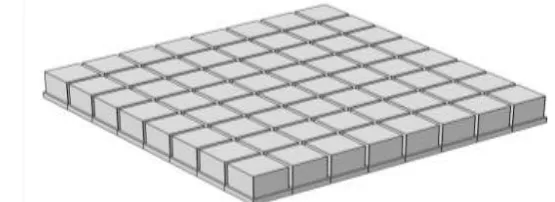
Examine the vibration transmission characteristics of8×8Single column plate phononic crystal unit cell finite periodic structure, further validated the effectiveness of the single column harden Phononic crystal design and the band gap calculation. Geometric model as shown in figure 3.12.Using COMSOL software for frequency response analysis, from one end of the cycle board input amplitude value for the unit displacement spectrum,Xaxis is the direction for the direction of displacement spectrum, frequency range is 100 Hz to 1500Hz, inspection average of the output displacement response at the other end of cycle board structure, the results as shown in figure 3.13
Fig. 3.13 Transmission characteristics of 8 × 8 periodic plate structure
As shown in the figure , board structure damping effect is obvious in the band gaps frequency range phononic crystal cycle , and the frequency response analysis Vibration frequency range and the band gap characteristics to calculate the band gap range almost coincide, further validated the effectiveness of the single column harden Phononic crystal design and the band gap calculation in this paper.
Ⅳ
.CONCLUSION
In this paper, the effects of density, elastic modulus, poisson’s ratio and the shape of scatterer are studied
on the low-frequency band gap characteristics of single column plate phononic crystals. The effects of material
constant and scattering body shape are analyzed in the band-gap characteristic. The following conclusions are
drawn:
(1)Among the material parameters of single column plate phononic crystal, the scatterer density and elastic modulus is large enough, excellent low-frequency band gap will be produced, both of them have a great influence on the phononic crystals band gap characteristic; But the scattererpoisson's ratio almost have no effect on crystal band gap characteristics.
(2)Through changing the phonon crystal scatterer shape into cuboid,with the equal height and volume of the scatterer, rectangular scattererphononic crystal unit cell has better low-frequency band gap characteristics than cylindrical scatterer phonon crystal unit cell.
(3) Through calculation analysis,we found that steel as the scatterer and rubber as matrix of phononic crystal, which structure with rectangular scatterer single column plate,can be well applied to the actual acoustic low-frequency sound insulation. It indicates that phononic crystal with a reasonable combination of materials and unit cell configuration can play an important role in engineering practice.
ACKNOWLEDGMENTS
This work was supported by Shanghai University of Engineering Science Innovation Fund for Graduate
Students (No.16KY0607). The authors are all indebted to the generous support.
REFERENCES
[1]. Sigalas M M, EconomouE N. Elastic and Acoustic Wave Band Structure [J].J. Sound Vib.,1992,158
(2) :377 382.
[2]. Kushwaha M S, Halevi P, Dobrzynski L, et al. Acoustic Band Structure of Periodic Elastic Composites [J].Phy. Rev. Lxtt.,1933,71(13) :2022-2025.
[3]. Qiu X Y. Research Review on the Band Cap of One-dimensional Phononic Crystals [J].Journal of Honghe Urriversity,2011,9 (2) :5-8.
[5]. Wu F G, Liu G Y, Liu Y Y. Acoustic Band Caps in 2D Liquid Phononic Crystals of Rectangular Structure
[J].J. Phys. D:Appl. Phys. ,2002,35:162-165.
[6]. Xu B R, Xu S 11, Wang L W. Study on Band Cap of One-dimensional Porous Silicon Phononic
Crystal [J].Journal of Synthetic Crystal.s,2012,41 (5):1440-1445.
[7]. Li ,J B, Wang Y S,Zhang C Z. Finite Element Analysis and Design of Band Structures for Two
dimensional Phononic Crystals Microcavity [J].Journal of Synthetic Crystals, 2010, 39(3):649-664.
[8]. Zhao H Y,Luo Y H,Chen A L.Properties of Acoustic Band Structure of Phononic Crystal with Square-like Archimedean Lattices[J]. Journal of Synthetic Crystals,2012,41( 1) : 243-247.
[9]. Dong H F,Wu F G,Mu Z F,et al.Effect of Basis Configuration on Acoustic Band Structure in Two-dimensional Complex Phononic Crystals[J].ActaPhysicaSinica,2010,59( 2) : 754-758.
[10]. Chen A L,Wang Y S.Study on Band Gaps of Elastic Waves Propagating in One-dimensional Disordered Phononic Crystal[J].Physica B, 2007, 392 ( 1-2) : 369-378.
[11]. Yan Z Z,Wang Y S . Wavelet based Method for Calculating Eastic Band Gaps of Two-dimensionalPhononicCrystals[J]. Physical Review B, 2006, 74: 22430322.
[12]. Hu J G, Zhang J, Jing S Y. Study on the Band Gaps of 2D Nesting Complex Structure Phononic Crystal [J].Journal of Synthetic Crystals, 200, 38( 5) : 1160-1164 .
[13]. Cao Y J, Yang X. Transmission Properties of the Generalized Fibonacci Quas-iperiodicalPhononi Crystal[J].ActaPhysicaSinica, 2008, 57( 6) :2620-2624.
[14]. Liu Q N. Analytic Method of Studying Defect Mode of 1D Doped Phononic Crystal[J]. ActaPhysicaSinica, 2011, 60( 4) : 0443021-0443024.
[15]. Yang R F, Fang Y T. Analytic Method of Obtaining Defect Modes of One-dimensional Phononic Crystals[J]. Journal of Synthetic Crystals, 2012, 41( 2) :258-261.
[16]. Liu Z Y, Zhang X, Mao Y et al. Locally Resonant Sonimaterials[J]. Siebce, 2000, 289: 1734-1736. [17]. Auld B A. Acoustic Fields and Waves in Solids [M]. New York, Wiley. 1973.
[18]. Wen X S, Wen J H, Yu D L et al. Photonic crystal[M]. National Defence Industry Press, Beijing, 2009.
[19]. Gu C L, Wang X K. Solid state physics [M]. Tsinghua University Press, Beijing, 1997.
[20]. Kunpeng Y U, Chen T, Wang X. Band gaps in the low-frequency range based on the two-dimensional
phononic crystal plates composed of rubber matrix with periodic steel stubs[J]. Physica B Condensed

![table 3.2To calculate the first gap data of the phonon crystal unit cell compared with literature[20], as shown in , you can see that the of first gap center frequency, bandwidth and cut-off frequency is very small, it is verified the accuracy of the calcu](https://thumb-us.123doks.com/thumbv2/123dok_us/1439243.1658327/4.595.154.442.209.395/calculate-compared-literature-frequency-bandwidth-frequency-verified-accuracy.webp)