e-ISSN: 2278-067X, p-ISSN: 2278-800X, www.ijerd.com
Volume 6, Issue 9 (April 2013), PP. 59-66
Simulation Model for Biodiesel Production using Plug
Flow reactor: Non Isothermal Operation
Gumus R. H., Wauton I, Osaro H
Department of Chemical and Petroleum Engineering, Niger Delta University, Wilberforce Island , P.M. B 071. Bayelsa State. Nigeria.
Abstract:- A mathematical model capable to predict the dynamic behavior of Non Isothermal tubular (plug) flow reactor on transesterification of sun flower oil has been developed. The model was simulated using the k values obtained from literature and temperatures of 25o C, 40o C and 60oC with varying feed ratios of 3:1, 6:1 and 9:1 respectively. The simulated results showed the effect of temperature and feed ratio on conversion and yield of biodiesel. The highest conversion was observed at 60oC while that of yield was at 40oC. A conversion of 90 % was achieved with a reactor volume of 487.7 liters.
Keywords:- Modeling, Plug flow Reactor, Trans esterification, Vegetable oil, Biodiesel production
I.
INTRODUCTION
Due to the drastic increase in environmental problems, associated with petroleum based fuel, a search for alternative fuel has gained significant attention in recent times (Rie et al ., 2006; Ayhan et al., 2005 and Fukuda et al., 2001). Among the different possible resources, biodiesel fuel derived from triglycerides of renewable lipid feedstock (Kusdiana et al., 2004) such as vegetable oil or animal fats has shown a great potential as a reliable substitute for petroleum based diesel fuel (Lalita et al., 2004). Biodiesel produced from vegetable oil is a good alternative to petroleum based diesel because of the similar properties exhibited to those of petroleum based diesel such as viscosity, volumetric heating value, high cetane and flash points (Lalita et al., 2004). Also, its environmental benefits such as renewability, carbon neutral property, biodegradability and low emission profile could be a solution to global warming (Rie et al ., 2006). The direct use of vegetable oils in fuel engines is problematic due to the high viscosity (about 11-17 time higher than that of petroleum based diesel) and lower volatility. There is incomplete combustion problem, which may lead to carbon deposit in the fuel injector [Gumpon et al., 2000; Kisidiana et al., 2001, Guan et al., 2007; Robiromerd and Martinez ., 2006).. Therefore, several methods have been employed to improve the properties of vegetable oil for fuel purposes. the trans esterification with ethanol or methanol to produce methyl ester that burned directly in unmodified diesel engines, with very low deposit formation (Noureddini et al.,1997). Generally, biodiesel is produced using batch reactor but the use of batch reactor is of high cost and achieving a very small quantity of the product.
Several research groups (He et al., 2007; Rie et al., 2006; Saka et al., 2001 and Kusdiana et al ., 2001) have studied biodiesel production experimentally using CSTR (reactive distillation technique) with efficient and high yield, non catalytic with supercritical methanol, high reaction rate (batch reactor) but required high temperature (350-450o C and pressure (45-65 MPa) and fixed bed reactor. In order to reduce the temperature and pressure to 270o C and 7 Mpa, Saka et al., (2001) has proposed a two step mechanism – by hydrolysis and trans-esterification. Guoging et al., (2007) used micro-tube reactor to achieve high conversion because of increased high flow rate, high contact surface and small reaction volume.
Kinetic model for trans-esterification of vegetable oil has been developed on various reactor types, with various catalyst system including plug flow reactors (Bambase et al., 2007; Demibas , 2002; Marjanovic et al., 2010 and Darnoko et al., 2000). However, very little has been reported of the development of dynamic behavior which actually predicts the performance of plug flow reactors. In this study, mathematical model to predict the dynamic effect of the trans esterification of vegetable oil in a non-isothermal plug flow reactor have been developed. The developed models were simulated using Polymath soft ware package to predict the optimal temperature and reactor volume to achieve high conversion and yield.
II.
MODEL FORMULATION
2.1 Reaction mechanism for alkali trans esterification of triglycerides and methanol
Equation (1) through (3) could be explicitly written as;
Where 𝑇𝐺 is triglycerides, 𝐴 is alcohol (methanol), 𝐷𝐺 is diglycerides. 𝑀𝐺 Is monoglycerides, 𝑀𝐸 is methyl ester, 𝐺𝐿 is glyceride and 𝐾1 through 𝐾6are the rate constants.
The rate expressions for the alkaline trans esterification of triglycerides and alcohol to methyl 10
𝑟𝑇𝐺= −𝐾1𝐶𝑇𝐺𝐶𝐴+ 𝐾2𝐶𝐷𝐺𝐶𝑀𝐸 (10)
𝑟𝐷𝐺 = 𝐾1𝐶𝑇𝐺𝐶𝐴− 𝐾2𝐶𝐷𝐺𝐶𝑀𝐸− 𝐾3𝐶𝐷𝐺𝐶𝐴+ 𝐾4𝐶𝑀𝐺𝐶𝑀𝐸 (11)
𝑟𝑀𝐺 = 𝐾3𝐶𝐷𝐺𝐶𝐴− 𝐾4𝐶𝑀𝐺𝐶𝑀𝐸− 𝐾5𝐶𝑀𝐺𝐶𝐴+𝐾6𝐶𝐺𝐿𝐶𝑀𝐸 (12)
𝑟𝐴= −𝐾1𝐶𝑇𝐺𝐶𝐴+ 𝐾2𝐶𝐷𝐺𝐶𝑀𝐸− 𝐾3𝐶𝐷𝐺𝐶𝐴+ 𝐾4𝐶𝑀𝐺𝐶𝑀𝐸 − 𝐾5𝐶𝑀𝐺𝐶𝐴
+𝐾6𝐶𝐺𝐿𝐶𝑀𝐸 ( 13 )
𝑟𝐺𝐿 = 𝐾5𝐶𝑀𝐸𝐶𝐴− 𝐾6𝐶𝐺𝐿𝐶𝑀𝐸 (14)
𝑟𝑀𝐸 = 𝐾1𝐶𝑇𝐺𝐶𝐴− 𝐾2𝐶𝐷𝐺𝐶𝑀𝐸+ 𝐾3𝐶𝐷𝐺𝐶𝐴− 𝐾4𝐶𝑀𝐺𝐶𝑀𝐸+ 𝐾5𝐶𝑀𝐺𝐶𝐴
−𝐾6𝐶𝐺𝐿𝐶𝑀𝐸 ( 15)
Where −𝑟𝑇𝐺, 𝑟𝐷𝐺, 𝑟𝑀𝐺, −𝑟𝐴, 𝑟𝐺𝐿, 𝑟𝑀𝐸 are the reaction rates of triglycerides, diglycerides, monoglycerides, alcohol, glycerides and methyl ester
2.2 Model Equations
The following assumptions were made for the modeling of plug flow reactor. (1) The reactor is operated at steady state (2) The reaction is a liquid phase reaction, density is constant so the volumetric flow rate at the inlet is equal to that of the outlet (3) The reaction is carried out in a non-isothermal condition (4) The work term is negligible (5) The specific heat capacity is constant (6) The summation of the energy is negligible, compared to the enthalpy.
A mole balance on species j at instant in time, t, yields the following equation (Fogler, 2008)
𝑅𝑎𝑡𝑒 𝑜𝑓 𝑓𝑙𝑜𝑤 𝑜𝑓
𝑗 𝑖𝑛𝑡𝑜 𝑡𝑒 𝑠𝑦𝑠𝑡𝑒𝑚
𝑚𝑜𝑙𝑒𝑠 𝑡𝑖𝑚𝑒
−
𝑅𝑎𝑡𝑒 𝑜𝑓 𝑓𝑙𝑜𝑤 𝑜𝑓 𝑗 𝑓𝑟𝑜𝑚 𝑡𝑒 𝑠𝑦𝑠𝑡𝑒𝑚
𝑚𝑜𝑙𝑒𝑠 𝑡𝑖𝑚𝑒
+
𝑅𝑎𝑡𝑒 𝑜𝑓 𝑔𝑒𝑛𝑒𝑟𝑎𝑡𝑖𝑜𝑛
𝑜𝑓 𝑗 𝑤𝑖𝑡𝑖𝑛 𝑡𝑒
𝑠𝑦𝑠𝑡𝑒𝑚
𝑚𝑜𝑙𝑒𝑠 𝑡𝑖𝑚𝑒
=
𝑅𝑎𝑡𝑒 𝑜𝑓 𝑎𝑐𝑐𝑢𝑚𝑢𝑙𝑎𝑡𝑖𝑜𝑛
𝑜𝑓 𝑗 𝑤𝑖𝑡𝑖𝑛 𝑡𝑒
𝑠𝑦𝑠𝑡𝑒𝑚
𝑚𝑜𝑙𝑒𝑠 𝑡𝑖𝑚𝑒
( 16)
𝐹𝑗𝑜 − 𝐹𝑗 + 𝐺𝑗 = 𝑑𝑁
Where 𝐹𝑗𝑜 and 𝐹𝑗 are the inlet and outlet molar flow rate of species j, 𝐺𝑗 is the generation term, 𝑑𝑁
𝑑𝑡 is the
accumulation term. Applying the model assumptions on equation 17, the mathematical model for the trans esterification of triglycerides and alcohol in non isothermal plug flow reactor is derived as follow;
Figure 1 Schematic diagram of a plug flow reactor.
From equation 17, the model equation is
𝐹 𝑉 − 𝐹𝑗𝑜 𝑗 𝑉 + ∆𝑉 + 𝑟𝑗∆𝑉 = 0 (18)
Dividing through by V and taking a limit as V --- 0,
𝑑𝐹𝑗
𝑑𝑉 = 𝑟𝑗 ( 19)
But 𝐹𝑗 = 𝑣𝐶𝑗 Therefore, equation 19 becomes 𝑣𝑑 𝐶𝑗
𝑑𝑉 = 𝑟𝑗 ( 20) 𝑑𝐶𝑗
𝑑 𝑉𝑣 = 𝑑𝐶𝑗
𝑑𝜏 = 𝑟𝑗 ( 21)
Substituting equation (10) through (15) into equation (21) will give the mathematical model of PFR used for the trans esterifcation of triglycerides and methanol as
𝑑𝐶𝑇𝐺
𝑑𝜏 = −𝐾1𝐶𝑇𝐺𝐶𝐴+ 𝐾2𝐶𝐷𝐺𝐶𝑀𝐸 (22) 𝑑𝐶𝐷𝐺
𝑑𝜏 = 𝐾1𝐶𝑇𝐺𝐶𝐴− 𝐾2𝐶𝐷𝐺𝐶𝑀𝐸 − 𝐾3𝐶𝐷𝐺𝐶𝐴+ 𝐾4𝐶𝑀𝐺𝐶𝑀𝐸 ( 23) 𝑑𝐶𝑀𝐺
𝑑𝜏 = 𝐾3𝐶𝐷𝐺𝐶𝐴− 𝐾4𝐶𝑀𝐺𝐶𝑀𝐸− 𝐾5𝐶𝑀𝐺𝐶𝐴+𝐾6𝐶𝐺𝐿𝐶𝑀𝐸 ( 24)
𝑑𝐶𝐴
𝑑𝜏 = −𝐾1𝐶𝑇𝐺𝐶𝐴+ 𝐾2𝐶𝐷𝐺𝐶𝑀𝐸− 𝐾3𝐶𝐷𝐺𝐶𝐴+ 𝐾4𝐶𝑀𝐺𝐶𝑀𝐸
−𝐾5𝐶𝑀𝐺𝐶𝐴+ 𝐾6𝐶𝐺𝐿𝐶𝑀𝐸 (25)
𝑑𝐶𝐺𝐿
𝑑𝜏 = 𝐾5𝐶𝑀𝐸𝐶𝐴− 𝐾6𝐶𝐺𝐿𝐶𝑀𝐸 (26) 𝑑𝐶𝑀𝐸
𝑑𝜏 = 𝐾1𝐶𝑇𝐺𝐶𝐴− 𝐾2𝐶𝐷𝐺𝐶𝑀𝐸+ 𝐾3𝐶𝐷𝐺𝐶𝐴− 𝐾4𝐶𝑀𝐺𝐶𝑀𝐸
+𝐾5𝐶𝑀𝐺𝐶𝐴− 𝐾6𝐶𝐺𝐿𝐶𝑀𝐸 (27)
The conversion of the species 𝑗 within the reactor is given as
𝑋𝑇𝐺 = 1 − 𝐶𝑇𝐺
𝐶𝑇𝑜 (28) The yield of methyl ester within the reactor is
= 𝐶𝑀𝐸
𝐶𝑇𝐺𝑂 (29)
The volume of the reactor is given as
𝑉 = 𝑣𝑜 1
−𝑟𝑇𝐺 𝑑𝑋𝑇𝐺 𝑥𝑇𝐺
𝑥𝑇𝐺 =0 ( 30)
For an open system in which energy is added by the surrounding and mass flow across the boundaries, the energy balance for the case of only one specie entering and leaving the system is given as (Fogler 2008).
_
𝑅𝑎𝑡𝑒 𝑜𝑓 𝑒𝑛𝑒𝑟𝑔𝑦
𝑟𝑒𝑚𝑜𝑣𝑒𝑑 𝑓𝑟𝑜𝑚
𝑡𝑒 𝑠𝑦𝑠𝑡𝑒𝑚
𝑏𝑦 𝑚𝑎𝑠𝑠 𝑓𝑙𝑜𝑤 𝑓𝑟𝑜𝑚
𝑡𝑒 𝑠𝑦𝑠𝑡𝑒𝑚
( 31)
𝑑𝐸
𝑑𝑡 𝑠𝑦𝑠𝑡 = Q – W + 𝐸𝑖𝑜𝐹𝑖𝑜 𝑛
𝑖=1 – 𝑛𝑖=1EiFi ( 32)
For flow reactors at steady state, the accumulation term is equal to zero. Therefore equation (32) becomes Q-W+ 𝑛𝑖=1EioFio- 𝑛𝑖=1EiFi = 0 (33) Where Q is the
heat flow from the surrounding to the system, W is the work done by the system, 𝐸𝑖𝑜 and 𝐸𝑖 are the energies
added or removed from the system by mass flow into or out of the system respectively.
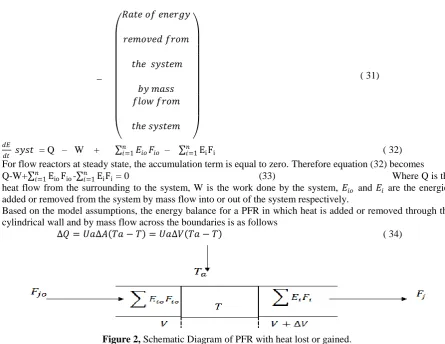
Based on the model assumptions, the energy balance for a PFR in which heat is added or removed through the cylindrical wall and by mass flow across the boundaries is as follows
∆𝑄 = 𝑈𝑎∆𝐴 𝑇𝑎 − 𝑇 = 𝑈𝑎∆𝑉 𝑇𝑎 − 𝑇 ( 34)
Figure 2, Schematic Diagram of PFR with heat lost or gained.
∆Ǫ+ 𝐹𝑖𝑜𝐻𝑖𝑜𝛥𝑉 − ∆𝑉 + ∆𝑉 = 0 ( 35)
Where Hi is the enthalpy of the specie 𝑗, Ǫ , the heat transfer coefficient of the surrounding fluid, ΔA is the total surface area through which heat is transferred to the system, Ta and T are the temperature of the surrounding fluid “ambient temperature” and temperature of the reactor respectively.
Ua∆V 𝑇𝑎− 𝑇 + 𝐹𝑖𝑜𝐻𝑖𝑜 𝑉 − 𝐹𝑖𝐻𝑖 𝑉 + ∆𝑉 =0 (.36)
Dividing through by V and taking a limit as V 0,
Ua 𝑇𝑎− 𝑇 − 𝑑𝐹𝑖𝐻 𝑖
𝑑𝑉 = 0 (.37 )
Differentiating equation (.37),
Ua 𝑇𝑎− 𝑇 − 𝐻𝑖𝑑𝐹𝑖
𝑑𝑉 − 𝐹𝑖𝑑𝐻 𝑖
𝑑𝑉 = 0 ( .38)
From mole balance on specie,
𝑑𝐹𝑖
𝑑𝑉 = 𝑟𝑖 = 𝑣𝑖(−𝑟𝑖) ( 39)
Where 𝑣𝑖 is the volumetric flow rate of specie 𝑖 and −𝑟𝑗 is the overall reaction rate of the whole species within
the reactor.
Also, 𝑑𝐻𝑖
𝑑𝑉 = 𝐶𝑃𝑑𝑇
𝑑𝑉 (40)
Where 𝐶𝑝 is the specific heat capacity of the specie 𝑖.
Substituting equation (.39) and (40) into equation (38),
Ua 𝑇𝑎− 𝑇 − 𝑣𝑖𝐻𝑖 −𝑟𝑗 − FiCpdT
𝑑𝑉 = 0 ( 41)
Rearranging equation (41) gives;
𝑑𝑇 𝑑𝑉=
𝑟𝑖∆𝐻𝑅𝑋+Ua 𝑇𝑎−𝑇
𝐹𝑖𝐶𝑝𝑖
( 42)
Equation (.42) is the energy balance equation showing the rate of change of temperature with respect to the change in volume of a non-isothermal PFR.
III.
RESULTS AND DISCUSSION
Kinetic models were developed and simulation was carried out on the transesterification of vegetable oil (sunflower oil) in a non isothermal plug flow reactor and the results are presented in Figures 2 to 8
Figure 2 shows that at time (t=0), there was no change in composition but just after 14 minutes, the composition of the reactants (CTG and CA) started decreasing while that of the products (CME and CGL) increased with time. Intermediates (CDG, and CMG) were also formed but disappeared as the reaction proceeds with time. It also shows that the rate of formation of the desired product (biodiesel) is higher than that of the undesired product (glycerol) and the rate of disappearance of the major reactant (triglycerides) is higher than that of the alcohol indicating that the limiting reactant is triglycerides and the overall reaction rate is time dependent. The observed result is comparable to the report in literature (Noureddini et al ., 1997).
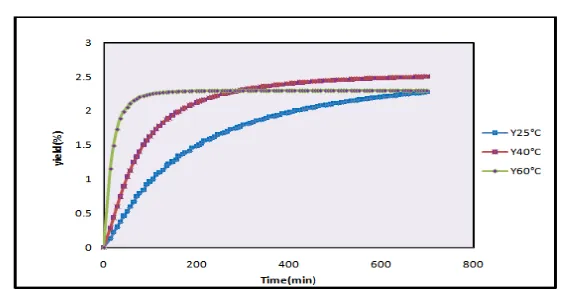
The effect of temperature on the dynamic behavior of triglycerides conversion as reaction proceeds with time is shown in Figure 4. Initial conversions of 0.0695, 0.199 and 0.524 were obtained at 25°C, 40°C and 60°C respectively. The result shows that, the reaction rate is faster at higher temperature but as the reaction proceeds with time, the conversion at 60°C remain constant while that of 25°C and 40°C increases linearly with time. This is an indication that higher temperatures will favor backward reaction, which agreed with reports in literature (Noureddini et al., 1997). Figure 5 shows that the yield increases as time increases. The yield obtained with time of 14 min was 0.127, 0.282 and 1.15 at 250C, 400C, and 600C respectively. Also confirming the effect of temperature on yield but at time (t=598 minutes) the yield at 60°C remained constant while that at 25°C and 40 o C linearly increased. Also, close to the end of the reaction, the yield at 40°C increased to 2.501 which is the highest compared to the other temperatures
Figure 3 Composition profile versus time at constant temperature = 40°C, feed ratio = 3:1
Figure 5 Effect of temperature on methyl ester yield at constant feed ratio =3:1.
3.1 Effect of Feed Ratio
The conversions for 3:1, 6:1, and 9:1 feed ratios are 0.199, 0.223 and 0.245 respectively (See Figure 6). As the reaction time increased to 700 minutes, the conversion also increased to 0.934, 0.998, and 0.999 for 3:1, 6:1 and 9:1 feed ratio respectively. This shows that increasing the feed ratio results to higher conversion. However, increasing the ratio above 9:1 may not result to any significant increase in conversion since there was convergence for 6:1 and 9:1 feed ratios. The yield for 3:1, 6:1, and 9:1 feed ratio 0.1999, 0.328, and 0.373 respectively (See Figure 7). Also the yield increased to 0.934, 2.941 and 2.971 with an increase in the reaction time to (700 minutes). Figure 8 shows the dynamic behavior of the conversion with respect to reactor volume. The conversion of triglycerides increases linearly with the volume of the reactor with constant volumetric flow rate of 0.01 liters per minutes. As the reactants moves from one point to another in the reactor, the volume of the reactor continues to increase hence results to increase in the triglycerides conversion and the total volume required to obtain a maximum of 0.934 conversion of sunflower at 40°C and 3:1 is Figure 8 shows the dynamic behavior of the conversion with respect to reactor volume. The conversion of triglycerides increases linearly with the volume of the reactor with constant volumetric flow rate of 0.01 liters per minutes. As the reactants moves from one point to another in the reactor, the volume of the reactor continues to increase hence results to increase in the triglycerides conversion and the total volume required to obtain a maximum of 0.934 conversion of sunflower oil at 40°C and 3:1 is 487.7 liters.
Figure 6 Effect of feed ratio on triglycerides conversion at constant temperature=40°𝐶
Figure 8, A Plot of conversion versus reactor volume.
IV.
CONCLUSION
The mathematical model and simulation carried out shows that the transesterification of vegetable oil (sunflower) with methanol in a non isothermal tubular (plug) flow reactor is tremendously favorable by increasing the alcohol to oil ratio from 3:1 to 6:1 and 9:1. At higher ratio, the reaction mean residence time, was greatly reduced which increased the reactor performance. The developed mathematical model is found to be more reliable and more useful to predict the dynamic behavior of the trans esterification of vegetable oil and alcohol in a non isothermal plug flow reactor operating condition considered especially at 40o C. The triglycerides conversion increased with temperature and remained constant as reaction time increased while the methyl ester yield decreased with increase in temperature with respect to time because the reaction is reversible. A volume of 487.7 liters can achieve a conversion of 90%
Acknowledgment
The authors would gratefully like to appreciate the Niger Delta University for the enabling environment for this study.
Nomenclature
K1 Reaction rate constant for elementary reaction 1 ( min1) K2 Reaction rate constant for elementary reaction 2 ( min1) K3 Reaction rate constant for elementary reaction 3 ( min1) K4 Reaction rate constant for elementary reaction 4 ( min1) K5 Reaction rate constant for elementary reaction 5 ( min1) K6 Reaction rate constant for elementary reaction 6 (min1) -r1 reaction rate for elementary reaction 1 (mol L-1min-1) -r2 reaction rate for elementary reaction 2 (mol L
-1 min-1) -r3 reaction rate for elementary reaction 3 (mol L
-1 min-1) -r4 reaction rate for elementary reaction 4 (mol L-1min-1) -r5 reaction rate for elementary reaction 5 (mol L-1min-1) - r6 reaction rate for elementary reaction 6 (mol L
-1 min-1) rTG Reaction rate for triglyceride (mol L-1 min-1) rDG Reaction rate for diglyceride (mol L- min-1) rMG reaction rate for monoglyceride (mol L-1 min-1) rA Reaction rate for Alcohol (mol L-min-1) rME Reaction rate for methyl ester (mol L-1 min-1) rG Reaction rate for glycerol ( mol L-1 min-1) rJ Reaction rate for species J (mol L-1 min-1) CTG Final concentration of triglyceride (mol L-1) CDG Final concentration of diglyceride (mol L
-1 ) CMG Final concentration of monoglyceride (mol L-1) CA Final concentration of alcohol (mol L-1)
CME Final concentration of methyl ester (mol L -1
CMG0 Initial concentration of monoglyceride (mol L-1) CA0 Initial concentration of alcohol (mol L-1) CME0 Initial concentration of methyl ester (mol L-1) Cpi Specific heat capacity of outlet species (Cal K
-1
Kg-1 mol Cp0 Specific heat capacity of inlet species (Cal K-1 Kg-1 mol-1) VR Volume of reactor (L)
υ0 Inlet volumetric flow rate (L min-1) υ Outlet volumetric flow rate (L min-1) τ Space time (min)
S Space velocity (min-1) Q Heat absorbed (Cal mol-1) Ti Temperature of outlet species T0 Temperature of inlet species
REFERENCES
[1] Bambase, M.E. , Nakomura N., Tanaka, J Matsumum M., (2007) Kinetic of hydroxide –Catalyzed methnolysis of crude sun flower oil for production of fuel grade methyl ester .J Chem Bio Technology
82 (3) pp 275-280.
[2] Darnoko, D. and Cheryan, M. (2000) Kinetics of palm oil trans esterification in a Batch Reactor.
JAOCS 77, pp 1167-1172.
[3] Demirbas, A. (2002) Biodesel Production from Vegetable Oil via Catalytic and Non catalytic Supercritical Methanol Trans esterificaton Methods Progress in Energy and Combustion Science 43. Pp 2349-2356.
[4] Fukuda. H and Akihinbo, K (2001) Biodesel Fuel Production by Transesterification of Oil .Journal of Bioscience and Bioengeering.
[5] Guan, G Kusakabe, K., Kimiko M; (2007) Continous Production of Biodesel using a Microtube Reactor.
[6] Gumpon P. (2000) Trans esterification of Palm oil in series of Continous Stirred Tank Reactor. Asian Journal on Energy and Environment. 7. (3) 336-346.
[7] Kusdiana, D Saka-S. (2001) Kinetic of Palm Oil Trans esterification in a Batch Reactor. Fuel. 80, 255-231.
[8] Kusdiana.D, Saka S (2001) Kinetic of Palm Oil Trans esterification of Rapseed oil in a Batch Reactor as Tested in Supercritical Methanol. Fuel. 80,693-695.
[9] Kusdiana, D., Saka, S. (2004) Two Step Preparation for Catalyst-Free Biodesel Fuel Production .
Applied Biochemical. Biotechnology. Pp 113- 116,781-791.
[10] Lalita, A. Sukunya, M. and Peesamai J.(2004) Factors Affecting the Synthesis of Biodiesel from Crude Palm Kernel Oil. The International Conference on Sustainable Energy and Environmental
(SEE). 1-3, pp 3-45.
[11] Robiromerd, S. and Martinez, L. (2006) Biodesel Production by using Heterogeneous Catalysts. Chinese Journal of Catalysis. 27, 391-396.
[12] Fogler, S. (2008) Element of Chemical Reaction Engineering. Fourth- Edition by MaCgraw Hill pp 8-1
[13] He, B.B, Singh, A.P. Thompson, J.C. (2007) Function Performance of a Pre-Reactor to a Reactive Distillation Colum for Biodi esel Production. American Society of Agricultural and Biological Engineers. 50. p123.
[14] Saka, S. Kusidina, D. (2002) Biodesel Fuel from Rapeseed Oil as Prepared in Supercritical Methanol. Fuel. 80, pp 255-231.
[15] Singh, S.S., Singh, D. (2010) Biodesel Production through the use of Different Sources and Characterization of Oils and their esters as the Substitute of Diesel. Renewable and Sustainable Energy Review 2000-2160.
[16] Noureddini, H and Zhu, D. (1997) Kinetics of Trans esterification of Soybean Oil. Journal of the American Oil Chemist Society. 74, (11) pp 1457-1463.
[17] Yamazaki, R. Iwamoto, S (2006) Non catalytic Alcoholysis of Oils for Biodiesel Fuel Production by a Semi Batch Process .Japan Journal of Food Engineering. 8, pp11-18.