CO
2
Absorbing Concrete Block
Balraj More, Pradeep Jadhav, Vicky Jadhav, Giridhar Narule, Shahid Mulani(Balraj More) VPCOE, Baramati, India (Pradeep Jadhav) VPCOE, Baramati, India (Vicky Jadhav) VPCOE, Baramati, India, (Giridhar Narule) VPCOE, Baramati, India, (Shahid Mulani) VPCOE, Baramati, India,
Email: [email protected]; [email protected], [email protected], [email protected], [email protected]
ABSTRACT: In order to serious climate change, deep reduction in CO2 emission will be required in coming decades.CO2 absorption is one of the key technology to control the global warming. Global warming is caused by sharply increased greenhouse gases emission by human activities. In building industry, CO2 emission mainly come from cement production. Capturing of CO2 from point source, from ambient air and reducing atmospheric CO2 concentration by using Zeolite powder and Zeolite sand. Concrete with Zeolite as a supplement material can absorb large quantity of CO2.Introducing Zeolite material into the concrete absorbs CO2 from the atmosphere hence it will be eco-friendly. Absorb CO2 and reduces the air pollution, Keep environment clean and full of oxygen.
Keywords:CO2 emission, Green House, Zeolite.
1. INTRODUCTION
There are several construction techniques as well as construction materials used presently. Most of the materials used are detrimental to the environment which is cause of several calamities. This detrimental materials concludes cement, aggregate, sand and admixtures etc. Even now-a-days we are preceding constructions with advance construction materials like polymer rubbers as well as different sands etc. Though we use advance materials we are far away from dominating pollution intensity .That is only reason we are facing multitudinous problems. The most disastrous gas which gets emitted from construction is CO2. CO2which act as back bone of global warming as well
as cause of several maladies expel from constructions. So many remedies have been implied as a material, instruments, etc. These materials include different types of polymers, purifying machines, refineries, etc. But still we are unable to reduce percentage emission of CO2. As it is
been found that obtuse quantity of CO2 get expelled from
construction; impeding it would definitely reduce total percentage of CO2 emission. This emission should be
stopped and CO2 from the air must be diminished putting
this as a main soul we are designing a concrete (which is main constituent of construction) by taking Zeolite as a rationale. This Zeolite substitute for fine aggregate and cement will consequently absorb the CO2. Zeolite is
manufactured in factories. This kind of material has property to absorb CO2with incredible strength. Because of
this nature this material can be substituted in place of aggregate. The Zeolite is available in powder as well as in fine aggregates form which can be used to replace sand and cement in concrete in planting the property to absorb CO2 from the atmosphere. This type of material is easily
available in market. As the material literally costly even here the replacement is made only upto certain extent so that this will be affordable. Deliberating all these problems and properties of this material we are making this CO2absorbing
cement.
2. MATERIALS AND METHODS
2.1 Test on zeolite
Aim- Preparation of Zeolite blocks for testing of strength
Material- Zeolite powder, Zeolite sand, Cement M53 Grade, Crushed sand, Aggregate(size 16 to 20mm),Weighing balance
Procedure:-
1. Take Water, Cement, Sand and aggregate in the proportion of 0.378:1:1.128:2.35.
2. Prepare 4 block of dimension 15x15x15 for testing of strength and durability.
3. Preparation should be in normal way just little difference is that 4 blocks of sand are prepared by substituting 20% of the sand with zeolite powder and subrogating 10% of the cement with zeolite powder.
4. While remaining 4 are prepared with 10% substitution of sand with zeolite sand ad 10% normal cement with zeolite powder.
5. Hence for such preparation amount of material taken is given below
6. Thereafter mix is prepared with these materials and fresh potable water is mixed.
7. The concrete is prepared by proper mixing and moulds are filled with it.
8. Thereafter these blocks are kept on vibrator for proper settling of concrete into moulds.
9. These blocks are then kept in water for curing up to 7 days.
10. After 7 days blocks are removed tested in compression testing machine.
11. Readings are taken on 7th, 14th,21th and on 28th days.
Observation Tables:
Table 1: 20% substitution by zeolite (10% sand+ 10% cement)
Block Numbe r
Day of testin g
Cross section of block(mm2 )
Maximu m load (KN)
Compressiv e Strength (N/mm2)
B1 7th day 22500 539.884 23.99
B2 14
th
day 22500 653.280 29.03
B3 21
th
day 22500 703.489 31.266
B4 28
th
day 22500 792.732 35.23
Table 2:30% substitution by zeolite (10% cement+20%sand)
Block Numbe r
Day of testin g
Cross section of block(mm2 )
Maximu m load (KN)
Compressiv e Strength (N/mm2)
B1 7th day 22500 525.645 23.362
B2 14
th
day 22500 610.689 27.14
B3 21
th
day 22500 698.054 31.02
B4 28
th
day 22500 761.965 33.865
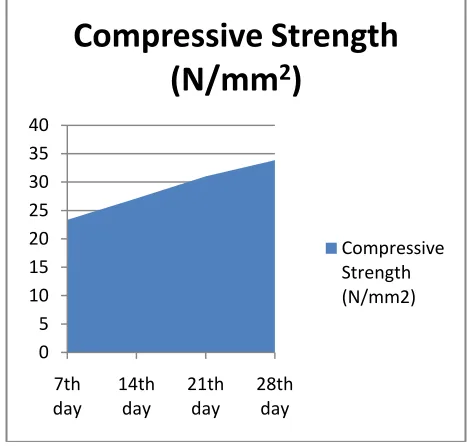
Graphical Representation shown below elaborates more about Strength of zeolite block
Graph 1: Compressive strength of Zeolite Block (Replacement= 10% sand + 10% cement)
Graph 2: Compressive strength of Zeolite Block (Replacement 30% = 20% sand + 10% cement)
Result:
Compressive strength of concrete blocks made by zeolite substitution with cement and sand are
1. 20% Replacement (10% sand + 10% cement) = 35.23N/mm2
2. 30% Replacement (20% sand + 10% cement) = 33.865N/mm2
Conclusion:-
Blocks made by using Zeolite sand and powder as substitution have equivalent compressive strength as normal Portland cement concrete block.
2.2 Test on zeolite block (CO2 absorption test) Aim- Test of CO2 Absorption by Zeolite concrete block
Apparatus- Weighing Balance, Moulds of Size 10x10x10 cm.
Procedure:-
1. Take Water, Cement, Sand and aggregate in the proportion of 0.378:1:1.128:2.35.
2. Prepare 4 block of dimension 10x10x10 cm for testing of CO2 absorption by zeolite block.
3. Preparation should be in normal way just little difference is that 2 blocks of sand are prepared by substituting 20% of the sand with zeolite powder and subrogating 10% of the cement with zeolite powder.
4. One is prepared with 10% substitution of sand with zeolite sand ad 10% normal cement with zeolite powder.
5. Remaining one is prepared with normal Portland cement concrete.
6. Thereafter mix is prepared with these materials and fresh potable water is mixed.
7. The concrete is prepared by proper mixing and moulds are filled with it.
8. Thereafter these blocks are kept on vibrator for proper settling of concrete into moulds.
9. These blocks are then kept in water for curing up to 7 days.
0 5 10 15 20 25 30 35 40
7th day
14th day
21th day
28th day
Compressive
Strength (N/mm
2
)
Compressive Strength (N/mm2)
0 5 10 15 20 25 30 35 40
7th day
14th day
21th day
28th day
Compressive Strength
(N/mm
2
)
10. After 7 days weight of the blocks is taken.
11. Readings are taken on pre-planned days upto 28th day
12. Following observations are obtained
Observation Tables:
Table 3: Increase in weight of Zeolite block and decrease in weight of Normal block
B1(30% Substit ution)
B2(20% Substitu tion)
B3(30% substituti on)
B4 (Normal Concrete Block)
Weight of block on 10th day(gm)
860 943 886 897
Weight of block on 14th day(gm)
864 948 894 890
Weight of Block on 21st day(gm)
877 959 908 875
Weight of block on 25th day(gm)
885 964 914 859
Weight of block on 28th day(gm)
889 968 917 852
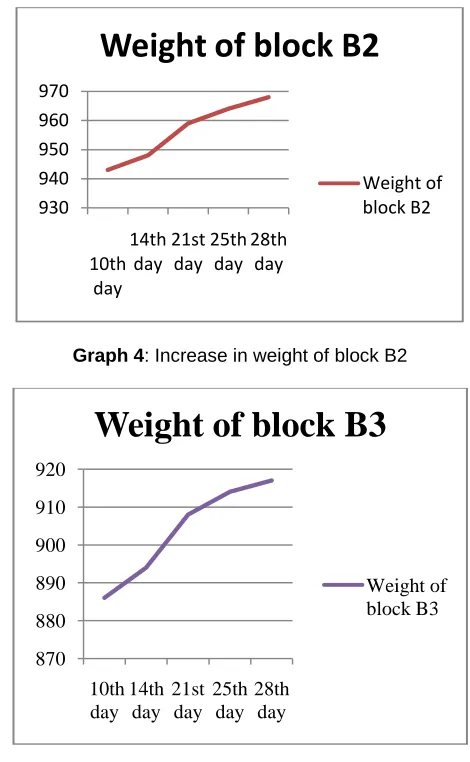
Graphical Representation of Increase in weight of every block due to absorption CO2
Graph 3: Increase in weight of block B2
Graph 4: Increase in weight of block B2
Graph 5: Increase in weight of block B3
Calculation:
Calculation of CO2 absorbed by blocks= Final Weight –
Initial weight/Molecular weight of CO2
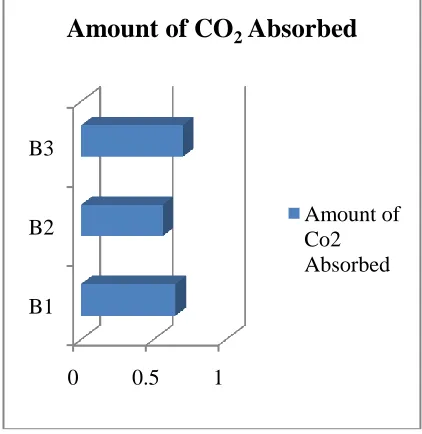
CO2 absorbed by B1-889-860/44=29/44=0.65mole
CO2 absorbed by B2=968-943/44=0.56mole
CO2 absorbed by B3=917-886/44=0.70mole
Table 4: Amount of CO2 Absorbed by each zeolite block
Block number Amount of CO2 Absorbed( Mole)
B1 0.65
B2 0.56
B3 0.70
840 850 860 870 880 890 900
10th day
14th day
21st day
25th day
28th day
Weight of block B1
Weight of block B1
930 940 950 960 970
10th day
14th day
21st day
25th day
28th day
Weight of block B2
Weight of block B2
870 880 890 900 910 920
10th day
14th day
21st day
25th day
28th day
Weight of block B3
Graph 6: CO2 absorption by zeolite blocks
Average amount of CO2 absorbed = 0.65+0.56+0.70/3 =
0.63
Result: CO2 absorbed by blocks equal to 0.63 mole of CO2
2.3. Test on Normal Block of Concrete
Aim: To determine the compressive strength of concrete specimens as per IS: 516 - 1959.
Apparatus: Compression Testing Machine
Age at test:
Tests should be done at recognized ages of the test specimens, usually being 7 and 28 days. The ages should be calculated from the time of the addition of water to the drying of ingredients.
Number of specimens:
At least three specimen-s, preferably from different batches, should be taken for testing at each selected age.
Procedure:
I. The specimens, prepared according to IS: 516 - 1959 and stored in water, should be tested immediately on removal from the water and while still in wet condition. Specimens when received dry should be kept in water for 24hrs. before they are taken for testing. The dimensions of the specimens, to the nearest 0.2mm and their weight should be noted before testing.
II. The bearing surfaces of the compression testing machine should be wiped clean and any loose sand or other material removed from the surfaces of the specimen, which would be in contact with the compression platens.
III. In the case of cubical specimen, the specimen should be placed in the machine in such a manner that the load could be applied to the opposite sides of the cubes, not to the top and the bottom. The axis of the specimen should be carefully aligned with the centre of thrust of the spherically seated platen. No packing should be used between the faces of the test specimen and the steel platen of the testing machine. As the spherically seated block is brought to rest on the specimen, the
movable portion should be rotated gently by hand so that uniform seating is obtained.
IV. The load should be applied without shock and increased continuosly at a rate of approximately 140kg/sq.cm/minute until the resistance of the specimen to the increasing load breaks down and no greater load can be sustained. The maximum load applied to the specimen should then be recorded and the appearance of the concrete and any unusual features in the type of failure should be noted.
Observation and calculation:
Table 6: Readings of Compressive strength of normal block
Sr. number
Cube Age of cube in days
C/s area of cube (mm2)
Maximum load (KN)
Compressive strength (N/mm2)
1 B2 7 22500 559.350 24.86
2 B2 14 22500 640.235 28.45
3 B3 21 22500 710.854 31.58
4 B4 28 22500 798.940 35.50
Result: The compressive strength of normal cube made up of Portland cement concrete= 35.50N/mm2
3. RESULT AND DISCUSSION
The graph shows that there is no effect on strength of block prepared by zeolite sand and powder as a substitute. Hence this can be utilized without any problem in the buildings. The zeolite block can be used in the road pavements, Chimney of factory as well as at the faces of building. The Zeolite is costly material hence only small substitution by it would make it affordable for the people. The zeolite is available in abundant amount. This can also be manufactured. As CO2 Is causing too many problems
which is leading to the heavier pollution effects like greenhouse effect, Environmental imbalance. The CO2
plays major role in this. Hence it is very important to reduce its percentage from the environment. CO2 is in gas form
hence it will directly come in contact with construction built around. Apart from that construction industry contribute 70% of the total CO2 expelling. As while cement
production and at the time of curing of the structure it will get evolved into atmosphere. Hence it is very important to reduce its emission. This material will definitely reduce its emission. Hence it must be used in the construction.
0
0.5
1
B1
B2
B3
Amount of CO
2Absorbed
Graph 7: Comparison of Strength of Zeolite blocks (30% and 20% replacement) and normal block.
4. CONCLUSION
The recent trends in technologies are leading to tremendous increase in pollution. Hence it is need of time to reduce the pollution otherwise consequences will be devastating. The zeolite made concrete is capable of absorbing CO2 without any emission of it. Otherwise
general concrete evolve huge amount of CO2 into the
atmosphere. The zeolite concrete block of size 10x10x10 cm has ability to absorb around 1 mole of CO2 in 50 days.
This property does not lose its strength and durability. Hence it can be used at any place without any doubt. This type of block is affordable and hence can be used generally.
4.1 Advantages of Model
It reduces the rate of emission of CO2 while
producing the cement in the industry.
It absorbs the CO2 from the surrounding
environment and helps to stop the air pollutions. It gives more durability as well as great
performance against ordinary Portland cement concrete.
The presence of olivine material in the concrete increases the strength.
The addition Zeolite has important advantages: Improves mechanical strength to the cement and stops emission CO2.
5. ACKNOWLEDGMENT
We are really thankful to Prof. Lonpande sir for their true guidance during whole project. Specially during taking tests for CO2 absorption and compressive strength of blocks.
We also want to appreciate Prof. Narule sir for allowing us to do experiment in the laboratory
6. REFERENCES
[1]. Utilization of concrete wastes to capture CO
2 (La utilización de basuras concretas para capturar CO
2) Kosuke Nakasone, Ken-ichiro Kushida, Mia Hirata and Itaru Jimbo Department of Materials Science, Tokai University 4-1-1 Kitakaname, Hiratsuka, Kanagawa 259-1292 JAPAN ,[email protected]. [2]. CO2 Uptake Model of Biomass Silica Foamed Concrete,Y.L.
Lee1*, H.B. Koh2, Alona C.L3 , A.T. Ahmad Karim4, M. Wimala5, C. Ng6 1,2,3,4,5,6Faculty of Civil and Environmental Engineering, UTHM *Corresponding email: [email protected]
[3]. CONCRETE MADE WITH ZEOLITE AND METAKAOLIN: A COMPARISON ON THE STRENGTH AND DURABILITY PROPERTIESR. Madandoust1, J. Sobhani2, P. Ashoori∗1 1Department of Civil Engineering, Faculty of Engineering, Guilan University, Rasht, P.O.Box 3756, Iran 2Department of Concrete Technology, Building and Housing Research Center, Tehran,13145-1696, Iran Received: 3 October 2012; Accepted: 20 February 2013.
[4]. Carbon Dioxide: Capturing and Utilization, Ali Kargari1 and Maryam Takht Ravanchi2 1Amirkabir University of Technology (Tehran Polytechnic) 2National Petrochemical Company, Petrochemical Research and Technology Co Islamic Republic of Iran.
[5]. Boden, T.A., G. Marland, and R.J. Andres. 2010. Global, Regional, and National Fossil-Fuel CO2 Emissions. Carbon Dioxide Information Analysis Center, Oak Ridge National Laboratory, U.S. Department of Energy, Oak Ridge, Tenn., U.S.A. doi 10.3334/CDIAC/00001_V2010.
[6]. Eco concrete, The contribution of cement and concrete to a more sustainable built environment, British Cement Association, 97.381, ISBN 0 7210 1577 8, 200
[7]. Gartner, E, Industrially interesting approaches to 'low-CO2' cements, Cement and Concrete Research, Volume 34, Issue 9, September 2004, pages 1489 – 1498, H.F.W. Taylor Commemorative Issue, Elsevier, 2004.
[8]. Use of Zeolite Dust in Lime Mortars, Vladimír PAVLÍK 1), Michaela UŽÁKOVÁ 2), 1) Doc. Ing., PhD.; Department of Material Engineering, Faculty of Civil Engineering, STU – Slovak University of Technology in Bratislava; Radlinského 11, 813 68 Bratislava, Slovak Republic; e-mail: [email protected], tel.: +421 (2) 59 274 691. 2) Ing.; Faculty of Civil Engineering, STU – Slovak University of Technology in Bratislava; Radlinského 11, 813 68 Bratislava, Slovak Republic; e-mail: [email protected]
[9]. Research*eu is our monthly magazine keeping you in touch with main developments (results, programmes, events, etc.). It is available in English, French, German and Spanish. A free sample copy or free subscription can be obtained from: European Commission Directorate-General for Research Communication Unit B-1049 Brussels Fax (32-2) 29-58220 E-mail:
[email protected] Internet:
http://ec.europa.eu/research/research-eu.
[10]. Post-combustion CO2 Capture with Chemical Absorption: A State-of-the-art Review M. Wanga* A. Lawala, P. Stephensonb, J. Siddersb, C. Ramshawa and H. Yeunga a Process Systems Engineering Group, School of Engineering, Cranfield University, UK. bRWE npower, UK. * Corresponding author. Tel: +0044 1234 754655; Fax: +0044 1234 754685; Email address: [email protected].
[11]. Carbon Dioxide Capture: Prospects for New Materials Deanna M. D’Alessandro,* Berend Smit,* and Jeffrey R. Long*
0 5 10 15 20 25 30 35 40
B1 B2 B3 B4
Compressive strength of normal block (N/mm2)