Vol. 5 Issue 9, September - 2019
An Evolutionary Algorithm for the Autonomous
Vehicle Routing Problem under Emergency
Evacuation
Jaqueline E. Masaki1, Yassir A. AbdelRazig1, and Doreen C. Kobelo2 1
Department of Civil and Environmental Engineering, FAMU-FSU College of Engineering, Tallahassee, FL
2
School of Architecture and Engineering Technology, Florida A&M University, Tallahassee, FL
Abstract— One of the consistent difficulties faced by the existing public safety systems is to ensure that residents evacuate safely and timely during an impending disaster. The future of autonomous vehicles (AVs) holds promising results in improving and facilitating the evacuation process. This paper proposes a multi-objective evolutionary algorithm for the vehicle routing problem, where autonomous vehicles are used during emergency evacuation. The objective of the proposed model aims to minimize the total evacuation cost, which is composed of two major components including the travel time cost and the cost associated with the accident risk of evacuees. A case study is undertaken to test the validity of the model and the proposed algorithm. Three scenarios were created and compared by considering different penetration rates of AVs. In each scenario, 30 autonomous buses were designated to evacuate 2000 households using 19 evacuation routes. The results showed that the use of AVs may help to reduce evacuation costs.
Keywords— Autonomous vehicles, self-driving vehicles, evacuation, evolutionary algorithms, vehicle routing problem
I. INTRODUCTION
Autonomous Vehicles (AVs) represent a technology that promises to play an important role in transportation automation during natural disasters [1]. A shared fleet of autonomous vehicles is expected to save lives in the event of a large-scale evacuation [2]. One of the consistent difficulties faced by the existing public safety systems is to ensure that residents evacuate safely and on time during an impending disaster. Congestion and accidents along the evacuation routes occurred relatively frequently in the past. Application of connected and automated vehicles during evacuation have the potential to move people from one place to another efficiently by minimizing accident risks and reducing travel time [3] [4]. Considering the amount of destructions that are generally caused during natural disasters, these vehicles could monitor road conditions, plot the best path to a safe destination, and take the evacuees to the nearest evacuation shelter in time. These vehicles can even be more useful for people with travel-restrictive medical conditions, elderly and those without cars.
In New Orleans, over 1,400 people were killed during Hurricane Katrina, mostly due to lack of efficient transportation and proper emergency evacuation planning [4]. AV-enhanced evacuation could have deployed throughout the New Orleans region and dispatch systems could have calculated and optimized timing and order of the evacuation based on risk and optimal evacuation route capacity [5] [6] [7]. Nowadays, most of the households have access to a car, receive timely warnings, and are able to evacuate themselves. Yet, the current system still fails to evacuate people efficiently with low accident risks. In a future that includes AVs, it is important to investigate how they can make the population safer in case of approaching disasters and facilitate emergency evacuation. This paper focuses on the analysis of the Vehicle Routing Problem (VRP) using evolutionary algorithms [5] [8] [9]. The VRP is a complex combinatorial optimization problem that belongs to the NP-complete class. Due to the nature of the problem, it is not possible to use the exact methods for large instances of the VRP. The evolutionary algorithm developed in this paper will be able to provide good quality solutions for large instances in a reasonable computational time, which is critical for emergency evacuation planning [10] [11]. Furthermore the proposed algorithm accounts not only for the travel time cost, but also for the cost, which is associated with the accident risk of evacuees.
II. PROBLEM DESCRIPTION
III. MATHEMATICAL MODEL
This section of the paper presents the VRP model for calculating travel time and accident risk. The formulation of this study is described next:
A. Notations
Sets:
𝑁 = {1, … . , 𝑎} - set of nodes
𝑉 = {1, … . , 𝑏} - set of vehicles
𝑁 = {1, … . , 𝑐} - set of evacuation routes
𝑖 = start node or pickup point index
j = end node or pickup point index
v = vehicle index
Decision variable:
𝑥𝑖𝑗𝑣= 1 if vehicle 𝑣 travelsfrom node 𝑖 to node 𝑗
= 0 otherwise
Parameters:
𝑡𝑖𝑗= traveled time from node 𝑖to node 𝑗
𝑎𝑖𝑗𝑣= accident risk from node 𝑖 to node 𝑗
𝑞𝑗𝑣= amount of people need to evacuate at node 𝑗
𝑄𝑗𝑣= maximum capacity of vehicle 𝑣
𝑊𝑇= weighted factor for travel time (0.5 million)
𝑊𝐴𝑅= weighted factor for accident risk (1 million
(fatal), 0.5 million (injury))
B. Model Formulation VRP: Vehicle Routing Problem
𝑀𝑖𝑛 [ 𝑊𝑇∙ ∑ ∑ ∑𝑀 𝑡𝑖𝑗
𝑗=1 𝑥𝑖𝑗𝑣 𝑁
𝑖=1 𝑉
𝑣=1 + 𝑊𝐴𝑅∙
∑𝑉𝑣=1∑𝑁𝑖=0∑𝑀𝑗=0𝑎𝑖𝑗𝑥𝑖𝑗𝑣] (1)
Subject to:
∑𝑉𝑣=1∑𝑁𝑖=0𝑥𝑖𝑗𝑣 = 1 ∀ 𝑗 ∈ 𝑁 (2)
∑ ∑𝑁 𝑥𝑖𝑗𝑣 = 1
𝑗=0 𝑉
𝑣=1 ∀ 𝑖 𝜖 𝑁 (3)
∑𝑁𝑖=0𝑥𝑖𝑗𝑣 − ∑𝑁𝑗=0𝑥𝑗𝑖𝑣 = 0∀ 𝑖, 𝑗 𝜖 𝑁, 𝑣 𝜖 𝑉 (4)
∑ ∑𝑀 𝑞𝑗𝑣
𝑗=0 𝑁
𝑖=0 𝑥𝑖𝑗𝑣 ≤ 𝑄𝑗𝑣 ∀ 𝑣 𝜖 𝑉 (5)
∑𝑉𝑖=1∑𝑁𝑗=0𝑥𝑖𝑗𝑣 ≤ |𝑉| ∀𝑣 𝜖 𝑉 (6)
∑𝑀 𝑥0𝑗𝑣 ≤ 1
𝑗=0 ∀ 𝑣 𝜖 𝑉 (7)
∑𝑁𝑖=0𝑥𝑖𝑜𝑣 ≤ 1 ∀ 𝑣 𝜖 𝑉 (8)
𝑥𝑖𝑗𝑣 ∈ {0,1} ∀𝑖, 𝑗 𝜖 𝑁, ∀ 𝑣 𝜖 𝑉 (9)
The objective for VRP is to assign vehicles to the possible evacuation routes, moving people from evacuation zones to safe destinations by minimizing the total cost associated with travel time and accident risk of evacuees. Constraints sets (2) and (3) guarantee that the demand at each pickup node
should be served exactly by one vehicle. Constraints set (4) ensures that the same vehicle arrives in node 𝑖 must leave from the same node (flow balance at each point). Constraints set (5) indicates that the total number of people evacuated for one route should not exceed the maximum capacity of the vehicle. Constraints set (6) ensures that the total number of evacuation vehicles should not surpass the sum of the emergency vehicles that the city has. Constraints set (7) and (8) states that one vehicle/bus, need to be able to serve on one route. Constraints set (9) defines decision variable as binary.
IV. SOLUTION APPROACH
The Vehicle Routing Problem (VRP) with path restrictions have the NP-hard complexity; therefore, the exact optimization algorithms will not be able to obtain solutions within a reasonable computational time for the realistic size problem instances. To address this drawback, this study proposes an evolutionary algorithm (EA) for solving the VRP mathematical model [2] [6] [7] [12]. The flow chart for the VRP is shown in Fig. 1.
Fig. 1. Solution approach flow chart
A. Representation Chromosomes
Vol. 5 Issue 9, September - 2019
Route 1 1 1 1 2 2 3 3 3
Bus ID 6 6 2 2 1 3 4 5 5
Household
2 6 7 9 1 3 4 5 8
Fig. 2. Solution approach flow chart
Households “2”, “6”, “7” and “9” are to be evacuated using route “1” with buses “6” and “2” respectively, while households “1” and “3” are to be evacuated using route 2 with buses “1” and “3”. Households “4”, “5”, and “8” are to be evacuated using route “3” with buses “4” and “5”. Each gene array includes three genes, representing route, bus ID and household.
B. Initialization of Chromosomes and Population
In this study the EA algorithm will use the chromosomes and initial population that are generated randomly.
C. Parent Selection
This step is very important and is used to identify the parents who will produce offsprings. In this study, binary tournament selection is proposed for parent selection. This type of selection chooses randomly two individuals from the population, and the fittest individual becomes a parent. The process is repeated several times to obtain the required number parent chromosomes.
D. EA Operations
After identifying parent chromosomes, the EA algorithm will apply two operators to produce the offsprings at a given generation: 1) crossover operator; and 2) mutation operator.
Crossover: Based on the chromosome representation proposed in this study, the order crossover is selected to produce the feasible offsprings. An example of the crossover operation is illustrated in Fig. 3.
Parent 1
Route 1 1 1 1 2 2 3 3 3
Bus ID
6 6 2 2 1 3 4 5 5
Househo
ld 2 6 7 9 1 3 4 5 8
Offspring 1
Route
1 2 1 1 2 2 3 2 3
Bus ID
3 5 2 2 1 3 4 2 6
House
hold 2 6 7 9 1 3 4 1 5
Parent 2
Route
1 1 1 2 2 2 3 3 3
Bus ID
3 3 2 5 2 3 6 4 1
House
hold 8 2 7 6 1 3 5 4 9
Fig. 3. An Example of a crossover operation.
In the provided example (Fig. 3), two parent chromosomes are randomly selected from the population. Then, a segment of the chromosome from the first parent is copied to the first offspring chromosome. In the example, arrays of genes with bus IDs “2”, “2”, “1”, “3”, and “4” are copied from the first parent to the first offspring chromosome. Next, the order crossover operator selects the gene arrays with missing bus IDs from the second parent and copies them to the first offspring chromosome. In the considered example, arrays of genes with vessels “3”, “5”, “2” and “6” are copied from the second parent to the first offspring chromosome. The second offspring is created in a similar fashion.
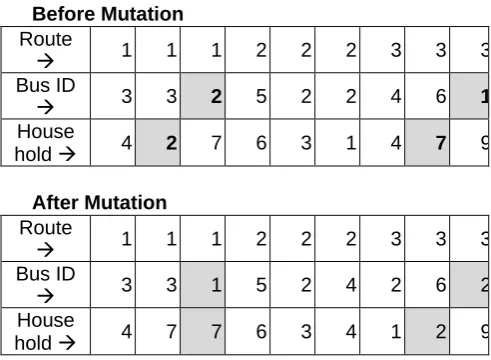
Mutation: The mutation operator that was selected for this study is the swap mutation. Based on the swap mutation operation, two alleles are picked at random and their positions are swapped. An example of the mutation operation is illustrated in Fig. 4.
Before Mutation
Route
1 1 1 2 2 2 3 3 3
Bus ID
3 3 2 5 2 2 4 6 1
House
hold 4 2 7 6 3 1 4 7 9
After Mutation
Route
1 1 1 2 2 2 3 3 3
Bus ID
3 3 1 5 2 4 2 6 2
House
hold 4 7 7 6 3 4 1 2 9
Fig. 4. An Example of a mutation operation.
In the example of a mutation operation demonstrated in Fig. 4, we observe that buses “2” and “1” originally using route “1” and “3”, switch their bus arrangement. Furthermore, households “2” and “7”, originally to be evacuated using routes “1” and “3”, are switched to routes “3” and “1” respectively.
E. Fitness Function
The fitness function of the developed EA algorithm is assumed to be equal to the objective function of the VRP mathematical model.
F. Survivor selection
plays an important role in the EA evolution, as it determines the offspring that will survive in the current generation and will become candidate parents in the next generation. In this study, generational offspring selection will be applied in which all offspring chromosomes will be moved to the next generation.
G. Termination Criterion
The termination criteria that will be used for this study will be based on the pre-specified number of generations.
V. NUMERICAL EXPERIMENTS
This section presents a detailed description of the numerical experiments conducted to evaluate effectiveness of the proposed evolutionary algorithm for the vehicle routing problem. Subsection V.A describes the case study area and the VRP model. Subsection V.B provides the data sets used for evaluation, including the map developed, assumptions made, and created scenarios. Three scenarios were evaluated: Scenario 1 - 0% penetration rate of AVs on traffic hence, no changes on the total travel time; Scenario 2 - 50% penetration rate of AVs hence, assume 25% percent reduction on travel time due to the use of autonomous buses in a mixed traffic; and Scenario 3 - 100% penetration rate of AVs hence, assume 50% percent reduction on travel time. Subsection V.C provides the results of the conducted numerical experiments comparing the three scenarios. The developed evolutionary algorithm was coded in MATLAB R2014b [14]. The numerical experiments were performed on a Dell Intel® Core™ i7-4790 Processor with 16 GB of RAM.
A. Case Study
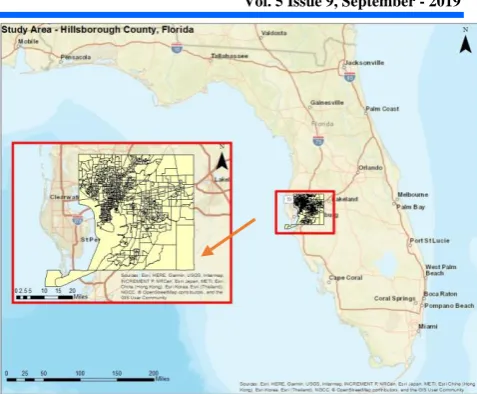
Hillsborough County located in Tampa, Florida was selected as a case study for this paper. This county was chosen because it was one of the counties, where a mandatory evacuation order was issued as a result of the declaration of one of the most recent and devastating disaster, Hurricane Irma, on September 10, 2017. Based on the 2010 census, this county has a population of 1,229,226, making it the fourth most populous county in Florida. It has an area of 1,266 square miles and its county seat is Tampa. The county has 10 major highways, including; 3 interstate highways; 3 U.S routes, and 4 state routes. As many counties in Florida, Hillsborough county needed individual and public assistance during evacuation. The overview of the case study area is given in Fig. 5.
Fig. 5. Overview of the study area: Hillsborough County, Florida
Based on the forecasted direction of Hurricane Irma, Hillsborough County ordered all residents in along the shores to evacuate. The county opened 16 shelters for the residents in evacuation areas. In this paper, the future of autonomous vehicles is considered in order to speed hurricane evacuations [3]. The vehicle routing problem for this paper considered randomly selected households in evacuation areas to be evacuated to open shelters using autonomous buses on evacuation routes.
B. Input Data Description
Vol. 5 Issue 9, September - 2019
Fig. 6. Hillsborough County VPR data sets
From the shape files the parameters of the VRP mathematical model were adopted. However, the information on the capacity of the shelters was unknown and because autonomous buses are not yet used the number of vehicles for this problem was selected randomly. Due to the nature of the problem modifications were made on the Figure 1. The following assumptions were adopted throughout the numerical experiments: 1) the vehicles are large buses operating in the region by the city and are full autonomous which means they operate without a driver and in all conditions; 2) One bus can evacuate people from more than one household; 3) The vehicles use satellite communications, real-time data and up-to-date maps to know the evacuation routes to the closest shelter and to receive real-time incident management and information on road and traffic conditions ahead; and 4) One shelter can adopt people from more than one household. Three scenarios will be developed for the VRP problem as explained in the beginning of this section. Under Scenario 1, assumes no autonomous vehicles and therefore no changes on the travel time; Under Scenario 2, 25% percent reduction on travel time due to the use of autonomous buses in a mixed traffic; and, under Scenario 3, 50% percent reduction on travel time due to the use of autonomous buses in full autonomous traffic. The assumptions were based on the expected reduction in travel time when using autonomous vehicles [2] [6] [7] [15].
Network Analyst tool in GIS was used to create a network dataset and find the best route using the network dataset. The routes from the households to
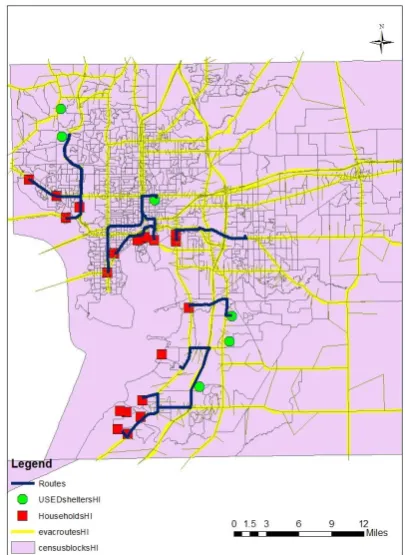
the shelters were generated by finding the closest shelters [16]. The roadway shapefile and Tampa bay Regional Planning Model (TBRPM), were retrieved from the Florida Standard Urban Transportation Model Structure (FSUTMS). Fig.7 shows the 19 evacuation routes that were generated based on this analysis.
Fig. 7. Hillsborough County evacuation routes
Travel time parameters, i.e. free flow time, volume, capacity and delay for each route, were estimated and the number of crashes per year was determined. The aforementioned data is provided in Table I below. The VRP parameters adopted for this paper are shown in Table II.
TABLE I. SELECTEDROUTESINHILLSBOROUGH
COUNTY
Route ID
Travel time (min) Scenar io 1
Travel time (min) Scenar io 2
Travel time (min) Scenar
io 3
Crash_freque cy (no.crashes/y
ear)
Route 1
16.2 7
12.2
0 8.14 53
Route 2
13.9 2
10.4
4 6.96 53
Route 3
12.0
0 9.00 6.00 49
Route 4
16.2 7
12.2
0 8.14 53
Route 5
11.0
9 8.32 5.55 47
Route 6
13.8 3
10.3
Route 7
11.9
9 8.99 6.00 38
Route 8
10.1
3 7.60 5.07 29
Route 9
13.3 6
10.0
2 6.68 271
Route 10
12.3
8 9.29 6.19 267
Route 11
12.0
5 9.04 6.03 213
Route 12
13.8 1
10.3
6 6.91 195
Route 13
12.6
7 9.50 6.34 194
Route 14
17.8 2
13.3
7 8.91 418
Route 15
15.4 0
11.5
5 7.70 19
Route 16
10.6
3 7.97 5.32 233
Route 17
11.3
1 8.48 5.66 109
Route
18 8.02 6.02 4.01 86
Route 19
15.5 7
11.6
8 7.79 225
TABLE II. INPUTSFORVRP PROBLEM
Parameter Value
Number of Routes [19]
Number of Buses [60]
Number of Households [2000]
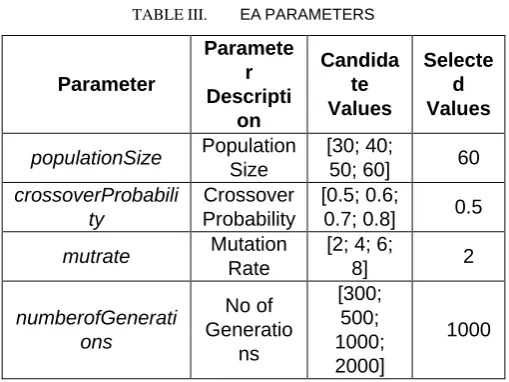
Parameter tuning was conducted in this paper to determine parameters to be used in the algorithm. Table III shows the values of the parameters that were adopted for this study.
TABLE III. EAPARAMETERS
Parameter
Paramete r Descripti
on
Candida te Values
Selecte d Values
populationSize Population
Size
[30; 40;
50; 60] 60
crossoverProbabili ty
Crossover Probability
[0.5; 0.6;
0.7; 0.8] 0.5
mutrate Mutation
Rate
[2; 4; 6;
8] 2
numberofGenerati ons
No of Generatio
ns
[300; 500; 1000; 2000]
1000
C. Comparative Analysis Results
The results presented herein are for all the three scenarios, described earlier in the paper. Each
scenario was executed using the same input values for number of routes, number of buses and number of households as described in Table II. No significant changes in the fitness values were observed for all the scenarios after generation 800 as seen in Figure 8. However, considering reduction in travel time for different penetration rates of autonomous vehicles in traffic, the fitness values decrease as the travel time decreases. Hence, this proves that with the objective of minimizing the total evacuation cost, the use of autonomous vehicles may help to reduce the total cost. From Fig. 8, with 0% penetration rate of autonomous vehicles in traffic, the total evacuation cost is $6.3059 x 10⁷ (scenario 1), while for mixed traffic is $6.1045 x 10⁷ (scenario 2), and for full autonomous vehicles in traffic is $5.9031 x 10⁷ (scenario 3). On average the total weighted evacuation cost of EA VRP with mixed traffic was lower by 3.2% as compared to the EA VRP with no autonomous vehicles. Furthermore, total weighted evacuation cost of EA VRP with full autonomous vehicles in traffic was lower by 6.4% as compared to the EA VRP with no autonomous vehicles. However, the cost savings are expected to increase drastically for large scale emergency evacuations (e.g., 500000 evacuees).
Scenario 1
Vol. 5 Issue 9, September - 2019
Scenario 3
Fig. 8. Convergence Patterns for VRP, EA
VI. CONCLUSIONS AND FUTURE WORK This study proposes an optimization model that addresses the evacuation of people from evacuation zones to shelters using self-driving public transportation (buses). The objective was to assign the evacuating vehicles to the available evacuation routes, moving people to safe destinations. Due to the problem complexity, an evolutionary-based algorithm was adopted as a solution approach. Numerical experiments were performed to test the efficiency of the developed algorithm by considering an emergency evacuation scenario at Hillsborough County, Florida.
The results of the numerical experiments supported the assumption that autonomous driving will potentially reduce the evacuation cost and improve evacuation process by reducing the total travel time of evacuees and accident risk. Results suggest that using full autonomous vehicles during evacuation leads to a reduction of 6.4% of the evacuation cost compared to manual driving. The main limitation of the study is related to possible assumptions bias for autonomous driving as AVs data are not currently available.
REFERENCES
[1] Montlick & Associates, "Self-Driving Cars Could Improve Evacuation Procedures,"
https://www.montlick.com/montlick-blog/auto- accidents/3057-self-driving-cars-could-improve-evacuation-procedures#.W0XdCthKjyg. Accessed Feb. 12, 2019.
[2] R. Zhang, F. Rossi and M. Pavone, "Routing Autonomous Vehicles in Congested
Transportation Networks: Structural Properties and Coordination Algorithms," National Science Foundation, Stanford, California, 2016.
[3] L. Bliss, "Could Self-Driving Cars Speed Hurricane Evacuations: The case for a fully autonomous escape plan," Ridgefield, 2016. [4] M. R. Boswell and W. Riggs, "Could Autonomous
Vehicles Save Lives in Disasters?,"
https://www.planetizen.com/features/95813-could-autonomous-vehicles-save-lives-disasters. Accessed Sep. 9, 2019
[5] N. Jozefowiez, F. Semet and E.-G. Talbi, "An evolutionary algorithm for the vehicle routing problem with route balancing," European Journal of Operational Research, pp. 761-769, 2009. [6] N. Moran and J. Pollack, "Route Assignment for
Autonomous Vehicles," in International Conference on Swarm Intelligence, 2016. [7] Y. Zhang, L. Shi, J. Chen and X. Li, "Analysis of
an Automated Vehicle Routing Problem in Logistics considering Path Interruption," Journal of Advanced Transportation, pp. 1-7, 2017. [8] O.H. Andrew, A genetic algorithm model for
Vehicle Routing Problem (VRP), Kumasi: Kwame Nkrumah University of Science and Technology, 2014.
[9] C. Prins, "A simple and effective evolutionary algorithm for the vehicle routing problem," Computers & Operations Research, p. 1985– 2002, 2004.
[10] K. C. Tan, Y. H. Chew and L. H. Lee, "A Hybrid Multiobjective Evolutionary Algorithm for Solving Vehicle Routing Problem with Time Windows," Computational Optimization and Applications, p. 115–151, 2006.
[11] B. Ombuki, B. J. Ross and F. Hanshar, "Multi-Objective Genetic Algorithms for Vehicle Routing Problem with Time Windows," Applied
Intelligence, p. 17–30, 2006.
[12] A. E. Eiben and S. J. E, Introduction to Evolutionary Computing, Springer, 2015. [13] M. A. Dulebenets, R. Moses, E. E. Ozguven and
A. Vanli, "Minimizing Carbon Dioxide Emissions Due to Container Handling at Marine Container Terminals via Hybrid Evolutionary Algorithms," IEEE, pp. 8131-8147, 2017.
[14] M. Wahde and D. Sandberg, "An elementary introduction to Matlab programming for stochastic optimization," 2010.
[15] J. T. Westbrook, "Tesla Hurricane Irma Update Taps Into Our Deepest Fears Of 21st Century Driving," 2017.
[16] Esri, "ArcGIS Network Analyst Tutorial," 2017.