pg. 1
EFFECT OF COMPENSATION AND WORK ENVIRONMENT TO EMPLOYEE PERFORMANCETHROUGH JOB SATISFACTION AS A VARIABLE OF MEDIATION IN PT METISKA FARMA
Abdul Samad Latuconsina 1, Djoko Setyo Widodo 2, Tjatjuk Siswandoko 3
Email: 1[email protected], 2[email protected], 3[email protected]
Masters of Management Universitas Krisnadwipayana
Campus Unkris Jatiwaringin PO BOX 7774/Jat CM Jakarta 13077
Indonesia ABSTRACT
This study a purpose to know and analyze the influence of compensation and work environment on employee performance with job satisfaction as a variable of mediation either simultaneously or partially in PT. Metiska Farma. The sampling technique used is accidental sampling is the way of sampling by chance, ie anyone who happens to meet with this researcher and considered suitable to be a source of data will be a sample of this study. The sample of respondents in this study was 80 people. Data analysis using path analysis or path analysis. From result of analysis and discussion hence can be concluded that: (1) partially compensation have positive, strong and significant effect to employee performance with correlation coefficient equal to 0,618; (2) partially working environment has positive, strong and significant effect on employee performance with correlation coefficient of 0.679; (3) partially job satisfaction has a positive, strong and significant effect on employee performance with correlation coefficient of 0.618; (4) simultaneously compensation, work environment, and job satisfaction have a positive, strong and significant effect on employee performance with correlation coefficient of 0.723; (5) the effect of compensation on employee performance through job satisfaction is 0.618 x 0.776 =0.479. While the effect of compensation on employee performance is 0.618. In this case, the direct impact of compensation on employee performance is greater when compared with indirect influence through job satisfaction is 0.618> 0.479, so it can be said that job satisfaction variable not as a mediation variable; and (6) the effect of work environment on employee performance through job satisfaction is 0,640 x 0,618 =0,395. While the effect of the work environment on employee performance is 0,679. In this case, it is known that the direct effect of work environment on employee performance is greater when compared with indirect influence through job satisfaction is 0.679> 0.395, so it can be said that job satisfaction variable, not as a mediation variable.
Keywords: Compensation, work environment, job satisfaction, employee performance Introduction
Human resources are now a challenge for management because management's success in determining human resource planning includes the preparation of human resource budgets and preparation of workforce programs to achieve organizational goals (Mangkunegara, 2009: 8). Although supported by facilities and infrastructure as well as abundant financial resources from the company, but without the support of reliable human resources and good corporate programs will not be completed properly. This states that human resources show the key points that must be highly considered with all their needs.
Organizations or agencies in implementing programs that have been given by the company always aim to achieve organizational goals. One way is to improve employee performance. Performance is basically what employees do or don't do so that affects how much they contribute to the organization including the quantity of output, the quality of output, the period of output, attendance at work and the cooperative attitude (Mathis and Jackson, 2002: 78). Performance is the result of the quality and quantity achieved by an employee in carrying out their duties following the responsibilities given to him (Mangkunegara, 2009: 67).
pg. 2
implementation of their work. Employee performance can be influenced by several factors such as ability factors and motivational factors (Mangkunegara, 2009: 67).Factors that are driving the level of organizational success besides performance are job satisfaction; job satisfaction can affect performance because job satisfaction plays an important role in the development of the company to improve employee efficiency and performance (Ahmed and Uddin, 2012: 101).
Mangkunegara (2009:117) states that job satisfaction is a feeling that supports or does not support the employee who is related to his work or with his condition. Employees will feel satisfied at work if the compensation given by the company is in line with expectations and all work facilities are complete and vice versa if compensation is not as expected and the work facilities are not supported it will certainly reduce employee job satisfaction.
Mathis and Jackson (2002:118) explain that the effort that must be made to improve employee performance is compensation. Compensation is an important factor that influences how and why people work in one organization and not another company. Employers must be competitive enough with the type of compensation to employ, maintain, and reward the performance of every individual in the organization.
According to Dessler (2009: 46) employee compensation refers to all forms of payment or gifts for employees and comes from their work. Employee compensation has two main components: direct payments in the form of wages, salaries, incentives, commissions, and bonuses, and indirect payments in the form of financial benefits such as insurance and holidays paid by the company.
Hasibuan (2009:118) explains compensation is all income in the form of money, direct or indirect goods received by employees as compensation for services provided to the company. Compensation is expected to be able to motivate employees to complete their work properly, with adequate compensation and increased motivation that is carried out successfully, then an employee will be motivated in carrying out the work assigned to him and try to overcome problems that occur and improve employee performance (Mangkunegara, 2009: 84).
Company leaders in assigning duties and responsibilities to employees should also pay attention to the work environment of employees. Spatial planning in the workplace such as furniture, coloring, lighting, air exchange, physical security, air quality, informal and formal meeting areas, quiet areas, privacy, personal storage, workspaces, etc., have an impact on employee performance so that the work environment does not only affect work morale and work passion but can affect employee performance (Nitisemito, 2001:183).
Leblebici (2012:2) several factors of the work environment that can affect employee performance include the lack of involvement of leaders in work, morale, and comfort in work. Working in a comfortable environment such as coworkers who are ready to help and interact with each other while working, even company leaders treat all employees equally so that it can result in improved employee performance and the performance of the entire organization.
Blazovich (2013:165) concludes from the results of his research that compensation has a positive and significant effect on performance. Blazovich's research (2013:165) is supported by the results of Jamil and Raja's research (2010:910) which states compensation is proven to have a significant effect on employee performance. Research conducted by Sopiah (2013: 87) concluded that financial compensation had a significant positive effect on employee performance. Juniarti (2014:13) concludes different results from previous studies that compensation has no significant effect on the performance of banking employees. Then the compensation variable has no partial effect on employee performance Research conducted by Juniarti (2014:13) is supported by the results of research conducted by Rizal et al (2014:74) that compensation has no significant effect on employee performance.
Compensation and work environment greatly affect employee performance, seen from previous studies there are differences in research results in the work environment on employee performance and compensation and employee performance.
pg. 3
Table 1. Summary of Research Gap Effect of Compensation on Employee PerformanceNo Researcher Research Variable Research Results
1 Blazovich (2013) 1. Compensation (X)
2. Employee Performance (Y)
Significant Positive
2 Jamil dan Raja (2010) 1. Compensation (X1)
2. Performance Evaluation (X2) 3. Promotion (Y)
Significant Positive
3 Sopiah (2013) 1. Compensation (X1) 2. Job Satisfaction (X2) 3. Employee Performance (Y)
Significant Positive
4 Rizal et al (2014) 1. Compensation (X)
2. Employee Performance (Y)
Significant Positive
5 Juniarti (2014) 1. Compensation (X)
2. Employee Performance (Y)
Significant Positive
Source: Prior Research Research Gap
Based on Table 1, that the results of previous studies of compensation have a positive and significant effect on employee performance, there are results of studies that state that compensation has no significant positive effect on employee performance and even the results of previous studies have resulted in compensation which has a significant negative effect on employee performance. From the results of different previous studies that have led to a research gap, therefore this influence can be explained by adding job satisfaction variables as mediating variables, and this is a gap for clarity of research results.
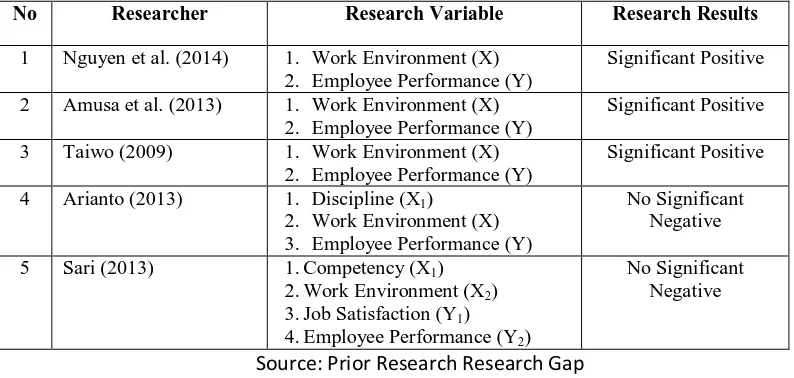
Nguyen et.al. (2014: 12) from the results of his research concluded that the work environment has a positive and significant effect on employee performance. The results of research from Nguyen et al. (2014: 12) supported by the results of research by Amusa et al. (2013: 460) were the results of the study concluded that the work environment has a significant effect on employee performance. Taiwo (2009:306) produces research that a conducive work environment can create high productivity, which means the work environment has a significant effect on employee performance.
The work environment does not significantly influence employee performance (Arianto, 2013:198). Arianto's research results are supported by research conducted by Sari (2013: 151) concluding that the work environment has an insignificant and negative influence on employee performance.
Table 2. Summary of Research Gap Work Environment on Employee Performance
No Researcher Research Variable Research Results
1 Nguyen et al. (2014) 1. Work Environment (X) 2. Employee Performance (Y)
Significant Positive
2 Amusa et al. (2013) 1. Work Environment (X) 2. Employee Performance (Y)
Significant Positive
3 Taiwo (2009) 1. Work Environment (X) 2. Employee Performance (Y)
Significant Positive
4 Arianto (2013) 1. Discipline (X1)
2. Work Environment (X) 3. Employee Performance (Y)
No Significant Negative
5 Sari (2013) 1.Competency (X1)
2.Work Environment (X2)
3.Job Satisfaction (Y1)
4.Employee Performance (Y2)
No Significant Negative
Source: Prior Research Research Gap
Based on Table 2, the results of previous studies work environment has a significant positive effect on employee performance and there are results of research that the work environment has a significant negative effect.
pg. 4
as a mediating variable, and this is a gap for clarity of research results.Dissatisfaction can be caused by a lack of wages or salaries received, career opportunities, job placement and relationships with other employees (Mangkunegara,2009:117). Compensation is the overall arrangement of remuneration for employers and employees directly or indirectly in the form of money, with this definition the more it can be realized that compensation will be able to increase or decrease work performance, job satisfaction, and employee motivation. Therefore the organization's attention to compensation arrangements must be correct and fair (Martoyo, 2007: 116).
The results of research conducted by Sopiah (2013: 9) concluded that compensation was proven to have a significant effect on employee job satisfaction. The results of research conducted by Sopiah are supported by the results of research conducted by Odunlade (2012: 10) that compensation has a significant effect on job satisfaction.
The company creates a clean and comfortable work environment that can have a positive impact on employee health, fatigue, boredom and attitude to superiors. And in the end, the work environment can affect the level of employee satisfaction or have an impact on the consistency of overall employee performance in the company (Jain and Kaur, 2013: 2).
Chaisunah (2011: 14) in his research stated that the work environment has a significant effect on employee job satisfaction. The results of different studies conducted by Dharmawan et al (2012:181) work environment did not significantly influence employee job satisfaction. Mangkunegara (2009:124) job satisfaction can be useful in improving employee work attitudes better towards workers. This is because employees feel the implementation of work and functions of the office receive attention from the leadership. Kristianto et al (2011: 8) produce research that job satisfaction has a positive and significant effect on employee performance. The results of the research of Kristianto et al (2011: 8) are supported by research by Papera et al. (2014:7) that job satisfaction has a positive and significant effect on employee performance. One of the factors that influence the level of employee performance is compensation, compensation is the provision of basic salary in which fixed salaries given by the company to employees create a sense of loyalty and commitment to the company is greater (Mathis and Jackson, 2002: 199).
This research takes the object in PT. Metiska Farma (MF) needs very high employee performance to increase company productivity. Thus the steps that must be taken to improve employee performance are very important, one of which is by providing fair compensation and creating a good and conducive work environment.
Compensation provided by PT. Metiska Farma can be direct through the basic salary, and indirectly such as employee benefits. In addition to basic wages, the company still provides incentives in other forms; employees also receive holiday allowances as one of the policies provided by the company to increase employee morale.
In the process of improving the performance of employees of PT. Metiska Farma does some upgrading of employee facilities, adding and repairing facilities that have been damaged, ideally, improving the facilities already provided will increase employee productivity due to the addition of facilities such as air conditioning, and internet access. So that employees feel comfortable and carry out their duties and do not experience difficulties when they need facilities and facilities that are needed for work.
Judging from the results of previous studies there are differences in research results, in addition to the dependent variable employee performance, the author adds one other variable that can affect the relationship between the two variables, namely job satisfaction, job satisfaction variables here as mediating variables namely variables that theoretically affect the relationship between independent variables with variables dependent becomes an indirect relationship and cannot be observed and measured.
Literature Review
Employee Performance
pg. 5
Sulistiyani and Rosidah (2003:223) a person's performance is a combination of ability, effort, and opportunity that can be valued from his work. Employee performance is what influences how much they contribute to the organization (Mathis and Jackson, 2002:78).Papera et.al. (2014:2) defines employee performance as employee behavior and results are crucial for organizational success. Martoyo (2000:91) employee performance is the result of work during a certain period compared to the various possibilities, targets, and work standards agreed upon together.
It can be concluded what is a performance from the understanding of experts and previous researchers that performance is basically what employees have done in their daily activities in the company and produce quality or non-quality output or in the form of services that employees provide to the company to achieve goals and the company's progress.
Compensation
Handoko (2001:155) compensation is anything that employees receive as compensation for their work. Compensation must have a logical, rational and sustainable basis. Meanwhile, according to Mathis and Jackson (2002:118) compensation is an important factor that influences how and why people work in one organization and not in another organization.
Compensation consists of three components, each of which varies. The first and biggest elements are basic compensation, regular compensation that employees receive regularly, either in the form of salary or wages. The second component of compensation is an incentive, a program designed to reward employees for good performance. These incentives come in the form of forms, such as bonuses and profit-sharing. The last component of compensation is benefits, benefits include health insurance programs, holidays, and others (Kaswan, 2012: 146).
Employee compensation refers to all forms of payment or gifts for employees and comes from their work. Employee compensation has two main components of direct payments and indirect payments (Dessler, 2009: 46).
It can be concluded what is compensation from the understanding of experts and previous researchers that compensation is all forms of payment provided by the company to employees for retribution for employee performance within a certain time.
Work Environment
Employee performance is influenced by many factors including the amount of composition of compensation given, proper placement, training, a sense of security in the future of mutation promotions. In addition to the compensation factor, there are still other factors that affect employee performance in carrying out tasks, namely the work environment. According to Nitisemito (2001:159) work environment is an internal or external condition that can influence work morale so that work can be expected to be completed faster and better.
Employees will be able to achieve maximum performance if they have high-achieving motives. Achievement motives that need to be owned by employees must be grown from within themselves and from the work environment. This is because the motivation for achievement that is grown in oneself will form the strength of self and if the work environment situation also supports the achievement of performance will be easier (Mangkunegara, 2009: 68).
It can be concluded from the understanding of experts and previous research that the work environment is an adaptation condition of an employee in the company, if the employee fits in the work environment in the company then his performance will increase if the employee does not fit into the work environment around the company then the performance will decrease. It is important to pay attention to the work environment because of the work environment influences employee performance and job satisfaction.
Job Satisfaction
pg. 6
Job satisfaction is a pleasant or unpleasant emotional state with which employees view their work (Handoko, 2001: 193). Job satisfaction reflects a person's feelings for his work appears in the positive attitude of employees towards work and everything that is encountered in the work environment. Job satisfaction can affect absenteeism, employee turnover, and work morale.It can be concluded what is job satisfaction from the understanding of experts and previous researchers. Job satisfaction is a perception of positive or negative emotional attitudes of employees that reflect whether the employee likes his job or does not like the work that has been given by the company.
Research Methods
Influence between Variables
1. Effect of Compensation on Employee Performance
The compensation which is often referred to as compensation is the right of a worker or employee that must be given by the organization or company to the worker after performing his obligations. Providing compensation is a very principle and significant part of management for the survival of the company. But before the form of compensation is given and received by employees must go through a network process from various sub-processes to provide compensation to employees for the work done.
Financial compensation in the business or industrial world can have the most important and significant influence on employee performance. The compensation system will provide two important objectives, namely to encourage employees to feel they have in the organization and encourage to achieve even higher.
Research conducted by Blazovich (2013) on employee compensation and performance variables shows that compensation is proven to have a positive and significant effect on employee performance. Similarly, the research conducted by Sopiah (2013) and Jamil (2010) also showed the same results as the research conducted by Blazovich (2013).
The partial effect between compensation variables and employee performance variables can be seen in the picture below. Then the hypotheses developed in this study are as follows:
H1: Compensation has a significant positive effect on employee performance.
2. Effect of Work Environment on Employee Performance
A good work environment will provide personal comfort and can arouse employee morale so that they can do their jobs well. Besides that, employees will be happier and more comfortable in working if the existing facilities are clean, not noisy, good air exchange and adequate and relatively modern equipment. A good work environment will affect employee performance.
Research conducted by Nguyen et.al. (2014) on the variable work environment and employee performance showed that the work environment proved to have a positive and significant effect on employee performance. Likewise, the research of Amusa et al. (2013) and Taiwo (2009) who tested the influence of the work environment on employee performance also showed that the work environment was proven to have a positive and significant effect on employee performance. Then the hypotheses developed in this study are as follows:
H2: The work environment has a significant positive effect on employee performance.
3. Effect of Compensation on Employee Performance mediated by Job Satisfaction
Financial compensation can motivate the performance of all employees to produce well. Because for some employees, wages are a way to meet their needs. It is suspected that the financial compensation system can be the beginning and end of an employee's job satisfaction. Therefore, if the financial compensation system is good and improved, it will cause feelings of pleasure or satisfaction with the work. The condition or feeling of pleasure can be a factor that drives an employee to show high individual performance according to company expectations.
Research conducted by Sugiyarti (2012) shows that job satisfaction is proven to mediate the effect of compensation on employee performance. Then the hypotheses developed in this study are as follows:
pg. 7
4. Effect of Work Environment on Employee Performance mediated by Job SatisfactionEmployee job satisfaction indicates whether or not they are fulfilled their desire for the work undertaken. If a person's work environment employees do not get what is expected including fair promotion opportunities, good income, pleasant colleagues and superiors as well as satisfaction with the work itself, then we can be sure the employee's performance will be bad.
Research conducted by Sugiyarti (2012) shows that job satisfaction is proven to mediate the influence of the work environment on employee performance. Then the hypotheses developed in this study are as follows:
H4: Job satisfaction mediates the effect of the work environment on employee performance. Population and Samples
The object of research was conducted at PT. Metiska Farma in Jakarta with a population and sample of 80 employees within the PT. Metiska Farma. The sampling technique is a saturation technique and the data analysis technique uses path analysis.
Research Results and Discussion
1. Effect of Compensation on Employee Performance
The results of the analysis of the effect of compensation on employee performance are known that the compensation coefficient beta is 0.618, the t value is 6.946 and the significance value is 0.000. This significant value is smaller than 0.05, this means that the compensation variable affects employee performance partially. The magnitude of the effect of compensation on employee performance is known to the value of R Square of 0.382, meaning that the effect of compensation variables on employee performance is 38.2% and the rest is influenced by other variables outside this study.
2. Effect of Work Environment on Employee Performance
The results of the analysis of the influence of the work environment on employee performance are known that the beta of the work environment coefficient is 0.679, the t value is 8.162 and the significance value is 0.000. This significant value is smaller than 0.05, this means that the work environment variables partially influence employee performance. The magnitude of the influence of the work environment on employee performance is known to the value of R Square of 0.461, meaning that the influence of work environment variables on employee performance of 46.1% and the rest is influenced by other variables outside this study.
3. Effect of Job Satisfaction on Employee Performance
The results of the analysis of the effect of job satisfaction on employee performance are known that the beta of the job satisfaction coefficient is 0.618, the value of t arithmetic is 6.942 and the significance value is 0.000. This significant value is smaller than 0.05, this means that job satisfaction variables partially influence employee performance. The magnitude of the effect of job satisfaction on employee performance can be seen R Square value of 0.382, meaning that the influence of job satisfaction variables on employee performance by 38.2% and the rest is influenced by other variables outside this study.
4. Effect of Compensation, Work Environment and Job Satisfaction on Employee Performance
The results of the analysis of the effect of compensation, work environment and job satisfaction on employee performance are known that the calculated F value of 27.814 and a significance of 0.000. This significant value is smaller than 0.05, this means that the variable compensation, work environment, and job satisfaction simultaneously affect employee performance. The magnitude of the effect of compensation, work environment and job satisfaction on employee performance can be seen R Square value of 0.523, meaning that the influence of compensation, work environment, and job satisfaction variables on employee performance is 52.3% and the rest is influenced by other variables outside this study.
5. Effect of Compensation on Employee Performance through Job Satisfaction
pg. 8
compensation on employee performance is greater when compared to the indirect effect through job satisfaction that is 0.618> 0.479, so it can be said that the job satisfaction variable is not a mediating variable.Based on the analysis of compensation pathways to employee performance through job satisfaction partially can be described as follows.
Figure 1. Path Analysis of the Effect of X1 on Y Through X3
6. Effect of Work Environment on Employee Performance Through Job Satisfaction
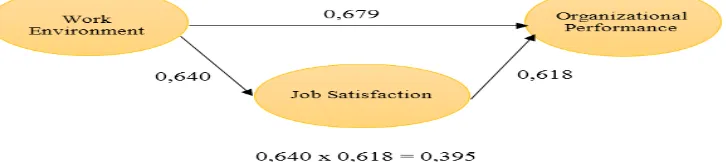
The results of the analysis of the influence of the work environment on employee performance through job satisfaction is known that the influence of the work environment on employee performance is 0.679. The effect of the work environment on employee performance through job satisfaction is 0.640 x 0.618 = 0.395. In this case, it is known that the direct effect of the work environment on employee performance is greater when compared to the indirect effect through job satisfaction that is 0.679> 0.395, so it can be said that the job satisfaction variable is not a mediating variable.
Based on the analysis of the work environment path to employee performance through job satisfaction can partially be described as follows.
Figure 2. Path Analysis of the Effect of X2 on Y Through X3
Conclusions and Suggestions
Conclusion
Based on the results of research that has been done to test the hypotheses and answers to the formulated problems, the researcher can draw the following conclusions:
1. Partially compensation has a positive, strong and significant effect on employee performance with a correlation coefficient of 0.618.
2. Partially, the work environment has a positive, strong and significant effect on employee performance with a correlation coefficient of 0.679.
3. Partially job satisfaction has a positive, strong and significant effect on employee performance with a correlation coefficient of 0.618.
4. Simultaneously compensation, work environment, and job satisfaction have a positive, strong and significant effect on employee performance with a correlation coefficient of 0.723.
pg. 9
6. The influence of the work environment on employee performance through job satisfaction is 0.640 x 0.618 = 0.395. While the influence of the work environment on employee performance is 0.679. In this case, it is known that the direct effect of the work environment on employee performance is greater when compared to the indirect effect through job satisfaction that is 0.679> 0.395, so it can be said that the job satisfaction variable is not a mediating variable.Suggestion
Based on the results of research and discussion, suggestions that can be followed up as follows:
1. Compensation is recommended to be increased by something that the employees receive as compensation for their work in the form of facilities and the form of career opportunities.
2. The work environment is recommended to be made better for employee activities by creating a comfortable working environment, bright lighting/light, cool air temperature in the workplace, good air circulation, absence of noise and odor, attractive decoration colors, so it is very helpful in arousing work enthusiasm and making employees feel at home in the office.
3. Although the level of satisfaction that occurs at PT Metiska Farma is quite high, it is not needed attention, because job satisfaction, if not handled properly and correctly, is not dynamic for the company and can make the company will be more developed, but it will hamper the company's growth. And some things are suggested to be improved, such as work that is within their abilities, creates a pleasant working atmosphere, and is more careful in moving positions.
4. To improve the performance of employees in carrying out their duties and functions, it is hoped that the leadership can pay attention to compensation for employees in terms of work, in particular, get an increase or reward associated with their achievements, so employees can be motivated in terms of improving performance in the company.
References
1. Abdurrahman, Fathoni. 2006. Metodologi Penelitian dan Teknik Penyusunan Skripsi. Jakarta : PT Rineka Cipta. 2. Ahmed, S dan Md Nokir Uddin. 2012. Job Satisfaction of Bankers and its Impact in Banking: A Case Study of
Janata Bank. Journal ASA University Review. 6(2).
3. Arianto, D. A. 2013. Pengaruh Kedisiplinan, Lingkungan Kerja Dan Budaya Kerja Terhadap Kinerja Tenaga
Pengajar. Jurnal Economia, 9 (2), 191-200.
4. Blazovich, Janell L. 2013. "Team Identity and Performance-Based Compensation Effects On Performance". Dalam Team Performance Management: An International Journal, Vol. 19 No.3/4 Hal 165-166USA: Accounting Departement, University If St Thomas.
5. Chaisunah. 2012. “Pengaruh Kompensasi dan dan Lingkungan Kerja terhadap Kepuasan Kerja Karyawan, Studi
Kasus Pada Bank Perkreditan Rakyat”, Vol.1, No.3, eJournal Administrasi Negara.
6. Darfina, Juniarti. 2014. Pengaruh Kompensasi Terhadap Kinerja Karyawan Dengan Motivasi Kerja Sebagai
Variabel Mediating (Studi Kasus Pada Karyawan Perbankan Tanjung Pinang).
7. Demet Leblebici. 2012. Impact of Workplace Quality on Employee’s Productivity: Case Study of a Bank in
Turkey. Journal of Business, Economics & Finance. Okan University, Turkey.
8. Dessler, Garry. 2009. Manajemen Sumber Daya Manusia, Edisi Kesepuluh. Jilid 2. 9. Fred Luthans, 2006, Perilaku Organisasi. Edisi Sepuluh, PT. Andi: Yogyakarta.
10.Ghozali, Imam. 2006. Aplikasi Analisis Multifariat Dengan Program SPSS. Cetakan Ke empat, Semarang : Badan Penerbit Universitas Diponegoro.
11.Gibson, 2002. Organisasi Perilaku, Struktur, Proses, Terjemahan, Edisi V. Jakarta: Penerbit Erlangga. 12.Handoko, T. Hani. 2001. Manajemen Personalia dan Sumber Daya Manusia. Edisi 2. Yogyakarta: BPFE.
pg. 10
15.Kaswan. 2012. Manajemen Sumber Daya Manusia untuk Keunggulan Bersaing Organisasi. Graha Ilmu,Yogyakarta.
16.Mangkunegara, A.A. Anwar Prabu. 2009. Manajemen Sumber Daya Manusia. Bandung: PT. Remaja Rosdakarya.
17.Mangkuprawira, TB.S dan A.V. Hubeis. 2007. Manajemen Mutu Sumber Daya Manusia. Ghalia Indonesia, Bogor.
18.Manullang, Marihot, 2009. Dasar-Dasar Manajemen. Gadjah Mada University Press. 19.Martoyo, Susilo. 2007. Manajemen Sumber Daya Manusia. Edisi 5. BPFE. Yogyakarta.
20.Mathis, R.L. & J.H. Jackson. 2002. Human Resource Management: Manajemen Sumber Daya Manusia. Terjemahan Dian Angelia. Jakarta: Salemba Empat.
21.Nguyen et.al. 2014. The Association Between Body Mass Index and Hypertension is Different Between East and
Southeast Asians. American Society for Nutrition: America.
22.Nitisemito, Alex Soemadji. 2001. Manajemen Personalia. Jakarta: Ghalia Indonesia.
23.Panggabean, S., Mutiara. 2004. Manajemen Sumber Daya Manusia. Bogor: Ghalia Indonesia. 24.Pasolong, Harbani. 2007. Teori Administrasi Publik. Alfabeta.
25.Robbins P. Stephen. 2006. Organizational Behavior. 9th Edition. New Jersey: Precentice Hall International Inc. 26.Sedarmayanti, 2001. Sumber Daya Manusia dan Produktivitas Kerja. Bandung: Mandar Maju.
27.Siagian, Sondang P. 2003. Manajemen Sumber Daya Manusia. Jakarta: Bumi Aksara.
28.Simanjuntak, Payaman J. 2005, Manajemen dan Evaluasi Kinerja, Jakarta: Lembaga Penerbit Fakultas Ekonomi UI.
29.Sopiah (2013), Perilaku Organisasional, Yogyakarta : Andi.
30.Sugiyono. 2010. Metode Penelitian Pendidikan. Alfabeta. Bandung.
31.Sulistiyani, Ambar Teguh dan Rosidah. 2003. Manajemen Sumber Daya Manusia. Yogyakarta : Graha Ilmu. 32.Taiwo, Akinyele Samuel. 2010. The Influence of Work Environment on Workers Productivity: a Case of Selected
Oil and Gas Industry in Lagos, Nigeria.