An Assessment Method of Information Transfer
Capacity for Smart Grid
Jian-gang Yao, Wu Wen, Zheng-wei Guo, Shen-jie Yang
College of Electrical and Information Engineering, Hunan University, Changsha, China;
Email: [email protected], [email protected], [email protected], [email protected]
Abstract—Smart grids will be regarded as a dual compound
network composed of power network and cyber network, called Cyber-power System (CPS). Studying the cyber-power relationship, especially the effects of cyber on the whole system, is of theoretical and engineering importance. In this paper, CPS studies were reviewed first, and then a method based on Inclusion-exclusion theory was proposed, which made elements disjoint and obtained the minimal path set for an assessment. By putting forward a simple model and precise calculation, we conclude that the optimized network topology is useful for analyzing the information transfer capability of smart grids. The results may provide theoretical guidelines for the construction of power grids, especially for optimizing the placement of smart grids.
Index Terms—Smart Grid; composite network; uncertainty;
transmission capacity; minimal path sets.
I. INTRODUCTION
Smart grids have attracted growing attention from the academic field. However, there is no clear unified idea on smart grids, as different countries and research institutions present specific connotations and denotations [1-6]. International Power Research Institute promoted in 2001 to study “IntelliGrid interactive network system” and in October 2009 to upgrade national strategy. The technical framework of "Smart Grids” was proposed by the European Union in 2005; Japan and South Korea also developed a “low-carbon smart grid development plan road map” and pilot projects in 2009. In 2006, State Grid Corporation of China carried out digital network & digital substation research and demonstration projects. In 2009 the State Grid Corporation of China proposed a “strong smart grid” scheme.
Understanding and definition of smart grids are not the same, but the objective basis and background for information network today coincide with the physical network. The integration system of information network and physical network (Cyber-physical system) is a hotspot in research. The fusion system of information network and power grid (Cyber-power system, CPS) can
be seen as a branch of Cyber-physical system. It is foreseeable that with the development in cloud computing, grid computing, mass storage, and communication technology, CPS will bring a full range of changes to the basic theory of the information network and power grid architecture. CPS will become another technological revolution after the Internet [6-7]. It will improve the communication and control capacities in the information-physical world.
Currently, CPS is a new field of research, as Institute of Electrical and Electronics Engineers (IEEE) and Association for Computing Machinery (ACM) have held CPS WEEK academic activities and meetings since 2008. China also attached notable importance to CPS. The National Natural Science Foundation and the Ministry of Science rank CPS as a priority funding area. Ji-feng He conducted relevant research and proposed a definition [8]. Zhong-jie Wang reviewed the studies on information and physical integration, which analyzed the interaction system of network layer and physical layer [9]. The important degree of information security of smart grids in survivability was discussed [10]. Jun-hua Zhao proposed a CPS framework, which is a new method based on the delay and data loss compensation [11]. Bamdad Falahati presented a network-power relationship from direct and indirect correlations [12]. Much research work has been carried out [13-15], and thus CPS is a promising field of research. With further comprehensive development of computing, sensing, communication technology and control theory, and as the research on the Internet matures, CPS will become a focus in technological development research.
However, CPS lacks a reliability evaluation model and an exact calculation method at present. Considering the transmission speed of the information network, we utilize the inclusion-exclusion theory on the analysis of the power communication network. In this paper, we present an accurate evaluation which has important significance in research of robustness and reliability of the power network.
II. CPS MODEL AND NETWORK TRANSMISSION ABILITY
A. Definition and Construction of the CPS Model
Smart grids can be regarded as a large-scale fusion system of the interdependent and deeply coupled information network and power network (Cyber-power
Corresponding author: Wu WEN, Hunan University, Changsha, [email protected]
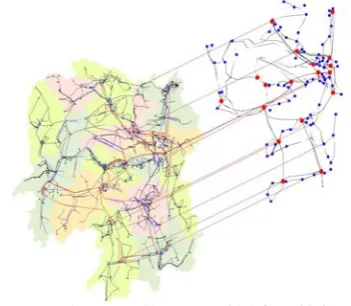
system, CPS). Figure 1 shows the mapping relationship between power network and information network in a provincial electricity network.
Fig 1. Binary network composed by power grid (left) and information cyber (right).
Generally CPS modeling involves two steps: first, set up a state space model of each unit by physical and information input/output (I/O) and information topology. Second, based on the network topology module, settle a Cyber-power model for two composite networks.
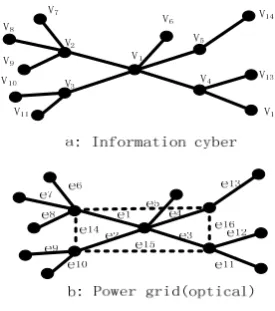
A simple topology model is described as an example. Figure 2 shows the three-layer information construction for the province node (V1), city nodes (V2, V3…V5), and
county nodes (V6, V7…V14). We also use three-layer
power grids for power source node (V14), supply network
(Line e1-e5, Line e14-e16), and distribution network (Line
e6-e13).
Fig 2. Diagram of Cyber-power system
B. Evaluation Method of Network Transmission Ability
The network transmission ability of power network is the base of the system planning and scheduling. Information network reliability is associated with the reliability of node equipment and the robustness of network topology. Higher reliability of node and link equipment will result in higher connectivity of topological construction of network, and thus we will get a higher reliability of information network system.
Like safety, the reliability of CPS must consider both information system and physical system, especially the mutual influence between them. Considering the strong
coupling between dual networks, we, in order to ensure the safety of electric power system, should not only minimize the probability of electrical equipment failure, but also increase overall system security and stability from the perspective of information network systems. The evaluation methods of a network can be divided into two categories:
1. List all minimal path sets or cut sets in the network, and statistically evaluate the reliability of disjoint grids according to the principle of inclusion-exclusion. The basic idea is: regardless of overlap, the number of all objects included in content is first calculated. Then exclude the number of duplicate calculations, so the calculation results are neither missing nor repeatedly counted. This method is called the principle of inclusion-exclusion.
2. Network topology simplification. Replace the network with simple structure until it is reduced to a link. However, only some parts of network can be simplified. Tang Huang presented a binary decision diagram for network simplification, which is more effective [16].
In this paper, we simplify the power network into supply nodes, load nodes and power lines, and simplify the information network into decision-making nodes, collecting nodes, execution nodes and fiber optic transmission networks. Information network node operation requires power supply from power grids, and the functioning of power grid nodes requires services from information and communication networks both interactive and interdependent. Reality is important information, because the network nodes are usually equipped with an uninterruptible power supply, and thus short-term supply outage will not greatly affect information network. Therefore, this article will not consider the effects from the power supply outage of information network.
It is assumed that nodes and links only have two states of work or failure, and the failures of nodes and links are independent; that is, failure of a node or link does not cause failure to another node or link. The basic principle of the algorithm is: a set of links with connected source host nodes in the network is called a road set. If in a road set, the failure of any road link will cause the source host nodes to be unconnected, then this path set is a minimal path set.
Let the information network be N={V, E}, the node set be V= {v1, v2…vn}, and the link chain set be{ e1, e2,…em}.
If in a known network, the minimum path set from the starting node i to the ending node j is Rij= {E1,,E2,…Em},
the generic system probability is:
1 1
P ( ) ( ) ( 1) ( )
m
m
ij i i j i j m
i i j m
p E p EE p EE E
= ≤< ≤
=
∑
−∑
+ + −" "(1) Only when the set is not cross routing, then
[1 (1 )]
i j
ij
ij v v r
r R
P p p p
∈
= × × −
∏
−(2) where Pr is the effective transmission probability of r∈
Rij, which is the rout for the transmission of two nodes pvi
and pvj. Routing Rij is composed of a node set Vr and a
x x
x r x r
r v e
v v e E
p p p
∈ ∈
=
∏
×∏
(3) Assume xij is transmission status between nodes vi and
vj. In this paper, I(Xij)=- ln (pij) represents the information
uncertainty. When information can be conveyed accurately and timely, Xij = 1; when the information
cannot be communicated suitably and accurately, Xij = 0.
The distribution of probability Xijis showed in Table 1.
TABLE 1.
DISTRIBUTION OF INFORMATION TRANSMISSION PROBABILITY
I(Xij) is a decreasing function of Pij; if Pij is closer to 1,
the probability is higher and the uncertainty is smaller. Considering the delay requirements of smart grid, when it delays beyond a certain time, the information will be considered invalid. Therefore, we set the path hop count S and threshold ST; when S<ST, the path meets the
delay requirements. When a path is only an effective route and the hop count S=ST, they have only one disjoint
routing, which has a minimum effective transmission probability.
( )
min( )
min1 min
T T
s s
v e
p = p + × p
(4) The physical meaning of Eq. (4) is: When there is only one routing, we can easily obtain the minimum transmission probability for efficient routing of all nodes and edges. From Eq. (2) we know Pij≤Pvi×Pvj, then:
max vi vj p =p ×p
(5) The physical meaning of the maximum probability is the multiplication of the beginning and ending nodes.
Uncertainty in information network transmission system:
( ) ij
ij ij r R
I w I X
∈
=
∑
(6) where wij is the information weight between vi and vj,
which is decided by the importance degree of the information network.
Information network transmission capacity:
m max
1 I I in C
I
− = −
(7) From Eq. (7), we can deduce C is within (0, 1). When the information network is disconnected, Cmin=Imin/Imax.;
when information network is connected, Cmax is close to 1.
min ln( max)
ij
ij ij r R
I w P
∈
= −
∑
(8)
m ln( min)
ij
ax ij
r R
I w P
∈
= −
∑
(9)
III. EXPERIMENTAL RESULTS AND ANALYSIS
A. Example A
This example is a province-city-country three-level power network, namely the provincial dispatching center,
dispatching center, terminal node. The network connection is like a tree. The information network and the physical network are shown in Fig. 3.
Fig. 3. Diagram of cyber-power system
The weight between information nodes viand vjis
wij, and the simulated values of wij for this example are
shown in Table 2.
TABLE II INFORMATION WEIGHT
connection weight connection weight
w1-2
w1-3
w1-4
w1-5
w1-6
w2-7
w2-8
0.30 0.25 0.15 0.15 0.15 0.05 0.05
w2-9
w 3-10
w 3-11
w 4-12
w 4-13
w 5-14
0.05 0.05 0.05 0.05 0.05 0.05
For this example, the same series of communication equipment is used to simplify the calculation. We assume the work efficiency values are the same between nodes. pvx=0.95, x=1,2... N. pey=0.9, y=1,2... M.
1) The middle layer is open-loop: pvx=0.95, x=1,2…14;
pey=0.9, y=1,2…16.
When ST=2, we calculated pmin=0.694 by Eq. (4),
Imax=0.364 by Eq. (9), pmax=0.9025 by Eq. (5), and
Imin=0.10258 by Eq. (8). The set which satisfies S<ST for
nodes v1 and v2 is {V1-V2, V1-V3-V2}. Two paths are
disjoint, so we obtained p12=0.8816 by Eq. (2). Similarly,
the probabilities of other nodes were calculated. With Eq. (6) and the information weights in Table 1, the uncertainty of information transmission was calculated to be I=0.1633. With Eq. (7), the total system transmission capacity was calculated to be C=0.8331.
When ST=3, similarly, we calculated pmin=0.5937,
Imax=0.5212, pmax=0.9025, Imin=0.10258, I=0.1633, and
C=0.8834.
2) The middle layer is close-loop: pvx=0.95, x=1,2…14;
pey=0.9, y=1,2…17.
Similarly: when ST=2, then I=0.1579, C=0.8480.
When ST=3, then I=0.1579, C=0.8938.
With the increase of the threshold, the node route may increase, the uncertainty of the total information network decreases, and the probability increases. The information transmission capacity with a delay threshold is showed in Fig. 4.
P Xij Pij
1 2 3 4 5 6 7 8 9 0.5
0.55 0.6 0.65 0.7 0.75 0.8 0.85 0.9 0.95 1
Threshold
Inf
o
rm
at
io
n T
ran
s
m
is
s
io
n Ca
pa
c
it
y
V2-V3-V4-V5 Open-loop V2-V3-V4-V5 close-loop
Fig 4. Information transmission capacity of cyber-power system
Through analysis, the following conclusions are drawn: the information transmission capacity is an increasing function of threshold ratio. Its physical meaning increases routing choice for the delay put grace. At the same time, routing growth consumes more transmission time. When the threshold is higher than 3, the growth rate declines. A closed-loop has higher information transmission ability than an open-loop, especially with low threshold.
B. Example b
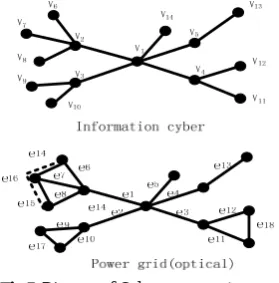
This example is a province-city-country three-level power network, namely the provincial dispatching center, dispatching center, and terminal node. The connected information network is like a tree. The information network and power grid are shown in Fig. 5.
Fig 5. Diagram of Cyber-power system
1) Terminal layer is open-loop: pvx=0.95, x=1,2…14;
pey=0.9, y=1,2…17.
When ST=2, then pmin=0.694, Imax=0.364,
pmax=0.9025, Imin=0.10258, I=0.1792, and C=0.7895.
When ST=3, then pmin=0.5937, Imax=0.5212,
pmax=0.9025, Imin=0.10258, I=0.1792, and C=0.8529.
2) Terminal layer is closed-loop, pvx=0.95, x=1,2... 14;
pey=0.9, y=1,2... 18.
Similarly: when ST=2, then I=0.1765, C=0.7968
When ST=3, then I=0.1765, C=0.8581.
We show the information transmission capacity with delay threshold in Fig. 6.
1 2 3 4 5 6 7 8 9 0.65
0.7 0.75 0.8 0.85 0.9 0.95 1
Threshold
Inf
or
m
at
ion T
rans
m
is
s
ion
C
apac
it
y
V6-V7-V8 Open-loop V6-V7-V8 close-loop
Fig. 6. Information transmission capacity of cyber-power system
Through analysis, we get the following conclusions. The information transmission capacity is an increasing function of threshold ratio. When the terminal layer is closed-loop, the advantage of transmission capacity is not obvious compared with an open-loop. The growth value in example b is smaller than in example a, especially when the threshold is between 2 and 3. The probability in example b is smaller than in example a in the same conditions, and the physical links are larger both in open-loop and closed-open-loop networks. When we design the physical layer network, we can take a minimal link to meet information transmission needs and thus to optimize information network placement.
IV. CONCLUSIONS
In this paper, we propose to use self-information to describe information transmission uncertainty, and then accurately evaluate the transmission capacity. We take inclusion-exclusion theory and disjoint analysis to assess the transmission capacity. Considering the timeliness and accessibility of network, closed-loop network has a higher information transmission capability, especially with low threshold.
1) Improving the reliability of important information nodes could obviously improve information transmission capacity.
2) Based on the network topology, we just need to design the physical link properly, and then with the minimum number of links, we can meet information transmission quality needs and save investment. 3) The accurate evaluation provides a basis for
placement optimization, and serves as a reference model to optimize Cyber-power network. It is conducive to the planning and scientific research.
ACKNOWLEDGMENT
REFERENCES
[1] Yi-xin Yu, Wen-peng Luan. Smart grid[J]. Power System and Clean Energy, 2009, 25 (1): 7– 11.
[2] Yi-xin YU, Wen-Peng Luan. Smart grid and its implementations [J]. Proceedings of the Chinese Society for Electrical Engineering, 2009,29 (34): 1 – 8.
[3] United States Department of Energy Office of Electric Transmission and Distribution. “GRID 2030” a national vision for electricity’s second 100 years [EB/OL]. http://www.smartgrid2030.com
[4] Rajkumar R, Insup L, LIU S, Stankovic J. Cyber-Physical systems: the next computing revolution.[C]. Proceedings of the 47th ACM/IEEE Design Automation Conference. California, USA: IEEE, 2010, 1 (1):731-736
[5] Dillon T, Potdar V, Singh J, Talevski A. Cyber-physical systems: Providing Quality of Service (QoS) in a heterogeneous systems-of-systems [C].environment Proceedings of 5th IEEE International Digital Ecosystems and Technologies Conference (DEST). Daejeon, USA: IEEE, 2011, 1(1):330-335
[6] Lin J, Sedigh S, Miller A.A general framework for quantitative modeling of dependability in cyber-physical systems: a proposal for doctoral research.[C].Proceedings of the 33rd IEEE International Computer Software and Applications Conference. Seattle, USA: IEEE, 2009, 1 (1):668-671
[7] Hnat T, Sookoor T, Hooimeijer P, Weimer W.Macrolab: a vector-based macro programming framework for cyber-physical systems. [C].Proceedings of the 6th ACM Conference on Embedded Networked Sensor Systems. New York, USA: ACM, 2008, 1 (1) : 225-238
[8] Ji-feng He. Cyber-physical systems [J]. Communications of the China Computer Federation, 2010, 6 (1) : 25-29 [9] Zhong-jie Wang, Xie Lu-Lu. Cyber-physical systems: a
survey[J]. Acta Automatica Sinica, 2011, 37 (10) : 1157-1166
[10]Lai-jun Chen, Shen-wei Mei, Chen Yin. Smart grid information security and its influence on power system Survivability [J].Control Theory and Applications, 2012, 29 (2) : 1- 6
[11]Jun-hua Zhao, Fu-shuan Wen, Yu-sheng Xie, Xue Li, Zhao-yang Dong. Cyber physical Power System: Architecture, Implementation Techniques and Challenges
[J]. Automation of Electric Power Systems, 2010, 34 (16) : 1-6
[12]Bamdad Falahati, Yong Fu, Lei Wu. Reliability Assessment of Smart Grid Considering Direct Cyber-power Interdependencies [J].IEEE Transactions on Smart Grid, 2012, 3 (3):1-6
[13]Xiao Wang, Min Wang, Yinghan Jin . The Design and Implementation of A Network Provenance System Framework[J]. Journal of software,2013, 8 (6): 1436-1442 [14]Jingyang Wang, Min Huang, Haiyao Wang, Liwei Guo,
Wanzhen Zhou. Research on Detectable and Indicative Forward Active Network Congestion Control Algorithm [J]. Journal of software,2012, 7 (6): 1195-1202
[15]Qilin Li, Mingtian Zhou Research on Dependable Distributed Systems for Smart Grid [J]. Journal of software,2012, 7 (6): 1250-1257
[16]Tang Huang, Tan Feng, Song Bin. Cyber-physical system security studies and research [C]. Proceedings of the International Conference on Multimedia Technology (CIMT 2011). Hangzhou, China: IEEE, 2011, :4883-4886
Jian-gang Yao serves as a Ph. D supervisor in the College of Electrical & Information Engineering of Hunan University in China. He is engaged in teaching and scientific research work related to electric power automation and power market.
Wu Wen received the M.S. degree in communications
technology engineering from Central South University, in March 2007. He is pursuing Ph. D. degree in the College of Electrical and Information Engineering, Hunan University, Hunan, China. His main research areas include: intelligent power grid, Cyber-power system, complex network control, communication.
Zhen-wei Guo received the M.S. degree in 2004. He is
currently pursuing the Ph. D. degree in the College of Electrical and Information Engineering, Hunan University, Hunan, China. His main research areas include: intelligent power grid, electric power system.
Shen-jie Yang received the M.S. degree in 2008. He is