On The Reduction Of Papr In The Multicarrier
Techniques Based On Mobile Wireless System
Kussum Bhagat, Dr. Jyoteesh Malhotra
ECE Department, Guru Nanak Dev University Regional Campus, Jalandhar, India; ECE Department, Guru Nanak Dev Universi-ty Regional Campus, Jalandhar, India.
Email: [email protected]
ABSTRACT :OFDM is very attractive technique now a day due to its various benefits like easy and efficient in dealing with multipath, robust in nature, spectral efficiency and high speed data transmission. Thus because of its applications OFDM plays a vital role for upcoming 4G wireless communication. OFDM works either as the multiplexing or modulation technique. It has also been used in broadband multimedia wireless services. Beside of its application, one major drawback of OFDM system is high Peak to Average Power ratio (PAPR) which causes non-linearity at the receiving end. The paper describes the PAPR problem in OFDM system and various PAPR reduction techniques that are used to reduce the PAPR have been discussed. The PTS technique for 16 QAM/OFDM systems is used to reduce the PAPR and simulation results are then analyzed. Also, SC-FDMA is another technique which can replace the OFDM. Thus the subcarrier mapping schemes of SC-FDMA has been described. The results for IFDMA and LFDMA for 16QAM modulation technique are shown when DFT spreading technique is applied.
Keywords :OFDM, PAPR, PTS, SC-FDMA, IFDMA, LFDMA
1 I
NTRODUCTIONThe adoption of OFDM for downlink radio transmission by 3GPP for cellular long term evolution (LTE) and SC-FDMA for uplink transmission follows the successful implementation of OFDM for a variety of other applications including digital sub-scriber loops, wide area broadcasting (digital audio and video), and local area networks. In OFDM technique the user data stream is spitted into several sub-streams then it multiplexes the data on several subcarriers and transmits it in parallel. OFDM uses orthogonal subcarriers, which overlap in the fre-quency domain [1]. OFDM extends the symbol duration of the individual data and uses orthogonal subcarriers to convey the lower data rate in parallel which mitigate the Intersymbol Inter-ference in OFDM system. Since each subcarrier signal is time-limited for each symbol, an OFDM signal may incur out-of-band radiation, which causes non-negligible adjacent channel interference (ACI). Therefore, OFDM scheme places a guard band at outer subcarriers, called virtual carriers (VCs), around the frequency band to reduce the out-of band radiation. The OFDM scheme also inserts a guard interval in the time do-main, called cyclic prefix (CP), which mitigates the inter-symbol interference (ISI) between OFDM inter-symbols. The trans-mit signals in an OFDM system can have high peak values in the time domain since many subcarrier components are added via an IFFT operation. Therefore, OFDM systems are known to have a high PAPR [2]. The high PAPR is a serious problem in OFDM system as it decreases the SQNR (Signal-to-Quantization Noise Ratio) of ADC (Analog-to-Digital Conver-ter) and DAC (Digital-to-Analog ConverConver-ter) while degrading the efficiency of the power amplifier in the transmitter.
1.1 Peak to Average Power Ratio (PAPR)
The well-known advantages of OFDM/OFDMA are sometimes counter-balanced by one major problem: The high PAPR as discussed above. The PAPR is defined as maximum instanta-neous signal power to that of average signal power.
PAPR = Ppeak / Pavg
When transmitting data from mobile terminal to the network, a power amplifier is required to boost the signal to higher level. The power amplifier is one of the biggest consumers of energy
in a device and should thus be as power efficient as possible to increase the operation time of the device on a battery charge. As the power amplifier should remain in linear region but when OFDM is used for uplink transmission in LTE, heavily consume the battery power of UE (User Equipment) because OFDM transmit multiple signals at one time which transfer the power amplifier in non-linear region and cause Inter symbol interfe-rence. High PAPR means power back off is required to remain in the linear region of the amplifier [3].
2.
PAPR
R
EDUCTIONT
ECHNIQUESThus PAPR degrades the transmit power efficiency perfor-mance. Hence different techniques are required to reduce the PAPR problem in OFDM. PAPR reduction techniques vary according to the requirement of the system and are dependent on various factors such as PAPR Spectral efficiency, increase in transmit signal power, loss in data rate, complexity of com-putation and increase in the bit-error rate (BER) at the receiver end. The most useful techniques that are used to reduce the PAPR are given below:
•Block Coding Technique •Selective Level Mapping (SLM) •Clipping Technique
•Partial Transmit Sequences (PTS)
•Single Carrier Frequency Division Multiple Access Technique (SC-FDMA)
2.1 Block Coding Technique
In this technique different set of code words and block codes are used to reduce tha PAPR in OFDM signal. Coding tech-nique is the non-distortion PAPR reduction techtech-nique which means it will not distort the OFDM signal. This is the simplest method but it could not work for the higher order bit rates. Sub block coding technique is the part of this technique which is used when PAPR exceeds the value of 3 dB. PAPR reduction can be achieved largely by using this method but it will result in the noticeable loss of data rate [4].
2.2 Selective Level Mapping (SLM) Technique
different phase sequences (each of length N) to create mod-ified data blocks with different phases before the IFFT opera-tion. Then after the IFFT operation, among the modified data blocks the block having minimum PAPR is selected for trans-mission. Information about the selected phase sequence should be transmitted to the receiver as side information and this is the reason for complexity. SLM can be used for any number of subcarriers and for any signal constellation. It pro-vides significant gain with moderate complexity [5].
2.3 Clipping Technique
The clipping technique employs clipping or nonlinear satura-tion around the peaks to reduce the PAPR. This is simple technique but spoils the orthogonality of OFDM subcarriers. Simple clipping technique, joint clipping and filtering technique, peak windowing technique, peak cancellation technique and nonlinear companding transform etc are the types of clipping technique. It may affect high-frequency components of in-band signal (aliasing) when the clipping is performed with the ny-quist sampling rate in the discrete-time domain [6].
2.4 Partial Transmit Sequence (PTS)
Partial Transmit Sequence (PTS) algorithm is a technique for improving the statistics of a multicarrier signal. The idea be-hind partial transmit sequence algorithm is to divide the origi-nal OFDM sequence into several sub-sequences and each sub-sequences multiplied by different weights until an optimum value is chosen [7].
2.5 Single Carrier Frequency Division Multiple Access Technique (SC-FDMA)
Another method is to replace the OFDM with SC-FDMA during uplink transmission. SC-FDMA is a simple technique for high data rate uplink communication and has been adopted by 3GPP for it next generation cellular system, called LTE. SC-FDMA is a modified form of OFDM with similar throughput per-formance and complexity. There is considerable interest in the use of SC-FDMA as the uplink transmission scheme in the 3GPP-LTE standard. This interest is justified by the inherent single carrier structure of SC-FDMA, having lower phase noise and PAPR as compared to OFDM [8].
3
SYSTEM
METHODOLOGY
The section deals with the system methodology of PAPR re-duction of OFDM system through PTS sub-block partition scheme and SC-FDMA technique, when DFT spreading tech-nique is applied on IFDMA and LFDMA subcarrier mapping schemes of SC-FDMA.
3.1 Reduction of PAPR using PTS
Partial Transmit Sequence (PTS) algorithm is described in this paper to reduce the PAPR value of OFDM. This method is similar to SLM, but the main purpose behind this method is that the input data frame is divided into non-overlapping sub blocks and each sub block is phase shifted by a constant fac-tor to reduce PAPR. PTS is probabilistic method for reducing the PAPR problem as there is no need to send any side infor-mation to the receiver of the system, when differential modula-tion is applied in all sub blocks [9].
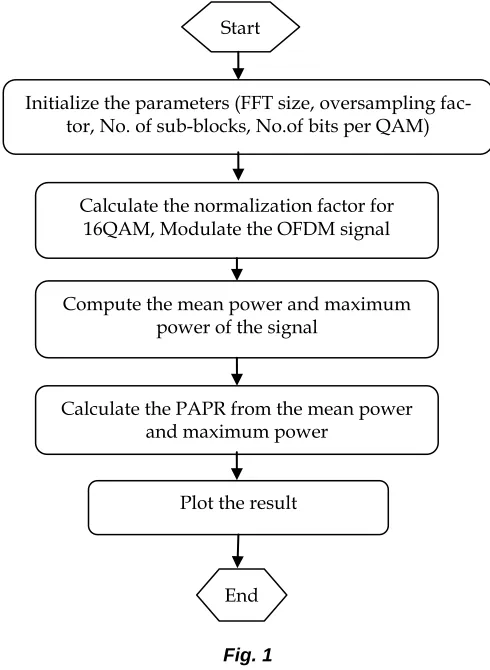
Flow chart of the PTS technique used for PAPR reduction is
Fig. 1
Table 1 show the parameters of 16 QAM/OFDM signal which is used for PAPR reduction by using PTS technique. Here FFT size and number of sub blocks varies to achieve the required result. The oversampling factor and number of bits per QAM symbols is 4 and number of OFDM blocks for iteration is 3000.
TABLE1
S.No Parameter Value
1 FFT size 128, 64, 32
2 Oversampling factor 4
3 No. of bits per QAM symbols 4
4 No. of sub blocks 1,2,4,8
5 No. of OFDM blocks 3000
3.2 Reduction of PAPR using SC-FDMA
There are three different subcarrier mapping schemes of SC-FDMA, localized FDMA (LFDMA), distributed FDMA (DFDMA) and interleaved FDMA (IFDMA). In the localized subcarrier mapping mode, the modulation symbols are assigned to adja-cent subcarriers. In the distributed mode, the symbols are equally spaced across the entire channel bandwidth. IFDMA is a special case of SC-FMDA and it is very efficient in that the transmitter can modulate the signal strictly in the time domain
Start
Initialize the parameters (FFT size, oversampling fac-tor, No. of sub-blocks, No.of bits per QAM)
Calculate the normalization factor for 16QAM, Modulate the OFDM signal
Compute the mean power and maximum power of the signal
Calculate the PAPR from the mean power and maximum power
Plot the result
Fig. 2
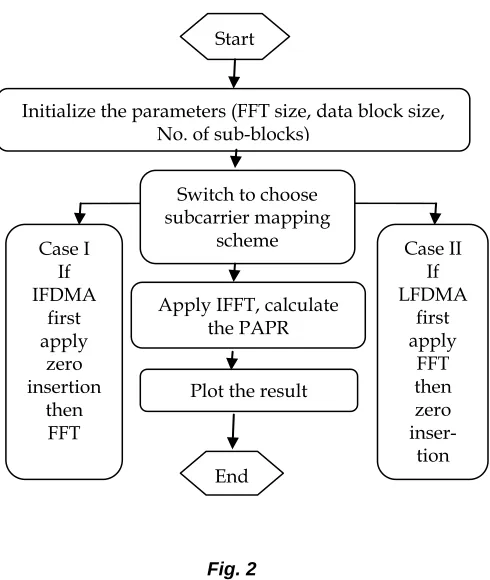
The paper describes the IFDMA and LFDMA mapping schemes to show the PAPR value when DFT spreading tech-nique is applied to IFDMA and LFDMA. In the DFT-spreading technique, M-point DFT is used for spreading, and the output of DFT is assigned to the subcarriers of IFFT. The effect of PAPR reduction depends on the way of assigning the subcar-riers to each terminal. The flow chart of subcarrier mapping schemes of SC-FDMA used for PAPR reduction is given in fig. 2. Table 2 gives the parameters for IFDMA and LFDMA sub-carrier mapping schemes of SC-FDMA. Here the FFT size is 128 and 64, number of data block size used are 32 and 16, number of iterations are 3000.
4 R
ESULT AND DISCUSSIONMatlab simulations are performed for 16QAM/OFDM system using PTS technique and IFDMA and LFDMA subcarrier map-ping schemes of SC-FDMA to evaluate the performance of PAPR are discussed below:
TABLE2
S.No Parameter Value
1 FFT size (N) 128,64
2 Data block size (M) 32,16
3 No. of OFDM
blocks for iteration 3000
The simulation results compare the PAPR performance of 16QAM/OFDM system with FFT size = 128, 64, 32. Figure 3(a) shows the CCDF of PAPR for a 16-QAM/OFDM system using PTS technique as the number of sub block varies. The simulation is done with FFT size = 128.
4
5
6
7
8
9
10
11
10
-310
-210
-110
0PAPR
0
[dB]
P
r
(
P
A
P
R
>
P
A
P
R
0
)
16-QAM CCDF of OFDM, 128-point 3000-blocks
original
No of subblocks= 1
No of subblocks= 2
No of subblocks= 4
No of subblocks=8
Fig. 3(a) PAPR performance of a 16-QAM/OFDM system for
FFT size = 128
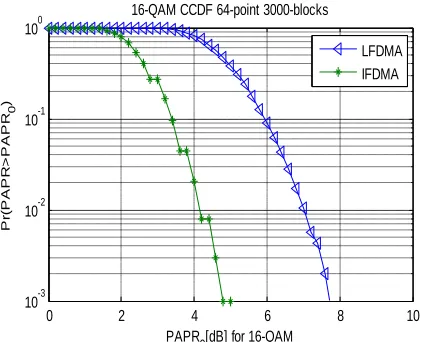
The table 3 shows the result of 16QAM/OFDM system using PTS technique. Here the result has been compared for differ-ent FFT size which shows that PAPR performance is improved at FFT size = 32. These next simulation results compare the PAPR performance when DFT- spreading technique is applied to the IFDMA and LFDMA. PAPR performance of the DFT-spreading technique varies depending on the subcarrier allo-cation method. Fig. 4(a) shows PAPR performance of IFDMA and LFDMA for 16QAM modulation technique when N = 128 and M = 32 and fig. 4(b) shows the PAPR performance of IFDMA and LFDMA for 16QAM with N = 64 and M = 16. The comparison of both the results reveals that PAPR performance is better for IFDMA than LFDMA.
Start
Initialize the parameters (FFT size, data block size, No. of sub-blocks)
Case I If IFDMA
first apply
zero insertion
then FFT
Case II If LFDMA
first apply
FFT then zero inser-tion Plot the result
End
Apply IFFT, calculate the PAPR Switch to choose subcarrier mapping
scheme
FFT size Subcarrier mapping
scheme PAPR in dB
128 IFDMA
LFDMA
4.7 8.2
64 IFDMA
LFDMA
TABLE4
0 2 4 6 8 10
10-3
10-2
10-1
100
PAPR0[dB] for 16-QAM
P
r
(
P
A
P
R
>
P
A
P
R
0
)
16-QAM CCDF 128-point 3000-blocks
LFDMA IFDMA
Fig. 4(a) PAPR performance of DFT-spreading technique for
IFDMA and LFDMA for FFT size = 128
0 2 4 6 8 10
10-3 10-2 10-1 100
PAPR0[dB] for 16-QAM
P
r(
P
A
P
R
>
P
A
P
R
0
)
16-QAM CCDF 64-point 3000-blocks
LFDMA IFDMA
Fig. 4(b) PAPR performance of DFT-spreading technique for
IFDMA and LFDMA for FFT size = 64
TABLE3
FFT size No. of sub blocks
PAPR in dB
128 8 7.9
64 8 7.1
32 8 6.7
Table 4 compares the performance of IFDMA and LFDMA for
FFT size 128 and 64. Comparison shows that IFDMA performs better than LFDMA.
5
C
ONCLUSIONIn this paper PAPR problem of OFDM system has been dis-cussed. The various PAPR reduction techniques are intro-duced. The PTS and SC-FDMA techniques proposed in this paper gives the improved result of PAPR. The survey on vari-ous reduction techniques conclude that IFDMA performs better and lowers the PAPR value up to high extent. In this paper to reduce the PAPR the simulation results for 16QAM/OFDM system with PTS and subcarrier mapping schemes of SC-FDMA technique has been analyzed. First the result for PTS technique has been discussed. The result shows that as the number of sub blocks increases the PAPR value decreases and PAPR is lower for FFT size = 32 i.e 6.7 dB. Then, the sub-carrier mapping schemes of SC-FDMA has been discussed. The comparison between two is done. The result shows that IFDMA performs better than LFDMA as PAPR for IFDMA is 4.7 dB and 5.0dB which is quite lesser than LFDMA. Thus SC-FDMA is efficient technique for uplink transmission as it per-forms better than OFDM and reduces the complexity.
References
[1] Mohsin Khan, Samima Iqbal and Waseem Asghar ” A Review Paper on: The PAPR Analysis of Ortho-gonal Frequency Division Multiplexing (OFDM)”, In-ternational journal of Mobile Network Communica-tions & Telematics ( IJMNCT) Vol. 4, No.1, February 2014.
[2] Taewon Hwang, Chenyang Yang, Gang Wu Shao-qian Li, and Geoffrey Ye Li “OFDM and Its Wireless Applications: A Survey, IEEE Transactions on Vehi-cular Technology”, Vol. 58, 4, May 2009.
[3] D.T.Kushnure, S.D.Biradar, S.S.Muttagi “PAPR Performance of OFDM System Using Modified SLM Approach”, International Journal of Innovative Re-search in Electrical, Electronics, Instrumentation and Control Engineering Vol. 2, Issue 1, January 2014.
[4] Jyoti Patel, Amit Kumar Sharma, Shailendra Singh Tomar “A Comparative analysis of various schemes for PAPR reduction of OFDM Signals”, International Journal of Engineering Science and Innovative Technology (IJESIT) Volume 3, Issue 2, March 2014.
[5] Madhusmita Mishra, Sarat Kumar Patra and Ashok Kumar Turuk “Analysis of Peak-to-Average Power Ratio Reduction Techniques for OFDM using a New-phase Sequence”, International Journal of Computer Application Volume 35– No.6, December 2011.
[6] Govind Patidar, Madhvi Jangalwa (September 2014) “Improvement of PAPR and BER in OFDM Using Combination of SLM and Clipping Tech-niques”, International Journal of Research in Com-puter and Communication Technology, Vol 3, Issue 9, September – 2014.
“Per-Reduction”, Signal & Image Processing: An Interna-tional Journal (SIPIJ) Vol.3, No.2, April 2012.
[8] Ixia Worldwide Headquarters “SC-FDMA Single Carrier FDMA in LTE”, November 2009.
[9] Arun Gangwar, Manushree Bhardwaj, “An Over-view: Peak to Average Power Ratio in OFDM sys-tem & its Effect”, International Journal of Communi-cation and Computer Technologies Volume 01 – No.2, Issue: 02 September 2012.