ISSN (e): 2250-3021, ISSN (p): 2278-8719
Vol. 06, Issue 04 (April. 2016), ||V3|| PP 45-52
Analysis of Number of Yarn Breaks during Warping Process
Kushal N. Vashi
1, Mox C. Patel
2, Mayur C. Patel
31(Bachelor of Engineering, Mechanical Engineer [8th semester], Universal College of Engineering and Technology)
2(Bachelor of Engineering, Mechanical Engineer [8th semester], Universal College of Engineering and
Technology)
3(Faculty of Mechanical Engineer, Assistant Professor, Universal College of Engineering and Technology)
Abstract: -The present study was conducted to determine the number of yarn breaks in the Warping Process on Warping Machine. Warping is the process which involves preparing the weaver’s beam for the weaving process with a predetermined number of spools or creel to the warp’s beam. The research encloses the basic problem of the number of breakage rate of cotton yarns during the warping process during the production process which results in increment of waste and poor quality of product. The approach to control this and to get the best optimum solution is based on the proper experimental design and analysis of the process parameters for effective machining.
Keywords: - ANOVA, Beam Drum Pressure Direct Warping Machine, No. of yarn cuts, Taguchi, Warping Speed, Warp Length
I.
INTRODUCTION
India has been visible for the textile goods from the ancient times across the world. The tradition coming from the traditional textile industry of India was feckly decline during the colonial regimen. However, the first textile mill in the country was established at fort gloster near Calcutta in 1818, through which the modern textile industry took birth in India. In 1850s, the cotton textile industry, however, made its real beginning in Bombay. In 1854, the first cotton textile mill of Bombay was established by the Parsi cotton merchant then it engaged in overseas and import/export trade. Also, the whooping majority of the early mills were the handwork of Parsi Merchants engaged in yarn and cloth trade at home and Chinese and also in African markets.
In warping process, the blending ratio of polyester in cotton: polyester blended yarns have a significant effect on yarn breaks and the breaks associated with carded yarns were more than accompanied the combed ones. The number of yarn breaks varies directly with single and plied yarn counts. Whereas the twist multipliers inversely affect the number of yarn breaks. For warp yarns of count 40 Ne, Yarns spun from Giza 70 exhibited higher breaks number, while for yarns of count 40 Ne, Giza 83 showed higher yarn breaks. Whereas the singeing process enhanced warp yarn breaks on warping machine by approximately 25% [1].The fiber content and construction of terry towel and every step of the production provide terry towel with different aspects which increases the performance [2].Conventional sizing is not appropriate for the preparation of wool yarns for weaving because of sensitivity of wool fibers to high temperatures. Due to this, wool warp is prepared mostly through the waxing procedure like Cold Sizing, which aims to improve the effect of conventional sized warp without the use of high temperatures. Thus, it has proved as a good solution for greater sensitivity to dynamic stresses during the weaving process and also to increase the efficiency of the process [3].Finite element analysis of the metallic loom is carried out to determine the critical stresses and deflection in its components so that optimum sizes and shapes of the structural members can be selected [4]. The tension of warp yarns is much highly interrupted in the weaving process due to its high and too low tension. The position of the warp stop motion must be set for every produced new article manually, so to overcome this PLC recognized warp stop motion is used for controlling the warp in starting using the stepper motors. The time needed for the functioning decreases from 188 s to 20 s automatically [5]. The yarn speed should be kept as constant as possible during warping. Thus, there were significant differences among the levels of count and applied tension at (0.01) probability levels or both tensile strength and elongation, while the interaction effects between count at one side and each of applied tension and warping speed at the other side were significant at (0.01) probability levels for two aimed characters [6]. In Sectional Warping Machine, the tension variation in weaver’s beam along and
Universal Warping Machines by Jakob Muller [9] noted that the new machines discovered highly acquaint more demands by highly elastic yarns and also for the light elastic and non – elastic threads through constant yarn tension achieved from core to the warp beam. K. L. Gandhi (2012) termed Warping as the second stage involved in the production of the goods after winding. The process deals with transferring the amount of single – end packages of cotton yarn from creel to be wound onto the beam in a parallel direction. Further, different process after the warping process, types of warping process with different materials which require sizing process or doesn’t require sizing, followed by the types of creel fixed in the different position in the machine for working purpose [10]. The end breakage rate is one of most critical spinning parameter that not only affects the maximum spindle speed but may also indicate the quality of yarns, the mechanical condition of the machine and the quality of raw materials [11]. The average tension in the warp yarn recorded during the working of the loom was about 35cN and the peak tension was between 60 to 70 cN. Tension recorded on the sides was higher than the ones at the middle of the beam [12]. Hari and Behera [13] noted about the developments in weaving machines through the entire phase posting from the recent year to past 20 decades emerging from its microprocessor, versatility, etc. depending upon the recent fashion trends. Life Cycle Assessments provide useful information among the quantities of energy and resources consumed and emissions associated with the production systems. The amount of work deals with the cotton fibre production which consumes about 40% less energy than polyester fibre production and the favorable conditions for the cultivation of cotton [14]. Yarn quality generally increases by sizing. A change in breaking force, elongation at break and abrasion resistance by sizing does not depend only on the sizing conditions, but also on the yarn properties before sizing. In addition to the breaking force, which is very important in the weaving process majorly emphasize that elongation at break, abrasion resistance, etc. depends largely on the fibre and yarn properties, and on the condition of processing the yarn for weaving [15].
The difference between MEMS sensor vertical accelerations before and after warp breaks is not significant. The difference between the horizontal accelerations before and after warp breaks is in significant range for any weave. So the MEMS accelerometer sensors in Jacquard weaving is a viable technique for detecting the warp breaks [16].Recent developments made in rapier weaving machine studied by Subhankar, Kunal and Mrinal [17] and they defined different pathways to recognize different flexibilities in the machinery for the work starring from various reed widths to the drive mechanisms with full programmable formation of work. Adjustment of the warp tension and loom speed can help to determine the optimum values of the warp tension and loom speed to be used in order to reduce the number of warp breaks for individual Air Jet Looms
[18]. The mounting of the pressure barriers on a flexible strip considerably reduces the loss of friction in their guiding system which improves the operating accuracy of the tensioner, similarly the amount of reduction of mass of accelerated elements effectively reduces the magnitude of yarn tension [19]. The investigation classifies with the different types of cottons categorized and its different levels of each parameter set to the warp yarn tension. In particular, pattern type and stitch length have a great impact on the yarn tension maximum and through their curves which shows the higher reproducibility with associated increase in process reliability and rise in product quality [20].
Majorly the differences occur due to different rates of let – off and warp tensions which are difficult to be involved in the process for cloth formation. Also a great suspect can be gained by a cross – fertilization of design ideas between weavers and knitters, particularly at a same time [21]. Total hand value is increased when the filament percentage in the core material is increased. The fabrics obtained from air – jet spinning has more stiffness than that of the fabrics obtained from ring spinning system [22]. The production of cotton materials also increases the waste with high amount of effluent problems including different functions like desizing, mercerizing, bleaching, dyeing, finishing, and printing to control the agents with different effluent treatment methods [23].
Rony and Alam [24] prepared the precious work on the Warping creel positions and different problems which reduces the production process and different remedies to reduce it. Optimal performance of textile materials can only be achieved if all parameters of yarn design and production have been chosen formally in accordance with the required amount determined by the application of the product [25].The preliminary condition for weaving trial indicates that a weaving a single cotton yarn without the traditional warp sizing may indeed be feasible at least for certain types of yarns, fabrics, and weaving machinery which reduces the cost of caustic and size agents with less wastage [26].The abrading machine produces that the sized yarns have greater strength, less elongation, lower permanent set, and uniform in physical properties and possess better weaving qualities than unsized yarns [27]. The replacement of the sizing process in terms of its update and installation doesn’t bring any complex procedures or more financial expenditure for using the pre-sizing process. It reduces the costs (size, water and energy costs) – with no negative impact on the properties of the sizing agents and regarding its quality of sized yarns [28]. Applications of micro machines in fabric formation studied by Jin, Tim and Vivek [29] noted that the knowledge regarding the warp break distribution is needed to locate the warp break along and across the weaving machines that dictates the design of devices and the number of solutions to automate repair of the broken ends. Advances in Warp Preparation Machinery was studied by William Whipple [30] and he studied that warping systems insures the much awaited highest quality section beams to get the proper sized yarn quality.
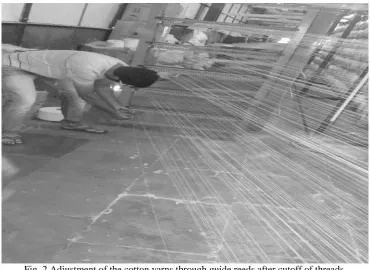
Fig. 2 Adjustment of the cotton yarns through guide reeds after cutoff of threads
II.
MATERIAL
Table 1 Characteristics of cotton types used in the study. [1]
Properties Giza 83
Fiber length 29.7
Uniformity % 47.8
Fiber strength 27.6
Fiber elongation 7.1
Micronair value 4.4
Maturity % 85
Fitness, mtex 168
Count (Ne) 40
Warping Process
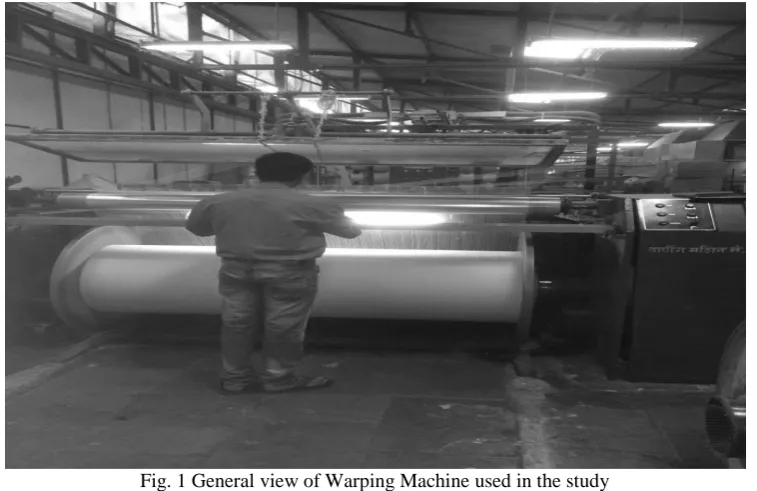
In general terms, Warping can be defined as the parallel winding of warp ends from many winding packages on to a common package called warp beams is known as Warping [24]. The objects of the warping is to convert the amount of predetermined number of single end packages, such as cones or spools into a thin sheet of yarn of specified length and width. The individual ends in the warp are uniformly spaced across its full width. The warp yarns compromise one of the systems of yarns required to produce a woven fabric and also for warp knitting. The basic forming of warp is considered by many is not at all removal of yarn faults, the breaks due to some accidental actions [24].
The performance standard of warping process majorly depends upon the end breakage rate during the process. To get a real estimate of the total end breakage rate, the average number of counts during the working of machine is noted automatically. The basic review can be considered using the observation based on the number of warp ends about 1,00,000 m * 400 ends for super speed warping machine and 60,000 m * 400 ends for high speed warping process recorded within a monthly period of time [1].
Fig. 3 running of the machine for the effective production
Table 2Characteristics of warping machine used in the study
Machine name Jupiter – Direct Warping M/c
Operating speed 300 – 1200 m/Min. Crawl speed 100 m/Min. Tensioner A, B, C Beam pressure 300 kg/cm2 Beam diameter 315 mm Warping length 1 – 999999 m Total number of ends 100 – 800 Beam Length 71.5 cm
Yarn types Natural – Synthetic – Blended
Statistical Analysis
Throughout this study, all data results were assessed statistically at significance level 0.01 for the effects of variable parameters on the number of yarn breaks during warping process. In the current study, the process parametric analysis has been carried out for the Number of Cut Yarns on Giza 83 cotton material. Experiments are carried out using Taguchi Design by varying Warping Speed, Beam Drum Pressure and Warp Length for the Minimum number of Cut Yarns on Giza 83 cotton material. Minitab 16 ® software was used for analyzing the experimental data. Analysis of Variance (ANOVA) was used to detect the significant effects of these variables.
III.
RESULTS AND DISCUSSION
Effect of Warping Speed on the Number of Cut Yarns
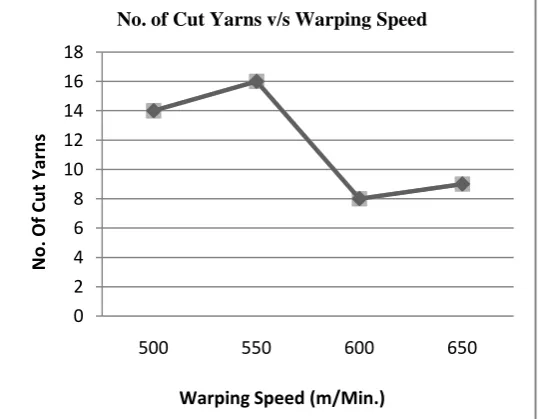
The Number of Cut Yarns increases with the gradual increase with the Warping Speed and this is also observed in the graph as shown in fig. 2, but at some moment the graph also shows the breakage rate of yarn decreases with increment in the speed at single point and then again the breakage rate increases with respect to the speed. The experimental results show that the amount of breakage rate decreases at the point where the maximum amount of characteristics of the material is satisfied. The amount of tension on the yarns decreases during winding of the drum due to less fixed drum pressure during the warping process, due to this the quality increases with the production rate. So from the theoretical results which allow the optimum response of Warping Speed for increasing the production rate through the Warping process which is explained previous chapters. The amount of breakage rate of Yarns of cotton increases due to the amount of properties that the material possesses. Additionally, the increase in Warping Speed will increase the production rate at the optimum value of speed which often decreases the Number of Cut Yarns during the Warping process.
Fig. 4 Effect of Warping Speed on the Number of Cut Yarns of cotton type Giza 83
0 2 4 6 8 10 12 14 16 18
500 550 600 650
N
o
. Of
C
u
t
Yar
n
s
Effect of Beam Drum Pressure on the Number of Cut Yarns
The Number of Cut Yarns increases with the increase in the beam drum pressure and this is also observed in the graph plotted as shown in the Fig. 3. This is because the Beam Drum Pressure has a large effect on the required properties of the cotton like fiber elongation, fiber strength, fiber length, fineness, No. of yarn counts, etc. An increase in the Number of Cut Yarns decreases the production rate and also lengthens the warping process. The amount of increase in the beam drum pressure associated with the elongation of the cotton yarn during the winding process of cotton yarns on the beam bracket. The number of cut yarns increases when the yarns are impinged from the guide reed. When the amount of tension increases on the cotton yarns the breakage rate increases because of the increase in the beam drum pressure. Thus, lower the beam drum pressure, lower will be the breakage rate of cotton yarns which increase the production rate and also will increase the warping process for the next stage.
Fig. 5 Effect of the Beam Drum Pressure on the Number of Cut Yarns of cotton type Giza 83
Effect of Warp Length on the Number of Cut Yarns
From Fig. 4, the Number of Cut Yarns increases with increase in the Warp Length, this is also plotted in the graph. Warp Length is the most important considered parameter for getting the optimum response for minimum number of cut yarns. Reducing the warp breaks on warping machine will uplift the efficiency of the warping process and also enhances the efficiency for the next stage process with the minimum number of warp breaks at higher warp length. As the warp length contains the fixed length ranging from 0-999999 m, though the increase in warp length will increase the production rate of cotton materials. So, for getting the minimum numbers of warp breaks, the optimum response for the Warping Speed and its characteristics Beam Drum Pressure have to be considered to increase the warping process.
Fig. 6 Effect of Warp Length on the Number of Cut Yarns on cotton type Giza 83
0 5 10 15 20 25 30
250 300 350 400
N
o
. Of
C
u
t
Yar
n
s
Beam Drum Pressure (kg/cm2) No. Of Cut Yarns v/s Beam Drum Pressure
0 2 4 6 8 10 12 14 16
2000 4000 6000 8000
N
o
. Of
C
u
t
Yar
n
s
IV.
CONCLUSION
Reducing the warp breaks on warping machines uplift the efficiency of this process and the efficiency of weaving machines, and finally enhances the quality of yarns and produced fabrics. In this study, the effect of warping speed, beam drum pressure and the warp length is majorly considered variable parameter for getting the optimum solution for the minimum number of warp breaks. The following conclusions can be drawn:
The number of cut yarns increase with the increase in the warping speed, but at some optimum response the number of warp breaks decreases which coincides the characteristics of the cotton material and reduces the yarn breakage at that optimum speed. It means that the Warping process should be allowed to work on that optimum speed to increase the production rate of the process.
Experimental results also show that the Warping Speed has the less significant effect on the Number of Cut Yarns as compared to other parameters.
Experimental study has resulted that the number of cut yarns increases with the increase in the Beam Drum Pressure. It means that low Beam Drum Pressure is most effective to achieve minimum Number of Cut Yarns. It shows that the Beam Drum Pressure has the more significant effect on the number of cut yarns as compared to other parameters.
It is predictable that with large number of warp length which means more number of warp ends on the beam bracket with increase in the number of cut yarns. It means that the number of warp breaks should be less at greater number of warp length.
This study also accounts that the minimum number of warp breaks will increase the production rate and will increase the production rate and will enhance the efficiency of the Warping Process and also will enhance the efficiency for next stage process.
The statistical analysis proved that the most significant parameter among all the three variable parameter is in order as Beam Drum Pressure ≥ Warping Speed ≥ Warp Length. Whereas the speed and warp length are considered as least effective parameter.
It was shown that intensive literature surveyed on the Warping Machine and material used in the study Giza 83, but lesser amount of Work is done on different cotton materials like Giza 70, Giza 89, etc.
Also the future scope can be carried out on different tensioners and guide reed can be allowed for processing on the machine to increase the speed of work and also increase the efficiency of the process with minimum number of warp breaks.
Similarly the future research can also be done on the life of different cotton material used for the production of shirts, denims, etc.
Also research can be done on the cold sizing agents before warping process to increase the property of the cotton material and also to increase its fineness, strength, elongation, etc.
V.
ACKNOWLEDGMENT
We would like to express our sincere thanks to Kumar Cotton Mills Pvt. Ltd. to carry out the experiment and also to implement it. We will also like to thank Mr. Pankaj Panchal for the cooperation and providing technical support.
REFERENCES
[1]. Alsaid Ahmed Almetwally, M. M. Mourad and Abeer Ebraheem Eldsoky Mohammed; “A Study of Yarn Breaks on Warping Machines”;Life Science Journal 2013;10(1).
[2]. Dr.S.Bankebihari, Gurbaksh;”An Observed Study of Factors Affecting Productivity in Textile
Industries”; SSRG International Journal of Industrial Engineering (SSRG-IJIE) – volume 2 Issue 3–May to June 2015.
[3]. Snjezana Branda, Stana Kovacevic and Borivoj Sabljak; “Prevention of Faults on Wool Fabrics by Application of Cold Sizing”; Textiles and Light Industrial Science and Technology (TLIST) Volume 2 Issue 4, October 2013.
[4]. Himanshu Chaudhary and S.K. Saha;” Finite Element Modeling of Carpet Weaving Loom Structure”;
Feb.24-25, 2005, pp. 197-203.
[5]. Frederik Cloppenburg, Yves-Simon Gloy and Thomas Gries;”Realization of an Automated Vertical Warp Stop Motion Positioning”;Actuators 2015, 4, 2-16; doi:10.3390/act4010002.
[6]. Dorgham ME; “Warping Parameters Influence on Warp Yarns Properties”; Dorgham, J Textile Sci Eng 2013, 3:2.
[7]. Eask Fernando and R. U. Kuruppu; “Tension Variation in Sectional Warping, Part I: Mathematical
[8]. Gerd Franzke, Jan Hausding and Chokri Cherif;” Improved Warp Knitting Machine for Symmetric Multi-Plies”; 16th International Conference on Composite Materials.
[9]. Jakob Muller Frick;” Universal Warping Machine”; 2011.
[10]. K. L. Gandhi; “Yarn preparation for weaving: warping”; Woodhead Publishing Limited, 2012.
[11]. Anindya Ghosh, Sayied Ishtiaque, Seenivasan Rengasamy and Asis Patnaik;” The Mechanism of End Breakage in Ring Spinning: A Statistical model to predict the end breakage in Ring Spinning”; Autex Research Journal, Volume 4, No1, March 2004.
[12]. Bhuvnesh C. Goswami, Rajesh D. Anandjiwala, Tony Shah and S. Yellambalse; “Material and Machine
Interaction during Weaving”; National Textile Center Annual Report, September 30, 1993.
[13]. P K Hari and B K Behra; “Developments in Weaving Machines”; Indian Journal of Fibre and Textile Research, Vol. 19, September, 1994.
[14]. Eija M.Kalliala, and Pertti Nousiainen; Life Cycle Assessment “Environmental profile of cotton and polyester cotton fabrics”; Autex Research Journal Vol 1, No.1, 1999.
[15]. Stana Kovacevic and Zeljko Penava;”Impact of Sizing on Physico-mechanical Properties of Yarn “;Fibres& Textiles in Eastern Europe October / December 2004, Vol. 12, No. 4.
[16]. Jin H Lee, Abdelfattah Mohamed Seyam, George Hodge, William Oxenham and Edward Grant;” Warp
Breaks Detection in Jacquard Weaving Using MEMS: Effect of Weave on Break Signals”; Journal of Engineered Fibers and Fabrics Volume 3, Issue 1 – 2008.
[17]. Subhankar Maity, Kunal Singha and Mrinal Singha; “Recent Developments in Rapier Weaving Machine in Textile”; American Journal of Systems Science, 2012.
[18]. Nkiwane and Londiwe;” Loom Speed and Tension to Reduce Warp and Weft Breaks in Air Jet
Weaving”; pp. 1-8, 2012.
[19]. Władysław Podsiedlik and Jan Wojtysiak; “multi-barrier electromagnetic tensioner for control of yarn
tension in processing”;Fibres& Textiles in Eastern Europe January / December 2006, Vol. 14, No. 5 (59).
[20]. Vivienne Pohlen, Andreas Schnabel, Florian Neumann, Thomas Gries; “Optimization of the Warp Yarn
Tension on Warp Knitting Machine”; Autex Research Journal, Vol. 12, No2, June 2012.
[21]. I Porat, K Greenwood, R Eron and AK Roy;” development of hybrid type warp let-off systems for
weaving and warp knitting”; International journal of textile research, volume 19, 1994.
[22]. P Pramanik and Vilas M Patil;”Low stress behavior of fabrics obtained from different types of cotton, nylon and core yarn”; Indian journal of fiber and research; volume 34, 2009, pp. 155-161.
[23]. B. Ramesh Babu, A.K. Parande, S. Raghu, and T. Prem Kumar;”Textile Technology: Cotton Textile
Processing: Waste Generation and Effluent Treatment”; the Journal of Cotton Science 11:141–153, 2007.
[24]. Abdullah Nur Uddin Rony and Khurshedul Alam; “Warping – Fibre Manufacturing – IBTEC, 2nd Batch, 2005-2006.
[25]. Salopek C., I. &Skendri, Z. “Design of yarn properties for improved fabric Performance”; Daaam International Scientific Book 2014 pp. 051-062.
[26]. A P S Sawhney, J B Price and T A Calamari; “A successful Weaving trial with a size – free cotton warp”;
Indian Journal of Fibre and Textile Research, Vol. 29, June 2004.
[27]. Walter T. Schreiber. Martin N. V. Geib. and Omar C. Moore;” Effect of sizing, weaving, and abrasion on
the physical properties of cotton yarn”; Part of Journal of Research of the National Bureau of Standards, Volume 18,May 1937.
[28]. Ivana Gudlin Schwarz and Stana Kovacevic;”a new pre-wet sizing process”; ISBN 978-953-51-0463-6, 2012.
[29]. Abdelfattah M. Seyam, George Hodge, William Oxenham and Eddie Grant; “Applications of
Mircomachines in Fabric Formation”; National Textile Center Annual Report; November 2002.
![Table 1 Characteristics of cotton types used in the study. [1] Properties Giza 83](https://thumb-us.123doks.com/thumbv2/123dok_us/7822617.1665307/4.595.174.423.369.634/table-characteristics-cotton-types-used-study-properties-giza.webp)