A CLONALG-based
A
pproa
ch for the S
et
C
overing
P
roblem
Masruba Tasnim
a,b, Shahriar Rouf
a,c, M. Sohel Rahman
a,d aAEDA GroupDepartment of CSE, BUET, Dhaka - 1000, Bangladesh.
bEmail: [email protected] cEmail: [email protected]dEmail: [email protected]
Abstract— In this paper, we propose a CLONALG-based
simple heuristic, which is one of the most popular artifi-cial immune system (AIS) models, for the non-unicost set covering problem (SCP). In addition, we have modified our heuristic to solve the unicost SCP. It is well known that SCP is an NP-hard problem that can model several real world situations such as crew scheduling in airlines, facility location problem, production planning in industry etc. In real cases, the problem instances can reach huge sizes, making the use of exact algorithms impractical. So, for finding practically efficient approaches for solving SCP, different kind of heuristic approaches have been applied in the literature. To the best of our knowledge, our work here is the first attempt to solve SCP using Artificial Immune System. We have evaluated the performance of our algorithm on a number of benchmark non-unicost instances. Computational results have shown that it is capable of producing high-quality solutions for non-unicost SCP. We have also performed some experiments on unicost instances that suggest that our heuristic also performs well on unicost SCP.
I. INTRODUCTION
The Set Covering problem (SCP) is a well known combinatorial optimization problem. Given a set of el-ements (called the universe) and sets whose union com-prises the universe, the set cover problem is to identify the smallest number of sets whose union still contains all elements in the universe. For example, assume we are given the following elements U = {u1, u2, . . . , um}, subsets S1, S2, . . . , Sn⊆U and costsc1, c2, . . . , cn. The goal is to find a set I ⊆ {1,2, . . . , n} that minimizes
i∈Ici, such that i∈ISi = U.
SCP is the problem of covering the rows of anm-row, n-column, zero-one matrix (aij) by a subset of columns of minimum global cost. So, we can formulate the problem through a binary linear programming model.
Definingxj = 1 if columnj(with costcj≥0) belongs to the solution and xj = 0 otherwise, the SCP is to
Minimize
n
j=1
cjxj (1)
Subject to
∀i∈ {1,2, . . . m}, n
j=1
aijxj≥1 (2)
∀j∈ {1,2, . . . n}, xj∈ {0,1} (3)
Equation 2 ensures that each row is covered by at least one column and Equation 3 is the integrality constraint. If the costscj are equal, the problem is referred to as the unicost SCP, otherwise, the problem is called the weighted or non-unicost SCP.
The problem of set covering has been considered in the literature as a basic formulation for many real-world optimization problems. Therefore, it is well-known for its numerous applications such as scheduling, manufacturing, service planning, information retrieval, etc. One important application of the problem is the delivery and routing problem. Another famous problem is the airline crew scheduling problem [7]. Balas [2] provided a survey on the applications of SCP in location, distribution and scheduling.
SCP is known to be NP-hard [22] and many algorithms have been developed for solving the problem. Exact algo-rithms are mostly based on and-bound and branch-and-cut techniques [3], [21]. However, exact algorithms are feasible for instances of very limited size. For this reason, many research efforts have been focused on the development of heuristics to find good or near-optimal solutions within a reasonable period of time. Greedy algorithms may be the most natural heuristic approach for quickly solving large combinatorial problems. As for the SCP, the simplest such approach is the greedy algorithm of Chvatal [11]. Although simple, fast and easy to code, greedy algorithms could rarely generate solutions of good quality as a result of their myopic and deterministic nature.
algorithms [27], tabu search methods [9], neural network algorithms [33], ant colony optimization (ACO) based [13], [23], [32], [34] approaches etc. Rather than applying a general meta-heuristic, some other heuristics, such as those based on Lagrangian relaxation are developed based on the problem-specific information of the SCP [4], [7], [10]. For a deeper comprehension of most of the effective algorithms for the SCP in the literature, the interested readers are referred to the survey by Caprara et. el [8].
In this paper, we would like to enrich the repertoire of heuristic solutions for SCP by presenting a new meta-heuristic based algorithm. In particular, we present an algorithm based on Artificial Immune System (AIS) [15] [26].
Artificial immune systems (AIS) are a special class of biologically inspired algorithms, which are based on the immune system of vertebrates and derived from vari-ous immunological theories, namely, the clonal selection principle, negative selection, immune networks etc [14]. These algorithms typically exploit the immune system’s characteristics of learning and memory to solve a prob-lem. AIS has been successfully applied to solve several NP-hard combinatorial optimization problems such as job shop scheduling [12], weapon-target assignment problem [31], flow shop scheduling [20] etc. It has also been applied to domains like data analysis [18], soft computing [16], network security [25], [28] etc. Wang et. al [35] provided a survey of AIS based optimization methods and applications.
In this paper, to solve SCP, we have adopted a varia-tion of the Clonal Selecvaria-tion Algorithm, originally called CSA in [17], and later renamed to CLONALG in [19]. CLONALG, inspired by the clonal selection theory of acquired immunity, has shown success on broad range of engineering problem domains. The clonal selection principle describes the basic features of an immune response to an antigenic stimulus. To the best of our knowledge, this work is the first attempt to solve SCP using AIS. The goal of this work is to design a simple heuristic that generates good results for non-unicost set covering problems. Furthermore, we have modified our heuristic to solve the unicost version of the SCP. To verify the efficiency of the proposed algorithms, extensive computational experiments are conducted on benchmark instances from Beasley’s OR Library [5].
The remainder of this paper is organized as follows. In Section II, we present a brief description of CLONALG. In Section III, we present our main contribution, where we describe the proposed algorithms in detail. The com-putational results, along with an insightful discussion, are presented in Section IV. Finally, conclusions are drawn with some future research directions in Section V.
II. CLONALG
CLONALG is a well known model based on the clonal selection and affinity maturation principle which is similar to mutation-based evolutionary algorithms. Survival of the fittest concept of evolutionary algorithm also applies here.
It is inspired by the following elements of the clonal selection theory:
• Maintenance of a specific memory set
• Selection and cloning of most stimulated antibodies
• Death of non-stimulated antibodies
• Affinity maturation (mutation)
• Re-selection of clones proportional to affinity with antigen
• Generation and maintenance of diversity
The goal of the algorithm is to develop a memory pool of antibodies that represents a solution to an engineering problem. In this case, an antibody represents an element of a solution or a single solution to the problem and an antigen represents an element or evaluation of the problem space.
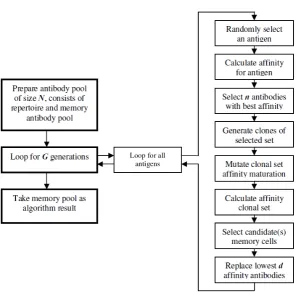
The algorithm provides two mechanisms for searching for the desired final pool of memory antibodies. The first is a local search provided via affinity maturation of cloned antibodies. More clones are produced for better matched (selected) antibodies. The second search mech-anism provides a global scope and involves the insertion of randomly generated antibodies to be inserted into the population to further increase the diversity and provides a means for potentially escaping local optima. Fig. 1 provides a complementing diagrammatic representation of the tasks and workflow of the CLONALG technique.
III. PROPOSEDALGORITHM
This section presents the details of the strategies used in our proposed algorithm. It can be broken down into three parts : Initial population generation, cloning principle and mutation strategy. As a basis, we first introduce the representation scheme and the affinity function.
A. Representation and Affinity Function
The first step in designing a heuristic algorithm for a particular problem is to devise a suitable representation scheme. The usual 0-1 binary representation is an obvious choice for the SCP since it represents the underlying 0-1 integer variables. We use ann-bit binary string as the antibody structure wheren is the number of columns in the SCP. A value of 1 for thei-th bit implies that column i is in the solution. Similarly, we use an m-bit binary string as the antigen structure where m is the number of elements to be covered. A value of 1 for the i-th bit implies that objecti must be covered.
The bit string lengths of the antibody and the antigen are equal to the number of subsets (n) and the number of elements to be covered (m) respectively. In our proposed algorithm, each antibody in the antibody pool is a feasible solution to the problem. The feasible solution construction method will be described shortly.
Figure 1: Overview of the CLONALG algorithm
For the unicost SCP, the affinity is measured by the number of subsets included in the antibody bit string. Suppose, Number of elements in two antibodies A1 and A2 are n1 andn2 respectively. Then, Affinity(A1) = n1 andAffinity(A2)= n2.
B. Overview of the Proposed Approach
In our algorithm AIS-SCP, we have proposed two kinds of heuristics for prioritizing both the elements inside a subset and the subsets themselves. After processing the given SCP instance, elements in every subset are sorted according to their usefulness. We determine the usefulness of an element by tracking how many subsets covered the specific element. According to our heuristic, an element which is covered by lesser number of subsets is more useful than an element covered by more subsets. Element usefulness helps to determine the global usefulness of a subset.
On the other hand, we have sorted the subsets according to the global usefulness of the subsets. We have deter-mined the relative global usefulness of two subsets S1 andS2 according to the following criteria:
1) Let, cost associated with S1 andS2 are c1 andc2 respectively.
a) If (c1 < c2), then subsetS1 has better global usefulness.
b) Else If (c1 > c2), then subset S2 has better global usefulness.
c) Else Check Criterion (2).
2) If the total number of elements covered by the subset S1 andS2 aree1 ande2 respectively, then
a) If (e1> e2), then subsetS1 has better global usefulness.
b) Else If (e1 < e2), then subset S2 has better global usefulness.
c) Else Check Criterion (3).
3) The subset, which covers more useful elements, has better global usefulness.
For unicost SCP, criterion (1) is not meaningful and hence is ignored.
We have created a single antigen for the SCP problem. The single antigen is composed of “11 . . . 1”, i.e.m con-secutive 1’s. Recall that,mis the length of the string is the number of objects to be covered. We have generated the initial antibody pool of a fixed size. Then, our algorithm proceeds by executing a number of iterations of exposing the system to all known antigens, in our case only one antigen.
Preprocessing is a popular method to speed up the algorithm. At the preprocessing step, we have applied column domination and column inclusion methods to reduce the run time of AIS-SCP.
• Column domination: Any columnj whose rows can be covered by other columns for a cost less thancj can be deleted from the problem. As expected, this reduction is ineffective for unicost problems. • Column inclusion: If a row is covered by only one
be included in the optimal solution.
We formally describe our algorithm in Algorithm 1. The first step of the CLONALG technique is initialization, which involves preparing an antibody pool of a fixed size. This pool is then partitioned into two components, a memory antibody section that eventually becomes rep-resentative of the algorithms solution and the remaining antibody pool used for introducing additional diversity into the system.
Algorithm 1AIS-based algorithm for solving SCP (AIS-SCP)
1: Preprocess the given SCP instance
2: Initialize parameters and generate Initial Population 3: foriterationCounter= 1 tonIterationdo 4: Select the Antigen
5: fori= 0 tomem−1 do 6: CalculateAffinity(M[i])
7: end for
8: Sort Memory Pool 9: fori= 0 torem−1 do 10: CalculateAffinity(R[i])
11: end for
12: Sort Remaining Pool 13: fori= 0 toNs−1 do 14: Select theith best antibody
15: Clone the selected antibody proportion to its affinity
16: end for
17: fori= 0 toNc−1do 18: Mutate each clone 19: end for
20: Sort Mutated clones
21: fori= 0 tomemRep−1do
22: Replace ith worst antibody in the M[ ] by the mutated antibody
23: end for
24: i= 0, j=rem−1 25: while i < remRep do
26: fork= 0 toRET RIAL COUNT do 27: Create Random AntibodyA
28: ifAffinity(A)< Affinity(R[j])then 29: ReplaceR[j]byA
30: break
31: end if 32: end for 33: i=i+ 1 34: j=j−1 35: end while 36: end for
37: return the best solution found
In Algorithm 1,memandremdenote the total number of antibodies in the memory pool and the remaining pool respectively. The variables M[ ] and R[ ] in Algorithm 1 denote the arrays which contain the antibodies of the memory pool and the remaining pool respectively. The function Affinity(A) returns the affinity of the antibody against the antigen. The variableNs is the size
of the antibody pool from which clones are created for all antibodies. The number of clones created for each antibody is calculated according to our cloning principle which will be described shortly. The variableNc denotes the total number of clones created for all antibodies per antigen exposure. The variable memRep denotes the total number of replacement of worst antibodies in the memory pool by the mutated antibodies based on affinity. Similarly,remRepis the total number of replacement of worst antibodies in the remaining pool by the randomly created antibodies. This step is done in order to introduce some randomness at each iteration.
In our algorithm, we have taken an approach to replace worst antibodies in the random pool by generating new random antibodies. For this purpose, we have used a constant RET RIAL COUNT. It is a predetermined value that denotes the maximum number of times random antibodies are created and compared with the existing antibody in the remaining pool. If the newly generated random antibodyA1’s affinity value is less than an exist-ing antibodyA in the remaining pool, A gets replaced. Having lower affinity (and thus lower cost),A1serves as a better option thanA. The variable,nIterationdetermines the total number of iterations the our AIS will run. We report the iteration count or generation number needed to first reach the best solution value or the best solution found withinnIteration.
C. Generation of Initial Population
We have generated the initial population in a mixture of probabilistic randomization and greedy addition and removal of subsets from the antibody bit strings. As mentioned earlier, each antibody in the antibody pool is a feasible solution to the problem. To construct a feasible solution, we use greedy addition and removal of subsets from the initial randomized antibody bit strings. For randomization purposes we have used an utility function probability(p,q) which returns true with a probability of p
q. We have initialized the antibody bit string by using two randomization function described below.
1) Randomization Function I: In the first randomiza-tion funcrandomiza-tion, p1 is computed by multiplying p with a probability multiplier factor using the following function:
p1= max
1,
p×exp
−ln 2× i
n
(4)
where,
i = ith bit of the antibody string n = Total length of the antibody string In Equation 4,exp −ln 2×ni
is the probability mul-tiplier. If the computed value ofp1 becomes less that 1, thenp1 is set to 1. Finally,ith bit of the antibody is set with probability p1
q .
p1 q , where
p1= max
1,
p×exp
−ln 2×n−i
n
(5)
In Equation 5, exp −ln 2×n−i n
is the probability multiplier. So,ith bit is set to 1 based on the probability of p1
q .
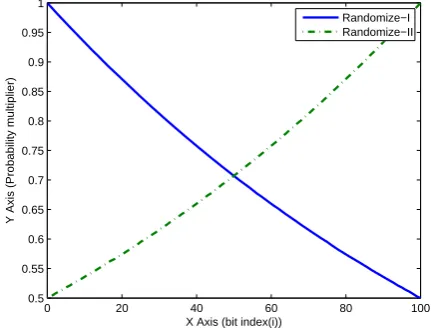
3) Usage of the Randomization Functions: We have passed different values of p, q to the two mentioned randomization functions in our algorithm to generate the initial population. Fig. 2 represents the relationship between the probability multiplier and the bit index (i) of the antibody string, for the two randomization functions. In the graph of Fig. 2, the total number of bits n in the antibody is set to 100. It is clear from the graph that for the case of randomization function I, it can be said that first bit gets set with pq probability while, it goes down exponentially to 2×pq. On the other hand, randomization function II is the opposite of randomized function I. Here, last bit gets set with probability pq while, it goes down exponentially to 2×pq at the first bit of the antibody bit string.
As mentioned earlier, initially we sort the subsets according to global usefulness. So, the first randomization function increases the probability of selecting lower cost subsets in the initial population. On the other hand, the second randomization function increases the probability of selecting higher cost subsets in the initial population. As a result, our initial population become diverse.
0 20 40 60 80 100 0.5
0.55 0.6 0.65 0.7 0.75 0.8 0.85 0.9 0.95 1
X Axis (bit index(i))
Y Axis (Probability multiplier)
Randomize−I Randomize−II
Figure 2: Plot of Probability Multiplier vs. bit index of the antibody bit string
4) Greedy Modifications: After initializing the whole antibody bit string, we apply greedy addition and remove operations to make the antibody bit string a feasible solution. The antibody must cover all the elements in the antigen to be a feasible solution. Hence, a function is called repeatedly to include a new subset greedily, until the antibody bit string becomes a feasible solution. In particular, a subset S constitutes a greedy choice if the inclusion of S would add the maximum number of new
elements in the antibody bit string. If two subsetsS1 and S2add the same number of new elements, then the subset which has the lesser cost is selected as the desired subset to be added in the antibody bit string. The greedy remove operation tries to remove any redundant subset. If all the elements covered by a subsetS, are also covered by any other subset or subsets in the antibody bit string, then the subsetS can be removed from the antibody bit string.
D. Cloning Principle
The number of clones created from each of the Ns selected antibodies is proportional to their affinity using a rank based measure. This is achieved by first sorting the set of selected antibodies in increasing order of their respective affinities to the antigen. Then, clones are created according to the rank. So, the antibody with the lowest affinity is cloned more. The number of clones created from each antibody is calculated as follows:
numClones[i] =
β×N
s i+ 1 + 0.5
, (6)
where, β is the clonal factor and Ns is the number of the selected antibodies, and i is the current rank of the antibody where i ∈ [0, Ns− 1]. The variable numClones[i]stores the number of clones created for the i-th ranked antibody. The total number of clones prepared for each antigen exposure to the system is thus calculated as:
Nc= Ns−1
i=0
numClones[i] (7)
E. Mutation Strategy
Mutation is very common in AIS algorithms and in most of the cases it is done in totally random fashion. It generally works by inverting each bit in the solution with some small probability. Mutation is generally seen as a background operator which provides a small amount of random noise. But this kind of blind mutation is not suitable for SCP. Because there are constraints, it is very unlikely that random alteration of objects would produce valid solutions. So, we have adopted a special method of mutation.
We have applied mutation to each cloned antibody. In our algorithm, the number of bits changed in the cloned antibody is based on a combination of the affinity factor, AF and the time factorTF. Total number of bits mutated in the antibody bit string calculated as follows.
B=s×AF×TF, (8) where,
s = Number of subsets included in the antibody string
The affinity factor,AF is calculated as follows.
AF = exp(−(AM F×minCost×(1 +af f−minCost)1 /8
)
where, AMF is the Affinity Multiplication Factor, a constant value. We set AMF to 0.1. The variable aff denotes the affinity of the cloned antibody selected for mutation. The minCost denotes the minimum cost of the best antibody solution found so far. For unicost SCP, minCost is the number of subsets of the best antibody solution found so far.
Fig. 3 plots the Equation 9, assumingminCost= 100. It is evident from the Fig. 3 that the greater the affinity (aff) is, the greater the value of affinity factor (AF). Higher value ofAF increases the number of bits mutated according to Equation. 8. Note that, as the AIS progresses, the affinity factor will also becomes stable at some point. This is bound to happen because the change inminCost gets lower as the AIS advances.
100 150 200 250 300 350 400 450 500 0.25
0.3 0.35 0.4 0.45 0.5 0.55 0.6
X Axis (Affinity)
Y Axis (Affinity Factor)
Figure 3: Affinity (aff) vs. Affinity Factor (AF) curve
Time factor,TF is calculated according to the following equation:
TF = 1−exp(−5t), (10) where,
t = i/T
i = Iteration Number T = Total No of Iterations
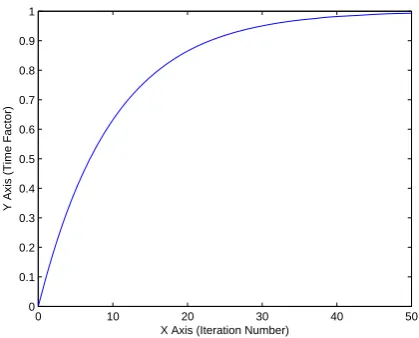
The relationship between the iteration number and time factor TF is illustrated in Fig. 4, for the value of T = 50. At the initial phase of mutation, we have searched for a better quality solution near the current antibody’s search space. If the min cost solution can be found by doing this, then we are done. After the initial phase of mutation, we have adopted an approach to increase versatility of our solution space by increasing the mutation rate exponentially.
In our algorithm, we have maintained a list. The list keeps the track of the subsets included in the antibody string. By randomly choosing a bit position in that list, the selected subset is removed from the cloned antibody bit string. Finally, to make an antibody bit string a feasible solution, we have applied the greedy addition and removal operations.
0 10 20 30 40 50 0
0.1 0.2 0.3 0.4 0.5 0.6 0.7 0.8 0.9 1
X Axis (Iteration Number)
Y Axis (Time Factor)
Figure 4: Iteration Number vs. Time Factor,TF curve
IV. EXPERIMENTALRESULTS
A. Experimental study on non-unicost SCPs
The effectiveness of the heuristic presented in this paper is tested on 55 non-unicost SCP test instances from Beasley’s OR-library [5]. Table I shows the details of these test problems, where density is the percentage of non-zero entries in the SCP matrix. Optimal solutions values for problem sets 4-6 and A-D are known. Problem sets E-F are large SCP’s for which optimal solutions values are not known.
TABLE I.: Test Problem Details Prob.
Set
Rows (m)
Columns (n)
Density
(%) No. of Ins.
4 200 1000 2 10
5 200 2000 2 10
6 200 1000 5 5
A 300 3000 2 5
B 300 3000 5 5
C 400 4000 2 5
D 400 4000 5 5
NRE 500 5000 10 5
NRF 500 5000 20 5
We have carried out the experiments on a PC with Intel Core i5 2.30 GHz processor and 6 GB memory under Windows 7. We have coded the algorithm presented in this paper in C++. Our algorithm AIS-SCP has solved each test instance 10 times. For solving each test instance by our algorithm, We have set a maximum number of 50 iterations per run. Other parameters of our proposed algorithm are set as follows:
Memory Antibody Pool Size = 1000
Remaining Antibody Pool Size = 1000
Number of Antibody Chosen = 250
Clonal Factor = 0.95
Memory Replacement Size = 100
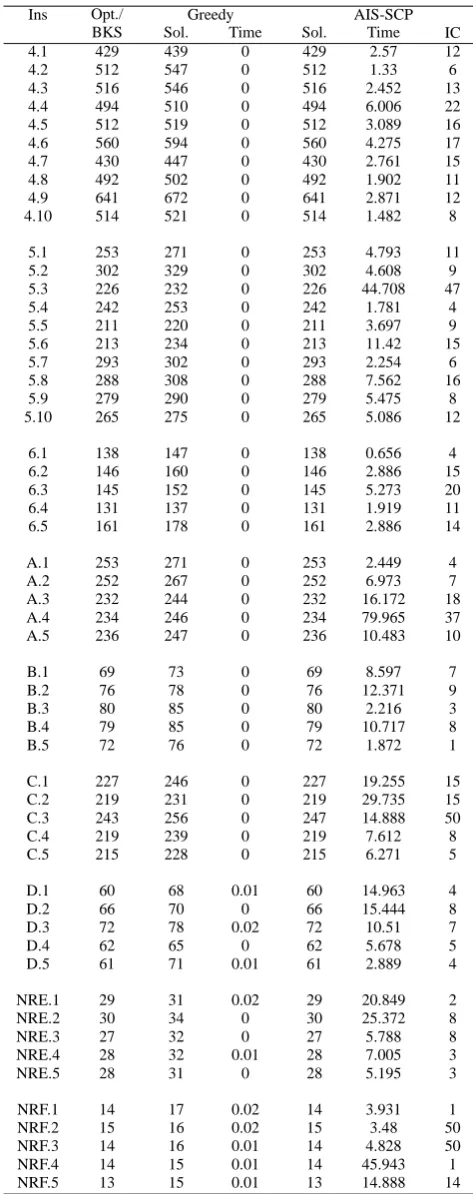
Table II reports the detailed results for AIS-SCP and the greedy heuristics (G) presented in [11]. In Table II we give, for each problem,
• the optimal solution value (Opt.) for problem set 4-6 and A-D or best known solution value (BKS) for problem sets E-F;
• for greedy heuristics, the solution value and the time needed to reach the solution. The solution time is measured in CPU seconds;
• for AIS-SCP, the best solution value found among the 10 trials, the solution time andIC, the iteration count or generation number needed to first reach the best solution value. The solution time is measured in CPU seconds and is the time that the AIS-SCP takes to first reach the final best solution.
By examining Table II, we observe that, AIS-SCP outperforms greedy heuristics [11] for all of these 55 test instances. It is also noted that iteration count and solution time needed to reach the best solution are rea-sonably small for all the problems. From Table II, we can say that AIS-SCP found all the optimal or best-known solutions for the 55 non-unicost instances except for one problem set C.3. At the time of testing the effectiveness of our algorithm, we have given emphasis on the fact of finding better quality solution in relatively small number of iterations. As mentioned earlier, we set the value of maximum number of iterations in each run to 50. Under this restriction, our algorithm has produced encouraging and high quality solutions.
In order to bring out the efficiency of the proposed AIS-SCP algorithm the solutions of the same set of test instances have been compared with the greedy heuristics (G) as well as the following existing SCP heuristics
Be : Lagrangian heuristic by [4]
BeCh : Genetic algorithm by [6]
PROG : Probabilistic greedy search by
heuristic [24]
Meta-RaPS : Effective and simple heuristic
approach by [30]
Table III is the summarized results for the solution quality that reports the average GAP for all these different heuristics mentioned earlier, where GAP is the percent-age of the deviation from the optima (Opt.) or best known solution (BKS), i.e.Gap= ((solution−BKS)/BKS)×
100. It is clear from that Table III, the average gap for our algorithm AIS-SCP is promising under the restriction of finding better quality solution in relatively smaller number of iterations.
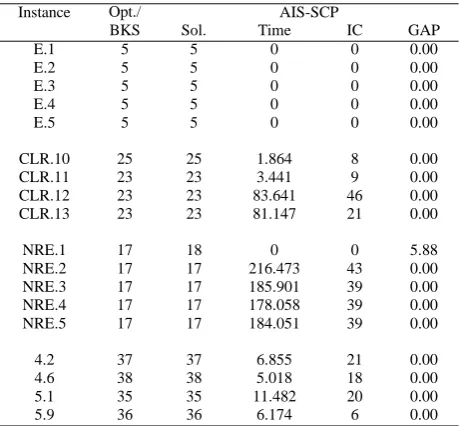
B. Experimental study on unicost SCPs
We also perform experiments on unicost SCP. The unicost test instances used are the set E and CLR from the OR-Library, as shown in Table IV. For the purpose of testing our algorithm, we have also used non-unicost test instances of set NRE, two test instances of set 4 (4.2,
TABLE II.: Detailed results for non-unicost instances
Ins Opt./ Greedy AIS-SCP
BKS Sol. Time Sol. Time IC
4.1 429 439 0 429 2.57 12
4.2 512 547 0 512 1.33 6
4.3 516 546 0 516 2.452 13
4.4 494 510 0 494 6.006 22
4.5 512 519 0 512 3.089 16
4.6 560 594 0 560 4.275 17
4.7 430 447 0 430 2.761 15
4.8 492 502 0 492 1.902 11
4.9 641 672 0 641 2.871 12
4.10 514 521 0 514 1.482 8
5.1 253 271 0 253 4.793 11
5.2 302 329 0 302 4.608 9
5.3 226 232 0 226 44.708 47
5.4 242 253 0 242 1.781 4
5.5 211 220 0 211 3.697 9
5.6 213 234 0 213 11.42 15
5.7 293 302 0 293 2.254 6
5.8 288 308 0 288 7.562 16
5.9 279 290 0 279 5.475 8
5.10 265 275 0 265 5.086 12
6.1 138 147 0 138 0.656 4
6.2 146 160 0 146 2.886 15
6.3 145 152 0 145 5.273 20
6.4 131 137 0 131 1.919 11
6.5 161 178 0 161 2.886 14
A.1 253 271 0 253 2.449 4
A.2 252 267 0 252 6.973 7
A.3 232 244 0 232 16.172 18
A.4 234 246 0 234 79.965 37
A.5 236 247 0 236 10.483 10
B.1 69 73 0 69 8.597 7
B.2 76 78 0 76 12.371 9
B.3 80 85 0 80 2.216 3
B.4 79 85 0 79 10.717 8
B.5 72 76 0 72 1.872 1
C.1 227 246 0 227 19.255 15
C.2 219 231 0 219 29.735 15
C.3 243 256 0 247 14.888 50
C.4 219 239 0 219 7.612 8
C.5 215 228 0 215 6.271 5
D.1 60 68 0.01 60 14.963 4
D.2 66 70 0 66 15.444 8
D.3 72 78 0.02 72 10.51 7
D.4 62 65 0 62 5.678 5
D.5 61 71 0.01 61 2.889 4
NRE.1 29 31 0.02 29 20.849 2
NRE.2 30 34 0 30 25.372 8
NRE.3 27 32 0 27 5.788 8
NRE.4 28 32 0.01 28 7.005 3
NRE.5 28 31 0 28 5.195 3
NRF.1 14 17 0.02 14 3.931 1
NRF.2 15 16 0.02 15 3.48 50
NRF.3 14 16 0.01 14 4.828 50
NRF.4 14 15 0.01 14 45.943 1
NRF.5 13 15 0.01 13 14.888 14
4.6) and two test instances of set 5 (5.1, 5.9). The cost of subsets are ignored for non-unicost test instances of set NRE, 4.2, 4.6, 5.1 and 5.9.
TABLE III.: Summarized results for the solution quality (average GAP) for non-unicost instances
Ins PROG Be Greedy BeCh Meta RaPS
AIS-SCP 4 0.57 0.06 3.78 0.00 0.00 0.00 5 0.88 0.18 5.51 0.09 0.00 0.00 6 0.69 0.56 7.22 0.00 0.00 0.00 A 0.75 0.82 5.61 0.00 0.00 0.00 B 0.00 0.81 5.57 0.00 0.00 0.00 C 0.87 1.93 6.88 0.00 0.00 0.33 D 0.00 2.75 9.79 0.00 0.00 0.00 NRE 0.00 3.5 12.75 0.00 0.00 0.00 NRF 1.43 7.16 12.98 0.00 0.00 0.00
TABLE IV.: Unicost Instances
Set No. of Ins.
Rows (m)
Columns (n)
Density (%)
Optimal Solution
E 5 50 500 20 Known
CLR.10 1 511 210 2 Unknown
CLR.11 1 1023 330 5 Unknown
CLR.12 1 2047 495 2 Unknown
CLR.13 1 4095 715 5 Unknown
NRE 5 500 5000 10 Known
4.2 200 1000 2 10 Known
4.6 200 1000 2 10 Known
5.1 200 2000 2 10 Known
5.9 200 2000 2 10 Known
value (Opt.) or best known solution value (BKS). The table also reports solution, solution time, iteration count or generation number needed to first reach the best solution value and the GAP for AIS-SCP. The solution time is measured in CPU seconds and GAP is the percentage of the deviation from the optima (Opt.) or best known solution (BKS) as mentioned earlier.
By examining Table V, we observe that, AIS-SCP is capable of producing good solutions for unicost instances. It is also noted that iteration count and average solution time needed to reach the best solution found are reason-ably small for all the unicost problems.
TABLE V.: Test results for unicost instances Instance Opt./ AIS-SCP
BKS Sol. Time IC GAP
E.1 5 5 0 0 0.00
E.2 5 5 0 0 0.00
E.3 5 5 0 0 0.00
E.4 5 5 0 0 0.00
E.5 5 5 0 0 0.00
CLR.10 25 25 1.864 8 0.00
CLR.11 23 23 3.441 9 0.00
CLR.12 23 23 83.641 46 0.00
CLR.13 23 23 81.147 21 0.00
NRE.1 17 18 0 0 5.88
NRE.2 17 17 216.473 43 0.00
NRE.3 17 17 185.901 39 0.00
NRE.4 17 17 178.058 39 0.00
NRE.5 17 17 184.051 39 0.00
4.2 37 37 6.855 21 0.00
4.6 38 38 5.018 18 0.00
5.1 35 35 11.482 20 0.00
5.9 36 36 6.174 6 0.00
V. CONCLUSION ANDFUTUREWORK
In this paper, a simple CLONALG-based heuristic is proposed for the non-unicost set covering problem. Then, we have modified the heuristic to solve the unicost SCP problems. To the best of our knowledge, this paper is a first attempt to solve SCP using artificial immune system. Our proposed algorithm systematically introduces randomness into a simple greedy heuristic to construct a feasible solution. Computational results show that the proposed algorithm is efficient in generating encourag-ing and high quality solutions for solvencourag-ing non-unicost problems in terms of the solution quality. Comparison with some other SCP heuristics also shows that it is competitive in solving the non-unicost SCP. Furthermore, another important attractiveness of this heuristic is its good performance for solving unicost problems.
Future works consist in using a wider parameter cali-bration in order to better explore the search space, as it is trying to determine a relation between the parameters and features of the instances. This aims to improve the quality of the solutions for some problem instances and solve the problem for more larger instances. It is also possible to improve the performance of the algorithm by making an adaptive adjustment of the parameters while the algorithm is running.
REFERENCES
[1] Uwe Aickelin. An indirect genetic algorithm for set covering problems. CoRR, abs/0803.2965, 2008. [2] Egon Balas. A class of location, distribution and
schedul-ing problems: Modelschedul-ing and solution methods. In
Pro-ceedings of the ChineseUS Symposium on System Analysis,
1983.
[3] Egon Balas and Maria C. Carrera. A dynamic subgradient-based branch-and-bound procedure for set covering.
Op-erations Research, 44:875890, 1996.
[4] John E. Beasley. A lagrangian heuristic for set covering problems. Naval Research Logistics, 37:151164, 1990. [5] John E. Beasley. Obtaining test problems via internet.
Journal of Global Optimization, 8:429433, 1996.
[6] John E. Beasley and P. C. Chu. A genetic algorithm for the set covering problem. European Journal of Operational
Research, 94:392404, 1996.
[7] Alberto Caprara, Matteo Fischetti, and Paolo Toth. A heuristic method for the set covering problem. Operations
Research, 47:730743, 1999.
[8] Alberto Caprara, Matteo Fischetti, and Paolo Toth. Algo-rithms for the set covering problem. Annals of Operations
Research, 98:353371, 2000.
[9] Marco Caserta. Tabu search-based metaheuristic algorithm for large-scale set covering problems. Metaheuristics: Progress in complex systems optimization, page 4363,
2007.
[10] Sebasti´an Ceria, Paolo Nobili, and Antonio Sassano. A lagrangian-based heuristic for large-scale set covering problems. Math. Program., 81:215–228, 1998.
[11] Vasek Chvatal. A greedy heuristic for the set-covering problem. Mathematics of Operations Research, 4:233235, 1979.
[13] Broderick Crawford and Carlos Castro. Integrating looka-head and post processing procedures with aco for solving set partitioning and covering problems. In ICAISC, pages 1082–1090, 2006.
[14] Dasgupta, Dipankar, and Fernando Nino. Immunological
Computation: Theory and Applications. Auerbach
Publi-cations, Boston, MA, USA, 1 edition, 2008.
[15] Dipankar Dasgupta, Senhua Yu, and Fernando Ni˜no. Re-cent advances in artificial immune systems: Models and applications. Appl. Soft Comput., 11(2):1574–1587, 2011. [16] Leandro Nunes de Castro and Jon Timmis. Artificial immune systems as a novel soft computing paradigm. Soft
Comput., 7(8):526–544, 2003.
[17] Leandro Nunes de Castro and Fernando J. Von Zuben. The clonal selection algorithm with engineering applications. In workshop on artificial immune systems and their
appli-cations, volume 3637, 2000.
[18] Leandro Nunes de Castro and Fernando J. Von Zuben. ainet: An artificial immune network for data analysis. Data
Mining: a heuristic approach, 1:231–259, 2001.
[19] Leandro Nunes de Castro and Fernando J. Von Zuben. Learning and optimization using the clonal selection prin-ciple. IEEE Trans. Evolutionary Computation, 6(3):239– 251, 2002.
[20] Orhan Engin and Alper D¨oyen. A new approach to solve hybrid flow shop scheduling problems by artificial immune system. Future Generation Comp. Syst., 20(6):1083–1095, 2004.
[21] Marshall L. Fisher and Pradeep Kedia. Optimal solution of set covering/partitioning problems using dual heuristics.
management Science, 36:674688, 1990.
[22] Michael R. Garey and David S. Johnson. Computers and
Intractability: A Guide to the Theory of NP-Completeness.
W. H. Freeman, 1979.
[23] Riad Hadji, Malek Rahoual, El-Ghazali Talbi, and Vincent Bachelet. Ant colonies for the set covering problem. In
Abstract proceedings of ANTS, pages 63–66, 2000.
[24] Mohamed Haouaria and Jouhaina Siala Chaouachia. A probabilistic greedy search algorithm for combinatorial optimization with application to the set covering problem.
Journal of the Operational Research Society, 53:792799,
2002.
[25] Paul K. Harmer, Paul D. Williams, Gregg H. Gunsch, and Gary B. Lamont. An artificial immune system architecture for computer security applications. IEEE Trans.
Evolution-ary Computation, 6(3):252–280, 2002.
[26] Emma Hart, Chris McEwan, Jon Timmis, and Andrew Hone. Advances in artificial immune systems.
Evolution-ary Intelligence, 4(2):67–68, 2011.
[27] Larry W. Jacobs and Michael J. Brusco. A local-search heuristic for large set-covering problems. Naval Research
Logistics, 42:11291140, 1995.
[28] Jungwon Kim and Peter J. Bentley. An evaluation of negative selection in an artificial immune system for net-work intrusion detection. In Genetic and Evolutionary
Computation Conference (GECCO-2001), pages 1330–
1337, 2001.
[29] Guanghui Lan and Gail W. DePuy. On the effectiveness of incorporating randomness and memory into a multi-start metaheuristic with application to the set covering problem.
Computer and Industrial Engineering, 51:362374, 2006.
[30] Guanghui Lan, Gail W. DePuy, and Gary E. Whitehouse. An effective and simple heuristic for the set covering problem. European Journal of Operational Research,
176(3):1387–1403, 2007.
[31] Zne-Jung Lee, Chou-Yuan Lee, and Shun-Feng Su. An immunity-based ant colony optimization algorithm for solving weapon-target assignment problem. Appl. Soft Comput., 2(1):39–47, 2002.
[32] Lucas Lessing, Irina Dumitrescu, and Thomas St¨utzle. A comparison between aco algorithms for the set covering problem. In ANTS Workshop, pages 1–12, 2004.
[33] Mattias Ohlsson, Carsten Peterson, and Bo S¨oderberg. An efficient mean field approach to the set covering problem.
European Journal of Operational Research, 133(3):583–
595, 2001.
[34] Zhi-Gang Ren, Zu ren Feng, Liang-Jun Ke, and Zhao-Jun Zhang. New ideas for applying ant colony optimization to the set covering problem. Computers and Industrial
Engineering, 58(4):774–784, 2010.
[35] Xiaolei Wang, Xiao Zhi Gao, and Seppo J. Ovaska. Ar-tificial immune optimization methods and applications - a survey. In SMC (4), pages 3415–3420, 2004.
M. Sohel Rahman received his B.Sc. Engg. degree from the Department
of Computer Science and Engineering (CSE), Bangladesh University of Engineering and Technology (BUET), Dhaka, Bangladesh, in 2002 and the M.Sc. Engg. degree from the same department, in 2004. He received his Ph.D. degree from the Department of Computer Science, King’s College London, UK in 2008. He is currently serving as a Professor in the Department of CSE, BUET. His research interests include String and sequence algorithms, Bioinformatics, Musicolgy, Design and Analysis of Algorithms, Meta-heuristics etc.
Shahriar Rouf received his B.Sc. Engg. degree from the Department
of Computer Science and Engineering (CSE), Bangladesh University of Engineering and Technology (BUET), Dhaka, Bangladesh, in 2011. He participated in the International Mathematical Olympiad (IMO) 2005 and the ACM-ICPC World Finals 2008 and 2009. He served as a Lecturer in the Department of CSE, BUET. His research interests include Design and Analysis of Algorithms, Computational Geometry, Computer Graphics etc.
Masruba Tasnim received her B.Sc. Engg. degree from the Department