Delay-dependent Robust H
∞
Control for T-S
Fuzzy Descriptor Networked Control System
with Multiple State Delays
Baoping Ma
School of Electrical and Automation Engineering, Nanjing Normal University, Nanjing, China Email: [email protected]
Qingmin Meng
Institute of Signal and Transmission, Nanjing University of Posts and Telecommunications, Nanjing, China Email: [email protected]
Abstract—The problem of delay-dependent robust H∞
control for T-S fuzzy descriptor networked control systems with multiple state time-delays is investigated. First, in terms of linear matrix inequality (LMI) approach, an improved delay-dependent criterion is established to ensure that the descriptor system is regular, impulse free and stable with H∞ performance. Without using model transformation
and bounding technique for cross terms, the criterion is less conservative. With the proposed criteria, we are able to obtain maximum allowable delay bound (MADB) of NCS. Numerical example shows that the proposed criteria are effective and less conservative.
Index Terms—delay-dependent, fuzzy descriptor system,
networked control system, linear matrix inequality
I. INTRODUCTION
In a Networked Control Systems (NCS) all the components of the control system such as sensors, controllers, and actuators along with the plant (to be controlled) are all connected via a real-time network, and the information (reference input, plant output, control effort etc.) between all these devices are all exchanged through communication channels[1]. Such NCS have received increasing attentions in recent years due to their low cost, simple installation and maintenance, and high reliability. In spite of these advantages, insertion of a communication network into the feedback path makes the analysis and design of NCS quite difficult. The study of NCS is an interdisciplinary research area, combining both network and control theories. Hence, in order to guarantee the stability and performance of an NCS, analysis and design tools based on both network and control parameters are required. The stability problem of NCS has been well investigated in [1]–[3].
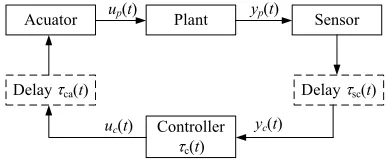
Consider a typical NCS with network-induced delays
as shown in Fig. 1 where τsc(t) is the delay from the sensor to the controller and τca(t) is the delay from the controller to the actuator; τc(t) is the delay taken for processing the control signal in the controller i.e.
Plant Sensor
Acuator
Controller c(t)
Delay ca(t) Delay sc(t)
up(t) yp(t)
uc(t) yc(t)
Figure 1. Networked Control Systems
computational delay of the processor. This delay is usually small when compared to network-induced delays since processor coded with the control algorithm works at a higher speed; hence, for the sake of simplicity, it is usually ignored in the analysis of NCS. But, if the processor speed is slow, then the effects of the computational delay in the controller cannot be neglected.
Three main issues raised in NCS are network-induced delay, data transmission dropout, and bandwidth and packet size constraints. As is known, network induced delay can significantly degrade the performance and even lead to instability of NCS, so the maximum allowable size of network-induced delay are an important indexes in the sense of guaranteeing system stability. Many researchers have studied stability analysis and controller design for NCS with linear controlled plant (namely, linear NCS) in the presence of network-induced delay[2][3][4]. Without loss of generality, a model of closed-loop MIMO NCS with structured uncertainties and multiple state time-delays is given [5].
Fuzzy control is a useful approach to solve the control problems of nonlinear systems. Takagi-Sugeno (T-S) fuzzy system proposed by [6] is a popular and convenient tool to approximate nonlinear systems because of its simple structure with local dynamics. Descriptor system, which are also referred to as singular systems, implicit systems , generalized state-space systems,
differential-This work is supported by the Natural Science Foundation of the Jiangsu Higher Education Institutions of China(Grant No. 07KJD510 109)
algebraic systems, have been extensively studied for many years as descriptor systems are more general and natural in describing the practical dynamical systems than standard state-space systems. In [7], a fuzzy model in the descriptor form is introduced, and stability and stabilization problems for the system are addressed. Recently, more and more attention has been paid to the study of fuzzy descriptor systems [8-10]. Therefore, it is meaningful to employ fuzzy descriptor model in NCS systems design. However, to the best of our knowledge, the fuzzy descriptor NCS with time-delay has not yet been fully investigated.
Since 2001, both delay-dependent [11][12] and delay- independent [13][14] stability conditions for singular time-delay systems have been derived by using the time domain method. Generally speaking, delay dependent conditions are less conservative than the delay-independent ones, especially when the size of delay is small. Moreover, in engineering practice, information on the delay range is generally available.
To obtain delay-dependent conditions, many efforts have been made in the literature, among which the model transformation technique and bounding technique on cross product terms are often used. While the applying of inequality on bounding some cross terms still led to relative conservatism. The delay-dependent conditions in [12] was derived without using model transformation and bounding technique, while the authors only proposed the criterion for E-exponential stability. Delay-dependent robust stability criteria for time-delay systems with norm-bounded is investigated in [15]. On the other hand, considerable attention has been paid to the problems of robust stabilization and H∞ control for time-delays systems [16-19]. For continuous descriptor time-delay systems, some results on the problem of delay-dependent robust stability/stabilization are given [20-23], the delay-dependent robust H∞control problem for descriptor time-delay system is discussed [24-25].
In this article, we mainly study the problem of robust stability of T-S fuzzy descriptor NCS with multiple time delays in state. First, an improved delay-dependent stability criterion for the T-S fuzzy descriptor NCS with multiple time delays is established in terms of LMIs without using any model transformation and bounding technique. Then based on this criterion, we are able to obtain maximum allowable delay bound (MADB) of NCS. Numerical example is given to show the effectiveness of the presented results.
The paper is organized as follows. Section II formulates the problem and gives a continuous model for fuzzy descriptor NCS with multiple time delay. Some preliminaries also included. The main results are presented in Section III. An example is included to demonstrate the power of this method in Section IV. Finally, Section V concludes this paper.
Notations. Throughout this paper, Rn denotes the n-
dimensional Euclidean space, whereas Rn×m refers to the
set of all n×m real matrices. For real symmetric matrix X, the notation X ≥0 (X > 0) means that the matrix X is positive-semidefinite (positive-definite). The superscript
T represents the transpose. The symbol * will be used in some matrix expressions to induce a symmetric structure.
II. PROBLEM FORMULATION AND PRELIMINARIES
Consider a model of fuzzy descriptor NCS with multiple state time-delays as
Rulei: If ξ1(t) isM i1and…and ξp(t) isMip, Then
) ( ) ( ) ( )
( ) (
1
t w B t u B t
x A t x A t
Ex N i wi
i dik k
i + − + +
=
∑
=
τ
z(t)=Cix(t)+Diu(t) ] 0 , [ ), ( )
(t =φ t t∈ −τ
x i=1,2,…,s (1) where ξ1(t)~ξn(t) are the premise variables, which are assumed to be independent of the input variable, Mik (k=1,2,…,p) is the fuzzy set and r is the number of if-then rules. x n
R
∈ is the state, u r
R
∈ is the control input, p
w∈R is the disturbance input which belongs toL2[0,∞), m
z∈R is the control output,τk (k=1,2,…,N) are constant
bounded delays in the state satisfying 0<τk <τ .
n n
E∈ ×
R
is singular and assume that 0<rankE=q<n. Ai, Adik, and Ci are real constant matrices of appropriate dimensions.
The system disturbance is assumed to belong to )
, 0 [
2 ∞
L , that is
∫
∞ <∞0 w (t)w(t)dt
T
This implies that the disturbance has finite energy. In view of multi-input and multi-output NCS with many independent sensors and actuators, [15] described the distributed time delays, such as the delays from sensor to controller and the delays from controller to actuator and controller process delay, as multiple state time-delays.
By using center-average defuzzier, product inference and singleton fuzzifier, the dynamic system (1) can be expressed by the following global model:
∑
=− +
= N
k
k dk t xt
A t t A t x E
1
) ( ) ( )
( ) ( )
( x τ
+B(t)u(t)+Bw(t)w(t)
) ( ) ( ) ( ) ( )
(t C t x t Dt u t
z = + (4)
where
∑
=
= s
i
i
i t A
h t A
1
)) ( ( )
( ξ
∑
== s
i
dik i
dk t h t A
A
1
)) ( ( )
( ξ
∑
== s
i
i i t B
h t B
1
)) ( ( )
( ξ
∑
== s
i
wi i
w t h t B
B
1
)) ( ( )
( ξ
∑
=
= s
i
i i t C
h t C
1
)) ( ( )
∑
== s
i
i i t D
h t D
1
)) ( ( )
( ξ
)) ( ( t
hi ξ denotes the normalized membership function which satisfies
∑
== s
i i i i
i
i t w t w t
h
1
)) ( ( / )) ( ( )) (
(ξ ξ ξ
∏
== p l il l
i t M t
w(ξ()) 1 (ξ()) ))
( ( t
Mil ξl is the grade of membership of ξi(t) in the fuzzy set Mil, then
hi(ξ(t))≥0, ( ()) 1
1
=
∑
= si i t
h ξ
Consider the nominal unforced descriptor system with w(t)=0 described by
∑
=
− +
= N
k
k dkxt
A t A t x E
1
) ( )
( )
( x τ
(5)
To facilitate the discussion, we introduce the following definitions.
Definition 1. [26]
1. The pair (E, A) is said to be regular if det(sE-A) is not
identically zero.
2. The pair (E,A) is said to be impulse-free if deg(det(sE
-A)) = rank E.
Definition 2. [26]
For a given scalarτ >0, the nominal descriptor delay system (5) is said to be regular and impulse-free for all constant time delays τk satisfying 0<τk <τ, if the pair (E, A) is regular and impulse-free.
Definition 3.
The uncertain fuzzy descriptor NCS with multiple state time delays system (1) is said to be robustly stable, if the system with u(t)=0 and w(t)=0 is regular, impulse-free
and stable for all admissible uncertainties. Definition 4.
For a given scalar The uncertain fuzzy descriptor NCS with multiple state time delays system (1) is said to be robustly stable, if the
Definition 4.
For given scalars τ >0and γ >0, the uncertain fuzzy descriptor NCS with time delay (1) is said to be robustly stable with H∞ performance if it is robustly stable in the sense of Definition 3 and under zero initial condition,
2
2 w
z <γ for any non-zeroω(t)∈L2[0,∞).
Without loss of generality, we can assume the matrices in (2) have the forms
⎥ ⎦ ⎤ ⎢ ⎣ ⎡ =
0 0
0 q I
E , ⎥
⎦ ⎤ ⎢
⎣ ⎡ =
22 21
12 11
A A
A A
A ,
⎥ ⎦ ⎤ ⎢
⎣ ⎡
= 1121 2212
dk dk
dk dk dk
A A
A A
A , ⎥
⎦ ⎤ ⎢ ⎣ ⎡ =
2 1
w w
w B
B B
and denote
⎥ ⎦ ⎤ ⎢ ⎣ ⎡ =
) (
) ( ) (
2 1
t x
t x t
x
with ∈ q×q
R
A11 , Adk11∈Rq×q and q R x1∈
Considering the network action, our main purpose is to design a state feedback controller
) ( )) ( ( ) (
1
t x K t h t
u j
s
j j
∑
=
= ξ
) ( ) (t xt K
= (6)
where
∑
== s
j
j
j t K
h t K
1
)) ( ( )
( ξ .
For simplicity, we will use A, Adk, B, Bw, C, D and K instead of A(t), Adk(t), B(t), Bw(t), C(t), D(t) in (2) and K(t) in (6).
Such that the following resultant closed-loop system
) ( ) ( )
( ) (
) (
1
t w B t
x A t BK A t x
E w
N
k
k
dk − +
+ +
=
∑
=
τ
x
z(t)=(C+DK)x(t) (7) is regular, impulse free and stable with H∞performance for any constant time delays τk satisfying 0<τk<τ.
III. MAIN RESULT
In this section we will give a solution to the delay-dependent robust H∞ control problem formulated previously by using LMI technique. Initially, we present the following theorem for the nominal unforced system
) ( ) ( )
( ) (
1
t w B t
x A t A t x
E N w
k
k
dk − +
+
=
∑
=
τ
x
) ( ) (t Cx t
z = (8) ]
0 , [ ), ( )
(t =φ t t∈ −τ
x
to be regular, impulse free and stable, which will play a key role in solving the aforementioned problem
Theorem 1: For a prescribed scalarτ >0, if there exist matrices
⎥ ⎦ ⎤ ⎢
⎣ ⎡ =
22 21
11 0
P P P
P , P11>0, Qk > 0, ⎥
⎦ ⎤ ⎢
⎣ ⎡
= 11 2212
* k
k k k
Z Z Z
Z
⎥ ⎦ ⎤ ⎢ ⎣ ⎡ =
0 0
21 11
k k k
Y Y Y
, ⎥⎦
⎤ ⎢ ⎣ ⎡ = 2111 1
k k k
Y Y Y
, ⎥⎦
⎤ ⎢ ⎣ ⎡ =
0 0
21 11
k k k
W W W
, ⎥⎦
⎤ ⎢ ⎣ ⎡ = 1121 1
k k k
W W W
with appropriate dimensions such that the following LMIs hold
0
≥ =P E P ET T
(9) 0
< +A P A
PT T (10)
1
1
11
0 0
k
k
k
Y W
Z τ τ
τ
− ⎤
⎥ − ⎥ <
⎥ ⎥
− ⎥⎦
1 2 4
3
2
*
* *
* * *
T T T
k k k k d k k w
T T
k k d k d d k w
T w k d
A Z A A Z A A Z B
A Z A A Z B
I B Z A
τ τ τ
τ τ
γ τ
⎡Γ + Γ + Γ +
⎢
Γ + ⎢
Γ = ⎢
− +
k=1,2,…,N (11) where k T T k k
k =Y +Y +C C+Q
Γ1 ,
T k k dk T
k =P A −Y +W
Γ2
T k k k
k =−Q −W −W
Γ3
w T k =P B
Γ4
∑
= = N k dk d A A 1Then the fuzzy descriptor NCS system (6) is regular, impulse free and asymptotically stable for any constant time delaysτk satisfying 0<τk <τ .
Proof : From (10), it is easy to see that 0
22 22 22
22P +P A <
AT T , this implies that A
22 is nonsingular, and thus the pair (E, A) is regular and impulse free. Therefore, system (8) is regular and impulse free.
Construct Lyapunov-Krasovskii functional for system (8) as ) ( ) ( ) ( )
(xt V1 xt V2 xt V3 xt
V = + +
where ) ( ) ( ) (
1 x x t E Pxt
V T T t =
∑∫
= − = N k t t k T t k x Q x x V 12( ) τ (α) (α)dα
β α α α
τ β ( ) ( )d d )
(
1 0
3 x x E Z Ex
V k T N k t t T t k
∑∫ ∫
= − + =whereETP=PTE≥0,
Zk, Qk are symmetric positive- definite matrices to be determined.
Taking the derivative of V(xt) along with the solution of (8), we have
) ( ) ( ) ( ) ( ) (
1 x x t E Px t x t E Pxt
V T T T T
t
= +
=2xT(t)PTEx(t)
⎜⎜ ⎝ ⎛ + − ⎥ ⎦ ⎤ ⎢ ⎣ ⎡ + ⎥ ⎦ ⎤ ⎢ ⎣ ⎡ Ω + Ω +
= 2 1 2
22 12 1 21 21 11 11 ) ( ) ( ) (
2 x t S S
A A t x A A P t xT T
+Bww(t)
)
⎟⎟ ⎠ ⎞ ⎜⎜ ⎝ ⎛ ⎥ ⎦ ⎤ ⎢ ⎣ ⎡ + ⎥ ⎦ ⎤ ⎢ ⎣ ⎡ Ω + Ω +
=2 () () 2()
22 12 1 21 21 11
11 x t
A A t x A A P t xT T
(
3 1)
2 4(
2 () 3 2 4)
) (
2xT t S −PTS + S − xT t S + S
+
2x (t)P S2 2x(t) P Bww(t) T T T T + +
∑ ∫
= − + = N k t t k T k T T k t x Y t x t Ax P t x 1 ) ( ) ( 2 { 1 ) ( ) ( 2 τ τ ) ( ) ( 2 ) ( ) )( (2 k k k
T k T k k dk T
T t P A Y W xt x t W xt
x − + −τ − −τ −τ + α α τ τ α τ d t w B P t x x W t x x Y t x w T T k k k T k k T )} ( ) ( 2 ) ( ) ( 2 ) ( ) (
2 1 1 1 1
+ − − − (12) where ⎥ ⎥ ⎥ ⎥ ⎦ ⎤ ⎢ ⎢ ⎢ ⎢ ⎣ ⎡ = ⎥ ⎦ ⎤ ⎢ ⎣ ⎡ Ω Ω Ω Ω = Ω
∑
∑
∑
∑
= = = = N k dk N k dk N k dk N k dk A A A A 1 22 1 21 1 12 1 11 22 21 12 11 α ατ ( )d
1 1 21 11 1
∑∫
= − ⎥⎦ ⎤ ⎢ ⎣ ⎡ = N k t t dk dk k x A A S ,∑
= − ⎥ ⎦ ⎤ ⎢ ⎣ ⎡ = N k k dkdk x t
A A S 1 2 22 12
2 ( τ )
α α
τ ( )d
1 1 21 11 3
∑∫
= − ⎥⎦ ⎤ ⎢ ⎣ ⎡ = N k t t k k k x Y Y S α ατ ) τ ( )d
(
1
1 21 11
4
∑
∫
= − ⎥⎦ ⎤ ⎢ ⎣ ⎡ − = N k t t k k k T k x W W t x S
(
)
∑
= − − − = N k k k k T k Tt x t Q xt x t Q x t
x V
1
2( ) () () ( τ ) ( τ )
(
)
α τ τ
τ τ () () ( ) ( )d
1 1
∑ ∫
= − − − − = N k tt k k k
T k T k k t x Q t x t x Q t x (13)
(
)
{
}
∑
∫
= − − = N k t t k T T k T T k t k t x E Z E t x t x E Z E t x x V 13( ) τ () () τ () ()dα
∑ ∫
∑
= − ⎪⎩ = ⎪ ⎨ ⎧ ⎟ ⎠ ⎞ ⎜ ⎝ ⎛ + − + = N k t t T w N k k dk k k k t w B t x A t Ax 1 1 ) ( ) ( ) ( 1 τ τ τ τ ⎟ ⎠ ⎞ ⎜ ⎝ ⎛ + − + ×∑
= ) ( ) ( ) ( 1 t w B t x A t Ax Z w N k k dk k τ}
α α α) ( )d( E Z Ex
xT T k
− (14) Noting that ) ( ) ( ) ( )
(t zt 2w t wt
zT −γ T
) ( ) ( ) ( )
(t C Cxt 2w t wt
xT T −γ T
=
Then we have
V(x) zT(t)z(t) 2wT(t)w(t)
t + −γ
V1(x) V2(x) V3(x) x (t)C Cx(t) T T t t
t + + +
=
) ( ) (
2wT t wt
γ −
∑ ∫
= − Ψ + ∆ = N k t t k T kT t xt t t
x k 1 d ) , ( ) , ( 1 ) ( ) ( ζ α ζ α α τ τ where P A A PT + T
= ∆
[
T T]
Tk T
T t x t w t x
x
t, ) (), ( ), (), ( )
( α τ 1 α
ζ = − , k=1,…,N
⎥ ⎥ ⎥ ⎥ ⎥ ⎦ ⎤ ⎢ ⎢ ⎢ ⎢ ⎢ ⎣ ⎡ Ψ Ψ Ψ Ψ Ψ Ψ Ψ Ψ Ψ Ψ = Ψ k k k k k k k k k k k 44 34 33 24 23 22 14 13 12 11 * * * * *
* (15)
A Z A k T k k k=Γ +τ
Ψ11 1
dk k T k k
k =Γ +τ A Z A
Ψ12 2
w k T k k
k =Γ +τ A Z B
Ψ13 4
1
14 k k
k =−τ Y
Ψ dk k T dk k k
k =Γ +τ A Z A
Ψ22 3
w k T dk k k =τ A Z B
1
24 k k
k =−τ W
Ψ
w k T w k k =−γ I+τ B Z B
Ψ 2
33
0
34= Ψk
11
44 k k
k =−τ Z
Ψ
Therefore, in the light of Lyapunov-Krasovskii stability theorem, if ∆ < 0 andΨk≤0, then ( )<0
t
x
V for any ζ(t,α)
≠ 0, thus the nominal unforced descriptor system (6) is asymptotically stable. Next, We consider the following index
[
zt zt w t wt]
tJ T
zw 0 () () () ()d
2
∫
∞ −= γ (16)
Noting that we have
=
∫
∞[
− +]
−∫
∞0 0
2 () () ( )d ( )d
) ( )
(t zt w t wt V x t V x t z
J t t
T
zw γ
[
zt zt w t wt V xt]
tT() () ( )d )
( ) (
0
2
∫
∞+ −
= γ −limt→∞V(xt)+V(x0)
(
∫
∞ ∆ =0 x(t) x(t)
∑ ∫
= −
Ψ + k
k t t
k T
k k
t t
1
d )) , ( ) , ( 1
τ ζ α ζ α α
τ
−limt→∞V(xt)+V(x0) (17) Applying Schur complement argument to (15), it follows from (11) and Schur complement argument that for any τk satisfying0<τ <k τ
( )
⎥⎦ ⎤ ⎢
⎣ ⎡ ⎥ ⎥ ⎥
⎦ ⎤
⎢ ⎢ ⎢
⎣ ⎡
− − +
⎥ ⎥ ⎥
⎦ ⎤
⎢ ⎢ ⎢
⎣ ⎡
− Γ
Γ Γ Γ
−1 11 1
1
2 3
4 2 1
0 0
0 *
*
0 *
k k
T w
k T dk
k T
k k
k k k
Z Z B
W A
Y A I
τ γ
⎥ ⎦ ⎤ ⎢
⎣ ⎡
− − ×
0
1 1
T k T k
w d
W Y
B A A
( )
⎥⎦ ⎤ ⎢
⎣ ⎡ ⎥ ⎥ ⎥
⎦ ⎤
⎢ ⎢ ⎢
⎣ ⎡
− − +
⎥ ⎥ ⎥
⎦ ⎤
⎢ ⎢ ⎢
⎣ ⎡
− Γ
Γ Γ Γ
≤ 1 11 −1
1
2 3
4 2 1
0 0
0 *
*
0 *
k k
T w
k T dk
k T
k k k k
Z Z B
W A
Y A I
τ γ
⎥ ⎦ ⎤ ⎢
⎣ ⎡
− − ×
0
1 1
T k T k
w d
W Y
B A A
<0
Since ∆<0, Ψk<0, V(x
0)=0 under zero initial condition and lim ( )≥0
∞
→ t
t V x , then the following LMI holds: 0
<
zw
J
This gives the desired results
2 2
2 w
z <γ
which implies that system (6) has H∞ performance γ. So for any0<τk<τ , we haveΨ <0
k . This completes the proof. □ Remark 1: Theorem 1 provides the delay-dependent asymptotic stability criteria for nominal NCS (6). Based on the theorem 1, we can obtain a less conservative MADB τ such that NCS are asymptotically stable by solving the following optimization problems,
⎩ ⎨ ⎧
) 11 ( ), 10 ( ), 9 ( , , , , , s.t.
/ 1 min
k k k k Z Y W
Q P
τ (18)
Equation (18) is a convex optimization problem and can be obtained efficiently using the MATLAB LMI Toolbox.
Now, we concentrate on the design of a state feedback controller of the form (6) which guarantees the resultant closed-loop system (7) to be regular. Based on Theorem 1, we obtain the following theorem.
Theorem 2. For prescribed scalars τ >0and γ >0, there exists a state feedback controller (6) such that the closed-loop fuzzy descriptor system (7) is regular, impulse-free and stable with H∞ performance γ for any constant time delaysτksatisfying0<
τ
k ≤τ
if there exist nonsingular matrix P, a0
≥ =P E P ET T
(19) 0
~
~+PTAT+BN+NTBT <
P
A (20)
0
* * * *
~ *
* *
0 *
*
~ 0 0 ~ *
~ 0 ~
~ ~
~
11 2
3 4 2 1
<
⎥ ⎥ ⎥ ⎥ ⎥ ⎥
⎦ ⎤
⎢ ⎢ ⎢ ⎢ ⎢ ⎢
⎣ ⎡
− −
− Ξ
Ξ Ξ Ξ
= Ξ
k w k
T T
T d T k
T T k
k k
k
Z P B Z
B N I
A P
A P
τ τ
τ γ
τ τ
k=1,2,…,N (21) where
C D N P DN C P Q P C C P Y
Y T T T T
k T T T k k
k = + + + + +
Ξ~ 1 ~ ~ ~ ~ ~ ~
T
k k dk
k A Y W
~ ~ ~
2= − +
Ξ
T k k k
k Q W W
~ ~ ~ ~
3=− − −
Ξ
P Bw k
~ ~
4= Ξ
In this case, a desired state feedback controller is given by
) ( ~ )
(t NP 1xt
u = − (22) Proof
Using inequality (10), we have
0 ) ( )
(A+BK + A+BK P<
PT T
Then pre-, post-multiplying both sides with P−T, P−1,
and defining P~=P−1, N=KP~, we can obtain (20).
Pre-, post-multiplying both sides of inequality (11) with diag{ T
P− , T
P− , T
P− , I } and its transpose, and defining
1
~=P−
P P K N= ~
P Y P Y k
T k
~ ~ ~ =
W P WkP
T k
~ ~ ~ =
we have
⎢ ⎢ ⎢ ⎢
⎣ ⎡
+ − Ξ
Ξ Ξ
Ξ
=
* *
*
~ ~
* *
~ ~
*
2 3
4 2
1
P A Z B P I
P B Z A P
d k T w T
w k T d T k
k k
k
τ γ
τ
0 ~ 0
~ ~
<
⎥ ⎥ ⎥ ⎥ ⎥
⎦ ⎤
− − −
k k k
Z W Y
τ τ τ
where
P DN C P Q P C C P Y
Y T T
k T T T k k k
~ ~
~ ~ ~ ~
1= + + + +
Ξ
(
PAZ AP P A Z BN CD
N k
T T k T
T + ~ ~+~
+ τ
)
P Z B N P A Z B
N k
T T k
T
T ~+ ~
+
(
P A Z AP N B Z A P)
W Y
A k d
T T d k T T T k k dk k
~ ~
~ ~ ~
2= − + + +
Ξ τ
Q W W P A ZkAdP
T d T T k k k k
~ ~
~ ~ ~
3=− − − +τ
Ξ
k BwP
(
PTATZkBwP NTBTZkBwP)
~ ~
~ ~
4= + +
Ξ τ
By Schur complement, we can obtain Ξk<0 is the same as (21).
Therefore, we can see the closed-loop fuzzy descriptor system (7) is regular, impulse free and stable with H∞ performance γ for all constant time delaysτk satisfy-ing0<
τ
k ≤τ
, and a desired controller can be obtained by u(t)=Kx(t) with K=NP~−1. The proof is completed.□ Remark 2: In the proof of these heorems , it is noted that neither model transformation nor bounding technique for cross terms, which are usually used in the existing results, is required. Hence, the derivation procedure is simpler and these theorems are less conservative than the existing ones.
Remark 3: If E=I, Theorems in this paper can be regarded as an extension of standard state-space fuzzy systems with multiple time-delay.
V. ILLUSTRATIVE EXAMPLES
In order to demonstrate the validity of the proposed methods, a numerical example is involved to illustrate the effectiveness of the proposed criteria. A T-S fuzzy descriptor system with multiple time delay is described as follows. It is supposed that x1 is measurable online. If x1 is P, then
∑
=
− +
= 2
1 1
1 () ( )
) (
k
k k d xt
A t x A t x
E τ
) ( )
( 1
1ut B wt
B + w
+
If x1 is N, then
∑
=− +
= 2
1 2
2 () ( )
) (
k
k k d xt
A t x A t x
E τ
) ( )
( 2
2u t B wt
B + w
+ (23)
Here the membership functions of P and N are given as follows:
1 2 1
1
1 1 1 )
( x
e x
h −
+ − =
1 2 1
2
1 1 )
( x
e x
h −
+ =
⎥
⎦ ⎤ ⎢ ⎣ ⎡ =
0 0
0 1
E , ⎥
⎦ ⎤ ⎢
⎣ ⎡− =
4 . 0 0
3 . 0 1 . 1
1
A
⎥ ⎦ ⎤ ⎢
⎣ ⎡
− − =
8 . 0 4 . 0
1 . 0 4 . 0
2
A , ⎥
⎦ ⎤ ⎢
⎣
⎡ −
=
0 0
2 . 0 1 . 0
11
d
A
⎥ ⎦ ⎤ ⎢
⎣
⎡ −
=
0 0
1 . 0 2 . 0
12
d
A
, ⎥⎦
⎤ ⎢
⎣ ⎡ =
3 . 0 1 . 0
0 2 . 0
21
d
A
⎥ ⎦ ⎤ ⎢
⎣ ⎡ =
1 . 0 2 . 0
0 1 . 0
22
d
A
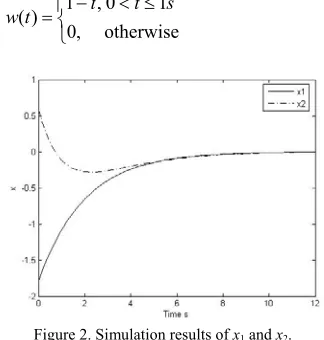
H∞ performance γ =2. The disturbance input w(t) is as follows:
⎩ ⎨
⎧ − < ≤ =
otherwise ,
0
1 0 , 1 )
(t t t s
w
Figure 2. Simulation results of x1 and x2.
According to Theorem 2 and using MATLAB LMI Toolbox, it is found that the maxium bound of time-delay is τ =0.7832. For example, whenτ1=0.73 , τ2=0.61,
the corresponding state feedback controller is u(t)=
[
−24.6357 −31.7942]
x(t)Fig. 1 gives the simulation results of x1 and x2 when the initial function φ(t)=
[
−1.8 0.6]
,t∈[−τ,0]. From Fig 1, we can see that the states x1 and x2 asymptotically converge to zero.VI. CONCLUSION
control, guaranteed cost control, variable structure control and so on, will be interesting topics for further research.
REFERENCES
[1] G.C. Walsh, O. Beldiman, L.G. Bushnell, Stability analysis
of networked control system, Proceedings of American Control Conference, San Diego, pp.2876–2880, 1999.
[2] W. Zhang, M. S. Branicky, S. M. Phillips, Stability of
networked control systems, IEEE Control System Magzine, vol. 21, pp.84–99, 2001.
[3] M. S. Branicky, S. M. Phillips, W. Zhang, Stability of
networked control systems: Explicit analysis of delay, Proceedings of American Control Conference, Chicago, pp.2352–2357, 2000.
[4] B.G. Marieke, Nathan van de Wouw, Stability of
networked control systems with uncertain time-varying delays, IEEE Trans. on Automatic Control, vol.54, pp.1575–1580, 2009.
[5] H. Yan, X. Huang, M. Wang, H. Zhang, Delay-dependent
stability criteria for a class of networked control systems with multi-input and multi-output, Chaos, Solitons and Fractals, vol. 34, pp.997–1005, 2007.
[6] T. Takagi, M. Sugeno, Fuzzy identification of systems and
its application to modeling and control, IEEE Trans. on Systems, Man and Cybernetics,vol.15, pp.116–132, 1985.
[7] K. Tanaka, M. Sano, A robust stabilization problem of
fuzzy control systems and its application to backing up control of a truck-trailer, IEEE Trans. Fuzzy Systems, vol. 2, pp.119–134, 1994.
[8] Z. Hongbin, S. Yanyan, F. Gang, Delay-dependent stability
and H∞ control for a class of fuzzy descriptor systems with
time-delay, Fuzzy Sets and Systems, vol.160, pp.1689– 1707, 2009.
[9] Y. Jun, Z. Shouming, X. Lianglin, A descriptor system
approach to non-fragile H∞ control for uncertain fuzzy
neutral systems, Fuzzy Sets and Systems, vol. 160, pp.423–438, 2009.
[10]T. Weihua, Z. Huaguang, Optimal guaranteed cost control
for fuzzy descriptor systems with time-varying delay, Journal of Systems Engineering and Electronics, vol. 19, pp.584–591, 2008.
[11]E. Fridman, Effects of small delays on stability of singular
perturbed systems, Automatica, vol. 38, pp.897–902, 2002.
[12]D. Yue, Q. Han, A delay-dependent stability criterion of
neutral systems and its application to partial element equivalent circuit model, IEEE Trans. Circuits System II, vol. 51, pp.685–689, 2004.
[13]S. Xu, P. Van Dooren, R. Stefan, and J. Lam, Robust
stability and stabilization for singular systems with state delay and parameter uncertainty, IEEE Trans. Autom. Contro, vol. 47, pp.1122–1128, 2002.
[14]J. Feng, S. Zhu, and Z. Cheng, Guaranteed cost control of
linear uncertain singular time-delay systems, Proceedings of 41st IEEE Conference Decision Control, pp.1802–1807, 2002.
[15]Z. Shuqian, Z. Chenghui, C. Zhaolin, and F. June,
Delay-dependent robust stability criteria for two classes of uncertain singular time-delay systems, IEEE Trans. on Automatic Control, vol. 52, pp.880–885, 2007.
[16]Q.C. Chen, L. Yu, W.A. Zhang. Delay-dependent output
feedback guaranteed cost control for uncertain
discrete-time systems with multiple discrete-time-varying delays. IET
Control Theory and Applications 2007; 1(1):97–103.
[17]Z. Gao, T. Breikin, H. Wang. Reliable observer-based
control against sensor failures for systems with time delays
in both state and input. IEEE Transactions on Systems,
Man and Cybernetics, Part A 2008; 38(5):1018–1029.
[18]H.C., Yan , X.H., Huang, M. Wang, et al. New
delay-dependent stability criteria of uncertain linear systems with multiple time-varying state delays. Chaos, Solitons and Fractals 2008, 37(1):157–165.
[19]C.Y., Lu, Tsai JSH, T.J Su. On improved delay-dependent
robust stability criteria for uncertain systems with multiple state delays. IEEE Transactions on Circuits and Systems 2002,49(2):253–256.
[20]E.K. Boukas, Delay-dependent stabilization of singular
linear systems with delays. International Journal of
Innovative Computing, Information and Control 2006,
2(2):283–291.
[21]H.J, Wang, A.K, Xue, R.Q.Lu, Delay-dependent robust
stability and stabilization for uncertain singular system with time-varying delay. Proceedings of the 2008 American Control Conference, Seattle, WA, U.S.A., 2008, 3626–3631.
[22]S. Zhu, Z. Li, Z. Cheng. Delay-dependent robust resilient
H∞ control for uncertain singular time-delay systems.
Proceedings IEEE Conference on Decision and Control, and European Control Conference. Seville: Spain, 2005, 1373–1378.
[23]R. Zhong, Z. Yang, Delay-dependent robust control of
descriptor systems with time delay. Asian Journal of
Control2006; 8(1):36–44.
[24]Z. Wu, W. Zhou, Delay-dependent robust H∞ control for
uncertain singular time-delay systems. IET Control Theory
and Applications 2007; 1(5):1234–1241.
[25]EK., Boukas, Singular linear systems with delay: H∞
stabilization. Optimal Control Applications and Methods
2007;28(4):259–274.
[26]Z. Wu, W. Zhou, Delay-dependent robust H∞ control for
uncertain singular time-delay systems, IET Control Theory Appl. vol. 1, pp.1234–1241, 2007.
Baoping Ma was born in Shanxi, China, in 1973. She received the B.Eng. degree in automation and M.S. degree in control theory and control engineering from Taiyuan University of Technology, Taiyuan, in 1994 and 1997, respectively. She received Ph.D. Degree in Thermal Engineering from Southeast University in 2001.