An Analysis Of Various Routing Techniques
Used In Wireless Sensor Networks
Tarun Bhalla
Research Scholar
Department of Computer Science and Engineering DAV Institute of Engineering and Technology
Jalandhar, India
Harpreet Bajaj
Associate Professor
Department of Computer Science and Engineering DAV Institute of Engineering and Technology
Jalandhar, India
Abstract—In today’s era with the rapid advancement in the field of wireless communication highlight the concept of Wireless sensor network (WSN) and now this topic become the center of attraction for all research scholars these days. The main reason for tremendous demand of sensor network is its use in almost every field where human can’t even think to approach. Beside of number of advantages WSN has to go through number of design issues and challenges to make proper use of sensing nodes in almost all over the network to satisfy the ongoing demand of market. Wireless Sensor networks are generally used for to transmit collective information from number of nodes to one base station. To carry information from a single node to base station every node utilizes some energy. The aim of wireless sensor network is to minimize the use of energy to transmit information from senor node placed at different location to base station and to achieve this number of routing protocols are designed for WSN. In this paper we are comparing various routing protocols based on their features, operation, area in which they are used, lifetime and the amount of energy they consumed to transmit message.
Keywords— Wireless Sensor Network (WSN), routing techniques, LEACH, PEGASIS, GEAR, SPIN, TEEN, HEED. EARP, IEEPB
I. INTRODUCTION TO WIRELESS SENSOR NETWORK
(WSN)
Wireless Sensor Network is a collection of N number of nodes generally referred as Sensor Node because of its ability to sense the data and forward it to its nearby node that helps to transfer information from one end user to other end user. During its transmission from one end to other node sensor nodes transmit data to some cluster heads and base stations to finally reach to its destination. Sensor nodes are preferred because its operation cost is low and has ability to easily monitor its physical surrounding environment to sense the desired data. To sense the data each sensor node require some energy to make it functioning happens that’s why some energy is provided to each node which in the end lead one of
the most important designing issue to create a wireless network of sensor node.
One of the first Wireless Sensor Networks was designed and developed in middle of 70’s by military and defense industries. WSNs were also used during the Vietnam War in order to support the detection of enemies in remote jungle areas. However, their implementations had large number of shortcomings like large size of nodes, huge consumption of energy and limited network lifetime capability. [1]
Since then lots of work on this vast field catches the eyes of researchers and developers. Now with the advancement of technology the concept of WSNs widely used in following area are:
Area Monitoring: WSNs is deployed over a certain region to make surveillance on the area or to detect some phenomenon. Like in defense or military to detect enemy intrusion, or used by civilians for geo-fencing of gas or oil pipelines. Logging: Wireless sensor networks are also used
for the collection of data for monitoring of environmental information.
Environmental Condition Monitoring: There are many applications in monitoring environmental parameters like Air Pollution monitoring, Forest Fire Detection, Land Slide Detection, Water quality monitoring, Natural Disaster Prevention and Chemical Agent Detection.
Agricultural Field: The use of WSNs on agriculture may benefit the industry and frees the farmer from maintenance of wiring in difficult environment. Precision agriculture is one of the most promising application domains of wireless sensor networks
protocols is done on the basis of some metrics (mobility, data aggregation, scalability, energy efficient, n/w lifetime).
II. PERFORMANCE CRITERIA TO EVALUATE ROUTING
PROTOCL:
There are different terms related to energy efficient on Wireless senor networks that are used to evaluate the performance of routing protocols are listed below[1] [10]:
Network Lifetime: The most précised definition for network lifetime is “Time to network partition”[11]. Network partition occur when there is cut-set in the network
Network Lifetime = E – (Ṵ + σ),
Where Ṵ= (∑Ui)/N (1)
E is the initial energy at each node, Ui is the average used energy, N is the total number of nodes in the network, σ is expressed as
σ2 = ((Ui - Ṵ)2)/N (2)
Energy per packet: It is referred as total amount of the energy that is sent while sending a packet from a source to destination.
Average Energy Dissipated: This metric is related to n/w lifetime and specify average amount of energy used by per node over time in the network.
Packet Delivery Ratio (PDR): It is the ratio of total number of packets received at the sink to the total number of packets sends from the source. It show how reliable your network is. Packet Size: Packet size is used to determine the
time that a transmission will last. We always prefer to reduce the size of packet either by combining several packet into one single packet or by some compression technique because it directly affect the energy consumption. Energy Spent per Round: It calculates total
amount of energy spent in routing a message in a round.
Total number of Nodes Alive or Dead: This metrics gives an idea of the area coverage of the network over time.
Network Delay: It is used to measure the average end-to-end delay of data packet transmission.
Success Rate: The total number of packets received at destinations verses total number of packets send from source.
Latency: The average latency is defined as the average amount of time between the start of disseminating a data and its arrival at a node interesting in receiving the data.
III. ROUNTING TECHNIQUE IN WSNS:
There are different terms related to energy efficient on Wireless senor networks that are used to evaluate the performance of Routing in WSNs may be more demanding than any other wireless networks. There are number of design issues that need to be considered while choosing routing technique for your network. Efficient routing technique offers low power consumption and also helps to increase the overall lifetime of network because detecting suitable route for processing information and maintaining the same route is a topic of major concern in WSNs because energy functions are varied from time to time due to random change of status in nodes. So to perform good routing we have to choose only that particular routing technique which will leads to achieve minimum energy consumption and maximum lifetime. Thus the routing protocols can be further classified are as following:[12]
A. Location-based Protocols: MCEN, SMECN, GAF, GEAR, SPAN, TBF, GeRaF
B. Data-centric Protocols: SPIN, Directed Diffusion, Rumor
C. Routing, COUGAR, ACQUIRE, EAD D. Hierarchical Protocols: LEACH, PEGASIS,
HEED, TEEN, APTEEN
E. Multipath-Based Protocols: Disjoint paths, Braided paths, N-to-1 Multipath Discovery F. QoS-Based Protocols: SAR, SPEED,
Energy-aware routing.
A. Location Based Protocl:
Location based protocol takes the advantage of position information in order to relay the received data to only certain regions and not to whole WSN. In these type of protocols path from source node to destination node and then it will help to minimize the energy consumption of sensor nodes. The scalability factor in these types of protocols are low because every node need to be aware of other nodes location. Assumption taken in Location based protocols are:
Every node knows its own network neighbor nodes.
Source node gives information about the destination node.
Examples of location based protocols are GEAR, Span, GeRaF, MCEN, SMECN, GAF
1) GEAR (Geographic Energy aware Routing Protocol): It is an energy-efficient protocol designed for routing queries in a sensor field to target the region. In this sensor nodes are aware of their residual energy as well as location and residual energy of their corresponding neighbor’s nodes and further try to contribute in balancing the energy consumption.
packets on the behalf of other nodes between any source and destination.
3) MCEN (Minimum energy communication network): It is a self-re-configuring protocol. When it is applied to static network it suffers a problem of battery depletion. It uses same type of node for transmitting and forwarding sensed data to sink due to this neighbor nodes die quickly.
4) SMCEN (Small-Minimum energy
communication network): This protocol is an advancement over MCEN which uses energy efficient property. This protocol uses minimal energy path to transfer sensed data.
B. Data Centric Protocl:
This type of protocol require less transmission to send originating data. Whenever data is to be send from source to sink, immediately sensor can perform some form of aggregation on the data and then send this aggregated data. The example of data centric protocols are SPIN, Directed Diffusion, Rumor Routing, COUGAR, ACQUIRE, EAD
1) SPIN :( Sensor Protocol for Information via Negotiation): SPIN [13] is among the early work to pursue a data centric routing mechanism. The idea behind SPIN is to name the data using high-level descriptor or meta-data. Each node upon receiving new data request advertise it to its neighbors and interested neighbors retrieve the data by sending a request message. This protocol solve the problem of flooding. This guarantees that there is no unnecessary data sent throughout the network. The SPIN protocol itself contained four protocols, SPIN-PP(a three stage handshake protocol for point to point media), SPIN-EC(SPIN with Energy Conservation), SPIN-BC (SPIN for Broadcast Networks), SPIN-RL (SPIN with reliability).
2) Direct Diffusion (DD):Direct Diffusion suggests the use of attribute value pairs such as name of objects, interval, durations and geographical area etc. The interest is broadcast by a sink through its neighbor. Each node on the other hand receive the interest can do caching for later use. Path repairing is also possible in Directed Diffusion. It differ from SPIN in terms of the on Demand data querying mechanism it has. Directed Diffusion cannot be applied to all sensor network applications since it is based on a query driven data delivery model. It is not good approach to use it for application such as environmental monitoring. [14]
3) Rumor Routing (RR):Rumor Routing is a compromise between flooding queries and flooding event notifications [15]. The idea is to route the queries to the nodes that have observed a particular
event rather than flooding the entire network to retrieve information about occurring events. It maintain only single path between source and destination as opposed to direct diffusion where data can be sent through multiple paths at low rates.
4) COUGAR: The COUGAR views the
network as a huge distributed database system [16]. Cougar utilize in-network data aggregation to obtain more energy savings. COUGAR provides network layer independent method for data query.
5) ACQUIRE (Active Query forwarding In Sensor Networks):It is similar to COUGAR. The ACQUIRE views the network as a distributed database where complex queries can be further divided into several sub queries. This approach is ideal for one-shot and complex queries for response which may be provided by many nodes. It provide efficient querying by adjusting the value of the look ahead hop parameter.
C. Hierarchical Routing Protocl:
This routing technique impose a structure on the network to achieve energy efficiency, stability, and scalability. In this type of routing technique network nodes are organized in the form of clusters in which node having higher residual energy acts as cluster head (CH). Then this cluster head is responsible for coordinating activates within the cluster. The goal of hierarchy routing is to manage energy consumption of WSNs a particular cluster, and by performing the data aggregation and fusion to decrease the number of transmitted packets to the sink. The example of hierarchical Routing Approach are LEACH, TEEN, APTEEN and PEGASIS. [9]
1) LEACH (Low Energy Adaptive Clustering Hierarchy): LEACH protocol is self-adaptive and self-organized in nature. It is a cluster based routing protocol in which a cluster head collects data from sensor nodes belonging to the cluster and sends the data to the sink node after data aggregation process. Leach is completely distributed and require no global knowledge of network. LEACH use single hop routing where each node can transmit directly to cluster-head and the sink. LEACH is organized into rounds, where each of them begins with a Set-up Phase and is followed by a Steady-State Phase. Depending on applications, the different variations of LEACH such as LEACH-C(Centralized), E-LEACH (Enhanced), V-LEACH, TL-LEACH (Two Level), S-LEACH (Solar Aware) and M-S-LEACH (Multi-Hop) can be used.
hierarchical grouping where closer nodes form clusters and same process goes on higher levels until it will find base station. In this protocol the CH sends data by two way to its neighbor i.e. hard threshold (HT) or Soft threshold (ST). TEEN is best suited for time critical applications.
3) APTEEN (Adaptive Threshold Sensitive Energy Efficient Sensor Network): The APTEEN is an improvement over TEEN and aims at both capturing periodic data collections and reacting to time-critical events [17]. It allow the sensor node to send their data periodically and react to frequent change in the value of sensed data by reporting immediately to their assigned CHs. It further support three types of query namely: Historical query, One-Time Query and Persistent Queries. APTEEN is best suited for time critical events such as habitat monitoring for example animal monitoring in forest.
4) PEGASIS (Power Efficient Gathering in Senor Information Systems): PEGASIS is an enhancement over LEACH protocol and it is a near optimal chain-based protocol. The basic idea of the protocol is that in order to extend network lifetime, node only communicate with their closest node and then take a turns for the search of BS [18]. It performs data fusion at every node except at the end node in a chain. When a node dies, the chain bi-pass the dead node and follow greedy approach to form new chain again. There is no cluster formation takes place in PEGASIS. PEGASIS are further classified into different version which are as follows:
4.1 EEPB (Energy Efficient PEGASIS Based): As in PEGASIS greedy technique is used to form the data chain. EEPB used distance threshold to overcome the problem of PEGASIS. It not only safes energy on threshold but also save overall residual energy of all the nodes. [19]
4.2 PEGASIS-ANT: This version of protocol uses ANT Colony Algorithm rather than greedy algorithm to construct data chain which results in global optimization. With this each round of transmission selects their leader by taking current energy into account which further results in prolonged network lifetime. [20]
4.3 H-PEGASIS: It is an extended version of PEGASIS protocol. It was introduced with the objective of decreasing the delay of transmission packets to the BS. [21]
4.4 PEGASIS with Double Cluster Head (PDCH):
This version prefers two cluster head to be used in a single chain and it will give hierarchical structure so that long chain is avoided. It also eliminate dynamic cluster formation problem. [22]
4.4 Improved Energy Efficient PEGASIS Based (IEEPB): It overcomes the problem of EEPB. In this IEEPB compares the distance between two nodes twice and then finds the shortest path to link two adjacent nodes. While selecting the leader IEEPB considers the node’s energy, distance between the BS and the nodes and then normalized these two factors. IEEPB has higher energy efficiency and longer lifetime. [23]
5) HEED (Hybrid Energy Efficient Distributed Clustering): HEED operates in multi-hop networks, using an adaptive transmission power in the inter-clustering communication. HEED was proposed with four primary goals namely: (i) prolonging network lifetime by distributing energy consumption, (ii) terminating the clustering process with in a constant number of iterations, (iii) minimizing control overheads, and (iv)producing well-distributed CHs and compact clusters.
D. Multipath Based Protocl:
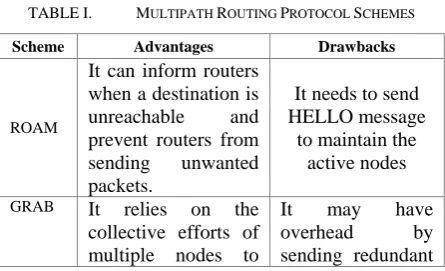
It has the advantage to achieve load balancing and is more resilient to route failure [24]. In multipath routing, each source sensor finds the first k shortest paths to the sink and divides its load evenly among these paths. There are lot of multi-path routing protocols that belong to this scheme are Disjoint paths, braided paths N-to-1 multipath discovery, ROAM, LMR, GRAB, CBMPR, DGR, DCF. [1]
1) Disjoint Paths: This protocol helps to find small number of alternate paths that have no sensor in common. In Sensor Disjoint Path routing, the primary path is best available whereas the alternate paths are less desirable because they have higher latency.
2) Braided Paths: To construct braided path, the first primary path is computed, then for each node on the primary path, the best path from a source sensor is computed.
3) N-to-1 Multipath Discovery: It is based on the simple flooding originated from the sink and is composed of two phases, namely, branch aware flooding and multipath extension of flooding. [25]
TABLE I. MULTIPATH ROUTING PROTOCOL SCHEMES
Scheme Advantages Drawbacks
ROAM
It can inform routers when a destination is unreachable and prevent routers from sending unwanted packets.
It needs to send HELLO message
to maintain the active nodes
GRAB It relies on the
collective efforts of multiple nodes to
Scheme Advantages Drawbacks
deliver data without dependency on any individual ones
data.
CBMPR Low interference,
simplicity
Path joining problems may be occurred.
E. QoS Based Protocl:
In this type of technique, the network has to balance between energy consumption and data quality [26] [27]. In this network has to satisfy certain metrics e.g. delay, energy, bandwidth etc. The QoS is important in delivery of data in critical application such as healthcare. Following are the QoS based protocols.
1) SAR (Sequential Assignment Routing): SAR is the first protocol for WSNs that introduced the QoS in routing protocols [28]. Routing decision in this depends of three factors: energy resource, QoS on each path, and the priority level of each packet. The overall objective of SAR is to minimize average
weighted QoS metric throughput the lifetime of network.
2) SPEED Protocol: This protocol provides soft real time end-to-end guarantees which will further avoid congestion when network is congested [29]. Routing model followed by SPEED is SNFG. This requires each node to maintain information about its neighbors and uses geographic forwarding to find paths. Speed perform better in terms of end-to-end delay and miss ratio.
3) Energy Aware Routing Protocol: It is designed for cluster based sensor networks, based on three tier architecture. There are some assumptions such as: Sensors are grouped into clusters prior to network operations. The algorithm employee’s cluster heads namely gateways. Gateways maintain the state of sensors and set up multi-hop route for collecting sensors data.
TABLE II. COMPARISON OF DIFFERENT SCHEMES
Name Type of
Protocol
Scalability Mobility Route Matrix Robust Data
Aggregatio n
Packet Delivery
Energy Efficient
Network Lifetime
GEAR Location
Based
Limited Fixed BS Best Route Good No Geo-Cast Based
Moderate High
SPAN Location
Based
Limited Supported Best Route Good No Protective
Type
Low Moderate
GAF Location
Based
Low Supported Best Route Good No Virtual Grid
Based
High Moderate
SMECN Location
Based
Good Supported Best Route Good No Minimum
Energy Based
High Moderate
SPIN
Data Centric
Limited Supported
Each node send data to its single
hop neighbor Good Yes
Meta-Data
Based Very Low High
DD Data Centric Limited Supported Best Path Low Yes Small Interval
Basis
Low energy efficient than
SPIN
Moderate
RR Data Centric Limited Supported Shortest Path Good Yes Long-Lived
Packet
Lower than DD
Moderate
COUGAR
Data Centric Limited Supported Best Path Low Yes Query -Proxy
Based
Lower but higher than
DD
High
ACQUIRE Data Centric Limited Limited Shortest Path Low No Query Based Low High
Name Protocol Type of Scalability Mobility Route Matrix Robust AggregatioData n
Packet Delivery
Energy Efficient
Network Lifetime
LEACH-C Hierarchical Good Fixed BS Best Route Good Yes Cluster Based Very High High
ELCH
Hierarchical Limited Fixed BS
Select the node having max Residual Energy
Good Yes Cluster Based High High
PEGASIS Hierarchical Good N/A
Greedy Route Selection
Scheme
Good Yes Chain Based High Very High
TEEN Hierarchical Good Fixed BS Best Route Limited Yes Very High Very High
APTEEN Hierarchical Good Fixed BS Best Route Good Yes Moderate Very High
HEED
Hierarchical
Limited Fixed BS Best Route Good Yes Good
Better than LEACH
ROAM Multipath
Based
Limited Limited Any Path Limited No Re-routing
Based
High Low
CBMPR Multipath
Based
Limited Low Best Path Limited No Re-routing
Based
Low Moderate
GRAB Multipath
Based
Good Good
Set of disjoint paths that satisfy
QoS requirement Good Yes Query Based High High
DCF Multipath
Based
High High Best Path Good Yes Multipath
Based
Moderate Moderate
SAR QoS Based High No Hello Message Low No Multipath
Based
Low High
SPEED QoS Based Low No Hello Message Limited No Re-routing
Based
High High
EARP QoS Based Limited Stationary Best Route Good Yes Query Based Very High Very High
IV. COMPARISON OF VARIOUS ROUTING TECHNIQUE:
With the increasing demand of Wireless communication, demand of routing is also increasing side by side to fulfill the demand number of routing techniques are used. Now it’s a tough job to decide which technique to be used to make communication successful with less efforts both in terms of physical way as well as in terms of logical way. Table 1, gives you on comparative analysis of various routing technique on the basis of number of parameter, which will be beneficial for everyone to choose which technique to follow to make routing successful in WSN’s.
V. CONCLUSION:
In this paper we have highlighted various routing technique used in wireless communication for routing. Every technique have their own porn and cons but the overall goal of each technique is to increase the lifetime of network without wasting much energy. On the basis of above comparison
done in Table II. PEGASIS protocol seems to be good enough to fulfill the overall objective of effective wireless communication i.e. transfer of packet of data from one sensor node to other sensor node by consuming least amount of energy and extended the lifetime of a network. But with the increasing amount of data to be send and with rapid increase in size of network it is very difficult for anyone to relay on a single routing technique. And this is the only main reason why routing techniques is a big issue of concern for researchers. A number of performance metrics maybe analyzed to conclude which technique you prefer to be used in Wireless Sensor Network.
References
[1] Nikolaos A. Pantazis, Stefanous A. Nikolidakis and Dimitrios
D. Vergados, “Energy-Efficient Routing Protocols in
Wireless Sensor Networks: A Survey” IEEE
Communications Surveys & Tutorials, 2013 Vol. 15, Issue. 2, pp. 551-591.
[2] ShamsadParvin, Muhammad Sajjadur Rahim, “Routing
Study,” International Conference on Electronics, Computer and Communication (ICECC 2008), pp 891-894.
[3] Rana. Sakshi, Aggarwal. Ankita, “Review of Chain Based
Protocol to Enchance Energy Utilization in Wireless Senor Network,” International Journal of Engineering and Management Research, Vol. 4, Issue. 4, Aug, 2014, pp. 82-85.
[4] Kumar. Adhitya, Nayyar. Anand, “Energy Efficient Routing
Protocols for Wireless Sensor Networks based on Clustering,” International Journal of Scientific & Engineering Research, Vol. 5, Isssue. 6, June, 2014, pp. 440-448.
[5] Jay G. Shah, Harsh A. Modi, Nachiket R. Dobariya,Apurva
V. Desai, Sandip. Delwadkar, “Technical Review of Wireless Sensor Network and its Protocol,” International Journal for Research in Emerging Science and Technology, Vol. 2, Issue. 1, Jan, 2015.
[6] D. Begum Sumaiya, R. Nithya, K. Parsanth, “Energy
Efficient Hierarchical Cluster Based Routing Protocols in WSN- A Survey,” International Journal for Innovation Research in Science & Technology, Vol. 1, Issue. 7, Dec 2014, pp. 261-266.
[7] K. Manikandan, P. Kanmani, M. MunniraSulthana, “Energy
Efficient Algorithms for Wireless Sensor Network,” International Journal of Advance Research in Computer and Communication Engineering, Vol. 4, Issue. 1, Jan 2015, pp. 342-346.
[8] Rana. Hetal, Vhatkar. Sangeeta, Atique. Mohommad,
“Comaparative Study of PEGASIS Protocols in Wireless Sensor Network,” IOSR Journal of Computer Engineering, 2014, Vol. 16, Issue 5, pp. 25-30.
[9] Kaur. Rupinder, Singh Tanupreet, “A review on different
energy-based routing protocols in wireless sensor networks,” International Journal of Computer System, Feb 2015, Vol. 2, Issue. 2.
[10] L. Alazzawi, A. Elkateeb, “Performance Evalutaion of the
WSN Routing Protocols Scalabilty,” Journal of Computer Systems, Networks, and Communications, 2008, Vol. 14, Issue. 2, pp. 1-9.
[11] O. Chipara, Z. He, G. Xing, et al., “Real Time power-aware
routing in sensor networks,” in Proceedings of the 14th IEEE
International Workshop on Quality of Service (IWQoS’ 06), pp. 83-92, New Haven, Conn, USA, June 2006.
[12] Deepak Goyal, Malay RanjanTripathy, “Routing Protocols in
Wireless Sensor Networks: A Survey,” IEEE International Conference on Advanced Computing & Communication Technologies (2012), pp 474-480.
[13] W. Henizelman, J. Kulik, H. Balakrishnan, “Adaptive
protocols for information dissemination in wireless sensor
networks” Proceeding of the 5th Annual ACM/IEEE
International Conference on Mobile Computing and Networking(MobiCom’99), Seattle, WA, August 1999.
[14] B. Krishnamachari, D. Estrin, S. Wicker, “Modelling data
centric routing in wireless sensor networks,” Proceedings of IEEE INFOCOM, New York, June 2002.
[15] D. Braginsky, D. Estrin, “Rumor Routing Algorithm for
sensor networks,” In Proc. 1st ACM International Workshop on Wireless Sensor Networks and Applications, USA, Atlanta, 2002, pp. 22-31.
[16] Y. Yao, J. Gehrke, “ The cougar approach to In-Network
Query Processing in Sensor Networks,” SIGMOD records, 2002, Vol. 31, Issue. 3, pp. 9-18.
[17] A. Manjeshwar, D. Agrawal, “APTEEN: A Hybrid protocol
for efficient routing and comprehensive information retrieval in Wireless sensor networks,” In Proc. International Parallel and Distributed Processing Symposium, Florida, 2002, pp. 195-202.
[18] Lindsey, C.S. Raghvendra, “PEGASIS: Power-Efficient
Gathering in Sensor Information System,” In Proc. IEEE Aerospace Conference, Vol. 3, Big Sky, MT, Mar. 2002, pp. 1125-1130.
[19] Liu Yueyang, Ji Hong and Yue Guangxin, “An
Energy-Efficient PEGASIS-Based Enhanced Algorithm in WSNs” Technology Forum, China Communications, August 2006.
[20] GUO, Wen-yu, ZHANG Wei and LU Gang, “PEGASIS
protocol in WSN based on an improved ant colony algorithm,”In Proc. of second International workshop on Education Technology and Computer Science,2010, pp. 64-67.
[21] S. Singh, M. Singh, D. Singh, “A survey on Energy Efficient
Hierarchical cluster based routing in WSN,” Int. J. of Advanced Networking and Applications, Vol. 2. Issue. 2, pp. 570-580, 2010.
[22] Wang Lin Pin, BI Wu, CAI Zhen, and Wang Zu-feng,”
Improved algorithm of PEGASIS protocol introducing double cluster heads in WSN,” International conference on computer, Mechatronics, Control and Electronic Engineering, 2010, pp148-151.
[23] FengSen, Qi Bing, Tang Liangruim “An Improved Energy
Efficient PEGASIS Based Protocol in WSNs” IEEE Eighth International Conference on Fuzzy Systems and Knowledge Discovery, pp. 2230-2233, 2011.
[24] M. Tarique, K. Tape, S. Erfani, “Survey of MultiPath
Routing Protocols for Mobile Ad Hoc Networks,” Networks and Computer Applications, 2009, Vol. 32, Issue. 6,pp. 1125-1143.
[25] M. Chu, H. Haussecker, F, Zhao, “Scalable Information
driven sensor querying and routing for ad hoc heterogeneous sensor networks,” International Journal of High Performance Computing Applications, Vol. 16, Issue. 3, Feb, 2002, pp. 293-313.
[26] Akkaya, M. Younis, “Energy and QoS Routing for WSNs,”
Cluster Computing, 2005, Vol. 8, Issue. 2, pp. 179-188.
[27] G. Shafiullah, A. Agyei, P. Wolfs, “A survey of Energy
efficient and QoS-Aware Routing Protocols for WSNs,”
Book: Novel Algorithms and Techniques, In
Telecommunications, Automation and Industrial Electronics, 2008, pp. 352-35.
[28] K. Sohribi, J. GAO, V. Ailawadhi, G. Pottie, “Protocols for self-organization of a WSN,” IEEE Pers. Commun. 1999, Vol. 7, Issue. 5, pp. 16-27.
[29] T. He, J. Stankovic, C. Lu, T. Abdelzaher, “SPEED A
Stateless Protocol for real time Communication in Sensor
Networks,” in Proc. 23rd International Conference on
Distributed Computing Systems, Torodo, 2003, pp. 46-55.
[30] Waware. Sanjay, Sarwade. Nisha, Gangurde. Pallavi, “A
Review of Power Efficient Hierarchical Routing Protocols in Wireless Sensor Networks,” International Journal of Engineering Research and Applications, March 2012, Vol. 2, Issue 2, pp. 1096-1102.
[31] Mohapatra. NibeditaPriyadarshini, Mohanty. Adyasa
, Pradhan. PrajnaParimita, Sahu. SasmitaKumari, “Enhancement of Energy Efficient Protocol for Wireless
Sensor Network with Improved Communication,”
International Journal of Inventive Engineering and Sciences, March 2015, Vol. 3, Issue. 4, pp. 23-28.
[32] Anand. Sakshi, Chandel. Sujata, “Comparison of Routing
Protocols in Wireless Sensor Networks: A Detailed Survey,” The International Journal of Engineering and Science, Dec-2014, Vol. 3, Issue. 12, pp. 20-27.
[33] Ahmed. Owais, Sajid. Ahthsham, Mehmood. MirzaAamir,
“Comparison of Routing Protocols To Access Network Lifetime of WSN,” International Journal of Computer Sciences, Nov 2011, Vol. 8, Issue. 6, No. 3, pp. 220-224.
[34] Singh. Bipandeep, Kaur. Simranjit, “An Improved
Energy-Efficient BBO-Based PEGASIS Protocol in Wireless Sensor Network,” International Journal of Engineering Research and Applications, March 2014, Vol. 4, Issue 3, pp. 470-474.
[35] O N. Anjumol, P.K.K. Thampi, “An Energy Efficient
Protocol Based Study of WSN to Increase The Lifetime,”
International Journal of Computer Engineering &
[36] G.Asha, S. Surgadevi, K. Shankar, “The comparison between routing protocols based on lifetime of Wireless Sensor Networks”, International journal of Engineering Science Invention, Vol. 3, Issue 11, Nov 14, pp. 20-26.
[37] M. Udhayavani, R. S MathuBala, “Performance Evaluation
of Protocols To enchance Energy Utilization in WSN,” Proceeding of 5th National Conference on VLSI, Embedded, and Communication & Networks, April 2014.
[38] A. Devasena, B. Sowmya, “A study of Power and Energy
Efficient Clustering Protocols in Wireless Sesnor Networks, “International Journal of Advance Research in Computer Science and Management Studies,” Nov 2013, Vol. 1, Issue 6, pp. 103-115.
[39] Gupta. Kumar Shashank, Khara. Sibaram, “Power Efficient
Routing Technique To Improve The QoS In Wireless Sensor
Network,” International Jouranl of Innovations
&Adavancement in Computer Science, March 2015, Vol. 4, pp. 661-668.
[40] Bansal. Parul, Kundu. Poonam, Kaur. Prabhjot, “Comparison
of LEACH and PEGASIS Hierarchical Routing Protocols in Wireless Sensor Networks,” Int. J. of Recent Trends in Engineering & Technology, Vol. 11, June 2014, pp. 139-144.
[41] Jaya G. Shah, Harh A. Modi, Nachiket R. Dobariya, Apurva
V. Desai and Sandip. Delwadkar, “Technical review of Wireless Sensor Network and its Protocol”, International Journal for research in emerging science and technology, Vol. 2, Issue. 1,Jan 15, pp. 35-41.
[42] Kaur. Ravneet, Sharma. Deepika, Kaur. Navdeep,