http://www.sciencepublishinggroup.com/j/ijtam doi: 10.11648/j.ijtam.20170306.20
ISSN: 2575-5072 (Print); ISSN: 2575-5080 (Online)
Structural Controllability and Observability in Industrial N 2
State Charts Applied to a Supervisory Servo Controller
Ying Shang
Department of Electrical and Computer Engineering, Southern Illinois University Edwardsville, Edwardsville, USA
Email address:
To cite this article:
Ying Shang. Structural Controllability and Observability in Industrial N 2 State Charts Applied to a Supervisory Servo Controller. International Journal of Theoretical and Applied Mathematics. Vol. 3, No. 6, 2017, pp. 239-243. doi: 10.11648/j.ijtam.20170306.20
Received: June 7, 2017; Accepted: July 24, 201; Published: January 14, 2018
Abstract:
This paper presents that the structural controllability and observability can be used for a class of discrete event systems modeled by industry-standard N-squared diagrams. The main results of this paper provide analytical assessment of large scale industrial system properties before the software simulation and hardware demonstration; therefore it offers immense savings in verification time and cost. The dynamics of N-squared diagrams are represented by linear time-invariant systems over the Boolean algebra. Structural controllability and structural observability of discrete event systems are transformed to “standard” controllability and observability problems in traditional linear systems over real numbers. The rank of the controllability and observability matrices determine not only the structural controllability and observability, but also which discrete nodes cannot be reached by the initial states and which discrete states have no outgoing paths to the output nodes, respectively. This rank condition is extremely easy to be verified through computer software, such as MATLAB, it can be used in large scale industrial systems or communication networks.Keywords:
Discrete Event Systems, N 2 Diagram/Charts, Controllability, Observability1. Introduction
Discrete event systems are dynamic systems whose evolutions are driven by asynchronous discrete transitions triggered by physical events. Examples of discrete event systems are communication networks [1], queueing systems [2], and hysteretic structural systems [3]. This paper has adopted N 2 diagrams or N 2 charts in [4] to model such discrete event systems. N 2 diagrams are an industry standard method for modelling large scale discrete event systems. The advantage is that the matrix-like structure can provide state space representations of system evolutions.
Major questions in discrete event systems include whether operational states can be reached from the initial states, or whether operational states can reach the final or exit states. These questions can be formulated similarly as structural controllability and structural observability ([5, 6, 7]) in event graphs. Recall that an event graph is structurally controllable if there exists a path from at least one input transition into each internal transition. An event graph is structurally observable if there exists a path to at least one output
transition from each internal transition.
the Boolean algebra. Therefore, the structural observability is transformed to standard observability construction. This paper provides an analytical observability test using the rank condition of the traditional observability matrix, and therefore, it greatly reduces the verification time and cost prior to hardware demonstration. The rank of the observability matrix determines not only the structural observability, but also which discrete nodes have no outgoing paths to the output nodes. The observability condition provides analytical assessment of the system properties before the software simulation and hardware demonstration, therefore the main results offer immense savings in verification time and cost.
This paper is organized as follows. Section 2 introduces the definition of the N 2 diagram. Section 3 defines structural controllability and observability in N 2 diagram. Section 4 applied the main results to a supervisory servo controller modelled as an N 2 diagram. Section 4 presents the conclusion and future research directions.
2. N 2 Diagram Modeling
The N 2 diagram/chart is a matrix-like squared diagram that represents functional or physical system interfaces, and it can be used to identify, define, analyze, design, and control many human machine interfaced systems, such as industrial systems, manufacturing systems, and communication networks, e.g., hysteretic structural control systems [3] and seismic damping systems [4]. Their matrix-like structure can easily lead to state representations of discrete event system and provide qualitative assessment of system properties prior to expensive testing on physical systems.
An example of a supervisory servo controller in shown in Figure 1, and its corresponding N 2 diagram is shown in Table 1. For any given system having a set of n distinct operating states, the corresponding N 2 diagram consists of n discrete states placed on the diagonal entries in the N 2 diagram. For instance, the first entry is placed on the top left corner, i.e. s1 denotes the Start mode, s2 denotes the Init
mode, s3 denotes the Standby mode, s4 denotes the Operate
mode, s5 denotes the Test mode, and the final or exist state is
placed on the lower right corner of the N 2 diagram, i.e. s6
denotes the Shutdown mode. Transitions from the higher nodes to the lower nodes are placed in the top right triangle of the N 2 diagram and transitions from the lower nodes to higher nodes are placed in the bottom left triangle of the N 2 diagram. For instance, transition from Standby mode to
Shutdown mode is denoted as t26 and placed in the the entry
B 6 and transition from Test mode to Standby mode is denoted as t53 and placed in the entry E 3, etc.
Table 1. N 2 diagram of a supervisory servo controller.
1 2 3 4 5 6
A s1 t12
B s2 t23 t26
C s3 t34 t35 t36
D t43 s4 t45 t46
E t53 s5 t56
F s6
Figure 1. Bubble chart state diagram for a supervisory servo controller.
There are a few assumptions [4] on which the N 2 diagram is constructed, such as the uniqueness of each state, at least one active state at a time, and at most one active transition at a time. N 2 diagrams are related to the state space representation in traditional linear systems. The N 2 diagram can be written in terms of a linear system over a Boolean semiring B=
(
R, ,∨ ∧)
, as ∨ is the logic OR operation, and∧ is the logic AND operation:
(
) (
)
( 1) ( ) ( ) ( ) ,
( ) ( ),
x k A k x k B u k
y k C x k
+ = ∧ ∨ ∧
= ∧
(1)
where Eq. (1) replace the traditional matrix operation using Addition(+) and Multiplication (×) in linear systems by the logic OR (∨) and AND (∧), respectively. The state variable
x (k) denotes whether the mode is active or not by indicating 0 or 1, respectively, using Boolean operations. The output variable y (k) denotes the exist or final node. In Eq. (1) only
A (k) is a time varying matrix because at every discrete event, only the active modes are marked 1, otherwise they are marked 0 in the A (k) matrix.
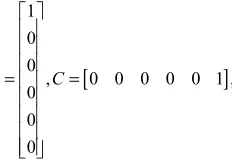
For example, the N 2 diagram of the supervisory servo controller shown in Table 1 can be modelled as Eq. (1) with B and C matrices defined as
[
]
1 0 0
, 0 0 0 0 0 1 ,
0 0 0
B C
= =
(2)
and the time-varying A (k) matrix would be varying at each event, for instance,
0 0 0 0 0 0
1 0 0 0 0 0 0 0 0 0 0 0
(1) ,
0 0 0 0 0 0 0 0 0 0 0 0 0 0 0 0 0 0
A
=
where only one entry A (1)2, 1 from mode s1, there is a only
one transition t12 is possible. The next Section will review the
definitions of structural controllability and observability and present the connection with classical controllability and observability matrix in linear systems.
3. Structural Controllability and
Structural Observability
Recall that a discrete event graph [5, 6] is structurally controllable if there exists at least one outgoing path from one input transition into each internal transition. A discrete event graph is called structurally observable if there exists at least one path reaching to the output transition from each internal transition. In practical industrial applications, users often need to find out which operational modes cannot be reached from the initial mode under any conditions, and which operational modes cannot exist in the final nodes. These questions are modified problems from structural controllability and observability in discrete event graph.
Definition 1: A discrete event system modelled as an N 2 diagram is called structurally controllable for any discrete state, if there exists at least one path from the initial node. It is called structurally observable if, for any discrete state, there exists at least one path to the final node or output node. The next proposition shows that that the structural controllability and observability of discrete event systems in an N 2 diagram can be determined using the rank conditions of the controllability and observability matrices in the traditional linear system.
Proposition 1 [3]: If the following matrix
1
( , ) n
Ctrb A B =B A∧B ⋯ A − ∧B (3)
has no zero rows, then the discrete event system modelled as an N 2 diagram is structurally controllable, where A is the transpose of the truth table of the N 2 diagram.
Proposition 2 [3]: If the following matrix
1
( , ) n
Ctrb A B =B A B× ⋯ A − ×B (4)
has no zero rows, then the discrete event system modelled as an N 2 diagram is structurally controllable, where A is the transpose of the truth table of the N 2 diagram.
Proposition 3: If the following matrix
1
( , )
n C
C A
Obsv A C
C A−
∧ = ∧
⋮ (5)
has no zero columns, then the discrete event system modelled as an N 2 diagram is structurally observable, where A is the
transpose of the truth table of the N 2 diagram.
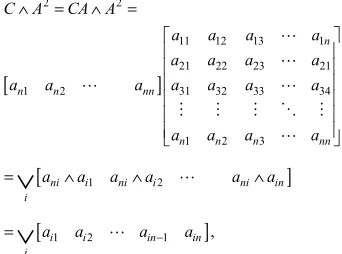
Proofs: Matrix C=[0 0 …. 1] which means that the final
node or exit node is reachable from itself. The matrix
[
]
[
]
11 12 13 1
21 22 23 21
31 32 33 34
1 2 3
1 2 1
0 0 0 1
,
n
n n n nn
n n nn nn
C A
a a a a
a a a a
a a a a
a a a a
a a a − a
∧ = = ⋯ ⋯ ⋯ ⋯ ⋮ ⋮ ⋮ ⋱ ⋮ ⋯ ⋯
where each entry is either 1 or 0 depending on whether the corresponding nodes can reach the final node, respectively. The matrix
[
]
[
]
[
]
2 2
11 12 13 1
21 22 23 21
1 2 31 32 33 34
1 2 3
1 2
1 2 1 ,
⋯ ⋯ ⋯ ⋯ ⋮ ⋮ ⋮ ⋱ ⋮ ⋯ ⋯ ⋯ n
n n nn
n n n nn
ni i ni i ni in
i
i i in in
i
C A CA A
a a a a
a a a a
a a a a a a a
a a a a
a a a a a a
a a a − a
∧ = ∧ = = ∧ ∧ ∧ =
∨
∨
where the entry aij is non-zero if and only if the node j is
reached from the node i. Continuing the calculation along with the observability matrix row by row, then if any column of the observability is zero, by definition, there is no path leading the node j to the final node.
Proposition 4: If the following matrix
1
( , ) ⋮
n C
C A
Obsv A C
C A −
× = × (6)
has no zero columns, then the discrete event system modelled as an N 2 diagram is structurally controllable, where A is
the transpose of the truth table of the N 2 diagram.
The proof is similar to proposition 4, therefore it is omitted here.
Remarks: The difference between Eq. (3) and Eq. (4) is that the matrix operations are using Boolean OR/AND, and traditional addition/multiplication, respectively. The same holds for Eq. (5) and Eq. (6).
4. Application to the Supervisory Servo
Controller
In order to show the applicability of the theoretical results presented in Section 3, consider for example, the state A of
1 0 0 0 0 0
1 1 0 0 0 0 0 1 1 1 1 0 , 0 0 0 1 0 0 0 0 0 1 1 0
0 1 0 1 1 1
A
=
and B and C matrices are given in Eq. (2). Then the controllability matrix in Boolean semring is given as
( )
1 1 1 1 1 1 0 1 1 1 1 1 0 0 1 1 1 1
, .
0 0 0 0 0 0
0 0 0 0 0 0 0 0 1 1 1 1
ctrb A B
=
Therefore, the 4th row and the 5th row are both zeros in the two controllability matrices, and therefore, the node 4 “Operation” and the node 5 “Test” are never reached by the initial mode “Start”. The reachability matrix in traditional real numbers provides the same answer as above:
( )
1 1 1 1 1 1
0 1 2 3 4 5 0 0 1 3 6 10
, .
0 0 0 0 0 0 0 0 0 0 0 0
0 0 1 3 6 10
ctrb A B
=
Similarly, the observability matrix in Boolean semring is given as
( )
0 0 0 0 0 1
0 1 0 1 1 1 1 1 0 1 1 1
, ,
1 1 0 1 1 1 1 1 0 1 1 1
1 1 0 1 1 1
obsv A C
=
Therefore, the 3rd column contains zeros in two controllability matrices, and therefore, the node 3 “Standby” cannot reach the final mode “Shutdown”. In fact, the production line will be in the deadlock situation between the internal loops without turning off the system. The observability matrix in traditional real numbers provides the same answer as above:
( )
0 0 0 0 0 1
0 1 0 1 1 1
1 2 0 3 2 1
, .
3 3 0 6 3 1
6 4 0 10 4 1
10 5 0 15 5 1
obsv A C
=
This supervisory servo controller has 6 nodes. The rank condition can be easily expanded into a large scale discrete-event model without increasing the computational complexity.
5. Conclusion
This paper presents state space representations of N 2 diagrams over the Boolean semiring and an analytical result for the structural observability of discrete event systems modelled by N 2 diagrams. The rank condition of the observability matrix determines whether internal discrete nodes can reach the final node and which nodes are the unobservable nodes. Therefore, it provides an analytical method to determine whether a discrete event system can get into and out of operational modes as required prior to hardware demonstration. It provides tremendous savings in verification time and cost. Future research can focus on stochastic N 2 diagrams, in which discrete transitions are modelled by probabilities of random variables. Potential applications can be found in genetic regulatory networks arising in biological systems.
References
[1] J. Y. Le Boudec and P. Thiran, Network Calculus, John Wiley and Sons, Springer-Verlag, 2002.
[2] C. G. Cassandras. Discrete Event Systems: Modeling and Performance Analysis. Irwinand Aksen, Boston, 1993.
[3] P. M. Sain, Y. Shang, and M. K. Sain, “Reachability analysis for n-squared sate charts over a Boolean semiring applied to hysteretic discrete event structural control model”. Proceedings of American Control Conference, June 8-10, 2005.
[4] P. Sain. “Qualitative results for a hierarchical discrete event control paradigm applied to structures operating under nominal and fault conditions,” Proceedings of American Control Conference, June 30-July 2, 2004.
[5] F. Baccelli, G. Cohen, G. J. Olsder, and K. P. Quadrat. Synchronization and Linearity: An Algebra for discrete event systems, John Wiley and Sons, New York, 1992.
[6] S. Zerhouni, P. Spacek, A. EL Moudni, and M. Ferney. “Max-plus algebra for discrete event systems-some links to structural controllability and structural observability,” In Proceedings of IEEE International Symposium on Intelligent Control, August 27-29, 1995.
[7] K. Cai, R. Zhang, W. M. Wonham. Relative observability of discrete-event systems and its supremal sublanguages, IEEE Transactions on Automatica Control, Vol. 60, Issue 3, pp. 659-670, 2015.
[8] H. Hihi, Structural Observability of Controlled Switching Linear Systems, International Journal of Control Science and Engineering, Vol. 2, Issue 5, pp. 127-135, 2012.
[10] S. Gracy, F. Garin, A. Y. Kibangou. Strong Structural Input and State Observability of LTV Network Systems with Multiple Unknown Inputs. In Proceedings of the 20th IFAC World Congress, Toulouse, France, July 9-14, 2017.