Published online November 20, 2014 (http://www.sciencepublishinggroup.com/j/ijepe) doi: 10.11648/j.ijepe.20140305.17
ISSN: 2326-957X (Print); ISSN: 2326-960X (Online)
Reducing energy consumption by considering the “wisdom
of the crowd”: USA and China study
Ali Hashemi Araghi, Ehssan Sakhaee
Department of Civil Engineering, University of Sydney, Sydney, Australia
Email address:
[email protected] (A. H. Araghi), [email protected] (E. Sakhaee)
To cite this article:
Ali Hashemi Araghi, Ehssan Sakhaee. Reducing Energy Consumption by Considering the “Wisdom of the Crowd”: USA and China Study.
International Journal of Energy and Power Engineering. Vol. 3, No. 5, 2014, pp. 261-265. doi: 10.11648/j.ijepe.20140305.17
Abstract:
Effective implementation of useful schemes that are readily accepted and implemented by a society for change require investigating the perceptions of problems and solutions as seen by a society, primarily those who are stakeholders and are most affected by change. This research aims to investigate the perceived problems and solutions of energy consumption in the two countries that contribute to the highest level of energy consumption in the world – namely China and the United States. The aim is to provide policy makers and government of better understanding the “wisdom of the crowd” when considering implementation for change – in this case reducing energy consumption in two separate societies.Keywords:
Energy Wastage, Fossil Fuel Emissions, Solving Energy Consumption, Non-Renewable Energy Sources, Renewable Energy Sources1. Introduction
In modern times—along with a dramatic growth in the global economy, technological innovation and the large expansion of human beings—industrialized areas continue to consume large amounts of energy [1]. The Energy Information Administration (EIA) [1] reports that world energy consumption will rise 56 per cent by 2040. Accordingly, the high demand for fossil fuels will add to air pollution levels and climate change due to emissions such as carbon dioxide (CO2) [2]. Figures 1 and 2, below, show the situation of CO2 emissions in different areas of the world. Figure 1 illustrates the increasing amount of energy consumed in China and rest of the non-Organization for Economic Co-Operation and Development (OECD) countries from 1990 to 2035. In 1990, China only released around three billion tons of CO2, while in 2035, four times as much energy is predicted to be emitted. However, according to Figure 2, from 1990 to 2035, the United States’ energy consumption will reduce. The total global emissions of CO2 reduced slightly between 1990 and 2007, and the proportion of total world CO2 emissions coming from the US is expected to decline to around 15 percent.
According to figure 3 [1] Sectors are consuming large amount of energy in each city, including industrial, transportation, residential (Heating, cooking, and etc.), and the
commercial sector. However, according to figure 4 [4] USA and China are two countries with the highest amount of CO2 emissions and so most of the energy in the world is consumed by these two countries alone. It is not surprisingly because these two countries are largest and strongest economy in the world.
Figure 2. Regional Shares of World CO2 Emissions: 1990, 2007, 2025 and
2035 [3].
Figure 3. World Energy Consumption by Sector 2012 [1].
Figure 4. Top10 CO2 emissions countries [4].
1.1. Purpose of Study
This paper investigates the perceived factors that contribute to energy consumption as viewed by employees of construction companies in two countries – USA and China. The primary interest is to see if there are cultural, geographical
and other situational factors (such as price of oil) that affect these perceptions. Results have been obtained via surveys of each of the countries to demonstrate these differences and solutions that have emerged from the masses from each country have been identified.
The authors believe that by better understanding the beliefs and perceptions of professionals in a society as solutions that are perceived to have the greatest impact are those that are most supported by a society. Hence governments’ decisions that take into consideration the perceived problems and solutions of qualified professionals in a society would gain greater level of support and implementation. The focus of this research is the perceptions of the problems and solutions of energy consumption of professionals working in the construction industry which include engineers, project managers, as well as owners of the organization, of the two mentioned countries. We also compere the apparent difference in the perceived problems and solutions in the two target countries.
2. Methodology
The instruments for this research will be a quantitative method investigating perceived common causes of energy wastage in various countries and also identifying possible solutions for bridging the gap in each country under study. The questionnaire consisting of 11 multiple choice questions made by REDCap online data Collection platform [5] would be used as principle instrumentation for the survey. Source of data collection could be based on electronic and paper-based. This survey is constructed in REDCap, and survey links and hard copies of the survey were anonymously disseminated to employees of construction companies located in the USA and China. Target participants for this research were professionals working in construction companies located in USA and China. The number of people participated in this research were 107 in USA and 105 person in China.
In the analysis phase, after all survey data is collected from our participants, we will calculate the average percentage for each question for each country. Consequently, we will find which parameters have are seen to have the most significant role for wasting energy in USA, and China, and which solutions are perceived to be most effective in decreasing energy wastage in the mentioned countries. The below formulae is used, where (1≤n≤5) is the number that each participant selects for each question, reflecting perceived importance (5 refer to most important and 1 refer to least important factor).
Average = ((∑n)/ (Number of Participants in each country)) (1)
3. Findings and Analysis Data
3.1. Findings Data in the United States
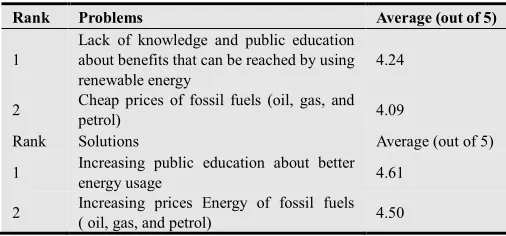
In the research performed in USA, the top two problems and solutions that resulted in the surveys, were based around public education and prices of fossil fuels. This is shown in Table 3.1.
Table 1. Perceived Factors of Energy Consumption Problems and Solutions for USA.
Rank Problems Average (out of 5)
1
Lack of knowledge and public education about benefits that can be reached by using renewable energy
4.24
2 Cheap prices of fossil fuels (oil, gas, and
petrol) 4.09
Rank Solutions Average (out of 5)
1 Increasing public education about better
energy usage 4.61
2 Increasing prices Energy of fossil fuels
( oil, gas, and petrol) 4.50
3.2. Findings Data in China
In the research performed in China, the top problems and solutions that resulted in the surveys, were based around quality of houses, prices of fossil fuels, and increasing use of renewable energy sources. This is shown in Table 3.2
Table 2. Perceived Factors of Energy Consumption Problems and Solutions for China.
Rank Problems Average (out of 5)
1 Poor housing development plans 4.15
2 Cheap prices of fossil fuels (oil, gas, and
petrol) 4.08
Rank Solutions Average (out of 5)
1 Increasing standard of new houses (for
example use double glazed windows) 4.42
2 Increasing use of renewable energy
instead of fossil fuels 4.29
4. Discussion
The discussion part focus on comparing results between United States and China, analyze and discuss why some particular factors are ranked as the most important one in each country.
4.1. Discussion about Highest Perceived Solution for Reducing Energy Consumption in USA
4.1.1. Increasing the Quality of Public Education on Better Energy Usage
Most important factor due to energy wastage in USA is lack of knowledge and public education about benefits that can be reached by using renewable energy. US households only use renewable energy on a small scale, especially when compared to other countries, such as some of Asian countries. Researchers assume that this is because people in the USA do not know much about the advantages of saving energy or using renewable energy, such as that renewable energy helps reduce greenhouse gas emissions, improve environmental
quality and public health, generate job opportunities, enhance economic development and save energy costs. Additionally, there is a correlation between lack of knowledge about benefits to be gained from renewable resources and lack of adequate public education. Many of the participant mentioned that the best solution to solve this problem is increasing the quality of public education on better energy usage. The most effective way for increasing public education can be gained by educating children as part of their school curriculum [6] as good habits and practices learned in early years is more effective than breaking bad habits later in life. Children are also more likely to adapt new ways than are adults. However, newspaper advertising, Billboards, brochure and commercials also can be effective [7] for all ages and backgrounds. Furthermore, allies of this viewpoint say this way can be permanent way to reduce energy wastage [8]. Because if children learn how to use energy efficiently, the knowledge can be passed down to their decedents and the next generation of people may have better knowledge of energy usage and continue to pass this on to their own children.
Opponents of this view say, however, this way could be effective, and it is suitable that governments consider budget about different ways to increasing the quality of public education but this is long term solution and could not be very effective in short term situations [9].
Moreover, in last two decades, the US government implemented a range of measures to reduce energy consumption in the country, but it seems that most of the projects were large in scale as they were related to government projects. Therefore, currently the most efficient action would be to increase the quality of public education in relation to better energy usage. However, increasing the quality of public education on better energy usage should be support by all government, because having knowledge about how to better use energy will be more important in the future by reducing fossil fuels resource consumption around the world.
4.1.2. Increasing Prices of Oil, Gas, and Petrol
Second important factor discovered in this research due to energy consumption is cheap prices of fossil fuels (oil, gas, and petrol) and most effective solution for decreasing energy consumption is increasing prices of fossil fuels including oil, gas, and petrol. Allies of this view says this way could be effective in short term. For instance, people encourage to use public transportation instead of private cars. Moreover, people prefer wear more clothes in winter when they are in houses to be able decreasing the temperature of heaters [10].
energy efficiency and renewable energy. By this way, level of energy consumption would be decrease considerably.
4.2. Discussion about the Highest Perceived Solution for Reducing Energy Consumption in China
4.2.1. Increasing Standard of New Houses (for Example Use Double Glazed Windows)
Poor housing development plans is the most significant perceived factor in China. However, most buildings located in large cities such as Beijing, Shanghai, and Guangzhou are new and of high quality of standard. However large amount of the population in China are living in rural area and, they are living in traditional houses, and thus suffering from lack of suitable systems to increase energy efficiency [11]. Based on survey improving the quality of new houses such as using double glazed windows is seen to be the best solution to reduce energy consumption in China.
Decisions making of constructing a new house will influence how it consumes energy in the future. People should consider to build an energy savings house that has been well designed with energy-efficient appliances. Green building can be constructed through several ways. Firstly, energy savings could be done by implementing insulation. Insulation performances as a fence to heat loss and heat gain, especially in walls, roofs, ceilings and floors [12]. The main function of insulation is to keep house warmer in winter and cooler in summer. Insulation ease reliance on cooling and heating systems. Australian Government Department of Industry [12] shows that insulation tremendously save around 40% in air condition and heating bills. It is a cost effective, practical and reliable approach to make a house to be more energy efficient. Secondly, double glazed window serves as a barrier of heat go outside. It helps remain indoor temperature without going down and eliminate the need to consume more energy to keep warm. Thirdly, as mentioned before, energy-efficient light, such as light emitting diode (LED) and compact fluorescent lights (CFL) can lower energy consumption.
Therefore, according to top paragraphs one possible solution could be give building/renovation loans to rural areas to increase the quality of houses and provide new systems for cooling and heating.
4.2.2. Increasing Use of Renewable Energy Instead of Fossil Fuels
Increasing the use of renewable energy is another solution to solve energy consumption problem in the studied countries. Participants involved in this research chose that increasing use of renewable energy can be one of the most effective way for solving energy consumption in China. Geographical factors limit domestic energy resources in China, and the country suffers from a lack of large fossil fuels resources, so are forced to depend on petroleum and coal imports to satisfy the domestic energy demand. Today China is the second largest consumer and also importer of oil in the world [13] and Chinese governments invest large amount of money to import fossil fuels from other countries. The second important perceived factor in China is cheap prices of fossil fuels
including oil, gas, and petrol and based on this research the most effective perceived solution to solve this problem is increasing the use of renewable energy. However, most of renewable energy projects need large amount of investment to be completed, and currently import fossil fuels from overseas is cheaper, but as non-renewable energy projects finally diminish, renewable sources can produce large amount of energy for all the times and it can be a stable solution to permanently solve the energy consumption problem in the years to come.
5. Conclusion
Although all of the factors mentioned are perceived to be effective in minimizing energy wastage, one major factor dominates in each country, a factor that has the most significant effect on total energy consumption. In order to effectively implement strategies to minimize energy consumption, it would be worthwhile to utilize the ‘wisdom of the masses’, the factors perceived to be the most important, which are more likely to win the hearts of the people in the target society when implemented. Understanding the current perceptions and leveraging off such an understanding is important in motivating a society to implement change. For example, in the USA, the participants’ answers of ‘lack of knowledge about benefits that can be reached by using renewable energy’ indicate that matters related to energy consumption should be dealt with by better educating the public on the benefits that can be gained renewable energy, as well as the problems caused by careless energy consumption. In China, however, the participants indicated that they would appreciate if the same problem was dealt with by improving housing development plans, and even raising the price of oil, gas and petrol, perhaps through higher taxes on non-renewable resources. Effective change can be implemented by considering public knowledge.
In Conclusion, the research outlines that there is a clear difference of perceived factors in each country. These apparent differences could be a result of socio-economical, geographical, cultural, and other possible factors that influence the perception of professionals in a society. For instance, the cheap prices of fossil fuels is a same factor in USA and China but people are working in USA believed that the best solution to solve this issue is increasing prices of fossil fuels but the same professional class in China identified the use of renewable energy instead of fossil fuels as the top solution.
Acknowledgment
We would like to express our deepest gratitude to Heidi helped us for collecting data from construction companies in the United States.
References
[1] EIA. (2013). International energy outlook 2013. Washing-ton: EIA - U.S energy information administration. Retrieved from http://www.eia.gov/forecasts/aeo/pdf/0383(2013).pdf
[2] James Hansen, Makiko Sato, Reto Ruedy, Ken Lo, David Lea, & Martin Medina-Elizade. (2006). Global temperature change. PNAS, Vol 103- No 39- pp 14288-14293.
[3] EIA, 2011. Emissions of greenhouse gases in the United states 2009, Washington: U.S department of Energy. Retrieved from http://www.eia.gov/environment/emissions/ghg_report/pdf/05 73(2009).pdf
[4] IEA, 2012. CO2 emissions from fuel combustion, Paris:
International energy agency. Retrieved from http://www.iea.org/publications/freepublications/publication/c o2emissionsfromfuelcombustionhighlights2013.pdf
[5] REDCap. (2014). Retrieved from
https://redcap-pro.sydney.edu.au/
[6] Bates, Sonya, & Tregenza, Neil. (2014, August 20). Education for Sustainability in the Early Years. Retrieved from Australian Sustainable Schools Initiative South Australia: www.decd.sa.gov.au/efs/files/pages/HallettCovePreschoolCas eSt.pdf
[7] To Reduce Energy Consumption. (2014, September).
Retrieved from Green Plant 4 Kids:
http://greenplanet4kids.com/heating-cooling/reduce-energy-co nsumption-thermostats
[8] Grantham, Stephanie. (2014, August). Household energy consumption, conservation & efficiency. Retrieved from
Alice Solar City:
http://www.alicesolarcity.com.au/sites/default/files/Alice%20S olar%20City%20Literature%20Review.pdf
[9] Ontario’s Long-Term Energy Plan. (2014, June 26). Retrieved
from Ontario Ministry of Energy:
http://www.energy.gov.on.ca/en/ltep/
[10] Agency, U. S. (2012). Resource Conservation and Recovery. U.S Environmental Protection Agency. Retrieved from http://www.epa.gov/osw/inforesources/pubs/orientat/
[11] How will a slowing China cope with rapidly aging buildings? (2013, June 28). Retrieved from China Economic Review: http://www.chinaeconomicreview.com/Unstable-Foundations-Part-2
[12] Australian Government Department of Industry. (2014). Building and Construction Industry. Retrieved from http://australia.gov.au/topics/business-and-industry/building-a nd-construction-industry
[13] EIA. (2014). China Analysis Brief Overview. U.S Energy
Information Administration. Retrieved from
![Figure 1. World CO2 Figure 1 Emissions by Region: 1990, 2007, 2025 and 2035 [3].](https://thumb-us.123doks.com/thumbv2/123dok_us/8487327.1715578/1.595.327.518.561.706/figure-world-co-figure-emissions-region.webp)
![Figure 2. Regional Shares of World CO2 Emissions: 1990, 2007, 2025 and 2035 [3].](https://thumb-us.123doks.com/thumbv2/123dok_us/8487327.1715578/2.595.58.273.453.665/figure-regional-shares-world-co-emissions.webp)