http://www.sciencepublishinggroup.com/j/jps doi: 10.11648/j.jps.20170504.11
ISSN: 2331-0723 (Print); ISSN: 2331-0731 (Online)
GC-MS Analysis of Phyto Components from the Stem Bark
of
Cola nitida
Schott & Endl
Olakunle Olayinka Mebude
*, Bola. Adeniyi
Faculty of Pharmacy, Department of Pharmaceutical Microbiology, University of Ibadan, Ibadan, Nigeria
Email address:
[email protected] (O. O. Mebude) *Corresponding author
To cite this article:
Olakunle Olayinka Mebude, Bola. Adeniyi. GC-MS Analysis of Phyto Components from the Stem Bark of Cola nitida Schott & Endl. Journal of Plant Sciences. Vol. 5, No. 4, 2017, pp. 99-103. doi: 10.11648/j.jps.20170504.11
Received: April 30, 2017; Accepted: June 27, 2017; Published: July 18, 2017
Abstract: The biochemical constituents of extracts obtained from the stem bark of Cola nitida collected from the University
of Ibadan, Nigeria is being reported. The ethanol extracts was analysed by Gas chromatography- mass spectroscopy (GC-MS) technique. The main constituents of the extracts were Cycloheptasiloxane tetradeca-methyl (35.287%), Cyclohexasiloxane dodecamethyl (24.941%), Cyclooctasiloxane hexadecamethyl (17.574%), 1H- cycloprop (e) azulen-7-ol-decahydro-1,1,7-trimethyl-4-methylene (7.816%), Cycloconasiloxane octadecamethyl (6.995%), Benzimidazol-5-amine-1-4-ethoxyp (2.265%) and 5-acetyl-2-benzylsulfanyl-6-methyl-nicotinonitrile (1.467%).Keywords: Cola Nitida, GC-MS, Phyto-Medicine
1. Introduction
Evidence exists that plants were used for medicinal purposes some 60,000 years ago. By 3500BC, Ancient Egyptians began to associate less magic with the treatment of diseases and by 2700BC, the Chinese had started to use herbs in a more scientific sense (1). The studies of botany and medicine became very closely linked during the Middle Ages virtually all reading and writing were carried out in the monasteries. Monks laboriously copied and compiled the manuscripts and prepared herbals that described identification and preparation of plants with reported medicinal characteristics. (2). Herbal medicine has become a popular form of healthcare; even though several differences exist between herbal and conventional pharmacological treatments, herbal medicine needs to be tested for efficacy using conventional trial methodology and several specific herbal extracts have been demonstrated to be efficacious for specific conditions. Nevertheless the public is often misled to believe that all natural treatments are inherently safe, herbal medicines do carry risks, so research in this area must be intensified. The main question that has not been often answered satisfactorily deals with the triad absorption/metabolism/efficacy/biochemical constituent of
herbs and their extracts which is actually an important unsolved problem in judging their many alleged health effects (3). The search for newer sources of antifungal and antibacterial is a global challenge pre occupying research institutions, Pharmaceutical companies and the academia, since many infectious agents are becoming resistant to synthetic drugs (4)
2. Materials and Methods
Cola nitida stem bark were obtained from the University of Ibadan and authenticated at the Department of Botany where a voucher specimen UIH-22487 was prepared and deposited. Dried stem bark were subjected to soxhlet extraction with distilled ethanol as extraction solvent. Extract was filtered, evaporated to dryness in-vacuo, weighed and stored.
3. Analysis of Organic Compounds in the
Plant Extracts (Gas Chromatography
Mass Spectrometry)
The GC-MS analysis of the stem bark extract of Cola nitida was carried out at the department of Chemical Engineering, University of Ilorin on Agilent 19091S Gas chromatograph (GC) interfaced to a mass spectrometer 433HP-5MS instrument employing the following conditions: silica capillary column fused with 100% phenyl methyl silox, (length; 30m x 250µm; film thickness 0.25µm). For GC-MS detection, an electron ionization system with ionization energy of 70eV was used. Helium gas (99.999%) was used as the carrier gas at constant flow rate 1.5ml/min and an injection volume of 1µl was employed (Split ratio of 50:1) injector temperature-300oC; average velocity of 45.67 cm/sec. The oven temperature was programmed from 100oC (Isothermal for 4 min.) with an increase of 4oC /min to 240oC. Total GC running time was 49 minutes. The relative percentage amount of each component was calculated, by comparing its average peak area to the total areas. The software adopted to handle mass spectra and chromatogram was a turbomass. The detection employed the NIST Ver. 2.0 year 2009 library (Paranthaman et al., 2012). After the performance of the GCMS was the identification of the components detected using their spectra.
4. Identification of Components
Interpretation on mass spectrum of GC-MS was done using the database of National Institute of Standard and Technology (NIST) which contains more than 62,000 patterns. The mass spectra of the unknown components were compared with the spectrum of the known components contained in the NIST library. The name, molecular weight and structure of the components of the test materials were also ascertained using the fragmentation patterns they exhibited and the information available in the library.
5. Results and Discussion
The biochemical constituents obtained from the stem bark of Cola nitida from the University of Ibadan, Nigeria are being reported. The ethanol extracts was analysed by Gas chromatography- mass spectroscopy (GC-MS) technique. The main constituents of the extracts were Cycloheptasiloxane tetradeca-methyl (35.287%), Cyclohexasiloxane dodecamethyl (24.941%), Cyclooctasiloxane hexadecamethyl (17.574%), 1H- cycloprop(e)azulen-7-ol-decahydro-1,1,7-trimethyl-4-methylene (7.816%), Cycloconasiloxane octadecamethyl (6.995%), Benzimidazol-5-amine-1-4-ethoxyp (2.265%) and 5-acetyl-2-benzylsulfanyl-6-methyl-nicotinonitrile(1.467%). Advances in high-throughput experimentations have resulted in massive databases of genomic, proteomic and chemical data which in combination with efficient separation methods and powerful spectrometric methods for identification and structure elucidation can be used for identification of active compounds using DNA microarray only (11)
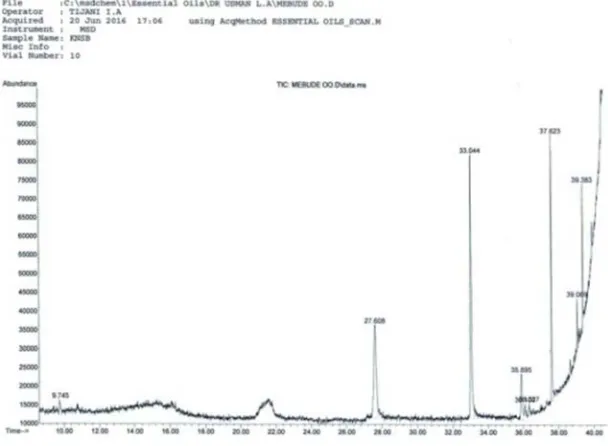
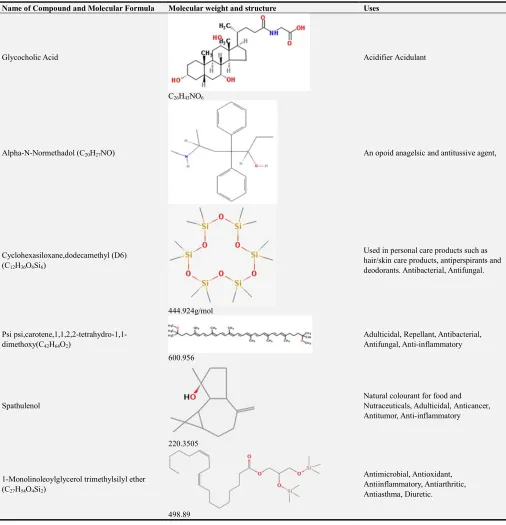
GC-MS chromatogram of Cola nitida stem bark extract (table 1, 2 and 3) showed nine(9) peaks indicating the presence of nine compounds. The chemical compounds identified in the extract of the stem bark of Cola nitida are presented in Table 1.
Figure 2. Showing retention time and peak area of essential oil.
Table 1. Showing the COMPOUNDS PRESENT IN ETHANOL EXTRACT OF Cola nitida stem bark.
Name of Compound and Molecular Formula Molecular weight and structure Uses
Glycocholic Acid
C26H43NO6
Acidifier Acidulant
Alpha-N-Normethadol (C20H27NO) An opoid anagelsic and antitussive agent,
Cyclohexasiloxane,dodecamethyl (D6) (C12H36O6Si6)
444.924g/mol
Used in personal care products such as hair/skin care products, antiperspirants and deodorants. Antibacterial, Antifungal.
Psi psi,carotene,1,1,2,2-tetrahydro-1,1-dimethoxy(C42H64O2)
600.956
Adulticidal, Repellant, Antibacterial, Antifungal, Anti-inflammatory
Spathulenol
220.3505
Natural colourant for food and Nutraceuticals, Adulticidal, Anticancer, Antitumor, Anti-inflammatory
1-Monolinoleoylglycerol trimethylsilyl ether (C27H54O4Si2)
498.89
Antimicrobial, Antioxidant, Antiinflammatory, Antiarthritic, Antiasthma, Diuretic.
**Source: -Dr. Duke’s Phytochemical and Ethnobotanical Databases. Compounds were ran through Dr Dukes database to get the properties of each compound.
The result of the present investigation reveals that the ethanolic extract of Cola nitida stem bark possessed significant anti-inflammatory, anti-oxidant, antitumor, and antimicrobial properties. The various biological activities of the compound present in the ethanolic extract of Cola nitida stem bark suggests its various activities as reported by (7), (9), (10).
The presence of steroid in the extract with strong antimicrobial, anti-oxidant and diuretic properties with the
of fungi infection and a promising alternative/adjunct/ supplement to the azole and allylamine group.
6. Conclusion
In conclusion, this study has shown that the ethanolic extract of Cola nitida stem bark possesses various compounds of interest microbiologically and pharmaceutically. Further elucidation to structurally identify the compounds using NMR and isolation of active compounds conferring on the plant the various microbiological attributes is ongoing
References
[1] United states department of Agriculture, Forest service and medicinal botany. (2005) USDA.gov.
[2] United states department of Agriculture, Forest service and medicinal botany (2005). USDA.gov.
[3] Firenzuoli F, Gori L, Crupi A, Neri D (2004). Flavonoids: risks or therapeutic opportunities? Recenti Prog Med.; 95:345–51).
[4] Latha PS, Kannabiran K. (2006) Antimicrobial activity and phytochemicals of Solanum trilobatum Linn. African Journal of Biotechnology; 5:2402-2404.
[5] Ratsch, C. (2005) The Encyclopedia of Psychoactive plants: Ethnopharmacology and its applications. Foreword Publisher
[6] Daels-Rakotoarison D A, Kouakoua G, Gressiera B, Dinea T, Bruneta C, Luyckxa M, Bailleul F, Trotin F. (2003) Effects of a caffeine-free Cola nitida nuts extract on elastase/alpha-1-proteinase inhibitor balance. J Ethnopharmacol; 89 (1):143– 150.
[7] Adeniyi et al, 2016. Invitro antifungal activities of Cola nitida on 5 Candida species and 4 dermatophytes. British Microbiology research Journal 14 (2):1-8.
[8] Odugbemi T (2006). Outlines and Pictures of Medicinal plants from Nigeria. Vol. 10. University of Lagos Press; p. 158.
[9] Kim K. Encyclopedia of Alternative Medicine. 2001; 22:203– 204.
[10] Jayeola O C. (2001) Preliminary studies on the use of kolanuts (Cola nitida) for soft drink production. J Food Technol Afr. 6 (1): 25–26.
[11] Chavan P, Joshi K, Patwardhan B (2006). DNA microarrays in herbal drug research. Evid. Based Complement. Alternat. Med.; 3:447–57).
[12] Parthipan B, Suky MGT, V. R. Mohan (2015). GC-MS Analysis of Phytocomponents in Pleiospermium alatum (Wall. ex Wight & Arn.) Swingle, (Rutaceae) J. of Pharmacognosy and Phytochemistry: 4 (1):216-222.