Journal of
Applied Research on Industrial Engineering
Journal of Applied Research on Industrial Engineering Vol. 2, No. 2 (2015) 77-85
A Mathematical Model for the Single Machine Scheduling Considering
Sequence Dependent Setup Costs and Idle Times
Ali Rafiei
1, Seyed Mahdi Homayouni
2*, Amir Shafiei Alavijeh
31,3 Department of Industrial Engineering, Najafabad Branch, Islamic Azad University, Isfahan, Iran 2 Department of Industrial Engineering, Lenjan Branch, Islamic Azad University, Isfahan, Iran
A B S T R A C T A R T I C L E I N F O
Planning and scheduling are among the most important parts of the management’s duties. Development of an efficient scheduling method can results in productivity improvement of an organization. Given the importance of production scheduling in an organization, this research seeks to propose a solution for one of the important problems for the production managers. This problem occurs if a considerable percentage of available production times is allocated to machine setup times. The objective of this research is to find a scheduling method to reach minimum of total production time, earliness and tardiness times. In previous researches not all effective factors on this scheduling method such as machine idle times and machine setup costs have been studied simultaneously. A mathematical model for the optimization of multi-product single-machine scheduling problem have been developed which considered sequence dependent setup costs, costs due to delay in delivery, holding costs, and costs related to machine idle time. Comparative results for the random small size test cases show that the proposed mathematical model can obtained an optimal solution in a relatively low computation time, however, for the large-scale cases this model is not efficient and an approximate method is required for these cases.
Article history:
Received: 5 December 2014 Received in revised format: 22 December 2014
Accepted: 25 December 2014 Available online:
10 September 2015
Keywords: “Production Scheduling”
“Sequence Dependent Setup Costs”
“Tardiness” “Earliness”
This paper is a revised and expanded version of a paper entitled [A Mathematical Model for the Single Machine Scheduling Considering Sequence Dependent Setup Costs and Idle Times] presented at [Second national conference on Industrial engineering & Sustainable Management, 2014, Lenjan, Iran].
1.
Introduction
Production scheduling is an important activity in the production and service companies. The purpose of production scheduling is to use various kinds of company resources in an optimum way in a
*
78
based schedule. Today, it is not only enough to make good decisions based on a criterion but also it isnecessary to use a multi-objective or multi-criteria decision (Tavakkoli Moghaddam, 2005). Nowadays, competition in market depends on final cost of production. Because a proper production scheduling can reduce production costs considerably, it is necessary for the manufacturers to develop more effective scheduling methods.
In order to find a good schedule and reduce production costs, tardiness, and earliness times, many researchers have conducted research via proposing mathematical models. Mokhtari et al. (2012) have divided scheduling problems into three groups in terms of the objective functions in their research:
a) with the aim of reducing the time of completing all works,
b) Reducing tardiness or earliness of works compared to the pre-determined delivery time, c) Reduction in the machine idle time.
In any case, offering a simplify production schedule plan, when the number of products on a machine is low, is relatively easy. However, increasing number of the products, existence of machine idle times, and in the case that the set-up costs depend on operations sequence, the scheduling problem is transformed into an NP-hard problem.
In some industries that the machine setup times (costs) cover considerable portion of total production time (cost), it is inevitable to investigate production schedule with regard to the sequence dependent setup costs. Zhu and Wilhelm (2005) worked on the literature review of machine scheduling with sequence dependent set up times (costs). In this review, only two research with multiple objective have been considered. Tan and Narasimhan (1997) have proposed a bi-objective model, including reduction in summation of setup costs and total tardiness times. To the best knowledge of the authors no researches investigated all effective parameters of the scheduling problem (i.e. setup times, idle times, due dates).
Allahverdi et al. (2008) believed that just few papers have considered simultaneous multi-objective in scheduling problem considering sequence dependent setup times. They said that it is necessary to pay more attention to this topic. According to literature review, following points can be mentioned as the gaps of previous research and suggestions of future research.
-
Emphasis on the sequence dependent setup times while considering costs of quality
control, test for starting production, the costs of producing non-compatible products in
order to achieve stable situation in production and so on.
-
Ignoring the machine idle times and costs related to it.
-
No analyses on the repeated jobs
-
Not paying attention to batch production of some products.
-
No investigations on the joint delivery times (various products of the same order).
This research develops a multi-objective mathematical programming model for a single machine scheduling problem. Section two review the most related researches to this paper, chronologically. Section three, presents the proposed mathematical model. In section four, a set of numerical test have been reported, in order to evaluate the performance of the proposed mathematical model. Finally, section five presents the conclusion remarks of the paper.
2.
Literature Review
79
considered minimization of the setup costs as their only objective function. Lee and Aslani (2004)considered the reduction of three objectives in the scheduling problem: a. Reducing total machine setup times
b. Reducing the tiredness numbers c. Reducing total production time
They used two methods for solving the problem including integrated planning and genetic algorithm and compared their results. Rabadi et al. (2004) considered reduction of tardiness and earliness against a joint delivery time as their objective function. Tavakkoli Moghaddam et al. (2006) tried to reduce balanced average of tardiness and earliness times in their research. Choobineh et al. (2006) compared their proposed method with a linear programming model and gained good results when the number of jobs increases. The results of meta-heuristic methods in suitable times are more reasonable than the results of linear programming model. Bigras et al. (2008) investigated the reduction of the total tardiness times as an effective objective on problem in addition to the reduction of total production time and used branch–and-bound method for solving the problem. Georgios et al. (2009) investigated the batch production scheduling problem. They considered multiple objectives (i.e. tardiness, stocks and make span reduction).
Naderi et al. (2010) reported the application simulated annealing algorithm for reducing total production time in a job shop scheduling problem. Hajinejad et al. (2011) considered delivery times of the products as an effective parameter on the scheduling problem and tried to reduce total production time. They used particle swarm optimization method for solving the scheduling problem. Karimi-Nasab et al. (2012) tried to solve problem using Meta-heuristic algorithms to minimize the completing time of all jobs on several machines. They considered two methods of simulated annealing and the genetic algorithm as two suitable methods for solving the scheduling problem. Subramanian et al. (2014) considered the problem to reduce the tardiness times under conditions of sequence dependent setup times and they used an innovative method (local search). Khowala et al. (2014) formulated the single machine scheduling problem with interfering job sets. They proposed a forward “shortest process time- earliest due date” heuristic to minimize total completion time and number of tardy jobs. Vanchipura et al. (2014) investigated the problem of production schedule in a machine assuming sequence dependent setup times in order to reduce total time of the production in some products.
3.
Problem Description and Formulation
This research proposes a mathematical programming model in order to gain an optimal multi-objective schedule and consideration of all effective parameters on the problem. This research has considered following points in its assumptions.
- Scheduling is performed for single machine (or a continuous production line). - Sequence dependent setup costs cover a considerable part of the costs.
- This is a batch production problem. - Repeated batch production is allowed.
- Inventory holding and shortage costs points are considered.
- Machine breakdown times are considered and included in objective function. - Delivery times are entered into problem independently.
3.1.
Assumptions:
Assumptions of the problem of production scheduling in single machine (or a continuous production line) are as followings:
80
- A virtual product is added to each scheduling horizon as a starting product: n=m+1- Production times is deterministic and pre-defined.
- Setup time (cost) s of each product depends on the product that is produced before it.
- Total production times plus setup times are equal or less than total available scheduling time. Therefore, some idle time can be scheduled before production of any product, so that total earliness or tardiness time would be minimized.
- Total production times in addition to setup times and idle times should be equal to total available scheduling time.
- Shortage costs are considered in two forms of dependent and independent to the time. - pre-defined Inventory holding costs is permitted.
- Costs for machines idle time are considered independent to the time.
- Each product delivery time is specified and can be equal or different from other product’s delivery times.
3.2.
Mathematical Programing Model:
For the mathematical programming of the model the following parameters are kept in mind:
m: the number of products,
n: The dimensions of setup matrix ,
TT: Total available scheduling time,
Hj: Holding costs of product j in an hour; j = 2,…, n,
Bi: Shortage costs of product j in an hour; j = 2,…, n.
Rj: Shortage costs of product j independent to the time; j = 2,…, n.
Dj: Delivery time of product j; j = 2,…, n.
E: Cost of machine breakdown (idle time) independent to the time.
Pj: Production time of product j; j = 2,…, n.
Note: all the above parameters equals to zero when j = 1.
SCij: Costs related to setup time to process product j after product i; i = 1,…, n and j = 1,…, n.
STij: Setup times to process product j after product i; i = 1,…, n and j = 1, …, n.
Moreover the following decision variables have been defined for the current model.
Wj: Earliness of product j (time that product j is produced earlier than its due time); j = 2,…, n.
Yj: Tardiness of product j (time that product j is produced later than its due time); j = 2,…, n.
Tj : Breakdown time before product j; j = 1, …., n.
Cj : Completion time of product j; j = 1, …., n+1.
Uj = {1 if the shortage occurred for product j; 0 otherwise}; j = 2,…, n.
Zj = {1 if the surplus occurred for product j; 0 otherwise}; j = 2,…, n.
Ij = {1 if breakdown occurred before product j ; 0 otherwise}; j = 2,…, n. Note: all above variables equal to zero for j=1.
Xij = {1 if product j is processed after product i; 0 otherwise}; j = 2,…, n.
In objective function (1), the phrase ∑mi=0∑mj=0SCij. Xij is considered as the sum of setup costs,
∑mj=0E. Ij as the sum of breakdown costs, ∑mj=1Bj. Yj as the sum of shortage costs dependent to time,
∑mj=1Rj. Uj as the sum of shortage costs independent to time and ∑mj=1Hj. Wj as the sum of holding costs dependent to time.
𝑀𝑖𝑛 𝑍 = ∑ ∑ 𝑆𝐶𝑖𝑗. 𝑋𝑖𝑗 𝑚
𝑗=0 𝑚
𝑖=0
+ ∑ 𝐸. 𝐼𝑗 𝑚
𝑗=0
+ ∑ 𝐵𝑗. 𝑌𝑗 𝑚
𝑗=1
+ ∑ 𝑅𝑗. 𝑈𝑗 𝑚
𝑗=1
+ ∑ 𝐻𝑗. 𝑊𝑗 𝑚
𝑗=1
81
∑ 𝑋𝑖𝑗
𝑛
𝑖=1
= 1 𝑗 = 1, … , 𝑛 (2)
∑ 𝑋𝑖𝑗
𝑛
𝑗=1
= 1 𝑖 = 1, … , 𝑛 (3)
𝐶𝑗− (𝐶𝑖+ 𝑆𝑇𝑖𝑗+ 𝑃𝑗+ 𝑇𝑗) ≥ 𝑀 × (𝑋𝑖𝑗− 1) 𝑗 = 2, … , 𝑛 𝑖 = 0, … , 𝑛 𝑖 ≠ 𝑗 (4)
𝑇𝑗− (𝐶𝑖− (𝐶𝑗+ 𝑆𝑇𝑖𝑗+ 𝑃𝑗)) ≥ 𝑀(𝑋𝑖𝑗− 1) 𝑗 = 2, … , 𝑛 𝑖 = 0, … , 𝑛 𝑖 ≠ 𝑗 (5)
𝑇𝑖 ≤ 𝑀 × 𝐼𝑖 𝑖 = 1, … , 𝑛 (6)
𝑇𝑖 ≥ 𝑀(𝐼𝑖− 1) 𝑖 = 1, … , 𝑛 (7)
𝑌𝑖− (𝐶𝑖− 𝐷𝑖) ≥ 𝑀(𝑈𝑖− 1) 𝑖 = 2, … , 𝑛 (8)
𝑌𝑖− (𝐷𝑖− 𝐶𝑖) ≤ 𝑀 × 𝑈𝑖 𝑖 = 2, … , 𝑛 (9)
𝑊𝑖− (𝐶𝑖− 𝐷𝑖) ≥ 𝑀(𝑍𝑖− 1) 𝑖 = 2, … , 𝑛 (10)
𝑊𝑖− (𝐷𝑖− 𝐶𝑖) ≤ 𝑀 × 𝑍𝑖 𝑖 = 2, … , 𝑛 (11)
𝑍𝑖+ 𝑈𝑖 = 1 𝑖 = 2, … , 𝑛 (12)
𝑇𝑇 = ∑ ∑(𝑆𝑇𝑖𝑗) 𝑚
𝑗=0
.
𝑚
𝑖=0
𝑋𝑖𝑗+ ∑ 𝑇𝑖+ ∑ 𝑃𝑖
𝑚
𝑗=0
+ 𝑇𝑙𝑎𝑔
𝑚
𝑗=0
𝑖 = 1, … , 𝑛 𝑗 = 1, … , 𝑛 (13)
𝑍1= 0, 𝑈1= 0, 𝑊1= 0, 𝑌1= 0, 𝐼1 = 0, 𝐶1= 0 𝑖 = 2, … , 𝑛 (14)
𝑇𝑗, 𝑊𝑗, 𝐶𝑖, 𝑌𝑖, 𝑇𝑙𝑎𝑔≥ 0 𝑖 = 1, … , 𝑛 𝑗 = 1, … , 𝑛 (15)
𝑋𝑖𝑗, 𝑈𝑖, 𝑍𝑖, 𝐼𝑖 = {0 𝑜𝑟 1} 𝑖 = 1, … , 𝑛 𝑗 = 1, … , 𝑛 (16) Only one product can be produced before and after a specific product, these set of constraints are presented in equations (2) and (3). Completion time of a product (Cj) is calculated through constraint set (4). Constraint set (5) to (7) of the model is to calculate idle times before production of a product (Tj). Tardiness (Yi) and earliness (Wi) times for a job are calculated through constraint set (8) to (11). However, constraint (12) implies that only one of the tardiness or earliness can be happened for each job. The cycle time or total time of all the jobs is calculated via equation (13). Equation set (14) shows that for a specific planning horizon, all the variables for the first job is set to zero. Constraint sets (15) and (16) illustrate type of the variables used in this mathematical programming model.
4.
Results and Discussion
In this section two test cases have been designed for evaluation of the proposed mathematical model. The first test case was designed so that all the possible solutions can be obtained manually, and the results of the mathematical solution be comparable to the manual solution. The second test case is a randomly generated to show the applicability of the proposed mathematical model.
4.1.
The first Test Case
82
300 $ for the second product, respectively. Moreover, tardiness cost independent to time is 2000 $ and3000 $ for the first and second product, respectively. Setup time and setup cost between the products are presented in matrices (17) and (18).
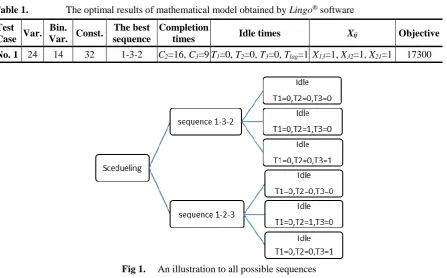
To solve the test case manually all the possible sequences for the products have been driven out and are presented in table 2. The first product for any production scheduling case is a dummy one which shows the start point of the scheduling. In this table, all possible sequences have been investigated with the consideration of the breakdown that can be planned. All possible sequences is shown in figure 1.
Setup costs matrix = [5000𝑀 100000𝑀 110003000
3000 2000 𝑀 ] (17)
Setup time matrix = [𝑀1 𝑀3 52
1 4 𝑀] (18)
Table 1. The optimal results of mathematical model obtained by Lingo® software
Test
Case Var.
Bin.
Var. Const.
The best sequence
Completion
times Idle times Xij Objective
No. 1 24 14 32 1-3-2 C2=16, C3=9 T1=0, T2=0, T3=0, Tlag=1 X13=1, X32=1, X21=1 17300
Fig 1. An illustration to all possible sequences
Table 2. The results of manual solving
The sequence The end time of jobs Idle times Xij Goal
1-3-2 C1=0, C2=16, C3=9 T1=0, T2=0, T3=0, Tlag=1 X13=1, X32=1, X21=1, 0 others 17300 1-3-2 C1=0, C2=17, C3=10 T1=0, T2=0, T3=1, Tlag=0 X13=1, X32=1, X21=1, 0 others 19500 1-3-2 C1=0, C2=17, C3=9 T1=0, T2=1, T3=0, Tlag=0 X13=1, X32=1, X21=1, 0 others 17500 1-2-3 C1=0, C2=11, C3=17 T1=0, T2=1, T3=0, Tlag=0 X12=1, X31=1, X23=1, 0 others 117150 1-2-3 C1=0, C2=10, C3=16 T1=0, T2=0, T3=0, Tlag=1 X12=1, X31=1, X23=1, 0 others 117900 1-2-3 C1=0, C2=10, C3=17 T1=0, T2=0, T3=1, Tlag=0 X12=1, X31=1, X23=1, 0 others 119750
83
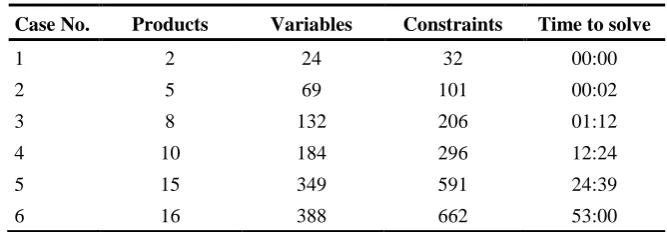
In this section six randomly generated test cases have been designed to evaluate the performance ofthe mathematical programming of the problem. Table 3 shows data of these test cases. It is obvious that as the number of products increases the number of decision variables and constraints for the test cases increases exponentially. This would be clear in figure 2. As an example if the number of products increase from 8 to 16 (doubled), the number of decision variables increase from 132 to 388 (tripled) and the number of constraints increase from 206 to 662 (more than tripled). Increasing in the number of decision variables and constraints results in increasing time to solve the test cases (e.g. for 16 products it needs more than 50 Minutes, while it was 1 Minutes for 8 products). Detailed results for these six test cases are presented in table 3.
Fig 2. The trend of increasing constrains & variables dependent to the number of jobs
Table 3. The time to solve randomly generated test cases
Case No. Products Variables Constraints Time to solve
1 2 24 32 00:00
2 5 69 101 00:02
3 8 132 206 01:12
4 10 184 296 12:24
5 15 349 591 24:39
6 16 388 662 53:00
5.
Conclusions
In this study, a mathematical model for the scheduling of multiple products on a single machine with sequence dependent setup times and costs. The novelty of this work is to schedule some variable idle time (if required) to reduce earliness or tardiness for the products in addition to determine their production sequence. Solving the small size test case shows that different feasible production sequence can decrease total costs (including setup costs, holding and shortage costs, and breakdown time costs). Moreover, total setup times can reach a minimum level compared to the production time. Obviously, breakdown times of the machine can be considered as suitable times to produce other works or do preventive maintenance operation.
In proposed model, all parameters are considered as deterministic and pre-defined parameters. These parameters can be considered as stochastic parameters to gain more actual results in future studies. Moreover, results of the random test cases shows that if the number of products need to be scheduled
24 69 132 184 349 388 32 101 206 296 591 662
0 100 200 300 400 500 600 700
2 5 8 10 15 16 N O. OF PROD U CT S IN S CHE D U LIN G HO RI ZON
84
in a period increases the number of decision variables and constraints increases in a higher rate.Therefore, time needed to solve the medium or large test cases would increase indefinitely. Although the proposed mathematical model can be considered for less than 25 products, it is suggested to develop heuristic or meta-heuristic methods for large-scale test cases, in future researches.
6.
References:
Allahverdi, A. Ng, C.T. Cheng, T.C.E. Kovalyov, M.Y. 2008. A survey of scheduling problems with setup times or costs, European Journal of Operational Research, Vol. 187, pp. 985–1032.
Alhaboubi, M.H. and Selim, S.Z. 1993. A sequencing problem in the weaving industry, European Journal of Operational Research, Vol. 66, No.1, pp. 65–71.
Bigras, L.F., Gamache, M. and Savard, G. 2008. The time-dependent traveling salesman problem and single machine scheduling problems with sequence dependent setup times, Discrete Optimization, Vol. 5, pp. 685–699.
Choobineh, F.F., Mohebbi, E. and Khoo, H. 2006. A multi-objective tabu search for a single-machine scheduling problem with sequence-dependent setup times, European Journal of Operational Research, Vol. 175, pp. 318–337.
Georgios, M., Kopanos, L. and Puigjaner 2009. Multi-Site Scheduling/Batching and Production Planning for Batch Process Industries, Computer Aided Chemical Engineering, Vol. 27, pp. 2109-2114.
Hajinejad, D., Salmasi, N. and Mokhtari, R. 2011. A fast hybrid particle swarm optimization algorithm for flow shop sequence dependent ,group scheduling problem, Scientia Iranica, Vol. 3, pp. 759-764.
Karimi-Nasab, M., Haddad, H., Feili, H. and Babaie, M.H. 2013, Solving a Batching-Scheduling Problem on a Multi-Operational Parallel Machine Using Two Meta Heuristic Algorithms. International Journal of Industrial Engineering & Production Management, Vol. 24, No. 2, pp. 225-236 (In Persian).
Khowala, K., Fowler, J., Keha, A., and Balasubramanian, H. 2014, Single machine scheduling with interfering job sets.Computers & Operations Research, Vol. 45, pp. 97-107.
Lee, S.M., Asllani, A.A. 2004. Job scheduling with dual criteria and sequence-dependent setups: mathematical versus genetic programming, Omega, Vol.32, pp.145 – 153.
Mokhtari, H., Nakhaei-Kamalabadi, A. and Zogerdi, S. 2012. Development of upper bound and Heuristic methods for order scheduling problem aiming to minimize machine idle time, Journal of Operations and Production Management, Vol. 3, pp. 41-58.
Naderi, B., Fatemi Ghomi, S.M.T. and Aminnayeri, M. 2010. A high performing metaheuristic for job shop scheduling with sequence-dependent setup times, The Applied Soft Computing, Vol. 10, pp. 703-710.
Rabadi, G., Georgios, M. and Anagnostopoulos, C. 2004. A branch-and-bound algorithm for the early/tardy machine scheduling problem with a common due-date sequence-dependent setup time, Computers & Operations Research, Vol. 31, pp.1727 – 1751.
Subramanian, A., Battarra, M. and Potts C.N. 2014. An Iterated Local Search heuristic for the single machine total weighted tardiness scheduling problem with sequence-dependent setup times, International Journal of Production Research, Vol. 52, No. 9, pp. 2729 – 2742.
85
Tavakkoli Moghaddam, R., Moslehi, G., Vaseia, M. and Azaronc, A. 2005. Optimal scheduling fora single machine to minimize the sum of maximum earliness and tardiness considering idle insert, Applied Mathematics and Computation, Vol. 167, pp. 1430–1450.
Vanchipura, R., Sridharan, R. and Subash Babu, A. 2014. Improvement of constructive heuristics using variable neighbourhood descent for scheduling a flow shop with sequence dependent setup time, Journal of Manufacturing Systems, Vol. 33, pp. 65– 75.
Yin, Y., Wu, W. H., Cheng, T. C. E., & Wu, C. C. 2014. Single-machine scheduling with time-dependent and position-time-dependent deteriorating jobs. International Journal of Computer Integrated Manufacturing, Vol. 28, No. 7, pp. 781-790.