O R I G I N A L A R T I C L E
Open Access
Interdisciplinary decision support model for
grid-bound heat supply systems in urban
areas
Susanna Erker
1*, Peter Lichtenwoehrer
1, Franz Zach
2and Gernot Stoeglehner
1Abstract
Background:In the past two centuries, energy consumption per capita has significantly increased. At the same time the fundamentals of energy provision have continuously developed towards fossil energy sources. This extended use of finite, unequally distributed and emission-intensive energy sources poses a challenge to both the energy, the climate and therefore the socio-ecological systems. Consequently, solutions are needed to reduce the fossil energy demand while fulfilling our daily energy services. District heating systems powered by renewable energy can contribute to this societal mission.
Methods:This paper presents the co called Eco.District.Heat-kit, a novel planning model supporting future
decision-making processes regarding grid-bound heating. The interdisciplinary approach assesses the feasibility of district heating systems at different locations from a qualitative and quantitative perspective. Given the lack of quick and simple planning tools in this field, the Eco.District.Heat-kit provides a time-efficient pre-evaluation on the basis of widely available input data.
Results:The decision support model rates district heating networks regarding the thematic areas of (1) integrated spatial and energy planning (2) costs, (3) resources, and (4) environment and climate. In addition, it involves a long-term planning horizon by including spatial development and climate scenarios until 2050. Finally, the Eco.District. Heat-kit identifies parameters both positively and negatively influencing the overall rating. This enables end-users to sort out non-optimal configurations before entering a more detailed planning stage.
Conclusions:Due to the straightforward methodological approach and the focus on basic parameters of district heating system planning, the Eco.District.Heat-kit supports energy suppliers, urban-planners and decision-makers at the beginning of planning processes. In order to increase both transparency and applicability of the model, its functionality and input parameters are disclosed within this paper, enabling the recreation and adaptation towards user-specific needs and local situations.
Keywords:Energy supply, District heating, Preliminary assessment, Cross-thematic evaluation, Urban planning, Integrated spatial and energy planning, Decision support model, Eco.District.Heat-kit
© The Author(s). 2019Open AccessThis article is distributed under the terms of the Creative Commons Attribution 4.0 International License (http://creativecommons.org/licenses/by/4.0/), which permits unrestricted use, distribution, and reproduction in any medium, provided you give appropriate credit to the original author(s) and the source, provide a link to the Creative Commons license, and indicate if changes were made.
* Correspondence:[email protected]
1Institute of Spatial Planning, Environmental Planning and Land
Rearrangement, University of Natural Resources and Life Sciences, Vienna, Peter-Jordan-Strasse 82, 1190 Vienna, Austria
Background
Urbanization and the energy system
The world’s population has increased significantly during the last decades, triggered by improved health care sys-tems, the industrial production of nitrogen fertilizers and the Green Revolution, leading to rising agricultural yields [1]. Besides the initiated hyper exponential growth of population within the last 2000 years and substantial growth rates within the last century [2], its spatial distri-bution has also shifted. Since the beginning of this millen-nium, more people are living in urban than in rural areas for the first time in history. This so called “urbanization” leads to the spreading of urban lifestyles especially effect-ive in states with expanding industries and/or low poten-tials for employment in rural areas [3,4]. The Population Division of the United Nations Department of Economic and Social Affairs predicts further global population growth from now 7.5 to 9.7 billion until 2050. By then, 6.4 billion people (about 65% of the total population) may live in cities [5]. Figure1illustrates both, the trend of growth and urbanization since 1950 and gives an outlook on how urban and rural regions may develop in the future.
Along with population growth and the physical, func-tional and social expansion of urban life, another global trend has been noticed over the last decades, regarding the use of energy. Before the industrial revolution, the energy consumption reached 20 GJ per capita and year, translating to approximately 20 EJ of global energy use in 1800 [6]. Due to economic growth, industrialization and the multiplying population [1, 7, 8], the global pri-mary energy use has grown to about 80 GJ per capita or
600 EJ in total in 2017 [9,10]. Furthermore, not only the extent but also the areas of consumption have changed. Figure 2 illustrates the over-proportional consumption of industrialized countries per capita and the increasing energy demand and population in developing regions within the last years. Considering urban growth rates in developing countries, a strong increase in energy con-sumption can be assumed analogously in these areas.
However, not only the total amount per capita but also the composition of energy consumption has radically changed, as shown in Fig. 3. Whereas biomass was the dominant source of energy in the early 1800s, since the middle of the twentieth century traditional biofuels were increasingly replaced by fossil energy sources such as coal, oil and gas.
Estimating future developments regarding the energy system, today’s global primary energy consumption will increase by another 30% till 2040 [11], enabling mechan-ical work, lighting, heating and cooling for society. How-ever, this trend causes far-reaching challenges. Since the majority of our current energy use is based on fossil and thus emission-intensive, unequally distributed and finite energy sources, our energy consumption exceeds the limits of global carrying capacity. On the one hand, this refers to the currently unsustainable and depleting use of limited resources such as oil, coal and gas and, on the other hand, to global warming, which is largely caused by the use of fossil fuels [12]. Therefore, the already high, still rising and fossil based energy consumption ap-pears to be one of the grand challenges of our time, also reflected in national and international strategies aiming
to protect our climate by transforming the energy sys-tem [13–16]. Concluding from documents such as the Kyoto Protocol(s) or the Paris Agreement, 1) the reduc-tion of energy consumpreduc-tion, 2) the increase in energy ef-ficiency and 3) the expansion of renewable energy sources are“key-objectives”. Based on these three goals, measures have to be determined to cut negative trends in global energy consumption, even if the demand for af-fordable, acceptable and accessible energy services of the steadily growing world population will presumably increase.
For an effective implementation of measures in line with international strategies on energy reduction, effi-ciency and decarbonization, it is mandatory to identify those key areas and aspects enabling optimal transform-ation processes. Here, the constantly increasing urbanization processes offer a new scope of action. Since urban areas are characterized by
a diverse mix and high density of consumer groups (e.g. the mix of functions such as housing, industry, retail and trade, services and mobility),
Fig. 2Growth in worlds population and primary energy use, 1800 to 2001 (own illustration according to [6])
a variety and high density of social and technical infrastructure (e.g. supply and disposal,
communication, transport infrastructure, financial system, education system, health system, cultural institutions, public safety, sport and leisure),
a broad spectrum of energy uses (e.g. heating, cooling, lighting, mechanical work, electricity)
and a mixture of energy services (e.g. hot water preparation, space heating, food preparation, supply and disposal, production, information,
transportation)
they accumulate high energy demands per area. Therefore, it is not surprising that 2.
3 of the world’s primary energy needs and 70% of total carbon emissions originate from urban areas [17]. Besides these energy-demanding effects, the multi-layered distribution of energy dependent uses and functions on scarce space compensates temporal fluc-tuations in supply and demand [18]. Accordingly, measures implemented in urban areas can be particularly effective.
In order to explain this effect more closely, the study at hand is dedicated to the evaluation of potential transformation measures within urban energy supply systems while keeping energy reduction, efficiency and decarbonization strategies in mind. Hereby, our study depicts one central aspect of the urban energy system by focusing on heat supply.
Heat supply
On a global level, energy used for heating accounts for 1.
3 of primary and 1.
2 of global final energy
consump-tion. Three quarters of the total primary energy used for heating is based on fossil fuels, while about 55% of this fossil fuel demand can be linked to industry and 40% to buildings. Overall, the building sector divided into resi-dential and commercial buildings accounts for the lar-gest amount of consumed heating energy, mostly used for space heating, but also hot water preparation and cooking [19]. Noteworthy, these three forms seldom quire more than 100 °C, in contrast to process heat re-quirements within the industry sector [20].
Referring to the European level, the residential building sector also has priority when it comes to efficient and sustainable use of energy. With more than 3000 heating degree days per year, heating is prerequisite for a high level of living comfort within colder climates in Central and Northern Europe [21, 22]. At the same time, al-most 75% of heating is fueled with fossil energy, while natural gas being the dominant fuel for households and industry nowadays [23]. Figure 4 illustrates both the estimated proportions of heat used in residential and service sector buildings on global and European level with respect to used energy sources according to [24]. Comparably more natural gas is used on the European level, while significantly higher shares of combustible renewables are used on the global level. Around 13% of the heat is supplied by district heating (DH) in the European Union, whereas only 8% worldwide.
The question remains open, how these consumption patterns can be changed in order to improve overall thermal-energy performance and, therefore, inhibit glo-bal warming, safeguarding the environment and creating resilient energy systems. On the one hand, the answer is
seen in a reduced heating demand, e.g. by refurbishing the existing building stock. On the other hand, imple-menting efficient forms of renewable energy utilization and implementing building-integrated renewable energy supply systems at the urban level will play a decisive role [25]. By promoting state of the art technologies of heat supply, decarbonization should be supported. Here, DH can be seen as one of the key technologies in urban areas.
District heating
DH has been used since the late nineteenth century and is experiencing an upswing ever since [26]. One reason is the possibility to use either one or more energy source(s) such as natural gas, biogas, wood chips and wood pellets for heat generation. DH is not only able to generate heat from different energy sources but also allows the use of otherwise unusable waste, sewage sludge or waste heat from sewage or industry [19,26]. Due to the central use of large, automatically operated heat generators with fine dust separators, pollution can be reduced compared to in-dividual combustion technologies. Another reason for the increased usage of DH might be the “recovered” room within buildings linked to the district heating network (DHN), since the room requirements for central heating systems or boilers are eliminated. Furthermore, there is no need to deliver or store energy sources at home as well as to deal with on-site maintenance [27]. At the same time, heat networks must be seen as isolated solutions, quite in contrast to the widely connected gas and electricity grids. Due to heat distribution losses, the benefits of DH do not automatically justify large, regional or national installa-tions [28].
Looking at the European level, especially countries with above-average climate-related demand for heating focused on the expansion of DH in the past [21, 22]. As shown in Fig. 5, about 50% of the total district heating sales in the European Union take place in Poland, Germany, Sweden, and Finland. Con-sidering the average use across all European member states, DH mainly supplies the residential sector (45%), followed by the tertiary sector (24%) and the industry (11%). The highest shares of population served by DHNs per member state can be found in Scandinavian and Baltic countries, followed by Central and Eastern Europe. DH gain little importance in Southern Europe [29].
Besides the country-specific expansion and sector-dependent usage of this technology, the energy sources for DH can also be described as heteroge-neous. In Eastern Europe, fossil energy such as coal and gas almost completely cover the energy supply for DH. In Sweden, Austria, and Estonia, Biomass represents the central energy input. Iceland is charac-terized by a high amount of geothermal energy, cov-ering 97% of energy inputs for DH. Other forms of energy such as solar thermal play a subordinate role at European level. In conclusion, up to 3.
4 of DH is based on fossil energy in the European Union [24, 29, 30]. Due to climate protection reasons, renewable en-ergy will have to increase in future district heating systems (DHS).
The long-term feasibility of this technology highly depends on national and international energy policies [24, 31]:
by building, owning, and managing DHSs, local authorities are seen as one central driving force behind DH [32]
mandatory connections to DHS in newly built and / or redeveloped buildings and /or districts support the development of DH [29,32]
the desire of being independent from fossil energy imports promotes this technology [32,33]
policies concerning low carbon energy by e.g. promoting bioenergy in close consultation with the agricultural sector, using waste heat and introducing taxes on fossil fuels set more incentives in favor of DH [32,33]
country-specific fiscal schemes, legal regulations as well as spatially coordinated energy planning strategies are shaping the penetration of this technology [29]
Regarding the broad spectrum of possible applications as well as restrictions of DH, there is the need to a) guide energy transition activities within the heating sector to-wards low carbon, b) promote the expansion of renewable energy and c) support planning authorities on the devel-opment of suitable heat supply systems. In order to be able to offer this kind of support and to foster the long-term economic and environmental feasibility of DHS in terms of affordable, acceptable and accessible energy, we identified four thematic areas playing a decisive role
(displayed in Table1): integrated spatial and energy plan-ning (ISEP), costs, resources as well as environment and climate.
By interlinking these four areas, DHS feasibility can be holistically assessed by keeping urban structure, techno-logical and economic options as well as environmental and climate protection in mind. Furthermore, social as-pects are indirectly taken into account through this multi-layered consideration, since those energy systems and technologies might be supported and accepted by the public, which guarantee secure, resilient, clean and affordable energy while ensuring at least welfare neutrality [34]. Consequently, economic and environmental feasibil-ity are not only fundamental to technological penetration but also determine social acceptance, e.g. through monet-ary benefits, novel employment opportunities, reduced pollution, and balanced ecosystems resulting from safe, re-liable and decarbonized energy technologies [35].
Therefore, the following research question arises: How is it possible to take the issues ISEP, costs, resources as well as environment and climate into account and thus support future decision-making processes for DHS?
Methods
Cross-disciplinary decisions in integrated spatial and energy planning
In order to answer the research question on how to take the four levels ISEP, costs, resources as well as
Table 1Four relevant areas for strategically support decisions on DH (own table)
Integrated spatial and energy planning (ISEP): Challenges always have a spatial relation, as do their solutions. Energy-related issues such as the efficient extraction, conversion, distribution, storage and use of energy as well as the choice of available technology need to be spatially
coordinated. Here, the research field of“integrated spatial and energy planning”(ISEP) comes into action, dealing with the spatial dimension of energy supply and demand [39,40]. The consideration of energy related aspects in the course of spatial planning can significantly influence the energy supply, distribution and consumption as well as the associated greenhouse gas emissions through the strategic organization and control of functions and uses in space.
Costs: Costs play a central role in the probability of technological conversion. In the end, potential heating systems will be attractive to both investors and customers if alternative options available for heating are associated with higher costs. This requires not only the consideration of the costs of heat generation, but also the construction of the network and the heat generation facilities. Focusing on the chosen technology, it depends on both technical and spatial conditions, whether a technology can be cost-efficiently installed at one specific place.
Those forms of energy carriers and technologies should be preferred which are regionally and/or locally available in order to reduce import costs and use potentials at hand, such as renewable energy, waste heat from sewage or industry and waste and sewage sludge incineration.
Resources: In line with the "Roadmap to a Resource Efficient Europe", EU Member States are called to remove barriers to resource efficiency. The roadmap claims to complement existing energy efficiency strategies for buildings with resource efficiency strategies that focus on a wider range of environmental impacts throughout the life cycle of buildings and infrastructure with sustainable use of materials and waste recycling [41]. In the light of heating systems, resources cover all materials that are bound by both the energy grids, the production sites as well as the buildings of the energy consumers. Here, type and age of the“building” under consideration influence the amount, composition and efficiency of the used materials. Consequently, the size of power plants, the length of needed pipelines and the need for rare, valuable or harmful materials play a central role.
Environment and Climate: As briefly explained in the introduction, the energy system is a main driver of anthropogenic greenhouse gas emissions and thus the main cause of human-induced global warming [23,42]. Regarding direct and indirect effects through carbon-dioxide-emissions, both the level of current energy consumption and, in particular, its composition plays a decisive role. The lower the energy consumption of our society, and the higher the share of renewable energy sources, the more emission-extensive and ecological compatible energy can be used.
environment and climate into account, it is essential to evaluate which forms of valuation models are currently available for the analysis of DHS. Moreover, it needs to be clarified, whether the existing models consider and link the four areas of interest.
In recent years, numerous tools for planning practice have been developed to support the transformational processes within the energy system from a spatial plan-ning perspective [36]. These planning tools serve the purpose of creating and homogenizing information ra-ther than only collecting and preparing data. In the best case, tool application is able to trigger discussions, resulting in awareness-raising effects while supporting future planning decisions [37].
Resulting from various, disciplinary perspectives, plan-ning tools show great differences in their thematic orienta-tion, applicability, availability and manageability. Following characteristics of planning tools supporting transform-ational processes of the energy system had been identified over the last years (e.g. [38,39]):
Tools can help to evaluate the status quo, compare planning perspectives or use scenarios in order to cover a wide range of development perspectives.
Tools can be based on qualitative arguments (checklists) and/or quantifiable facts (calculators). Depending on the type of decision, qualitative
evaluations support a structured discussion, e.g. on how aspects should be implemented. In case of quantitative assessments, data can be calculated or estimated.
Tools can be used in a variety of decision-making situations, both universally applicable or answering a very specific, narrowly defined issue. Additionally, different topics can be addressed: results may indi-cate direct spatial consequences, conflict potentials, CO2-emissions, ecological footprints or even
eco-nomic aspects such as infrastructure cost or regional economic effects.
Tools differ in terms of spatial perspective, as they can be implemented on regional, municipal, district, local, object or individual level. Due to the high level of complexity on the regional level, the number of available tools increases with smaller scales.
Tools differ in their complexity and level of detail, ranging from rough estimations with few input parameters to complex models, based on a large number of detailed input, requiring precise knowledge of the particular situation.
Tools generate a wide range of different results, such as new data sets or ratings. Some are capable of generating information about system
interrelations from a factual and/or value point of view. Depending on the considered system relations and how aspects are integrated or omitted, different
results are“produced”. Therefore, both the chosen method as well as the form of input data lead to different results.
While there are great differences between tools, they all have one thing in common: the starting point and im-petus for the development of a tool determines its later functionality and outcome. Due to the resulting concep-tual, contextual and methodological differences, it is es-sential to understand what tools do (chosen methods) and why they do it (impetus and objectives of the devel-opers) in order to apply them to concrete decision-making situation. The problem relies in the se-lection, interconnection and weighting of methods, input data and indicators, often only known to tool-developers and untouchable or invisible to users.
With regard to DH, more and more planning tools had been developed within the last years [40–42]. In the sense of the above-mentioned characteristics, these tools often support detailed planning approaches such as the technical or the economic feasibility of DH (e.g. [43–46]). In some cases, spatial aspects are additionally imple-mented (e.g. [47–51]). However, there are no simple pre-evaluation methods available concerning whether a DHS is feasible on a selected location or not. Conse-quently, extensive data sets are essential in order to carry out evaluations using existing approaches. Furthermore, most of the planning tools focus on one of the subject areas identified in chapter“District heating”, while missing out on interlinking them.
The Eco.District.Heat-kit
Given the lack of holistic planning models, the so called Eco.District.Heat-kit (EDHk) was developed on the ex-ample of the European member state Austria in the course of the FFG1-funded project “Eco.District.Heat” from 2016 until 2018. The EDHk represents a decision support model corresponding to the first stage of tool development, which discloses the impetus and objectives of its developers while staying adaptable to user- and regional-specific requirements.
assessments (SEA) to assess the potentials and limits of our environment [52, 53]. By applying and integrating these two methods, it becomes possible to incorporate both qualitative and quantitative aspects of DHS, while assessing and comparing the four relevant levels ISEP, costs, resources, and environment and climate.
Preference matrices
When using preference matrices, individual attributes are aggregated into abstract, overall features. This ap-proach of merging individual characteristics into a final result is based on IF-THEN relations, regarding a chosen pair of attributes: “IF attribute 1 has the value A AND attribute 2 has the value B THEN both values can be ag-gregated to a total value of A”. Depending on the weighting of both attributes, the overall result can be shifted [54].
Therefore, preference matrices represent a method of prioritization, based on the pairwise aggregation, linking the factual and the value level while stimulating content-related discussions. In this context, the factual level describes measurable facts with regard to a specific topic and can be determined by valuation models. Con-sequently, the factual level corresponds to an approxi-mation of reality. The value level denotes attitudes and opinions towards a certain issue [55, 56]. By selecting relevant features, calibrating them and negotiating the weighting within the matrices, both facts and values can be considered within preference matrices.
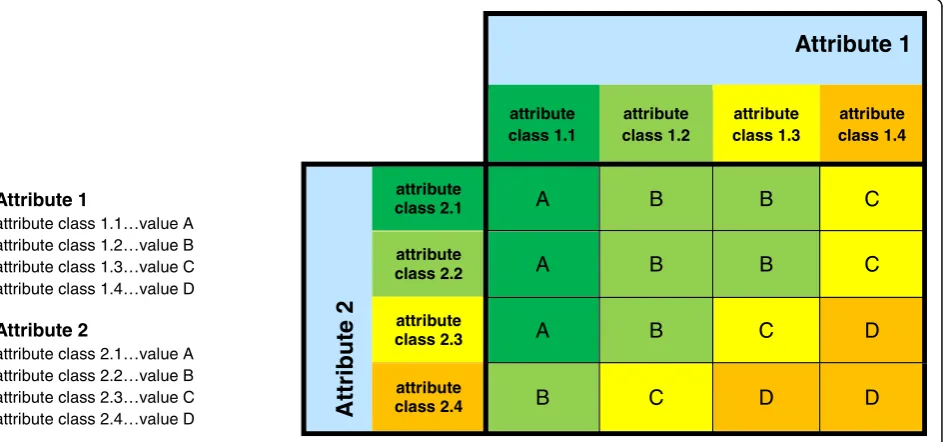
Figure6illustrates the aggregation mode of a fictitious preference matrix. Two attributes (1 and 2) are blended together by using four attribute classes (A to D). The number of classes can be even or odd and freely
selected. The boundaries between the feature classes are also variable, but should be based either on already established limits or expert opinions. In any case, the class limits have to be disclosed in order to allow a transparent and comprehensive evaluation and to make facts and values behind the matrix visible.
The center of the matrix filled with valuations from A to D reflects the values of the linked attributes and re-sults from the weighted intersection of rows (attribute 2) and columns (attribute 1). In the illustrated case, bute 1 has a stronger influence on the rating than attri-bute 2. In particular, the two attriattri-bute classes “1.1” and “1.2” of attribute 1 dominate those of the second attri-bute. The prioritization changes from attribute“1.3” on-ward. The chosen example shows, that positive ratings (here“A”and“B”) dominate rating classes from C to D.
Decision trees
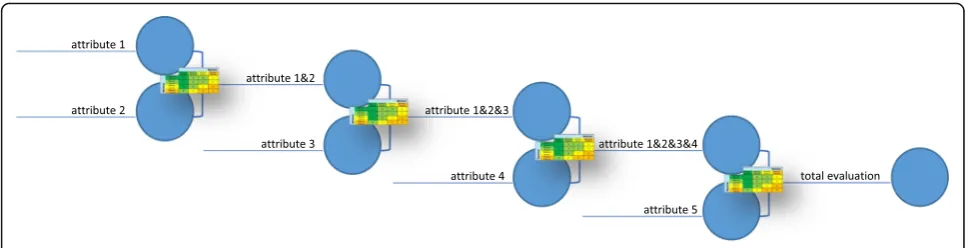
With the help of preference matrices, it is possible to merge two attributes, taking weighting and attribute classes into account. However, when aiming to describe and evaluate an entire system such as a DHS from a comprehensive point of view, it becomes necessary to link more than two attributes. Decision trees make it possible to rank and link different kinds of attributes or even preference matrices [57, 58]. Herein, the ranking within the“tree”determines the value of the attribute or the preference matrix. Components, standing at the be-ginning of the evaluation chain are superimposed by successive components and therefore, will be dominated by their evaluation results. Figure7represents a decision tree, connecting multiple preference matrices:
Attribute 1
attribute class 1.1…value A attribute class 1.2…value B attribute class 1.3…value C attribute class 1.4…value D
Attribute 2
attribute class 2.1…value A attribute class 2.2…value B attribute class 2.3…value C attribute class 2.4…value D
Attribute 1
attribute class 1.1
attribute class 1.2
attribute class 1.3
attribute class 1.4
Attribute 2
attribute
class 2.1 A B B C
attribute
class 2.2 A B B C
attribute
class 2.3 A B C D
attribute
class 2.4 B C D D
Accordingly, the following procedure is to be followed when combining preference matrices and decision trees:
1. Collecting the attributes: All attributes important to the evaluation of a chosen topic need to be collected (e.g. literature review or review of existing models)
2. Determining the attribute classes: In order to make the pre-selected attributes assessable, attribute classes need to be defined
3. Ranking the attributes: With regard to the evaluation, the most important attributes have to be inserted at the end of the rating chain, while less important attributed should be started with. This ranking can be determined by using a decision tree 4. Linking pairs of attributes: Using preference
matrices, the collected and ranked attributes should be aggregated into abstract, overall features.
Implementation of the methods
In the beginning of the research process, an interdiscip-linary research team searched for district heating-related parameters in the context of Austria. The research group consisted of experts from the fields of spatial planning, integrated spatial and energy planning, energy eco-nomics, building and materials science. Based on a comprehensive literature review and expert know-ledge, the research team identified 31 interdisciplinary parameters concerning DH. By using a modified ver-sion of the system analysis after Vester [59–61], the pairwise influence of these 31 parameters on each other was tested in order to evaluate the ability of pa-rameters to influence (system drivers) or being influ-enced (control variables). The following eight parameters turned out to particularly influence DHS and therefore, are of special interest for the develop-ment of the EDHk: 1) type of the buildings to be sup-plied by DH, 2) mix of functions, 3) thermal insulation potential, 4) density of workplaces, 5) potential of compacting and extension, 6) building density, 7) population density and 8) used heat sources. The
selection and evaluation process as well as the detailed definition of the eight influencing parameters and characteristics of the remaining parameters are docu-mented in (Zach F, Erker S, Stoeglehner G: Factors in-fluencing the environmental and economic feasibility of district heating systems – a perspective from inte-grated spatial and energy planning, unpublished).
Following the 31 parameters while especially focusing on the eight influencing ones, attributes were identified to form the centerpiece of the EDHk. In contrast to pa-rameters, attributes correspond to measurable quantities. Therefore, attributes can either be congruent with the parameters itself or serve to describe them. Starting with a literature review, attribute classes were deter-mined while necessary input data and calculation steps were defined.
Hereinafter, the attributes were ranked using decision trees and preference matrices. Together with national experts from energy and urban planning practice, the identified attributes, the attribute classes, the input data, the calculation steps as well as the rules of aggregation within the individual matrices had been discussed, reflected and eventually adapted. In particular, attention was paid to the integration of scientific knowledge and practical knowledge.
Finally, the applicability of the model as well as the re-liability of its results were tested, based on eight hetero-geneous case study areas in Austria (see [62]). Additional insights and findings had been incorporated into the model and completed the development of the EDHk in June 2018.
In accordance with this approach, 42 attributes and 35 matrices had been developed and integrated into the EDHk (see Additional files 1, 2 and 3). Additionally, a list of required input data and possible calculation ap-proaches to determine the attribute classes can be found in the appendix. By following the methodological in-sights of the EDHk in this chapter and using the Additional files 1,2 and 3, the interdisciplinary decision support model for grid-bound heat supply systems in urban areas can be applied.
Results
The EDHk represents an interdisciplinary decision sup-port model to evaluate the long-term suitability of DHS in urban areas. Therefore, the result section is dedicated to the description of this novel approach. First, relevant framework conditions for the EDHk are determined. Second, the selected attributes, required data inputs and the rules of aggregation are elucidated. By applying the EDHk, the sections ISEP, costs, resources as well as en-vironment and climate gradually come together to form a holistic picture of the DHS under evaluation. Poten-tials and restrictions of DHN on a selected site become visible. Finally, the implementation of an overall rating is discussed in the third section.
Framework conditions
In order to ensure a high level of applicability, essen-tial framework conditions need to be clarified before the actual evaluation starts. Otherwise, decision models can quickly lead to ambiguity and frustration among its users. Accordingly, we dedicate this section to the following two points: preparatory data collec-tion and rules for delimitating and subdividing the project area.
Before applying the EDHk, relevant input data has to be collected. Knowledge concerning the urban district as well as the existing and/or planned heating supply sys-tem is decisive for the successful and optimal use of the EDHk. Central inputs are listed in the Additional file2. The more data about the planning project and the plan-ning area is available, the more conclusions can be drawn from the results with regard to subsequent effects as well as implementation and improvement potentials. In any case, users benefit from local knowledge in order to estimate eventually unavailable data. As the EDHk
was developed on the example of Austria, input data and calculation steps are state-specific. However, we fo-cused on the integration of widespread data (e.g. by EuroStat) in order to transfer the EDHk to further spatial contexts.
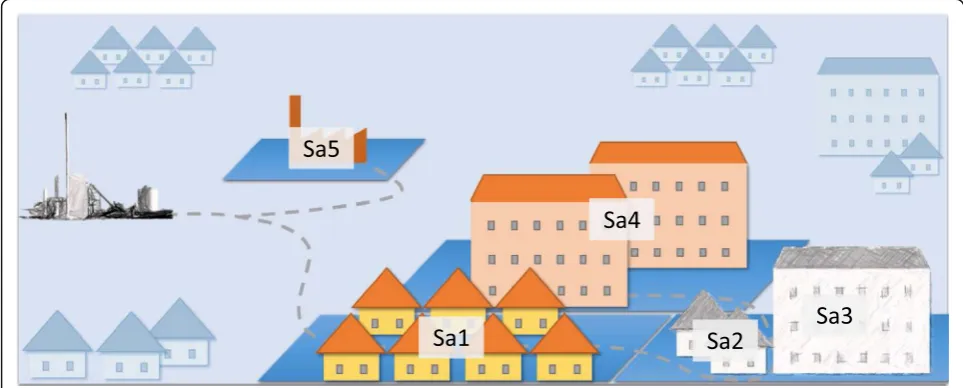
Subsequently, a detailed delimitation of the project area has to be followed. This includes all areas that are directly affected by the planned DH project, such as existing residential, service and industrial buildings as well as future settlement development projects. Excluded are those areas without any relevance to the planning project until 2050. After delimiting the project area, it has to be subdivided into a maximum of five homoge-neous subareas in order to ensure manageability of the results. This subdivision has to be based on urban plan-ning principles: At the beginplan-ning, a distinction should be made between building land and grassland. Small-scale green areas are to be assigned to the corre-sponding construction areas. Thereinafter, the building land can be differentiated with regard to its current (col-ored buildings) or planned (black and white buildings) predominant use, while the following categories can be considered: “housing”, “services”, and“production”. The final differentiation is based on the most dominant building type, corresponding to the usable floor space per area. Here, a distinction can be made between “single-family houses”, “terraced houses”, “multi-story buildings”, and “industrial and commercial buildings”. The following figure shows a possible subdivision into multiple subareas (see Fig. 8).
After a) the necessary gathering of data and informa-tion on the DH project and the planning area and b) the delimitation and subdivision of the project area into a maximum of five subareas, case study settlements can be evaluated by the EDHk.
Assessment of district heating relevant attributes
In order to give insights on both the impetus and objec-tives as well as the methodology and functionality of the EDHk (see Cross-disciplinary decisions in integrated spatial and energy planning), the following subchapters will illustrate why certain attributes were chosen. Fur-thermore, questions about i) how the chosen attributes can be estimated by selected input data and calculation steps and ii) how estimated attributes might be aggre-gated by using preference matrices will be answered in the Additional files2and3.
Embedding the project in a planning period
In order to start the evaluation, general information about the project unfolding validity across all four levels is needed. This includes information on possible development scenarios such as trends of building refurbishment, popula-tion growth as well as possible effects of climate change up to 2050. All of these scenarios can significantly influence the future possibilities of DH within the urban district under investigation and should be roughly estimated.
Integrated spatial and energy planning
In order to evaluate the spatial feasibility of DHS, both relevant and easily assessable attributes in the Austrian context were selected. After several iterative coordin-ation processes within the research project, 17 attributes for ISEP had been defined, based on 41 entries (input data) and the methods described in chapter “Preference Matrices”. The exact linkages of attributes, input data and calculation steps can be taken from the Additional files2and3.
Concerning the topic ISEP, the research team focused on information about 1) heat consumers and heating de-mand (location analysis), 2) the distribution of energy (grid analysis) as well as 3) the potential heat sources (heat source analysis). These three areas determine, whether the selected settlement is suitable for a DHS or not from a spatial and technical perspective.
At first, knowledge concerning the attributes“heat de-mand”, “heat demand density”, “mix of functions” and “mixed system use”is necessary to estimate whether the existing heat requirements justify the long-term imple-mentation of a grid-bound heat supply system [63]. Taking into account qualitative and quantitative input data concerning“building typology”,“the share and type of predominant utilization” and the “construction period” of buildings, important estimations concerning the heat demand can be carried out. In combination with the“size of each subarea”and information concern-ing the “development scenarios” up to 2050, the results of the consumer related analysis can be refined. By reporting potential “high temperature process heat de-mand”,“space heat demand”and“hot water demand”of
the industry and service sector, the EDHk is able to evaluate the attributes “heat demand per year” with re-gard to high temperature heat, space heat and hot water, the “heat demand density” as well as the “mix of func-tions”. Finally, it must be clarified whether there should be a mixed system use e.g. by additionally implementing district-cooling.
Secondly, inputs concerning existing and planned net-work infrastructure are required to estimate whether the network lengths and the degree of utilization justify the use of a DHS due to associated heat losses and an effi-cient use of space [27, 64]. In that sense, the “type of network”, its “lengths” and the“planned degree of con-nection” play an important role when it comes to later suitability of DHS. By incorporating previous inputs, the EDHk can determine the occupancy density in GWh per kilometer and year, which is crucial for the efficient op-eration of a grid-bound heating network. In addition, the network specifications will be used to determine whether there is a parallel operation of a gas and a DHS. Consid-ering fundamental parts of a resilient energy system, such as redundancy and diversity, a parallel network structure will be positively assessed from an energy se-curity point of view, while occupancy rates might suffer from duplicate structures. Subsequently, information on the“possible cascading use”of heat is required. The cas-cading use of heat not only ensures efficient energy use, but also avoids the installation of non-essential energy generation and distribution systems, whereby land con-sumption can be minimized.
The last part of the ISEP evaluation focuses on the analysis of the potential heat sources for DHS. It is ne-cessary to estimate the heat potential across all subareas and set them in relation to the heat requirements and the potential distribution network. Thus, the potential of locally available heat supply in GWh/a needs to be assessed, distinguishing between decentralized and ctralized technologies as well as fossil and renewable en-ergy sources. Depending on the availability of the chosen heat sources, the level of heat to cover process heat, space and / or hot water demands can be assessed. Finally, the availability of “energy storage devices” needs to be assessed in order to evaluate the potential of com-pensating possible fluctuations in production or consumption.
Costs
The goal of the costs section is to evaluate the most cost-effective DHS. For this purpose, both already speci-fied attributes and new user-inputs are taken into ac-count. The cost evaluation is based on five additional entries and eleven attributes that are blended to form an overall result.
Already specified scenarios with regard to “settlement developments” and “building refurbishments” are incor-porated in the cost evaluation. Both scenarios pose an indirect influence on the suitability and the costs of grid-bound heat supply systems. In addition to the sce-narios, the attributes “mix of functions”, “ implementa-tion of district cooling systems”, “redundant network operations (resilience)” and the calculated “occupancy density” from the previous spreadsheet are included in the cost evaluation. While “the mix of functions” has a positive effect on the temporal distribution of heat de-mand and thus the efficient supply of areas, the “use of district cooling systems” and “redundant grid opera-tions” have negative impacts on the costs. Less clear conclusions can be drawn from the “occupancy rate” which can have both positive or negative effects on costs depending on its amount. The limit value for (cost) effi-cient operation requires more than 2 GWh per kilo-meter and year.
Besides these already evaluated attributes, additional inputs are essential for the economic evaluation. The “construction period of the DHN” is used to estimate the “pipe costs”. Recently built networks with better insulation comprise higher costs per kilometer pipe length. Likewise, the “sealing of the pipeline corridor” has an effect on the costs. Unsealed surfaces are associ-ated with lower costs than sealed surfaces. Likewise, “height level differences”have an impact on the costs of network construction. If there are height differences of 40 m and more, both the network construction and the operation (due to increased pressure) are uneconomical [64]. In addition, the“intended supply temperature level” and the“costs for the primary energy source”have an in-fluence on the operating costs. The higher the temperature level or the costs for primary energy sources, the more expensive the operation of the system becomes.
Finally, the factor “occupancy density” influences cost-effectiveness of the potential DHS. If the density of a subarea is below 0.5, both the supply of new buildings and non-refurbished old buildings is presumably uneco-nomical. The exact calculation steps to evaluate attri-butes by input data as well as the rules for aggregation can be found in the Additional files2and3.
Resources
Similar to the evaluation of the costs, the resource as-sessment is based on previously established values and
novel input data. Since most of the information needed for the evaluation of the resource-efficiency within DHS is covered by the former sections, only three further in-puts are additionally required. Overall, the resource as-sessment is based on the intersection of seven attributes. On the basis of the pre-defined values the EDHk eval-uates, whether the information on the scenarios up to 2050 has led to a “change in the building stock” or to “building refurbishment”. Both the creation of new buildings (residential, industrial or service) and the ther-mal insulation of the building substance pose negative effects, due to the additional use of materials. Similar rules apply to the evaluation of the“use of district cooling systems” and the “creation of redundant network infra-structures”. Both entail an additional expenditure of re-sources and thus mean a worsening of the present result.
The resource assessment is completed by including ef-fects of the planed network structure and its design. Here, “the nominal pipe diameter” concerning both the existing and the planed DHN as well as the planed gas network comes into focus. Additionally, the “length of the planed network” and“the construction period of the DHN” are evaluated. The larger the diameter and the more recent the network was installed the more material is required.
Besides the intersection of seven basic characteristics, the resource section additionally may offer quantitative output on the matter of resources used for the building stock and the DHN in tons. However, it wasn’t possible to transform these values into the established quantita-tive rating model. Therefore, the values on tons material used per building stock and DHS can be calculated for informational propose.
Environment and climate
Finally, the assessment of environmental and climate-related aspects is based on existing data inputs and intersects seven previously evaluated attributes.
At the beginning, the kit examines whether the general information indicates a “modified building stock” or a “building refurbishment”. Both the construction of resi-dential, industrial or service buildings and the thermal renovation result in an increase of resource consump-tion, which translates into an increased ecological foot-print and therefore, negative effects on the environment.
Finally, the“use of district cooling systems”, the“ nom-inal pipe diameter”, “the construction period of the DHN” and “creation of a redundant network structure” are evaluated. All four features entail additional re-sources, consequently worsening the final rating results.
regenerative energy sources. The higher the share of re-newables, the better the final rating.
Noteworthy, a detailed evaluation of the greenhouse gas emissions concerning different energy sources and build-ings was not feasible, due to the ranking of emissions: It was not clear where to draw the limits for high or accept-able emissions. Every additional ton of CO2-equivalent is harmful from a climate and environmental perspective. Therefore, emissions resulting from a planned DHS can be calculated for informational purpose but are not in-cluded in the ranking itself.
Overall rating
In the end, the partial results per subarea need to be merged. This corresponds to a weighted aggregation, which is based on the size of the respective subarea. Here, large partial areas have a higher impact on the final result than comparatively smaller structures. There-fore, a large, positively valued subarea can compensate a small area and can help the overall project in achieving a “positive”rating.
If the overall rating does not achieve the desired result, users may overthink their inputs within the subareas in the individual result categories ISEP, costs, resources and environment and climate. In order to improve a non-optimal result (and thus the overall result), the following actions should be considered: On the one hand, siting influences all the results affected by location-related characteristics, such as building density, the existing building substance or the prevailing degree of sealed pipeline corridors. On the other hand, planning related measures can improve the result. This includes project-specific changes such as type of planned net-work, lengths of pipelines or forms of heat sources. It should be noted that the adaptation of single inputs might improve individual aspects, but do not necessarily lead to an optimization of the overall result. For ex-ample, the creation of new buildings can guarantee the necessary heat demand to operate a network, whereas the new construction has a negative impact on the costs. In addition to the modification of individual values, negative rated subareas can be excluded from the overall rating in order to achieve a better overall result. How-ever, this is only recommended if e.g. the exclusion of one subarea does not lead to an interruption of the net-work. Subsequently, the kit enables“experimenting”with individual values and visualizes connections and interlin-kages of relevant system attributes.
Discussion
The anthropogenic climate change increases the need for a transformation of the urban heat supply system. Especially with regard to future urban developments, such as the conversion and densification of existing
urban structures as well as the extension in fringe areas, DHSs are seen as an opportunity to redesign our heat supply system. In order to support DH-related develop-ment processes, a variety of possible methodological approaches and planning tools can be found. However, these tools often focus on purely technical or economic aspects of the planned network structures, while disregarding a holistic assessment of the system. Consequently, approaches allowing a first evaluation concerning the suitability for DHS are widely missing. Likewise, cross-thematic approaches are barely available, interconnecting e.g. spatial, technical, economic and ecological aspects.
Due to these research gaps, the EDHk was developed, representing an interdisciplinary, strategic decision-sup-port model, capable of assessing urban areas with regard to their long-term suitability for DHS. By offering a transparent evaluation model, the EDHk might serve as a basis for discussion for all planning participants. Since decisions regarding technical infrastructure could have far-reaching and long-term effects on surrounding areas, preliminary assessments are essential for strategic plan-ning decisions. To achieve the utmost benefits of the EDHk and to profit from the early recognition of poten-tial problems, it has to be applied early in the planning process. In addition to the potentials of preliminary as-sessments, the kit offers an intertwined consideration of relevant aspects that are usually analyzed separately. In particular, the interdisciplinary cooperation of research institutions with thematic expertise in the fields of en-ergy planning, spatial planning, economics, resources and ecology supported the successful development of a versatile planning kit. Due to the consideration of multi-faceted disciplines, the EDHk unfolds benefits for differ-ent target groups, including energy supply companies, planners, decision-makers, but also private individuals affected by any planned DHN. By creating a common basis for decision-making and for these different target groups, the EDHk enables its potential users to identify planning hotspots and to act proactively. Concluding, the following advantages of the EDHk approach can be highlighted:
– identifying basic DH relevant variables and interlinking them
– disclosing both the basic variables and the evaluation methods behind EDHk
– considering both qualitative and quantitative data
– creating awareness for the relations between different aspect
– comprehensively evaluating DH planning projects
– comparing different planning locations for DH
– offering a time-efficient assessment due to its pre-liminary character
– altering the methodological approach due to its high level of flexibility
– triggering discussions due to its strategical character
– supporting a wide range of potential target groups
– homogenizing the basic knowledge on DHS
As part of the modeling, it has to be noted that ISEP was of particular importance. Since the energy transition can be understood as geographically-constituted process [65], ISEP served as the foundation of modeling. Due to its cross-sectional orientation, the geographical compo-nents regarding energy demand, supply and network structure build the basis for the later evaluation of tech-nical, economic, resource-specific and environmental as-pects. Only by assessing local predispositions at first, the former aspects can be evaluated. In course of the further kit design, we came across a logical hierarchy of aspects since most of them are more or less interdependent. Therefore, the development of the Additional files 1, 2 and3significantly helped to create a coherent evaluation model. Furthermore, the documentation of the decision steps supported the discussion process within the re-search group as well as with external partners. New con-siderations could quickly be visualized and eventually be adapted.
Besides its benefits it is essential to mention limitations of the EDHk. As illustrated above, the EDHk has the pur-pose of pre-evaluating DHSs. Therefore, it is essential to understand that the kit is not capable of replacing detailed planning. This would require a different set of methods to process more detailed input data. The EDHk has to be understood as the first part of a long evaluation process. Following this, one particular pitfall has to be considered: the proposed classification using four rating classes from “A” to “D” might blur the final result. For instance, “A” rated subareas might be close to a“B”rating, whereas“B” ratings could be close to an“A”or“C” rating and so on. When linking the ratings, this appears to be a methodo-logical deficit. It must be noted that particularly close re-sults can lead to misleading conclusions. Therefore, a subsequent detailed planning becomes inevitable.
Furthermore, the methodical shortcomings of the re-source and the environment and climate section must me mentioned. Here, quantitative information could be provided concerning the use of resources as well as the associated CO2-emissions and the ecological footprint. However, a qualitative rating of these values was not feasible. This results from the fact that any additional re-source consumption and the associated impacts on en-vironment and climate had to be rated “negative”, while no grading of the rating was possible at the time: How much resource consumption is acceptable and when is it
too much from a material and environmental point of view? By finding a suitable indicator for the efficient use of resources and the associated impacts on environment and climate, the rating of all four areas could be homogenized.
Besides the development of an interdisciplinary method, a prototype for internal use was created in Excel in the course of the research project. Here, pro-ject- and site-specific data can be entered, whereas the basic information required for the evaluation of selected attributes is separated and can be shown when required. Based on the approach of [62], case study areas of already existing and planned DHNs were used to analyze whether the model is fully functional and leads to realis-tic results. Resulting from this, the model was continu-ously improved. This prototype is not yet open access, since it was only applied under the supervision of devel-opers, while overlooking e.g. later user-friendliness, ac-cessibility, design or IT basics. However, to increase the usability of the chosen methods, a prototype for external use should be developed. As part of further research, it should be considered to develop the prototype e.g. by creating a Web or a GIS application, while keeping ap-plicability, availability and manageability in mind.
Conclusions
The aim of the research project “Eco.District.Heat” was to develop an interdisciplinary, strategic decision sup-port to assess district heating supply systems on urban level. For this purpose, energetic, spatial, environmental, material and ecological aspects as well as qualitative and quantitative criteria were integrated in order to create a holistic model.
Using the EDHk, existing or planned urban areas can be modeled and analyzed on the basis of selected criteria with regard to their long-term suitability for DHSs. In line with this, scenarios are integrated into the evalu-ation model in order to be able to consider possible de-velopment paths until 2050 and thus evaluating the long-term suitability of DHSs. With the kit, users are capable of optimizing long-term DH projects early before decisive framework conditions have been determined, preliminary decisions made and detailed planning had begun. Subsequently, the EDHk empha-sizes those aspects, which require special attention in the further planning process.
further evaluations. Rather such a result indicates the need for improvement of the project and points to the necessary adaptation measures at the planning location. Early in the planning process and thus, before a formal planning procedure has been started, the EDHk illus-trates where urban areas might be suitable for DH from a technical point of view or should be kept free from project development due to disproportionately negative effects on costs, the environment or resources. In many cases, non-optimal planning outcomes can be avoided before long-lasting decisions have been made. Finally, in-formal planning considerations can be transferred to the formal planning processes through the use of the EDHk.
Endnotes 1
The Austrian Research Promotion Agency (FFG) rep-resents the national funding agency for industrial re-search and development in Austria [74].
Additional files
Additional file 1:The four Decision Trees of the EDHk. (PDF 82 kb)
Additional file 2:Needed data input, units and descriptions for subsequent evaluation of the attributes within the EDHk. (PDF 114 kb)
Additional file 3:Matrices and Classifications of the EDHk. (PDF 151 kb)
Abbreviations
DH:District Heating; DHN: District Heating Network; DHNs: District Heating Networks; DHS: District Heating System; DHSs: District Heating Systems; EDHk: Eco.District.Heat-kit; ISEP: Integrated Spatial and Energy Planning
Acknowledgements
The authors would like to thank the entire project team of“Eco.District.Heat” as well as the Advisory Board Members for the accompaniment of the research processes. Findings, conclusions and recommendations within this paper reflect results of the original study, and represent a content-related development and post-processing of research results.
Funding
This paper is based on findings from the project“Eco.District.Heat– Potenziale und Restriktionen leitungsgebundener Wärmeversorgung in Stadtquartieren”(Project No 854673). The project is funded by the Austrian Ministry of Transport, Innovation and Technology (BMVIT) within the program“Stadt der Zukunft”of the Austrian Research Promotion Agency (FFG). The funding body had no role in data collection, analysis, and interpretation of data as well as in writing the manuscript.
Due to funding regulations, we are instructed to include the following paragraph:“Stadt der Zukunft ist ein Forschungs- und Technologieprogramm des Bundesministeriums für Verkehr, Innovation und Technologie. Es wird im Auftrag des BMVIT von der Österreichischen ForschungsfÖrderungsgesellschaft gemeinsam mit der Austria Wirtschaftsservice Gesellschaft mbH und der Österreichischen Gesellschaft für Umwelt und Technik ÖGUT abgewickelt”.
Availability of data and materials
All sources of data and materials analyzed in the course of this paper are listed in the reference section. Newly generated data and materials such as indicators and rules of classification for the EDHk can be found either in the article itself or in the supplementary materials (Additional files1,2and3). Additional information on the selection process of the indicators are documented in (Zach F, Erker S, Stoeglehner G: Factors influencing the environmental and economic feasibility of district heating systems–a perspective from integrated spatial and energy planning, unpublished). Further information on the applicability of the EDHk can be found in
Lichtenwoehrer et al. (2019): Future compatibility of district heating in urban areas - a case study analysis in the context of integrated spatial and energy planning.
Authors’contributions
SE took a lead in the write-up of the article, performed a literature analysis and interpreted data and materials relevant to this research. She led the development of the EDHk and designed a Beta Version for internal use. PL contributed case study experiences to the tool development, lectured the article and supported the preparation of the supplementary materials. Furthermore, PL tested the EDHk to ensure its functionality. FZ had a central part within the research project Eco.District.Heat and gave input to technical and economic aspects concerning district heating systems. GS coordinated the research project Eco.District.Heat, contributed knowledge to integrated spatial and energy planning as well as the development of planning and assessment methods. He contributed to conceptualizing and revising the paper. All authors read and approved the final manuscript.
Ethics approval and consent to participate Not applicable.
Consent for publication Not applicable.
Competing interests
The authors declare that they have no competing interests.
Publisher’s Note
Springer Nature remains neutral with regard to jurisdictional claims in published maps and institutional affiliations.
Author details 1
Institute of Spatial Planning, Environmental Planning and Land Rearrangement, University of Natural Resources and Life Sciences, Vienna, Peter-Jordan-Strasse 82, 1190 Vienna, Austria.2Austrian Energy Agency,
Mariahilfer Strasse 136, 1150 Vienna, Austria.
Received: 10 October 2018 Accepted: 20 February 2019
References
1. Mattick CS, Williams E, Allenby BR (2010) Historical trends in global energy consumption. IEEE Technol Soc Mag 29:22–30.https://doi.org/10.1109/MTS. 2010.938106
2. Varfolomeyev SD, Gurevich KG (2001) The Hyperexponential growth of the human population on a macrohistorical scale. J Theor Biol 212:367–372. https://doi.org/10.1006/jtbi.2001.2384
3. Häußermann H, Siebel W (2004) Stadtsoziologie: Eine Einführung. Campus Verlag, Frankfurt/Main
4. Schäfers B (2010) Stadtsoziologie: Stadtentwicklung und Theorien -Grundlagen und Praxisfelder. Springer-Verlag, Wiesbaden
5. UNFPA, DSW (2011) Weltbevölkerungsbericht 2011. Bevölkerungsfonds der Vereinten Nationen. Deutsche Stiftung Weltbevölkerung, Hannover 6. Grübler A (2004) Transitions in energy use. In: Encycl Energy, Laxenburg 7. Medlock KB, Soligo R (2001) Economic development and end-use energy
demand. Energy J 22:77–105
8. Michaelides E (2012) Alternative energy sources. Springer Science & Business Media, Fort Worth
9. BP (2018) BP statistical review of world energy 2018, 67th edn. BP p.L.c, London
10. IEA (2017) Key world energy statistics 2017. International Energy Agency and Organisation for Economic Co-operation and Development, Paris Cedex 11. EIA (2017) International energy outlook 2017. U.S. Energy Information
Administration, Washington DC
12. IPCC (2015) Climate change 2013. The physical science basis. Technical summary. IPCC, Geneva
14. UNFCCC (2008) Kyoto protocol. Reference manual on accounting of emissions and assigned amount. United Nations Framework Convention on Climate Change, Bonn
15. United Nations (2015) Paris agreement, Paris
16. United Nations (1998) Kyoto Protocol to the United Nations Framework Convention on Climate Change
17. IEA (2016) Energy Technology Perspectives 2016, Paris Cedex
18. Stoeglehner G, Neugebauer G, Erker S, Narodoslawsky M (2016) Integrated spatial and energy planning: supporting climate protection and the energy turn with means of spatial planning. Springer, Vienna
19. Eisentraut A, Brown A (2014) Heating and cooling without warming. Market Developments and Policy Considerations for Renewable Heat. Featured Insight. International Energy Agency, Paris Cedex
20. Isaac M, van Vuuren DP (2009) Modeling global residential sector energy demand for heating and air conditioning in the context of climate change. Energy Policy 37:507–521.https://doi.org/10.1016/j.enpol.2008.09.051 21. Werner S (2006) The new European Heating Index. Effects on DH from
directives, laws and regulation. Chalmers University of Technology, Göteborg 22. Tsikaloudaki K, Laskos K, Bikas D (2011) On the establishment of climatic
zones in Europe with regard to the energy performance of buildings. Energies 5:32–44.https://doi.org/10.3390/en5010032
23. European Commission (2012) An EU Strategy on Heating and Cooling 24. Werner S (2017) International review of district heating and cooling. Energy
137:617–631.https://doi.org/10.1016/j.energy.2017.04.045
25. Keirstead J, Shah N (2013) Urban energy systems: an integrated approach. Routledge, London
26. Lund H, Werner S, Wiltshire R, Svendsen S, Thorsen JE, Hvelplund F, Mathiesen BV (2014) 4th Generation District heating (4GDH): integrating smart thermal grids into future sustainable energy systems. Energy 68:1–11. https://doi.org/10.1016/j.energy.2014.02.089
27. Nussbaumer T, Thalmann S, Jenni A, Ködel J (2017) Planungshandbuch Fernwärme. Bundesamt für Energie BFE, Bern
28. Bruns E, Futterlieb M, Ohlhorst D, Wenzel B (2012) Erneuerbare Energien in Wärmenetzen–eine realistische Perspektive? Z Für Energiewirtschaft 36: 159–172.https://doi.org/10.1007/s12398-012-0087-z
29. European Commission (2016) Mapping and analyses of the current and future (2020 - 2030) heating/cooling fuel deployment (fossil/ renewables). In: Work package 1: Final energy consumption for the year 2012
30. Colmenar-Santos A, Rosales-Asensio E, Borge-Diez D, Blanes-Peiró J-J (2016) District heating and cogeneration in the EU-28: current situation, potential and proposed energy strategy for its generalisation. Renew Sust Energ Rev 62:621–639.https://doi.org/10.1016/j.rser.2016.05.004
31. Sayegh MA, Danielewicz J, Nannou T, Miniewicz M, Jadwiszczak P, Piekarska K, Jouhara H (2017) Trends of European research and development in district heating technologies. Renew Sust Energ Rev 68:1183–1192.https:// doi.org/10.1016/j.rser.2016.02.023
32. Magnusson D (2012) Swedish district heating—a system in stagnation: current and future trends in the district heating sector. Energy Policy 48: 449–459.https://doi.org/10.1016/j.enpol.2012.05.047
33. Lake A, Rezaie B, Beyerlein S (2017) Review of district heating and cooling systems for a sustainable future. Renew Sust Energ Rev 67:417–425.https:// doi.org/10.1016/j.rser.2016.09.061
34. Cohen JJ, Reichl J, Schmidthaler M (2014) Re-focussing research efforts on the public acceptance of energy infrastructure: a critical review. Energy 76: 4–9.https://doi.org/10.1016/j.energy.2013.12.056
35. Stigka EK, Paravantis JA, Mihalakakou GK (2014) Social acceptance of renewable energy sources: a review of contingent valuation applications. Renew Sust Energ Rev 32:100–106.https://doi.org/10.1016/j.rser.2013.12.026 36. Stöglehner G, Erker S, Neugebauer G (2013) Tools für Energieraumplanung.
Ein Handbuch für deren Auswahl und Anwendung im Planungsprozess. Bundesministerium für Land- und Forstwirtschaft, Umwelt und Wasserwirtschaft, Wien
37. Stöglehner G, Erker S, Neugebauer G (2013) Tools für Energieraumplanung. UVP-Report, Wien
38. Abart-Heriszt L, Erker S (2018) Österreichweite Energieverbrauchs- und Treibhausgasemissionsdatenbank auf Gemeindeebene. Austria-wide Energy Consumption and Greenhouse Gas Emissions Database on Municipal Level. AGIT 4 2018:6, Vienna
39. Stoeglehner G, Neugebauer G, Erker S, Narodoslawsky M (2016) Processes and Tools for Integrated Spatial and Energy Planning. In: Integrated Spatial
and Energy Planning: Supporting Climate Protection and the Energy Turn with Means of Spatial Planning. Springer, Wien
40. Allegrini J, Orehounig K, Mavromatidis G, Ruesch F, Dorer V, Evins R (2015) A review of modelling approaches and tools for the simulation of district-scale energy systems. Renew Sust Energ Rev 52:1391–1404.https://doi.org/ 10.1016/j.rser.2015.07.123
41. Castaldo VL, Pisello AL (2018) Uses of dynamic simulation to predict thermal-energy performance of buildings and districts: a review. Wiley Interdiscip Rev Energy Environ 7.https://doi.org/10.1002/wene.269 42. Dermentzis G, Schnieders J, Pfluger R, Pfeifer D, Feist W, Ochs F (2017) An
overview of energy district tools in Europe and the importance of an equivalent heating reference temperature for district simulations. Bauphysik 39:316–329.https://doi.org/10.1002/bapi.201710036
43. Bachmaier A, Narmsara S, Eggers J-B, Herkel S (2016) Spatial distribution of thermal energy storage systems in urban areas connected to district heating for grid balancing—a techno-economical optimization based on a case study. J Energy Storage 8:349–357.https://doi.org/10.1016/j.est.2016.05.004 44. del Hoyo AI, Herrero López S, López Perez S, Rämä M, Klobut K, Febres JA
(2018) Models for fast modelling of district heating and cooling networks. Renew Sust Energ Rev 82:1863–1873.https://doi.org/10.1016/j.rser.2017.06.109 45. Huang H, Ooka R, Kato S (2005) Urban thermal environment measurements
and numerical simulation for an actual complex urban area covering a large district heating and cooling system in summer. Atmos Environ 39:6362–6375. https://doi.org/10.1016/j.atmosenv.2005.07.018
46. Lund H, Möller B, Mathiesen BV, Dyrelund A (2010) The role of district heating in future renewable energy systems. Energy 35:1381–1390.https:// doi.org/10.1016/j.energy.2009.11.023
47. De O, Schneider S, Quiquerez L, Lachal B, Hollmuller P (2017) Spatial and temporal characterization of energy demand and resources for an existing and dense urban district in Geneva, pp 259–264
48. Delmastro C, Martinsson F, Mutani G, Corgnati SP (2017) Modeling Building Energy Demand Profiles and District Heating Networks for Low Carbon Urban Areas, Procedia Engineering 198 (2017), pp 386–397
49. Girardin L, Marechal F, Dubuis M, Calame-Darbellay N, Favrat D (2010) EnerGis: a geographical information based system for the evaluation of integrated energy conversion systems in urban areas. Energy 35:830–840. https://doi.org/10.1016/j.energy.2009.08.018
50. Nageler P, Schweiger G, Schranzhofer H, Mach T, Heimrath R, Hochenauer C (2018) Novel method to simulate large-scale thermal city models. Energy 157:633–646.https://doi.org/10.1016/j.energy.2018.05.190
51. Olsen PK, Lambertsen H, Hummelshøj R, Bøhm B, Christiansen CH, Svendsen S, Larsen CT, Worm J (2008) A new low-temperature district heating system for low-energy buildings, In Proceedings of the11th International Symposium on District Heating and Cooling, Reykjavik
52. Kamiske GF (2015) Handbuch QM-Methoden: Die richtige Methode auswählen und erfolgreich umsetzen. Carl Hanser Verlag GmbH Co KG, München
53. Quelle G (2012) Planen Führen Wachsen: Mit Methode zum Erfolg. BoD– Books on Demand, Dortmund
54. Fürst D, Scholles F (2008) Handbuch Theorien und Methoden der Raum-und Umweltplanung. Rohn
55. Erker S (2017) Spatial Resilience in the light of energy crises. A concept for integrated spatial and energy planning. Cumulative dissertation. University of Natural Resources and Life Sciences, Vienna
56. Erker S, Stangl R, Stoeglehner G (2017) Resilience in the light of energy crises–part I: a framework to conceptualise regional energy resilience. J Clean Prod.https://doi.org/10.1016/j.jclepro.2017.06.163
57. Bachfischer R (1987) Die ökologische Risikoanalyse. TU München 58. Scholles F (2008) Bewertungsmethoden. Der Relevanzbaum. In: Fürst D,
Scholles F (eds) Handbuch Theorien und Methoden der Raum- und Umweltplanung, 3., vollständig überarbeitete Auflage. Rohn, Dortmund 59. Vester F (2012) Die Kunst vernetzt zu denken: Ideen und Werkzeuge für einen neuen Umgang mit Komplexität Ein Bericht an den Club of Rome, 9th edn. dtv Verlagsgesellschaft, München
60. Vester F (1997) Neuland des Denkens. Dtv, München
61. Vester F (1976) Ballungsgebiete in der Krise. Vom Verstehen und Planen menschlicher Lebensräume. Deutscher Taschenbuchverlag, München 62. Lichtenwoehrer P, Erker S, Zach F, Stoeglehner G (2019) Future compatibility
63. Büchele R, Haas R, Hartner M, Hirner R, Hummel M, Kranzl L, Müller A, Ponwieser K (2015) Bewertung des Potenzials für den Einsatz der hocheffizienten KWK und effizinter Fernwärme- und Fernkälteversogung. Endbericht, Vienna
64. EnergieSchweiz (2018) Modul 6: Thermische Netze. Eignung und Realisierung. In: Räumliche Energieplanung Werkzeuge für eine zukunftstaugliche Wärme- und Kälteversorgung. Energie Schweiz für Gemeinden, Sirnach
65. Bridge G, Bouzarovski S, Bradshaw M, Eyre N (2013) Geographies of energy transition: space, place and the low-carbon economy. Energy Policy 53:331– 340.https://doi.org/10.1016/j.enpol.2012.10.066
66. United Nations (2015) World population prospects: the 2011 revision. United Nations Department of Economic and Social Affairs/Population Division, New York
67. Grübler A, NakićenovićN (1996) Decarbonizing the global energy system. Technol Forecast Soc Change 53:97–110. https://doi.org/10.1016/0040-1625(96)00049-2
68. Ritchie H, Roser M (2018) Energy production & changing energy sources. In: OurWorldInData.org https://ourworldindata.org/energy-production-and-changing-energy-sources
69. Smil V (2016) Energy transitions: global and national perspectives, 2nd edn. Praeger, Santa Barbara
70. McEvedy C, Jones RM (1978) Atlas of World Population History. Puffin, Harmondsworth; New York etc
71. Biraben JN (1980) An essay concerning mankind’s demographic evolution. J Hum Evol 9:655–663.https://doi.org/10.1016/0047-2484(80)90099-8 72. United Nations (1999) The world at six billion. Table 1,“world population
from”year 0 to stabilization. United Nations, New York
73. Kremer M (1993) Population growth and technological change: one million B.C. to 1990. Q J Econ 108:681–716.https://doi.org/10.2307/2118405 74. FFG (2019) FFG promoting innovation. About the Austrian Research
![Fig. 1 Urban and rural population by development groups, 1950 to 2050 (own illustration according to [66])](https://thumb-us.123doks.com/thumbv2/123dok_us/325159.1524991/2.595.59.540.478.714/fig-urban-rural-population-development-groups-illustration-according.webp)
![Fig. 2 Growth in worlds population and primary energy use, 1800 to 2001 (own illustration according to [6])](https://thumb-us.123doks.com/thumbv2/123dok_us/325159.1524991/3.595.59.540.463.714/fig-growth-worlds-population-primary-energy-illustration-according.webp)
![Fig. 4 Estimated proportions of different forms of heat used in residential and service sector buildings;in IEA energy balances, while end-user categories are excluded (own illustration according to [ “Heat” denotes commercial heat deliveries24])](https://thumb-us.123doks.com/thumbv2/123dok_us/325159.1524991/4.595.57.536.491.701/estimated-proportions-different-residential-categories-illustration-commercial-deliveries.webp)
![Fig. 5 Final energy consumption by sectors on European level in 2012; ranked according to the percentage of population served by DH percountry (own illustration according to [29])](https://thumb-us.123doks.com/thumbv2/123dok_us/325159.1524991/5.595.57.540.489.704/consumption-european-according-percentage-population-percountry-illustration-according.webp)