R E S E A R C H A R T I C L E
Open Access
Effectiveness of PBL methodology in a
hybrid dentistry program to enhance
students
’
knowledge and confidence.
(a pilot study)
Ebtissam M. Al-Madi
1, Sree Lalita Celur
2*and Mamoona Nasim
3Abstract
Background:Knowledge and self-confidence are two critical determinants of future success of dental students. The present pilot study was conducted with an objective to simultaneously assess both knowledge and confidence gained by dental undergraduate students in the Head and Neck Anatomy course by employing didactic lecture-based and problem-lecture-based learning methods.
Methods:A paper-based assessment tool comprising of 30 Multiple choice questions to assess knowledge, followed by a Likert’s scale to assess students’confidence to answer the given knowledge question was designed. This tool was used in a cohort of first year dental students before the commencement of Head and Neck Anatomy course (Pre-course), immediately after the completion of Head and Neck Anatomy course (Post-course), and again in third year before the same cohort entered their clinical courses (Pre-clinics). The difference in students’
knowledge and confidence through both pedagogies was evaluated by Paired‘t’test. Pearson correlation analysis was done to determine the correlation between knowledge scores and self-reported confidence.
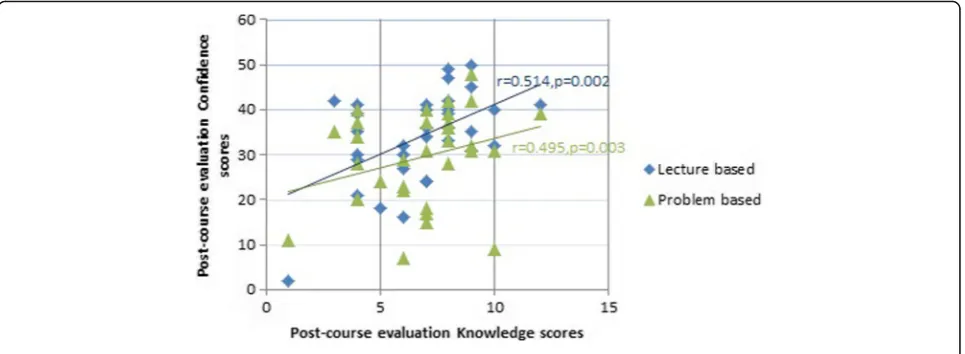
Results:A statistically significant increase (p< 0.05) was noted in the mean knowledge and confidence scores in the post-course evaluation, through both didactic lecture-based and problem-based learning methods. On the other hand, a significant decrease (p< 0.05) in the mean knowledge and confidence scores of didactic lecture-based items in comparison to problem-based items was noted in the pre-clinics evaluation.. The post-course evaluation results yielded a Pearson correlation coefficient ofr= 0.514,p= 0.002 for lecture-based items andr= 0.495,p= 0.003 for problem-based items, denoting a positive moderate correlation between the knowledge and confidence scores for both lecture-based and problem-based methods.
Conclusion:A significant improvement in both knowledge and self-reported confidence demonstrated at the end of Head and Neck Anatomy course proves both didactic lectures and problem-based learning methods to be equally effective in a hybrid dentistry program in the short term. However, the non-significant reduction in the pre-clinics knowledge and confidence scores among the PBL lessons proves it to be a potent learning tool for long term retention of knowledge, and sustainability of confidence.
Keywords:Dental education, Problem-based learning, Self-reported confidence, Teaching methods, Knowledge retention, Confidence sustainability
* Correspondence:[email protected]
2College of Dentistry, Princess Nourah bint Abdulrahman University, Eastern
Ring Road, P.O. Box: 84428, Riyadh 11671, Kingdom of Saudi Arabia Full list of author information is available at the end of the article
Background
Having a comprehensible judgement of one’s own abilities and strengths enables a person to be self-confident [1]. This self-confidence in turn is an outcome of cognitive processing and transformation of various sources of information [2]. Al-though self-confidence is one of the most important generic competencies in academia [3], confidence without adequate background knowledge is potentially harmful [4]. Dental stu-dents must be self-confident of their knowledge to make the appropriate decisions for their patients [5,6]. Poor alignment of knowledge and confidence results in either under confident or overconfident practitioners posing a threat to patients [7,8].
Active learning strategies entice students into a con-gruent discussion and habit of critically analyzing situa-tions, thus maximizing the impact of the material on the learners [9]. Problem Based Learning (PBL) methodology utilizes real problems as triggers and creates a learning environment that motivates students to get involved ac-tively and think critically [10]. The knowledge thus gained would be retained and applied for problem solv-ing in their future clinical practice [3]. This self-learning plays a vital role in boosting the confidence of students.
Several published studies evaluated the outcomes of problem-based and traditional methods at the curriculum and single course level with varying results [11–13]. How-ever, in terms of test scores there were no significant differ-ences in the short-term results in majority of studies [11]. Heijne-Penninga M found that students of student-centered PBL curricula showed a substantially better long-term know-ledge retention than teacher-centered traditional curriculum students [14]. Similar results were obtained by Beers GW and Bowden S at a single setting [15].
The kinship of confidence and knowledge is known to ac-celerate the learning process, thereby improving student per-formance and competence. Literature search reveals few studies showing active learning techniques to enhance know-ledge and confidence of health profession students [7,16,17], but no studies were found evaluating the effectiveness of PBL methodology to enhance both knowledge and confidence, spe-cifically in a dentistry setting either at the curriculum or a sin-gle course level. In order to address this lacuna, a pilot study was conducted at a single course level of Head and Neck Anatomy in the College of Dentistry, Princess Nourah bint Abdulrahman University (CD-PNU). The CD-PNU adopted a hybrid dental program incorporating didactic lectures and PBL tutorials. This program spans for a period of 6 years, with the students learning the foundation subjects and undergoing
pre-clinical training in the first 2 years after which they start clinical training on real patients from third year. Knowledge and understanding of head and neck anatomy and its applied aspects is fundamental for dental graduates, not only to per-form oral surgical procedures but also to minimize associated complications. The Head and Neck Anatomy course, which is a 12-week block course for the first-year students at CD-PNU, is designed in such a way that factual knowledge is transferred through didactic lectures, while the topics requiring scientific inquiry are covered through 7-jump PBL methodology [18], so as to foster critical thinking and scientific inquiry.
Hence, the present study was conducted with a hypothesis that PBL has a positive effect on knowledge retention and self-confidence of dental students. The objectives of the study were 1) to evaluate the students’knowledge and self-reported confidence before and after the completion of Head and Neck Anatomy course in the first year, by stratifying the data based on didactic lectures and PBL sessions; 2) to evaluate the reten-tion of knowledge gained in Head and Neck Anatomy course and associated self-reported confidence just before entering the clinics in third year; and 3) to determine the correlation between knowledge scores and self-reported confidence.
Methods
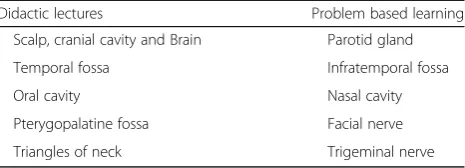
This cross-sectional pilot study was reviewed and approved by the PNU Ethical Review Board (IRB number: 2015/CDS/E/ 002) and was conducted at CD-PNU during the academic years 2015–16 and 2017–18 (Fig.1). Since the study instru-ment was only in the form of a written assessinstru-ment, the PNU Ethical Review Board approved that a verbal consent from the participants is adequate. The students were ensured that either participation or non-participation in the study would not in-fluence their academic grades. Thirty-three out of 42 female students enrolled for the Head and Neck Anatomy course in the academic year 2015–16, voluntarily participated in the study. To assess the students’knowledge, a paper based as-sessment tool comprising of 30 multiple choice questions (MCQs) of the single best type was designed and checked for construct validity. The MCQs were mainly of C2 or C3 level of Bloom’s taxonomy, as they were appropriate to examine the comprehension and application abilities of students. Out of these 30 MCQs, 15 were structured from the topics cov-ered through didactic lectures, and the remaining 15 from the topics covered through PBL (Table1). The MCQs to as-sess knowledge had 3 distractors and a correct answer and each item was scored as either 0 (incorrect) or 1 (correct). Each MCQ was followed by a confidence item on a 5-point
Likert scale (0 = not sure at all, 1 = very unsure, 2 = some-what sure, 3 = very sure, and 4 = extremely sure) to assess students’self-reported confidence about the correctness and certainty of the answer. Fifteen MCQs based on didactic lec-tures could yield a maximum score of 15, and like-wise 15 MCQs based on PBL could yield a maximum score of 15. A maximum score of 60 could be yielded from the 15 confi-dence items based on didactic lectures, and similarly a max-imum score of 60 could be yielded from the 15 confidence items based on PBL.
The same assessment instrument was used for pre-course, post-course, and pre-clinics evaluation. The pre-course evalu-ation was to have a baseline data to compare and correlate the post-course knowledge and self-reported confidence. The pre-clinics evaluation was done fifteen months after the deliv-ery of the head and neck anatomy course, to determine the re-tention of knowledge gained by each instructional method.
Composite knowledge and confidence scores were calculated for each student by numerically summing the score for each MCQ and confidence item respectively. Statistical analysis was done using SPSS (IBM SPSS Statistics for Windows, Version 21.0. Armonk, NY: IBM Corp.). Mean and standard deviation of composite knowledge and confidence scores for the pre-course, post-course, and pre-clinics evaluation were calcu-lated for the entire cohort, and the data followed the normal distribution. The difference in pre and post-course evaluation scores for the didactic lectures and PBL was evaluated by paired‘t’test, and the difference in post-course and pre-clinics evaluation scores for both the instructional methods was also evaluated by paired ‘t’ test. Pearson correlation analysis was done to determine the relation between knowledge scores and self-reported confidence of both didactic lectures and PBL.
Results
Changes between pre- and post-course evaluation scores
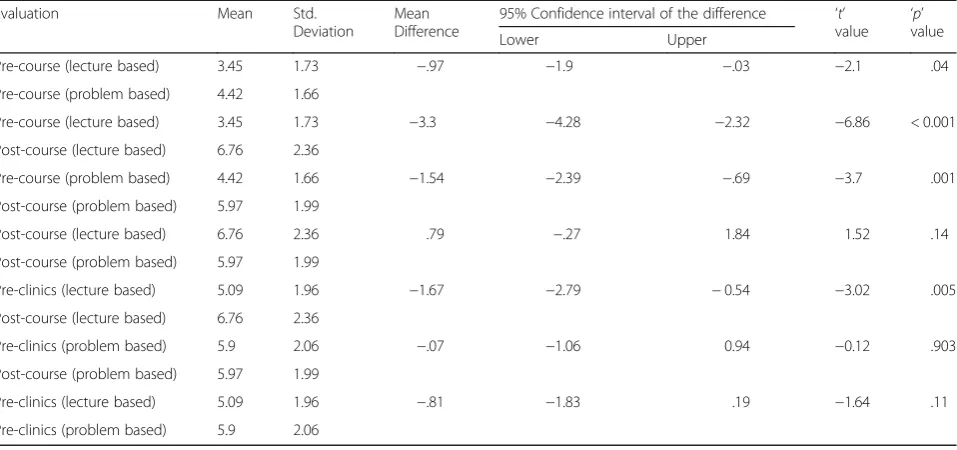
The mean knowledge score (lecture based) increased from 3.45 ± 1.73 to 6.76 ± 2.36 with statistical significance (p< 0.001), and the mean knowledge score (problem based) increased from 4.42 ± 1.66 to 5.97 ± 1.99 with statistical significance (p= 0.001) (Table2). The mean confidence score (lecture based) in-creased from 18.06 ± 7.84 to 33.97 ± 10.17, and the mean confi-dence score (problem based) increased from 11.15 ± 8.86 to 29.42 ± 10.4 with a statistical significance (p< 0.001) (Table3). No statistically significant difference was noted in the
post-course evaluation knowledge scores of both the problem based and lecture based items (p= 0.14) (Table2). However, a statistically significant improvement was noted in the confi-dence scores of the post-course evaluation with a higher mean score for lecture based items in comparison to problem based items. (p= 0.002) (Table3).
Changes between post-course and pre-clinics evaluation scores
The mean knowledge score (lecture based) decreased from 6.76 ± 2.36 to 5.09 ± 1.96 with statistical significance (p= 0.005), and the mean knowledge score (problem based) mar-ginally decreased from 5.97 ± 1.99 to 5.9 ± 2.06 with no stat-istical significance (p= 0.903) (see Table 2). The mean confidence score (lecture based) decreased from 33.97 ± 10.17 to 25.24 ± 8.46 with a statistical significance (p< 0.001), and the mean confidence score (problem based) decreased from 29.42 ± 10.4 to 25.39 ± 9.7 with no statistical signifi-cance (p= 0.06) (Table 3). No statistically significant differ-ence was noted in the pre-clinics evaluation knowledge and confidence scores of both the groups (Tables2&3).
Correlation among knowledge and confidence scores
There was no statistically significant correlation among the knowledge and confidence scores in the pre-course and pre-clinics evaluation. The post-course evaluation results yielded a Pearson correlation coefficient ofr= 0.514,p= 0.002 for the lecture based items and r= 0.495, p= 0.003 for the problem based items (Fig.2). Although the obtained‘p’value is statistically significant, the obtained‘r’value denotes a positive moderate correlation between the knowledge and confidence scores for both lecture based and problem based methods.
Discussion
PBL is encouraged by CD-PNU as it encompasses active learning with preset learning objectives [19]. Real life clinical scenarios are used as triggers to motivate learners to take re-sponsibility for their own learning, which ultimately improves their self-confidence and abilities in practically dealing with those situations in future [20]. The Head and Neck Anatomy course was designed to incorporate both the teacher centered and student-centered pedagogies. Students showed significant improvement in both knowledge and confidence by both the pedagogies upon completion of the course. This is analogous to the report of Kang KA et al. showing significant improve-ment in the knowledge, confidence and satisfaction with all the three educational modalities of lecture based, problem based, and simulation with PBL, in nursing students [21].
No statistically significant difference in the post-course knowledge scores of both didactic lectures and PBL por-tray that both the learning methodologies are at par, and endorse the conclusion of Bassir SH, Sadr-Eshkevari P, Amirikhorheh S, and Karimbux NY that PBL does not negatively influence the acquisition of factual knowledge
Table 1Topics of Head & Neck anatomy course used for structuring MCQs
Didactic lectures Problem based learning
Scalp, cranial cavity and Brain Parotid gland
Temporal fossa Infratemporal fossa
Oral cavity Nasal cavity
Pterygopalatine fossa Facial nerve
in dental students [12]. However, other literary evidence showed that PBL had a positive effect, with students gaining higher theoretical scores compared to traditional lecture based teaching which is not similar to our findings [13,22]. This contrast could be attributed to the local academic set-ting, where students have no formal education of this type in Higher secondary school, and they are introduced to the concepts of PBL for the first time at their undergraduate level of professional study. The other factors which could be responsible for this contrast are the differences in study de-sign and outcome variables [12].
Although the students’ performance improved after the course by both didactic lectures and PBL, the assessment of knowledge scores in the pre-clinics evaluation showed that there was a significant decrease in the students’ knowledge gained by didactic lectures, which was not the case with PBL. Thus, PBL helped in both short term and long-term retention of knowledge similar to the findings of Beers GW and Bow-den S in nursing stuBow-dents [14]; and Heijne-Penninga M et al. in medical students [15]. These long term gains achieved by PBL is beneficial for the incorporation of basic sciences know-ledge into clinical practice. In contrast to PBL, team based
Table 2Changes in pre-course, post-course, and pre-clinics knowledge scores
Evaluation Mean Std.
Deviation
Mean Difference
95% Confidence interval of the difference ‘t’
value ‘p’value
Lower Upper
Pre-course (lecture based) 3.45 1.73 −.97 −1.9 −.03 −2.1 .04
Pre-course (problem based) 4.42 1.66
Pre-course (lecture based) 3.45 1.73 −3.3 −4.28 −2.32 −6.86 < 0.001
Post-course (lecture based) 6.76 2.36
Pre-course (problem based) 4.42 1.66 −1.54 −2.39 −.69 −3.7 .001
Post-course (problem based) 5.97 1.99
Post-course (lecture based) 6.76 2.36 .79 −.27 1.84 1.52 .14
Post-course (problem based) 5.97 1.99
Pre-clinics (lecture based) 5.09 1.96 −1.67 −2.79 −0.54 −3.02 .005
Post-course (lecture based) 6.76 2.36
Pre-clinics (problem based) 5.9 2.06 −.07 −1.06 0.94 −0.12 .903
Post-course (problem based) 5.97 1.99
Pre-clinics (lecture based) 5.09 1.96 −.81 −1.83 .19 −1.64 .11
Pre-clinics (problem based) 5.9 2.06
Table 3Changes in pre-course, post-course, and pre-clinics confidence scores
Evaluation Mean Std.
Deviation
Mean Difference
95% Confidence interval of the difference ‘t’ value
‘p’
value
Lower Upper
Pre-course (lecture based) 18.06 7.84 6.9 5.24 8.58 8.43 < 0.001
Pre-course (problem based) 11.15 8.86
Pre-course (lecture based) 18.06 7.84 −15.9 −19.87 −11.94 −8.18 < 0.001
Post-course (lecture based) 33.97 10.17
Pre-course (problem based) 11.15 8.86 −18.27 −21.95 −14.59 −10.13 < 0.001
Post-course (problem based) 29.42 10.4
Post-course (lecture based) 33.97 10.17 4.54 1.84 7.25 3.42 .002
Post-course (problem based) 29.42 10.4
Pre-clinics (lecture based) 25.24 8.46 −8.73 −12.99 −4.47 −4.17 < 0.001
Post-course (lecture based) 33.97 10.17
Pre-clinics (problem based) 25.39 9.7 −4.03 −8.36 0.29 −1.89 .06
Post-course (problem based) 29.42 10.4
Pre-clinics (lecture based) 25.24 8.46 −.15 −1.74 1.44 −.19 .85
learning (TBL) led to large gains in knowledge only over the short term [23].
Unlike knowledge scores, confidence scores in the post-course evaluation were on a higher range for the lecture based items in comparison to the problem based items. This partial lack of congruency between knowledge gained and self-reported confidence is primarily because of inadequate sensitization to the process of self-directed learning and self-assessment as the students selected for the study are still in the first year of dental school. Secondly, the self-reported confidence scores would have been more correlative with the knowledge scores, when the students are driven to apply the gained knowledge in practically solving problems and treating patients in a clinical setting, which provides a more accurate means of self-evaluation. This assumption is based on the re-sults of Callis et al., which displayed that students of hybrid-PBL curriculum were better at applying basic science knowledge to a clinical case in comparison to students of trad-itional lecture based curriculum [24].
A moderate positive correlation of knowledge and self-reported confidence through both the pedagogies, was demonstrated in the post-course evaluation of the current study. This is in contrast to Tousignant & DesMarchais find-ings, in which they reported a very weak correlation of stu-dent self-assessment and performance in a problem-based learning medical program, attributed partly to the stress as-sociated with summative assessment [6]. This optimum in-tellectual confidence is essential for the creation of a non-hazardous environment of clinical practice, and is con-sidered a positive sign in providing quality care to the pa-tients [25]. This positive correlation of knowledge and self-reported confidence dissolved by the time of pre-clinics evaluation, which might be because the students still did not have any opportunity to integrate their knowledge with prac-tice. It is also presumed that the positive correlation of knowledge and confidence would evolve back, as the transi-tion of the students’ theoretical knowledge progresses into
clinical practice, by which time the students would be able to identify their own strengths and weaknesses adequately [26].
As the confidence scores were self-reported in this study, inter-rater variability might have influenced the results. More-over, as there was no incentive given to the students for taking the pre-course, post-course, and pre-clinics evaluation, some students may not have answered the knowledge questions to the best of their ability. Other methodological limitations to this study include using a single course setting restricted to fe-male students, and using only MCQs to assess student know-ledge. Addressing these issues, further continuation of the study is suggested, to determine the application of basic sci-ence knowledge gained through PBL in solving the problems encountered in clinical practice. The current study also gives scope for long-term studies evaluating the retention of know-ledge acquired by both lecture-based and PBL methods. Simi-lar studies done throughout the curriculum would provide a true reflection of the effectiveness of PBL methodology in a hybrid dentistry program.
Conclusion
A significant improvement in both knowledge and confidence was demonstrated at the end of Head and Neck Anatomy course delivered for the first year dental students by both di-dactic lectures and PBL methods. This improvement in both the parameters at the conclusion of the course indicates both student centered and teacher centered learning methods to be equally effective in a hybrid dentistry program. The non-significant reduction in the pre-clinics knowledge and confidence scores resulting from PBL proves it to be a potent learning tool for long term retention of knowledge, and sus-tainability of confidence.
Abbreviations
CD-PNU:College of Dentistry, Princess Nourah bint Abdulrahman University; MCQs: Multiple choice questions; PBL: Problem based learning; PNU: Princess Nourah University
Acknowledgements
We thank Prof. Mamata Hebbal, College of Dentistry, PNU for assistance with statistical analysis, and comments that greatly improved the manuscript. We would also like to show our gratitude to Dr. Arwa Alazman and Dr. Dakila Alkattan for sharing their wisdom with us during the course of this research.
Funding
Not applicable.
Availability of data and materials
The datasets used and/or analysed during the current study are available from the corresponding author on reasonable request.
Authors’contributions
EA made substantial contributions to conception and design of the study. SC analyzed and interpreted the data and was a major contributor in writing the manuscript. MN revised the manuscript critically for important intellectual content. All authors read and approved the final manuscript.
Ethics approval and consent to participate
This pilot study was reviewed and approved by the PNU Ethical Review Board (IRB number: 2015/CDS/E/002). Since the study instrument was only in the form of a written assessment, the PNU Ethical Review Board approved that a verbal consent from the participants is adequate.
Consent for publication
Not applicable.
Competing interests
The authors declare that they have no competing interests.
Publisher’s Note
Springer Nature remains neutral with regard to jurisdictional claims in published maps and institutional affiliations.
Author details 1
Department of Restorative Dental Sciences, College of Dentistry, King Saud University, Riyadh, Kingdom of Saudi Arabia.2College of Dentistry, Princess Nourah bint Abdulrahman University, Eastern Ring Road, P.O. Box: 84428, Riyadh 11671, Kingdom of Saudi Arabia.3Department of Anatomy, Histology & Embryology, University of Health Sciences, Lahore, Pakistan.
Received: 20 June 2018 Accepted: 16 November 2018
References
1. Eva KW, Regehr G. Self-assessment in the health professions: a reformulation and research agenda. Acad Med. 2005;80(Suppl 10):S46–54.
2. Bandura A. The explanatory and predictive scope of self-efficacy theory. J Soc Clin Psychol. 1986;4:359–73.
3. Adnan NL, Karomiah W, Abdullah W, Awang Y. Would problem-based learning affect students’generic competencies? Afr J Educ Technol. 2011;1(3):1–14. 4. Kampmeyer D, Matthes J, Herzig S. Lucky guess or knowledge: a
cross-sectional study using the bland and Altman analysis to compare confidence based testing of pharmacological knowledge in 3rdand 5th year medical students. Adv in Health Sci Educ. 2015;20:431–40.
5. Valdez CA, Thompson D, Ulrich H, Bi H. Paulsen S. a comparison of pharmacy students’confidence and test performance. Am J Pharm Educ. 2006;70(4):76.
6. Tousignant M, DesMarchais JE. Accuracy of student self-assessment ability compared to their own performance in a problem-based learning medical program: a correlation study. Adv Health Sci Educ. 2002;7:19–27. 7. Thomas MC, Macias-Moriarity LZ. Student knowledge and confidence in an
elective clinical toxicology course using active-learning techniques. Am J Pharm Educ. 2014;78(5):95.
8. Dory V, Degryse J, Roex A, Vanpee D. Usable knowledge, hazardous ignorance
–beyond the percentage correct score. Med Teach. 2010;32(5):375–80. 9. Nelson LP, Crow ML. Do Active-Learning Strategies Improve Students’
Critical Thinking? High Educ Stud. 2014;4(2):77–90.
10. Uchimiya Y. Educational effects of PBL for students in the Faculty of Dentistry--with special reference to the educational effects on dysphagia. Kokubyo Gakkai Zasshi. 2007;73(3)-74(1):43–50.
11. Polyzois I, Claffey N, Mattheos N. Problem-based learning in academic health education. A systematic literature review. Eur J Dent Educ. 2010;14:55–64. 12. Bassir SH, Sadr-Eshkevari P, Amirikhorheh S, Karimbux NY. Problem-based
learning in dental education: a systematic review of the literature. J Dent Educ. 2014;78(1):98–109.
13. Huang B, Zheng L, Li C, Li L, Yu H. Effectiveness of problem-based learning in Chinese dental education: a meta-analysis. J Dent Educ. 2013;77(3):377–83. 14. Beers GW, Bowden S. The effect of teaching method on long-term
knowledge retention. J Nurs Educ. 2005;44(11):511–4.
15. Heijne-Penninga M, Kuks JBM, Hofman WHA, Muijtjens AMM, Cohen-Schotanus J. Influence of PBL with open-book tests on knowledge retention measured with progress tests. Adv in Health Sci Educ. 2013;18:485–95. 16. Mnatzaganian C, Fricovsky E, Best BM, Singh RF. An interactive, multifaceted
approach to enhancing pharmacy students’health literacy knowledge and confidence. Am J Pharm Educ. 2017;81(2):Article 32.
17. Goldman KN, Tiegs AW, Uquillas K, Nachtigall M, Fino ME, Winkel AF, Lerner V. Interactive case-based learning improves resident knowledge and confidence in reproductive endocrinology and infertility. Gynecol Endocrinol. 2017;33(6):496–9.
18. Wood DF. ABC of learning and teaching in medicine : problem based learning. Brit Med J. 2003;326(7384):328–30.
19. Druckman D, Bjork RA. Learning, remembering, believing: enhancing human performance. 6th ed. Washington DC: National Academy Press; 1994. 20. Azer SA. Navigating problem-based learning. 1st ed. Australia: Churchill
Livingstone; 2007.
21. Kang KA, Kim S, Kim SJ, Oh J, Lee M. Comparison of knowledge, confidence in skill performance (CSP) and satisfaction in problem-based learning (PBL) and simulation with PBL educational modalities in caring for children with bronchiolitis. Nurse Educ Today. 2015;35(2):315–21.
22. Albanese MA, Mitchell SM. Problem-based learning: a review of literature on its outcomes and implementation issues. Acad Med. 1993;68(1):52–81. 23. Emke AR, Butler AC, Larsen DP. Effects of team-based learning on short-term
and long-term retention of factual knowledge. Med Teach. 2016;38:306–11. 24. Callis AN, McCann AL, Schneiderman ED, Babler WJ, Lacy ES, Hale DS.
Application of basic science to clinical problems: traditional versus hybrid problem-based learning. J Dent Educ. 2010;74(10):1113–24.
25. Davis DA, Mazmanian PE, Fordis M, Van Harrison R, Thorpe KE, Perrier L. Accuracy of physician self-assessment compared with observed measures of competence. JAMA. 2006;296(9):1094–102.