SOFTWARE ARTICLE
HIA: a genome mapper using hybrid
index-based sequence alignment
Jongpill Choi
1*, Kiejung Park
2, Seong Beom Cho
1and Myungguen Chung
1*Abstract
Background: A number of alignment tools have been developed to align sequencing reads to the human reference genome. The scale of information from next-generation sequencing (NGS) experiments, however, is increasing rapidly. Recent studies based on NGS technology have routinely produced exome or whole-genome sequences from several hundreds or thousands of samples. To accommodate the increasing need of analyzing very large NGS data sets, it is necessary to develop faster, more sensitive and accurate mapping tools.
Results: HIA uses two indices, a hash table index and a suffix array index. The hash table performs direct lookup of a q-gram, and the suffix array performs very fast lookup of variable-length strings by exploiting binary search. We observed that combining hash table and suffix array (hybrid index) is much faster than the suffix array method for finding a substring in the reference sequence. Here, we defined the matching region (MR) is a longest common sub-string between a reference and a read. And, we also defined the candidate alignment regions (CARs) as a list of MRs that is close to each other. The hybrid index is used to find candidate alignment regions (CARs) between a reference and a read. We found that aligning only the unmatched regions in the CAR is much faster than aligning the whole CAR. In benchmark analysis, HIA outperformed in mapping speed compared with the other aligners, without signifi-cant loss of mapping accuracy.
Conclusions: Our experiments show that the hybrid of hash table and suffix array is useful in terms of speed for mapping NGS sequencing reads to the human reference genome sequence. In conclusion, our tool is appropriate for aligning massive data sets generated by NGS sequencing.
Keywords: Hybrid index, NGS, Mapper, Sequence alignment, Hash table index, Suffix array index
© 2015 Choi et al. This article is distributed under the terms of the Creative Commons Attribution 4.0 International License (http://creativecommons.org/licenses/by/4.0/), which permits unrestricted use, distribution, and reproduction in any medium, provided you give appropriate credit to the original author(s) and the source, provide a link to the Creative Commons license, and indicate if changes were made. The Creative Commons Public Domain Dedication waiver (http://creativecommons.org/ publicdomain/zero/1.0/) applies to the data made available in this article, unless otherwise stated.
Background
Recent studies based on next-generation sequencing (NGS) technology have produced hundreds or thousands of exome or whole genome sequences with decreas-ing cost of NGS experiments [1]. As the NGS technolo-gies evolve, NGS technolotechnolo-gies have gradually increased read length and decreased error rate [2]. To keep pace with developing NGS technologies, many alignment tools have been developed for both short and long reads. These tools include SSAHA2 [3], BWA [4, 5], AGILE [6], SOAP2 [7], Bowtie2 [8], SeqAlto [9] and others. Among them, many aligning programs use index-based mapping
strategy. For example, SSAHA2, AGILE and SeqAlto use a hash table (HT) index of a reference genome, whereas BWA, SOAP2 and Bowtie2 use an index of the reference genome based on the Burrows–Wheeler transform [10].
All HT-based alignment tools use the same seed-and-extend strategy [11, 12], which proceeds by searching for candidate alignment regions (CARs), aligning each location, and reporting the best alignments. A HT index supports very fast lookup of candidate locations with q-grams (strings of length q). Smaller q increases the sensitivity and the number of CARs, whereas larger q decreases the sensitivity and number of CARs. Further-more, because q is fixed, the HT must be rebuilt when q-grams of a new length are needed. Most BWT-based alignment tools use the full-text minute index [13], which is memory-efficient and similar to the suffix tree. With respect to matching time, the suffix tree is efficient for
Open Access
*Correspondence: [email protected]; [email protected]
1 Division of Bio-Medical Informatics, Center for Genome Science, Korea National Institute of Health, Osong, Korea
Page 2 of 9 Choi et al. Algorithms Mol Biol (2015) 10:30
exact matching, although it is slow for inexact match-ing. BWA and Bowtie2 follow similar seed-and-extend approaches, including the use of HT-based algorithms for long reads.
Support of long-read alignment, high speed, accuracy, and sensitivity are essential features of the current NGS mapping tools. Here, we tried to merge the advantages of HT-based and suffix tree-based alignment in a tool that satisfies these requirements. To this end, we developed a genome mapper using hybrid index-based sequence alignment (HIA).
In this article, we describe the HIA tool, and show the results of comparisons of performance on simulated and real read data between HIA and the other four popular alignment tools including BWA, Bowtie2, SOAP2 and SeqAlto. The results of the benchmark analysis demon-strate that HIA outperforms the other aligners, especially in speed.
Methods Hybrid index
Let Σ be an alphabet and S = s0s1 … sm−1 be a string over
Σ. Let |S| = m be the length of S, S[i] = si be the i-th
sym-bol of S, S[i, j] = si … sj be a substring, and Si = S[i,m−1]
be a suffix of S. We define a q-gram as a substring of S with length q. In the context of DNA sequence, the alphabet Σ consists of the four nucleotides A, C, G, and T, i.e., Σ = {A, C, G, T}. We assign A, C, G, and T to the numbers 0, 1, 2, and 3, respectively. Thus, each q-gram is encoded as an unsigned integer with two bits per nucleo-tide. However, most reference genome sequences con-tain a nucleotide other than {A, C, G, T}, such as ‘N’. This occasionally happens with NGS read sequences as well. We replace ‘N’ with a uniform random nucleotide such as BWA and many other tools do.
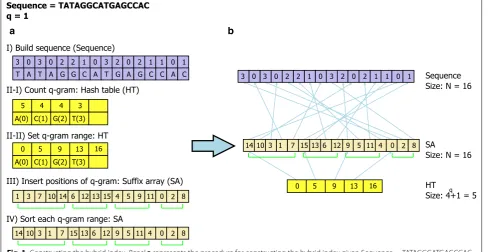
In terms of a hybrid index, SOAP2 implements a hash table on the FM-index which is a compressed SA. On the other hand, our hybrid index consists of a reference sequence, a suffix array (SA), and a hash table (HT), as in Fig. 1. Since there are four symbols in the alphabet, a reference sequence of length N can be packed into N/4 bytes. The SA is an array of the starting positions (inte-gers) of suffixes of the reference sequence in lexicograph-ical order. The number of suffixes of a sequence of size N is N. The HT is an array of pointers into SA indicat-ing which positions in SA belong to which q-grams. Since we define a q-gram as a string of length q, the number of elements of HT is 4q + 1. Given a q-gram, HT[x]
is the first position of the q-gram in SA, where x is the numeric value of the q-gram. We define the range (R) of the q-gram in SA by (1):
(1)
R(x)= [HT[x], HT[x+1] −1]
If the q-gram does not exist in the sequence, HT[x] is the first position of next existing q-gram in the sequence so that HT[x] and HT[x + 1] are the same, and R(x) is empty.
The procedure for constructing the hybrid index con-sists of four processes, as follows: (1) packing the refer-ence sequrefer-ence in a 2-bits per base format (Sequrefer-ence); (2) counting each q-gram in the sequence and set the range of q-grams in SA (HT); (3) inserting the sequence posi-tions of each q-gram into its range of SA; and (4) sorting the range for each q-gram (SA) lexicographically. Based on the heuristic determining the final positions of most of the suffixes using only the first few symbols of each suf-fix [14], the SA construction algorithm proceeds sorting the length-w prefixes of the suffixes in a q-gram range. If some suffixes share also a length-w prefix, then the sort is repeated by sorting the length-w substrings that follow the length-w prefixes, and so on. In order to reduce the sequence access time, length-w prefixes are converted to integer values. In the case that the size of the memory word is 4 bytes and the size of the alphabet is 4, the w is set to between 0 and 16. The ranges of q-grams are not overlapped so that the fourth process can also be parallel-ized. Figure 1 describes the underlying data structure and the method for constructing a hybrid index of a reference sequence.
Retrieving positions of a query Q in the sequence is implemented in two steps: HT lookup and binary search of the SA. If the prefix of Q of length q (q-gram) is a substring of the sequence, we find the range (R) in which the q-gram belongs in the SA, using Eq. (1). Oth-erwise, the range (R) returns an empty range, indicating that Q is not in the sequence. If the returned range is not empty, we next find the positions at which Q occurs in the sequence by binary search of the substring Q[q, |Q| − 1], based on the SA. Theoretically, searching a length-m substring in a string of length N by SA can be implemented in O(mlogN) time in the worst case. The hash table index can reduce the length of searching string such as (m′ = m − q) and reduce the size of the searching range such as (n′ ≪ N). When the reference sequence is the GRCH37 build of the human genome and q is 14, the length of packed sequence is 2,861,343,766 and the aver-age size of the searching range is 14.12. Our experiment showed that the hash table index can decrease consider-ably the searching time (see Additional file 1).
We will indicate each MR as 3-tuple <dv, ro, L>, where ‘ro’ (read offset) is the starting position in the read where the MR occurs, ‘dv’ (diagonal value) is defined as dv = sp − ro, and ‘L’ is the length of the MR. Given a length-m′ MR, there are (m′ − q + 1) q-grams having the same diagonal values and consecutive read offsets. Diagonal values having same values implies that the corresponding MRs are close each other in the refer-ence sequrefer-ence. A CAR (candidate alignment region) is a list of MRs, which are close each other and ordered by ‘ro’. We define a CAR as a seed and align only the unmatched regions in CAR.
The procedure for finding MRs and CARs of a read is as follows: (1) retrieving range of SA of each q-gram using HT and SA; (2) computing diagonal values; (3) sort-ing by diagonal value and offset; (4) groupsort-ing MRs with same diagonal value and successive offsets; (5) merging the adjacent MRs into CARs; (6) sorting the CARs by matched bases in descending order. For example, given a read (r = GCCATG) and q-gram length (q = 2) and the hybrid index constructed in Fig. 1, we can find MRs and CARs as follows:
I. Retrieve range of SA of each q-gram using HT and SA
0-th q-gram positions: (GC: SA[10, 11]) 1-th q-gram positions: (CC: SA[8]) 2-th q-gram positions: (CA: SA[6, 7]) 3-th q-gram positions: (AT: SA[3, 4]) 4-th q-gram positions: (TG: SA[15])
II. Compute diagonal values
(GC, 5, 0), (GC, 11, 0), (CC, 11, 1), (CA, 4, 2), (CA, 11, 2), (AT, −2, 3), (AT, 4, 3), (TG, 4, 4)
III. Sort by diagonal value and offset
(AT, −2, 3), (CA, 4, 2), (AT, 4, 3), (TG, 4, 4), (GC, 5, 0), (GC, 11, 0), (CC, 11, 1), (CA, 11, 2)
IV. Group MRs with same diagonal value and successive offsets
MR0: (AT, −2, 3, 2) ← (AT, −2, 3)
MR1: (CATG, 4, 2, 4) ← (CA, 4, 2), (AT, 4, 3), (TG, 4, 4) MR2: (GC, 5, 0, 2) ← (GC, 5, 0)
MR3: (GCCA, 11, 0, 4) ← (GC, 11, 0), (CC, 11, 1), (CA, 11, 2)
a b
Page 4 of 9 Choi et al. Algorithms Mol Biol (2015) 10:30
V. Merge the adjacent MRs into CARs and set matched bases
CAR0: (MR0; 2) CAR1: (MR1, MR2; 5) CAR2: (MR3; 4)
VI. Sort the CARs by matched bases
CAR1: (MR1, MR2; 5) CAR0: (MR3; 2) CAR2: (MR2; 2).
Although diagonal values of two adjacent MRs are dif-ferent, they could be located in a same CAR if there were inserted or deleted bases between them. In the case of CAR1, the difference value between diagonal value of MR1 and diagonal value of MR2 is 1 and there is one inserted base (C) between MR1 and MR2. We refer to this value as adjacency and we use the value in order to set the permitted size of insertion and deletion between MRs.
In order to find MRs and CARs efficiently, we apply three heuristics. Let the read length and the error rate be m and ε, respectively. The first heuristic is that there is a common substring of length at least m/(k + 1) between two reads of length m with k differences [15]. Let λ = εm be the expected number of errors in a read and let X be the random variable. We can compute the chance of observing a read with at most k errors as below.
The formula (2) is the cumulative distribution func-tion of X. We are able to calculate the rate of reads with at most k errors according to the formula (2). If we set k = 1.5λ, the rate of reads with at most 1.5λ errors approach to 0.9 and we can use the q-gram with length m/(1.5λ + 1). Using a q-gram with the same length as the common substring decreases the number of MRs and CARs.
Secondly, since a q-gram that occurs in many regions in the sequence is not a good discriminator, such q-gram was given less weight than one that occurs in few regions. This heuristic is based on the inverse document fre-quency (IDF) commonly used in the field of informa-tion retrieval. The IDF is a measure of whether or not the term is common across all documents [16]. Applying this heuristic, we can filter out the less weight q-grams and consequently skip undesirable MRs and CARs.
Finally, given a read (r) and two strings, S1 and S2, both of length m, if the number of matched bases between r and S1 is greater than the number of matched
(2)
P
X≤k
=
k
i=0
e−i/i!
bases between r and S2, then the number of differences between r and S1 is smaller than the number of differ-ences between r and S2. This heuristic can be used to rank CARs by the number of matched bases and to filter out the lower-ranked CARs.
Hybrid mapping: aligning candidate alignment region (CAR)
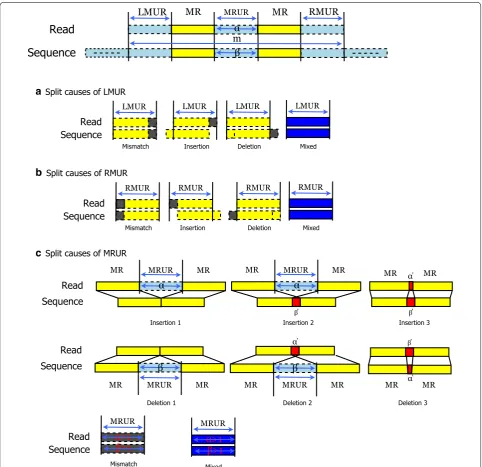
To align the top-ranked CARs, we simply align the unmatched regions in each CAR, because the MRs are already aligned (matched). We classify the unmatched regions into three groups: leftmost unmatched region (LMUR), which is the left unmatched region of the first MR in a CAR; rightmost unmatched region (RMUR), which is the right unmatched region of the last MR in a CAR; and unmatched regions between two MRs (MRURs). The matched and unmatched region can be separated because of mismatch, insertion and deletion. We analyze these split causes such as Fig. 2. In the cases of LMUR and RMUR, if the only adjacent bases between these unmatched regions and MR are mismatched and other bases are matched then the split cause is Mismatch; if they are inserted and oth-ers are matched then the split cause is Insertion; if they are deleted and others are matched then the split cause is Deletion; otherwise the split cause is Mixed. The Mis-match, Insertion and Deletion information clearly indi-cate how these unmatched regions are aligned. Thus, we can apply the Needleman–Wunsch algorithm [17] only to the mixed cause unmatched region so that we can reduce computation time for the dynamic programming method of the Needleman–Wunsch algorithm.
be mismatched (Mismatch). Except all the causes men-tioned above, the others are Mixed. We also can apply the Needleman–Wunsch algorithm only to the Mixed cause MRUR in order to reduce the dynamic programming load. For example, in the case of CAR1 in Fig. 3, there is one MRUR between MR1 and MR2. Through “Insertion 2”, we know one insertion between MR1 and MR2, and then obtain 2M1I3M (CIGAR format). In the case of CAR
2, there is one RMUR and the split cause is “Mixed.” Thus we can apply Needleman-Wunsch to the RMUR, and then obtain 4M1I1M or 5M1I (CIGAR format).
Extended hybrid mapping
Hybrid mapping might miss some CARs and result in the failure of mapping (unmapped). The main reasons for missed CARs might be one of following reasons: (1) a
b
c
Page 6 of 9 Choi et al. Algorithms Mol Biol (2015) 10:30
too many errors in a read; (2) too many highly frequent q-grams in a read; and (3) many high-ranked CARs. In the first case, a long q-gram based on the first heuristic approach results in empty q-gram ranges. In the sec-ond case, the secsec-ond heuristic approach causes highly frequent informative q-grams to be missed. In the third case, the lower-ranked but informative CARs are lost because of the third heuristic approach. We applied extended hybrid mapping to the unmapped, which uses shorter q-grams including some highly frequent q-grams, and extends ranked CARs further. Together, these modi-fications increase the sensitivity of the technique.
Implementation
We implemented HIA on Java to support multiple plat-forms (see Additional file 2). HIA takes the reference sequence FASTA file as the input, builds the hybrid index, and then outputs the hybrid index: SA file (.sa), HT file (.idx), packed sequence file (.seq), and reference sequence information file (.seqInfo). For the alignment, HIA takes the hybrid index and a query FASTQ file as inputs, and outputs the mapped and unmapped align-ments in SAM format. To reduce the bottle-neck on reading reads and writing mapped results, we divided the alignment procedure into reading, mapping, and writ-ing procedures. Each procedure runs in an independent thread and is scheduled using three queues. Furthermore, HIA also outputs a report, consisting of a summary file of mapping results and two pie chart graphs of the map-ping rate, to inform the user about the mapmap-ping results. Additionally, during the alignment, HIA summarizes the FASTQ input and reports the basic statistics and base quality information: statistics of FASTQ; base quality per read position, as a bar graph; base quality, as a heat map; and quality score, as a box-plot graph. This summary is useful to determine the quality of the NGS sequence data
that is produced. We used JFreeChart [18] to generate all graphs.
Results and discussion
Evaluation data sets and evaluation measurements
We made six datasets from the GRCH37 build of the human genome, using Mason [19]. Two of these are unpaired Illumina-like datasets, consisting respectively of one million 100 bp reads and one million 150 bp reads, which Mason simulated with parameters ‘illumina -hn 2 -sq -n 100 -N 1000000’ and ‘illumina -hn 2 -sq -n 150 -N 1000000’. The next two datasets are paired Illumina-like read datasets, which Mason simulated with parameters ‘illumina -hn 2 -sq -rn 2 -mp -ll 375 -le 100 -n 100 -N 1000000’ and ‘illumina -hn 2 -sq -rn 2 -mp -ll 375 -le 100 -n 150 -N 1000000’. The last two datasets are unpaired 454-like read datasets, which Mason simulated with parameters ‘454 -hn 2 -sq -rn 2 -k 0.3 -bm 0.4 -bs 0.2 -nm 250 -N 1000000’ and ‘454 -hn 2 -sq rn 2 -k 0.3 -bm 0.4 -bs 0.2 -nm 400 -N 1000000’. Mason also generated the correct alignment results of the six read datasets in SAM format. The exact command-line parameters and descriptions for each dataset can be found in the Addi-tional file 1.
To assess the performance on real data, we obtained the Illumina dataset from a human re-sequencing study [20] and the 454 dataset from the 1000 Genomes Project Pilot (1000 Genomes Project Consortium, 2010). The Illumina dataset consists of 1,296,188,286 101 bp × 99 bp paired-end reads. The 454 dataset has NCBI Short Read Archive accession number SRR003161 and contains 1,375,489 reads with an average length of 355 bp. We made three test datasets from the Illumina dataset and one test dataset from the 454 dataset such as (1) one million paired-end HiSeq reads, (2) one mil-lion 101 bp single-end HiSeq reads, (3) the whole of the paired-end HiSeq reads, and (4) the whole of the 454 reads.
We applied the following four evaluation measures in benchmark study: Aligned (%), Unique (%), Q10 (%) and Time (s). The Aligned (%) denotes the percent of aligned reads over total reads and indicates the over-all mapping rate. The Unique (%) measures the percent of uniquely aligned reads over total reads and refers to MAPQ ≥ 1. The Q10 (%) measures the fraction of mapped reads MAPQ ≥ 10. The Time is the elapsed time (seconds) including both the index loading time and the alignment time. In the case of the simulated datasets, the %Err measures the percent of wrong aligned reads over the reads satisfying Unique (%) or Q10 (%). We adopt the concept of a correct alignment from Langmead and Salzberg [8], who determined an alignment correct only if the alignment was on the Fig. 3 Finding MRs and CARs. Find MRs and CARs given a read
same strand and the leftmost position was within 50 bp of the assigned position.
Evaluation results
To evaluate the performance of HIA, we compared HIA to BWA, Bowtie2, SOAP2 and SeqAlto on six simulated datasets and two real datasets. In all tests, we used the GRCH37 build of the human genome as the reference sequence used in alignment. We performed the align-ments using a computer with two Intel Xeon 6-Core X5670 2.93-GHz processors and 48 GB RAM. All align-ment tools were run with a single thread for alignalign-ment except for multi-thread tests.
Performance of index generation
Table 1 shows the results for index generation. These results indicate that the indexing time of HIA is compa-rable to other aligners. Especially, HIA is able to reduce the time of index generation by using multiple threads of modern multi-core computers (Additional file 1).
In the perspective of SA construction, we performed several tests of index generation and compared the results from our index generation algorithm and the divsufsort that is one of the best SA construction algorithms [21]. It was clear that the divsufsort outperforms our algorithm in build-ing the SA of the human genome (see Additional file 1). We bypassed this problem through implementation of the mul-tiple threading in the construction of the SA of the human genome (see comparison of the performance of the multi-ple threading and divsufort algorithm in Additional file 1). Moreover, since the construction of the SA is required once in the alignment of the NGS data, we believe that this would be not serious problem in practical application.
Results of simulated single‑end reads
We ran six of the aligners with various parameter settings for 100, 150, 250 and 400 bp single-end reads. All results can be found in the Additional file 1. SeqAlto can only
align Illumina-like reads, so it was excluded from the tests for 454-like datasets.
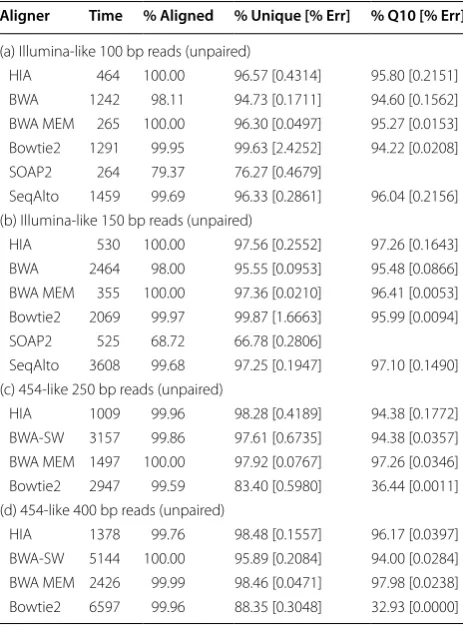
Table 2 shows the best results from the sensitivity and precision perspectives. For both Illumina-like datasets and 454-like datasets, HIA is significantly faster than all of the other aligners except BWA MEM and SOAP2. SOAP2 is very fast, but not as sensitive as HIA. BWA is slightly more accurate, but not as sensitive as HIA for Illumina-like datasets. However, HIA is more sensitive and accurate than BWA for 454-like datasets. Bowtie2 is similar to HIA with regard to sensitivity, but not as accurate as HIA for both Illumina-like datasets and 454-like datasets. SeqAlto is slightly more accurate, but not as sensitive as HIA for Illumina-like datasets. BWA MEM is more accurate and more sensitive than HIA for Illumina-like datasets, but not as sensitive as HIA for 454-like datasets.
Results of simulated paired‑end reads
We also ran six of the aligners with the same parameter settings as in the single-end reads for 100 and 150 bp paired-end reads. All results can be found in the Addi-tional file 1.
Table 1 Results of index generation
Time measurement is elapsed time (minute). Memory is the peak memory for the index construction. Size is the sum of all generated files
Aligner Options Time Memory (GB) Size (GB)
HIA -t 1 -q 14 165 20.32 12.63
HIA -t 12 -q 14 28 20.47 12.63
BWA 65 4.53 5.40
bowtie2 99 5.35 4.10
soap2 55 3.39 5.90
seqAlto -I 0 genome.fa 28 33 37.99 22.40
seqAlto -I 1 genome.fa 22 12 13.19 5.52
Table 2 Results for simulated single-end reads
Time measurement is elapsed time (second). Unique refers to MAPQ ≥ 1 if MAPQ available. Q10 refers to MAPQ ≥ 10
Aligner Time % Aligned % Unique [% Err] % Q10 [% Err]
(a) Illumina-like 100 bp reads (unpaired)
HIA 464 100.00 96.57 [0.4314] 95.80 [0.2151] BWA 1242 98.11 94.73 [0.1711] 94.60 [0.1562] BWA MEM 265 100.00 96.30 [0.0497] 95.27 [0.0153] Bowtie2 1291 99.95 99.63 [2.4252] 94.22 [0.0208] SOAP2 264 79.37 76.27 [0.4679]
SeqAlto 1459 99.69 96.33 [0.2861] 96.04 [0.2156] (b) Illumina-like 150 bp reads (unpaired)
HIA 530 100.00 97.56 [0.2552] 97.26 [0.1643] BWA 2464 98.00 95.55 [0.0953] 95.48 [0.0866] BWA MEM 355 100.00 97.36 [0.0210] 96.41 [0.0053] Bowtie2 2069 99.97 99.87 [1.6663] 95.99 [0.0094] SOAP2 525 68.72 66.78 [0.2806]
SeqAlto 3608 99.68 97.25 [0.1947] 97.10 [0.1490] (c) 454-like 250 bp reads (unpaired)
HIA 1009 99.96 98.28 [0.4189] 94.38 [0.1772] BWA-SW 3157 99.86 97.61 [0.6735] 94.38 [0.0357] BWA MEM 1497 100.00 97.92 [0.0767] 97.26 [0.0346] Bowtie2 2947 99.59 83.40 [0.5980] 36.44 [0.0011] (d) 454-like 400 bp reads (unpaired)
Page 8 of 9 Choi et al. Algorithms Mol Biol (2015) 10:30
Table 3 shows the best results from the sensitivity and precision perspectives. For both datasets, HIA is signifi-cantly faster than all of the other aligners except BWA MEM and SOAP2 while retaining good alignment tivity and precision. SOAP2 is very fast, but not as sensi-tive as HIA. BWA and SeqAlto are similar to HIA with respect to sensitivity. BWA MEM is more accurate than the other aligners. Bowtie2 is less sensitive as compared with HIA, BWA and SeqAlto.
Results of real datasets
We ran six of the aligners with various parameter settings for one paired-end reads and two single-end reads. All results can be found in the Additional file 1.
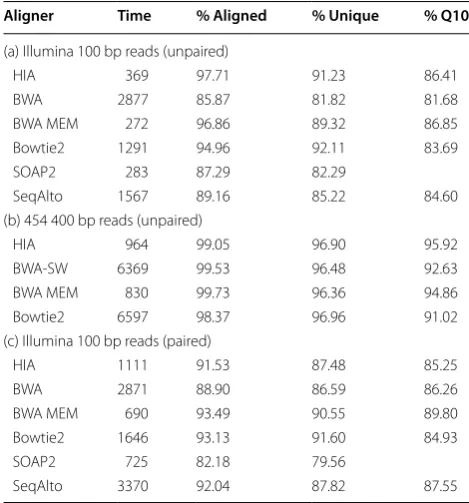
Table 4 shows the best results from the total number of reads aligned for single-end reads and paired-end reads. For two single-ends, HIA and BWA MEM are higher ranks than the other aligners in terms of the speed and the total number of reads aligned. For the paired-end reads, the aligned percentage of Bowtie2 is higher than the other aligners, but HIA is faster than all of the other aligners except SOAP2.
Results of multithreading tests
We ran six of the aligners with 6 threads and 12 threads modes for the whole of the paired-end HiSeq reads. All results can be found in the Table 5. HIA is faster than the other aligners for both 6 threads and 12 threads modes.
Conclusions
We developed a new sequence alignment tool for align-ing short and long reads to a reference genome. HIA has two indexes, a HT index and a SA index. The HT is
capable of direct lookup of a q-gram, and the SA can very rapidly look up q-grams of variable length. Our experi-ments show that the hybrid of HT and SA is useful, from the perspective of speed, for mapping NGS sequencing reads to a reference genome sequence. HIA also sup-ports the multithreading of mapping. In particular, HIA is much faster than all of the other aligners; therefore, our tool is appropriate for aligning massive data sets gener-ated by NGS sequencing.
The accuracy of alignment is very important in re-sequencing because the main purpose of alignment is to discover the variants relative to a reference genome. Although these variants (or sequencing errors) cause sequencing reads within them to match inexactly to the reference, alignment tools should nonetheless cor-rectly map these reads to the reference. Considering the Table 3 Results for simulated paired-end reads
Time measurement is elapsed time (second). Unique refers to MAPQ ≥ 1 if MAPQ available. Q10 refers to MAPQ ≥ 10
Aligner Time % Aligned % Unique [% Err] % Q10 [% Err]
(a) Illumina-like 100 bp reads (paired)
HIA 1009 99.96 97.17 [0.0859] 96.75 [0.0510] BWA 2554 99.79 97.70 [0.0954] 97.49 [0.0692] BWA MEM 646 99.99 98.03 [0.0282] 97.95 [0.0172] Bowtie2 1691 97.13 97.09 [1.2711] 93.73 [0.0128] SOAP2 586 84.54 82.75 [0.3356]
SeqAlto 2945 99.61 97.15 [0.0833] 97.02 [0.0788] (b) Illumina-like 150 bp reads (paired)
HIA 1153 99.99 98.10 [0.0780] 97.89 [0.0537] BWA 5380 99.78 98.17 [0.0983] 98.06 [0.0876] BWA MEM 649 99.99 98.43 [0.0137] 98.39 [0.0083] Bowtie2 2348 97.13 97.12 [0.9904] 94.14 [0.0083] SOAP2 856 75.25 74.04 [0.3487]
SeqAlto 7191 99.58 97.80 [0.0723] 97.74 [0.0698]
Table 4 Results for real datasets
Time measurement is elapsed time (second). Unique refers to MAPQ ≥ 1 if MAPQ available. Q10 refers to MAPQ ≥ 10
Aligner Time % Aligned % Unique % Q10
(a) Illumina 100 bp reads (unpaired)
HIA 369 97.71 91.23 86.41
BWA 2877 85.87 81.82 81.68
BWA MEM 272 96.86 89.32 86.85
Bowtie2 1291 94.96 92.11 83.69
SOAP2 283 87.29 82.29
SeqAlto 1567 89.16 85.22 84.60
(b) 454 400 bp reads (unpaired)
HIA 964 99.05 96.90 95.92
BWA-SW 6369 99.53 96.48 92.63
BWA MEM 830 99.73 96.36 94.86
Bowtie2 6597 98.37 96.96 91.02
(c) Illumina 100 bp reads (paired)
HIA 1111 91.53 87.48 85.25
BWA 2871 88.90 86.59 86.26
BWA MEM 690 93.49 90.55 89.80
Bowtie2 1646 93.13 91.60 84.93
SOAP2 725 82.18 79.56
SeqAlto 3370 92.04 87.82 87.55
Table 5 Results of the multithreading tests
Time measurement is elapsed time (minute)
Aligner Time (6 threads) Time (12 threads)
HIA 932 505
BWA 4006 2586
BWA MEM 1162 645
bowtie2 1180 789
soap2 2217 1616
results of the benchmark analysis, we can conclude that HIA performs comparably to four popular alignment tools.
Availability and requirements
• Project name: HIA
• Project home page: http://biomi.cdc.go.kr/hia/
• Operating systems: Platform independent
• Programming language
• License: GNU GPL
• Any restrictions to use by non-academics: none.
•
Abbreviations
HIA: hybrid index based sequence alignment; GS: next-generation sequenc-ing; CAR: candidate alignment region; MR: matching regions; HT: hash table; BWT: Burrows–Wheeler transform; SA: suffix array; IDF: inverse document frequency; LMUR: leftmost unmatched region; RMUR: rightmost unmatched region; MRUR: unmatched region between two MRs; FASTA: FAST-All; SAM: sequence alignment/map format; GRCh37: genome reference consortium human genome build 37; MAPQ: mapping quality.
Authors’ contributions
JP wrote the Java code, performed data analysis and co-wrote the manuscript. KJ co-supervised the work and co-wrote the manuscript. SB co-supervised the work and wrote the manuscript. MG wrote the manuscript and co-supervised the work. All authors read and approved the final manuscript.
Author details
1 Division of Bio-Medical Informatics, Center for Genome Science, Korea National Institute of Health, Osong, Korea. 2 Biomedical Research Institute, College of Medicine, Hanyang University, Seoul, Korea.
Acknowledgements
This work was supported by an intramural grant from the Korea National Institute of Health, Korea Centers for Disease Control and Prevention (2013-NG72001-00).
Competing interests
The authors declare that they have no competing interests.
Received: 7 November 2014 Accepted: 17 December 2015 Additional files
Additional file 1. It includes the test datasets, all tested results, and information of all used tools.
Additional file 2. It contains the jar file of HIA. HIA can be used without restriction.
References
1. 1000 Genomes Project Consortium, Durbin RM, Abecasis GR, Altshuler DL, Auton A, Brooks LD, Gibbs RA, Hurles ME, McVean GA. A map of human genome variation from population-scale sequencing. Nature. 2010;467:1061–73.
2. Glenn TC. Field guide to next-generation DNA sequencers. Mol Ecol Resour. 2011;11:759–69.
3. Ning Z, Cox AJ, Mullikin JC. SSAHA: a fast search method for large DNA databases. Genome Res. 2001;11:1725–9.
4. Li H, Durbin R. Fast and accurate short read alignment with Burrows– Wheeler transform. Bioinformatics. 2009;25(14):1754–60.
5. Li H, Durbin R. Fast and accurate long-read alignment with Burrows– Wheeler transform. Bioinformatics. 2010;26:589–95.
6. Misra S, Agrawal A, Liao WK, Choudhary A. Anatomy of a hash-based long read sequence mapping algorithm for next generation DNA sequencing. Bioinformatics. 2011;27:189–95.
7. Li R, Li Y, Kristiansen K, Wang J. SOAP: short oligonucleotide alignment program. Bioinformatics. 2008;24:713–4.
8. Langmead B, Salzberg SL. Fast gapped-read alignment with Bowtie 2. Nat Methods. 2012;9:357–9.
9. Mu JC, Jiang H, Kiani A, Mohiyuddin M, Bani Asadi N, Wong WH. Fast and accurate read alignment for resequencing. Bioinformatics. 2012;28(18):2366–73.
10. Burrows M, Wheeler DJ. A block-sorting lossless data compression algo-rithm. Technical report 124, Palo Alto, CA, Digital Equipment Corporation; 1994.
11. Homer N, Merriman B, Nelson SF. BFAST: an alignment tool for large scale genome resequencing. PLoS One. 2009;4:e7767.
12. Li H, Homer N. A survey of sequence alignment algorithms for next-generation sequencing. Brief Bioinform. 2010;11:473–83.
13. Ferragina P, Manzini G. Opportunistic data structures with applications. In: Proceedings of the 41st annual symposium on foundations of computer science IEEE Computer Society, Los Alamitos, CA, USA; 2000. p. 390–8. 14. Larsson NJ, Sadakane K. Faster suffix sorting. Theoret Comput Sci.
2007;387:258–72.
15. Pevzner PA, Waterman MS. Multiple filtration and approximate pattern matching. Algorithmica. 1995;13(1/2):135–54.
16. Robertson SE. Understanding inverse document frequency: on theoreti-cal arguments for IDF. J Document. 2004;60(5):503–20.
17. Needleman SB, Wunsch CD. A general method applicable to the search for similarities in the amino acid sequence of two proteins. J Mol Biol. 1970;48:443–53.
18. JFreeChart. http://www.jfree.org/jfreechart/. Accessed 20 June 2012. 19. Mason. http://www.seqan.de/projects/mason.html. Accessed 15 May
2012.
20. Lam HYK, Clark MJ, Chen R, Chen R, Natsoulis G, O’Huallachain M, Dewey FE, Habegger L, et al. Performance comparison of whole-genome sequencing platforms. Nat Biotechnol. 2012;30(1):78–82.
21. divsufsort. https://code.google.com/p/libdivsufsort/. Accessed 10 Jan 2015.
• We accept pre-submission inquiries
• Our selector tool helps you to find the most relevant journal
• We provide round the clock customer support
• Convenient online submission
• Thorough peer review
• Inclusion in PubMed and all major indexing services
• Maximum visibility for your research
Submit your manuscript at www.biomedcentral.com/submit