ARCHITECTURAL STUDIES
I. THE ROYAL STOAPlate IV
GENERAL DESCRIPTION
Between the area excavated by Professor Wilhelm Doerpfeld in 1896-97 east of the Theseum,' and the line of the electric railway to Piraeus, a sector was excavated in the campaigns of 1931 and 1932 in which were laid bare the foundations of a large stoa with a rectangular building behind it to the west (Figs. 1 and 2). This may be identified as the Stoa Basileios mentioned by Pausanias at the beginning of his description of the Ancient Agora of Athens.2 Only about forty metres of the southern part of the stoa have been uncovered. There remain unexplored the northern part of the building, cut throug,h by the railway, and a return projecting east from the south end of the stoa, lyingf under a sector that is to be included in the coming campaign.
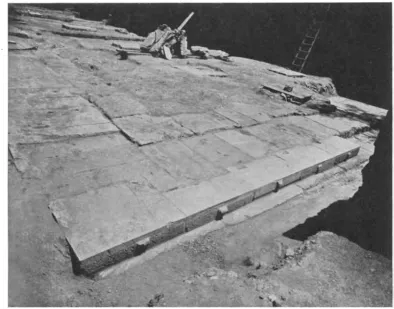
The remains, which will be described in detail below, consist of the foundations of the back wall of the building, the piers for the interior colonnade, and part of the foundations of the exterior or front colonnade with the cuttings in the rock for the same wherever they have been ripped out. A single course of five marble blocks remains to show the location and level of the first step of the crepis at the south end of the building.
The building behind the stoa, dating from the third century before Christ, is a rectanigle measuring 12.50 m. by 16.50 m., divided into two equal parts by an east-west wall. It is clearly an addition to the stoa, and apparently communicated with it, for there is no possible approach to the lower level of the smaller building save through the larger.
THE STOA
The only significant dimension of the stoa that can be ascertained at present is its depth, which was very nearly 11.50 m. measuring from the socle of the back wall to the presumed face of the lowest step of the crepis. The spacing of the interior columns works out at very nearly 6.00 m. on centres, and consequently gives a submultiple of that distance for the exterior supports. The usual restoration would be to have two exterior supports for one in the interior, but certain difficulties that arise when a restored plan is attempted make it quite possible that tho ratio was three to one. Sufficient fragments have been found to show that the outer order was Doric, the inner,
1 Ath. Mitt. XXI, 1896, pp. 107 if.; XXII, 1897, p. 225. Ant. Denkm. 11, T. 37.
2 1, III, 1.
American School of Classical Studies at Athens is collaborating with JSTOR to digitize, preserve, and extend access to
Hesperia
-
~~~~~~~~~~~~~~~~~~~~~~~~~~~~~~~-
~~~~~~~~M
T
-
i
-
~~~~~~~~~~~~~~~~~~~~~~~~~~~~~~~~~~~~~~~~~~~~~~~~~~~~~~~~~~~~~~~~~~~~~~~~~~~~~~~~~~~~~~~~~~~~~~~~~~~~~~~~~~~~~~~~~~~a
-isit: - s~~~~~~~I
112 RICHARD STILLWELL
as might be expected, Ionic. On the other hand there are not enough data to make a complete restoration of the orders, and consequently this will not be attempted until further research furnishes additional indications, or shows that no more information is to be expected.
One interesting fact that may be noted from the plan is that the spacing of the interior supports is greater than half the depth of the building, and as a consequence
fors an ineirage ons ocuieyt h prenc of an eastwardpoeto .~~~~~~~~~~~~~~~~~-_
atne we the south end of the so,adbyinferenrceofond isymmetry,eto ah similrs proecttion ath
1 A variation of a few centimetres in the spacing of the foundationi piers and the absencee of definiite
ARCHITECTURAL STUDIES 113 the nortli end. There is a building of a considerably later period than that in which the present stoa must be dated which has just such characteristics, namely the Stoa of Antigonos at Delos.' Possibly the Athienian building furnished an example for the Delian. A noticeable irregularity occurs in the line of the foundation for the rear wall, which is not straight but bends to the west as it runs southward from the railway. The actual point of the bend is unfortunately not preserved, having been torn away in the con-
b~~~~~~~~~~~~~~~~~~~~~~~~~~~~
'-4~~~~~
Fig. 3. Watei B isin at Southt Enld of Royal Stoa
struction of a mediaeval well. The explanation of this peculiarity is not apparent, unless one supposes that part of the foundation is of an earlier date, and that the bend was the result of an addition or alteration. That the back wall was straight, however, is shown conclusively by the setting line which can be traced along the top of the foundation. There is no evidence that the building ever ran farther to the south, for the level of the rock rises shortly beyond the south steps. On the other hand no cutting exists to show that the stoa formerly terminated where the bend in the foundation seems to come. The angle may be the result of a slight change in orientation after the
1 Delos. La Portique d'Antigone. Cf. also the Great Stoa in the Sanctuiary of Athena at Lindos in
114 RICHARD STILLWELL
construction of the btuilding- had begun from the southern end. Inasmuch as the foundation blocks were to be covered at the southern extremity of the stoa there was no reason for relaying tliem. As will be noted under the discussion of the construction,
the marble steps remaining in situ seem to have been let into the foundation in a rather uinusual manner for anythingf but an alteration or change of plan.
Fig~~~~~~~~~. 4. Reaiin W.l at Sot End of Roa Sto
A lag wte bai (Fig 3).. mesrn 0.X27m o h niesoda n
" '
J~~~~~~~~~~~~~~~~~~~~~~~~~~~~~~~~~~~~~~~~~~~~~~~~~~~~~~~~~~~~~~~~~~~~~~~~~~~~~~~~~~~~~~J
L~~ ~~~~~~~~~~~~~~~~~~~~. ... .
M.~~ :.I
~
~
_ _~~~~~~~~~~~~~~~~~~~~~~~~~~~~~~k
-~~~~~~~~~~~~~~~~;-
,, X 0 . : . *lx 4 5 3 f~~~~~~:t ' : - 1 t
lFig. 4. Retailiihig Wa,ll at Soutli End of Royal Stoa
A large water basin (Fig. 3) measurincr 1.80 m. X 2.70 m on t}le inside stood at one
time immediately within the southern limit of the buildingr. At present there are five large poros slabs on which the outlines of the basin may be traced by the presence of the hard waterproof stucco that originally lined it. At the wvest end of the basin the stucco turns up in such a way as to show the presence of a small pier against the centre of the end wall. This presumably was for a fountain. The floor of the tank is some O.Om. below the supposed floor level of the stoa, and if the tank remained open it would have been siink in the floor. The line of the south stylobate cuts very close to the corner, and the orientation of the tank is not that of the stoa but is some degrees removed
L
_ .0:'C
_.
t=
A
-e~~~~~~~~~~~~~~~LJIZI
2~~~~~~~~~~~~~~-t
ISTl
n L1 ? ,, 1 w Lii
\,~
F ' _ | X l
g~~~~~~~~~~~~~~~I
Cig
|
p
S~~~~~~~~~~G
1WLU
PLATE IV
\' i_~~~~~~~~~~~~~~~~. . . I, . I I.1. I I. ,'
J
E
"O"P-
EXCAVATIONCSS
t1_ ~~~~~~~~~~~~~~~~~~~~~~~~~~T o
I-
AGOZA EXCAVATIONS
)'ECTOPS A % E
c1
LJIIZIZ
2
LZE2ILW
I
YFhJ2
LII
UP jiiiZZZUPIflPn
L1
1
4~~~~
L
Iii7
Li
0
:F't
-t
',-0
X~~~~~~~~~~~LI
0
.
X~~~~~~~~~~~~G
C1=<02l WWLL1J
N'rr t t < J Q m I! ,,f
Xt ,Xh. D
W - <~~~~~~~~~~~~~~~~~~~~~~~~~~~~~~I
- ar~~~~~~~~~~~~~~~~~~~~~~~~~~~-
AGOZA EXCAVATIONS
$ECTOPS A % E
o 2 s 5 1 s2
- -
ARCHITECTURAL STUDIES 115 the former being the earlier, but it also appears that the basin was respected by the builders of the stoa, and that it remained in use.
Parallel with the rear wall of the stoa, and about a metre further west, runs a retaining wall of squared but not faced poros and conglomerate blocks (Fig. 4). The wall begins just north of the south corner of the stoa, and is the continuation of a lilgiter wall, built of uncoursed pieces of Acropolis limestone. The conglomerate retaining wall is preserved four courses high at the south end, and breaks down as it extends north. For a distance of twenty-five metres it consisted of courses of headers and double stretchers, but the alternation of these in succeeding courses was not observed, that is, the same course will contain headers and stretchers, all save the lowest course which consists solely of stretchers. Where the wall crosses the front of the Hellenistic building some of the blocks have been removed, five from the west face of the wall, and one from the east. The two remaining blocks on the west side of the wall seem to have been left for some purpose in connection with the Hellenistic btuilding, and it may not be purely a coincidence that they would serve to give foundations for an opening made from the stoa into the southern chamber of the addition. The northern part of the retaining wall has been much overbuilt by later construction. A section, four blocks long and two high, remains where the wall passes beyond the line of the Hellenistic structure. The west face of the upper stones has been cut down leaving a projecting lip at the bottom, anld the blocks retain traces of red stulcco. A cutting in a block that forms a corner indicates that at some time a small, very poor building was made here.
CONSTRUCTION
At the south end of the building (Fig. 5) the poros foundation blocks, coursing with the marble step-euthynteria, were originally laid 1.25 m. wide. A rabbet 0.20 m. wide was then hacked in their upper front face, and an additional course of poros, 0.50 m. in width, was laid south of the main course so as to provide a foundation for the marble step. This rather haphazard form of construction is a little startling in a building of the date to which we must assign the Royal Stoa. The marble step was then laid, the first four blocks counting from the west being of blue Hymettus marble, and the fifth of white Pentelic. Again the discrepancy is disturbing,. The steps were not dowelled to their foundation, nor clamped against it, but evidently it was thought that the double dowelling of the next marble course would afford sufficient bond. One dowel of the next course occurs in the marble step and is matched by another in the poros foundatlon. The faces of the steps were never finished. They still retain their lifting bosses, and all but one of the steps show merely a roughly picked protecting surface, with a slight smoothing around the edges done with the chisel. The remaining block, the third from the west, is better finished and shows a drafting on its lower edge, 0.055 m. high and 0.005 m. deep. The lower corners of several of the blocks are chipped in such a way as to make a satisfactory finish impossible, but inasmuch as it seems to have been the intention to cover the face of this course, it presumably did not matter. That this course
116 RICHARD STILLWELL
was never entirely covered, but that the ground level came up very nearly to the upper edge of the blocks, is shown by the wear that can be distinctly seen on the upper surface, and the rounding, down of the actual front edg,e of the course. The fill which was densely packed against the face of the blocks contained pottery that could not date later than the second half of the fifth century B.C.
'
m'
~~~~~~~~~~~~~~~~~~~~~~m
Fig. 5. View of Step at South End of Royal Stoa
The dowels were 0.01 m. by 0.06 m. in section. The upper surface of the marble was
dressed with a toothed chisel, with three teeth to the centimetre. Only one clamp appears
in this course. It holds the north side of the marble block at the corner to the poros
ARCHITECTURAL STUDIES 117 Rear Wall
Running north from the corner the foundations of the rear wall are made of soft poros blocks ranging from 0.48 m. to 0.84 m. wide and 1.17 m. to 1.34 m. long, laid as headers. They are well jointed, but neither their inner nor outer edges are lined up. No clamps were used. These blocks bear on their upper surfaces pairs of dowels, with a single prvhole between, for blocks which varied in length from 1.11 m. to 0.97 m.
Fig. 6. The Rear Wall of t-he Royal Stoa near the North End of the Area
This next course, to judge from the setting, line, the position of the dowels, and the pryholes, must hiave been very nearly 0.80 m. in width, and was presumably either of marble, or of hard poros. The poros foundation at the south end was two courses deep, save at the extreme southwest point where a single course rests on the rock.
Opposite the third inner column, from the south, the construction chianges and the headers give way to stretchers and backers. The general thickness of the wall is main- tained. The distance between the joints is 1.20 m. to 1.30 in., and at each joint the
stones are drafted, to the right of the joint. The field of each block is left quite rough. The setting line for the course above is set 0.08 m. behind the drafted edges of the blocks.
118 RICHARD STILLWELL
Behind the fifth interior column the fourndation becomes deeper (Fig. 6). From two courses it changes to four, and later to five, and it is bedded on the friable rock that underlies this area. Two blocks which belong to the upper course of the foundation remain in place at the north end of the area. The level is maintained very accurately, there being a difference of less than one centimetre in the whole length. As might be expected, the underlying courses are laid alternately as headers and stretchers and show anathyrosis throughout. No clamps or dowels occur save in the top course. The close fitting joints of courses three and four below the top are distinguished by being roughly bevelled, generally on one side of the joint only, and the faces of the blocks have been picked roug,hly to a plane surface, not always perpendicular. The top of course III (counting down) shows a setting line less than five centimetres behind the average face of the blocks. To this line are set the headers of course II, the southern corner of whose blocks has been drafted so as to give a surface for alignment. The upper and lower edges of tllis course have been worked so as to produce an approximately straight line 0.02 m. outside of the setting line. This is not a drafting but rather a bevelleld out, done with a chisel.
The upper surface of course II has had the same treatment as the one below. Course I, the top course, has its blocks drafted on both sides of the joint, and a drafting as well along the lower edge. The upper edge was not drafted, nor even bevelled, if we may judge by the remaining two blocks. Their faces are picked off roughly, and are not plumb.
The deepening of the foundation to five courses occurs behind interior column number six. The bottom course here is laid with fairly tight joints, but it is not faced in any way. Course IV increases 0.06 m. at one point, making course III correspondingly shal- lower. The height of the courses is as follows:
Course I (top) 0.47 m. Course II 0.47 m.
Course III 0.51 m. to 0.53 m. (0.46 m.)
Course IV 0.42 m. to 0.40 m. (0.47 m.)
Course V 0.45 m. ca.
The east side, (inside), of the foundation is quite rough, and the stones project unevenly. It is evident from the dowels preserved in the top of Course I at the north end of the area that the joints of the socle, or of the succeeding course, were not placed with any regard to the top foundation course. At this point the length of two blocks seems to have been respectively 1.015 m. and 1.035 m., and a dowel falls across one of the joints in the foundation.
The stones that faced the wall seem on the whole to be of a slightly lharder poros than those used as backers or levellers at the bottom of the foundation. The joints of the backers fall within a few centimetres of the stretchers', and the stretchers themselves are not of a uniform thickness but vary as much as ten centimetres.
ARCHITECTURAL STIUDIES 119
The Piers for the Inner Colonnade
These foundations are roughly 1.30 m. square, and are built up in courses, more or less in number depending on the depth of the rock. Each course consists of two blocks, twice as long as wide, set side by side, and the direction of the joints changes ninety degrees for each course. The only pier of which more than the top course shows has lost the final foundation course, but shows below that three courses respectively 0.45 m., 0.42 m., and 0.44 m. high. The blocks are dressed generally with a broad chisel, save where the upper surface of the last or highest course has been dressed with toothed chisels to receive the next course, probably a plinth for the column. A faintly discernible weather line, or rather pressure line, in(licates that this plinth was about 1.15 m. square. In general the upper surface of the top course of the piers lies 0.05 m. above the upper surface of the back wall foundation. The spacing of the piers is not accurate, but they are large enough to allow the plinths to have beeln set accurately on them without the danger of projecting over at one side or the other. No trace of setting lines can be found and for the spacing of the interior columns we must work by averages. These piers were sunk in square holes cut for them down to bedrock, through the earlier fill, and especially through the layer of burning that seems to date from the Persian invasion. The floor of the stoa was of packed earth, and has left few. traces. The excavation revealed the fragments from the destruction of the building coming as low as the general level of the rock surface within the stoa. If we restore one additional step above the one preserved at the south end of the building we will have very nearly the level of the stoa floor. Two steps above the preserved steps bring the floor so high that there is no possible explanation for the lack of a well-defined strosis some twenty centimetres above the rock at its hi(rhest point.
ARCHITECTURAL FRAGMENTS
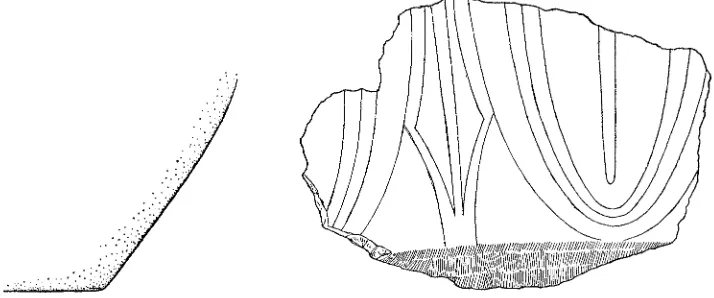
There remained in the area of the stoa after its destruction only a very few blocks, but many fragments and splinters of its marble architecture. Chief among these is one most important piece, a cornice block from an initerior angle. It is of excellent profile, with a bedmold consisting of a cyma reversa, and a strongly accented drip below the edge of the corona. The bedmold is of the usual fifth century type (Fig. 7). It is interesting to observe that the fascia above the bed- mold, and the intervias, which are on the same plane, recede slightly from the perpendicular, but the face of the corona seems to have been quite perpendicular. The upper side of the block shows two lifting holes, for tongs, about 0.305 m. apart. The back of the block has been
Fig. 7. Bedmold of
Cornice
120 RICHARD STILLWELL
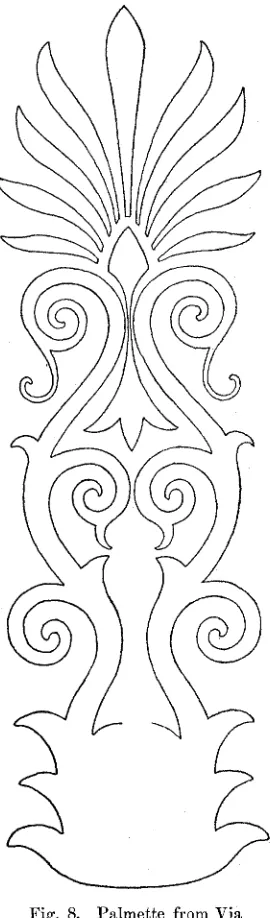
fragmeiits, were probably of terracotta. The most miteresting, feature in the way of decoration is the painting, of the viae, which are adorned with palmettes of the flame
Fig. 8. Palmette from Via
type, issuing from scrolls which in turn spring from an acanthus leaf. The design, somewhat restored on the basis of other fragments found nearby and belonging to the same order, is illustrated in Fig. 8. These palmettes were scratched in outline on the marble and the back- g-round was painted red. Whether the ornament itself was colored does not appear. It is clear that the design was applied before the block was hoisted into place, for the via on one side of the block has been worked down nearly a centimetre in order to make the block fit, and the anathyrosis has been recut. This entailed the slicing off of the sides of the scrolls. The band behind the viae was painted red, the mutules shiow traces of blue color, and the bedmold' is decorated with a leaf and tongue done in red, green, and presumably gold. Although no trace. of the actual gilt remains, the marble where it was applied has been stained a blackish color, not to be confused with the traces left by black paint. The character of the stain is that which would be left by metal. The soffit of the bedmold where it projected slightly over the metopes was red. The gu;ttae were probably also colored, for each gutta bears an incised circle on its lower face, some three millimetres from the edge. What color was applied here does not appear.
Three other cornice blocks were also found, although none of these retains the overhanig of the cornice. One is preserved to its full length, 1.007 m. Another seems to have measured originally 1.008 m. The average width of the mutules was 0.401 m. and that of the viae 0.10 m. with very slight variations.
The cornice blocks were fastened by I clamps, and
ARCHITECTURAL STUDIES 121
of the top and of the wash above the overhang can be clearly seen. A rough cutting at the back of the block seems to be for a beam.
Frieze (Fig. 9)
Numerous but very small fragments of poros triglyphs, retaining a great deal of their bright blue coloring, were found among the marble chips dating from the destruction of
320 ca.
- 022
035 .002x .03/ 7 .060 /#03 ./02 qoj J/0.2
~~~.016 ;2' & 17:8,
, .~~~~~~~~~~~~~~~~~~~~~~~~~~~~~~~05
= L Li L LiL J i L .27
.032 U.0033
~
~
~
.03 0/Fig. 9. Restoration of Entablature
122 RICHARD STILLWELL
The Architrave
One fragment of a regula, having a length to the joint of 0.205 m., may safely be attributed to this stoa. If the joint fell in the centre, the regula would measure, accordingly, 0.41 m. in length. The height of the fillet of the taenia and the face of the regula are almost equal, 0.043 m. The guttae are a little less than half the regula, but the taenia is augmented with a delicate ovolo that brings its height to 0.058 m. It will be observed that the sides of the guttae sway in slightly, a peculiarity noticeable in the Periclean buildings on the Acropolis. The under sides of the guttae have an incised circle and a centre point as do those of the mutules. Traces of red paint appear on the face and under surface of the taenia. The workmanship of all the above fragments is of the best quality.
Again we are at a loss to complete the dimensions of the architrave, and must look to future excavations, and the lucky finding of some transported fragments to complete our restorations.
No surely recognisable fragment of the Doric capitals of the outer colonnade remains. Several chips of fluting from the columns were found, and if we restore the drums as having the usual twenty flutes the lower diameter of the columns would have measured from 0.75 m. to 0.80 m. Stylobate blocks are as rare as capitals.
Fg1.Fgeto l/
Fig. 10O Fragmenit of Voltite
Interior Order
ARCHITECTURAL STUDIES 123 a narrow exterior border, widening toward the bottom, of some other color, which was carried as well into the space left between the tongue and the outer border of the leaf. The under surface or bed of the cap is visible on this fragment, and has been worked down smoothly with a tootlhed chisel. The height of the echinus is not
available.
A third fragment, which does not actually fit the first, but is the continuation of the joint between the horizontal and the curved volute band, seems to show a flare out which when taken with that noticeable on the first fragment indicates a corner capital. The only place that this could be used would be on the column of the interior order at the southwest corner of the building, i. e., where the interior colonnade turned to the east.
A piece of the upper part of a column with an astragal may go with this interior order although the workmanship is apparently not quite as good. Still, on account of
Fig. 11., Fragment of Echinus of initerior Order
the rather bad weathering of the piece it is difficult to tell. This gives us the information that the columns were fluted, at least in part, and that the astragal measured 0.02 m. and the fillet below it 0.013 m. in height. The upper diameter, exclusive of the fillet and astragal, would be about 0.60 m.
Several chips of unfluted column drums, the diameter of which may be about 0.60 m. or a little over, were also found, and these may with all probability be assigned to the interior order. The outer surface of the drum is worked very finely with a toothed chisel, save at the joint, where a finer finish has been applied. The bed, where one drum rested on another, is rubbed smooth. Inside of this resting sur- face, whiceh is about 0.12 m. wide, the core of the drum shows again tooth chisel work.
124 RICHARD STILLWELL
Date of the Building
Certain evidence of the date of the stoa is lacking, but from the style of the fragments preserved we can place it on the one hand as not earlier than the Parthenon, and even from the analogy of the flame palmette to other examples, as late as the first part of the fourth century. The evidence from the fill against the step at- the south, and from trial trenches cut through the filling thrown in to form the floor, points to the fifth century, and we may tentatively assign it to the latter half of the fifth century before Christ. A closer dating is of course to be desired, and may well be ascertained on the completion of the excavation. The building lasted through Roman times and apparently was entirely destroyed by the fifth century A.D.
II. THE HELLENISTIC BUILDING
Plate V
At the time when the stoa was construieted, the rock of the Theseum hill came forward to the line of the retaining wall for a length of some thirty or more metres north of the southern end of the structure. The addition of a rectangular building measuring some seventeen by twelve and a half metres necessitated quarrying the rock away and cutting through two earlier cisterns which lay in the area. Actually the back wall of the new building lies more than sixteen metres from the rear wall of the stoa, and there was a space of some three and a half metres between the earlier and the later buildings. How this space was treated is impossible to say. Probably it was unroofed, although no trace of provision for draining the open areas remains.
ARCHITECTURAL STUDIES 125 fully laid, with their tops nearly at the same level. They rest partly on earth, partly on the projection of the broad foundation. A cutting on one of them may indicate a step to a sill in a door between the two chambers. On the north of the median wall five blocks remain, also resting partly on the foundation and partly on dirt. These are much better joined, and are brought to a level surface some 0.06 m. below the top of the
Fig. 12. Marble Base Blocks in Hellenistic Building
central course. Presumably these two flanking, rows of blocks represent the foundations of seats that ran around, or at least partly around, the two chambers. From the eastern
wall of the northern chamber two poros blocks 0.70 m. wide project one metre into the
126 RICHARD STILLWELL
across the end of the chamber and was supported by light construction. Cuttings in the rock for two similar foundations appear in the southern chamber.
Tlle excavation revealed a heavy layer of marble chips extending over the whole area of the building save where the walls had been removed. Over this was laid at some time in the Roman period a floor of marble slabs, fifteen of which remain in situ. They are preserved only in the northern chamber. The southern chamber has at its east end two marble blocks that formed the base of some construction resembling an altar (Fig. 12). The northeast corner is preserved, and if we restore the length so as to place it sym- metrically in the room, we get a dimension of 3.20 m. The depth is not ascertainable. The poros foundation which supported the construction. has completely disappeared except for those blocks that remain in situ.
Final Period. Late walls
This structure can be dated in the third century before our era on the evidence of the sherds found in the well at.the southeast corner and in the two cisterns. All of these were filled when the building, was erected. Trial pits in other locations confirm this dating.
After the destruction of the building, prestumably towards the end of the Romani period, two walls consisting partly of re-used materials were erected inside of the limits of the north and south boundaries of the building. A cross wall of rubble masonry was built across the northeast corner but there are no indications to show for what purpose this rebuildingy served.
lII. CISTERNS IN SECTION A
In clearing the slopes of the Kolonos Agoraios three double cisterns were found cut down into the living rock and intended for the storage of rain water. All three are alike in their general features, consisting of two bell-shaped chambers opening above in bottle-neck mouths and connected at their floor levels by underground passages. In the bottom of each chamber, directly below the mouth, there is a shallow circular depression towards which the floor slopes gently from all sides in an arrangement which was doubtless designed to facilitate the cleaning of the cistern. Walls and floors alike are covered by a single coat of stucco made principally from sand, fine gravel and lime. This plaster has survived in firm and well preserved condition save where the rock has broken away behind it.
ARCHITECTURAL STUDIES 127 pier, built up, in part, of re-used materials (Fig. 13). Notwithstanding these precautions, a great mass of the eastern wall, facing towards the stoa, has fallen in. A short surviving section of a poros water channel leading into the cistern's mouth from the direction of
Fig. 13. Cistern in Sector A. View of the Interior
the stoa suggests that the reservoir drew its water from the roof of that building. Its mouth opened in a room floored with pebble mosaic and enclosed by walls of poros masonry.
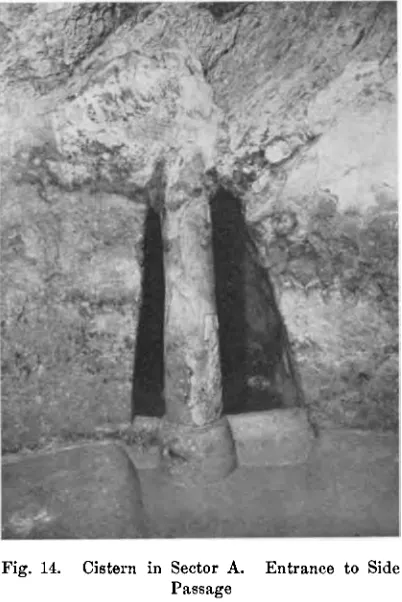
A rock-cut passage, some 2.44 m. long and 2.15 m. high, supported at its southern
end by a single columnn, connected this chamber with its northern counterpart (Fig. 14).
128 RICHARD STILLWELL
the annex to the stoa. The lower part was then filled in with broken stone and earth to carry the southern foundation of the new building.
If one may judge from the pottery found in the filling overlying the bottoms of these two chambers, they must both have gone out of use as water reservoirs towards the close of the fourth century B.c. The lowest filling of the southern chamber was especially
interesting. It consisted largely of ashes and charcoal, freely intermingled with miniature
Fig. 14. Cistern in Sector A. Entr ance to Side
Passage
unpainted kraters, kantharoi, and open bowls. In clearing out slightly more than one half
of the filling more than five thousand of these vessels were secured. The combination of
miniature vases in such numbers with traces of burning suggests that, after the chamber had ceased to be used for the storage of water, it became a refuse dump for some neig,hbouring, sanctuary or altar. The northern chamber yielded no miniature vases or ashes and this circumstance suggests the possibility that the material was brought from the south- west, which is the direction in which the Theseum is located.
PO~~~~~~~~~~~~~~~~~~~~~~~~~~~~~~~~~~~~~~~~s ROS < 331Ss _ AEGINETAN POR03 5n,y'1,Q
CONGLOMERATE ':ib ';i>s
t----,2ACROPOL15 LIME5TONE ml&
a
- - TUCCO |---
,,@u R O CK C UTS 5t'"
As5ssss EXCAVATION CUTS 5
RI,~~~~~~~~~~~~~~s 7 7 _s
Wo,E,,,,,,,i,,j0,j,S55ss'
~ ~ ~
7\ APLATE V
S E
'ON/1~~~~
@S- <z'~ T\4 --
.1, -
- >s~~s
/4<~~~~~~~~~~~~~~~~~~~~~~ 4
44/4
/ //? /5/~
~
f 2 7/ 17/7 / 75-<ya /7o and
7/
ARCHITECTURAL STUDIES 129 the northwest corner of the new building. The southern of the two chambers was very slender, having a lower diameter of only 1.35 m. compared with a depth of 5.30 m. Its lower 0.45 m. was filled in and th-le western foundation of the annex was carried unbroken across it. The connecting passage-way is ca. 7.70 m. long and 1.75 m. high. The nlorthern chamber is larger, measuring 4.30 m. in depth and 3.30 m. in its lower diameter. A well was cut through its floor in later times and both well and cistern yielded Byzantine pottery. None of the few sherds found in the filling of the southern chamber nleed be later than the third century B.C.
In clearing the bedrock just to the west of the southwest corner of the annex to the stoa the mouth of another bell-shaped reservoir was found which has a depth of 3.17 m. and a lower diameter 2.70 m. A winding passage 9.20 m. long and 1.20 m. high, led westward to another larger storage chamber (depth 5.68 m., lower diameter 4.20 m.). This room is an excellent specimen of rock-cutting and plasteringf and has survived in almost perfect condition. Overlying the floor of each of these chambers was a cone- shaped deposit (0.80-1.00 m. high in the middle) of viscous red earth in which was found a quantity of pottery of the third and second centuries B.C. The upper filling was of late Byzantine times.
The regularly double nature of these cisterns is probably due to the faulty nature of the rock in which it would be safer to cut two or more small chambers rather than one large cavity of equal capacity. This argument is borne out by the excavations of 1932 which have revealed in the still more treacherous bedrock at the northern foot of the Areopagos water storage systems comprising more numerous and smaller chambers connected by underground channels. That one mouth was reserved for the ingress and the other for the drawing of water is disproved by the fact that in the case of the southern chamber of the first cistern in Section A, the inlet in no way interfered with the draw mouth. Indeed, the separate mouths of these cisterns may well have opened in different properties.
The close similarity in plan and in stucco suggests that the three cisterns are not far apart in the date of their construction. We cannot, to be sure, fix that date with certainty. It is probable, however, that the first was cut shortly after the building of the stoa from which it drew its water. As we have seen, it appears to have gone out of use as a cistern towards the end of the fourth century B.C. Of the second cistern
we can only say that it was rendered useless by the construction of the stoa annex, probably in the third century B.C. The third cistern was in use in the early Hellenistic
period but scarcely later.'
I~~~~~~~~~~~~~I
AiF' 54.V g
ARCHITECTURAL STUDIES 131
IV. THE ZEUS STOA
The first campaign in 1931 revealed at the southwesterni edge of Sector Epsilon, the presence of a colonnade or stoa ruinning parallel with the general line of foundations forming the eastern' limit of the buildings in the area excavated previously partly by Doerpfeld and in part by the Greek Archaeological Society' (Fig. 15). The second campaign followed this stoa to its northern limit. The southern end of the stoa appears at the extreme southern limit of the excavation, but until further exploration can be made very little can be said about it. The present report, therefore, will be confined to a discussion of the remains in situ, but their relation with the complex of buildings to the west must wait for explanation until the entire section can be uncovered.
No architectural fragments have come to light that determine whether the stoa was Ionic or Corinthian, althou0,h the former is more probably the case. One base of Pentelic marble remains in situ above a stylobate and two steps of Hymettus marble. - These in turn are based on a euthynteria course of Piraeus stone, which towards the northern end of the stoa rests on a lower course of the same material. The subfoundation, increasing in depth to the north with the slope of the land, is of conglomerate, as are the filling courses behind euthynteria and steps.
Altogether, a length of nearly forty metres of this stoa has come to light. It is broken from time to time by late pits which were sunk through the structure and, save at th'e south end, has been stripped down to the subfoundations, or to the course lyingf below the euthynteria. Many of the blocks of the latter were turned up on end and built into a late wall that ran along the course of the colonnade. Some of these have since been restored to their places, as has also one block of the lower step which was found lying nearby.
Construction
A careful examination of the construction and technique of 'the building gives the following characteristics. The conglomerate blocks of the subfoundation were laid on rock or hard-pan, and are only roughly squared. Their upper surfaces are carefully levelled off to receive the euthynteria, wh'ich consists of blocks of Piraeus stone, laid as headers and carefully jointed with anathyrosis on the edges adjacent to the face of the stones, from which the square lifting bosses have not been removed. The euthynteria blocks are roughly 1.40 m. long and 0.65 m. wide. The height of the course is about 0.35 m., varying, slightly with the inequality of the foundations. As has been already stated, there is a well fiinished course below the euthynteria which runs from the north end of the stoa to a point some 9.50 m. south. It consists of a series of stretchers varying from 1.35 m. to 1.41 m. in len(,th, 0.65 m. to 0.70 m. in width, and 0.475 m. high. Backers of conglomerate lie behind these. This course also shows lifting bosses. The joints are bevelled on one edge with the toothed chisel, and the remainder of the surface is picked.
' W. Judeich, Topographie 'on Athen, 2nd Ed., p. 331.
132 RICHARD STILLWELL
The effect is not that of a carefully finished course, and it is doubtful whether it was ever meant to be seen. If it was, then the lowest marble step must, at the north end, have been raised too far above the ground level to be of any use (Fig. 16). Probably the finishing of this lower course was intended as a safeguard against a possible shift in the level of the Agora, or it may merely have provided for temporary visibility while
Fig. 16. North End of the Zeus Stoa
the finished level of the grade was being determined. In Roman times, at any rate, this course was visible at the north end of the stoa, where it returns for 2.10 m. to the west and then turns southi against the end wall foundation. No setting line can be traced, but from the weathering it seems that the euthynteria was set back some 0.07 m. from the f ace of the course below it.
ARCHITECTURAL STUDIES 133 step. Each block was dowelled to the euthynteria with square dowels, and clamped at each end to the neighbouring, step block with one, and to the conglomerate backer with two hook clamps, set in a slightly dovetailed cutting. Well defined anathyrosis, with a joint surface about 0.06 m. to 0.08 m. wide, occurs at the ends of each block. The face of the step, which is not drafted at the base, is finished in its lower half with a toothed
~-W- ''J
~~~~~~~~~~~~~~~~.
4i0
Fig. 17. Zeus Stoa. View of Base in situa from the West
chisel and is picked above. There is no projection of one surface beyond the other but. the difference in working is clearly visible (Fig. 18).
Only four blocks of the second step remain, but the settingy lines on the lower step show that their lengths ranged from 1.195 m. to 1.372 m. This step was only 0.279 m. high and had a tread of 0.335 m. to the settingr line for the stylobate. The blocks were fastened to the lower step by two square dowels. Those at the southern end of each block come at the joint and were leaded from the end of the stone before the next
block was set. The other dowels occur as much as 0.15 m. from the north end of the blocks and are equipped with pour channels, leaded from the face of the step. This
134 RICHARD STILLWELL
the fact that some of the setting lines for the blocks have been struck twice. The clamps on the other hand show no clear trace of a second use, though they may belong to the resetting of the blocks. It seems hardly likely, however, that so large and important a colonnade could have been moved. A restoration would be unlikely to affect the lower part of the building, and there are no other signs of this having been
Fig. 18. Zeuis Stoa. View of Base froni tlle East
done. The finish of the blocks of the second step is in every way similar to that of the blocks of the first, save that there is a drafting along the lower edge, some 0.04m. high and 0.005 m. deep, the upper edge of the drafting being very slightly bevelled. It may be noted here that the setting lines that governed the face of each succeeding course agree with the foremost face of the blocks and not with the drafting which was cut afterward.
ARCHITECTURAL STUDIES 135
second step. The leng,th of the stylobate block is 1.29m., the height 0.25m., and the
depth about 0.89 m. The back is only roughly squared, being concealed by the floor of the stoa, and only the upper edge is brought to a line. It shows some wear, as though the floor of the stoa, consisting of hard packed dirt, and not pavement, were, as might
Fig. 19. South End of Zeus Stoa
be expected, a trifle lower. The base was fastened to the stylobate with two dowels, presumably square. The ends of the pour channels may be seen. On the top of the base are two dowels, 0.06 m. by 0.05 m. and 0.04 m. deep, for securing the column. Fragments of fluted columns which agree in diameter with the base have been found, but no complete drum exists. Of the capitals and entablature there is no sure trace. It is clear from an inspection of the plan that this colonnade served as an ornamental fa~ade for the complex of chambers to the west. If we take the length
(1.29mi.) of the remaining stylobate block for the interaxial spacing of the columns, we
ARCHITECTURAL STUDIES 137 The date of the colonnade is likewise not fixed
by any factual evidence save technique, and a close inspection seems to indicate that it may belong to the late third, but more probably to the early second century B.c. The setting of the step blocks and the clamps which hold them to their backers, as well as the deeply grooved setting lines, resemble the work on the stoa of Attalus, which is dated in the second ceintury. The actual workmanship and stone- cutting, are, however, superior.
V. THE " PERIPHRAGMA"
Midway between the Altar of the Twelve Gods (?) and the Pisistratid drain, that rtins through the excavations, lies a construction the purpose of wliclh is at the same time clear and yet most mystifying (Fig. 20). A foundation ca. 18.40 m. long and 3.68 m. wide with marks of post holes, and with the stumps of two marble posts still
in situ, surrounds an area in which was a long, narrow foundation, part of which is still preserved (Fig. 21). The blocks which form the foundation average 1.27 m. long by 0.47 m. wide. Their depth varies from 0.50m. to 0.32m., the deeper blocks being generally nearer the north end of the foundation,
which is bedded in or on the hard fill that formed the level of the agora at this point. Only at the extreme north end of the structure did the blocks rest on masonry, and here it is only a question of their havingr been laid over part of an earlier foundation. The length of the blocks gives the
spacing of the posts of the fence (1.27 m.), and
originally there were fifteen posts oln the sides and four on the ends, the corner posts being counted twice. Each post was fastened by two oblong dowels, and the upper surface of the foundation or sill was in a few cases dressed off slightly to ac- commodate the post, but generally the trace of the post on the masonry is very slight. The dowels measure 0.055 m. by 0.012 m. The posts, from the
El
w~
~~~~~~~~~
.1
"7W
138 RICHARD STILLWELL
traces on the foundation, were about 0.33 m. by 0.25 m. in section at the foot. The corner posts were presumably square and had the larger dimension. Both within and without the boundary of the fence the foundation is dressed down smooth for a portion of the total height of the blocks. On the outside this dressing does not maintain an even height but is deeper at the north end, extending down 0.28 m. from the top of the course. At the south end the depth is less, being only 0.18 m. The difference in level occurs about one third of the way from the north corner, on the west side.
~~~~~~~~~~~~1
-
E1
LIL
0) 0.50
Fig. 22. Limestone Post and Capping Stone
On the east the break occurs nearer the north end and is almost exactly opposite the extension of the south side of the altar steps. On the inside of the circuit the dressing is only about 0.10 m. deep. At some period in the history of this foundation there was an alteration. The original posts were removed and were replaced by a new series witlh about the same spacing, although considerably more irregular. The new uprights were not dowelled to the base, but were set in holes cut in the foundation to a depth of 0.12 m. to 0.05 m. and were leaded in. Two stumps of these remain
in situ. The enclosure was at the same time lengthened towards the south by two more uprights, makin(r the total leng-th about 21.00 m. The extra posts were set in separate blocks, one a re-used statue base with an inscription.
The southeast corner post of the new series still remains in place. It is of marble which is rather a poor quality of Pentelic, and it shows holes for wooden rails 0.09 m. by 0.03 m. On the east side there is evidence for two rails on the post that remains in situ, set about a foot apart, with the bottom rail a foot above the foundation. Neither the height nor the spacing of the rails was uniform. This can be seen on two other posts remaining in situ. One almost complete post, of Hymettus marble, has three rail holes preserved on each side.
ARCHITECTURAL STUDIES 139 surfaces. The rail holes are slightly larger than in the marble posts, and measure 0.047 m. by 0.115 m.
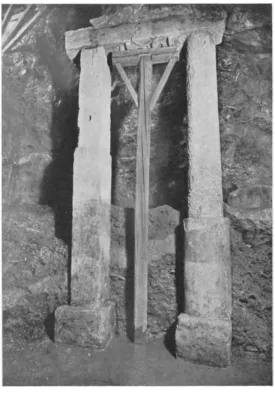
As will be noted, the face of the post shows a V-shaped cutting which divides the upright into two jambs. An iron dowel is still preserved and a part of the capping stone, quite possibly the one that fitted this actual post, has been found. It is triangular in section, with the lower edges of the triangle chamfered off so as to give a vertical fascia about 0.07 m. high. At the end, where a joint came over the centre of the upright, is a dowel cutting, and on onie of the sloping, faces, presumably the one that originally was turned towards the inside of the fence, is a hook clamp.'
A capping stone, of similar section, but lacking any clamps or dowels, made of marble, was also found built into a mediaeval cistern not far off. Presumably it should be assigned to the marble series, but it is difficult to see how it could have been held in place.
What the structure was that this carefully built fence surrounded is lnot clear. Five limestone blocks remain in situ on the east side. They are held together by E clamps, and the face o-f each block has been dressed down smooth for a distance of about 0.16 m. from the top which lies about 0.10 m. higher than the top of the foundation for the fence. A well marked weather line, set back 0.09 m. from the face of the course, gives the front line of the course above, but what this course was is not known. Inasmuch as the five blocks are laid directly on dirt, or rather hard fill, they could not have been intended to carry any great weight. The space between the inner foundation or euthynteria, and the inner edg,e of the fence course, about 0.41 m., seems never to have had anything save an earth floor. Unfortunately both ends of the original inner basis have disappeared. Probably they were spaced as far from the ends of the fence as were the sides. When the fence was lengthened the inner basis seems to have been carried out to the south, and a limestone slab, nearly but not quite on line with the face of the inner euthynteria, as well as some foundations to the south of the original fence, strengthen this hypothesis. The fence foundation at the south also shows evidence of having been trimmed to accommodate another slab similar to the one in situ,
and adjacent to it on the west. The cutting ends at a distance nearly enough the same distance from the west fence to make the addition centre on the two lines of fence.
It shotuld be noted that the enclosure does not have parallel sides. The divergence is about 0.12 m., the south end being the narrower.
140 RICHARD STILLWELL
VI. THE ALTAR
Near the eastern limit of Sector Epsilon is a rectangular structure of which are preserved, on the west side, four marble steps, risingf above a euthynteria of Piraeus stone (Fig. 23). Although the eastern half of the monument was badly quarried away in mediaeval times, the foundations and the southeast corner block of the euthynteria
_ia~~~~~~~~~~~i
Fig. 23. View of Altar from the Southwest
remain, and make it possible to ascertain the original size of the building. It was a rectangle measuring, on the bottom step, 8.76 m. by 5.43 m. The setting lines for the southeast corner step can be seen on the course below, and the restoration of the original dimensions is certain.
ARCHITECTURAL STUDIES 141 down smooth for a distance of about 0.17 m. from the upper edge, and a smooth band 0.05 m. to 0.10 m. wide, in the same plane as this upper facing, is found on either side of the vertical joints. The remainder of the face of each stone is left rough but does not project more than about five centimetres. Only the outer blocks of this course were of Piraeus stone. The remainder, or fillino' blocks of the course, were of conglomerate or poros and so far as can be seen only the outer ring of blocks was clamped together.
Fig. 24. View of Altar from the Northeast
The steps, four in number, are found in two courses of marble, each the heighit of two steps (Figs. 26, 27). The treads, beginning at the bottom, average respectively 0.327 in.,
0.3275 i., and 0.325 m. in width. The top step has no definite width, but formed a
142 RICIHIARD STILLAVN E.I I
370 .
0 3
P1/
/ N '<f~t/~1~
>'M'
.54-~~~~~~~~~~~~~~~~~~~~~~~~~~~~~~~~~~~~~~~~~~~~IIiii1P\\
.0
~ ~ ~ ~ ~ ~ ~ ~ ~ ~ ~ ~ ~ ~ ~ ~ ~ ~ ~
H<K~~~~~~~~~~z
ARCHITECTURAL STUDIES 143 steps varies from 0.288 m., for the top step at the west side to 0.32 m. for the bottom step. Inasmuch as the top step at the north end of the building, where it is least worn, gives a height of 0.30 m., this may be taken for very nearly the height of the step. The fortunate preservation of a fragment of one of the eastern corners of the upper pair of steps gives the valuable information that the narrow ledges were continued around the east side of the monument and that consequently the onily approach was from the west. Given the dimensions of the structure, or rather of the platform which was left at the top of the steps, 8.35 m. by 4.247 m., and the fact that the approach lies on the west, it seems clear that the building was an altar.'
At the south end of the west side the lower marble course is exposed and the clamps and dowels are clearly visible. The clamps are of the H type, from 0.34 m. to 0.36 m. long. The dowels are of the thin oblong type and measure about 0.02 m. by 0.09 m. in section. The blocks were dowelled in one end only. The dowel near the southwest
Fig. 26. Section of Steps Fig. 27. Section of North End
corner is provided with a narrow rectanuular pour channel showing that the block which it fastened was the last one of its course to be laid. Hence it follows, if we may restore only two blocks alon(g the south face of the upper course, that the southeast block was tlhe first to be put in place.
Careful inspection of the dowel holes reveals the fact that the dowels seem to have been chiselled out with some care. A deep groove was cut on one side, or all around the dowel, which was then removed (Fig. 28). This fact might pass unnoticed were it not for the fact that the clamps show an entirely different state of affairs. Here the marble has been recklessly hacked away. Further inspection makes the removal of the metal of the dowel at the south end of the preserved second marble course a bit of magic, unless the block had been raised. Otherwise it would have been impossible to free the dowel without causing far more damage to the marble than is the case. It seems senseless to raise a very large block, as this was, for the puirpose of removing a small piece of bronze, and then returning it to its place, or very nearly to its place, for there is a slight shift of the block to the west. The pry holes in the
I The great altar of Demeter at Pergamon lhas about the same dimensions, length 8.60 m., breadth
144 RICHARD STILLWELL
eastern edg,e of the block of the lower marble course seem rather strange, and there is no corresponding mark in the poros backer adjacent to one of these holes. A patch at the northwest corner of the lower step has two sets of pin holes for fastening it in place. Apparently the repair fell out once and was replaced. One is inclined to think that some alteration was made to the structure, or even that it was moved in antiquity
from some other position.
Fig. 28. Detail of Holes for Clamps and Dowels
Further inspection confirms this hypothesis. There are a number of spalls in the marble along the lower edge of the bottom step, particularly along the north side. Inasmuch as the north and south ends of the step are absolutely level, with a rise of one centi- metre at the centre, and since the second step is almost absoltutelv level for its whole length, one can hardly account for these breaks by settling. They seem rather to be the result of damage caused by prying up fhe block. The confirming piece of evidence is that, on the north side, the first joint from the corner of the lower marble course shows that the upper surface of the course was worked off rather rouaghly so as to make an even bed for the block above, but the ledge which corresponds to the first step is not worked off and here the upper surfaces have a difference in level of over a millimetre.
This evidence for the removal and re- erection of the monument allows us to explain the presence of the letter alpha with a broken bar which occurs on the eastern face of the southwest corner block. It is not well cut, but is, rather, scratched on to the stone. The workmanship of the step blocks and all the technical indications point to a date much earlier than the letter would allow, and it is necessary to have the monument disassembled in order to have the letter placed where it is. There is, moreover, on the south end of the block that carries the third and fourth steps a sign, gamma, standing on a pi.' It seems then that when the building was re-erected the southwest corner
I These letters would have served for reassembling the stiruicture as did the letter s on the frieze
ARCHITECTURAL STUDIES 145 blocks were the first to be laid, and that the work proceeded in a clockwise direction instead of the counter-clockwise direction that was the case in the former laying. The dowels were never replaced. The letters A N were scratched on the top of the east side of the long block of the second course.
The top northwest corner block bears on its upper surface two dowel holes. They are of different types, one the long narrow variety, the other square. Both have pour channels, but the oblong dowel has a much better cut channel than its neighbour.
RE~~~~~~~~~~~~~~~~~~~~~~~~~~~~~~~~~
Sasr_
292.rti ~Fig 29 ltr Dtilo Marbl O-rthstt
which is the later type. Surrounding0 these ctting sasihl ogee ufc
what!
caeaoe Th on bloc of th pltfr partly.cut prpr awayAinmediaevai' .~~~~~~~~~~~~~~~~~~~n
times~, hs a smlsqae dowl,bute cutn is so sallw tha it is har to imagin
I . ~~~~~~-7
thath it server servd forn laid sto esual above.easoite it hsurdwl
146 RICHARD STILLWELL
preserved to its full lenogth. The present length is about 2.90 m. As will be seen from the drawing (Fig. 30), which gives the principal dimensions, it was a corner piece. The
M9NT ELEVJAT -'O-A'
COUGH M;CEID
~ ~ ~ ~ ~ ~ ~ ~ ~ ~ ~ ~ ~ ~ ~ ~ ~
/ LOPI~~~~~~~~~~~~~~~~~~~~~~~~~~~~~~~~~
-*AP-
A,
PA 1'ZI tA9 ELEVAjIO 10 * 51 ELEVATION --
Fig. 30. DraWing of Orthostate froi Alt ar