J
SSE
Journal of Social Science EducationVol. 18, No. 3 (2019) DOI 10.4119/jsse-1443 pp. 5-25
Do non-formal and informal adult education affect
citizens’ political participation during adulthood?
Robin Busse
Georg-August-Universität Göttingen
Julia Lischewski
Soziologisches Forschungsinstitut e. V., Göttingen
Susan Seeber
Georg-August-Universität Göttingen
Keywords: Political participation, political action, non-formal and informal adult education
- Non-formal and informal adult education have an impact on adults’ political participation.
- The results differ with regard to the intention to participate and reported participation. - Voluntary courses significantly influenced adults’ intention to participate politically. - Mandatory courses did not affect adults’ political participation.
- Reading books or magazines significantly affected adult voter turnout.
Purpose: While research on political participation hardly takes into account the effects of non-formal or informal education, the effects of formal education are well investigated. The aim of this paper is to determine the extent to which non-formal and informal education contribute to adults’ participation in different political activities when formal educational background and other socioeconomic factors are controlled.
Method: This paper uses data from the German National Educational Panel Study (NEPS, N=9,084). Binomial logistic regressions are used for the analyses, and average marginal effects (AMEs) are used for the model’s output.
Findings: The findings reveal that non-formal and informal adult education significantly affect different political activities. However, the effects of non-formal and informal adult education differ with regard to the different forms of political participation. The results underline the importance of differentiated analyses of political participation and non-formal and informal adult education. In addition, the results show that some types of non-formal and informal education have a greater impact on adults of low socioeconomic status.
Research limitations: This paper cannot account for self-selection effects because adults’ participation in different political activities was collected only in one wave.
1 INTRODUCTION
Studies on the effect of education on political participation have a long tradition in political science and educational research. Particularly in democracies, the impact of
formal education, in the form of graduation certificates, on various modes of political participation has been examined (Bödeker, 2012; Campbell, Converse, Miller, & Stokes, 1960; Gille, de Rijke, & Gaiser, 2011; Hadjar & Becker, 2006, 2007; Mays, 2008; Rosenstone & Hansen, 1993; Schlozman, Verba, & Brady, 2012; Verba, Schlozman, & Brady, 1995; Wolfinger & Rosentone, 1980). One of the key research findings in political science is that people with a higher educational level are more involved in politics, participate more intensively and exercise their democratic rights better and more comprehensively than do individuals with lower-level school degrees. The influence of education, however, differs depending on the concrete form of political participation (Campbell, 2009; Steinbrecher, 2009). Moreover, the effects of education on political participation differ with regard to institutional arrangements and contextual features, which in turn vary across countries. Based on the data of the European Social Survey, Gallego (2010, p. 239) shows, for example, that in some European democracies no strong systematic relationship between education and voting in elections was found, whereas a strong relationship between education and unequal voter turnout in countries such as the Czech Republic and Germany has been observed.
In regard to explaining the effects of education on political participation, one starting point is to recall Paulo Freire’s influence on educational models, educational training of teachers and adult learning (Gadotti & Torres, 2009, pp. 1264-1266). His contributions to the theoretical model of Critical Pedagogy have afforded young people “to acquire and assert a sense of their rights and responsibilities in a democratic society that recognizes the common good over the corporate good” (Giroux, 2010, p. 335). According to Freire, education is a “political and moral practice that provides the knowledge, skills and social relations which enable students to explore for themselves the possibilities of what it means to be engaged citizens” (Giroux, 2010, p. 336). Freire’s ideas and pedagogical approach have exerted a lasting influence over generations of teachers and intellectuals in several advanced industrial societies (Gadotti & Torres, 2009, p. 1265; Giroux, 2010, p. 335).
in political activities during adulthood (Persson, 2013b, pp. 691-692). A third body of research offers another revisionist view. According to this view (which is often referred to as ‘the sorting model’), the social status gained by relatively higher education supposedly increases citizens’ political participation (Campbell, 2009; Persson, 2011, 2013b, pp. 692-693). Persson & Oscarsson (2010, p. 140) emphasize that these three models represent extreme opinions about educational effects. In sum, research points in different directions, and therefore, this is an area in need of further study. However, the models help to explain possible pathways between education and political participation.
Previous studies on the relationship between education and political participation usually include the highest educational attainment as an independent variable in the study design (e.g., Gille et al., 2011; Hadjar & Becker 2006, 2007; Schäfer, Schwander, & Manow, 2016; Schlozman et al., 2012). Thus, the influence of individual educational pathways – and particularly the influence of continuing education – has often been neglected. Particularly in Germany, the effects of education on political participation are large (Gallego, 2010). A look at the configuration of the German education and training system is important to understand the mechanisms guiding returns to education. Germany’s education and training system facilitates a large number of different educational chains and trajectories in formal, non-formal, and informal environments (Blossfeld, Roßbach, & von Maurice, 2011; Blossfeld & von Maurice, 2011, p. 19). After completing primary education, students can transfer to three different secondary school types1: lower, intermediate and upper-level secondary schools. School leavers of upper-level secondary schools mainly transfer to tertiary education at universities and universities of applied sciences. Only a small share of upper secondary school leavers (approximately 22%) enter vocational education and training (VET) that are full-qualifying or, in other words, that lead to recognized certificates (Authoring Group Educational Reporting, 2018, p. 131). After completing lower or intermediate secondary school, students face different alternatives (Solga, 2014; Tjaden, 2017). One of the dominant pathways is entering a VET program. School leavers with an intermediate school certificate, however, are two times more likely to enter full-qualifying VET programs than those holding lower secondary school degrees (Authoring Group Educational Reporting, 2018, p. 131). Moreover, access to full-qualifying VET programs is important in preventing unemployment and, thus, the risk of social exclusion (Authoring Group Educational Reporting, 2018, pp. 200-201). Based on data from the German Socio-Economic Panel, Groh-Samberg and Lohmann (2011) report that respondents’ participation in politics and culture varies strongly according to school-leaving and VET qualifications. The risk of social exclusion in terms of low participation in culture and politics is relatively high among respondents with low school-leaving qualifications and without VET qualifications. For example, individuals with a lower secondary school leaving certificate (Hauptschulabschluss) tend to show less political interest (15%), while those with an intermediate school leaving certificate show a significantly higher interest in politics (appr. 35%; Groh-Samberg & Lohmann, 2011, p. 185).
Although educational trajectories in Germany continue after completing compulsory school, VET, or higher education, existing research on political participation has paid little attention to the effects of adult learning in non-formal or informal environments (Feinstein & Hammond, 2004, p. 104). However, some studies provide evidence that adult education increases participation in political activities (Feinstein & Hammond, 2004; Ruhose, Thomsen, & Weilage, 2019).
context of non-formal adult education is the company or workplace: companies mainly provide non-formal training courses (Authoring Group Educational Reporting, 2018, p. 175-176), and thus, adults in Germany participate mostly in job-related, non-formal education activities. The majority of job-related learning activities are fully or partly paid for by employers. A small share of adults participates in job-related learning activities without any support from their employers. In addition to job-related activities, there are also nonjob-related activities, which account for a minority of non-formal adult learning (Cedefop, 2015, p. 59). Little is known about informal adult education, which is defined “as learning resulting from daily life activities related to work, family, or leisure” and is often referred to as non-intentional or experiential learning (Colardyn & Bjornavold, 2004, p. 71). Informal learning is not only important on the job but also in the course of political engagement (Allmendinger et al., 2011, p. 288).
Understanding non-formal and informal adult education as an essential part of educational trajectories leads to the question of to what extent non-formal and informal adult education contribute to participation in political activities when formal educational background and other socioeconomic factors are controlled.
2 THEORY: RETURNSTOADULTLEARNING – EFFECTSOFNON-FORMALANDINFORMALADULT
EDUCATIONONPOLITICALPARTICIPATION
This section discusses the mechanisms by which participation in non-formal and informal adult education may affect adults’ political participation. The theoretical framework broadly follows the dominating models in the discussion of how education is related to political participation.
2.1 The cognitive pathway: acquisition of knowledge and skills via non-formal and informal adult education
Developing knowledge and skills that citizens need to understand the political system and to express their ideas is one way in which education supposedly triggers political participation (Brady, Verba, & Schlozman, 1995; Persson, 2013b, p. 690-691; Verba et al., 1995). Galston (2001, p. 223), for example, emphasizes that it is difficult for citizens to understand political events or to integrate new information into an existing framework, unless they possess a basic level of knowledge, especially concerning political institutions and processes. Verbal and cognitive competences that go hand in hand with better education are an essential prerequisite of participating politically. Language and abilities in writing and speaking are necessary to understand and communicate about politics (Persson, 2013, p. 16). In addition to knowledge and skills, education triggers encouraging attitudes such as political efficacy (Verba et al., 1995, p. 349). Citizens with better education are supposedly more likely to believe they can effectively influence decisions in the political process (Jackson, 1995, p. 280).
The acquisition of civic skills (such as the communication and organizational capacities needed for political activity) begins early in life, particularly in school (Brady et al., 1995, p. 273; Verba et al., 1995, pp. 304-305). Although a large part of education during the life course occurs prior to entering the labor market (Ehlert, 2017, p. 437), the development of civic skills does not cease when schooling ends. Citizens can acquire civic skills throughout the life cycle, notably as adults (Brady et al., 1995, p. 273; Verba et al., 1995, pp. 304-305). Non-political institutions offer many opportunities for adults to acquire, maintain, or refine civic skills. Hence, Verba et al. (1995, p. 310) hypothesize that by developing skills in the workplace and other non-political institutions, adults also become more competent in politics.
suggest that adult education fosters generic cognitive and personal development. Beyond formal and non-formal education, adults can acquire knowledge and skills in informal learning environments. Informal learning processes are organized by individuals themselves (Allmendiger et al., 2011, p. 288), and the roles of students and teachers are not clearly defined. This informality characterizes using the Internet, reading specialist magazines or books, asking questions of colleagues, etc. Hence, learning activities in informal environments can also provide opportunities to acquire civic skills. Therefore, learning in non-formal and informal environments may also enable the development of civic skills, which in turn trigger political participation.
2.2 The positional pathway: positional effects of non-formal and informal adult education The relative education model (or ‘sorting model’) claims that education affects political partici-pation through sorting processes (Persson, 2011, p. 456, 2013b, p. 692-693). According to the sorting model, “education matters to the extent that it determines an individual’s social network position, which in turn influences political participation” (Persson, 2011, p. 458). In other words, education works as a sorting mechanism that places individuals with higher levels of education into environments that encourage political participation (Persson, 2013b, p. 693). In numerous studies, socioeconomic status (SES) has been proven to be a powerful predictor of participation (e.g., Brady et al., 1995).
Non-formal and informal adult education may also advance social class in terms of SES (Feinstein & Hammond, 2004, p. 202). Some scholars have found that adult education leads to increased income levels and job promotions (Büchel & Panneberg, 2004; Ehlert, 2017; Ruhose, Thomsen, & Weilage, 2019; Wolter & Schiener, 2009). These monetary returns to adult education have the potential to affect one’s social network position.
Adults who come from a high-status background are already more likely to be politically engaged (Brady et al., 1995), whereas low-SES adults are less likely (Gimpel, Lay, & Schuknecht, 2003). Therefore, non-formal and informal adult education are perhaps more likely to have a larger impact on adults with lower SES. Previous literature has hinted that adult education can compensate for social disadvantages (Minello & Blossfeld, 2017; Campbell, 2008). However, it is also reasonable to expect that non-formal and informal adult education have a higher impact on adults with higher SES than on less-advantaged adults (some refer to this as an “acceleration effect”, see Campbell, 2008). One explanation is that people with higher SES (those with higher educational attainment, with jobs, and/or those employed in high-skilled occupations) participate more frequently in adult education than do adults with lower SES (Becker & Hecken, 2018, pp. 400-401; Boyadjieva & Ilieva-Trichkova, 2017). Studies reveal two main mechanisms behind this social inequality in adult education¬: cumulative disadvantages/advantages and the “Matthew effect” (Bask & Bask, 2015).
2.3 Training assignment as a mediator of the relationship between adult education and political participation
that mandatory training courses resulted in higher levels of training motivation (Tsai & Tai, 2003). In contrast to these findings, the majority of studies support the positive effects of voluntary training courses. Most recently, based on a meta-analysis of 29 studies, Gegenfurtner, Könings, Kosmajac and Gebhardt (2016) demonstrated that trainees who voluntarily participated in a training program were more motivated and transferred more than trainees for whom training was mandatory. In line with this, Curado, Lopes Henriques, & Ribeiro (2015) reported that voluntary enrollment has a greater impact on the autonomous motivation to transfer than does mandatory enrollment. Other scholars reported similar effects of voluntary training programs for adults (Authoring Group Educational Reporting, 2018, p. 187; Baldwin, Magjuka, & Loher, 1991; Clark, Dobbins, & Ladd, 1993). In line with this, voluntary courses should yield the highest returns in terms of the development of civic skills because their participants are more interested and more inclined to learn than participants in mandatory courses. Furthermore, participants in mandatory courses might see the training as an additional burden. In addition, encouraging and active patterns of individuals may be the reason to voluntarily take part in further education courses and to participate in politics. Thus, it is important to distinguish between mandatory and voluntary training courses for adults. In sum, these theoretical considerations lead us to the following research questions and hypotheses:
• Research Question 1: To what extent do different types of non-formal and informal adult education affect adults’ political participation?
• Research Question 2: To what extent do different types of non-formal and informal adult education compensate for the disadvantages of adults with low socioeconomic status?
• Hypothesis 1: Non-formal and informal adult education have an impact on adults’ political engagement.
• Hypothesis 2: Non-formal and informal adult education have a larger impact on adults with a lower SES.
• Hypothesis 3: Voluntary non-formal training courses lead to higher political participation than mandatory, non-formal training courses.
3 DATAAND METHODS
The analyses conducted are based on the starting cohort 6 (SC6, version 8.0.0) of the German National Educational Panel Study (NEPS: Blossfeld et al., 2011). This substudy provides longitudinal information on adult education and records a wide spectrum of formal, non-formal and informal educational activities as well as information on the previous life course of respondents. Data collection took place between 2009 and 2017.
3.1 Political participation
In wave 6, respondents were asked about their participation in different political activities (coded as 0 = no, 1= yes). In addition, the dataset allows us to distinguish between the reported participation and the intention to participate (possible participation) in different political activities. In addition to voter turnout, the NEPS substudy collects data on respondents’ participation in collections of signatures and authorized demonstrations. The different political actions collected in this substudy can be used to analyze the returns of formal, non-formal and informal learning activities on different dimensions of political participation. Considering different dimensions of political participation allows one to account for the different means citizens use to influence political decisions.
Respondents’ participation differs with regard to different forms of political participation. 89% of respondents reported that they voted in the last German federal elections in 2013. Possible participation in the federal election was slightly higher: approximately 96% of respondents reported they would vote if German federal election were held tomorrow. Approximately 80% would participate in collecting signatures, while only 60% would take part in authorized demonstrations.
3.2 Non-formal and informal adult education
Between 2009 and 2013 (waves 1 to 6), information is available on various non-formal education opportunities. Therefore, for the analysis of this study, respondents’ participation in non-formal and informal adult education will be calculated over a period of approximately 5 years. Non-formal courses can be further divided into voluntary and mandatory courses. We use this operationalization as an indicator of the motivation for course participation. In each survey wave, additional information such as funding, duration and motivation is available for the two course types. Therefore, between 2009 and 2013, up to ten courses can be distinguished in terms of this additional course information.
In addition to participation in training courses, between 2009 and 2013, information on respondents’ participation in the following non-formal activities is available: visiting trade fairs, congresses, or special lectures. By calculating the respondents’ participation in these activities, an additive index with a range from 0 to 5 was created. Measurements of informal education are available for the same period. We can differentiate between the following two variables: reading textbooks, specialized books or professional magazines, and using any computerized learning programs or learning from CDs or DVDs and similar materials. Again, an additive index was created to measure respondents’ participation in these informal learning activities between 2009 and 2013. In sum, the following five non-formal and informal opportunities for adult education are available for the research purpose of this article: courses, congresses, special lectures, books/ magazines and computerized learning programs.
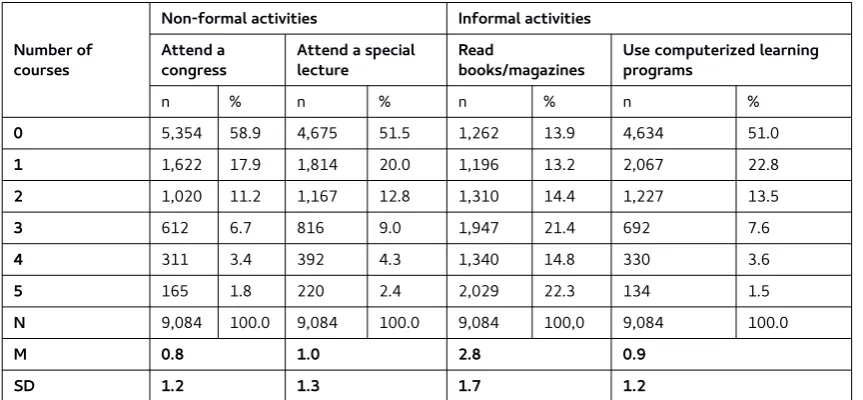
Information on adult participation in non-formal and informal education is as follows. The data show that approximately 69% of respondents participated in one or more non-formal courses over the last five years. Respondents attended, on average, two courses (M = 2.3; SD = 2.4) between 2009 and 2013. Furthermore, there is variation in adults’ participation in adult learning with regard to the type of adult education. Respondents’ average attendance in voluntary courses over the last five years (M = 1.6; SD = 2.0) was two times higher than in compulsory courses (M = 0.7; SD = 1.3). In addition, frequent attendance of adult training courses varies between compulsory and voluntary courses: while 20% of respondents attended more than one compulsory course, the percentage of those who participated in more than one voluntary course is higher (40%) (Table A1).
computer-learning programs. Compared to other types of adult education, respondents’ participation in congresses is lower. Reading books or magazines, on the other hand, at over 86%, seems more widespread. However, no information is available on the topics of these materials. Thus, it is not clear whether these books or magazines focus on knowledge relevant to becoming more competent in work/professional life, society and politics, or if they address more personal topics.
3.3 Socioeconomic status (SES)
An accurate measure of SES is educational attainment because it has the most consistent impact on political engagement (Brady et al., 1995; Nie, Junn, & Stehlik-Barry, 1996). We control the education lifespan in the form of general school qualification and VET. The combination of both school qualification and VET degree is implemented on the CASMIN scale3. When interacted with non-formal and informal adult education, educational attainment (measured via the CASMIN scale) permits a test of whether non-formal and informal adult education have, as hypothesized, a stronger impact on adults with lower SES.
3.4 Other control variables
In addition to the main explanatory factors, we also control the educational background of both parents via the CASMIN scale. Other control variables include gender, age, marital status, country of birth, state of residence (East or West Germany) and current employment.
4 RESULTS
4.1 Descriptive results of non-formal and informal adult learning and different modes of political participation
The following discussion describes the key findings from our analyses regarding the hypotheses proposed in this paper, based on the data in the NEPS Study (Starting Cohort Adults: SC6). Main bivariate findings will be presented first to shed more light on the main differences between the various forms of learning activities with regard to their correlation to other learning activities and different forms of political participation.
Table 1: Pearson correlation coefficients for non-formal and informal forms of adult education (N=9,084)
Measure 1 2 3 4 5 6
1. Compulsory Courses – .062*** .042*** .050*** .145*** .099***
2. Voluntary Courses – .226*** .320*** .372*** .178***
3. Congresses – .601*** .450*** .178***
4. Special lectures – .529*** .218***
5. Books or Magazines – .363***
6. Computerized learning
programs –
Note. *** p<0.001, ** p<0.01, * p<0.05. Source: LIfBi, NEPS, Starting Cohort Adults (SC6), Wave 1 to 6, doi:10.5157/NEPS:SC6:8.0.0. Unweighted sample, authors’ calculations.
Figure 1 provides initial insights into the impact of respondents’ participation in non-formal and informal adult education on their political participation. The aim here is to clarify the effect of non-formal and informal adult education on different modes of political participation when all non-formal and informal activities are controlled at the same time. Based on logistic regressions, the effect sizes of non-formal and informal adult education on adult voter turnout, voting intention, and intention to participate in collection of signatures and authorized demonstrations have been estimated. Because effect sizes such as the odds ratios are not comparable between models (Auspurg & Hinz, 2011), average marginal effects (AME) were estimated instead. The AMEs display the percentage-point change in the probability of the dependent variable for a one-unit change in the respective independent variable.
Figure 1: Adult participation in political activities by respondents’ participation in non-formal and innon-formal adult education (logistic regressions, average marginal effects AME, 95% CIs).
Note. Estimates based on estimation of models only including adolescent participation in non-formal and informal adult
education. *** p<0.001, ** p<0.01, * p<0.05. Model fit: Voter turnout (N=3,118, Pseudo R2 Nagelkerke=0.118), Voting
intention (N=9,084, Pseudo R2 Nagelkerke=0.031), Collection of signatures (N=9,067, Pseudo R2 Nagelkerke=0.074),
Authorized Demonstration (N=9,076, Pseudo R2 Nagelkerke=0.067). Source: LIfBi, NEPS, Starting Cohort Adults (SC6),
Wave 1 to 6, doi:10.5157/NEPS:SC6:8.0.0. Unweighted sample, authors’ calculations.
The influence of adults’ non-formal and informal education on different forms of political participation will be revealed with the aid of separate multivariate logistic regression models (Table 2 and Table 3, Models 1–4). The goal of the following regression models is to clarify the effect of non-formal and informal adult education on different modes of political participation when important control variables are taken into account. To compare these models, the same independent variables will be used in each regression model. Again, average marginal effects will be reported to make the effect sizes of the models comparable. To assess the model fit of each regression model, the Pseudo R-square by Nagelkerke will be used.
4.2 Reported voter turnout and voting intention
In Model 1, approximately 23% of the variance in the dependent variable (reported voter turnout in the 2013 German federal election) is explained by the independent variables (Table 2). Approximately 14% of the variance in the dependent variable (reported voter turnout) is explained by adults’ formal, non-formal and informal education. Approximately 9% of the variance in the reported voter turnout is explained by adults’ formal education when non-formal and informal learning activities are not included in the model (Table 4A). The lowest predictive power is shown in Model 2: only approximately 7% of the variance in the intention to vote is explained by the factors accounted for in the model. Although the regression models of the intention to vote and the reported voter turnout (Table 2, Model 2 vs. 1) show almost similar significant explanatory factors, the impact of the independent variables on reported voter turnout is stronger compared to Model 2.
and informal learning activities was included in the model (Table A4). Reading books had an additional and substantial impact on adults’ reported voter turnout: the more specialized books or professional magazines adults had read over the last five years, the higher their likelihood of voting. With each specialized book or professional magazine, the likelihood to vote increased by 1.1%. Those who had used computerized learning programs during the last 5 years were slightly more likely to take part in the German federal elections in 2013: an increase of one computerized learning program was related to a 1.3% higher probability of voting. In contrast, the effect of non-formal training courses, congresses and special lectures is not significant. The higher participation likelihood of adults who were reading books or using computerized learning programs can be partly explained by the fact that congresses and special lectures focus more on knowledge relevant in very specific contexts than on knowledge that is relevant for different contexts. Learning environments that enable the acquisition of broad knowledge may foster, in turn, the acquisition of those civic skills that are relevant for political participation. In terms of the control variables, the findings of Model 1 reveal that parental education did not affect adult voter turnout, whereas respondents’ current employment, age, country of birth, marital status and residence did.
Table 2: Who has the intention to vote in federal elections and who voted in the German federal elections in 2013? (logistic regressions, average marginal effects AME)
Model 1: Reported voter
turnout Model 2: Intention to vote
Sex (Ref.: male) -0.005 (0.011) 0.003 (0.004)
Age 0.003*** (0.001) 0.001** (0.000)
Current employment (Ref.: unemployed) 0.072*** (0.012) 0.013* (0.005)
Residence (Ref.: West Germany) -0.026 (0.014) -0.021*** (0.006)
Country of birth (Ref.: Germany) -0.195*** (0.029) -0.023* (0.010)
Marital status (Ref.: not married) 0.052*** (0.012) 0.017*** (0.005)
Casmin 0.017*** (0.003) 0.005*** (0.001)
Casmin mother 0.002 (0.004) -0.000 (0.001)
Casmin father 0.005 (0.003) 0.004** (0.001)
Adult education attended over the last 5 years
Number of compulsory courses -0.002 (0.005) 0.000 (0.002)
Number of voluntary courses 0.007 (0.004) 0.002 (0.001)
Number of congresses 0.006 (0.007) 0.001 (0.002)
Number of special lectures 0.008 (0.007) -0.000 (0.002)
Number of books/magazines 0.011* (0.004) 0.003* (0.002)
Number of computerized learning programs 0.013* (0.006) 0.002 (0.002)
N 3,118 9,084
Pseudo R² (Nagelkerke) 0.231 0.067
Note. Standard errors are in parentheses. *** p<0.001, ** p<0.01, * p<0.05. Source: LIfBi, NEPS, Starting Cohort Adults (SC6), Wave 1 to 6, doi:10.5157/NEPS:SC6:8.0.0. Unweighted sample, authors’ calculations.
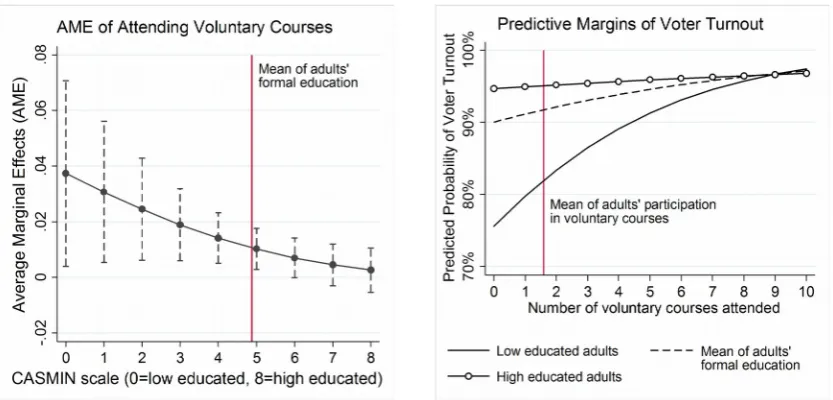
interactions, the results are displayed in Figure 2. For easier interpretation, Figure 2 reports only the effect of attending voluntary courses, but the model includes all other non-formal and informal learning activities. The figure depicts the effect of respondents’ participation in voluntary courses on voter turnout in the federal elections in 2013 for different levels of formal education. Note that Figure 2 accounts only for respondents’ formal education and their participation in non-formal and innon-formal education plus the corresponding interaction terms. No other control variables were included in these models.
Figure 2: Effects of respondents’ participation in voluntary courses on voter turnout in the federal elections in 2013 at different levels of formal education (logistic regression, average marginal effects AME (95% CIs) and Predictive Margins PM).
Note. Estimates based on estimation of an additional model only including adults’ formal education and their participation
in non-formal and informal adult education. N=3,118. Pseudo R2 (Nagelkerke)=0.146. Source: LIfBi, NEPS, Starting
Cohort Adults (SC6), Wave 1 to 6, doi:10.5157/NEPS:SC6:8.0.0. Unweighted sample, authors’ calculations.
4.3 Possible participation in collections of signatures and authorized demonstrations At first glance, adult education measures seem to play a more important role in Model 3 (intention to participate in collections of signatures) and Model 4 (intention to participate in authorized demonstrations) compared to Model 1 (reported voter turnout) and Model 2 (voter intention). However, the predictive power of Model 3 and Model 4 was low. Thus, control variables other than those accounted for in these models could reduce the impact of adult education measures.
The number of voluntary training courses attended during the last five years did affect adults’ plans to participate in collections of signatures and demonstrations, whereas the number of mandatory courses did not. However, the effect sizes were small: those who participated in voluntary training courses planned to take part in collections of signatures and authorized demonstrations slightly more often. Models 3-4 show that the effect sizes of special lectures, books or magazines and computerized learning programs were small but significant. Interestingly, attending congresses has a small negative but significant effect on the intention to participate in demonstrations (Table 3). This result is surprising because in the bivariate analysis (Table A3), the effect of congresses on political participation was positive. This may be because of the interaction with the different types of formal education accounted for in the regression models. Formal education had a strong influence on adult intention to participate in collections of signatures and demonstrations.
Table 3: Who intends to participate in collections of signatures and authorized demonstrations? (logistic regressions, average marginal effects AME)
Model 3: Collections of
signatures Model 4: Authorized demonstrations
Sex (Ref.: male) -0.018* (0.008) -0.061*** (0.010)
Age 0.001 (0.000) 0.001 (0.001)
Current employment (Ref.: unemployed) 0.003 (0.010) 0.017 (0.013)
Residence (Ref.: West Germany) 0.001 (0.010) 0.006 (0.012)
Country of birth (Ref.: Germany) -0.129*** (0.019) -0.041* (0.021)
Marital status (Ref.: not married) 0.026** (0.009) -0.011 (0.011)
Casmin 0.022*** (0.002) 0.029*** (0.003)
Casmin mother 0.006* (0.003) -0.003 (0.003)
Casmin father -0.001 (0.002) 0.006* (0.003)
Adult education attended over the last 5 years
Number of compulsory courses -0.001 (0.003) 0.004 (0.004)
Number of voluntary courses 0.010*** (0.003) 0.013*** (0.003)
Number of congresses 0.001 (0.005) -0.012* (0.005)
Number of special lectures 0.019*** (0.005) 0.032*** (0.005)
Number of books/magazines 0.015*** (0.003) 0.017*** (0.004)
Number of computerized learning programs 0.009* (0.004) 0.016*** (0.005)
N 9,065 9,067
Pseudo R² (Nagelkerke) 0.108 0.093
In sum, after controlling for different and important explanatory factors, the regression models report small-to-moderate but significant effects for some types of non-formal and informal adult education. Additional estimations show that the inclusion of non-formal and informal adult education increases the Pseudo R-square (Nagelkerke) in Model 1 by 0.6% and in Model 2 by 2.5%. In Models 3 and 4, the inclusion of non-formal and informal adult education increased the Pseudo R-square (Nagelkerke) by 2.6%.
5 DISCUSSION
This article investigated the link between non-formal and informal adult education and different forms of political participation. To reveal the contribution of non-formal and informal adult education to adults’ participation in politics, important explanatory factors were controlled. The results support the widespread view that formal education has an impact on citizens’ political participation. In contrast to other studies on political participation, this article accounted for formal education via the CASMIN scale and was thus able to control for different types and different educational chains of formal education. Furthermore, the findings show that non-formal and informal adult education has an additional and substantial impact on adults’ political participation (Hypothesis 1). However, the effects of non-formal and informal adult education differ with regard to the different forms of political participation. Non-formal training courses and informal adult learning have a greater impact on adults’ intention to participate in collections of signatures and authorized demonstrations than on adults’ reported voter turnout.
Moreover, it is important to further distinguish between voluntary and mandatory courses. Mandatory courses did not affect adults’ political participation, whereas voluntary courses did (Hypothesis 2). One explanation is perhaps that voluntary courses may feature better learning settings to foster civic skills that in turn trigger political participation. There might also be variations between participants in voluntary and mandatory courses. The motivation and particularly the interest in the subject of the course may be higher in voluntary courses. Findings from other studies show that participants in voluntary courses report a higher acquisition of new knowledge and skills than participants in mandatory courses (Authoring Group Educational Reporting, 2018, p. 187). Another way to explain these differing effects is that participants in mandatory courses might see the training as an additional burden and thus show less interest and motivation. However, one cannot dismiss that encouraging and active patterns of individuals may be the reason to voluntarily take part in further education courses and to participate in politics. In addition to voluntary courses, attending special lectures has an impact on adults’ intention to take part in collections of signatures and participate in demonstrations. Compared to voluntary courses, congresses and special lectures, the effect of congresses is slightly smaller. Non-formal adult education has no significant effect on adult voter turnout in the last federal election or on the intention to vote. Reading books or magazines seems to be more important for the federal election.
Furthermore, the findings provide mixed evidence for the compensation hypothesis (Hypothesis 3). There is no evidence for compensation when applied to mandatory courses, congresses or computerized learning programs. Contrarily, the results support the compensation hypothesis, as it applies to voluntary courses, books/magazines and special lectures. In these cases, non-formal and informal adult education has a considerable impact on adults of low SES (measured by the CASMIN scale).
political participation via intention may be biased. The intention to do something does not take into account the cost and benefit of a political act. This study mainly focused on intention to participate politically because the NEPS Study only provided the reported participation for the last elections. To prove the robustness of the findings presented in this article, it is crucial to re-estimate the effects of non-formal and informal adult education on adults’ reported participation in unconventional political activities such as collections of signatures and authorized demonstrations. Another weakness of this study is that respondents’ intention to participate and reported participation were collected only once. The dataset does not provide information on respondents’ initial political participation. Because this article has been limited to a cross-sectional dataset, it cannot account for self-selection processes. Therefore, a causal effect of non-formal and informal adult education is difficult to isolate due to confounding factors (i.e., variables possibly related to both adult education and engagement).
This paper underlines the importance of further research on the effects of non-formal and informal education, as ambiguity remains regarding the precise mechanism by which non-formal and informal adult education might influence adults’ political participation. It is probable that some part of what is observed as the influence of non-formal and informal education works through a positional pathway. Adult education may improve adults’ SES and thus place them in environments that encourage political participation. Similarly, there is likely also a cognitive pathway: adults who participate in non-formal and informal adult education develop civic skills, which in turn trigger political participation. Both pathways could occur at the same time. It should be emphasized that the pathways described in this article represent extreme opinions about the impact of education and that there are several (other) explanatory factors. Nevertheless, the models help to illuminate possible pathways between adult education and political participation.
REFERENCES
Allmendinger, J., Kleinert, C., Antoni, M., Christoph, B., Drasch, K., Janik, F., … Ruland, M. (2011). 18 Adult education and lifelong learning. Zeitschrift Für Erziehungswissenschaft, 14, 283–299. doi
10.1007/s11618-011-0197-0
Auspurg, K., & Hinz, T. (2011). Gruppenvergleiche bei Regressionen mit binären abhängigen Variablen - Probleme und Fehleinschätzungen am Beispiel von Bildungschancen im Kohortenverlauf. Zeitschrift für Soziologie, 40(1), 62-73.
Autorengruppe Bildungsberichterstattung [Authoring Group Educational Reporting] (2018). Bildung in Deutschland 2018. Bielefeld: W. Bertelsmann.
Baldwin, T. T., Magjuka, R. J., & Loher, B. T. (1991). The perils of participation: Effects of choice of training on trainee motivation and learning. Personnel Psychology, 44, 51–65.
Bask, M., & Bask, M. (2015). Cumulative (Dis)Advantage and the Matthew Effect in Life-Course Analysis. PloS One, 10(11), 1–14. https://doi.org/10.1371/journal.pone.0142447
Bäumer, T., Preis, N., Roßbach, H.-G., Stecher, L., & Klieme, E. (2011). 6 Education processes in life-course-specific learning environments. Zeitschrift Für Erziehungswissenschaft, 14(2), 87–101.
https://doi.org/10.1007/s11618-011-0183-6
Becker, R., & Hecken, A. E. (2018). Berufliche Weiterbildung – theoretische Perspektiven und empirische Befunde. In R. Becker (Ed.), Lehrbuch der Bildungssoziologie (pp. 367–410). Wiesbaden: Springer Fachmedien.
Bilger, F., Gnahs, D., Hartmann, J., & Kuper, H. (2013). Weiterbildungsverhalten in Deutschland. Resultate des Adult Education Survey 2012. doi 10.3278/14/1120w
Blossfeld, H. P., & von Maurice, J. (2011). Education as a lifelong process. Zeitschrift für Erziehungswissenschaften, Sonderheft 14, 19-34. doi 10.1007/s11618-011-0179-2
Bödeker, S. (2012). Soziale Ungleichheit und politische Partizipation in Deutschland. Grenzen politische Gleichheit in der Bürgergesellschaft. OBS-Arbeitspapier. Retrieved from https://www.otto-brenner-shop.de/uploads/tx_mplightshop/2012_02_07_Boedeker_AP_03.pdf
Boyadjieva, P., & Ilieva-Trichkova, P. (2017). Between Inclusion and Fairness. Adult Education Quarterly, 67(2), 97–117. https://doi.org/10.1177/0741713616685398
Brady, H. E., Verba, S., & Schlozman, K. L. (1995). Beyond SES: A Resource Model of Political Participation. American Political Science Review, 89(2), 271–294.
Braun, D., & Tausendpfund, M. (2019). Politisches Wissen und Europawahlen. In B. Westle & M. Tausendpfund (Eds.), Politisches Wissen (pp. 207–236). Wiesbaden: Springer VS.
Büchel, F., & Pannenberg, M. (2004). Berufliche Weiterbildung in West-und Ostdeutschland: Teilnehmer, Struktur und individueller Ertrag. Journal for Labour Market Research, 37(2), 73-126.
Büchter, K. (2010). Berufliche Weiterbildungsbeteiligung–theoretische und historiographische Zugänge. Berufs- und Wirtschaftspädagogik online, (19).
Campbell, A., Converse, P. E., Miller, W. E. & Stokes, D. E. (1960). The American Voter. New York: John Wiley and Sons.
Campbell, D. E. (2006). What is education’s impact on civic and social engagement? In R. Desjardins & T. Schuller (Eds.), Measuring the Effects of Education on Health and Civic Engagement. Proceedings of the Copenhagen Symposium (pp. 25–126).
Campbell, D. E. (2008). Voice in the Classroom: How an Open Classroom Climate Fosters Political Engagement Among Adolescents. Political Behavior, 30(4), 437–454. https://doi.org/10.1007/s11109-008-9063-z
Campbell, D. E. (2009). Civic engagement and education: An empirical test of the sorting model. American Journal of Political Science, 53(4), 771-786.
Cedefop (2015). Job-related adult learning and continuing vocational training in Europe: a statistical picture. Luxembourg: Publications Office. Cedefop research paper; No 48. http://dx.doi.org/10.2801/392276 Clark, C. S., Dobbins, G. H., & Ladd, T. L. (1993). Exploratory Field Study of Training Motivation. Influence of
involvement, credibility, and transfer climate. Group & Organization Management, 18(3), 292–307.
Colardyn, D., & Bjornavold, J. (2004). Validation of Formal, Non-Formal and Informal Learning: policy and practices in EU Member States. European Journal of Education, 39(1), 69–89.
Curado, C., Lopes Henriques, P., & Ribeiro, S. (2015). Voluntary or mandatory enrollment in training and the motivation to transfer training. International Journal of Training and Development, 19(2), 98–109. doi: 10.1111/ijtd.12050
Delli Carpini, M. X., & Keeter, S. (1999). What Americans Know About Politics and Why It Matters. New Haven and London: Yale University Press.
Dudley, R. L., & Gitelson, A. R. (2002). Political Literacy, Civic Education, and Civic Engagement: A Return to Political Socialization? Applied Developmental Science, 6(4), 175–182.
https://doi.org/10.1207/S1532480XADS0604\_3
Ehlert, M. (2017). Who Benefits from Training Courses in Germany? Monetary Returns to Non-formal Continuing education on a Segmented Labour Market. European Sociological Review, 33(3), 436–448. doi 10.1093/esr/jcx042
Feinstein, L., & Hammond, C. (2004). The contribution of adult learning to health and social capital. Oxford Review of Education, 30(2), 199–221. https://doi.org/10.1080/0305498042000215520
Gadotti, M., & Torres, C. A. (2009). Paulo Freire: Education for Development. Development and Change, 40(6), 1255–1267.
Gallego, A. (2010). Understanding unequal turnout: education and voting in comparative perspective. Electoral Studies, 29(2), 239–247. doi 10.1016/j.electstud.2009.11.002
Galston, W. A. (2001). Political Knowledge, Political Engagement, and Civic Education. Annual Review of Political Science, 4(1), 217–234. https://doi.org/10.1146/annurev.polisci.4.1.217
Gille, M., de Rijke, J., & Gaiser, W. (2011). Zivilgesellschaftliche Beteiligung in der Altersspanne von 13 und 32 Jahren – Entwicklung, Bedingungsfaktoren, Kontexte. Zeitschrift für Erziehungswissenschaft, 14(4), 551–579.
Gimpel, J. G., Lay, J. C., & Schuknecht, J. E. (2003). Cultivating democracy: Civic environments and political socialization in America. Washington, D.C: Brookings Institution Press.
Giroux, H. A. (2010). Paulo Freire and the Crisis of the Political. Power and Education, 2(3), 335–340. https://doi.org/10.2304/power.2010.2.3.335
Grönlund, K., & Milner, H. (2006). The Determinants of Political Knowledge in Comparative Perspective. Scandinavian Political Studies, 29(4), 386–406.
Hadjar, A., & Becker, R. (2006). Bildungsexpansion und Wandel des politischen Interesses in Westdeutschland zwischen 1980 und 2002. Politische Vierteljahresschrift, 49(1), 12–34.
Hadjar, A., & Becker, R. (2007). Unkonventionelle politische Partizipation im Zeitverlauf. Kölner Zeitschrift für Soziologie und Sozialpsychologie, 59(3), 410–439.
Hillygus, D. S. (2005). The missing link: exploring the relationship between higher education and political engagement. Political Behavior, 27(1), 25–47.
Hubert, T., & Wolf, C. (2007). Determinanten der beruflichen Weiterbildung Erwerbstätiger. Empirische Analysen auf Basis des Mikronzensus 2003. Zeitschrift für Soziologie, 39 (6), 473-493.
Kleinert, C., & Matthes, B. (2009). Data in the field of adult education and lifelong learning: Present situation, improvements and challenges (RatSWD Working Paper, No. 91). Berlin: RatSWD.
Krapp, A. (2005). Das Konzept der grundlegenden psychologischen Bedürfnisse. Ein Erklärungsansatz für die positiven Effekte von Wohlbefinden und intrinsischer Motivation im Lehr-Lerngeschehen. Zeitschrift für Pädagogik, 51(5), 626-641.
Malcolm, J., Hodkinson, P., & Colley, H. (2003). The interrelationships between informal and formal learning. Journal of Workplace Learning, 15(7/8), 313–318.
https://doi.org/10.1108/13665620310504783
Mays, A. (2008). Der Einfluss jugendlicher Sozialisationserfahrung auf ausgewählte Aspekte der politischen Identität im Erwachsenenalter. Dissertation zur Erlangung des sozialwissenschaftlichen Doktorgrades, Georg-August-Universität. Göttingen.
Minello, A., & Blossfeld, H.-P. (2017). Can adult education compensate for early disadvantages? The role of adult education in reducing inequalities for German men and women. In J. Erola & E. Kilpi-Jakonen (Eds.), Social Inequality Across the Generations (pp. 161–180). Edward Elgar Publishing.
https://doi.org/10.4337/9781786432568.00016
Nie, N. H., & Hillygus, D. S. (2001). Education and Democratic Citizenship. In D. Ravitch & J. P. Viteritti (Eds.), Making Good Citizens. Education and Civil Society (pp. 30-57). New Haven & London: Yale University Press.
Nie, N. H., Junn, J., & Stehlik-Berry, K. (1996). Education and democratic citizenship in America. Chicago: University of Chicago Press.
Niemi, R. G., & Junn, J. (1998). Civic Education. What Makes Students Learn. New Haven & London: Yale University Press.
Oberle, M., & Leunig, J. (2018). Wirkungen politischer Planspiele auf Einstellungen, Motivationen und Kenntnisse von Schülerinnen und Schülern zur Europäischen Union. In B. Ziegler & M. Waldis (Eds.), Politische Bildung in der Demokratie (pp. 213–237). Wiesbaden: Springer Fachmedien.
https://doi.org/10.1007/978-3-658-18933-4_14
Persson, M. (2011). An Empirical Test of the Relative Education Model in Sweden. Political Behavior, 33(3), 455–478. https://doi.org/10.1007/s11109-010-9138-5
Persson, M. (2013a). Does education cause participation in politics? (Gothenburg studies in politics, Bd. 134). Gothenburg: Department of Political Science, University of Gothenburg.
Persson, M. (2013b). Review: Education and Political Participation. British Journal of Political Science, 45(3), 689–703. https://doi.org/10.1017/S0007123413000409
Persson, M., & Oscarsson, H. (2010). Did the Egalitarian Reforms of the Swedish Educational System Equalise Levels of Democratic Citizenship? Scandinavian Political Studies, 33(2), 135–163. https://doi.org/10.1111/j.1467-9477.2009.00244.x
Popkin, S.L., & Dimock, M.A. (1999) Political knowledge and citizen competence. In S. L. Elkin & K. E. Soltan (Eds.), Citizen Competence and Democratic Institutions (pp. 117-146). The Pennsylvania State
University Press.
Rosenstone, S. J., & Hansen, J. M. (1993). Mobilization, participation, and democracy in America (New topics in politics). New York: Macmillan Pub.
Ruhose, J., Thomsen, S. L., & Weilage, I. (2019). The benefits of adult learning: Work-related training, social capital, and earnings. Economics of Education Review, 72, 166–186.
https://doi.org/10.1016/j.econedurev.2019.05.010
Schäfer, A., Schwander, H., & Manow, P. (2016). Die sozialen „auffälligen“ Nichtwähler: Determinanten der Wahlenthaltung bei der Bundestagswahl 2013. In H. Schoen & B. Wessels (Eds.), Wahlen und Wähler. Analysen aus Anlass der Bundestagswahl 2013 (pp. 21–44). Wiesbaden: Springer VS.
Schlozman, K. L., Brady, H. E. & Verba, S. (2012). The unheavenly chorus. Unequal political voice and the broken promise of American democracy. Princeton: Princeton University Press.
Smets, K., & van Ham, C. (2013). The embarrassment of riches? A meta-analysis of individual-level research on voter turnout. Electoral Studies, 32(2), 344–359. https://doi.org/10.1016/j.electstud.2012.12.006 Steinbrecher, M. (2009). Politische Partizipation in Deutschland. Baden-Baden: Nomos.
Torney-Purta, J., Lehmann, R., Oswald, H., & Schulz, W. (2001). Citizenship and Education in Twenty-Eight Countries: Civic Knowledge and Engagement at Age Fourteen. Amsterdam: International Association for the Evaluation of Educational Achievement.
Tsai, W.-C., & Tai, W.-T. (2003). Perceived importance as a mediator of the relationship between training assignment and training motivation. Personnel Review, 32(2), 151-163.
Verba, S., Schlozman, K. L. & Brady, H. E. (1995). Voice and equality. Civic voluntarism in American politics (4. Aufl.). Cambridge, Mass.: Harvard Univ. Press.
Wolfinger, R. E., & Rosenstone, S. J. (1980). Who votes? New Haven: Yale University Press.
Wolter, F., & Schiener, J. (2009). Einkommenseffekte beruflicher Weiterbildung. Kölner Zeitschrift für Soziologie und Sozialpsychologie, 61(1), 90–117. https://doi.org/10.1007/s11577-009-0043-z
ENDNOTES
1 In some federal states, comprehensive schools or schools with multiple tracks (Gesamtschule) were introduced as an
alternative to the traditional three-tiered secondary education system.
2 Because of item nonresponse, the sample size can vary with the political activity. Compared to the other dependent
variables, there is only a small sample size available for actual voter turnout. This is because voter turnout in the 2013 German federal elections was collect for only 33% of respondents. The rest of the sample was asked about their participation in the 2009 federal elections. Since this article accounts for adult learning between 2009 and 2013, respondents’ participation in the 2009 federal election cannot be investigated.
3 According to the typical German educational trajectories, the scale includes the following characteristics: 0 =
APPENDIX
Table A1: Number and distribution of compulsory and voluntary courses
Number of courses
Type of non-formal training course
Overall
Compulsory Voluntary
n % n % n %
0 5,952 65.5 3,740 41.2 2,805 30.9
1 1,410 15.5 1,765 19.4 1,444 15.9
2 920 10.1 1,311 14.4 1,447 15.9
3 374 4.1 814 9.0 943 10.4
4 234 2.6 590 6.5 839 9.2
5 97 1.1 363 4.0 522 5.7
6 60 0.7 242 2.7 462 5.1
7 19 0.2 125 1.4 232 2.6
8 14 0.2 78 0.9 214 2.4
9 2 0.0 38 0.4 88 1.0
10 2 0.0 18 0.2 88 1.0
N 9,084 100.0 9,084 100.0 9,084 100.0
M 0.7 1.6 2.3
SD 1.3 2.0 2.4
Source: LIfBi, NEPS, Starting Cohort Adults (SC6), Wave 1 to 6, doi:10.5157/NEPS:SC6:8.0.0. Unweighted sample, own calculations.
Table A2: Number and distribution of non-formal and informal activities
Number of courses
Non-formal activities Informal activities
Attend a
congress Attend a special lecture Read books/magazines Use computerized learning programs
n % n % n % n %
0 5,354 58.9 4,675 51.5 1,262 13.9 4,634 51.0
1 1,622 17.9 1,814 20.0 1,196 13.2 2,067 22.8
2 1,020 11.2 1,167 12.8 1,310 14.4 1,227 13.5
3 612 6.7 816 9.0 1,947 21.4 692 7.6
4 311 3.4 392 4.3 1,340 14.8 330 3.6
5 165 1.8 220 2.4 2,029 22.3 134 1.5
N 9,084 100.0 9,084 100.0 9,084 100,0 9,084 100.0
M 0.8 1.0 2.8 0.9
SD 1.2 1.3 1.7 1.2
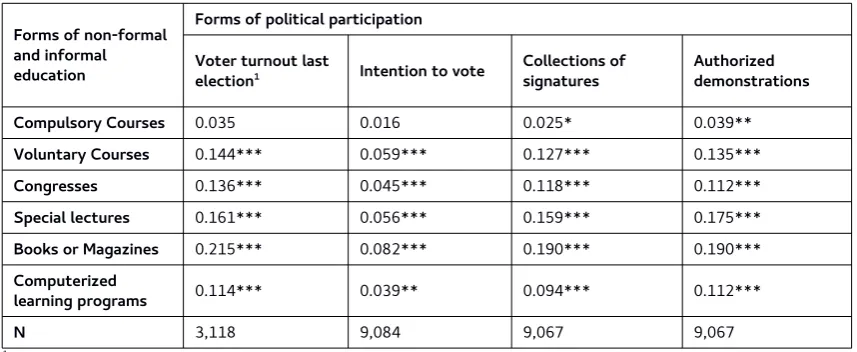
Table A3: Pearson correlation coefficients for non-formal and informal forms of adult education and different modes of political participation
Forms of non-formal and informal education
Forms of political participation
Voter turnout last
election1 Intention to vote Collections of signatures Authorized demonstrations
Compulsory Courses 0.035 0.016 0.025* 0.039**
Voluntary Courses 0.144*** 0.059*** 0.127*** 0.135***
Congresses 0.136*** 0.045*** 0.118*** 0.112***
Special lectures 0.161*** 0.056*** 0.159*** 0.175***
Books or Magazines 0.215*** 0.082*** 0.190*** 0.190***
Computerized
learning programs 0.114*** 0.039** 0.094*** 0.112***
N 3,118 9,084 9,067 9,067
1 Compared to the other dependent variables, there is only a small sample size available for actual voter turnout. This is
because voter turnout in the 2013 German federal elections was collect for only 33% of respondents. The rest of the sample was asked about their participation in the 2009 federal elections. Since this article accounts for adult learning between 2009 and 2013, respondents’ participation in the 2009 federal election cannot be investigated.
Note. *p < 0.05; **p < 0.01; ***p < 0.001
Table A4: The impact of respondents’ formal, non-formal and informal education on their reported voter turnout (logistic regressions, average marginal effects AME)
(1) formal
education (2) + non-formal and informal education (3) + control variables1
Casmin 0.031*** 0.018*** 0.017***
(0.003) (0.003) (0.003)
Adult education attended over the last 5 years
Number of compulsory courses 0.000 -0.002
(0.005) (0.005)
Number of voluntary courses 0.012** 0.007
(0.004) (0.004)
Number of congresses 0.012 0.006
(0.007) (0.007)
Number of special lectures 0.013 0.008
(0.008) (0.007)
Number of books/magazines 0.014** 0.011*
(0.004) (0.004)
Number of computerized learning programs 0.010 0.013*
(0.006) (0.006)
N 3.118 3.118 3.118
AIC 2013.8 1939.4 1802.8
BIC 2025.9 1987.8 1899.5
Pseudo R² (Nagelkerke) 0.090 0.142 0.231
1 Control variables: sex, age, current employment, residence, country of birth, marital status, parental education.
Note. Standard errors are in parentheses. *** p<0.001, ** p<0.01, * p<0.05