Three-Dimensional Computer Model of Benign
Paroxysmal Positional Vertigo in the Semi-Circular
Canal
Zarko Milosevic
1,3, Igor Saveljic
1,3, Dalibor Nikolic
1,3, Nebojsa Zdravkovic
2, Nenad Filipovic
1,3, Neda
Vidanovic
1,31 Faculty of Engineering, University of Kragujevac, 34000 Kragujevac, Serbia 2
Faculty of Medical Science, University of Kragujevac, 34000 Kragujevac Serbia
3 BioIRC Research and Development Center for Bioengineering, 34000 Kragujevac, Serbia
Abstract
Benign Paroxysmal Positional Vertigo (BPPV) is the most common vestibular disorder. In this paper we tried to investigate a model of the semi-circular canal (SCC) with parametrically defined dimension and full 3D three SCC from patient-specific 3D reconstruction. Full Navier-Stokes equations and continuity equations are used for fluid domain with Arbitrary-Lagrangian Eulerian (ALE) formulation for mesh motion. Fluid-structure interaction for fluid coupling with cupula deformation is used. Particle tracking algorithm has been used for particle motion. Velocity distribution, shear stress and force from endolymph side are presented for one parametric SCC and three patient-specific SCC. All models are used for correlation with the same experimental protocols with head moving and nystagmus eye tracking.
Keywords: semi-circular canals, sedimenting particle, BPPV, biomechanical model, fluid-structure interaction
Received on 8 June 2017, accepted on 3 September 2017, published on 28 February 2018
Copyright © 2018Zarko Milosevic et al., licensed to EAI. This is an open access article distributed under the terms of the Creative Commons Attribution licence (http://creativecommons.org/licenses/by/3.0/), which permits unlimited use, distribution and reproduction in any medium so long as the original work is properly cited.
doi: 10.4108/eai.28-2-2018.154142
1. Introduction
Balance is the ability of the body to maintain centre of mass over its base of support while standing or walking. Causes of balance disorders in most cases are related to pathologies of the inner ear [1]. Balance problems often lead to falls [2], which is a constant but underinvestigated problem, in part because of the difficulties in determining the cause of the fall. The semi-circular canals are interconnected with the main sacs in the human ear: the utricle and the saccule, which constitute otolith organs. The theory that angular acceleration produces an inertial induced flow of endolymph was first proposed by Mach [2]. That was the first attempt of a mathematical description of flow in the canals. The brain
processes 3D rotational information in terms of maximal response directions. BPPV is the most common vestibular disorder. It occurs because of the presence of basophilic particles in the semicircular canals. These particles are displaced otoconia (calcium carbonate crystals) from the utricle and their motion through semicircular canal system is driven by gravity. BPPV has primary symptoms: nausea, dizziness, vertigo and ocular nystagmus. For patients with BPPV symptoms, a non-surgical repositioning procedures (CRP) is applied. It consist of a series of timed head reorientations designed to relocate the particles under the action of gravity from the horizontal canal (HC) lumen to the utricular vestibule where they no longer generate anomalous gravity-sensitive angular motion sensations [3-5]. The most common diagnostic procedure for BPPV is the Dix-Hallpike head manoeuvre [4]. This manoeuvre tilts the
on
Pervasive Health and Technology
Research Article
head backward by about 120 degrees with the plane of rotation aligned with both the plane of the posterior SCC and the direction of gravity.
The weakness of the one-canal approach is that it does not account for fluid coupling between canals and it is unable to describe the role of the semicircular canal geometry in responses to complex 3D head movements. Therefore, it is important to use 3D mathematical approaches. In this paper, we present a 3D model for parametric SCC and with real patient geometry by full fluid-structure interaction approach for particle, wall, cupula deformation and endolymph flow.
2. Methods
2.1. Physiological description
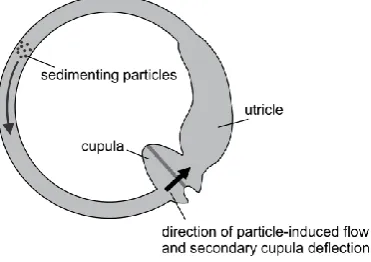
BPPV is diagnosed by tracking the eye movements (nystagmus) during and after a head manoeuvre. The nystagmus aims to compensate any angular motion in order to stabilize our vision. It is an indicator for the perceived angular velocity. Fluid mechanics and sedimenting particles tracking in a SCC are schematically presented in Fig. 1. It can be noticed that sedimenting particles can move with the fluid motion and gravity through the SCC and they can hit the cupula and make false sensation to the patient which causes dizziness.
Figure 1 Fluid mechanics and sedimenting particles
tracking in a semicircular canal
2.2. Numerical procedure for fluid domain
where is a selected large number, the penalty parameter. Substituting the pressure p from Eq. 1 into the Navier-Stokes equations we obtain:
, , , 0
V i
i k k j ij i k k i
v
v v v v f
t
(2)
2.3. Numerical procedure for solid-fluid
interaction
For modelling fluid structure interaction we employ loose coupling method where solid and fluid are modelled separately and the solutions are obtained with different FE solvers, but the parameters from one solution which affect the solution for the other medium are transferred successively. If the loose coupling method is employed, the systems of balance equations for the two domains are formed separately and there are no such computational difficulties. We implement fluid-structure interaction for cupula deformation and endolymph flow. Cupula is modelled as elastic 3D membrane with brick finite element and endolymph domain as 3D 8-node finite elements.
2.4 ALE (Arbitrary Lagrangian Eulerian)
formulation
For mesh movement ALE (Arbitrary Lagrangian Eulerian) formulation is implemented. The presented formulation of the FE modelling is necessary when the fluid boundaries change significantly over the time period used in the analysis. It is particularly convenient when the boundary of the fluid represents a deformable solid, for appropriate modelling the solid-fluid interactions. Finally, it is worth noting that the mesh motion is arbitrary and it can be specifically designed for each problem. As well, it is important to emphasize that the solution for the fluid flow does not depend on the FE mesh motion [6].
2.5. Particle tracking algorithm
element trilinear interpolation. The integration methods used are first-order Euler scheme and the more accurate fourth-order Runge-Kutta.
3. Results
Force distribution for the parametric model of one semicircular canal is presented in Fig. 2. Different lengths and radius curvature can be prescribed and results for 3D one SCC may be quickly calculated. This simple model can be used for a detailed three-dimensional study of fluid flow behaviour and for understanding the mechanism of different disease as BPPV. User can prescribe different head motions and obtain the results for the endolymph fluid flow, shear stress, velocity, deformation and drag force on the wall.
Figure 2 Total force from fluid which reacted to the wall
of the semicircular canal
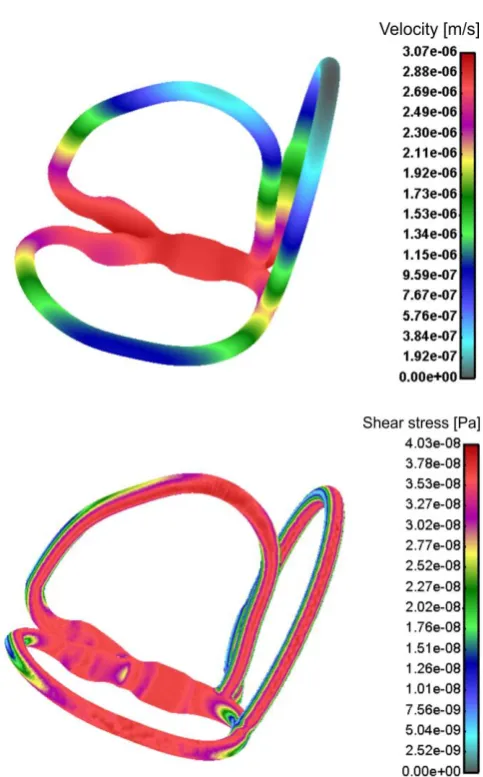
Fluid velocity distribution for real patient-specific geometry of three SCC for prescribed head motion is presented in Fig. 3. A 3D reconstruction is done with our software platform from original DICOM images. A user can prescribe different head motion and see the response for all three SCC with numerical results such as shear stress distribution, velocity, cupula deformation and drag force on the wall.
Figure 3 Fluid velocity and shear stress distribution for
real patient-specific geometry of three SCC for prescribed head motion
Figure 4 Distribution of the forces which act from endolymph side
It can be seen that HC cupula receives smaller amount of the forces from fluid side than other parts of the SSC walls, but this HC cupula part is responsible for deflection and sensation of the cells for brain information.
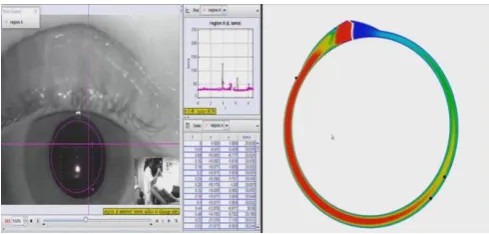
Figure 5Eye tracking analysis and simulation of the
particles and cupula deformation
Comparison with numerical model of one SCC with cupula deformation and three sedimenting particles which are moved inside the fluid domain and eye tracking motion is done during the Dix-Hallpike test [4] for BPPV (Fig. 5). A user is brought from sitting to a supine position, with the head turned 45 degrees to one side and extended about 20 degrees backward. Once supine, the eyes are typically observed for about 30 seconds. If no nystagmus ensues, the person is brought back to sitting. There is a delay of about 30 seconds again, and then the other side is tested.
Numerical model of fluid-structure interaction with
Figure 6 Analytical and numerical solution for cupula
deformation for head manoeuvre from 0 to 120
Analytical [6] and numerical solution for cupula deformation for head manoeuvre from 0 to 120 is presented in Figure 12.
4 Discussion
In this study a full three-dimensional mathematical model of the semi-circular canal is presented focusing on the BPPV problem. We tried to simulate standard CRP for BPPV with one parametric and three full SCC taking into consideration full 3D Navier-Stokes equations, fluid-structure interaction and for particle motion full 3D tracking algorithm. Our approach gives more physiologically realistic description of the SCC, fluid motion, otoconia interaction with wall, fluid and cupula as well as cupula elastic deformation. We also used otoconia cluster and there was no limit with size and number of otoconia particles. Inside fluid domain, we can simulate vortices inside the utricle and ampulla which is almost impossible with models from the literature. Also, cupula deformation can be very complex deformation in 3D. It is also easy to implement nonlinear behaviour of cupula deformation when experimental data for material model description are available.
5 Conclusions
We have presented parametric and a full three-dimensional mathematical model of the semi-circular canal with full fluid-solid interaction of otoconia particle, cupula deformation and endolymph fluid flow. The basic explanation of physiological background of vestibular system is firstly described, then finite element numerical procedures for fluid and fluid-structure interaction are given. Different simulation results for one parametric SCC, patient-specific three SCC are presented. Simulation of many dynamics positions of the head with this model can give very precise positions of fluid and also all dynamic fluid parameters, shear stress, forces from fluid, cupula deflection. This can help in better diagnostic process of balance disorders.
Acknowledgment
This research is supported by the grants: EC FP7 610454 EMBalance project, III41007 and OI174028 Ministry of Education, Science and Technological Development of Serbia.
References
[1] Berthoz A. The sense of movement. Harvard University Press. 2002.
[2] Mach E. Grundlinien der Lehre ion den Bewegung8empfindungen. Leipzig: Wilhelm Engelmann. 1875.
[3] De la Meilleure G, Dehaene I, Depondt M, Damman W, Crevits L, Vanhooren G. Benign paroxysmal positional vertigo of the horizontal canal. J Neurol Neurosurg Psychiatry 1996; 60: 68–71.
[4] Dix MR, Hallpike CS. The pathology, symptomatology and diagnosis of certain common disorders of the vestibular system. Proc. R. Soc. Med. 1952; 45(6): 341-354.
[5] Parnes LS, McClure JA. Free-floating endolymph particles: A new operative finding during posterior semicircular canal occlusion. Laryngoscope 1992; 102(9): 988-992.