©2014 JNAS Journal-2014-3-10/1199-1215 ISSN 2322-5149 ©2014 JNAS
The generating set for some maximal soluble
subgroups of GL(4,P
k
)
Behnam Razzaghmaneshi
Assistant professor of Department of Mathematics Talesh Branch, Islamic Azad University, Talesh, Iran
Corresponding author:
Behnam Razzaghmaneshi
ABSTRACT: In this paper we show that the number of conjugacy classes of irreducible soluble GL(4,3) subgroup of is 108, whose :65 consist of imprimitive groups and 43 of primitive groups.
Keywords: generating set, soluable, maximal
INTRODUCTION
In determining all permutation groups of a deferent degree The first work is probably due to Ruffini(1799)
,
who gives The possible orders of the groups of degree 5.This them is taken up-again By Cauchy (1845),
who determines the possible orders of the groups of degree Up to 6. Mathieu(1858)continus cauchy’s work,
determining the Possible Orders of the groups of degrees 7 and 8. Miller(1896 a)Suggests that Ruffini’s work is in Complate,
and citesan omission in Cauchy’s list for degree 6 .Serret(1850)determines all subgroups ofs
4ands
5.Miller(1896 a)says thatthise work is correct.
kirkman(1862–3)Lists the transitive groups of degrees 3 to 10.Miller(1896 a) Says that This list is correct up to degree
7
,
has missing six groups of Degree 8,
another six of degree 9,
and is highly inaccurate for degree 10.Jordan(1871a)gives a table containing the numbers of conjugacy classes of primitive maximal soluble groups of
degree lees then
10
6. He claims there are five such classes of degree 81,
but there are only four,
(see to Chapter6).This error is Likely to lead to errors for larger degrees.Also
,
the Second And third entries in the last row of this table should be Swapped.In The same paper,
Jordan also gives a table containing the numbers of conjugacy classes of transitive maximale soluble groups of degree Up to 10000.(This is an a stounding achievment if for no other reason Than the amount of counting required to prepare it.for example,
ifp
is a prime greater than 3,
Jordan claims that the number of conjugacy classes of transitive maximal soluble groups of degreep
2 6
3
2
is 8306).Again,
the error in the first table is Likely to errors in this on too.Jordan (1872)caunts all the primitive groups of degrees 4 to 17.His count Matches that of sims except that Jordan has one les for degrees 9
,
12 and 15,
eight less for degree 16 and two less For degree 17.These errors are Pointed out by Miller(1894,
4b,
1895c,
1897a,
1897b and 1900a).Jordan(1874)states that every transitive group of degree 19 is either alternating,
symetric or affine.This agrees With sim’s list.Veronese(1885)determines all groups of degree up to 6.Miller(1983)cites several errors for degree 6.Ask with(1890) and Cayley(1891) determine the groups of degree
6 and get the same answers.Their count of the intransitive ones is correct but undercount the transitive groups by three
,
as cole(1893a) points out,
as kirkman(1862–3) had already (success fully,
according to Miller)determined the transitinves,
degree 6 was then complete.Askwith(1890a) and Cayley(1891) also arrive at the same determination of the groups of degree 7.They undercount both the transitive and intransitives by one,
as cole(1893a) Points out.With kirkman’s transitives and col’s additional intransitive,
Degree 7 was then complete .2. Periliminares:
The first we determine the JS-imprimitives of
(
4
,
)
kp
GL
.Recall that the number JS-maximals of
(
2
,
)
kp
1200
(
2
,
)
:
(
)
(
2
,
2
),
1
(mod
4
).
),
4
(mod
3
),
2
,
2
(
)
(
:
)
,
2
(
,
:
)
,
2
(
,
2
,
)
,
1
(
:
)
,
2
(
8 1 4 8 1 3 2 1 2 2 1 2
k p k k p k p k k k kp
Sp
N
Q
C
p
M
p
O
N
Q
C
p
M
C
C
p
M
p
S
wr
p
GL
p
M
k k k
Therefore the Js-imprimitives of
(
4
,
)
kp
GL
are listed below.).
4
(mod
1
,
)
,
2
(
:
)
,
4
(
),
4
(mod
3
,
)
,
2
(
:
)
,
4
(
,
)
,
2
(
:
)
,
4
(
,
2
,
)
,
1
(
:
)
,
4
(
2 4 4 2 3 3 2 2 2 4 1
k k k k k k k k k k kp
S
wr
p
M
p
M
p
S
wr
p
M
p
M
S
wr
p
M
p
M
p
S
wr
p
GL
p
M
Now we listed the JS-primitives of
(
4
,
)
kp
GL
.6.1-The JS-primitives of
(
4
,
)
kp
GL
.There is one JS-primitive of
(
4
,
)
kp
GL
whose unique maximal abelian normal subgroup has orderp
4k
1
,
namely.
M
5(
4
,
p
)
:
C
P4K 1C
4,
k
the normaliser of a singer cycle.
There is one JS-primitive of
(
4
,
)
kp
GL
whose unique maximal abelian normal subgroup has orderp
2k
1
,
namely
(
4
,
)
:
(
2
,
)
2,
2
.
24
6
p
M
p
C
p
M
k k
We think the filed of k
p
2 elements here as the filed of 2 by 2 matrices that is the linear span of our fixed singer cycle of(
2
,
)
k
p
GL
.Now we come to the JS-primitives of
GL
(4,
kp
) whose unique maximal abelian normal subgroup is the scalargroup.Let M be such a group. There are three cases examine.
6.1.1-Cas1:
Assume that k
p
3
(mod
4
)
and that the Fitting subgroup F of M isC
k 1D
8D
8.
p
ThenF
M
is
isomorphic to a completely reducible maximal soluble subgroup of
(
4
,
2
)
O
that dosenot fix any non-zero isotropicsubspace of the natural module for
(
4
,
2
).
O
However,
O
(
4
,
2
)
is isomorphic toS
3wr
S
2,
so inparticular it issoluble. Therefore
F
M
).
2
,
4
(
O
So in this case we find exactly one JS-primitive,
).
2
,
4
(
)
(
:
)
,
4
(
1 8 87
C
D
D
O
p
M
pk1201
6.1.2-Case2:
Assume that
3
(mod
4
)
kp
and that the Fitting subgroupF
ofM
isC
k 1D
8Q
8.
p
ThenF
M
is
isomorphic to a completely reducible maximal soluble subgroup of
(
4
,
2
)
O
that dose not fix any non-zero isotropicsubspace of the natural module for
(
4
,
2
)
O
.Threre is a unique
(
4
,
2
)
O
-conjugacy class of such groups and that each group in this class is isomorphic toHol
(
C
5).ThereforeF
M
=
Hol
(
C
5)
.So in this case we find exactly on JS-primitive,
).
(
)
(
:
)
,
4
(
1 8 8 58
p
C
D
Q
Hol
C
M
pkk
6.1.3-Case3:
Assume that
1
(mod
4
).
kp
Therefore we can write the Fitting subgroupsF
ofM
asC
k 1D
8D
8.
p
Then
F
M
is isomorphic to a completely reducible maximal soluble subgroup of
Sp
(
4
,
2
)
that dosenot fix any non-zero isotropic subgroup of the natural module forSp
(
4
,
2
)
.Every such subgroup is
Sp
(
4
,
2
)
-conjugacy to eitherO
(
4
,
2
)
o r
Ho l
(
C
5).
So in this case we find exactly two JS -primitives
).
(
)
(
:
)
,
4
(
),
2
,
4
(
)
(
:
)
,
4
(
5 8
8 1 1 0
8 8 1 9
C
Ho l
D
D
C
p
M
O
D
D
C
p
M
k k
p k
p k
Although 9
(
4
,
)
k
p
M
and 1 0
(
4
,
)
k
p
M
admit the same description as 7
(
4
,
)
k
p
M
and 8
(
4
,
),
k
p
M
respectively
,
they arise in different way and so are given different numbers. For example the JS-maximals ofGL
(
4
,
3
)
are.
,
,
,
,
2 3 5 6 81
M
M
M
M
a n d
M
M
Of these
M
3,
M
5,
M
7a n d
M
8 are maximal soluble,
whileM
1a n d
M
6 are conjugate to subgroups ofM
7,
a n d
M
2 is a conjugate to a subgroup ofM
3.
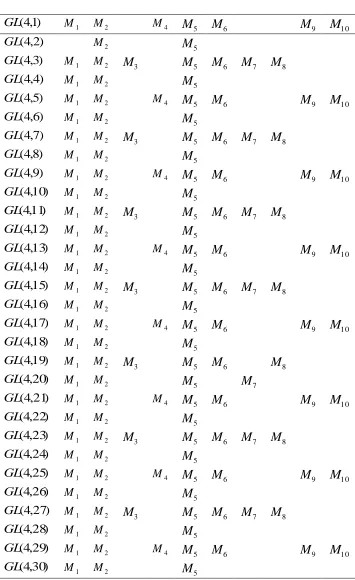
The following table show the JS-maximals of
(
4
,
),
kp
GL
forp
k=1,
…,
1202
Table 1. The JS-maximals of(
4
,
),
k
p
GL
forp
k
1
,...
30
.10
M
9M
6M
5M
4M
2M
1M
)
1
,
4
(
GL
5M
2M
)
2
,
4
(
GL
8M
7M
6M
5M
3M
2M
1M
)
3
,
4
(
GL
5M
2M
1M
)
4
,
4
(
GL
10M
9M
6M
5M
4M
2M
1M
)
5
,
4
(
GL
5M
2M
1M
)
6
,
4
(
GL
8M
7M
6M
5M
3M
2M
1M
)
7
,
4
(
GL
5M
2M
1M
)
8
,
4
(
GL
10M
9M
6M
5M
4M
2M
1M
)
9
,
4
(
GL
5M
2M
1M
)
10
,
4
(
GL
8M
7M
6M
5M
3M
2M
1M
)
11
,
4
(
GL
5M
2M
1M
)
12
,
4
(
GL
10M
9M
6M
5M
4M
2M
1M
)
13
,
4
(
GL
5M
2M
1M
)
14
,
4
(
GL
8M
7M
6M
5M
3M
2M
1M
)
15
,
4
(
GL
5M
2M
1M
)
16
,
4
(
GL
10M
9M
6M
5M
4M
2M
1M
)
17
,
4
(
GL
5M
2M
1M
)
18
,
4
(
GL
8M
6M
5M
3M
2M
1M
)
19
,
4
(
GL
7M
5M
2M
1M
)
20
,
4
(
GL
10M
9M
6M
5M
4M
2M
1M
)
21
,
4
(
GL
5M
2M
1M
)
22
,
4
(
GL
8M
7M
6M
5M
3M
2M
1M
)
23
,
4
(
GL
5M
2M
1M
)
24
,
4
(
GL
10M
9M
6M
5M
4M
2M
1M
)
25
,
4
(
GL
5M
2M
1M
)
26
,
4
(
GL
8M
7M
6M
5M
3M
2M
1M
)
27
,
4
(
GL
5M
2M
1M
)
28
,
4
(
GL
10M
9M
6M
5M
4M
2M
1M
)
29
,
4
(
GL
5M
2M
1M
)
30
,
4
(
GL
1203
6.2-The imprimitive soluble subgroups of
GL
(
4
,
2
)
.By above table there is one JS-imprimitives of
GL
(
4
,
2
)
,
namelyM
2:
GL
(
2
,
2
)
wr
S
2or.
)
2
,
2
(
:
2 22
M
wr
S
M
A polycyclic presentation for
M
2 is:,
1
,
,
,
,
{
2
a
e
d
c
b
a
,
,
,
,
1
}.
,
1
,
,
,
,
1
,
,
,
1
,
3 2 2 3
2 2
e
e
e
e
e
e
e
c
e
d
d
d
d
d
b
d
c
c
c
e
c
b
d
b
d c b a
c b
a b a a
6.2.1-Theorem:
A complete and irredundant list of
GL
(
4
,
2
)
-jugacy class representatives of the irreducible subgroups ofM
2 is:
a
,
b
,
c
,
d
,
e
,
ab
,
c
,
e
,
a
,
bd
,
c
,
e
,
a
,
c
,
e
.
proof:
See short (1992
,
7.2,
p.85).By use from above table
,
obviously that the JS-imprimitives ofGL
(
4
,
3
)
areM
1(
4
,
3
),
M
2(
4
,
3
)
andM
3(
4
,
3
).
There are exactly 18
GL
(
4
,
3
)
-cojugacy classes of irreducible soluble subgroups whose gurdion isM
1،33GL
(
4
,
3
)
-conjugacy classes of irreducible soluble subgroups whose guardian is
M
2 and 14GL
(
4
,
3
)
-conjugacy classes ofirreducible soluble subgroups whose gardian is
M
3.Therefore there are 65GL
(
4
,
3
)
-conjagacy classes ofimprimitives soluble subgroups. We have picked exactly one representative from each of these classes. The following table details how many groups of each order there are in this set of representatives.(see short(1992
,
7.3;
p.86-93)).Table 1. The imprimitive soluble subgroups of
GL
(
4
,
3
)
.Order 16 32 48 64 96 128 192 256 384 512 768 1152 2304 4608 Number 5 12 2 12 5 10 4 6 3 1 1 1 2 1
The JS-primitives of
GL
(
4
,
)
kp
,
for
3
kp
areM
5,
M
6,
M
7and
M
8and for
p
2
is
M
5.
k
Now we determine the primitive subgroups of
M
5,
M
6,
M
7and
M
8.6.4-The primitive subgroups of
M
5(
4
,
3
)
.Recall that
M
5(
4
,
p
)
C
p4k 1C
4k
,
the normaliser of a singer cycle. A polycyclic presentation for
M
5 is :,
1
|
,
4
a
b
a
,
1
.
1
4
pk p ka
1204
6.4.1-Theorem:
A complete and irredundant list of
GL
(
4
,
2
)
-conjugacy class representatives of the primitive subgroups of)
2
,
4
(
5
M
is:
,
,
,
,
,
,
,
,
,
.
3 3
2 3
2
a
b
a
b
a
b
a
b
b
b
proof:
See short (1997
,
8.5,
pp.95-100).Thus the six groups listed in the theorem are pairwise non-isomorphic
,
and so no two of them can be conjugate in)
2
,
4
(
GL
.Therefore there are 10
GL
(
4
,
3
)
-conjugacy classes of irreducible soluble subgroups:4 consist of imprimitive groups and 6 of primitives ones.6.4.2-Theorem(short
,
1992,
8.5,
pp.100):There are exactly 21
GL
(
4
,
3
)
-conjugacy classes of primitive soluble subgroups that haveM
5(
4
,
3
)
as theirguardian.
Thus by use above theorem we have obtained a complete and irredundant set of representatives of these classes.
6.5-A generating set for 6
(
4
,
)
k
p
M
.
Recall that 6
(
4
,
)
k
p
M
(
2
,
2)
2.
4
p
C
M
k
We already saw a polycyclic presentation for 4(
2
,
2)
kp
M
inchapter 2.From the proof of theorem 2.17
,
we see that a extra element of order 2 needed to generate 6(
4
,
)
k
p
M
can be chosen so that it acts
P-th poweringly on a generator of the center of
(
2
,
),
2 4
k
p
M
and trivially on each of the other members of ourcanonical generating set for
(
2
,
).
2 4
k
p
M
Therefore we have.6.5.1-Proposition: 6
(
4
,
)
2(
2
,
)
(
2
,
),
k i k k
p
M
p
M
p
M
where
i
is 3 or 4 according as kp
is congruent to 3 or1 modulo 4
,
respectively.Proof:
Set
:
2(
2
,
)
(
2
,
).
k i k
p
M
p
M
G
Then
|
|
48
(
1
).
2
kp
G
LetA
be our fixd singer cycle ofGL
(
2
,
p
k).
It isnot difficult to see that
A
I
2 is the unique maximal abelian normal subgroup of bothG
and 6(
4
,
)
k
p
M
.
Therefore (4, )
(
)
6(
4
,
)
k pGL
A
M
p
N
G
k
(this last equality because
Sp
(
2
,
2
)
is soluble).SinceG
M
6,
the result follows.It is now easly to write down a polycyclic presentation for 6
(
4
,
).
k
p
M
6.6-The generating set for 7
(
4
,
)
k
p
M
.
Recall that 7
(
1 8 8)
(
4
,
2
).
C
D
D
O
M
kp Let
F
be the Fitting subgroup ofM
7. We could find agenerating set by the methods given in chapter 2. The following structure theorem yields a much simpler way.
6.6.1-Theorm:
7
M
is conjugate to(
M
3(
2
,
p
)
M
3(
2
,
p
))
S
2,
kk
where the non-trivial element of the
S
2is the permutation1205
Proof:
Let
G
be the group(
M
3(
2
,
p
)
M
3(
2
,
p
))
S
2,
k k
as defined in the statement of the theorem. Them
Fit
(
G
)
is the tensor square of(
3(
2
,
)),
k
p
M
Fit
and so
Fit
(
G
)
C
pk1
Q
8
Q
8.
SinceQ
8 is absolutely irreducible in),
,
2
(
p
kGL
it follows from the outer Tensor product Theorem thatFit
(
G
)
is irreducible.Then by Theorem 4.3)
(
G
Fit
is conjugat toF
.So
G
is conjugate to a subgroup of the normaliser in(
4
,
)
kp
GL
ofF
,
namelyM
7.
Since|
G
|
|
M
7|,
theresult follows.
We now redefine 7
(
4
,
)
k
p
M
to be
(
M
3(
2
,
p
)
M
3(
2
,
p
))
S
2.
k k
It is then easly to write down a polycyclic presentation for
M
7.
Note that
),
8
(mod
7
),
(
),
8
(mod
3
),
)
3
,
2
(
(
2 1
2 1
7
k p
k p
p
if
S
cr
BO
C
p
if
S
cr
GL
C
M
k k
where by
G
cr
T
we mean the crown product of the groupG
and the transitive permutation groups T.In our case the crown product can be defined (abstractly) as the quotient of the wreath prooduct by the unigue diagonal central subgroup of the base group.Obviously it is important to find the primitive subgroups of
GL
(
2
,
3
)
cr
S
2 andBO
cr
S
2.
LetN
be either ofthese groups
,
let a be the centre ofN
(the scalar subgroup of order2) and letE
be the Fitting subgroups ofN
.Then
A
E
is symplectic space on which
E
N
acts in the natural way as
(
4
,
2
).
O
The following theorem identifiesthose primitive subgroups of
N
which containE
.6.6.2-Theorem:
Let
G
be a subgroup ofN
that containsE
. ThenG
is imprimitive if and only ifE
G
normalises amaximal
isotropic subspace of
A
E
.
Proof: see short (1992
,
8.3,
pp.95-97)6.7-The generating set for 8
(
4
,
).
k
p
M
Let
F
be the field of kp
elements,
whenp
k
3
(mod
4
).
we construct a generating set forM
8 by the followingmethods.
Let
z
be a generator for the scalar group,
and defineu
1,
v
1,
u
2and
v
2 by,
,
1
0
0
1
:
,
0
1
1
0
:
,
0
1
1
0
:
2 2 2 1 2 2 21
I
u
I
v
I
v
I
u
Where
,
and
belong to the prime subfield ofF
and1
.
1206
Then
{
u
1,
v
1,
u
2,
v
2,
z
}
generates the Fitting subgroupF
ofM
8.
To extend this set toa generating set forM
8,
we first require a generating set forHol
(
C
5).
Actully,
it is more convenient to choose a generating set for).
2
,
4
(
O
we choose this set to consist of the three matricesf
,
g
and
h
defined below
1
1
0
0
0
1
0
0
0
0
0
1
0
0
1
0
:
1
0
0
0
0
1
0
0
0
0
0
1
0
0
1
0
:
1
0
0
0
0
1
0
1
1
0
1
1
0
0
0
1
:
h
g
f
setting
b
:
h
f
anda
g
f
b
g
2
)
(
:
,
we find that
a
has order 4,b
has order 5,
and,
)
(
)
(
b
a
b
2 so that
a
,
b
Hol
(
C
5).
There are tow
resons we work with
f
,
g
andh
.One resons is that each is an involution;
this means that the solutions to the liner equations we must solve are less complicated .The other reson is that each of these matrices has mainlyzeros in its last colum
;
experience shows that calculations not involvingv
2are much simpler.It is also useful that thefirst three rows of
g
andh
are the same . In this case,
there exists a matrixf
ofGL
(
4
,
F
)
such that,
1 1
1
u
u
f
,
2 1 1 1 1
u
v
v
v
f
u
f
2
2u1u2,
v
f
2
2v2 .Where the
i.And
jare scalars.Setting
1=
2=
1=1 and
2=-1 .We find that one such matrix is
f
:=21.
1
1
1
1
1
1
1
1
1207
Then
f
has determinat 1,
and its square is
I
4.Let
be an element ofF
such that2
=
;
)
8
(mod
7
2
,
)
8
(mod
3
2
k k
p
if
p
if
Then
,
there exists a matrixg
ofGL
(
4
,
F
)
such that,
1 1
1
v
u
g
,
,
2 2 2
1 1 1
u
u
u
v
g g
v
2 2v
2.
g
Where the
i and
j are scalars.Seting
1
1
1
and
2
2
1
,
we find that one such matrix is
.
1
0
1
0
0
1
0
1
1
0
1
0
0
1
0
1
:
1
g
Then
g
has determinat 1,
and its square is
I
4or
I
4,
acording as kp
is congruent to 3 or 7 modulo 8.Then,
there exists a matrix
h
ofGL
(
4
,
F
)
such that.
,
,
,
2 2 2 2
2 2 2
1 1 1
1 1 1
v
u
v
u
u
u
v
v
u
h h h h
Where the
i and
jare scalars.Setting
2
1
and
1
1
2
1
,
we find that one such matrix is
1
2
:
h
.
Then
h
has determinat 1,
and its square is
I
4.1208
1
1
1
1
1
1
1
1
2
1
b
.Also
,
b
has determinant 1 and order 5.The action ofb
onF
is given by the matrix
1
1
0
1
0
1
0
1
0
0
0
1
1
0
1
1
b
.Now set
a
gf
bg
2
)
(
:
.Then
1
1
1
1
1
1
1
1
1
1
1
1
1
1
1
1
3a
.Also
,
a
has determinate 1 and its fourth power is -I
4.
Furthermore,
b
a
b
2.
The action ofa
onF
is given by thematrix
.
1
1
1
0
1
0
1
0
0
1
1
1
0
0
1
0
a
Finally we have that
M
8
a
,
b
,
u
1,
v
1,
u
2,
v
2,
z
.
Set
N
:
a
,
b
,
u
1,
v
1,
u
2,
v
2
.
It is clear thatN
M
8
SL
(
4
,
F
)
and thatM
8
N
Y
z
.
The givenelement
,
whitoutz
,
from a polycyclic generating sequence forN
,
and the corresponding relations are:1209
Note that each of these relations is independent of the value of k
p
modulo 8. It can be checked via CAYLEY thatN
dosenot split overN
F
.6.8-Some primitive subgroups of 6
(
4
,
)
k
p
M
Recall that 6
(
4
,
)
2(
2
,
)
(
2
,
),
k i k k
p
M
p
M
p
M
where i is 3 or 4
,
acording ask
p
is congruent to 3 or 1 modulo 4,
respectively
,
Also recall that
.
)
8
(mod
5
,
)
8
(mod
3
)
3
,
2
(
,
)
8
(mod
1
)
,
4
(
1k k k
p k i
p
if
NS
p
if
GL
p
if
BO
C
p
M
kTherefore
,
since the scalar group is the subgroup that is amalgamated in the tensor product,
we may write
).
8
(mod
5
),
8
(mod
3
)
3
,
2
(
),
8
(mod
1
)
(
)
,
4
(
21 6
k k k
p k
p
if
NS
p
if
GL
p
if
BO
C
C
p
M
k
Then subgroup amalgamated in this central product of order 2
,
except when
5
(mod
8
),
kp
in which case ithas order 4. In this central decomposition of
M
6,
denote the first central factor byX
and the second byY
.In this section we determine some primitive subgroups of 6
(
4
,
)
k
p
M
by using our knowledge of
X
,
Y
and of the subgroups of central products.6.8.1-Proposition:
Every primitive subgroup of 6
(
4
,
)
k
p
M
contains the scalar matrix
I
4.Proof:
The proof when
1
(mod
8
)
kp
is sufficient to indicate the method. LetG
be a subgroup of 6(
4
,
)
k
p
M
that
dosenot contain
I
4.By examining the Burnside inclusion diagram of
BO
,
we see thatG
Y
must be of order 1 or 3.Therefore6
C
X
G
. Observe thatX
C
6
X
C
3.Ifp
3
,
then this group is reducible,
and ifp
3
,
then it is notprimitive
,
because it has anon–cyclic abelian normal 3-subgroup.
We now specialise to the case
3
(mod
8
).
kp
ThenY
GL
(
2
,
3
).
Let
G
be a primitive subgroup of 6(
4
,
)
k
p
M
1210
Where
X
1
X
GY
,
X
0
X
G
,
Y
1
XG
Y
,
Y
0
G
Y
and
is an isomorphism fromX
1X
0to 01
Y
Y
.SinceG
is primitive,
it is clear(from elementary propertise of the tensor product)that bothX
1 andY
1 mustbe primitive.The primitive subgroups of
X
were discussed in section 2,
and the primitive subgroups ofY
were discussed in section 3.6.8.2-Lemma:
The only possibilities for the pair
(
Y
1,
Y
0)
are)
),
3
,
2
(
(
))
3
,
2
(
),
3
,
2
(
(
),
),
3
,
2
(
(
)),
3
,
2
(
),
3
,
2
(
(
)),
3
,
2
(
),
3
,
2
(
(
GL
GL
GL
SL
GL
Q
8SL
SL
and
SL
Q
8 .Proof:By use from the burnside inclusion diagram of
GL
(
2
,
3
)
yeilds that,
ifY
1did not contain
SL
(
2
,
3
)
,
ThenG
would be a subgroup ofX
SD
1 6or
X
D
1 2.
The first of these obviously has a non-cyclic abelian normal 2-subgroup and so cannot be primitive.If
p
3
,
then1 2
D
X
is reducible
,
and ifp
3
,
then31
(
1
)
2k
p
and soX
D
1 2 can not be primitive,
because it has anon-cyclic abelian normal 3-subgroup.Hence
Y
1
SL
(
2
,
3
).
SinceX
is metacyclic,
it follows thatX
1X
0ismetacyclic.Therefor
Y
1Y
0 must be metacyclic too.6.8.3-Teorem:
Let
G
be a subgroup ofM
6 such thatG
Y
SL
(
2
,
3
).
IfB
is an abelain normal subgroup ofG
,
then 0X
B
.Proof:
Without loss of generality we can assume that
B
I
4
.
Clearly
B
Y
is an abelian normal subgroup ofG
Y
,
which isSL
(
2
,
3
)
or
GL
(
2
,
3
).
Therefore
B
Y
I
4
.
AlsoG
Y
must normaliseXB
Y
.
The only subgroups ofGL
(
2
,
3
)
that arenormalised by
SL
(
2
,
3
)
are the normal subgroups ofGL
(
2
,
3
)
.SinceB
is abeline,
we conclude thatXB
Y
is
I
4 orQ
8.Since
B
is normal inG
,
we have from by Theorem 3.1.5 that(
X
BY
)
/(
X
B
)
(
XB
Y
)
/(
B
Y
),
Where
is the set of outomorphism ofX
Y
induced by the elements of G acting by conjugation.
Since the 3-elements of
SL
(
2
,
3
)
act trivially onX
but non-trivially onQ
8/
I
4
,
we conclude thatB
cannot bea diagonal subgroup of
X
Y
,
and thusB
X
.6.8.4-Theorem:
1211
Let
G
:
X
1
SL
(
2
,
3
)
and
H
K
SL
(
2
,
3
),
Where
I
2
K
X
1.
Then by proof of above theorem,
wehave the Figure following
1
6.8.5-Corollary 1:
If
X
1 is a primitive subgroup ofX
,
thenX
1
GL
(
2
,
3
)
is a primitive subgroup ofM
6. 6.8.6-Theorem K:If
X
1is a primitive subgroup ofX
,
then the diagonal betweenX
0
SL
(
2
,
3
)
and
X
1
GL
(
2
,
3
)
isprimitive.
Proof:
See short(1992
,
theorem 8.6.5,
pp.103-104) Now we specialise to the case
3
.
k
p
We have).
3
,
2
(
)
3
,
2
(
)
3
,
2
(
)
3
,
4
(
2 3 166
M
M
SD
GL
M
The primitive subgroups of
SD
1 6 areSD
1 6,
Q
8andC
8.WhenX
1
X
0,
we get six group,
all of which are primitiveby theorem
K
and it corollary whenX
1X
0hasOrder 2
,
we get five groups,
all of which are primitive by theoremK
.ISOTEST shows that among these eleven groups there are ten distinct isomorphism types of sylow 2-subgroups .The two groups whose sylow 2-subgroups are isomorphic have derived groups of deffirent orders.Therefore these eleven groups are pairwise non-isomorphic.None of these groups is isomorphic to a subgroup of
M
5(
4
,
3
)
becausethat group is metacyclic.So there are exactly
11
GL
(
4
,
3
)
-conjugacy classes of primitive soluble subgroups whose gurdian is
M
6.6.9-The primitive subgroups of 7
(
4
,
)
k
p
M
when
3
(mod
8
).
kp
we assume that
3
(mod
8
)
kp
andF
is the field ofp
k
elements.Also,
We denoteGL
(
4
,
F
)
byL
.We established in section 3 that).
)
3
,
2
(
(
)
,
4
(
( 1)/2 27
p
C
GL
cr
S
M
pkk
Denote by