The second campaign of excavations in the American zone of the ancient Agora of Athens was begun on January 25, 1932, and was continued until June 4. Although this was the extent of the operations on a large scale, the work, in fact, was continuous throughout the year, for during the summer the task of making the excavated areas tidy included the clearance of several wells, and in the Autumn stones of archaeological interest were taken from the walls of modern houses which were demnolished in preparation of the terrain for subsequent excavation.
The scientific staff for 1932 was composed of the following members in addition to the Director: Professor Richard Stillwell, supervising architect; Charles Spector, assistant architect, H. A. Thomnpson, F. 0. Waage, Eugene Vanderpool and Miss Dorothy Burr respectively in charge of the four areas of excavation; Mrs. Howard Simpkin, artist; Mrs. T. L. Shear in charge of the coins; Miss Lucy Talcott, Miss Virginia Grace, Mrs. Dow and Mrs. Parsons, recorders in the cataloguing department; Professor B. D. Meritt in charge of the study of the inscriptions; and Miss Hetty Goldman in charge of the study of the early pottery. Mr. H. Wagner of the German Archaeological Institute has done most satisfactorily the professional photographic work. This staff was supplemented by the appointment to it of the distinguished archaeologist, Professor A. D. Keramopoullos, as representative of the Archaeological Society of Athens. The onerous business management of the organization has continued to be in the competent hands of Mr. A. Adossides, and Sophokles Lekkas, the experienced forenman of many campaigns of excavation, has been head foreman in charge of all labor operations. Throughout the season hearty support, advice and assistance were generously furnished by the Greek Government through Dr. K. Kourouniotes, Director of Antiquities in the Ministry of Education, and by the Greek Archaeological Society through Professor G. P. Oikonomos, its Secretary. Nineteen modern houses were demolished on a surface of 1 t/2 acres, and earth to a total of 10,000 tons was removed in carts by a conltractor as in the preceding campaign.
The excavations of the present season were conducted in four areas, in two of which work was done during the first campaign in the Summer of 1931. These areas are designated by the Greek letters, A, E, A, `T, on the plan of the district reproduced in the First Report of the Excavations, Hesperia, II, 1933, p. 99, Fig. 2. In the northern-
most sector, A, which lies under the Hill of the Theseum, the foundations of the Royal Stoa were uncovered in the first season. The identification of this building has been
81
American School of Classical Studies at Athens is collaborating with JSTOR to digitize, preserve, and extend access to
Hesperia
452 T. LESLIE SHEAR
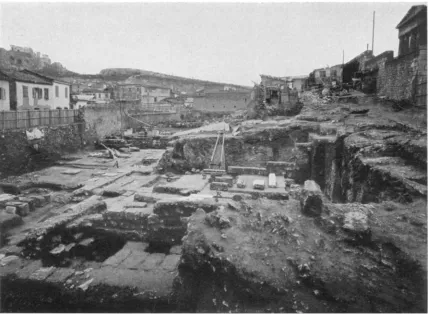
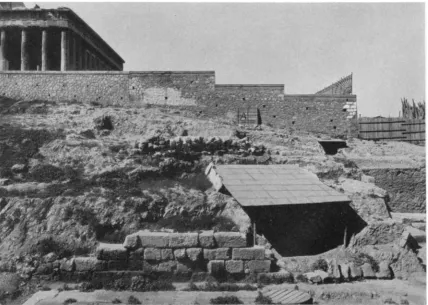
confirmed by the current investigations, which were conducted under the supervision of Dr. Thompson, anid the presence of another structure has been rev-ealed which opens from the Stoa on the west side. An immense amount of labor was required to cut away the living rock of the cliff in order that the building could be placed in this exact spot, so that it is obvious that its location here was necessitated by its relation
Fig. 1. The Foundations of the Royal Stoa withi its Annex on the Right
to the Stoa, to which it must have serv ed as an annex. It may have been used as office space for administrative officers of the city, or it may have provided additional rooms for the storage of official records and. archives.
pottery found below and around the stones. This Hellenistic building has been described from the architectural point of view by Professor Stillwell in the First Report, Hesperia, II, 1933, pp. 124 to 126.
At the time when the Hellenistic building was erected the use of an elaborate system of waterworks in the vicinity was abandoned. Two well-shafts on its south
* _
..~~~~~~~~~~~~~~~... .: -7 , . . 7:
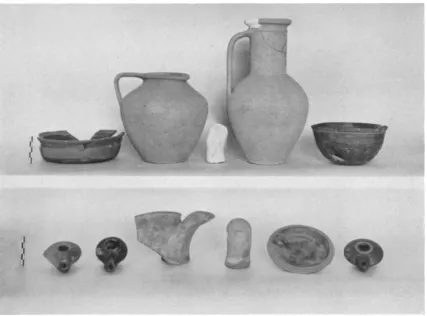
Fig. 2. Objects from a Well
side were actually covered by some of the foundation blocks. The objects in these wells, such as lamps, and vases, date from the fourth and the early part of the third century B. C., and nothing of later date occurred in the deposits. In one of the wells,
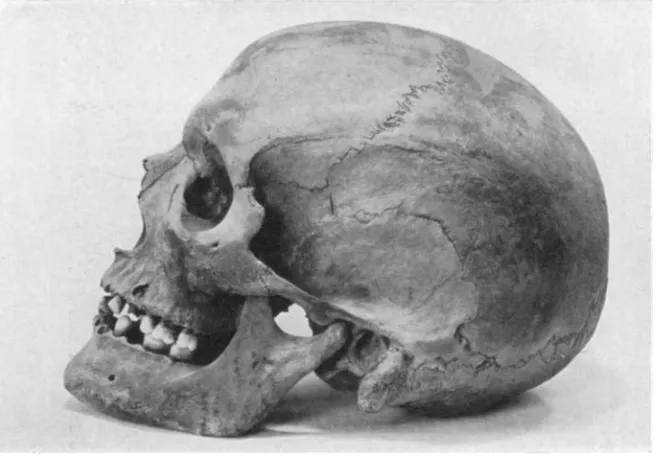
of which the site is marked C in Figure 1, was also found a beautiful bronze head of a woman, which is described in the article on sculpture. This shaft, which has a diameter of 1 in., extends to a depth of 7.10 m. The filling was uniform in character from the top to the bottom, consisting largely of heavy clay and of many large and small stones, interspersed with which were coarse pots and objects, of which a selected group is illustrated in Figure 2. At a depth of 6 m. in the well was lying the skeleton
454 T. LESLIE SHEAR
of an adult man, whose skull has special interest because of the decayed condition of one of the teeth. The skull, which is shown in Figure 3, has a cephalic index of .778. An upper right molar tooth had been removed some eight or ten years before death, but a decayed upper left bicuspid had been left in the mouth and had caused an abscess of the jaw. The man must have suffered great pain, and the poisons developed from the abscess may have been an indirect cause of his death. No trace of dental treatment is visible. Just west of the well a second shaft, Figure 1, D, leads to an underground passage which opens into a large cistern lying to the south. This cistern has been fully
Fig. 3. Skull with diseased Tooth
described in Hesperia, II, 1933, pp. 126-128. The datable objects from it belong to the
fourth and to the beginningr of the third century B.c. The largest group of vases is
made up of small undecorated bowls and cups. Several thous'ands of these were found, and the position in which they were lying indic-ates that they had been thrown in through the well-opening in the roof. They were undoubtedly cheap votive offerings dedicated in some neighboring sanctuary, which had been cast out and buried when the shrine became overcrowded with dedications. Other wells Ind cisterns with underground connecting galleries occur in the neighborhood, and the deposits in all cases show that they were filled up in the third century B.c., but. no evidence was produced by the
excavations to account for the abandonment at that time of such an elaborate system of waterworks.
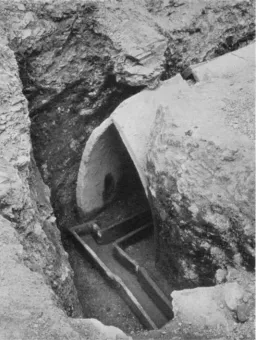
corner of the building, formerly excavated, south of the Royal Stoa. The channel itself is made of terracotta sections which are cemented together. The inner width of the water course is 0.15 m. This channel is set on bedrock or hard earth and is covered by a series of pairs of hug,e curved terracotta tiles, which are placed on end, straddling
Fig.! 4.Cre fWae-hne
t L w n e T
t as as fi t.
In the corner which appears in Figure 4 the channel is properly:constructed toprovide' tgh
*+'~~Fg 4., ConrofWtr-bne
channelf pses.> Tetlswhcmesrmoeha m. inhih n r .6 m. in
and a Greek coin of Athens of the second century B.C. were found in the tunnel, but
456 T. LESLIE SHEAR
it, and the fact that the channel is laid in part over the foundations of the Royal Stoa on the west side would indicate that it is of late Roman date.
A group of shanties occupied by refugees was located on the rocks above the Hellenistic building, close to the modern terrace wall bounding the precinct of the Theseum, as may be seen in the photograph reproduced in Figure 1. With much difficulty
.,-, -Fg 5)
__.i~~~~~~~~~~~~~~~~~~~~~~~~~~~~~~~~~~~,4. Ar
by it,' i,s idcte in
Fiue
5 b itswoe oe A hc srie gish al Thi sat was clae ;~~~~~~~~~~~~~~~~~~~~~Vj duigteSmero 92udr th uevso fM. Vadrol1~~~~~~~~~~~~~~~~~~~~~~~~1
i_
~~~~-At t:P e-i4 Ni
Fig. 5. Site of the Mouth (A) of the Rock-clit Shaft
these refugees wrere dislodged from the'ir precarious perch. In the subsequent opera;tions of clearing the rock the mouth of a rectangular shaft cut in the rock was uncoverecl. The position of the shaft, so close to the terrace wall that its mouth is partly covered by it, is indicated in Figure 5 by its wooden cover (A) which is raised against the wall. This shaft was cleared during the Summer of 1932 under the supervision of Mr. Vanderpool.
was a black-figured oenochoe of the type and style of the Ainasis painter while near
the top were found some late black-figured and early red-figured sherds. A definite date is given to the later contents of the deposit by ostraka of Aristeides and Themistokles
(483B.C.) which were lying at a depth of 4.50 m.-6 m.
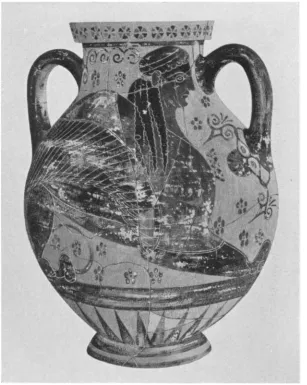
Fig. 6. Early Attic Amphora
458 T. LESLIE SIIEAR
of 15.10 to 16.25 in., but its badly weathered surface indicates that it had stood for some time in an exposed position before it was thrown away. Because of the worn condition of the surface the photograph, Fig. 6, was made from a water-color of the vase by Mr. Piet de Jong. Each side of the vase is almost completely filled by a large sphinx of archaic type, and rosettes are scattered in the few remaining blank spaces and are closely placed around the edge of the rim. Palmettes and lotus buds are
Fig. 7. Attic Black-figured Bowl
grouped around the base of the handles. This fine specimnen of early Attic ware must date as early as the seventh centutry B.C.
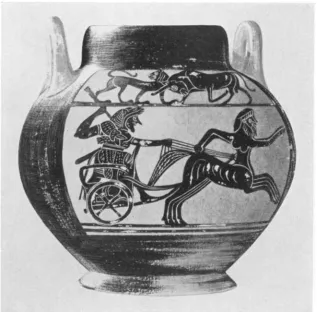
A vase of early Attic black-figured style has particular interest because of the scene
with which it is decorated. Again because the surface of the vase is poorly preserved
the illustration, Fig. 7, is taken from a water-color by Mr. de Jong. The decorations
other side of the vase three water-birds appear in the upper panel while the central panel is occupied by a group of five standing figures who are conversing together.
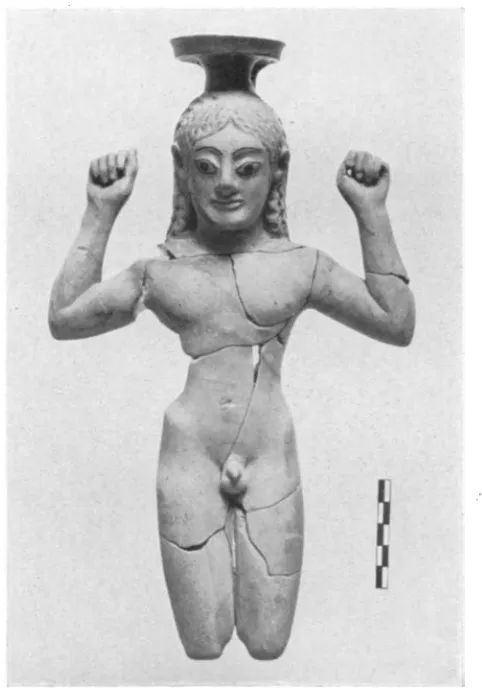
The finest object secured from the shaft is a plastic vase in the form of a kneeling boy (Fig. 8). The arms are upraised and the hands are loosely clasped as if they might
Fig. 8. Plastic Vase
have held the ends of a ribbon which may have passed around the neck of the vase. The exquisite modelling of the figure, the careful rendering of accurate details of the hands and feet, and the superb finish of the surface mark this as a masterpiece of archaic work. It probably dates from the third quarter of the sixth century B.C.
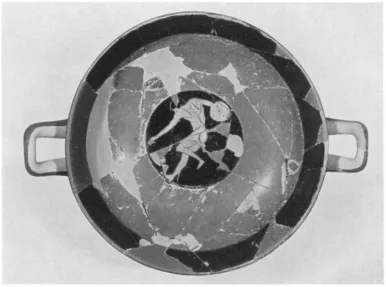
From the end of the sixth century comes a red-figured cylix (Fig. 9). This vase
460 T. LESLIE SHEAR
body of the bowl is an equally well polished red. The medallion is decorated with the figure of an athlete represented at the instant before he hurls the discus.
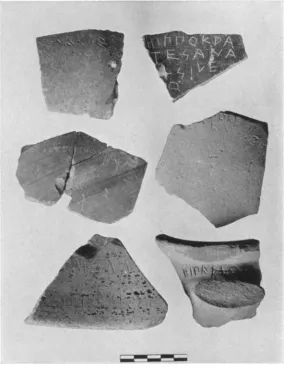
Among the many other discoveries in this shaft not the least important is a series of ostraka of which a group is shown in Figure 10. Here has been secured for the first time a ballot cast in January 487 B.c. against the first man to be ostracized, Hipparchos son of Charmos. The group also includes three of the votes cast against Megakles
Fig. 9. Attic Red-figured Cylix
The second sector of the excavations, E, lying southeast of the first and directly east of the Theseum, was excavated under the supervision of Mr. Waage. This, also, was a completion of the work begun in the previous season. The entire facade of the Stoa of Zeus was uncovered and this building has been described by Mr. Stillwell in
Fig. 10. Ostraka
462 T. LESLIE SHEAR
Figure 11 gives such a view of the temple, and shows in the centre the north end of the Stoa of Zeus, with the top of the drain and the statue of Hadrian visible in the left corner. With the uncovering of more of the drain several inscribed stelae were found lying, across the top where they had been re-used as cover blocks. Two of these stelae are shown in place in Figure 12. Since the inscribed surfaces were placed downwards the
ii J
Fig. 1.1. View over Excavated Area from East
letters have been badly worn by the action of water, but with much painstaking effort the essential contents have been deciphered by Professor Meritt and have proved to be of considerable historical importance. They will be published by him in the first number o f Hes.peria in 1934. The area around the marble altar was extensively cleared and just north of that building there was uncovered a statue of a woman clad in transparent garments, which is published in a later article in this number.
The two southern sectors of the year's excavation, one extending north and south on Eponymon Street, Delta, and the other east and west on Asteroskopeiou Street, Stigm ia ~see the Plan in IIesperia, II, 1933, p. 99), furnished the surprise of the season.
It was confidently expected that the ancient street which had appeared in Sector Epsilon would be picked up in one or other of these areas, and that in them some of the public buildings mentioned by Pausanias would be uncovered. But the results have shown that no public buildings were located here, for the slight house foundations existing must have belonged to private houses or to shops, which lay on the outskirts of the Agora and behind the sites of the large public buildings. It is clear that the
_-_hI.c- .; .. X ?!
Fig 12 Inscribed'Ste'ae'in place over Water-channel
A
view
of thesou-th
en of En ymon S tre is given 'a.. in Figure,1 i s onancient street must turn before it reached the area of these southern sections. The disappointment which was at first caused by the absence of public monuments was subsequently more than compenisated by the discovery of Geometric burials with undisturbed contents, and by the finding of a great quantity of vases and of small objects belonginofl to the Greek and to the Hellenistic periods.
464 T. LESLIE SHEAR
earth in this area proved to be shallow, only from 1.50 to 2 metres, the cellars of some of the houses extended down to bedrock. Figure 14 shows the area after excavation. The ground is seen to be pock-narked with shafts of wells and of cesspools which are often lying side by side. In the absence of a main sewer system in this part of the
Fig. 13. South End of Eponymon Street
city the houses have cesspools beneath them, which in some cases have not been cleaned out for many years. It is a disagreeable but necessary task to remove this filth and
dig out the shaft to its bottom. A few of the wells have been in use in modern
times, but others were filled uip with earth and de'bris at various periods of antiquity.
It is in suich wells that many important and interesting objects have been found.
23 in. anid from top to bottom was filled with a deposit dating from the fifth to the third century B.c. A well at the south end, in which had been thrown the pieces of
the statue of the marble Faun, which will be discussed in a later article, went out of use and was filled up in the latter part of the fourth century A.D., as is proved by the
coins, pottery and terracottas in the (leposit. The type of late Roman terracottas there found is illustrated bv the crude figures of chickens andl a dog shown in Figure 15.
Fig. 14. Section Delta after Excavation
The well in this area which yielded the most important objects was of an early date. Two wells, in fact, close together had been cut through the bedrock to a depth of 13 m. but before they had been long in use the wall between them apparently collapsed and they were abandoned. The objects found in them in great quantity all date from the second half of the sixth century B.c. There are many vases of numerous shapes, including
466 T. LESLIE SHEAR
the eyebrows are painted black. A necklace is indicated by two black bands across the throat. A break at the back proves that the head was affixed to some object and it has been plausibly suggested that this was the decorative end of an epinetron or onos. No remains of foundation walls exist in this area, nor are there any cuttings in the hard-pan whence blocks might have been removed. It is improbable that any large buildings ever stood here. The multiplicity of ancient wells points rather to the presence of a residential area. Furthermore, undisturbed deposits from the Geometric and the early Attic periods exist in many places just above the hard-pan. Any building of
Fxig. 15. Tleiilacotta F'igiules. Roman I Peiiodl
considerable size wxould have required deeper foundations than could ever have been constructed here.
Among the early Attic remains from this area two v ases, which date from the early part of the sixth century, are especially important. One is a large amphora which is decorated on each side with the head of a horse. The second is a demnos of characteristic shape with a rounded bottom which was made to be set on a stand or tripod (Fig. 17). It is cov ered with decorative scenes arranged in three horizontal bands, of which the upper has a series of palmettes and lotuses with groups of small figures between them. In the central band scenes are portrayed with figures on a larger scale, the main group representing the Calydonian boar hunt.
stan(ls Atalante, who is followed by a man, only the first letter of whose name, P, is preserved. This is undoubtedly Peleus who is traditionally represented as playing an aggressive role in the combat. The boar is attacked from behind by a dog which has leaped against its lhaunches. Then comes a man named Geron, another new character in this myth, who is running up with a poised spear, and finally Akastos approaches holding a dog by the leash with the left hand and ready to hurl a stone with the right. The
Fig. 16. Archaic Terracotta Bust
lowest band of the vase is decorated with groups of animals of orientalizing type, a boar between two sirens and a bull between two lions. This important example of Attic black-figured ware is particularly interesting because of the new elements in the mythological scene.
The most southern sector of the excavations, Stigma, which lies at the base of the north slope of the Areopagus, was cleared under the supervision of Miss Burr. Here, as in Delta, the deposit of earth was slight, and the cellars of some of the modern houses extendedI almost down to bedrock. In the absence of heavy foundations public buildings probably did not exist here, but there are considerable remains of a Roman
house, with arrangements for its hot bath, in the eastern part of the area. Sections of Greek walls are also preserved and stretches of a street or road of the Greek period. An elaborate systemi of underground drains and water-channels was uncovered, and many
468 T. LESLIE SHEAR
wells and cisterns were cleared with profitable results. But in the midst of later cuttings for pipes and walls, spared by some mysterious chance, stood urn burials and unrifled graves of the early Geometric period. Topographically, therefore, this area was presumably outside the limits of the Geometric town, and in classical times it seems to have been behind the region occupied by the public monuments of the market place. One of the most important discoveries in the section was a deposit of early votive terracotta objects which will be fully described in a later article by Miss Burr. The
Fig. 17. Deinos with the Calydonian Boar Huint
Geometric burials are also of great interest. Two amphoras which were standing near each other give a characteristic picture of the type of interment. The hard-pani was cut in a round hole barely large enough to receive the vase which was placed in it. The body was partially burned near-by and the remnants of the charred bones were deposited in the vase. Its mouth was covered by a bowl and finally stones were packed about the top, and the are'a was entirely paved with a layer of small stones. It is a surprising phenomenon that these burials should have remained untouched in areas which have been thickly settled throughout the ages. The result is, of course, purely accidental and probably many graves, similar to those fouind, were destroyed in the course of the construction of modern house foundations.
at the centre of which are figures with the shape of the hour-glass. A triple wave-line is painted in dark brown on a broad buff band about the body, while above and below this are bands of black glossy paint of varying widths. These stylistic motives represent
... .. ...
Fig. 18. Proto-geometric Amphora
the survival of Mycenaean ornamentation, and their presence marks the vase as a product of the transitional period between thie Mycenaean and the Geometric. This type
of vase is, therefore,
called proto-geometric and may be dated about 1000 -Bc. The mouth of the amphora was stopped by a small bowl which fitted tightly in its neck. Similar burial practices from Geometric times have been reported at other sites a'nd were commonly in vogue in the Geometric cemetery at Corinth. It is probable that470 T. LESLIE SHEAR
grain or other dry foodstuffs were deposited in the bowl. The amphora itself contained, in addition to the charred bones, two large brooches and two stick pins, all made of iron, a metal which was still rare in the Geometric age.
Besides the urns cist graves were also used for burials. One of these again illustrates the combined practice of cremation and inhumation. An oblong cutting in the hard-pan was made for the grave, in and about which were many traces of fire, while only pieces of the bones remained. It was presumably covered with a layer of small stones beneath
Fig. 1.9. Geometric Pyxis
whichi the vases were placed; and part of its north wall was built of stones necessitated by the slope of the rock. Among the ten vases in the grave were three pyxides or toilet-boxes, one of which is shown in Figure 19. By analogy with thie gra-ves at Corinth the presence of the pyxides would mark this as the grave of a woman, and in some of the Corinthian graves the boxes still contained cubes of carbonate of lead which were uised as cosmetics by thie women.
made by Pheidias. Another terracotta which has affiliations of style with the sculpture of the Parthenon is the plaque shown in Figure 20. This is an ancient trial cast in terracotta made from a mould, and is a complete unit in itself. The mould was intended to be used for a cast in bronze or silver, but before the cast in precious metal was made the mould was tested with the cheaper material. The scene is a combat between two youths. The one on horseback is of slight build and approximates the size of
Fig. 20. Teiracotta Plaque~~~~~~~~~~~~~~~~~~~~~~~~.. ...
Amazons who are represented in scenes similar to this on fourth century reliefs. The modelling of the bodies, the treatment of the drapery, the symmetry of the pose of the group, the restrained suggestion of violent action, and the type and pose of the horse are characteristics which mark this as a work of the latter part of th*e fifth or of the early part of the fourth century B.C.
In the series of terracottas secured in the season's campaign one can follow the development of this art from its primitive stage in the eighth century B.C. to the period
of its highest and finest expression in the fifth and fourth centuries, and then trace its gradual decline until in the fourth century A.D. it has reverted to as crude and primitive
472 T. LESLIE SHEAR
The excavation of the eastern part of Sector Stigma was directed by Dr. Thompson. Some exploratory digginig had been done here in 1897 by Dorpfeld, in the course of which he uncovered part of a Roman house (Ath. Mitt., XXII, 1897, p. 478). The house proves to consist of several rooms, one of which is a hypocaust. The furnace for the heating system lies at the back of the building where it was built against the scarp of the cliff on the south. The rooms are in a poor state of preservation but two building
. . .~~~~~~~~~~~~~~~~~~~~~~~~~~~~~~~~~~~~~~~~~~~~~~~~~~~~~~~~~~~~~~~~~~~~~~~~~~~~~~~~~~~~~~~~~~~~~~~~~~~~~~~~~~~~~~~~~~~~~~~~ .. ..
Fig. 21. Attic Black-figured Skyphos
periods can be discerned. The house appears to have been destroyed at the close of the f'ourth century A.D.
The presence of the house confirms the evidence of the many wells and cisterns in support of the view that this was a residential district, and, again, the objects from the wells have proved to be of great intrinsic interest and of much chronological value. A large pithos yielded a quantity of objects of the Hellenistic period, including lamps, Megarian bowls, other pottery and some terracottas which are approximately uniform in date, and the date itself is verified by the presence of several coins of Athens which are placed in the first half of the third century B.C. A deposit of earlier date was found in a well which extended to a depth of 9.50 m. Practically all the vases, which date from the six'th century B.C. were lying in the lowest metre of the deposit. Several of
with an interesting scene is illustrated in Figure 21. The space on either side of the vase is occupied by a group consisting of a youth riding an hippalektryon between two draped standing women who are facing the rider. The youth is reining in his animal who is prancing with its equine forelegs while the woman in front is gazing with astonishment at the spectacle. Purple color is used on parts of the figures and traces
-. .~4 - , j, a - : -' - ? '
q q | _ia ... b # S ; B .... ... ... ... . * X [ ,* > ,
Fig. 22. Lead Weight
of white are also preserved. Beneath the handles there is a goose on one side and a
cock on the other.
The excavations have produced mnany classes of objects in large numbers. The lamps are becoming so increasingfly numerous that it will be presently possible to illustrate graphically the entire developiment of the lamp-making industry in Athens from the earliest to the latest times. The many bronze and silver coins not only reveal the sequence of Athenian issues but they also throw light on the foreign commercial relations of the city in their many ramifications. The inscribed documents furnish historical and chronological information of inestimable value. Quite ap'propriately the Agora has also
yielded a series of official. weights, seven of lead and four of marble. The largest lead
474 T. LESLIE SHEAR
tEMO, weighs 1790 gramines (Fig. 22). Two of the imarble pieces weigh the same and the third but slightly less. Another lead unit weig,hs 440 grammes. Previous investigators have determined the weight of the Solonian mina at from 440 to 400 grammes. The weight just mnentioned, therefore, would be one mina and the others would be approximatelv four minae. Another lead which is stamped with the amphora weighs 320 gr., or about
3/4 of a mina, and still another gives a weight of 225 gr., or about half a mina. Four
of the weights were found in a well which contained nothing later than the third century B.C., and they should, consequently, conform to the Solonian standar(I, but
Fig. 23. Dicast's Ticket and Ballot
accuracy of official weights was evidently not considered essential for trading in the markets of Athens.
One small group of objects is of interest as illustrating the judicial system of the Athenians. These are the bronze tickets and ballots used by the dicasts or jurors in the performance of their duties in the law courts. One of the tickets, which belonged to a man named Nikion, is shown on the left of the picture in Figure 23. On the right of the picture is a bronze ballot which the juror used for registering his decision. Since this example has a solid hub it served as a vote for acquittal. These bronzes date from the fourth century B.C. and are contemporaneous with Aristotle's account of the system
in his Conzstitution of Athens.
The various objects found in the excavations are being studied by members of the staff and they will be published in preliminary form in successive volumes of Hesperia.