Research Article
High-level Programming and Symbolic Reasoning on
IoT Resource Constrained Devices
Sal vatore Gaglio
1,2, Giuseppe Lo Re
2, Gloria Martorella
2, Daniele Peri
2,∗ 1ICAR CNR, Viale delle Scienze, Ed. 11, 90128 Palermo, Ital y2DICGIM Univ ersity of Palermo,V iale delle Scienze, Ed. 6, 90128 Palermo, Ital y
Abstract
While the vision of Internet of Things (IoT) is rather inspiring, its practical implementation remains challenging. Conventional programming approaches prove unsuitable to provide IoT resource constrained devices with the distributed processing capabilities required to implement intelligent, autonomic, and self-organizing behaviors. In our previous work, we had already proposed an alternative programming methodology for such systems that is characterized by high-level programming and symbolic expressions evaluation, and developed a lightweight middleware to support it. Our approach allows for interactive
programming of deployed nodes, and it is based on the simple but e
ective paradigm of executable code exchange among nodes. In this paper, we show how our methodology can be used to provide IoT resource constrained devices with reasoning abilities by implementing a Fuzzy Logic symbolic extension on deployed nodes at runtime.
Keywords: High-level programming, Resource constrained devices, Knowledge Representation, Fuzzy Logic.
Received on 22 December 2014; accepted on 10 March 2015; published on 28 May 2015
Copyright © 2015 D. Peri et al., licensed to ICST. This is an open access article distributed under the terms of the Creative Commons Attribution license (http://creativecommons.org/licenses/by/3.0/), which permits unlimited
use, distribution and reproduction in any medium so long as the original work is properly cited. doi:10.4108/cogcom.1.2.e6
1. Introduction
According to the Internet of Thing (IoT) vision [1], all kinds of devices, although computa tionall y limited, might be used to interact with people or to manag e informa tion concerning the individ uals themsel ves [2]. Besides reactiv e responses on input chang es, the whole netw ork may exhibit more adv anced beha viors resul t-ing from reasont-ing processes carried out on the individ-ual nodes or emerging from local interactions. However, nodes’ constr aints lea ve the system designers many challeng es to face, especiall y when distributed appli-cations are considered [3]. Conventional progr amming methodol ogies often prov e inappropria te on resource constr ained IoT devices, especiall y when knowledg e must be trea ted with a high lev el represen tation or chang es of the applica tion goals may be required after the netw ork has been depl oyed [4]. Moreov er, the implemen tation of intellig ent mechanisms, as well as
∗Corresponding author.Email: [email protected]
solution in terms of efficiency , while 6 reports our concl usions.
2. Key Concepts of the Development Methodology
Mainstream praxis to progr am embedded devices consists in cross-com pila tion of specialized applica tion code together with a gener al purpose oper ating system. The resul ting object code is then upl oaded to the on-board permanen t stor age. Instead, our methodol ogy is based on high-lev el executable code exchang e betw een nodes. This mechanism, while abstr acted, is implemen ted at a very low lev el avoiding the burden of a complex and thick softw are layer betw een the hardw are and the applica tion code. Indeed, a Forth environmen t runs on the hardw are providing the core functionalities of an oper ating system, incl uding a command line interf ace (CLI). This also all ows for interactiv e dev elopmen t, which is a peculiar feature of our methodol ogy tha t can be used even to reprogr am depl oyed nodes. This way, nodes can be made expand their capabilities by exchanging pieces of code among themsel ves in real time. The CLI is accessible through either a microcon troller’ s Univ ersal Asynchronous Receiv er-Transmitter (UART) or the on-board radio [6]. The Forth environmen t is inheren tly provided with an interpreter and a compiler . Both can be easil y extended by definin new words stored in the dictionary. Being Forth a stack -based languag e, words use the stack for par ameters passing. A command, or an entire progr am, is thus just a sequence words.The acquisition of sensory data is already supported as we have previousl y extended the dictionary with the words to manag e the sensor -MicroC ontroller Unit (MCU) interf ace, to enable the Anal og to Digital Converter (ADC) and to lea ve the sensory reading on the stack. For instance, the progr am to measure the tem per ature is just the word temperature, whereas
sensing the ambien t light is achiev ed by executing the single word luminosity. Although the code is concise
but expressiv e, the execution of these words involves the reading from the ADC and the return of the raw data on the stack. The description of a task in natur al languag e and its implemen tation can be thus made very similar .
Our progr amming environmen t is composed of some nodes wirelessl y depl oyed and a wired node tha t beha ves as a bridg e to send user inputs to the netw ork. In previous work [7], we introd uced the syn tactic construct tha t implemen ts executable code exchang e among nodes:
tell:hcodei:tell
in which hcodeiis a sequence of words, sent as char acter
strings, to be remotel y interpreted by the receiv er node. The address of the destina tion node is left on the top
temperature
Bridge node A301 tell: temperature :tell
Node address: A301
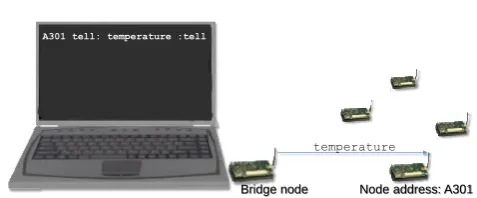
Figure 1. Executable code exchange to make a node sense the temperature quantity. To tell a node to locally perform temperature measurements, the user can interact with the bridge node interpreter by typing on its shell the sequence of words to exchange symbolic programs. The destination node address –the hexadecimal valueA301in the example– is expressed as a 16-bit value according to the IEEE802.15.4 short addressing mode. The wordtemperatureis the symbolic program that is copied in the outgoing frame payload, sent as character string to be remotely interpreted.
of the stack. A numeric as well as a string value, can be taken at run time from the top of the stack and inserted in the outg oing packet when special markers, such as ∼
for numbers and ∼sfor strings are encoun tered.
Theref ore, the exchang e of code promotes distributed computa tions since a node tha t is not equipped with tem per ature and light sensors can tell another to measure the tem per ature or ambien t light just by executing the construct tell: hcodei :tell and
incl uding the symbolic progr am for the measuremen t as follows:
tell: temperature :tell
or it can be typed at the CLI of the bridg e node, as in Figure 1.
Due to their internal limita tions, sensor nodes are mostl y confine to perceiv e environmen tal conditions in WSN applica tions. This is not expected to chang e in the IoT context , yet in the following section we show how using a suitable progr amming approach even small sensors can be provided with symbolic reasoning abilities.
3. Distributed Processing and Symbolic Reasoning
In our progr amming environmen t, purel y reactiv e beha viors can be easil y implemen ted on the remote nodes by sending them the sequence of words to be executed if certain conditions are met. Let us consider the following command giv en through the CLI of the bridg e node:This command broadcasts –the word bcst lea ves the
reserv ed address for the purpose on the stack – the code betw een the tell: and :tell words. Once receiv ed,
each node executes the word close-to-window? to
evaluate if it is close to the window and, if so turns the red LED on. The word close-to-window?, already
in the dictionary , perf orms tem per ature and luminosity measuremen ts and checks if both sensory readings are abov e a predefine threshol d. As it can be noticed, the code is quite understandable, although all the words oper ate just abov e the hardw are lev el by setting ports or enabling the ADCs to read tem per ature and light exposure. This code, as well as those in the rest of the paper , has been used on Iris Mote nodes equipped with the MTS400 sensor board to acquire data about tem per ature and light exposure. For the sake of showing how it is possible to incorpor ate in our middlew are new abstr actions to support intellig ent applica tions here we introd uce a Fuzzy Logic extension. Fuzzy Logic has the peculiarity to be appropria te to implemen t approxima te reasoning in sev eral contexts as well as for machine learning purposes [8]. We adopted a classic Forth Fuzzy Logic implemen tation [9] tha t we modifie to make it run on the Harv ard architecture AVR microcon troller used in the Iris Mote pla tform. Finall y, we also enriched the original implemen tation with the possibility to exchang e fuzzy definition and evaluation among nodes.
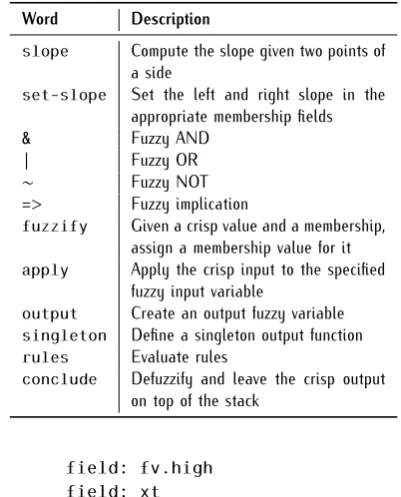
The wordset to enable high-lev el fuzzy reasoning on IoT resource constr ained devices is provided in Table 1 and all ows for the crea tion of fuzzy input/output variables, for the definitio of the rela ted membership functions, for fuzzific tion, for rule evaluation and for defuzzific tion processes.
Differen tly from [9], to crea te a new fuzzy variable we incl uded the word fvarto be used according to the
following syn tax:
<min_val> <max_val>fvar<name>
where <min_val> and <max_val> represen t the defini
tion domain of the fuzzy variable and <name> is the
name associa ted with the new variable. Differen tly from
<min_val> and <max_val> values tha t are expected
to be on the stack, the variable name is provided at run time. When this construct is executed by the node interpreter , a new entry named <name>is crea ted in the
dictionary , which is located in Flash memory , while a fi e cells structure is all ocated in RAM. As ill ustr ated in Figure 2, a fuzzy variable can be thought of as a sequence of fie ds. The Forth code to crea te this struc-ture is self -explana tory:
begin-structure fv field: fv.crisp field: fv.link field: fv.low
Table 1. Words defined in the dictionary to implement fuzzy reasoning according to [9].
Word Description
slope Compute the slope given two points of a side
set-slope Set the left and right slope in the appropriate membership fields
& Fuzzy AND
| Fuzzy OR
∼ Fuzzy NOT
=> Fuzzy implication
fuzzify Given a crisp value and a membership, assign a membership value for it
apply Apply the crisp input to the specified fuzzy input variable
output Create an output fuzzy variable
singleton Define a singleton output function
rules Evaluate rules
conclude Defuzzify and leave the crisp output on top of the stack
field: fv.high field: xt end-structure
Once the word fvar is executed, a generic fv
structure is instan tiated and <min_val>and <max_val>
values are stored in the fv.low and fv.high fie ds.
The firs fie d stores the crisp input value, and it is followed by a link fie d, i.e. the membership function list associa ted with tha t fuzzy variable. The following tw o fie ds contain the validity rang e, i.e. the minim um value and the maxim um value all owed for the crisp input. Finall y, as we want to all ow the nodes to reason about sensory data, the last fie d contains the address of the word to perf orm the measuremen t of the physical quan tity associa ted with tha t variable.
Let us defin tw o fuzzy variables, tempandlightexp.
The last fie d of temp stores the address of the
word temperature, while the address of the word
luminosity is the last fie d of lightexp. The words
luminosity and temperature have been already
introd uced in the previous section.
Similar ly, to crea te a membership function, the word
memberexpects on the stack four control poin ts which
determine the shape of the membership function and its name is provided at run time according to the following syn tax:
<bottom-left> <top-left> <top-right> <bottom-right>
member<name>
As a fuzzy variable, also a membership function is a generic structure composed of sev eral fie ds:
fv.crisp
fv.link
Jfv.low
fv.high
xt fuzzy variable name
Figure 2. The definition of a fuzzy variable include a new entry in the Flash memory word dictionary and allocates five contiguous cells in RAM as a sequence of fields. The first cell stores the crisp input value, while the link field contains the address of the first defined membership function related to the fuzzy variable. The following two cells store the validity range, while the last one stores the execution token (xt), i.e. the address of the word to sense the physical quantity associated with the fuzzy variable. Once the fuzzy variable name is used, the address of the first field is fetched on top of stack.
field: link field: lm field: lt field: rt field: rm field: ls field: rs end-structure
The firs fie d contains the truth value resul ting after the fuzzific tion process, while the second fie d stores the address of the next membership function. Essen tiall y, a fuzzy variable and its membership functions are implemen ted as linked list. Membership functions are trapezoidal and theref ore four control poin ts are stored in the appropria te four successiv e fie ds, left -most (lm), left -top (lt), right -top (rt), and right -most (rm). Finall y, tw o further memory cells are required to store the left slope (ls) and the right slope (rs) of both sides. When the firs membership function is defined the fuzzy variable link fie d stores the address of the newl y crea ted membership function. As the
word member is executed, the four control poin ts on
top of stack are stored in the appropria te fie ds of the membershipstructure along with the left and right
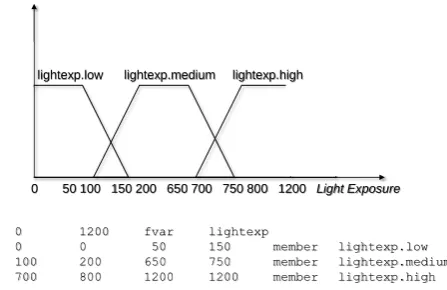
slopes. Figure 4 shows the code to defin the fuzzy variable rela ted to light exposure named lightexp
and the rela ted membership functions according to the words described previousl y.
Moving on with the initial exam ple in which a node evaluates its proximity to a window , in place of tw o crisp variables, the fuzzy variables tempand lightexp
0 1200 fvar lightexp
Bridge node A301 tell: 0 1200
fvar lightexp :tell
Node address: A301
Figure 3. Similarly to Figure 1, the executable code exchange mechanism allows to define fuzzy variables and their related membership functions on already deployed nodes. To remotely define the fuzzy variable lightexp, the code to be remotely executed must be enclosed betweentell:and:telland typed at the CLI of the bridge node that sends the executable code to the destination node. The remote node receives the sequence of words 0 1200 fvar lightexp and locally interprets it.
0 50 100 150 200 650 700 750 800 1200 Light Exposure
0 1200 fvar lightexp
0 0 50 150 member lightexp.low 100 200 650 750 member lightexp.medium 700 800 1200 1200 member lightexp.high
lightexp.low lightexp.medium lightexp.high
Figure 4. Fuzzy sets associated with the fuzzy variable
lightexp. On the right side, the code to define the fuzzy variablelightexpand its membership functions. The definition domain, corresponding to the raw readings values interval [0,1200], is given before the wordfvar, while the wordmember
defines each of the three trapezoidal membership functions by using four control points (bottom-left, top-left, top-right, and bottom-right).
can be easil y define on depl oyed nodes provided tha t the symbolic progr am is placed betw een tell: and :tellas indica ted in Figure 3.
The represen tation of a fuzzy variable and its membership functions in memory is provided in Figure 5.
A node can be made measure light exposure, and fuzzify it with the code:
lightexp measure apply
The word measure fetches the xt fie d of the fuzzy
fval
0
0
50 fv.crisp
0
1200 Address of
the word luminosity lightexp
150
0
655 lightexp.low
Address of
lightexp.low fval
100
200
650
750
655
655 lightexp.medium
Address of lightexp.medium
fval
700
800
1200
1200
655
0 lightexp.high
Address of
lightexp.high 0
Figure 5. Memory representation of the fuzzy variable
lightexp and its related membership functions after the code shown in Figure4is executed. The implementation refers to linked structures. Each link field stores the address of the next defined membership function. A link field that is equal to zero indicates the last membership function concerning that variable. It is worth noticing that the slope values are “scaled" to 65535 since this is the maximum number that can be expressed with 16-bits.
code. In detail, when the word measureis interpreted,
the word address, which is stored in the xt fie d, is executed. Then, the word luminosityis executed and
the sensory reading is left on top of the stack. This value is trea ted as crisp input by the wordapply. As its
name sug gests, the word applyapplies the crisp input
to all the membership functions referring tolightexp
and stores the fuzzy truth value in the corresponden t
fval fie d. Basicall y this word scans the linked list
and fuzzifie the sensory reading for each membership function.
To access the truth value resul ting from the fuzzific tion process the code:
lightexp.low @
pushes onto the stack the truth value by using the buil t-in word @ (fetch). Rather than through a threshol ding process, a device can establish if it is close to the window through the evaluation of fuzzy rules in the form:
temp.high @ lightexp.high @ & => close-to-window
where temp.highand lightexp.highare membership
functions of the fuzzy input variable temp and
lightexprespectiv ely, and close-to-windowis one of
the linguistic labels associa ted to the output variable. Similar ly to the case of the threshol ding process, if both the tem per ature and the light exposure lev els are high a node can infer to be under sunlight , and thus close to the window .
temp.low
temp.medium
temp.high
Figure 6. The execution of temp lightexp 2
classification thermal-zone creates the word
thermal-zone that is bound to the two fuzzy variables. A 9 cells sized memory area is allocated as temp and
lightexp have both three linguistic variables associated. In essence, each of these cells identifies a thermal-zone, a membership class according to which the node classifies itself. This area stores all the possible combinations for the rule evaluation process and aggregation.
4. Inferring the Node Distribution according to
Thermal Zones
Let us suppose we intend to make the depl oyed nodes able to discov er their distribution with respect to thermal zones of an environmen t lighted by some windows exposed to direct sunlight , and lam ps. Each node assesses in turn the thermal zone it bel ongs to, and makes the others aware of this informa tion. We define the syn tactic construct classification to make the
nodes able to classify according to an arbitr ary number of fuzzy variables. With the previousl y define input variables tempand lightexpthe code:
temp lightexp 2 classification thermal-zone
crea tes the new word thermal-zone, which is bound
to the tw o fuzzy variables temp and lightexp as
ill ustr ated in Figure 6.
When the new word thermal-zone is executed, it
measures the tem per ature and luminosity , fuzzifie the crisp inputs and evaluates the rules by storing the firin strength for each rule, indica ting the degree to which the rule matches the inputs. The rule gener ation process considers all the possible combina tions of all the membership functions, -i.e. in this case, the set of all ordered pairs (a,b) where a and b are linguistic
terms associa ted respectiv ely with tempand lightexp.
temp.low @ lightexp.low @ &
temp.mediu m @ lightexp.low
@ &
temp.high @ lightexp.low
@ &
temp.low @ lightexp.med ium @ &
temp.mediu m @ lightexp.med
ium @ &
temp.high @ lightexp.med ium@ &
temp.low @ lightexp.high @ &
temp.mediu m @ lightexp.high
@ &
temp.high @ lightexp.high
@ & temp.low
temp.medium
temp.high
Figure 7. The rule generation involves the evaluation of all the possible combinations of the truth values of each membership function. Finally, the rule aggregation process consists in scanning the table to return the cell index storing the rule with the maximum strength. This index represents the class the node belongs to.
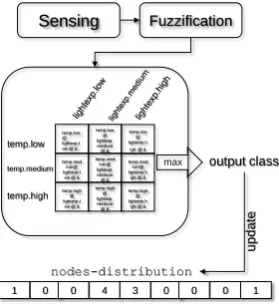
of a larg e scale rule base may be required in real-time fuzzy systems [10–12]. When needed, the table is traversed to compute the membership grade of the output by aggreg ating all rules. The rule with the maxim um strength is taken as the output membership class (Figure 7). This way, each node is able to classify itself into one of the thermal zones. To support more sophistica ted beha viors, it is possible to expl oit the mechanism of code exchang e among nodes to trig ger the process of neighbor discov ery in order to keep track of their classific tion into thermal-zones.
For this purpose, it is necessary to defin the table nodes-distribution to contain the number of
nodes for each thermal zone (Figure ˜reffig:thermal classific tion). To trig ger the whole classific tion pro-cess, the word classification-start can be sent
to already depl oyed nodes through the executable code exchang e par adigm. For instance, each device starts the timer and can transmit once, after wait-ing (word on-timer) for a time tha t is function of
its unique ID. When its time is elapsed, the word
classification-spread is executed, the node
classi-fie itself into a thermal zone and then broadcasts the class it bel ongs to, together with the code to make the others upda te the whole distribution. The Forth code required for the entire process is the following:
: local-update
nodes-distribution update ;
: spread
dup local-update
bcst [tell:] ~ local-update [:tell] ;
: classification-spread thermal-zone spread ;
Sensing Fuzzification
temp.low @ lightexp.l ow @ & temp.med
ium@ lightexp.l ow @ & temp.high @ lightexp.l ow @ &
temp.low @ lightexp. medium @ & temp.med
ium@ lightexp. medium @ & temp.high
@ lightexp. medium @ &
temp.low @ lightexp.h igh @ & temp.med ium@ lightexp.h igh @ & temp.high @ lightexp.h igh @ &
temp.low
temp.medium
temp.high
max output class
1 0 0 4 3 0 0 0 1
nodes-distribution
update
Figure 8. The word “thermal-zones” operates by sensing the temperature and light. Both sensory readings are treated as crisp input and fuzzified according to the membership functions of lightexp and temp. The rule generation considers all the pairs of truth values related to linguistic variables bound to different fuzzy variables. This is justified by the fact that each combination represents a different thermal zone identified by distinct temperature and light conditions. Indeed, the index of the cell storing the maximum value represents the thermal zone the node belongs to. The cell correspondent to the output class is incremented in nodes-distribution in order to allow each node to assess the distribution of the others.
: classification-start start-timer
on-timer [’] classification-spread ;
in which the word spreadcrea tes a messag e with the
code to make the other devices upda te locall y the
nodes-distribution. At the end of theupdateprocess,
each node holds the curren t nodes distribution in terms of thermal zones, as such:
Class 1 2 3 4 5 6 7 8 9 # 5 1 0 0 0 0 0 1 1
Five nodes bel ongs to class 1, one node to class 2 and so on. Each node knows the number of nodes in the netw ork and their position, without any centralized computa tion. Once some nodes are moved from their position to another , and the process is trig gered again, each node is able to detect the new distribution.
bcst tell: thermal-zone 8 class? [if] red led on [then] :tell ;
5. Experimental Results
Beca use of the limita tions in terms of available resources, the implemen tation of symbolic reasoning on resource constr ained devices must be particular ly efficien t. Our approach makes IoT applica tions to be dev eloped on real devices provided with an environ-men t running at close contact with the hardw are. This prev ents the presence of further intermedia te lay-ers betw een the hardw are and softw are applica tions, increasing efficiency . Moreov er, as already widel y dis-cussed, although running on the hardw are, the sym-bolic computa tion all ows to trea t knowledg e with a high degree of expressiv eness. Differen tly from main-stream approaches, distributed computa tion is made inexpensiv e due to the fact tha t both high and low lev el executable code can be exchang ed. The incl usion of reasoning mechanisms on resource constr ained devices is particular ly efficien t as it occupies only 6 bytes of RAM and 863 bytes of Flash memory . The fuzzy word-set consists of 31 words. The applica tion all owing the classific tion into thermal zones is quite compact since it consists of only 20 words and occupies 560 bytes of RAM and 825 bytes of Flash memory .
6. Conclusions
In this paper , we show ed how distributed symbolic reasoning can be implemen ted on resource constr ained IoT devices by expl oiting executable code exchang e. Our contribution aims to fil the lack in the absence of progr amming par adigms enabling a vast adoption of IoT in everyda y lif e. The possibility to exchang e executable code makes the system adaptiv e and autonomous, since each node can evolve on the basis of real time inputs, in terms of both data and executable code, from other nodes and from the user . We show ed how abstr actions and symbolic expression evaluation can be efficien tly incorpor ated into a progr amming model for such netw orks by expl oiting both interpreta tion and compila tion of code. As an exam ple, we described the syn tactic constructs tha t can be define to make the nodes aware of their position with respect to a subdivision of the environmen t into thermal zones. Our methodol ogy rev eals suitable for implemen ting more adv anced beha viors on IoT devices since symbolic reasoning is perf ormed even on inexpensiv e, and resource constr ained microcon trollers.
References
[1] Atzori, L., Iera, A. and Morabito, G.
(2010) The Internet of Things: A Surv ey.
Computer Networks 54(15): 2787 – 2805.
doi:http://dx.doi.org/10.1016/j.comnet.2010.05.010 .
[2] Guo, B., Zhang, D., Yu, Z., Liang, Y., Wang, Z.
and Zhou, X. (2013) From the Internet of Things to
Embedded Intellig ence. World Wide Web16(4): 399–420.
doi:10.1007/s11280-012-0188- y.
[3] Martorella, G.,Peri, D.and Toscano, E.(2014)
Hard-ware and Softw are Pla tforms for Distributed Com-puting on Resource Constr ained Devices. In Gaglio, S. and Lo Re, G. [eds.] Advances onto the Internet of Things(Spring er Interna tional Publishing), Advances in Intelligent Systems and Computing 260, 121–133.
doi:10.1007/978-3-319-03992-3_9 .
[4] Kortuem, G.,Kawsar, F., Fitton, D.and
Sundramoor-thy, V.(2010) Smart Objects as Buil ding Blocks for the
Internet of Things. Internet Computing, IEEE14(1): 44–
51. doi:10.1109/MIC.2009.143 .
[5] De Paola, A., Ortolani, M., Lo Re, G., Anastasi, G.
andDas, S.K.(2014) Intellig ent Manag emen t Systems for
Energy Efficiency in Buil dings: A Surv ey. ACM Comput. Surv.47(1): 13:1–13:38.
[6] Gaglio, S.,Lo Re, G.,Martorella, G.andPeri, D.(2014)
A Fast and Interactiv e Approach to Applica tion Dev el-opmen t on Wireless Sensor and Actua tor Netw orks. In Emerging Technology and Factory Automation (ETFA), 2014 IEEE: 1–8. doi:10.1109/ETF A.2014.7005179 .
[7] Gaglio, S., Re, G.L., Martorella, G. and Peri,
D. (2014) A Lightw eight Middlew are Pla tform for Distributed Computing on Wireless Sensor Netw orks. Procedia Computer Science32(0): 908 – 913.
doi:http://dx.doi.org/10.1016/j.procs.2014.05.510 , URL
http://www.sciencedirect.com/science/article/
pii/S1877050914007108. The 5th Interna tional
Conference on Ambien t Systems, Netw orks and Technol ogies (ANT-2014), the 4th Interna tional Conference on Sustainable Energy Informa tion Technol ogy (SEIT-2014).
[8] Navara, M.andPeri, D.(2004) Automa tic Gener ation of
Fuzzy Rules and its Applica tions in Medical Diagnosis. In Proc. 10th Int. Conf. Information Processing and Management of Uncertainty, Perugia, Italy, 1: 657–663.
[9] VanNorman, R.(1997) Fuzzy Forth.Forth Dimensions18:
6–13.
[10] De Paola, A., Lo Re, G. and Pellegrino, A. (2014) A
Fuzzy Adaptiv e Controller for an Ambien t Intellig ence Scenario. InGaglio, S.andLo Re, G.[eds.]Advances onto the Internet of Things(Spring er Interna tional Publishing), Advances in Intelligent Systems and Computing260, 47–
59.
[11] Jin, Y. (2000) Fuzzy Modeling of High-dimensional Systems: Complexity Red uction and Interpretability Improv emen t.Fuzzy Systems, IEEE Transactions on8(2):
212–221. doi:10.1109/91.842154 .
[12] Yam, Y., Baranyi, P. and Yang, C.T. (1999) Red uction
of Fuzzy Rule Base via Singular Value Decom position. Fuzzy Systems, IEEE Transactions on 7(2): 120–132.