World Inventia Publishers
J
ournal of
S
cientific
R
esearch in
P
harmacy
http://www.jsrponline.com/
Vol. 6, Issue 6, 2017 ISSN: 2277-9469
USA CODEN: JSRPCJResearch Article
FORMULATION AND INVITRO EVALUATION OF BENDROFLUMETHAZIDE ORAL DISPERSIBLE TABLETS
CH. Suresh 1*, Seethavar Saathwika 2, CH. Bhagya Rekha 2, Divya Sree Mudari 2, D. Mounika 2, CH. Piyanka 2
* 1 Principal, Vijay College of Pharmacy, Nizamabad, Telangana, INDIA. 2 Vijay College of Pharmacy, Nizamabad, Telangana, INDIA.
Received on: 00-00-2017; Revised and Accepted on: 00-00-2017
ABSTARCT
I
n the present work, an attempt has been made to develop fast disintegrating tablets of Bendroflumethiazide. Novel method of co processed super disintegrates technology was employed to formulate the tablets. All the formulations were prepared by direct compression method. The blend of all the formulations showed good flow properties such as angle of repose, bulk density, tapped density. The prepared tablets were shown good post compression parameters and they passed all the quality control evaluation parameters as per I.P limits. Among all the formulations F4 formulation showed maximum drug release i.e., 98.16% in 30 min hence it is considered as optimized formulation. The F4 formulation contains CP2 as super disintegrate in the concentration of 10 mg. (CP 2 contains CCS and CP in 1:2 ratio).KEYWORDS: Bendroflumethiazide, Co processed super disintegrates, CCS and CP.
INTRODUCTION
O
ral administration of drugs is preferred due to its ease of swallowing, distress avoidance, versatility and most significantly, patient compliance. The large number of patients find it difficult to swallow tablets and capsules, and do not take their medicines as prescribed. It is estimated that 50 % of the population affected by this problem, which finally results in a higher chance of noncompliance and ineffective therapy. For these reasons, tablets that can disintegrate in the oral cavity have attracted enormous attention. Solid dosage forms as oral tablets have the most considerable place among the entire pharmaceutical formulations. Taste-masking is a crucial step in the formulation of an acceptable fast dissolving/ disintegrating tablet (FDDT). Traditional tablet formulations generally do not solve the issues related to taste masking, because it is supposed that the dosage form will not disintegrate until it passes through the oral cavity. To eliminate the bitterness, the tablet can be prepared by adding flavors and sweetening agent or by sugar coating on the tablets. Many FDDT technologies combine unique types of taste masking as well ODTs technology, which makes tablets dissolve or disintegrate in the oral cavity without any additional water intake, has drawn a great deal of attention. ODTs are a solid dosage form that provides the rapid disintegration or dissolution of solid to present as suspension or solution form even when placed in the mouth under limited bio-fluid. Orally disintegrating tablets are known by various names such as orodispersible tablets, quick disintegrating tablets, fast disintegrating tablets, fast or rapid dissolving tablets, porous tablets, mouth dissolving tablets and rapimelts. The excipients used in ODT technology are usually hydrophilic in nature and can be selected on the basis of drug's physicochemical properties like hydrophilicity or hydrophobicity. If the active pharmaceutical ingredient is hydrophobic in nature, then dosage form is called disintegrating tablet whereas, if it is hydrophilic, then the dosage form is called fast dissolving tablet . The ODT formulation defined by the Food and Drug Administration (FDA) as “a solid dosage form containing medicinal substances which disintegrates rapidly, usually within a matter of seconds when placed upon the tongue”. U.S. Food and Drug*Corresponding author:
Dr. CH. SureshPrincipal,
Department of Pharmacy,
Vijay College of Pharmacy, Nizamabad, Telangana, INDIA.
Administration approved Zydis, ODT formulation of Claritin (loratadine) in December 1996. It was followed by a Zydis ODT formulation of Klonopin (clonazepam) in December 1997, and a Zydis ODT formulation of Maxalt (rizatriptan) in June 1998. Further a number of drugs have been approved by regulatory authorities for ODT formulations . The aim of this article is to review the advantages, limitations, formulation challenges, manufacturing techniques, patented technologies, marketed formulations and evaluation tests of ODTs [1-7].
Advantages of ODTs The advantages of ODTs include: [8, 9] No need of water to swallow the tablet.
Compatible with taste masking and have a pleasing mouth feels.
Can be easily administered to paediatric, elderly and mentally disabled patients.
No residue in the oral cavity after administration.
Manufacturing of the tablets can be done using conventional processing and packaging equipments at minimum cost.
Allow high drug loading.
Accurate dose can be given as compared to liquids.
Dissolution and absorption of the drug is fast, offering a rapid onset of action.
Limitations of ODTs It includes: [10]
The tablets commonly have insufficient mechanical strength. Hence, conscientious handling is necessary.
The tablets may leave an unpalatable taste and grittiness in the oral cavity if not formulated properly.
Drugs which have large doses, can cause problems to formulate them into ODTs.
Patients who simultaneously take anticholinergic drugs are not suitable candidates for ODTs.
Challenges in the formulation of ODTs: [11]
Mechanical strength and disintegration time: Disintegration time will extend if the mechanical strength is more, so a good cooperation between these two parameters is always necessary.
Taste masking: Efficient taste masking of the bitter drugs must be done so that the taste of the drug is not felt in the oral cavity.
Mouth feel: The particles produced after disintegration of the ODT should be verysmall. ODT should not leave any residue in the mouth after oral administration. Addition of flavors and cooling agents like menthol enhance the mouth feel.
sensitivity to environmental conditions such as humidity and temperature.
Cost: The technology adopted for an ODT should be acceptable in terms of cost of the final product.
Salient Features of Fast Dissolving Drug Delivery System: [12] Ease of administration in accurate dose.
No need of water to swallow the dosage form.
Convenience of administration.
Some drugs are absorbed from the mouth, pharynx and esophagus as the saliva passes down into the stomach; in such cases bioavailability of drugs is increased.
Good mouth feels properly of MDDS helps to change the basic view of medication as "bitter pill", particularly for paediatric patients.
MATERIALS AND METHODS
Materials:
Bendroflumethiazide, Microcrystalline cellulose, Cross carmellose sodium, Cross povidone, Magnesium stearate, Talc
Methodology:
Preformulation Studies:
The goals of the preformulation study are:
To establish the necessary physicochemical characteristics of a new drug substance.
To determine its kinetic release rate profile.
To establish its compatibility with different excipients.
Hence, preformulation studies on the obtained sample of drug include colour, taste, solubility analysis, melting point determination and compatibility studies and flow properties.
Determination of absorption maximum (λmax):
Absorption maximum is the wavelength at which maximum absorption takes place. For accurate analytical work, it is important to determine the absorption maxima of the substance. Bendroflumethiazide was weighed accurately 10 mg and transferred to 100 ml volumetric flask, dissolved in 0.1N HCL and the final volume was made up to 100 ml with 0.1N HCL to get a stock solution (100µg/ml). From the stock solution, 1 ml was pipette out in 10 ml volumetric flask and the final volume was made up to 10 ml with 0.1N HCL to get 10µg/ml. Then this solution was scanned at 200-400nm in UV-Visible double beam spectrophotometer (UV-3200, Labindia, India) to get the absorption maximum (λmax).
Construction of Bendroflumethiazide calibration curve with phosphate buffer PH 6.8:
100mg of Bendroflumethiazide was dissolved in 100ml of 0.1N HCL to give a concentration of 1mg/ml (1000µgm/ml). From the above standard solution (1000µgm/ml) 1ml was taken and diluted to 100ml with ).1N HCL to give a concentration of 0.01mg/ml (10µgm/ml). From this stock solution aliquots of 0.5, 1, 1.5,2 and 2.5ml were pipette out in 10ml volumetric flask and the volume was made up to the mark with ).1N HCLto produce concentration of 5, 10,1,20 and 25µgm/ml respectively. The absorbance (abs) of each conc. was measured at respective (λmax) i.e., 290 nm.
Drug- excipient compatibility studies by FT-IR:
The compatibility between the pure drug and excipients was detected by FTIR spectra obtained on Bruker FTIR Germany(Alpha T).The potassium bromide pellets were prepared on KBr press by grounding the solid powder sample with 100 times the quantity of KBr in a mortar. The finely grounded powder was then introduced into a stainless steel die and was compressed between polished steel anvils at a pressure of about 8t/in2. The spectra were recorded over the wave number of 8000 to 400cm-1.
Flow properties:
Angle of Repose:
It is performed to determine the flow rate of powder done by the funnel method. The powder was poured into a funnel which is fixed from height of 2cm of the plane surface. Circumference was drawn with a pencil on the graph paper and the radius of base of a pile was measured at 5 different points and average was taken for calculating Angle of repose using following formula:
Ө= tan-1 H/R
Where, Ө=angle of repose; H=height of powder cone; R=radius of powder cone
Angle of Repose less than 300 shows the free flowing property of the material.
Table No. 1: Angle of Repose values (as per USP)
Angle of Repose Nature of Flow
<25 Excellent
25-30 Good
30-40 Passable
>40 Very poor
Loose bulk Density (LBD):
Loose bulk density was obtained by dividing the mass of powder by the bulk volume in cm3. The sample of about 50 cm3 of powder, previously been passed through a standard sieve no. 20, was carefully introduced into a 100 ml graduated cylinder. The cylinder was dropped at 2 second intervals on to hard wood surface three times from a height of 1 inch. The bulk density of each formulation was then obtained by dividing the weight of sample in grams by the final volume in cm3 of the sample contained in the cylinder. It was calculated by using equation given below:
Df = M /Vp
Where, Df = bulk density; M = weight of sample in grams; Vp = final volume of powder in cm3
Tapped bulk density (TBD):
It is the ratio of total mass of the powder to the tapped volume of the powder. Volume was measured by tapping the powder for 750 times if the difference between these two volumes is less than 2%. If it is more than 2%, tapping was continued for 1250 times and tapped volume was noted. Tapping was continued until the difference between successive volumes is less than 2 % (in a bulk density apparatus). It is expressed in g/ml and is given by
Do = M /Vp
Where, Do = Tapped density; M = weight of sample in grams; Vp = final volume of powder after tapping in cm3
Carr's consolidation index:
The Carr index is an indication of the compressibility of a powder. This is calculated by the formula
C = (pb - Pt) / pb × 100
Where, ρb is the bulk density; ρt is the tapped bulk density
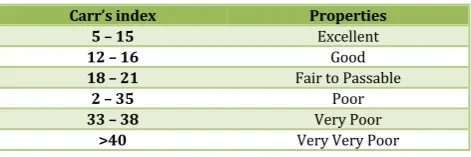
A Carr index greater than 25 is considered to be an indication of poor flowability, and below 15, of good flowability.
Table No. 2: Carr’s index value (as per USP)
Carr’s index Properties
5 – 15 Excellent
12 – 16 Good
18 – 21 Fair to Passable
2 – 35 Poor
33 – 38 Very Poor
>40 Very Very Poor
Hausner’s ratio:
The Hausner ratio is a number that is correlated to the flowability of a powder or granular material. The Hausner ratio is calculated by the formula
Where, ρb is the bulk density; ρb is the tapped bulk density
Hausner ratio greater than 1.25 is considered to be an indication of poor flowability.
Preparation of co processed super disintegrates:
Co processed super disintegrates were prepared by using sodium Vivasole and polyplasdone XL. The super disintegrates were mixed in different concentrations and labeled as CP1,CP2,CP3.The blend of super disintegrates was mixed thoroughly for a period of 15 min, collected and used for preparing formulations in different concentrations.
Table No. 3: Composition of co processed super disintegrates
Ingredients CP1 CP2 CP3
CCS 500 500 500
CP 500 1000 1500
CP = Coprocessed super disintegrate
Preparation of tablets:
Composition of Bendroflumethiazide Dispersible Tablet by direct compression is shown in table 6.4. All the ingredients were weighed. Required quantity of drug and excipient mixed thoroughly in a polybag. The blend is compressed using rotary tablet machine-10 station with 6mm flat punch, B tooling. Each tablet contains 10 mg Bendroflumethiazide and other pharmaceutical ingredients.
Table No. 4: Composition of various tablet formulations
Ingredients F1 F2 F3 F4 F5 F6 F7 F8 F9
Bendroflumethiazide (mg) 5 5 5 5 5 5 5 5 5
CP 1(mg) 10 20 30 - - -
-CP 2(mg) - - - 10 20 30 - -
-CP 3(mg) - - - 10 20 30
Mg St(mg) 3 3 3 3 3 3 3 3 3
Talc(mg) 3 3 3 3 3 3 3 3 3
MCC(mg) Qs Qs Qs Qs Qs Qs Qs Qs Qs
Total wt(mg) 100 100 100 100 100 100 100 100 100
Post Compression Parameters:
Evaluation of uncoated tablets:
Shape and colour:The tablets were examined under a lens for the shape of the tablet and colour by keeping the tablets in light.
Uniformity of thickness: Randomly 10 tablets were taken from formulation batch and their thickness (mm) was measured using a Vernier callipers.
Hardness test: The hardness of the tablets was determined using Monsanto hardness tester. It is expressed in Kg/cm2. Six tablets were randomly picked from each formulation.
Friability test: It is the phenomenon whereby tablet surfaces are damaged and/or show evidence of lamination or breakage when subjected to mechanical shock or attrition. The friability of tablets was determined by using Roche friabilator (Lab India, FT 1020). It is expressed in percentage (%). Ten tablets were initially weighed [W(initial)] and transferred into friabilator. The friabilator was operated at 25 rpm for 4 min or run up to 100 revolutions. The tablets were weighed again [W (final)]. The percentage friability was then calculated by,
𝐹
=
[
𝑊
(
𝑖𝑛𝑖𝑡𝑖𝑎𝑙
𝑊
(
𝑖𝑛𝑖𝑡𝑖𝑎𝑙
)
-
𝑊
(
)
𝑓𝑖𝑛𝑎𝑙
)
]
×
100
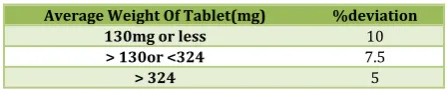
Weight variation test:The tablets were selected randomly from each formulation and weighed individually to check for weight variation. The U.S Pharmacopoeia allows a little variation in the weight of a tablet. The % deviation in weight variation is shown in table.
Table No. 5: Limits of Weight variation
Average Weight Of Tablet(mg) %deviation
130mg or less 10
> 130or <324 7.5
> 324 5
Drug Content estimation:
The content uniformity test is used to ensure that every tablet contains the amount of drug substance intended with little variation among tablets within a batch.
10 tablets were weighed and triturated. The tablet triturate equivalent to 50 mg of the drug was weighed accurately, dissolved in pH 1.2 buffer and diluted to 100 ml with the same. Further dilutions were done suitably to get a concentration of 10 μg/
ml with simulated gastric fluid pH 1.2. Absorbance was read at 290
nm against the reagent blank, and the concentrations of drug in μg/
ml was determined by using the regression equation.
Drug content in mg / tablet = conc. μg/ml * dilution factor /1000
% Drug content = drug content in mg * 100 / label claim
In -vitro dissolution studies:
In-vitro release studies were carried out using a modified USP XXIII dissolution test apparatus (Lab India, DS-800).
The dissolution fluid was 500ml of 0.1N HCL at a speed of 50rpm at a temperature of 370c were used in each test. Samples of dissolution medium (5ml) were withdrawn for every 2min and assayed for Bendroflumethiazide by measuring absorbance at 290 nm. For all the tests 5ml of the test medium were collected at specified time intervals and replaced with same volume of 0.1N HCL. Details:
Apparatus used : USP II Lab India DS 800 Dissolution Medium : 0.1N HCL
Dissolution Medium volume : 500ml Temperature : 370C Speed of paddle : 50rpm
Sampling Intervals : 2, 4, 6, 8, 10, 15, 20,25 and 30 min Sample withdrawn : 5ml
Absorbance measured : 290 nm.
RESULTS AND DISCUSSION
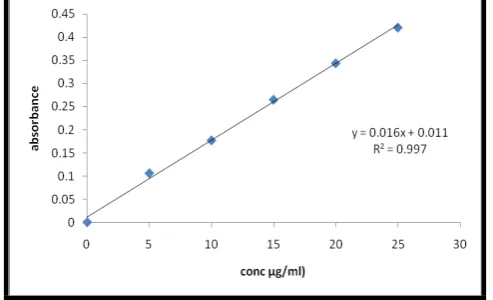
Standard Calibration curve of Bendroflumethiazide:
Table No. 6: Concentration and absorbance obtained for calibration curve of Bendroflumethiazide in 6.8 pH phosphate
buffer
S. No. Concentration (µg/ml) Absorbance* (at 278 nm)
1 0 0
2 5 0.106
3 10 0.177
4 15 0.265
5 20 0.344
6 25 0.431
Fig. 1: Standard graph of Bendroflumethiazide 6.8 pH phosphate buffer
Evaluation Parameters for Fast Dissolving Tablets of Bendroflumethiazide:
Pre-compression parameters:
The data’s were shown in Table 7.2.The values for angle of repose were found in the range of 25°-30°. Bulk densities and tapped densities of various formulations were found to be in the range of 0.41
to 0.50 (gm/cc) and 0.50 to 0.58 (gm/cc) respectively. Carr’s index of the prepared blends was fall in the range of 13.06% to 18.18%. The Hausner ration was fall in range of 1.14 to 1.22. From the result it was concluded that the powder blends had good flow properties and these can be used for tablet manufacture.
Table No. 7: Pre-compression parameters
Formulations Bulk Density (gm/cm2) Tap Density (gm/cm2) Carr’s Index (%) Hausner ratio Angle of Repose (Ɵ)
F1 0.45 0.55 18.18 1.22 27.91
F2 0.47 0.55 14.54 1.17 28.23
F3 0.50 0.58 13.79 1.16 29.34
F4 0.46 0.55 16.36 1.19 26.71
F5 0.50 0.58 13.79 1.16 29.34
F6 0.47 0.55 14.54 1.17 28.23
F7 0.50 0.58 13.79 1.16 29.34
F8 0.41 0.50 18.34 1.21 26.78
F9 0.41 0.50 18.02 1.21 26.78
Post compression Parameters:
Weight variation test:
Tablets of each batch were subjected to weight variation test, difference in weight and percent deviation was calculated for each tablet and was shown in the Table 7.3. The average weight of the tablet is approximately in range of 307 to 298.5, so the permissible limit is ±5% (>250mg). The results of the test showed that, the tablet weights were within the pharmacopoeia limit.
Hardness test:
Hardness of the three tablets of each batch was checked by using Monsanto hardness tester and the data’s were shown in Table 7.3. The results showed that the hardness of the tablets is in range of 2.0 to 2.5 kg/cm2,which was within IP limits.
Thickness:
Thickness of three tablets of each batch was checked by using Vernier Caliper and data shown in Table-7.3 .The result showed that thickness of the tablet is raging from 4.56 to 5.34.
Friability:
Tablets of each batch were evaluated for percentage friability and the data’s were shown in the Table 7.3. The average friability of all the formulations lies in the range of 0.30 to 0.51% which was less than 1% as per official requirement of IP indicating a good mechanical resistance of tablets.
In vitro disintegration time:
Tablets of each batch were evaluated for in vitro disintegration timeand the data’s were shown in the Table 7.3. The results showed that the disintegration time of prepared tablets were in the range of 17 to 25.33 seconds.
Assay:
Assay studies were performed for the prepared formulations. From the assay studies it was concluded that all the formulations were showing the % drug content values within 97.23 -100.26 %.
Table No. 8: Post-Compression parameters
Formulation code Weight
variation (mg) Hardness (kg/cm
2) Thickness (mm) Disintegration Time (sec) Friability (%) Assay (%)
F1 105.9 2.5 4.59 20.33 0.43 97.23
F2 104.4 2.3 4.64 23.66 0.34 98.55
F3 110.7 2.5 4.59 25.33 0.49 98.16
F4 109.2 2.4 4.58 19.00 0.47 99.34
F5 99.4 2.3 4.59 20.33 0.49 98.16
F6 102.4 2.6 4.64 22.66 0.34 98.55
F7 101.3 2.5 4.59 20.33 0.49 98.16
F8 107.3 2.3 4.56 17.00 0.34 99.25
Invitro Dissolution studies:
Table No. 9: Invitro dissolution data
Time (Min) F1 F2 F3 F4 F5 F6 F7 F8 F9
2 15.46 10.83 49.72 24.37 13.45 18.46 28.45 39.5 12.51
4 26.63 26.72 60.16 31.68 25.67 33.26 35.28 46.35 26.38
6 35.64 36.16 68.15 49.37 31.73 45.32 48.9 56.28 35.17
8 40.38 47.46 72.56 58.35 34.56 56.93 66.83 69.71 47.37
10 46.44 58.57 78.41 74.37 41.91 62.44 72.54 76.26 54.96
15 53.64 68.25 83.27 81.34 62.48 68.97 78.17 80.14 62.56
20 69.82 73.19 87.45 88.18 76.89 84.47 82.45 85.26 78.35
25 75.67 86.87 91.35 94.65 81.19 89.54 87.16 89.54 82.34
30 80.56 90.16 94.26 98.16 89.5 93.16 92.18 95.28 89.26
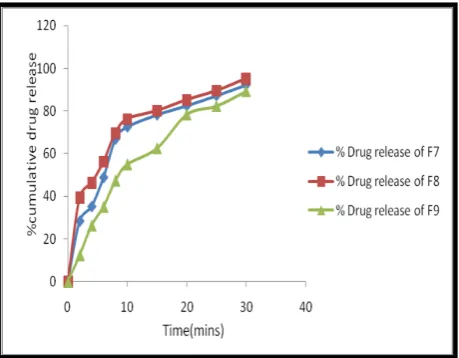
Invitro dissolution studies were carried out by using 500ml of 6.8 pH phosphate buffer in USP dissolution apparatus by using paddle method. The dissolution studies were carried out for about 30
min. The dissolution data for all the formulations were given in the Table. 9.
Fig. 2: Dissolution profile of formulations prepared with CP1 Fig. 3: Dissolution profile of formulations prepared with CP2 as super disintegrate as super disintegrate
Fig. 4: Dissolution profile of formulations prepared with CP3 as super disintegrate
From the tabular column it was evident that the formulation F4 prepared with super disintegrate CP2 shown better drug release that is 98.16% in 30 mins.
CONCLUSION
I
n the present work, an attempt has been made to develop fast disintegrating tablets of Bendroflumethiazide. Novel method of co processed super disintegrates technology was employed to formulate the tablets. All the formulations were prepared by direct compression method. The blend of all the formulations showed good flow properties such as angle of repose, bulk density, tapped density.The prepared tablets were shown good post compression parameters and they passed all the quality control evaluation parameters as per I.P limits. Among all the formulations F4 formulation showed maximum drug release i.e., 98.16% in 30 min hence it is considered as optimized formulation. The F1 formulation contains CP2 as super disintegrate in the concentration of 10 mg. (CP 2 contains CCS and CP in 1:2 ratio).
REFERENCES:
2. Kaur T, Bhawandeep G, Sandeep K, Gupta GD. Mouth dissolving tablets: a novel approach to drug delivery. Int J Curr Pharm Res 2011;3(1):1-7.
3. Shukla D, Chakraborty S, Singh S, Mishra B. Mouth Dissolving Tablets-An Overview of Formulation Technology. Scientia Pharmaceutica 2009;309-326.
4. Deshika R, Viness P, Yahya EC, Lisa CT. Rapidly disintegrating oramucosal drug delivery technologies. Pharm Dev Tech
2009;14(6):588-601.
5. Suresh B, Rajender M, Ramesh G, Rao MY. Orodispersible tablets: An overview. Asian J Pharm 2008;2(1):2-11. 6. Pfeffer M, Swedberg K, Granger C, Held P, McMurray J,
Michelson E et al. Effects of candesartan on mortality and morbidity in patients with chronic heart failure: the CHARM-Overall programme. Lancet 2003;362(9386):759–66. 7. Goodman and Gilman Manual of Pharmacology and
Therapeutics, Second Edition by Randa Hilal-Dandan, Laurence Brunton.
8. Keny RV, Desouza C, Lourenco CF. Formulation and evaluation of rizatriptan benzoate mouth disintegrating tablets. Indian J Pharm Sci 2010;72(1):79-85.
9. Parikh BN, Patel DM, Patel CN, Dave JB, Gothi GD, Patel TD. Formulation optimization and evaluation of immediate release tablet of telmisartan. J Global Pharm Tech
2010;2(2):79-84.
10. Shid SL, Hiremath SP, Borkar SN, Sawant VA, Shende VS, Tote MV, Birari RB, Changrani SR. Effect of superdisintegrants in rapidly disintegrating flurbiprofen sodium orodispersible tablets via direct compression and camphor sublimation. J Global Pharm Tech 2010;2(1):107-117.
11. Rajalakshmi G, Damodharan N, Chudhary A, Reddy DM. Formulation and evaluation of orodispersible tablets of pheniramine maleate. Chem Tech Res 2010;2(1):310-318. 12. Zade PS, Kawtikwar PS, Sakarkar DM. Formulation, evaluation
and optimization of fast dissolving tablet containing tizanidine hydrochloride. Int J Pharm Tech Res 2009 ;1(1):34-42.
How to cite this article:
CH. Suresh et al. FORMULATION AND INVITRO EVALUATION OF BENDROFLUMETHAZIDE ORAL DISPERSIBLE TABLETS. J Sci Res Pharm 2017;6(6):66-71.
Conflict of interest: The authors have declared that no conflict of interest exists.