Global Narratives of Refugee Youth: Examining the Interwoven Strands of an Interdisciplinary Arts Process Kate Collins
Towson University ABSTRACT
The following is a critical analysis of the pedagogical and creative practices developed as part of a new community-engaged interdisciplinary arts graduate course which partnered a range of educators pursuing a Master’s degree in interdisciplinary arts infusion with high school students who are refugees. This article explores the question of how the arts can be a vehicle to effectively and ethically share the global stories and narratives of refugee youth and how sharing those stories can affect change. The author first describes the unique context of the project and its participants and then lays out the framework of scholarship that informed the course and its culminating artistic products. The second half of the essay describes the three main artistic strategies that grew out of the collaborative efforts, how they told the global narratives of refugee youth offering nuance and complexity, and how that, in turn, held potential for change. The three interwoven strategies include the creation of an original performance script, a photo essay, and a series of visual art installations. The project director reflects on these efforts as a means to uncover some of the core values important for future replication of the work as well as more broadly applicable insights.
communities, education, and the arts. The commonality between every student in this course (and in our program) was the interest in and dedication to deepening knowledge and skills for arts integration with young people.
Partners: High School Students/Refugees
Ultimately, the 14 refugee youth who chose to join the program were from Syria, Eritrea, Somalia, South Sudan, and the Democratic Republic of Congo. There were six boys and eight girls who ranged in age from 14 to 18. Multiple languages were spoken within this group, but Arabic and Tigrinya (spoken in Eritrea) were the most prominent. Levels of English acquisition ranged significantly. We met one night a week for eight weeks at the high school, directly after the tutoring program offered by MARYO. Pizza dinner, service-learning credits, and transportation were provided as incentives for consistent attendance for these very long Tuesdays at school.
A Learning Laboratory Framework
This interdisciplinary arts special topics course was designed to focus on social action and conceived of as an arts learning laboratory utilizing a generative process. The scholarship that informed the process and the resulting arts products were necessarily wide-ranging, arming us with the tools and insights needed for a meaningful arts-based learning experience. The aim was to create a mutually beneficial space for learning about arts for social action where graduate students could take on a different role, not as teachers or even tutors, but as collaborators working side-by-side with our youth partners.2 The secondary aim was to create a culminating arts event that would allow the group to share our creative efforts as a form of action on our university campus and in the broader community. The art form(s) we would utilize and how our process and culminating products would take shape were wide open and meant to be responsive to our young partners.
After an examination of the literature that informed our process, this paper reflects on the three tangible outcomes of our creative work that were shared at two culminating public presentations. Each creative strand—a performance script, a series of visual art installations called
Conversation Pieces, and photo documentation of our entire process—
shared the global narratives of our young partners in different ways. 2 It is worth noting that the thoughts and feelings of the high school stu-dents about being referred to as refugees varied greatly. Some did not know what the term “refugee” meant or said they had not heard it before; others did not want to claim refugee as a group to which they belonged or a topic about which they wished to speak. Moving forward in the project, we typically referred to the high school students as our partners.
A significant student refugee population comes from the Middle East and Africa, as well as from Central and South America. As a university arts educator, I have long been invested in the intersecting practices of collaborative artmaking and dialogue as a means to build bridges between disparate groups and foster intercultural communication. Thus, I believed this setting held great potential for reciprocal learning exchanges.
This paper offers a critical analysis of pedagogical discoveries made during the unique learning laboratory framework developed for this new service-learning course and partnership. More specifically, this paper explores the three distinct but interrelated ways with which we employed a range of arts practices to share the stories and global narratives with and for our refugee student partners. Our efforts allowed us to create space for self-expression as well as provoke awareness and change.
Partnership Goals
Graduate students enrolled in this interdisciplinary arts service-learning course expressed eagerness for an intensive project-based learning opportunity that would allow them to work alongside refugee youth. The long term goal of the newly established service-learning partnership was to include high school students-both Native
English speakers and ESOL speakers-to learn to become engaged and
informed allies to one another through extended artmaking practices embracing collaboration, collective problem-solving, and dialogue. Given logistical and funding issues and the newness of our endeavor, we chose to initiate our work with just the refugee students at our partner high school so we would have sufficient time to understand their needs and circumstances. This choice meant that our initial focus would be for my graduate students, who are largely public school teachers, to become better equipped to support ESOL students and more informed allies of refugee youth.
Partners: Graduate Students/Teachers
students deserve to move beyond harrowing experiences and build a better life” (Brown & Bousalis, 2017, p. 49). The arts provide this opportunity by creating space for them to “discover, be heard, and tell about their experiences” (p. 49). Yet another critical benefit of using the arts is the possibility to develop culturally responsive pedagogical practices that bring community members into the classroom as well as students into the community (Roxas, 2011), which might increase a sense of community for refugee students and their families.
Dialogue and Listening as Art
Art historian Grant Kester (2004) coined the term dialogical aesthetic, which reflects a “shift from a concept of art based on self-expression to one based on the ethics of communicative exchange” (p. 106). Those who engage in this practice “define themselves as artists through their ability to catalyze understanding, to mediate exchange, and to sustain an ongoing process of empathetic identification and critical analysis” (p. 118). Central to that is the practice of listening, which Kester (2004) asserts, “is as active, productive and complex as speaking” (p. 114). While we did not have a pre-conceived notion of what our culminating work would be, it was inevitable that these values would be imbued in whatever we created. These values also meant that the processes we moved through each week were as much “the art” as the culminating works we eventually created.
Projects in Humanization
Beyond the aesthetic realm, literacy scholars Kinloch and San Pedro (2014) have much to offer in defining the priorities of this project and the weekly encounters between graduate and high school student partners. Both scholars regularly engage in action research with youth and write together about what they call Projects in Humanization (PiH).
We understand such projects as experiences we have with people that are directed by the desires for social, political, and educational change that can only happen if relationships are forged in light of, and because of, human differences. PiH are framed within a discourse of care (Greene, 2000; Noddings, 1993) and listening (Bakhtin, 1981, 1990; Schultz, 2009) as relationships with people are created, as conversations among those people are exchanged, and as interactions rooted in difference, conflict, vulnerabilities, and respect are forged. (p. 28)
To support their conception of PiH, Kinloch and San Pedro (2014) draw upon Bakhtinian theoretical concepts which include the notion All three will be explored in the latter part of this essay.
Refugees: Schools and Representation
The number of refugees permitted into the U.S. is currently capped at 45,000, the lowest number since 2002 (Gomez, 2018). For the newcomer children who do make it to the U.S., the school environment allows them to integrate into American life, which can be important for regaining a sense of stability in their lives (Carnock & Garcia, 2015). Research reveals, however, that “the histories of resettled refugee children are often hidden from their teachers and other school staff in the United States by factors such as language barriers, privacy concerns, cultural misunderstandings, and stereotypes” (Dryden-Peterson, 2015, p. 3). This presents some genuine challenges for teachers and schools welcoming these new students, as many refugee children experience trauma and frequently interrupted schooling (Carnock & Garcia, 2015). The information that schools receive can often be limited, and each learner has a different story.
Refugees in this nation and across the globe frequently struggle with the limitations of an over-simplified narrative which can quickly influence how they are perceived when arriving in American schools. Historically, after World War II, the stereotype transitioned from political hero to traumatized victim (Pupavac, 2006); more recently, the stereotype of Syrian refugees in particular has evolved to dangerous, threatening, and associated with terrorism (Rettberg & Gajjala, 2015). Even now, the representations of refugee advocacy organizations inspired by compassion for victims tend to leave out the masses of ordinary refugees (Pupavac, 2008). The persistence of these over-simplified and highly biased representations of refugees in mass media is compounded by the ways in which our own current government rhetoric and policies have perpetuated these problematic narratives. The problem is compounded yet again by the fact that relatively few Americans have contact with refugees, and therefore have no firsthand experience that causes them to call these false narratives into question.
Arts Education with Refugees
we would become more informed educators, allies, and arts
integration specialists. Sharing our creative efforts became a form of action that offered a more complex and nuanced image of refugees than is typically conveyed through mass media. Each strand reflects the three major aspects of what we created and shared at our two public events at the end of the semester. These strands also reflect the various strategies for conveying the stories of refugee youth and our collective group. One event where we shared our work was on our university campus. This was important for sharing our work within the university community, but also because the university was a coveted space to which most of our high school students earnestly aspired. Being connected with a university was a big motivator for the youth who joined our project. The second event was an invited opportunity at a major art museum in our community, which allowed us to share our efforts in a larger public forum.
Strand One – The Script
The first strand involves creating and sharing the text of a
performance script that I compiled in the early weeks of our project. The script revealed for the high school students what we were learning from the time we spent together. Without identifying any one individual’s words, the script folds together pieces of the high school students’ personal stories gleaned from mini-one-on-one interviews conducted by the graduate students on our second night together. The script points out places of overlap and distinction in their stories, along with elements that stood out to us as we listened. It was early in the project when we first shared this script. Initially, I composed it just for our group, with no plans for sharing it elsewhere. I hoped it could be an effective way to use art to make it clear to our young partners that we were truly listening and invested in them. I also wanted to model for them how their stories could become impactful art that could effect change—an idea that was initially challenging to convey by simply explaining in English. We figured out early that modeling and examples worked well for conveying complicated ideas, and so I crafted this script. The first night my graduate students and I read the script aloud to the high school students (see Figure 1), there was laughter at first, then some tears, and then silence. The facial expressions and body language of our young partners told us—they wanted to hear every word. that “we are continually helping others further their understandings
of themselves by answering their stories, listening, and being present in the conversation” (p. 24). Furthermore, they add that “our identities are a collection of how others see us, believe in us, and know us” (p. 24), which validates the importance of engagement with the other in efforts of coming to know ourselves. This also aligns with education scholar Greene (2000) who advocates for people engaging in collaborations; “once they are open, once they are informed, once they are engaged in speech and action from their many vantage points, they may be able to identify a better state of things—and go on to transform” (p. 59). By design, the participants on all sides of the project were exposed to multiple vantage points, which indeed became transformative for all.
Our Space as a “Third Space”
In contemplating asset pedagogies such as third space (Bhabha, 2004), it is not surprising to find that service-learning opportunities (Gannon, 2009), community art studios (Timm-Bottos & Reilly, 2014), and intercultural exchanges (Kramsch & Uryu, 2013) have been conceptualized as such. For instance, Gannon (2009) offers that “in work with young people designated as ‘at risk’ in and out of school, the metaphor of the third space evokes a hybrid, in-between, disruptive space that can operate to disturb normative and deficit perceptions and to disrupt pre-service teacher subjectivities” (p. 21). Third space, then, became an apt way to frame our own dynamic after-school engagements where normative teacher-student relations were disrupted and replaced with side-by-side collaboration. This arrangement meant that the grad students were able to look
carefully at individual members of [the] group [to] dispel stereotypes about the needs of all people from particular backgrounds, while at the same time [gaining] a more complete understanding of how group membership affects the contexts in which students live. (Nieto, 2008, p. 30)
To achieve this, listening was prioritized. The multiple languages of our students became centered and viewed as assets for our creative processes, along with their rich and complicated cultural identities and narratives.
The Three Strands of Our Creative Efforts
STUDENT B:
-FINALLY-STUDENT C: -got to meet our young partners,
STUDENT D: -refugee students at a Baltimore City high school-STUDENT E: -on a Tuesday night in mid-October.
STUDENT F: They were probably nervous and didn’t know what to expect.
STUDENT G: Us, too.
STUDENT H: BUT, we were definitely excited.
STUDENT I: We played some ice-breakers, got a little silly-STUDENT J: -learned each other’s
names-STUDENT K: -and had- ALL: -a lot of fun!
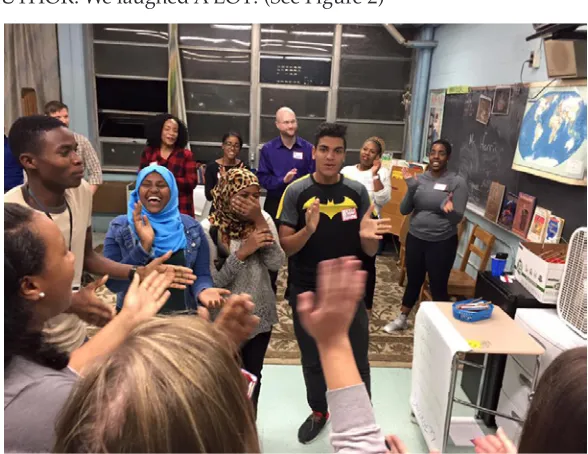
AUTHOR: We laughed A LOT! (See Figure 2)
Figure 2. Upon our request to teach us some of their languages on our first night
together, the high school students happily used songs and dance to teach us some basic Arabic, Somali, Swahili, and Tigrinya. Author photograph.
Figure 1. Graduate students and professor reading the newly crafted script to our
high school student partners for the first time. Photo by Michael Bussell, 2017.
Contextualizing the script. As one reads the script included below, note that there are no distinct characters indicated—only graduate student readers along with myself. It is intentionally written so that the high school students, who were still learning English, would find it accessible. The script is meant to be read aloud at a steady clip. Hyphens at the beginning and end of sentences indicate that a thought is continued as if a single person were speaking. Listeners are essentially hearing our collective voice. The technique is adapted from theatre artist Michael Rohd. While Rohd typically choreographs these scripted works, which he refers to as choreographic docu chorales (M. Rohd, personal communication, January 16, 2018), ours remained an un-staged reading. By performing our reading with scripts in hand, we provided the sense of transparency one might find with documentary theatre while also conveying that the understandings we shared were still unfolding; the narrative was a work in-progress. In reading the script, the word “ALL” indicates moments that all of the graduate students and myself speak in unison as if sharing the same thought at the same time. Italicized directions should be self-explanatory and indicate a sense of tone. The very last segment of the script was added once we determined that we would be performing our script at our two public events.
-finally-STUDENT H: We decided pretty quickly …we LIKE these guys. AUTHOR: So, on week two, we came back and paired up.
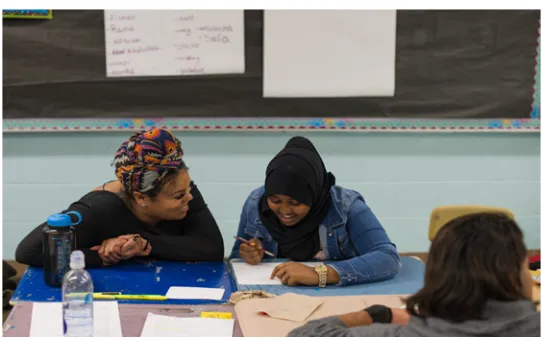
Figure 3. One-on-one interviews between teachers and high school students led to
the insights that informed our script. Photo by Michael Bussell, 2017.
STUDENT E: Just one high school student with one [graduate] student- (See Figure 3)
STUDENT F: -so we could get to know each other better-STUDENT G: -and here’s some of what we learned:
STUDENT H: My partner is from Eritrea but has never actually set foot there. She’s mostly lived in Sudan.
STUDENT I: My partner too. STUDENT J: Mine too.
STUDENT K: My partner lived most of her life in Syria, but then she was in Turkey for 3 years, and then came here.
STUDENT A: My partner has lived in Kenya, Bombasa, Kakuma, Somalia, and now here.
STUDENT C: Wow. That’s a lot of moving. A lot of starting over. AUTHOR: With all of that moving, we got curious about what they
missed-STUDENT A: On our first night, we broke up into groups-STUDENT B: -so our new partners could teach us a bit of their languages.
STUDENT G: We have students in our group who are from Somalia, South Sudan, Syria, Iraq-
STUDENT K: -Eritrea, and the Democratic Republic of Congo-STUDENT F: -and they’ve actually lived in more countries than that. STUDENT C: Most of the students speak at least three languages, with English being the newest.
STUDENT D: Arabic, Tigrinya, and English. STUDENT I: Arabic, Kurdish, and English. AUTHOR: Somali, English, and Swahili. STUDENT E: Some
French-STUDENT F: -and a bit of
Turkish-STUDENT D: and – there’s probably more. STUDENT G: Wow. I speak one language. STUDENT H & STUDENT E: Me too. STUDENT I: Me… four?
STUDENT J: Okay, hey, I do teach Spanish.
STUDENT K: And I teach German. But we were still a little in awe of our new partners.
STUDENT A: And we had a blast learning some words and phrases together.
STUDENT B: Our language lessons involved dancing and singing as a way to help us remember.
STUDENT H: My partner said the same thing. STUDENT I: Mine too. Respect was a big topic.
STUDENT J: Yes. It really bothered my partner that students here don’t respect their
teachers-STUDENT A: -and that cell phones are allowed in schools! ALL: (GROAN of classroom teacher recognition)
STUDENT K: Didn’t she also say that the school periods were longer here, but you learn less in more time?
STUDENT J: Yup. ALL: (flatly) Huh.
STUDENT B: Our conversations were certainly eye opening. (short
pause)
STUDENT C: My partner is really determined to focus on her goals and her family.
STUDENT D: My partner wants to be a doctor.
STUDENT I, STUDENT E & STUDENT B: (raise hands) Mine too! STUDENT F: (raise hand) Dentist!
STUDENT G: (raise hand) Nurse. STUDENT J: (raise hand) Air Force pilot. STUDENT H: (raise hand) Software developer. STUDENT C: (raise hand) Mechanic.
STUDENT A: (raise hand) Dad.
STUDENT C: (PAUSE. Surprise, then delight). …That’s cool. STUDENT J: I have no trouble believing they’ll do it, too.
STUDENT K: I was really interested in the things our partners talked about that the world needs to do better.
STUDENT A: No more guns-STUDENT E: -what they thought of the U.S.,
STUDENT F: -their surprises and challenges, STUDENT C: -likes and
dislikes-ALL: Soccer!!!!
STUDENT G: -and what they looked forward to as they think about the future.
STUDENT H: We also talked about things the world needs to do better.
STUDENT I: We had some pretty great conversations.
STUDENT J: My partner talked about language barriers, adapting to school, and facing discrimination.
STUDENT K: My partner talked about being robbed and beaten up here in [the city].
STUDENT A & STUDENT D: Mine too.
STUDENT B: And not feeling safe anywhere but home or school. ALL: << Pause. Deep breath.>>
STUDENT C: My partner misses his brothers and his little nephews still in Syria.
STUDENT D: Mine misses her sisters and their children, still in Sudan. STUDENT A: Mine misses sleeping under the stars. She misses how peaceful and comfortable those moments were.
AUTHOR: And a lot of our partners missed their friends- STUDENT E: -and their favorite foods.
STUDENT F: Since most of us are teachers, I was really interested to hear my partner’s impression of American schools.
STUDENT G: My partner shared that the teachers here in the U.S. are much nicer – they don’t hit you.
individuals—we all have different stories.” STUDENT I: But we’re lucky. We get to see that.
AUTHOR: And my partner said she thought art is cool because “it tells a story.”
STUDENT G: So—let’s use the art we make together to help others hear the stories of our refugee student partners.
STUDENT A: Get a glimpse into our conversations. STUDENT H: And see
STUDENT I: -Really see
them-STUDENT B: -for the funny, smart, loving- STUDENT A: -and dynamic individuals they are. STUDENT C: I like it. Let’s do it.
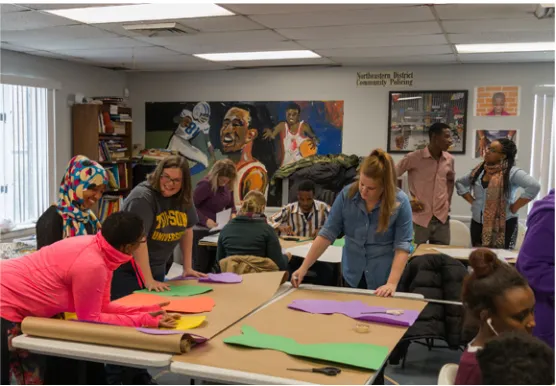
Figure 4. Students and teachers busy at work on their visual art installation during
an all-day Saturday gathering at a local community center. Photo by Michael Bussell, 2017.
STUDENT F: Since a lot of important conversations were had during our time
together-STUDENT K: -we created these works as a way of digging deeper into the ideas that resonated most. (See Figure 4)
AUTHOR: Yes. “No more killing people from different places with guns,” my partner said.
STUDENT I: You mean no more war?
AUTHOR: - (adamantly shakes head in agreement) No more war. (pause) STUDENT E: My partner offered that people don’t talk to each other enough.
STUDENT B: They spend too much time in their comfort zones, not speaking to new people.
STUDENT F: (pause) You had smart partners. STUDENT E & STUDENT B: (not surprised) I know.
STUDENT G: My partner talked about how it’s not easy being a refugee.
STUDENT H: “Coming to the U.S., people look at you differently,” she said.
AUTHOR: Even when you try to “be more American”—they look at you differently.
STUDENT C: (exasperated) Just going to the super market… it’s SO different from Syria or Lebanon.
STUDENT J: My partner put it really simply: “Refugees are new. You have to help them.”
STUDENT K: And mine said, “most people think that refugees know nothing.”
STUDENT A: Sure, sometimes language can be a barrier-STUDENT K: -but in reality, they know the same- STUDENT A: -and more.
STUDENT B: I loved getting a small peek into my partner’s life-STUDENT J: -and hearing their stories.
were titled partly as an homage to Grant Kester’s (2004) book with the same title, but more importantly, they were a way to celebrate, document, and share the important conversations that occurred each week. When it became clear that the majority of our group would be too uncomfortable with any kind of public performance, I came up with the overarching structure of these visual art installations as a way to embrace what we all found most meaningful about the time we spent together—our conversations. These pieces invited the student-teacher collaboration teams to go deeper into their prior conversations and consider what they would like others to know about them. Some wanted to share their goals and aspirations; some wanted to celebrate their partnership and talk about their commonalities as a means to say “we are not so different;” some wanted to infuse elements from their culture and use their own language(s) to share the cultural distinctions they were proud of; and others chose to talk about what the world and our city needed to do better. It was a challenging task. The group was provided with only a basic framework to follow: incorporate everyone’s silhouette and integrate text that somehow revisited their conversations. The rest of the creative decision-making was theirs to make. Each pair or group worked through the conceptual and implementation decisions together.
The Conversation Pieces allowed the students to work with their collaborator-teacher as equals in a non-hierarchical setting, devising a concept and telling their stories on their own terms. The silhouettes of teachers and students facing one another in conversation reflected our unique third space dynamic and highlighted the reciprocal relationships that became such a valued part of the experience for everyone. For the high school students in particular, the works served as an important vehicle of self-expression and agency. At the same time, for our two public events, they became dialogic works in that they served as a point of entry for communicative exchange (Kester, 2004) between people who may otherwise never interact. Our public presentations involved the artist-collaborators being present and ready to converse with viewers as they engaged with each
Conversation Piece (see Figure 6).
STUDENT J: Some of the works are still in progress, just like WE are. Still learning. Still figuring out how to say what we want to say. AUTHOR: But they’ve been a wonderful way to talk about goals, impressions of the U.S., things we miss, commonalities we discovered, things we need to do better in this
world-STUDENT H: -where we come from and where we hope to go. STUDENT G: We call them our Conversation Pieces.
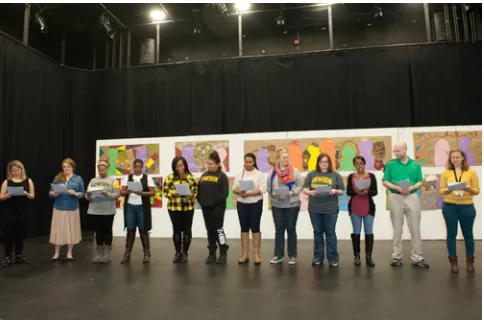
It was clear from the initial student reactions that they found the script powerful, and so while it was not the original intent, we chose to repeat our collective script reading again for our two public presentations at the conclusion of our project (see Figure 5). We realized performing this script would be a helpful way to frame our project for others who would be learning about it for the first time while providing insight on how we spent our time together. It was not until some closing conversations, however, that several of the high school students pointed to the script and our collective performance of it as something that they would remember most from this program; they felt listened to and acknowledged.
Figure 5. All of the graduate students and professor collectively performing a
read-ing of our script for our first public performance at our university. Our visual art installations were displayed directly behind us. Photo by John Bidlack, 2017.
Strand Two – Conversation Pieces
Figure 7. These two women graduate students worked closely with this young
man through our entire project. Here they applaud the thoughtful poetry he chose to incorporate into the graphic background in both English and Tigrinya. Photo by
Michael Bussell, 2017.
Strand Three – The Photo Narrative
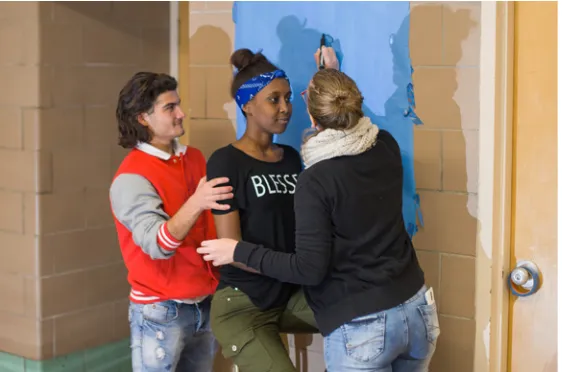
The third strand of our storytelling involves the photo documentation that has been included throughout this essay. Whereas we are
only able to share nine photos in this article, our two public events included a 90-image slide show of our weekly engagements. The time spent eating pizza, co-creating, conversing, working intently with partners, teaching one another, writing poems, finding the right words to express our thoughts, communicating through gestures, searching the Internet for translation assistance, and taking on new creative challenges together was all part of our art, our process, our collective story of high school student refugees and graduate students coming together as creative partners (see Figure 8). All of these elements and the ensuing laughter, joy, and struggles they shared informed the relationships we established. Our stories would be incomplete if we did not also share these images that in many ways reveal more about what we created together than words on a page ever could; they transcend the languages that could sometimes be a barrier for our group. Oral communications were often complicated, but the photos reveal how very much was communicated,
nonetheless. Figure 6. Students and teachers stood with their Conversation Pieces as guests at our
first event toured around and asked questions. If students struggled with English, their teacher partners were there to support them. Author photo.
Figure 9. This group of female teachers and students ended up working together
nearly every week and created their Conversation Piece together. It was not uncom-mon for students to share that “This (program) is the only time I smile.” Photo by
Michael Bussell, 2017. Thoughts on Moving Forward
In addressing the central question of this essay—how we as educators invested in arts integration can use the arts as a vehicle to learn from, translate, and share others’ global narratives or stories as a form of social action—this project helped us identify three rich possibilities as demonstrated through the script and accompanying photos. More importantly, the values that informed those choices are critically important for the work moving forward. Each story strand supported and fed into the others, creating space for individuality and complexity. This all came about through an investment in ethical engagement, educator responsiveness, and above all, deep listening, the fruits of which led to student ownership, open sharing, and strong relationships. In a space of multiple languages and vast cultural differences, trust had to be earned over time. Feelings of vulnerability, displacement, trauma and loss were often tangible. Accordingly, the graduate students’ roles as co-collaborators—their openness, adaptability, joyful presence, and collective problem solving—were critical for creating space for the important global stories of our young partners to unfold. Consequently, I now recognize the importance of being even more intentional about authentic listening as part of our preparation and as a practice that we must constantly attend to throughout the process.
The descriptions in this essay along with the photo documentation of the project have offered readers a window into the varied artistic Figure 8. A graduate student and two high school students trace silhouettes with
great focus and care for our first night working on the Conversation Piece installa-tions. Photo by Michael Bussell, 2017.
and learning spaces with confidence, knowledge, and strategies. The experience gained by these teachers will surely cause a ripple effect not only for the immigrant and refugee youth who enter their schools and classrooms, but for every learner.
References
Bakhtin, M. M. (1990). Art and answerability: Early philosophical essays by M. M. Bakhtin (V. Lipaunov, Trans.). Austin, TX: University of Texas Press.
Bhabha, H. K. (2004). The location of culture. London, England: Routledge. Brown S. L., & Bousalis, R. (2017). Empowering young minds through
communication, creative expression, and human rights in refugee art.Art Education,70,(4), 48-50.
Carnock, J. T. & Garcia, A. (2015, November 24). The critical role schools play in responding to refugees [Web log post]. Retrieved from https://www. newamerica.org/education-policy/edcentral/educating-refugees-us-schools/.
Dryden-Peterson, S. (2015). The educational experiences of refugees in countries of first
asylum (Research Report). Retrieved from Migration Policy Institute
website: https://www.migrationpolicy.org/research/educational-experiences-refugee-children-countries-first-asylum.
Gannon, S. (2010). Service-learning as a third space in pre-service teacher education. Issues in Educational Research, 20(1), 21-28.
Gomez, A. (2018, January 3). Refugee admissions to U.S. plummet in 2017. U.S.A. Today. Retrieved from https://www.usatoday.com/story/news/ world/2018/01/03/refugee-admissions-u-s-plummet-2017/999903001/
Greene, M. (2000).Releasing the imagination: Essays on education, the arts, and social
change. San Francisco, CA: Jossey-Bass Publishers.
Hale, J. E. (2001).Learning while Black: Creating educational excellence for African
American children. Baltimore, MD: Johns Hopkins University Press. Holquist, M. (Ed.). (1981). The dialogic imagination: Four essays by M. M. Bakhtin (C.
Emerson & M. Holquist, Trans.). Austin, TX: University of Texas Press. Kester, G. H. (2004). Conversation pieces: Community + communication in modern art.
Berkeley, CA: University of California Press.
Kinloch, V., & San Pedro, T. (2014). The space between listening and storying: Foundations for projects in humanization. In. D. Paris & M. T. Winn
(Eds.),Humanizing research: Decolonizing qualitative inquiry with youth and
communities (pp. 21-42). Thousand Oaks, CA: SAGE Publications. Kramsch, C. & Uryu, M. (2012). Intercultural contact, hybridity, and third space.
In J. Jackson (Ed.), The Routledge handbook of language and intercultural communication (pp. 211-226). London, England: Routledge.
Kretzmann, J. P., & McKnight, J. L. (1993). Building communities from the inside
out: A path toward finding and mobilizing a community’s assets. Evanston,
IL: Center for Urban Affairs and Policy Research, Neighborhood Innovations Network, Northwestern University.
Mentor. (2009). Mentoring immigrant and refugee youth: A toolkit for program
coordinators. Retrieved from
http://www.mentoring.org/new-site/wp-content/uploads/2015/09/Mentoring_Immigrant_and_Refugee_Youth_ Toolkit_for_Program_Coordinators.pdf.
Nieto, S. (2008). Nice is not enough: Defining caring for students of color. In M. Pollock (Ed.), Everyday antiracism: Getting real about race in school (pp. 28-32). New York, NY: The New Press.
Noddings, N. (1993).Educating for intelligent belief or unbelief. New York, NY:
Teachers College Press.
Pupavac, V. (2006). Refugees in the ‘sick role’: Stereotyping refugees and eroding refugee strategies we used throughout our weeks together—dance, music,
visual arts, poetry, and theatre. Our process was not limited to a single art form because as an interdisciplinary arts program invested in better understanding the potential of the arts to support and engage learners; our mandate and desire was to examine a wide variety of arts practices and draw upon the innovations and new research with each form. This choice allows us to build upon the range of artistic strengths already present with the teachers and students in the space. Furthermore, by identifying a variety of artistic possibilities to explore and share narratives, we are better able to effectively tap into our student partners’ still-unknown and still-developing talents and passions, as well as their many ways of knowing and sharing experiences. It served our project well to be framed as an interdisciplinary arts effort as it allowed us to draw upon a wide-reaching toolbox and body of scholarship.
Employing a generative process that did not have a specific arts project in mind from the outset also served us extremely well and allowed us to be truly responsive. By being consistent with our values and embracing a range of arts practices, we could ensure that each creative tactic complimented the next and filled in the gaps in the narratives of our partners and our own unique partnership. If language failed us, we had images. If images failed us, we had movement, music, and poetry. Embracing all of the art forms and a spirit of experimentation and responsiveness allowed for a range of varied narratives conveying depth of character for each young person and educator who became a part of this project.
rights (Research Paper No. 128). Retrieved from United Nations High Commissioner for Refugees website: http://www.unhcr.org/en-us/ research/working/44e198712/ refugees-sick-role-stereotyping-refugees-eroding-refugee-rights-vanessa.html.
Pupavac, V. (2008). Refugee advocacy, traumatic representations and political disenchantment. Government and Opposition, 43(2), 270-292.
Rettberg, J. W., & Gajjala, R. (2016). Terrorists or cowards: Negative portrayals of
male Syrian refugees in social media.Feminist Media Studies,16(1),
178-181.
Roxas, K. C. (2011). Creating communities: Working with refugee students in classrooms. Democracy & Education, 19(2), 1-8.
Schultz, K. (2009).Rethinking classroom participation: Listening to silent voices. New
York, NY: Teachers College Press.
Timm-Bottos, J., & Reilly, R. (2015). Learning in third spaces: Community art studio as storefront university classroom. American Journal of Community
Psychology, 55(1/2), 102-114.
Wang, C., & Burris, M. A. (1997). Photovoice: Concept, methodology, and use for participatory needs assessment. Health Education & Behavior, 24(3), 369-389.