OF PSYCHOLOGICAL STUDIES
HYPERION UNIVERSITY www.hyperion.ro
47
STUDY ON OCCUPATIONAL INTERESTS IN TEENAGERS
IGOR, RACU a CARMEN, BOIANGIU b
a, b „Ion Creangă” State Pedagogical University from Kishinev
Abstract
This article presents the results of an experimental research of a study on development of occupational interests at teenagers using the Self-directed Search (SDS). The interests are manifesting through closeness behaviors to certain activities, and they are identifiable by certain qualitative and quantitative indicators.The interests emphasizes the correspondence between the subject’s tendencies and a range of objects and actions, so that the subject is actively and by his own will focusing toward the named objects or actions, which are representing a major importance to him, by attracting him and giving him satisfaction. Hence, the interests gather needs, motives, tendencies, and goals, in a relatively stable manner to actively reporting to something, by certain utilitarian order criteria (Popescu-Neveanu, 1978).
Currently, the best-known and most widely used questionnaire of interest has its basis on Holland's theory. Holland believes that people show different interests for working with people or objects and preferences for working with ideas or facts (Holland, Fritzsche, Powell et.al, 2010).
Keywords: occupational interests, adolescence, teenager’s behavior, study profiles
1. THEORETICAL FRAMEWORK
48
certain interests is not preventing others to emerge, but on the contrary. There are bounds and mutual influence between different interests, generally speaking (Chircev, Salade, 1976)
Currently, the best-known and most widely used questionnaire of interest has its basis on Holland's theory. Holland believes that people show different interests for working with people or objects, and preferences for working with ideas or facts. The six types of interests are: the Realistic interests (R); the Investigative interests (I); the Artistic interests (A); the Social interests (S); the Entrepreneurial interests (E); the Conventional interests (C) (Holland, Fritzsche, Powell et. al, 2010).
2. OBJECTIVES AND HYPOTHESES
2.1. OBJECTIVES
The Scope of this research consists in studying the teenager’s occupational interests.
Some Objectives (a part of them) of the ascertaining research shown in this article are the following:
- Identifying the occupational interests for students of the three profiles under study: pedagogy, humanities and sciences;
- Determining the level of development of occupational interests, comparatively between the three profiles, as well as between the three age levels of each of the profiles.
- Studying the development of teenager’s occupational interests by gender.
2.2. HYPOTHESES
H1: There are statistically significant differences between occupational interests for students of the three profiles under study: pedagogy, humanities and sciences;
H2: There are statistically significant differences between occupational interests for students by gender.
3. METHOD
3.1. PARTICIPANTS
The research sample consisted of 257 adolescents of whom 81 were male and 176 female, aged between 14 and 18 years.
3.2. INSTRUMENTS
49
the personal and the environmental factors were interacting, this process facilitating their decision making. There are two known tools to support the application of the typological theory of Holland: The Vocational Preference Inventory – VPI (1985) and the Self-Directed Search – SDS (1994). Self-Directed Search (SDS) is a self-administered, self-scored and self-interpretable instrument for professional counseling.
3.3. PROCEDURE
Students were recruited through cluster sampling among every high school. All of the recruited students completed the questionnaires. The required time taken to complete research instruments was about 30 minutes. No time limitation was given; privacy and anonymity of participants were carefully protected. The students filled out the questionnaires during a class period. The questionnaires were handed out to the students by trained co-researchers in the presence of a teacher, or by a teacher who was instructed on how to handle clarifications asked for by subjects. Subjects’ questions, if any, were answered. The purpose of the research and its importance for improving career guidance and counseling were explained to the students, to increase their motivation and attention in filling out the questionnaire.
3.4. EXPERIMENTAL DESIGN The independent variable: gender, profiles
The dependent variable: occupational interests.
4. RESULTS
In this paper, we present the results of the ascertaining study obtained from applying the Self-Directed Search (SDS) questionnaire and the Interests Evaluation Questionnaire (IEC).
During early adolescence (age group 14-16), we found on the first position as dominant type for the pedagogical and humanist profiles, the same kind of interest: the Artistic type for the ninth grade, respectively the Social type for the tenth grade. For the second period of adolescence (age group 16-18), we found on the first position as dominant type for the pedagogical and humanist profiles, the same kind of interest: the Entrepreneurial type.
50
Figure 1. The dominant types of interests - SDS, by study profiles
For the pedagogical profile, the first position of the dominant type of interest is the Social type, with a percentage of 43% (37 students) from the number of the pedagogical profile students, followed by the Artistic type, with a percentage of 40.6% (35 students). The lowest percentage occurs in the conventional type.
For the humanities profiles, the first position of the dominant type of interests is the Entrepreneurial type, with a percentage of 34.4% (32 students) from the number of the humanities profile students, followed by the Social type with a percentage of 32.2% (30 students) and by the Artistic type with a percentage of 29% (27 students). There were observed small differences in percentage between the first three types of interests. The lowest percentage manifested in Realistic and Investigative types.
For the sciences profile, the first position of the dominant type of interests is the Entrepreneurial type, with a percentage of 38.5% (30 students) from the number of the sciences profile students. The difference between the Entrepreneurial type and the Investigative type (with a percentage of 15.4% - 12 students) which took the second place, was of 23.1%. For the other five interest types preferred by the students of this profile, we found small differences in percentage. The lowest percentage occurs in the Conventional type.
For the dominant types of interests, the pedagogical profile presents on the first position the Social type, while the humanities and sciences profiles presents on the first place the same type of occupational interests, the Entrepreneurial type.
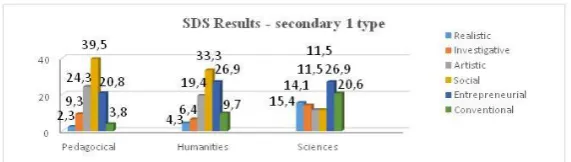
We present the results of the secondary 1 type of interest, by study profiles: For the pedagogical profile, the first position of the secondary 1 type of interest is the Social type, with a percentage of 39.5% (34 students) the dominant type being as well the Social type. The lowest percentage occurs in the Realistic type, with a percentage as low as 2.3% (2 students).
51
Figure 2. The secondary 1 type of interests – SDS results by profiles
For the sciences profile, the first position of the secondary 1 type of interest is the Entrepreneurial type, with a percentage of 26.9% (21 students), the dominant type being as well the Entrepreneurial type. The lowest percentage occurs in the Artistic and Social types, with percentages of 11.5% (9 students).
For the secondary 1 type of interests, the pedagogical and humanistic profiles are occupying on the first position the same type of occupational interest, namely the Social type, while the sciences profile presents on the first position the Entrepreneurial type.
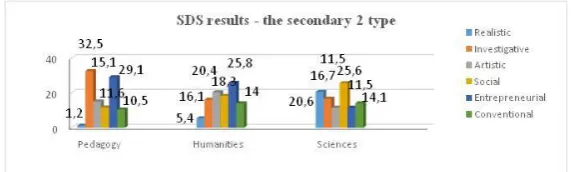
We present the results of the secondary 2 type of interest, by study profiles: For the pedagogical profile, the first position of the secondary 2 type of interest is the Investigative type, with a percentage of 32.5% (28 students) the dominant type being the Social type, and the secondary 1 type being as well the Social type. The lowest percentage occurs in the Realistic type, with a percentage as low as 1.2% (1 student).
For the humanities profile, the first position of the secondary 2 type of interest is the Entrepreneurial type, with a percentage of 25.8% (24 students), the dominant type being the Entrepreneurial type, and the secondary 1 type being the Social type. The lowest percentage occurs in the Realistic type, with a percentage as low as 5.4% (5 students).
For the secondary 2 type of interests, the pedagogical and humanistic profiles are occupying on the first position the same type of occupational interest, namely the Social type, while the sciences profile presents on the first position the Entrepreneurial type.
For the sciences profile, the first position of the secondary 2 type of interest is the Social type, with a percentage of 25.6% (20 students), the dominant type being the Entrepreneurial type, and the secondary 1 type being as well the Entrepreneurial type. The lowest percentage occurs in the Artistic and Entrepreneurial types, with percentages of 11.5% (9 students).
52
Figure 3. The secondary 2 type of interests – SDS by study profiles
The statistical examination allowed us to ascertain that, between the three profiles, statistically significant differences were found for all of the interest types, as presented in the Table 1.
Table 1. Study profiles comparison by occupational interests
Occupational interests Kruskal-Wallis χ2 Degrees of freedom p
sdsReal 55,04 2 < 0.001
sdsInv 34,39 2 < 0.001
sdsArt 17,20 2 < 0.001
sdsSoc 26,17 2 < 0.001
sdsEnt 10,87 2 0,004
sdsConv 27,43 2 < 0.001
According to presented data, we can remark that the vocational branch (pedagogical profile) is acquiring high scores on the Social scale, while the theoretical branch (humanities and sciences) scores are higher on the entrepreneurial scale.
As a conclusion, for the students of pedagogical classes is prevailing the Social and the Artistic type; for the students of humanities classes is predominating the Social and the Entrepreneurial type; for the students of sciences profile we can speak of the domination of the Entrepreneurial type, the summative code presenting a wide variety for the children we have tested.
In order to verify the hypothesis that there are significant differences between occupational interests of teenagers by gender, we also processed the results considering this variable.
Analyzing Figure 4, we can state, for the dominant type of interests:
53
Figure 4. The dominant type of interests – SDS results by gender
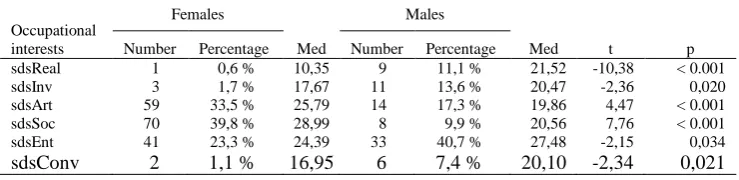
- Females preferences are manifested for the Social type with a percentage of 39.8% (70 students), followed by the Artistic type with a percentage of 33.5% (59 students), then by the Entrepreneurial type with a percentage of 23.3% (41 students). Their preferences for the other types of interest distributes to the other three types of interest - Investigative, Realistic and Conventional in small percentages.
Table 2. The significance of differences between females and males – the “t” test
We ascertain statistically significant differences between males and females for all types of interest (table 2). The girls scored high for the Social type, while the lowest score is for the realistic type. The boys have a high score on the Entrepreneurial type and the lowest score on the Conventional type.
5. CONCLUSIONS
The both hypothesis are confirmed. As a conclusion, for the students of pedagogical classes is prevailing the Social and the Artistic type; for the students of humanities classes is predominating the Social and the Entrepreneurial type; for the students of sciences profile we can speak of the domination of the Entrepreneurial type, the summative code presenting a wide variety for the children we have tested. There are statistically significant differences between males and females for all types of interest. The girls scored high for the Social type, while the lowest score is for the realistic type. The boys have the highest score on the Entrepreneurial type and the lowest score on the Conventional type.
Occupational interests
Females
Med
Males
Med t p
Number Percentage Number Percentage
sdsReal 1 0,6 % 10,35 9 11,1 % 21,52 -10,38 < 0.001
sdsInv 3 1,7 % 17,67 11 13,6 % 20,47 -2,36 0,020
sdsArt 59 33,5 % 25,79 14 17,3 % 19,86 4,47 < 0.001
sdsSoc 70 39,8 % 28,99 8 9,9 % 20,56 7,76 < 0.001
sdsEnt 41 23,3 % 24,39 33 40,7 % 27,48 -2,15 0,034
54 REFERENCES
Chircev, A., Salade, D. (1976). Orientarea școlară şi preorientare profesională – îndrumător pentru cadrele didactice. E.D.P., Bucureşti.
Holland J.L. (1976). The Self-Directed Search professional manual. Palo Alto: Consulting Psychologists Press.
Holland, J. L. (1985). Vocational Preference Inventory (VPI) Manual. Odessa: Psychological Assesment Resources.
Holland J. L. (1992). Making vocational choices: A theory of vocational personalities and work environments. Odessa: Psychological Assessment Resources.
Holland, J. L. (1997). Making Vocational Choices. 3d ed. Odessa: Psychological Assessment Resources.
Holland, J. L., Fritzsche, B. A., Powell, A. B., Pitariu, H., Iliescu, D. & Vercellino, D. (2010). Ghid profesional de utilizare a SDS (Self-Directed Search) (adaptare după Holland, J. L., Powell, A. B., & Fritzsche, B. A.). Bucureşti: OS România.