1 | P a g e
DATABASE DEVELOPMENT OF HISTORICAL
DOCUMENTS: SKEW DETECTION AND CORRECTION
S P Sachin
1, Banumathi K L
2, Vanitha R
31
UG, Student of Department of ECE, BIET, Davangere, (India)
2,3
Assistant Professor, Department of ECE, BIET, Davangere, (India)
ABSTRACT
During document scanning, skew is inevitably introduced into the incoming document image. Skew
detection is one of the first operations to be applied to the scanned documents when converting data
to a digital format. Its aim is to align an image before processing because text segmentation and
recognition methods require properly aligned next lines. The first one is based on the Hough
transform. Hough transform is performed on the scanned document image and the variance in ρ
values is calculated for each value of θ. The angle that gives the maximum variance is the skew
angle. The second approach is based on the base-point method. Here a concept of basepoint is
introduced. After the successive base-points in every text line within a suitable sub-region were
selected as samples for the straight-line fitting. The average of these baseline directions is computed,
which corresponds to the degree of skew of the whole document image. The above mentioned
algorithms have been implemented and the results have been compared for accuracy.
Keywords:
Basepoint, Hough Transform, Recognition, Segmentation, Skew
I. INTRODUCTION
Organizations are moving at a fast pace from paper to electronic documents. However, large amounts of paper
documents inherited from a recent past are still needed. Digitization of documents appears as a bridge over the
gap of past and present technologies. Scanners tend to be of widespread use for the digitization of documents.
One of the important problems in this field is that, very often documents are not always correctly placed on the
scanner either manually by operators or by the automatic feeding device. For humans, rotated images are
unpleasant for visualization and introduce extra difficulty in text reading. For machine processing, image skew
brings a number of problems that range from needing extra space for storage to making more error prone the
recognition and transcription of the image by automatic Optical Character Recognition tools
(OCR)[1][2][3][4]. These reasons make skew detection[5] and correction phases a common place in any
environment for document processing. This very frequent problem yields rotated images. Besides that, it
2 | P a g e
increases the space needed for image storage, etc. So skew detection and correction is very important step thatneeds to be corrected before segmentation.
Skew estimation and correction are the important preprocessing steps of line segmentation and word
segmentation approaches. Skew angle is the angle that the text lines in the digital image makes with the
horizontal direction. There are two types of skew in document images. They are single skew and multiple
skew[7].
Single skew: In this skew, whole document is skewed to single angle. This work deals with single skew
problem. Example for single skew is as shown in Fig 1.1.
Figure 1.1: Single Skew Figure 1.2: Multiple Skew
Multiple Skew: In this skew, scanned document can have many sections; each may be skewed to different
angle. Example for multiple skew is as shown in Fig 1.2.
Detecting the skew of a document image and correcting it are important issues in realizing a practical
document reader. A variety of algorithms have been devised to tackle these problems which are listed below.
“ManjunathAradhya V N, Hemantha Kumar G and P Shivakumara’s Algorithm”: M. Aradhya [9]
discusses the skew detection technique based on Hough Transform. It uses Thinning as preprocess step.
“Skew Detection Algorithm for Gurmukhi Script by G S Lehal and RenuDhir”: Lehal and Dhir [10]
proposed algorithm for detection of skew in documents containing Gurmukhi script. This algorithm is based on
projection profile.
“Fast Algorithm for Binary Image Rotation”: This proposed algorithm [11] for rotating binary images
originates from the property that the rotation matrix can be factorized into three skewing matrices. Such a
property had been applied to derive a fast three-pass rotation algorithm for general images (gray level or color
images). To the rotation of general images, the virtue of decomposing rotation into the three skewing is that all
operations are simplified to one-dimensional interpolations and data moves.
Skew correction can be achieved by
Estimating the skew angle
3 | P a g e
There are many approaches for skew detection and correction. This paper presents two approaches to overcomethe problem of skew. They are
Hough transform method.
Baseline method.
1.1. Document Image Processing Steps
In document analysis the first step is to acquire a digitized raster image of the document using a suitable
scanning system. Then it is followed by skew detection and skew correction [8]. Before the structure of the text
is obtained, a test is carried out to find out whether the document is skewed. Then skew corrected image is
obtained. Now the skew corrected image can be applied for further steps like segmentation. Then the resulting
image is given for recognition system.
The document image processing system is as shown in Fig 1.3. It is consisting of three blocks. They are
Database, Skew detection and Skew correction.
Figure 1.3: Document image processing steps
1.2. Motivation
As per survey, there were no solutions for accurate skew correction. There may be a chance where single
document will have multiple skewed lines. It is very hard to segment the skewed text document. These
problems which we have mentioned motivated us to take up this project. We have introduced the techniques in
order to overcome all these problems.
II. IMPLEMENTATION
The implementation of the complete project is divided into three different modules/subprojects which are then
4 | P a g e
Document acquisition
Skew detection and correction
User interface2.1 Document Acquisition
Different handwritten historical documents are collected from different places to build a huge database.
Documents over here are of two kinds mainly palm leaf manuscripts and paper manuscripts which are stored
in the memory so that it can be accessed with the help of user interface whenever needed. These documents
are given as an input for skew detection and correction process which needs to be skew corrected.
2.2 Skew Detection and Correction
We implemented Skew detection and correction using two approaches namely Hough transform method and
Baseline method.
1. Hough Transform Method: Hough transform is one of the powerful global techniques which can be
used to isolate features of a particular shape within an image. This method is used mainly for single
skewed document.
2. Baseline Method: Skew correction is done by estimating the lower baseline and determining its angle
relative to horizontal. This method is used mainly for skew detection of multi skewed document image.
2.3.User Interface
A GUI is a type of computer human interface on a computer. It solves the blank screen problem that
confronted early computer user.
Method 1: Hough Transform Method
When Hough transform method is selected, Following three steps are executed
Step1: Binarization
Step2: Skew Detection
Step3: Skew correction
Let us study in detail about each step by considering respective flow charts.
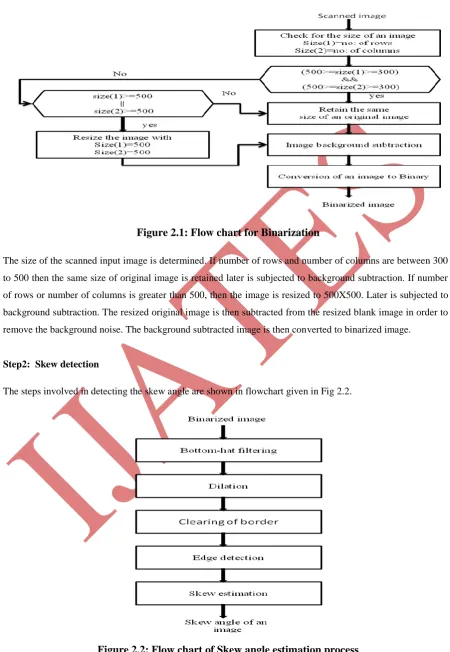
Step1: Binarization
The flow chart given in Fig 2.1 explains about resizing and Binarization of scanned input image before
5 | P a g e
Figure 2.1: Flow chart for Binarization
The size of the scanned input image is determined. If number of rows and number of columns are between 300
to 500 then the same size of original image is retained later is subjected to background subtraction. If number
of rows or number of columns is greater than 500, then the image is resized to 500X500. Later is subjected to
background subtraction. The resized original image is then subtracted from the resized blank image in order to
remove the background noise. The background subtracted image is then converted to binarized image.
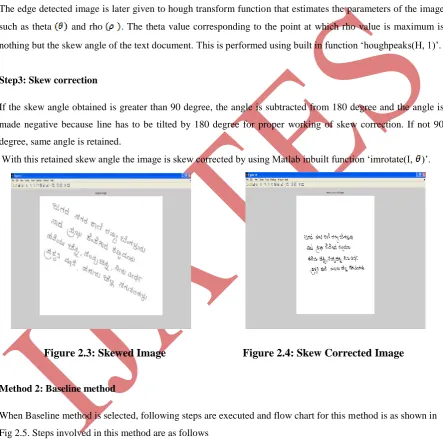
Step2: Skew detection
The steps involved in detecting the skew angle are shown in flowchart given in Fig 2.2.
6 | P a g e
The obtained binary image is filtered by using Bottom-hat filter to enhance the black spots in a whitebackground. „Imbothat‟ built in function is used. The filtered image is then subjected to dilation. Dilation is an
operation that grows or thickens object in binary image. „Imclose‟ inbuilt function is used that performs
dilation followed by erosion. The next step in the process is to clear borders. It clears the unwanted borders
surrounding the word. „Imclearborder‟ inbuilt function is used. The Border cleared image is applied as input to
the edge detection process is used to detect the extra edges. The built in function, used over here is
Syntax: edge (o,'sobel','horizontal')
The edge detected image is later given to hough transform function that estimates the parameters of the image
such as theta and rho . The theta value corresponding to the point at which rho value is maximum is
nothing but the skew angle of the text document. This is performed using built in function „houghpeaks(H, 1)‟.
Step3: Skew correction
If the skew angle obtained is greater than 90 degree, the angle is subtracted from 180 degree and the angle is
made negative because line has to be tilted by 180 degree for proper working of skew correction. If not 90
degree, same angle is retained.
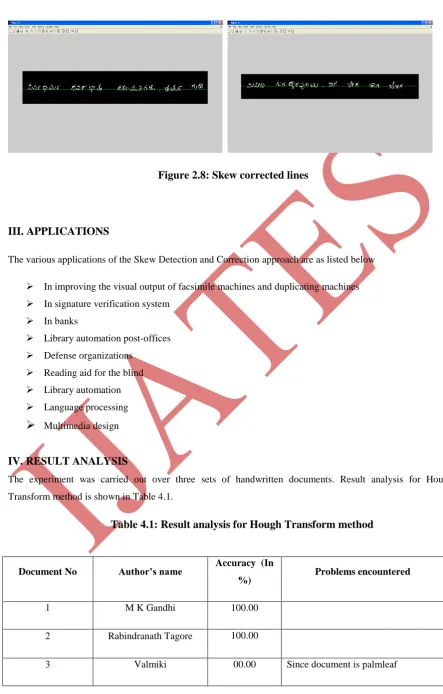
With this retained skew angle the image is skew corrected by using Matlab inbuilt function „imrotate(I, )‟.
Figure 2.3: Skewed Image Figure 2.4: Skew Corrected Image
Method 2: Baseline method
When Baseline method is selected, following steps are executed and flow chart for this method is as shown in
Fig 2.5. Steps involved in this method are as follows
Original image which is having multiple skewed lines is cropped in order to get required number of lines in the
given document. The lines within the selected area as shown in Fig 2.6 are considered for further steps. In the
cropped image only single line is considered .The tilted line 1 and line 2 are shown in Fig 2.7. Bottom pixels
are found. These pixels are considered to be the points and a line is fitted to these points by using MATLAB
inbuilt function „polyfit(x,y,1)‟. Angle at which the line has tilted is found by using parameters (slope and
7 | P a g e
Baseline is drawn for skew corrected line from the first bottom pixel till the width of the line. The skewcorrected lines are as shown in Fig 2.8.
Figure 2.5: Flow chart of Baseline method implementation
Figure 2.6: Original image
8 | P a g e
Figure 2.8: Skew corrected lines
III. APPLICATIONS
The various applications of the Skew Detection and Correction approach are as listed below
In improving the visual output of facsimile machines and duplicating machines
In signature verification system
In banks
Library automation post-offices
Defense organizations
Reading aid for the blind
Library automation
Language processing
Multimedia designIV. RESULT ANALYSIS
The experiment was carried out over three sets of handwritten documents. Result analysis for Hough
Transform method is shown in Table 4.1.
Table 4.1: Result analysis for Hough Transform method
Document No Author’s name Accuracy (In
%) Problems encountered
1 M K Gandhi 100.00
2 Rabindranath Tagore 100.00
9 | P a g e
Upon conducting experiment on the documents mentioned in Table 4.1, we got 100 percent result fordocuments 1 and 2. But zero percent of it for document 3 (Valmiki). Because document 3 is palm leaf and it
has high background noise with itself and ornamentation.
For Baseline method we have considered our own handwritten documents as we did not find any poet‟s
document having multiple skew. Palm leaf manuscripts are also been considered. This method works for both
single skew and multiple skew.
Table 4.2: Result analysis for Baseline method
Document No Number of lines in
the document
Number of lines
corrected
Accuracy (In
%)
Problems
encountered
1 4 2 50.00 Insufficient
spacing between
the successive
lines
2 6 6 100.00
3 8 6 75.00
Table 4.2 shows the result analysis for Baseline method. Document 1(Valmiki) is a palm leaf manuscript. It had
four lines among which only two lines got skew corrected. So we got 50 percent accuracy. For the document 2,
all the lines got skew corrected. So we got 100 percentage of accuracy. Document 3 has 8 lines among which 6
lines got skew corrected with 75 percentage of result.
V. CONCLUSION
For efficient Text-line Segmentation of Historical documents, the preprocessing steps are necessary such as
Skew detection and Correction. Since different authors may write with different skew (either Single skew or
Multi skew). In order to overcome this we have implemented two approaches, namely Hough transform and
Baseline method. Hough transform method can be applied only for single skewed document and Baseline
method can be applied for both single skewed and multi skewed documents.
5.1. Scope for Future Enhancement
Converting handwritten document into printed format.
Improving the complexity of baseline method.
10 | P a g e
REFERENCES
[1] B. B. Chaudhuri and U. Pal, “A complete printed BanglaOCR system”, Pattern Recognition, vol.31,
pp.531-549.
[2] R. Plamondon and S. Srihari. Online and offline handwriting recognition: A comprehensive survey. IEEE
Trans. Pattern Anal. Machine Intell., 22(1):63–84, 2000.
[3] SEETHALAKSHMI R "Optical Character Recognition for printed Tamil text using Unicode", Thanjavur,
TamilNadu.
[4] R SANJEEV KUNTE and R D SUDHAKER SAMUEL"A simple and efficient optical character recognition
systemfor basic symbols in printed Kannada text".
[5] Amin A, Fischer S. “Fast algorithm for skew detection”. IS&T/SPIE Conference on Real-Time Imaging,
USA, 1996; 65–76 [6]
[6] L. Likforman-Sulem, A. Hanimyan, and C. Faure, ''A Hough Based Algorithm for Extracting Text Lines in
Handwritten Documents'', Proc. 3rd Int‟l Conf. on Document Analysis and Recognition (ICDAR‟95), 1995,
pp. 774-777.
[7] U. Pal, M. Mitra, and B. B. Chaudhuri, “Multi-skew detection of Indian script documents”, in Proc. 6th
Int.Conf. Document Analysis Recognition, pp. 292-296.
[8] ManjunathAradhya V N, Hemantha Kumar G, and Shivakumara P, “Skew Detection Technique for Binary
Document Images based on Hough Transform”, International Journal of Information Technology Volume 3.
[9] Ahmed Maher and Ward Rabab, “A Rotation Invariant rule-Based Thinning Algorithm for Character
Recognition”, IEEE Transaction on pattern analysis and machine Intelligence, Vol 24, No 12, December
2002.
[10] Lehal G S and Dhir R, “A Range Free Skew Detection Technique for Digitized Gurmukhi Script
Documents”, Fifth International Conference on Document Analysis and Recognition, 1999. ICDAR '99.
[11] A. Amin, S. Fischer, T. Parkinson, and R. Shiu. Fast algorithm for skew detection. IS&T/SPIE Symposium