270 | P a g e
1,2,3Diploma Students, Asia Pacific University, Kuala Lumpur, Malaysia
ABSTRACT
Mobile computing technology has undergone a thriving evolution in the past few years. Following this
evolution, the usefulness of computers has been greatly enhanced, unlocking more possibilities and bringing
more benefits to the mankind. It also leads to many notable innovations in the technology scene. One of the most
notable one is the Google Glass, the chosen research subject of this study. Google Glass is a type of Wearable
Computer developed by Alphabet Inc. This research strives to provide a better understanding on mobile
computer. The study also provides in-depth analysis specifically on Google Glass, covering its CPU and I/O
specification, features, general and memory architecture, instruction set, registers, and also implementation
issues. The similarities and differences between the architecture of Google Glass and general (Von Neumann)
computer architecture are being covered in this study as well. Last but not least, this study provides insights on
the future of mobile computing, pointing out several limitations of mobile computing. The data of this research
are mainly collected from various journals, books and electronic sources.
Keywords: CPU Specification, Google Glass, Mobile Computing, Memory Architecture
I INTRODUCTION OF GOOGLE GLASS
Google Glass is a type of Wearable Computer developed by X, a semi-secret R&D facility under Alphabet Inc. It was developed under Project Glass, with the mission of ubiquitous computer. Project Glass strives to create a device that allow hands-free displaying of information anywhere, anytime, with just natural language voice commands spoken by the users. Google Glass can be categorized as a type of Optical Head-Mounted Display (OHMD) shown in “Fig.1”. It uses Augmented Reality (AR) technology to overlay a level of digital information on top of the physical world, augmenting computer-generated graphics into the view of the users. Under the effort of Project Glass team, a highly interactive and sophisticated voice command system has been designed for Google Glass, allowing it to be fully operational with just the use of voice commands.
Ooi Shu He
1, Saveetha Ganesan
2, Kho Zhi Yuen
3A NEW STUDY OF GOOGLE
G
LASS
WEARABLE
COMPUTERS AND ITS
SPECIFICATION,
271 | P a g e
Figure 1: Google Glass
II CPU SPECIFICATION, FEATURES AND GENERAL ARCHITECTURE
2.1 Central Processing Unit (CPU)
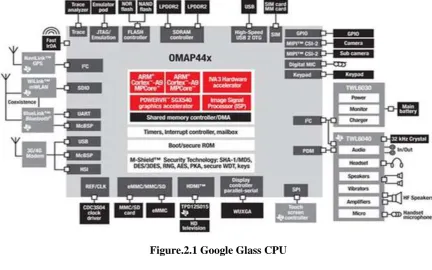
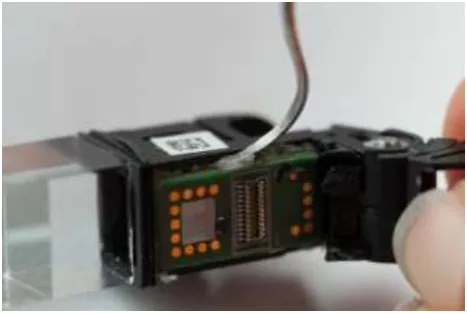
The Central Processing Unit (CPU), or processor, interprets can carries out the basic instructions that operate a computer [1]. Mobile computer has been granted its portability with the invention of system on a chip (SoC), a type of integrate circuit (IC) which integrates all essential electronic components and circuits of a system into a single chip shown in “Fig.2.1”. By putting execution resources, graphics processing, system memory, and several other subsystems in a single IC, data transfers can be achieved more efficiently without soldering a bunch of separated chips onto the motherboard [2]. This technology significantly decreases the size of system unit and power consumption.
272 | P a g e
Figure 2.2:ARM Cortex –A9
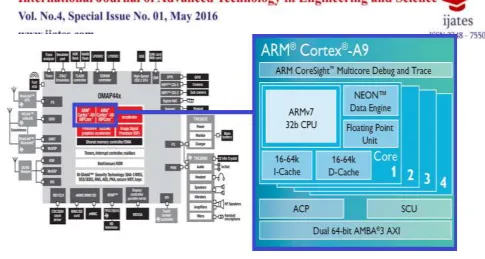
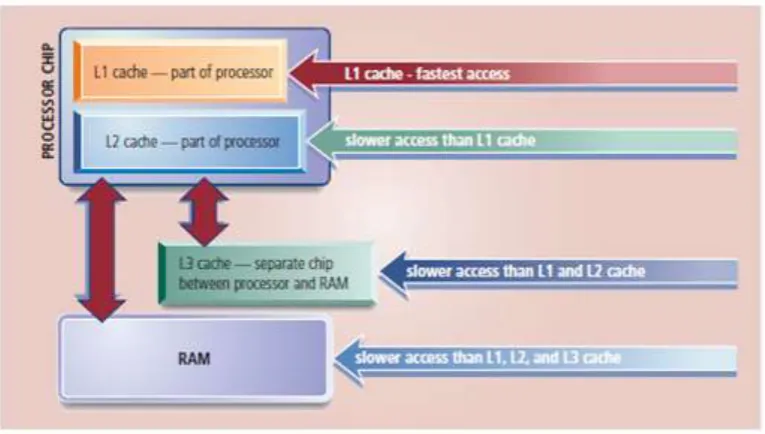
Google Glass is using an OMAP4430, a SoC manufactured by Teas Instruments. It can operates with a speed of 1.0GHz to 1.2GHz. It consists of a dual-core ARM Cortex-A9 MPCore 32-bit processor with Symmetric Multiprocessing (SMP) and a PowerVR SGX540 3D graphic core. Cortex-A9 implements the widely supportedARMv7-A architecture. Designed around the high efficiency, out-of-order (OOO), dual issue superscalar 8-stage pipeline, Cortex-A9 is able to achieve up to 2.50 DMIPS/MHz per core, delivering outstanding levels of performance and power efficiency with the functionality required for leading-edge products. The micro-architecture of the processor supports two types of L1 Cache, I-Cache and D-Cache, both providing up to 32KB of cached memory shown in “Fig.2.2. On top of that, the processor also consists a L2 Cache with up to 8MB of cached memory [3].
2.2 Features
2.2.1 Hands-free, first-person photos & videos
Google Glass’s unique design allows users to capture photo and video without using their hands. With simple voice commands and head movement, users are able to activate Google Glass and take a snapshot or record down the scenario right in front of their eyes. Users are even able to share the photos or videos with their friends in real time. With Google Glass, users are able to capture every precious moment in their life shown in “Fig.2.3”.
273 | P a g e
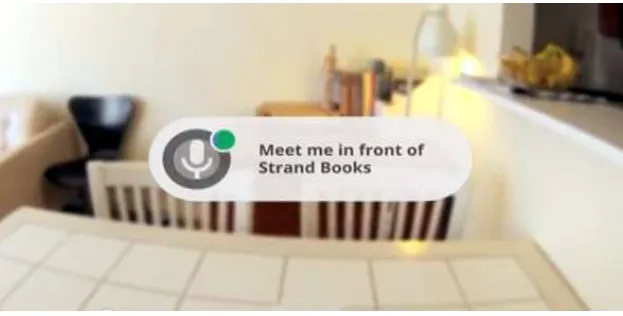
2.2.2 Speech Recognition & Voice DictationGoogle Glass can be operated with just voice commands in natural language. Users are able to use it without compromising their physical movement. All they need to say is “Okay Glass,” and follow up with any action that they wish to be taken. Glass can recognize and carry out the requested actions in almost immediate. Google Glass also has built-in translation function, users can ask Glass how to pronounce a word in certain language, and it will then provide the translation. It also allows users to input message through voice dictation, and displays the message for editing before sending it shown in “Fig.2.4”.
Figure 2.4: Voice Dictation
2.2.3 Inertial Sensing, Operates with Head Movement
Google Glass has an inertial sensor installed within. It provides a feature known as “Head Wakes Up”, delivering users an alternative to activate Glass by tilting their head up to certain angle. For instance, users are able to bring out the menu, scrolling through and select option with just eye or simple head movement. With this feature, Glass became one of the pioneers who integrates inertial sensor as an input device in mobile computers.
2.2.4 Information at Anywhere, Anytime
Google, being the most used search engine, has become a universal database for everyone today. In addition, it also provides useful features such as Google Now, Translate, News, Articles and Images, supplying the users with latest and crucial information. As a Wearable Computer designed by the same company, Glass has all these exclusive features integrated in it. Implementation of Google Now also allows users to get real-time updates based on their location. Users can instruct Google Glass to identify an object, pull up information or answer a question almost instantly.
2.2.5 Chatting Through Glass
274 | P a g e
2.3 General Architecture
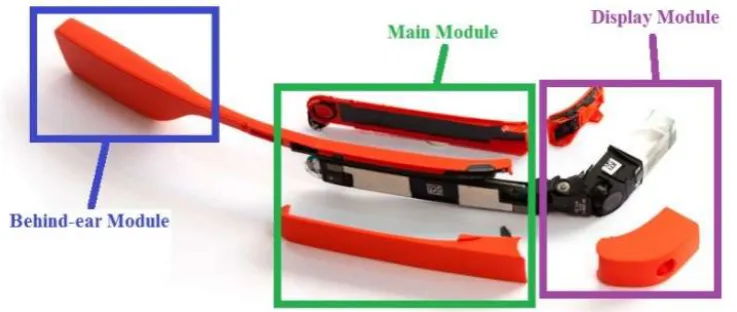
Despite of its wearable size and glass-like design, Google Glass is a compact device that made up of many electronic components. The general architecture of Google Glass can be separated into three major sections: the main module, behind-ear module and display shown in “Fig.2.5”.
Figure 2.5 Architecture
2.3.1 Main Module
The main module consists of the main logic board and side touchpad. The side touchpad is being assembled right on top of the main logic board. It is a full custom module manufactured by Synaptics, and is driven by a Synaptics T1320 touchpad controller. Coming to the main logic board, a TI OMAP4430 SoC and 1GB Eplida Mobile DDR2 RAM Chip can be found powering the device. A 16GB SanDisk NAND Flash, TI TWL6030B1 Power Management and Lattice LP1k36 – FPGA are soldered beside them. On the other side of the logic board, there are a Cambridge Silicon Radio GSD 4E SiRF GPS Transceiver, Broadcom BCM4330 WifiTranceiver and TI TWL6041B Audio Codec. There is also a Wolfson WM7231 MEMS Microphone Chip on it. Alongside with them there’s two flex PCB that attach the display module and behind-ear module to the logic board [4]. Comparing to the typical desktop system, the use of SoC greatly reduce the system unit size of Google Glass without compromising its performance, at the same time making it possible to be in wearable size. Some essential but space consuming components like GPU and audio card are integrated into one single SoC.
2.3.2 Display Module
275 | P a g e
battery and speaker has been installed in a behind-ear module. Both components are connected to the main logic board with a flex PCB. Google Glass is using a single-cell Lithium Polymer battery with the capacity of 570 mAH. It is not user replaceable. A bone conduction speaker can be found right beside the battery. This kind of speaker uses the bone of the skull to conduct sounds to the inner ear [4].
Figure 2.6 Display Module
2.3.3 Instruction Set
Instruction set architecture (ISA) is the set of processor design techniques used to implement the instruction work flow on hardware. It tells how the processor is going to process program instructions in machine language. Google Glass is using Cortex A-9 processors. These processors use the ARMv7-A architecture, a type of Reduced Instruction Set Computer (RISC). It is different from the x86 architecture, a type of Complex Instruction Set Computer (CISC) used by normal Intel and AMD processors. In CISC, a single instruction can usually execute several low-level operation or capable of multi-step operations. However, only simple instructions that can be executed within single clock cycle are being used in RISC [5].
All ARM instructions are 32 bits long and stored word-aligned. The instructions mostly contain a 4-bit condition field. One value of this field specifies that the instruction is executed unconditionally. Fourteen other values specify conditional execution of the instruction. The 14 available conditions allow:
• Tests for equality and non-equality.
• Test for <, <=, >, and >= inequalities, in both signed and unsigned arithmetic. • Each condition code flag to be tested individually.
The sixteenth value of the condition field is used for a few instructions which do not allow conditional executionThe ARMv7-A instruction set can be divided into six broad classes of instruction: branch instructions, data-processing instructions, status register transfer instructions, load and store instructions, coprocessor
instructions and exception-generating instructions. Each of them has its distinguish functions [6].
III MEMORY ARCHITECTURE & MODEL
276 | P a g e
is equipped with 16GB of flash storage and syncs with Google Drive in the cloud for added accessibility to the photos and videos the users had taken. Google Glass also comes with a micro-USB port for files transferring and device charging [7]. Google Glass doesn’t have any SIM or micro-SIM card slot due to its limited size. Users who wish to store more data have to utilise the available Google Cloud storage. On the other hand, Google Glass only allocates roughly 10MB to the heap [8].
3.1 Flash Memory
Flash memory is a type of nonvolatile memory that can be erased electronically and rewritten, similar to EEPROM. Most computers use flash memory to hold their startup instructions because it allows the computer to easily update its contents [9]. Flash memory can be further broken down into two categories, NAND flash memory and NOR flash memory. Google Glass is using a 16GB SanDisk NAND Flash. However, only 12GB of memory is available to the users. NAND flash memory is a type of non-volatile storage technology that does not require power to retain data. It can be electrically erased and reprogrammed. NAND flash memories also reduce the cost per bit and increase maximum chip capacity when comparing with magnetic storage device, such as hard disks. NAND flash memory stores information in an array of memory cells made from floating-gate transistors and connected in a way that resembles a NAND gate: several transistors are connected in series, and the bit line is pulled low only if all the word lines are pulled high.
3.2 Random Access Memory (RAM)
Random Access Memory (RAM), also called main memory, consists of memory chips that can be read from and written to by the processor and other devices. It is a type of volatile temporary storage. (Shelly, et al., 2011) RAM can be categorised into static or dynamic RAM. Google Glass is using a type of DRAM (Dynamic RAM) known as DDR2 SDRAM, specifically 1GB of Elpida Mobile DRAM Chip. However, only 682MB of RAM is available to the users.
IV IMPLEMENTATION ISSUES
Technology revolutionizes overtime with the objective of creating more alternatives to overcome existing issues and problems. Mobile computers were invented with the purpose of providing users the ease and luxury of having their computers alongside them everywhere they go. Yet, with all these new implementations in new and upcoming mobile computers, not each and every existing issue is resolved, and new issue may still emerge.
4.1 Interoperability
277 | P a g e
to allow interoperability of Google Glass and Apple’s devices, such as iPhones, Apple’s iOS would need to have custom built-in apps to allow the usage of Google Glass [10].
4.2 Connectivity
In a computer, connectivity is crucial to ensure device is able to carry out certain functions. It is exceptionally important when it comes to mobile computers. Basic definition of connectivity in computer terms is the communication to allow devices to transfer data back and forth [11]. In the case of Google Glass, connectivity refers to the network connections required. Most of the functions within Google Glass require a constant connection to the Internet. For example: GPS, Google Search, Translation and video chat. Alternatively the users are able to fulfil this requirement with the use of cellular data. However, Google Glass’s internet usage is massive. It can maximize user’s cellular data quota in a short while. This becomes a major issue when there is no available Wi-Fi connection for the users, the functions of the device will be greatly limited.
4.3 Memory
In a computer, memory is considered the storage of all data flowing within a device. To pin-point a specific part of memory is the RAM. RAM is where the operating system, application programs and data is stored so it can be retrieved at any given moment by the computer’s processor [12].Google Glass has a RAM of 1GB of which only 682MB is usable. This implementation of the RAM is assumed to be insufficient as Google Glass is required to carry out many RAM-consuming processes simultaneously shown in “Fig.2.7”.
Figure 2.7: Memory Cache
278 | P a g e
4.4 PrivacyIn general, privacy can be defined as the ability of one to seclude themselves and their personal information from becoming knowledge to the others. As the development in mobile computing technology progress, privacy has become a notable issue.With the use of Google Glass, users would be able to capture each and every scenario they saw at any given moment without compromising their physical movement. Undoubtedly this feature brings great benefits, allowing users to take images in almost any situation, whether it’s an extreme situation or emergency. Nevertheless, if these users decide to take photos of people within their surrounding without their permission, their acts will become an invasion of privacy. Moreover, Google Glass users could be in danger if any hacker manages to hack into their device and get a view of everything on-going in the users’ life,
4.5 Pipelining
Pipelining is a technique used within a processor that allows processor to fetch a second instruction before it completes the machine cycle for the first instruction. Processor that use pipelining are generally faster as they do not required to wait for one instruction to complete the machine cycle before fetching the next one. However, there are several issues with the implementation of pipelining, especially in mobile computers. One of the most notable one is the data dependency that occurs when two instructions are accessing data from the same memory location. Since Google Glass is using an advance set of technology that specifically designed for Wearable Computers, this issue might not be obvious. As an example, there won’t be any issues if the users are recording a video and taking images at the same time, even though both actions are accessing and writing graphics data into the memory. However, for a less advanced mobile computer, it could lead to a pipelining issue as both functions require instruction from the same memory location.
V FUTURE OF MOBILE COMPUTING
Mobile computing has a very promising and bright future due to the variety of technological and electronical advancements that is uprising currently. Mobile computer now days are designed and programmed with the flexibility of being able to carry out functions like a regular desktop with the luxury of effortless usage. There are many predictions and ideas on what the future of mobile computing looks like. Many suggest that the progressions of Artificial Intelligence (AI) and ubiquitous computing may take over mobile computing entirely. Some ideas for the future of mobile computing are transparent smartphones, dual-screen mobiles computers and mobile computer projections [13].
5.1 Google Glass
As mobile computing technology advances, Google Glass also progresses with their upcoming invention of Google Glass 2.0. It is planned to come with two editions: Consumer Edition and Enterprise Edition, each with different set of specifications designed for different type of users. The
adjustment of the prism size is done
279 | P a g e
overcome this issue. This device also offers users an external battery pack, along with a new Li-Polymer fast charging battery that will last twice longer. Google Glass EE also has the option of a foldable and “clip-on” design which provides the users an advantage of switching lenses based on their jobs.
VI CONCLUSION
To put it in a nutshell, the emergent of mobile computers and advancement in mobile computing technology truly benefit the mankind. Its innovation brings a great deal of revolution and enhancement to each and every aspect of human life, unlocking more potentials and alternatives that allow things to be completed more effectively and efficiently. Even though it comes with several limitations, but it was no doubt that mobile computers bring many advantages and great convenience to the people. Its emergent also generalised computers to the public, gradually increased its popularity and importance, changing it from a “luxury machine” to necessity. This breakthrough has greatly accelerate the progression of technology, eventually lead to the invention of Wearable Computer, which bring human race one step closer to the concept of ubiquitous computer. Google Glass is undoubtedly one of the greatest innovations in mobile computing technology, as it merges a powerful processing machine into small glasses. Even though not flawless, its introduction has set a new level for the future world of technology, uplifting the standard and leading to more imagination, imagination that will transform into reality one day.
VII ACKNOWLEDGEMENT
The authors acknowledge Dr Jothi Sophia, Principal, CSI JACON, Madurai, India for their constant encouragement and motivation to contribute this paper in International Conference, India
REFERENCES
[1] Shelly, G. B. et al., 2011. Discovering Computers 2011: Living in a Digital World, Boston: Course Technology, Cengage Learning.
[2] Ku, A., 2011. The Amazon Kindle Fire: Benchmarked, Tested, and Reviewed. [Online] Available at: http://www.tomshardware.com/reviews/amazon-kindle-fire-review,3076-9.html [Accessed 1 May 2016].
[3] ARM Ltd., 2016. Cortex-A9 Processor. [Online] Available at: http://www.arm.com/cortex-a9.php [Accessed 1 May 2016].
[4] Torborg, S. & Simpson, S., 2014. What's inside Google Glass?. [Online] Available at: http://www.catwig.com/google-glass-teardown/
[Accessed 16 April 2016].
[5] Firmcodes, 2016. Difference between RISC and CISC architecture. [Online] Available at: http://www.firmcodes.com/difference-risc-sics-architecture/ [Accessed 3 May 2016].
[6] ARM Ltd., 2000. ARM Architecture Reference Manual. [Online]
https://www.altera.com/content/dam/altera-www/global/en_US/pdfs/literature/third-280 | P a g e
party/archives/ddi0100e_arm_arm.pdf [Accessed 8 May 2016].
[7] Lardinois, F., 2013. Google Releases Glass Specs: Full Day Battery Life, 5MP Camera, 720p Video, 16GB Flash Memory & Bone Conduction Transducer. [Online]
Available at: http://techcrunch.com/2013/04/15/google-releases-full-glass-specs-full-day-battery-life-5mp-camera-720p-video-16gb-flash-memory-bone-conduction-transducer/
[Accessed 10 May 2016].
[8] Columbia University, 2014.Innovating on Google Glass. [Online]
Available at: http://www.cs.columbia.edu/~lierranli/coms6998-7Spring2014/gallery/GoogleGlassApp.pdf [Accessed 14 May 2016].
[9] Shelly, G. B. et al., 2011. Discovering Computers 2011: Living in a Digital World, Boston: Course Technology, Cengage Learning.
[10] Bostic, K., 2013. Google confirms iPhone compatibility for Glass, but questions remain over notifications.
[Online]
Available at: http://appleinsider.com/articles/13/02/22/google-confirms-iphone-compatibility-for-glass-but-questions-remain-over-notifications
[Accessed 16 May 2016].
[11] Your Dictionary, 2016. Connectivity. [Online] Available at: http://www.yourdictionary.com/connectivity [Accessed 1 May 2016]
[12] Rouse, M., 2016. RAM (random access memory). [Online]
Available at: http://searchstorage.techtarget.com/definition/RAM-random-access-memory [Accessed 30 April 2016].