R E S E A R C H A R T I C L E
Open Access
Integration of clinical and basic sciences in
concept maps: a mixed-method study on teacher
learning
Sylvia C Vink
1, Jan Van Tartwijk
2*, Jan Bolk
3and Nico Verloop
1Abstract
Background:The explication of relations between clinical and basic sciences can help vertical integration in medical curricula. Concept mapping might be a useful technique for this explication. Little is known about teachers’ ability regarding the articulation of integration. We examined therefore which factors affect the learning of groups of clinicians and basic scientists on different expertise levels who learn to articulate the integration of clinical and basic sciences in concept maps.
Methods:After a pilot for fine-tuning group size and instructions, seven groups of expert clinicians and basic scientists and seven groups of residents with a similar disciplinary composition constructed concept maps about a clinical problem that fit their specializations. Draft and final concepts maps were compared on elaborateness and articulated integration by means of t-tests. Participants completed a questionnaire on motivation and their evaluation of the instructions. ANOVA’s were run to compare experts’and residents’views. Data from video tapes and notes were qualitatively analyzed. Finally, the three data sources were interpreted in coherence by using Pearson’s correlations and qualitative interpretation.
Results:Residents outshone experts as regards learning to articulate integration as comparison of the draft and final versions showed. Experts were more motivated and positive about the concept mapping procedure and instructions, but this did not correlate with the extent of integration fond in the concept maps. The groups differed as to
communication: residents interacted from the start (asking each other for clarification), whereas overall experts only started interaction when they had to make joint decisions.
Conclusions:Our results suggest that articulation of integration can be learned, but this learning is not related to participants’motivation or their views on the instructions. Decision making and interaction, however, do relate to the articulation of integration and this suggests that teacher learning programs for designing integrated educational programmes should incorporate co-construction tasks. Expertise level turned out to be decisive for both the level of articulation of integration, the ability to improve the articulated integration and the cooperation pattern.
Keywords:Curriculum development, Instructional design, Educational intervention, Clinical knowledge, Analysis of content, Concept mapping, Cooperative learning, Teacher learning, Design-based research, Clinical reasoning
* Correspondence:[email protected]
2Centre for Teaching and Learning, Educational Development and Training,
Faculty of Social and Behavioural Sciences, Utrecht University, PO Box 80.140, 3508 TC Utrecht, The Netherlands
Full list of author information is available at the end of the article
Background
Medical curricula are intended to help students to relate clinical and basic science knowledge. Localizing under-lying basic science mechanisms allows teacher and students to focus on relevant relations with clinical phenomena [1]. To develop a curriculum that ad-dresses this so-called vertical integration requires the articulation of basic science mechanisms and their relations with clinical concepts, because designing an educational programme requires a clear view on what knowledge should be incorporated [2]. Teachers’ tacit knowledge is of little help to develop an instructive curriculum [1,2], and this holds true for both clinical or basic science tacit knowledge. However, clinical teachers, often experienced clinicians, are used to rely on illness scripts when analysing patient cases [3], using so-called chains of practice [1]. Their basic sci-ence knowledge pertains to the underlying mecha-nisms of understanding these patient cases, but tends to remain inactivated when they analyse patient cases that to them are not complicated [4,5]. For the devel-opment of an integrated curriculum, teachers should be able to decide which clinical and basic science con-cepts, and which relations between them, should be in-corporated in the programme in order to design assignments, choose relevant patient cases and guide student discussions. Therefore, the study presented here investigated how medical teachers can be instructed to make their integrated clinical and basic science know-ledge explicit. Concept mapping is a technique by which to explicate and share knowledge [6,7]. The resulting con-cept maps contain networks of hierarchically ordered and linked concepts. Concept mapping is recommended as a means to elicit tacit knowledge [8] and thus might help medical teachers to articulate relations between clinical and basic science knowledge [1,9].
Teachers’learning to articulate integration
The articulation of integration of clinical and basic sci-ences is not receiving much attention in teacher learning programmes in the medical domain [10]. When it comes to teachers’ability to explicate the integration of clinical and basic sciences, looking at three prevalent views on learning [11] might help to understand how teachers im-prove the articulation of integration (cf [12]): a cognitive view, emphasizing teachers’ knowledge as a source for improving teaching practice; a constructivist view, stres-sing teachers’learning process as an active interpretation process of new information based on teachers’ own knowledge and experiences; and a third view emphasiz-ing the cooperative aspects of teacher learnemphasiz-ing, that is, teachers learning with and from other teachers. For concept mapping as a means for teacher learning, these three views pertain to different aspects. The cognitive
view addresses the concept maps themselves, which re-flect the integration of clinical and basic science con-cepts that teachers are able to explicate, and hence designate the integration they are likely to apply in their teaching practice. Here, the instructions guiding the teachers in constructing the concept map should be taken into account, because they influence what teachers articulate in the concept map [13]. From a constructivist point of view, it is not the concept maps, but the process of concept mapping that is vital [7]. Examining draft and final versions of concept maps and teachers’ views on the activity of concept mapping helps us to understand how medical teachers apply the concept mapping in-structions and how they improve the articulation of inte-gration of clinical and basic sciences [7,14,15]. The third view on teacher learning also focuses on the process of learning, but highlights the importance of cooperation. Although some studies recommend involving more than one constructor in the construction of concept maps for educational purposes, in none of these studies are con-cept maps constructed jointly [14,16-18]. For the devel-opment of integrated curricula, communication between clinicians and basic scientists is deemed decisive [19], in particular because they have different views on which basic science concepts should be incorporated in a med-ical education programme [20]. Thus, cooperative learn-ing, with its strong emphasis on communication, could be helpful for the articulation of integration. Due to the information gaps in mixed groups [21], establishing the relations between clinical and basic sciences is expected to be easier than when teachers construct the maps individually. Research on the cooperation between teachers can illuminate how teachers learn [22], and so could contribute to our understanding of how medical teachers can explicate the integration of clinical and basic sciences in concept maps and of the factors that affect their ability for articulation.
The process of teacher learning
maps constructed by expert groups and residents, submitted) we found that residents were able to ar-ticulate the integration of clinical and basic sciences in concept maps to a significantly greater extent than experts. A cognitive explanation for this could be that due to their clinical experience, experts’ basic science knowledge becomes encapsulated by clinical higher order concepts, whereas the basic science knowledge of residents plays a more overt role in the under-standing of clinical problems, cf. [4,5]. Although ex-perts can still relate these encapsulated basic science concepts to clinical concepts when they are presented [23] to them, detailed relations between clinical and basic science concepts seem to be irrelevant for un-derstanding a clinical problem in educational settings. It was also suggested that group dynamics and their reflection in the communication could account for the level to which expert groups and resident groups articulate their knowledge. If this is the case, the expertise level of the constructor groups could then account for differences in the concept mapping processes, i.c. the dynamics of cooperation [22] and consequently for differ-ences between the concept maps. We therefore scruti-nized the process of concept mapping and searched for the factors that account for the articulated integration in the concept maps and affect thus the learning process of interdisciplinary groups of clinicians and basic scientists at different expertise levels. Insights into the factors that fa-cilitate or hinder the articulation of integration can be used to refine the concept mapping instructions, in order to instruct teachers effectively. So far, research has focused on the concept maps themselves, i.e., taking a cognitive point of view [14,24]. Our focus in this study was on the process of concept mapping, thereby exploring construct-ivist and cooperative learning approaches.
Methods
Participants and procedure
Seventeen groups, all composed of both clinicians and basic scientists working at the Leiden University Medical Centre, participated in the experiments, including the pilot experiments. With the invitation for participation, aims of the sessions, procedure and time investment were explained. Acceptance of the invitation was inter-preted as participants’consent. Ten groups were desig-nated as‘experts’: the participants had at least five years’ experience as clinician or basic scientist and were involved in preclinical and/or clinical education. Two groups consisted of five, one group of two, and seven groups of three experts. To examine the influence of ex-pertise level, seven resident groups with a disciplinary composition equivalent to that of the seven groups of three experts were included (see Tables 1 and 2 for an overview of the participants). Each group constructed a
concept map about a clinical problem that fitted the disciplinary composition of the group, e.g., a surgeon, a pathologist and a general practitioner constructed a concept map about blood in faeces, and a lung special-ist, a specialist in infectious diseases and an immunolo-gist constructed a map about coughing. In order to minimize the influence of content bias on the findings, concept maps of eight different clinical problems were constructed.
Table 1 Composition of groups of the pilot
Concept map Discipline of each participant
Cough GP
oto-rhino-laryngology (focus anatomy)
Hypertensia physiology cardiac diseases
physiology
internal diseases
internal diseases
nephrology
Proteinuria nephrology
nephrology
pathology
physiology
internal diseases
Table 2 Composition of both expert and resident groups
Blood in faeces GP
pathology
surgery
Chronic abdominal pain radiology/anatomy
gynaecology
internal diseases
Cough infectious diseases
immunology
lung diseases
Diarrhoea anatomy
gastro-internal diseases
infectious diseases
Diarrhoea gastro-internal diseases
microbiology
surgery
Painful joints immunology
rheumatology
surgery
Proteinuria gynaecology
Pathology
Nephrology
The aim of the concept mapping sessions was to struct a concept map which included all relevant con-cepts and relations needed for clerks to understand the clinical problem at hand. Because the focus of the study was the articulation of integration, the groups were asked to explicate all information relevant for clerks, without bothering about the actual use of the concept map in medical education, either for curriculum plan-ning or as a help for students. The concept maps were constructed in at least two sessions, as recommended by Novak [25]. We considered the draft made during the first session to be an intermediate state in the ability to articulate integration, which was further developed during the second session [1]. In the first session, the groups were guided step by step through concept map-ping instructions that included directives intended to en-courage them to articulate the integration of clinical and basic sciences. First they were instructed to contribute and discuss concepts that were particularly relevant from the perspective of participants’own disciplines. To keep an overview of these concepts, the groups could organize them in any way they wanted. The second in-struction focussed on organization: the groups explored both clinical concepts and basic science concepts as higher order concepts by which to organize basic science and clinical concepts, respectively. Subsequently, the groups were encouraged to explore any other relations between clinical and basic science concepts and to link them. As a final step, the participants had to explain two complex patient cases in order to check whether the concept map was comprehensive enough. The draft ver-sions were constructed with the aid of post-it notes and large sheets of paper. We expected this“physical”way of constructing to enhance communication, particularly in groups in which participants met each other for the first time. This would thus contribute to the learning process [21]. After the first session, the first author digitized the draft concept maps by means ofInspiration@, a software tool for concept mapping. Approximately a month later, in a second group session, participants were asked to check whether any mistakes had been made during digitization, and to review and refine the ordering and relations between the concepts in order to improve the articulation of the knowledge relevant for clerks. A re-searcher was present to explain this aim and to remind the groups to use the hand-out with the instructions but they were not guided through the instructions, as they were in the first session. Scheduling of the second ses-sion depended on the diaries of the group members. The Institutional Board of Leiden University Medical Centre, where the concept maps were constructed, provided eth-ical approval for the study.
Before the actual experiment started, we conducted pilots with groups of five and two participants to find
the optimal group size and instructions. In cooperative learning, group size has been associated with different interaction patterns [26]. We assumed that larger groups, with consequently more disciplines, would mean a greater challenge to bridge the gaps between the disciplines [27], whereas small groups implied a less challenging task to articulate integration. This might be reflected in the com-munication patterns [22,27]. When group size and in-structions had been optimized, leading to a construction process that the participants experienced as feasible, we were able to investigate the context variable ‘expertise level’[28]. The optimal group size turned out to be three.
Data collection and analysis
Three data sources were used: the draft and final versions of the concept maps (to track improvement of articulation during the concept mapping process), a questionnaire (to examine the perceived usefulness of the instructions) and video tapes of the sessions combined with field notes (to analyse cooperation). After each first session of the pilot groups and the expert groups, we discussed the instruc-tions with each group to check feasibility and clarity, so that we could adapt them to practical needs. After the pilot, there were no major adaptations of the instructions.
Concept maps
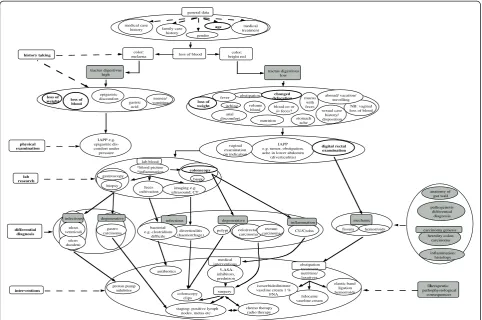
We measured both the elaborateness of the draft and final versions of the concept maps in terms of number of clinical and basic science concepts, and features that measured the articulated integration of clinical and basic sciences (see Figure 1 for examples). These features had been developed in a previous study to describe differ-ences in articulated integration. The interrater reliability in that study turned out to be sufficient (a mean Cohen’s kappa of .95 (Vink SC, Van Tartwijk J, Bolk JH, Verloop N, Gosselink MJ: Consistent variations between concept maps constructed by expert groups and residents, sub-mitted) to justify having one researcher coding the draft versions in the present study. The concept maps of the pilot were left aside, because the instructions were modified after the pilot sessions. The differences in articulated integration between the first and the sec-ond session were measured by performing a t-test for two related samples on the analysis of the draft and final versions.
Questionnaire
of the questions on motivation. In the version filled in by the residents an additional four items were used to question the different ways of ordering the concepts map in detail, because the residents were discussing the different ways of ordering to a much greater extent than the experts did. In order to examine the impact of the sessions on motivation,t-tests were run on the questions concerning motivation. Because the integration as artic-ulated in the expert concept maps differed significantly from that in the resident concept maps, ANOVAs were used to investigate whether these groups also differed regarding the perceived usefulness of the instructions. Additional Pearson’s correlations were performed to examine whether the means of participants’motivation, their views on procedure and instructions and their satisfaction with the concept map were related to the articulation of integration measured by the number of links.
Video tapes and field notes
We gathered data by means of video tapes and field notes of the pilot sessions, and the first sessions of
eleven three-participant groups to examine cooperation within the groups. A first rough qualitative analysis was conducted by means of a checklist matrix structured along the concept mapping instructions [29]. Per in-struction and per participant, notes were made of ques-tions, answers to quesques-tions, subjects of discussion, positive and negative remarks and motivations that par-ticipants gave for their contributions, in order to map out the communication in the group. Moreover, per in-struction we wrote observations that pertained to the whole group, such as how much effort it took to apply the instruction and make decisions, and added quotes to illuminate the notes. One tape was analysed by two re-searchers in order to cross-check the interpretation and to fine-tune the checklist matrix. We felt one researcher was sufficient for video analysis, because this was trian-gulated by data from the questionnaires and the draft and final concept maps. A summary of the notes per in-struction was briefly discussed with the groups of partic-ipants during the second session, to check whether they recognized the findings. We grounded categories in the data in different rounds of analysis, thus clustering the
fissura hemorroids colo(rectal) carcinoma polypi CU/Crohn gastro carcinoma ulcus duodeni ulcus ventriculi biopt biopsy medical case
history family case history gender age medical treatment general data tractus digestivus
high tractus digestivuslow
loss of weight loss of
blood epigastric discomfort gastric acid nausea/
vomiting loss of
weight volume blood obstipation mucus with feces fever itching nutrition sexual case history/ disposition NB: vaginal loss of blood loss of blood
physical examination IAPP e.g. epigastric dis-comfort under pressure IAPP e.g. tumor, obstipation, ache in lower abdomen (diverticulitis) digital rectal examination vaginal examination on indication *blood picture *inflammation gastroscopy colonscopy feces cultivation imaging e.g. ultrasound, CT
infectious degenerative degenerative
inflammation rectum carcinoma mechanic interventions proton pump inhibitor surgery
staging: positive lymph nodes, metas etc.
chemo therapy radio therapy 5-ASA-inhibitors, prednison colonscopy clips antibiotics nutrition/ laxatives lidocaine vaseline cream elastic band ligation hemorroids anatomy of gut wall heredity colon carcinoma color: melaena color: bright red differential diagnosis history taking lab research isosorbidedinitrate vaseline cream 1 %
FNA
carcinoma genesis pathogenesis differential
diagnosis blood on or
in feces?
inflammation: histology
changed
defecation abroad/ vacation/ travelling
therapeutic pathophysiological
consequences anal
discomfort stomach ache diverticulitis (haemorrhage) infectious medical interventions lab blood obstipation treatment bacterial e.g..clostridium difficile
Figure 1Resident concept map about blood in faeces, constructed by a GP, a surgeon and a pathologist.Clinical concepts are white,
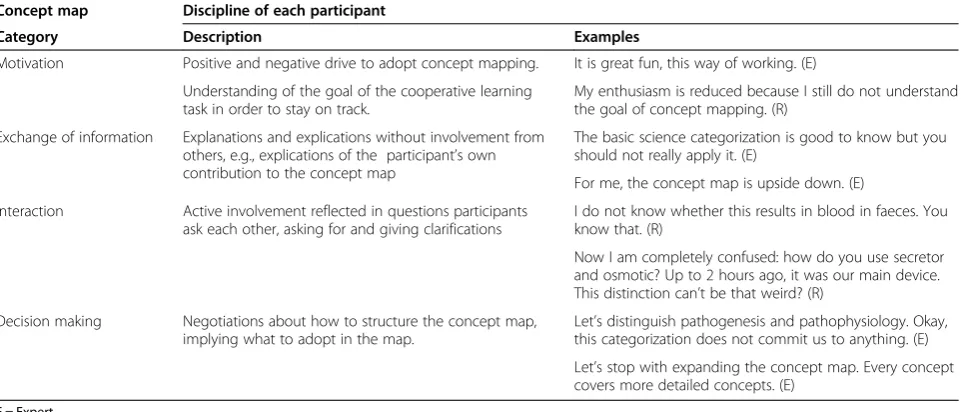
categories that could describe the video tapes in a qualitative way. Eventually, the data were clustered into 1. motivation, 2. exchange of information, 3. inter-action and 4. the decision-making process. These cat-egories combined some of the communication patterns as described by Weinberger & Fischer [22] and some conditions for effective cooperative learning [21], which we interpreted as a validation of the categories for analysis. In Table 3 the categories are presented in detail.
Results
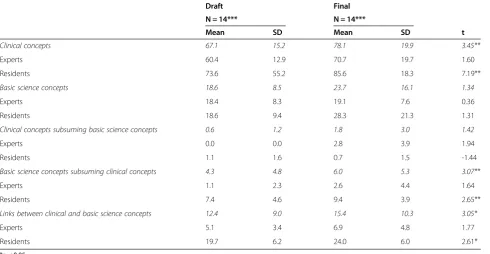
Learning expressed by draft and final concept maps Table 4 presents the differences between the draft and final versions of the concept maps. In the second session, participants added more (especially clinical) concepts to the concept map, and articulated integration to a signifi-cantly higher extent via links between clinical and basic science concepts, and via basic science concepts sub-suming clinical concepts. Additional analysis comparing resident and expert concept maps revealed that only the residents were responsible for the significant improve-ments in articulated integration.
Participants’views on concept mapping
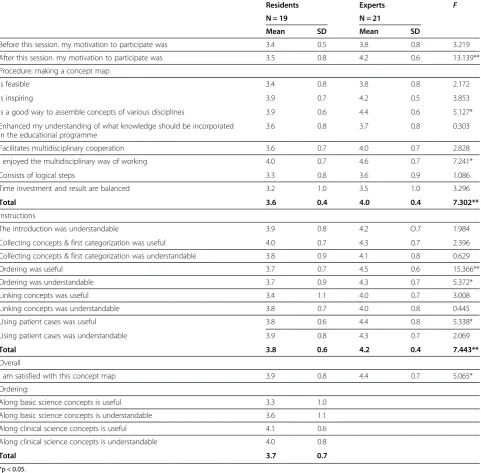
Regarding participants’ views on procedure and instruc-tions we distinguished between experts and residents, for their concept maps differed significantly in the ar-ticulation of integration. The reliability of the 20 items used in the analysis was satisfactory (Cronbach’s alpha .87) or high (Cronbach’s alpha .93) for the residents’ ver-sion with 24 items. Overall, experts were significantly more positive about the procedure and instructions of
concept mapping than residents; seven out of twenty questions showed a significant difference between the two groups, as Table 5 shows. The experts really enjoyed the concept mapping sessions; their motivation increased significantly (p < .05), whereas residents’ motivation grew no more than slightly. The residents were significantly more positive about the instruction to order the concepts along clinical concepts than about the instruction to order the concepts along basic science concepts (p < .05) (t-values not shown in Table 5). Participants’ motiv-ation, their view on procedure and instructions and their satisfaction with the concept map were significantly related with the extent of articulated integration in the concept maps measured by links. However, this correl-ation was negative (see Table 6).
Cooperative learning
After clustering the data from the video tapes and the field notes, four categories emerged: 1. motivation, 2. ex-change of information within the group, 3. interaction between participants and 4. the decision-making process. Quotations below have been translated from Dutch to English, and expertise level is indicated by (E) for experts and (R) for residents in order to illustrate the impact of the context variable‘expertise’.
Motivation
Regarding motivation, concept mapping cut two ways: enthusiasm about the activity of concept mapping itself and motivation that came from working towards a goal. The multidisciplinary approach obviously motivated the experts: they expressed their surprise about the input of the others, and the disciplinary differences that became
Table 3 Coding categories used for the analysis of the video tapes and the field notes
Concept map Discipline of each participant
Category Description Examples
Motivation Positive and negative drive to adopt concept mapping. It is great fun, this way of working. (E)
Understanding of the goal of the cooperative learning task in order to stay on track.
My enthusiasm is reduced because I still do not understand the goal of concept mapping. (R)
Exchange of information Explanations and explications without involvement from others, e.g., explications of the participant’s own contribution to the concept map
The basic science categorization is good to know but you should not really apply it. (E)
For me, the concept map is upside down. (E)
Interaction Active involvement reflected in questions participants ask each other, asking for and giving clarifications
I do not know whether this results in blood in faeces. You know that. (R)
Now I am completely confused: how do you use secretor and osmotic? Up to 2 hours ago, it was our main device. This distinction can’t be that weird? (R)
Decision making Negotiations about how to structure the concept map, implying what to adopt in the map.
Let’s distinguish pathogenesis and pathophysiology. Okay, this categorization does not commit us to anything. (E)
Let’s stop with expanding the concept map. Every concept covers more detailed concepts. (E)
apparent. One of the expert groups decided to meet a third time because the gynaecologist did not agree with the internist’s viewpoint about how to categorize diagno-ses. The pilot groups showed less motivation. Unlike the experts, the residents took the different viewpoints more for granted. They showed less motivation for the ses-sions. Although the target users (medical clerks) of the concept maps were described, it was especially the resi-dents who remained uncertain about the level of know-ledge of these target users.
“As clinicians you always concentrate on this part of the concept map (points to the patient-related concepts) but the most important piece of clinical reasoning is this (points to basic science
concepts).” (E)
“Who is the target group?”(R)
Some groups expressed difficulties with the task to con-struct a concept map about all knowledge they considered absolutely relevant for understanding a clinical problem. The experts were inclined to create a decision tree, and thus seemed to be guided by the question: what know-ledge does one usefor diagnosinga clinical problem?
“I have trouble knowing where to start the thinking process.”(E)
Exchange of information
Explanations and motivations of contributions were clustered as‘exchange of information’(see Table 3). Par-ticipants explained how their disciplines coloured their views on the concepts.
“You think of the patient, as a first step, I think of the context.”(E)
Information was exchanged right from the start of the concept mapping process, when participants were col-lecting concepts. In the resident groups, these explana-tions already in this first stage often led to quesexplana-tions and hence interaction. This was the case in one expert group. There was only one resident group in which the emphasis in the communication was on exchange of in-formation. In this group, one of the participants joined later.
Interaction
In the expert groups, interaction occurred in particular when joint decisions had to be taken, i.e., about links, the organization of the concepts and labelling the links. Although labelling the links was deemed unnecessary -most relations were causal or sequential - , it provoked discussions about what was cause and what conse-quence. The pilot group of two experts exhibited hardly any interaction. For residents, decision making was not
Table 4 Differences between draft and final versions of the concept maps
Draft Final
N = 14*** N = 14***
Mean SD Mean SD t
Clinical concepts 67.1 15.2 78.1 19.9 3.45**
Experts 60.4 12.9 70.7 19.7 1.60
Residents 73.6 55.2 85.6 18.3 7.19**
Basic science concepts 18.6 8.5 23.7 16.1 1.34
Experts 18.4 8.3 19.1 7.6 0.36
Residents 18.6 9.4 28.3 21.3 1.31
Clinical concepts subsuming basic science concepts 0.6 1.2 1.8 3.0 1.42
Experts 0.0 0.0 2.8 3.9 1.94
Residents 1.1 1.6 0.7 1.5 -1.44
Basic science concepts subsuming clinical concepts 4.3 4.8 6.0 5.3 3.07**
Experts 1.1 2.3 2.6 4.4 1.64
Residents 7.4 4.6 9.4 3.9 2.65**
Links between clinical and basic science concepts 12.4 9.0 15.4 10.3 3.05*
Experts 5.1 3.4 6.9 4.8 1.77
Residents 19.7 6.2 24.0 6.0 2.61*
*p < 0.05. **p < 0.01.
a prerequisite to interact; most resident groups started interaction while collecting concepts, triggered by the tributions of the others. These contributions entailed con-cepts they did not know, leading to interaction, that is, asking for explanations or joint consultations of the Internet and remarks about their learning due to the input of others.
“What does MALT mean?”(R)
“I have added these concepts with another meaning in mind. Now, I discover that when you replace them, their meaning is changed.”(E) (indicating that by relating a concept to other concepts, meanings change somewhat)
Table 5 Differences between experts and residents concerning their view on concept mapping procedure and instructions
Residents Experts F
N = 19 N = 21
Mean SD Mean SD
Before this session. my motivation to participate was 3.4 0.5 3.8 0.8 3.219
After this session. my motivation to participate was 3.5 0.8 4.2 0.6 13.139**
Procedure: making a concept map
Is feasible 3.4 0.8 3.8 0.8 2.172
Is inspiring 3.9 0.7 4.2 0.5 3.853
Is a good way to assemble concepts of various disciplines 3.9 0.6 4.4 0.6 5.127*
Enhanced my understanding of what knowledge should be incorporated in the educational programme
3.6 0.8 3.7 0.8 0.303
Facilitates multidisciplinary cooperation 3.6 0.7 4.0 0.7 2.828
I enjoyed the multidisciplinary way of working 4.0 0.7 4.6 0.7 7.241*
3.3 0.8 3.6 0.9 1.086
Consists of logical steps
Time investment and result are balanced 3.2 1.0 3.5 1.0 3.296
3.6 0.4 4.0 0.4 7.302**
Total
Instructions
The introduction was understandable 3.9 0.8 4.2 O.7 1.984
4.0 0.7 4.3 0.7 2.396
Collecting concepts & first categorization was useful
Collecting concepts & first categorization was understandable 3.8 0.9 4.1 0.8 0.629
Ordering was useful 3.7 0.7 4.5 0.6 15.366**
Ordering was understandable 3.7 0.9 4.3 0.7 5.372*
Linking concepts was useful 3.4 1.1 4.0 0.7 3.008
Linking concepts was understandable 3.8 0.7 4.0 0.8 0.445
Using patient cases was useful 3.8 0.6 4.4 0.8 5.338*
Using patient cases was understandable 3.9 0.8 4.3 0.7 2.069
Total 3.8 0.6 4.2 0.4 7.443**
Overall
I am satisfied with this concept map 3.9 0.8 4.4 0.7 5.065*
Ordering:
Along basic science concepts is useful 3.3 1.0
Along basic science concepts is understandable 3.6 1.1
Along clinical science concepts is useful 4.1 0.6
Along clinical science concepts is understandable 4.0 0.8
3.7 0.7
Total
*p < 0.05. **p < 0.01.
Table 6 Pearson’s correlations between participants’motivation
Motivation Mean score on procedure Mean score on instructions Satisfaction with the concept map
Number of links -.506** -.548** -.624** -.468
**p < 0.01.
Most resident groups spent much time organizing the concepts along the two structures offered: clin-ical concepts subsuming basic science concepts or the other way around, basic science concepts sub-suming clinical concepts. Although some of them expressed having difficulties categorizing clinical con-cepts within a framework of basic science concon-cepts, they all maintained a basic science categorization. This categorization provoked interaction: residents expressed doubts about which category to place some of the clin-ical concepts in, asked each other and consulted the internet.
“Is there a third group of pathophysiological explanations of proteinuria?”(R)
“I do not know whether this results in blood in faeces. You know that”. (R)
The instruction to analyse, summarize and explain the patient cases raised questions and therefore led to inter-action. If a case did not belong to the domain of a par-ticular participant, he/she tended to participate less in the discussion.
Decision-making process
The pilot groups of five participants had difficulties to rec-oncile five disciplinary viewpoints. Too many disciplinary viewpoints hindered the decision-making process about the organization of the concept map. This resulted in a bunch of concepts that to some extent were grouped, but not really organized or related.
“There are too many points of view. I don’t see how we can structure this”. (E)
“You seem to make a decision tree. But we are making a scientific ordering”. (E)
The residents started to order the concepts before they were instructed to do so. For them, an explicit instruc-tion to consider different ways to order the concepts seemed to hinder rather than help decision making. Six of the seven expert groups did not start ordering until they received the instruction. They had frequently to be reminded to organize the concept map. All groups started with an ordering of the concepts that adhered closely to the phases of clinical reasoning (e.g., history, lab, diagnoses) and subsequently added an ordering as instructed: clinical concepts subsuming basic science concepts and basic science concepts subsuming clinical concepts. Basic science ordering sometimes evoked doubts about whether clinical or basic science concepts should be the organizational device, and slowed down decision making.
“In this schematization, you are trying to do two things at the same time: from basic science to differential diagnosis and from patient case to basic science knowledge. (R)
“The basic science categorization is good to know but you should not really apply it”. (E)
“But how do students learn? First anatomy, embryology. No, that does not work”. (E)
Decisions about linking concepts were based on con-siderations about complexity; too many links would make the concept map chaotic. In all groups, the in-struction to analyse patient cases led to adaptations and helped to decide about the final version of the map. It was especially the residents who used the concept map for their own analysis and explanation of the case.
“Yes, I can reason along these lines”while pointing to a part of the concept map (R)
“Let’s stop expanding. Every concept covers more detailed concepts. This is a framework”. (E)
Discussion
settings in other studies [21,22], our results suggest that decision making and interaction are related: decision mak-ing turned out to be a means to induce interaction in the expert groups. In groups with too many participants deci-sion making was rather difficult, probably due to too many gaps between disciplines that had to be bridged.
The extent of articulation of integration in concept maps could not explained by motivation, nor by the value participants attached to the procedure and the in-structions. Our data suggest that it is the interaction provoked by the instructions focussing on integration that accounts for the articulation of integration. Both ex-pert and resident groups expressed problems reconciling the two ordering devices in their concept maps. How-ever, the experts remained focused on the clinical side of their explanation, described as chains of practice [1], whereas the residents used underlying basic science mechanisms for the organization of their maps more fre-quently, even though they experienced the instruction to order clinical concepts along the lines of basic science concepts as less helpful. We assume that it was not only the higher number of basic science concepts in the maps that accounted for residents’ prevalence for ordering along underlying basic science mechanisms, but that also the patho-physiological explanations residents gave each other might have caused them to focus on anatomical and pathophysiological explanations. This articulation of integration was further improved in the second session, an improvement which we could view as learning to ar-ticulate integration, similar to the learning processes in other concept mapping studies [14,25].
A combination of the cognitive, constructive and co-operative learning perspectives deepened our under-standing of the use of concept mapping instructions on different expertise levels. The concept maps in our study not only disclosed characteristics of the shared know-ledge of groups of clinicians and basic scientists on different expertise levels (which could be explained by cognitive psychological insights [4,30]) but also sug-gested that the articulation of integration can be im-proved, with the draft [version] functioning as a stepping stone for further articulation rather than a static reflection of cognitive structures. Hence, the ability to articulate in-tegration might be considered a dynamic skill, subject to being influenced, as suggested elsewhere [13], and might thus be learned. The instructions appeared to affect the concept mapping process and subsequently the resulting concept maps, so that these maps, not surprisingly, differ somewhat from concept maps in other studies [6,14]. A striking difference is that most groups decided not to label the links, because overall these links indicated causal rela-tions, which may be a consequence of the focus to linking in particular clinical and underlying basic science mecha-nisms. The cooperative learning view helped to detect
decision making and interaction as facilitating factors for learning to articulate integration in expert and resident groups, and added another viewpoint to explain the differ-ences between residents’ and experts’maps. Cooperative learning is usually an approach for peer learning [21]. Both expert and resident groups were supposed to be peers: experts among experts and residents among res-idents. However, the definition of ‘peer’might need to be differentiated. Experts might regard each other less as peers than residents do. Because of their specialized knowledge, the knowledge gap between experts might be larger than between residents. If this is the case, interaction might be a confounding variable for expert-ise level.
Our study has an explorative character and should therefore be continued in new experiments, for further refinement of the instructions and procedure. First, our results allowed us to state only the relatedness of inter-action and articulation of integration. Follow-up re-search should examine whether there is a causal relationship. This might be investigated by triggering interaction in the expert groups by means of advancing decision making in the concept mapping session, and measuring the integration in the resulting concept maps. A next step is to quantify interaction and decision mak-ing, and correlate this to the integration articulated in the concept maps. Second, we conducted this study in one medical centre. Its specific organizational culture might have coloured the interaction between the experts and the way they have cooperated. This context variable should be taken into account in a follow-up study. Third, we endeavoured to detect patterns in the data from the video tapes and field notes, and decided to make a qualitative analysis with the risk of bias in the in-terpretation [28,29,31]. Such an explorative approach should be followed by research intended to quantify this qualitative information [32].
Conclusions
three disciplines involved, we run the risk that integra-tion remains confined to discussing separate view-points instead of relating them, a phenomenon that is also reported in PBL classes [33]. Finally, our results support the idea of involving residents in developing integrated curricula, because they are better able to ar-ticulate integration in concept maps and to question each other about the relevance of concepts and their relations than experts.
Competing interests
The authors declare that they have no competing interests.
Authors’contributors
SV conceived the idea for this study and designed the study, analysed the data and drafted the manuscript. JT participated in the design of the study and the analysis and revised the draft versions of the manuscript. NV supervised the study design and offered suggestions for the main focus of the study and reviewed the different versions of the manuscript. JB participated in the data collection and commented on the revised versions. All authors approved the final manuscript for publication.
Acknowledgements
The authors want to express their appreciation to all experts, residents and basic scientists in training who were willing to participate in this study and showed to be very dedicated to the construction of integrated concept maps. We want to thank Manon Gosselink, Dato de Gruijter and Gijs van Duijn for their contribution in the analysis of the study.
Author details
1
ICLON, Graduate School of Teaching & Leiden University Medical Centre, Wassenaarseweg 62A, 2333 AL Leiden, The Netherlands.2Centre for Teaching and Learning, Educational Development and Training, Faculty of Social and Behavioural Sciences, Utrecht University, PO Box 80.140, 3508 TC Utrecht, The Netherlands.3Leiden University Medical Centre, PO Box 9600, 2300 RC Leiden, The Netherlands.
Received: 28 March 2014 Accepted: 23 January 2015
References
1. Kinchin IM, Cabot LB, Hay DB. Using concept mapping to locate the tacit dimension of clinical expertise: towards a theoretical framework to support critical reflection on teaching. Learn Health Soc Care. 2008;7(2):93–104. 2. Eraut M. Non-formal learning and tacit knowledge in professional work. Br J
Educ Psychol. 2000;70(1):113–36.
3. Schmidt H, Norman G, Boshuizen HPA. A cognitive perspective on medical expertise- theory and implications. Acad Med. 1990;65(10):611–21. 4. Boshuizen HPA, Schmidt HG. On the role of biomedical knowledge in
clinical reasoning by experts, intermediates and novices. Cognit Sci. 1992;16(2):153–84.
5. Van de Wiel MWJ, Boshuizen HPA, Schmidt HG. Knowledge restructuring in expertise development: evidence from pathophysiological representations of clinical cases by students and physicians. Eur J Cogn Psychol. 2000;12(3):323–55.
6. Novak JD. The promise of new ideas and new technology for improving teaching and learning. Cell Biol Educ. 2003;2(2):122–32.
7. Novak JD. Meaningful learning: the essential factor for conceptual change in limited or inappropriate propositional hierarchies leading to empowerment of learners. Sci Educ. 2002;86(4):548–71.
8. Hoffman RR, Lintern G. Eliciting and representing the knowledge of experts. In: Ericsson KA, Charness N, Feltovich PJ, Hoffman RR, editors. The Cambridge handbook of expertise and expert performance. New York: Cambridge University Press; 2006. p. 203–22.
9. Daley B, Torre D. Concept maps in medical education: an analytical literature review. Med Educ. 2010;44(5):440–8.
10. Martimianakis MA, Hodges BD, Wasylenki D. Understanding the challenges of integrating scientists and clinical teachers in psychiatry education:
findings from an innovative faculty development program. Acad Psychiatry. 2009;33(3):241–7.
11. Darling-Hammond L, Bransford J. Preparing teachers for a changing world. What teachers should learn and be able to do. 1st ed. San Francisco: Jossey-Bass; 2005.
12. Cochran-Smith M, Lytle SL. Relationships of knowledge and practice: teacher learning in communities. Rev Res Educ. 1999;24:249–305. 13. Schmidt HJ. Alternative approaches to concept mapping and implications
for medical education: commentary on reliability, validity and future research directions. Adv Health Sci Educ. 2006;11(11):69–76. 14. Rendas AB, Fonseca MF, Pinto PR. Toward meaningful learning in
undergraduate medical education using concept maps in a PBL pathophysiology course. Adv Physiol Educ. 2006;30(1):20–9.
15. Torre D, Durning SJ, Daley BJ. Twelve tips for teaching with concept maps in medical education. Med Teach. 2013;35(3):201–8.
16. Cutrer WB, Castro D, Roy KM, Turner TL. Use of an expert concept map as an advance organizer to improve understanding of respiratory failure. Med Teach. 2011;33(12):1018–26.
17. Edmondson KM. Concept mapping for the development of medical curricula. J Res Sci Teach. 1995;32(7):777–93.
18. Weiss LB, Levison SP. Tools for integrating women's health into medical education: clinical cases and concept mapping. Acad Med.
2000;75(11):1081–6.
19. Harden RM. The integration ladder: a tool for curriculum planning and evaluation. Med Educ. 2000;34(7):551–7.
20. Koens F, Custers EJFM, Ten Cate TJ. Clinical and basic science teachers' opinions about the required depth of biomedical knowledge for medical students. Med Teach. 2006;28(3):234–8.
21. Slavin RE. Research on cooperative learning and achievement: what we know, what we need to know. Contemp Educ Psychol. 1996;21(1):43–69. 22. Weinberger A, Fischer F. A framework to analyze argumentative knowledge
construction in computer-supported collaborative learning. Comput Educ. 2006;46(1):71–95.
23. Rikers RMJP, Schmidt HG, Moulaert V. Biomedical knowledge: encapsulated or two worlds apart? Appl Cogn Psychol. 2005;19(2):223–31.
24. McGaghie WC, Boerger RL, McCrimmon DR, Ravitc MM. Learning pulmonary physiology: comparison of student and faculty knowledge structures. Acad Med. 1996;71(1):S13–5.
25. Novak JD, Gowin DB. Learning how to learn. New York: Cambridge University Press; 1984.
26. Strijbos JW, Martens RL, Jochems WMG. Designing for interaction: six steps to designing computer-supported group-based learning. Comput Educ. 2004;42(4):403–24.
27. McGaghie WC, Boerger RL, McCrimmon DR, Ravitch MM. Agreement among medical experts about the structure of concepts in pulmonary physiology. Acad Med. 1994;69(10):S78–80.
28. Gravemeijer K, Cobb P. Design research from a learning design perspective. In: Van den Akker J, Gravemeijer K, McKenney S, Nieveen N, editors. Educational design research. London: Routledge; 2006. p. 17–51. 29. Miles MB, Huberman AM. Qualitative data analysis. Thousand Oaks: SAGE
Publications; 1994.
30. Van de Wiel MWJ, Boshuizen HPA, Schmidt HG, Schaper NC. The explanation of clinical concepts by expert physicians, clerks and advanced students. Teach Learn Med. 1999;11(3):153–63.
31. Barab S, Squire K. Design-Based Research: putting a stake in the ground. J Learn Sci. 2004;13(1):1–14.
32. Raudenbush SW. Learning from attempts to improve schooling: the contribution of methodological diversity. Educ Res. 2010;34(25):25–31. 33. Prince KJAH, Boshuizen HPA. From theory to practice in medical education.