R E S E A R C H A R T I C L E
Open Access
An
ex vivo
, assessor blind, randomised, parallel
group, comparative efficacy trial of the ovicidal
activity of three pediculicides after a single
application - melaleuca oil and lavender oil,
eucalyptus oil and lemon tea tree oil, and a
“
suffocation
”
pediculicide
Stephen C Barker
1*and Phillip M Altman
2Abstract
Background:There are two components to the clinical efficacy of pediculicides: (i) efficacy against the crawling-stages (lousicidal efficacy); and (ii) efficacy against the eggs (ovicidal efficacy). Lousicidal efficacy and ovicidal efficacy are confounded in clinical trials. Here we report on a trial that was specially designed to rank the clinical ovicidal efficacy of pediculicides. Eggs were collected, pre-treatment and post-treatment, from subjects with different types of hair, different coloured hair and hair of different length.
Method:Subjects with at least 20 live eggs ofPediculus capitis(head lice) were randomised to one of three treatment-groups: a melaleuca oil (commonly called tea tree oil) and lavender oil pediculicide (TTO/LO); a
eucalyptus oil and lemon tea tree oil pediculicide (EO/LTTO); or a“suffocation” pediculicide. Pre-treatment: 10 to 22 live eggs were taken from the head by cutting the single hair with the live egg attached, before the treatment (total of 1,062 eggs). Treatment:The subjects then received a single treatment of one of the three pediculicides, according to the manufacturers’instructions. Post-treatment: 10 to 41 treated live eggs were taken from the head by cutting the single hair with the egg attached (total of 1,183 eggs). Eggs were incubated for 14 days. The proportion of eggs that had hatched after 14 days in the pre-treatment group was compared with the proportion of eggs that hatched in the post-treatment group. The primary outcome measure was% ovicidal efficacy for each of the three pediculicides.
Results:722 subjects were examined for the presence of eggs of head lice. 92 of these subjects were recruited and randomly assigned to: the“suffocation” pediculicide (n = 31); the melaleuca oil and lavender oil pediculicide (n = 31); and the eucalyptus oil and lemon tea tree oil pediculicide (n = 30 subjects). The group treated with eucalyptus oil and lemon tea tree oil had anovicidal efficacyof 3.3% (SD 16%) whereas the group treated with melaleuca oil and lavender oil had anovicidal efficacyof 44.4% (SD 23%) and the group treated with the
“suffocation”pediculicide had an ovicidal efficacyof 68.3% (SD 38%).
Conclusion:Ovicidal efficacy varied substantially among treatments, from 3.3% to 68.3%. The“suffocation” pediculicide and the melaleuca oil and lavender oil pediculicide (TTO/LO) were significantly more ovicidal than eucalyptus oil and lemon tea tree oil pediculicide (EO/LTTO) (P < 0.0001). Ranking: 1.“Suffocation”pediculicide (68.3% efficacy against eggs); 2. Melaleuca oil and lavender oil (44.4%) pediculicide; 3. Eucalyptus oil and lemon tea
* Correspondence: [email protected]
1
Parasitology Section, School of Chemistry & Molecular Biosciences, and UniQuest Pty Ltd, University of Queensland, Brisbane, QLD, Australia 4072 Full list of author information is available at the end of the article
tree oil (3.3%) pediculicide. The“suffocation” pediculicide and TTO/LO are also highly efficacious against the crawling-stages. Thus, the“suffocation”pediculicide and TTO/LO should be recommended as first line treatments.
Trial Registration:The study was listed at the Australian/New Zealand Clinical Trial Registry (ANZCTR): reg. no. 12609000884202.
Background
Pediculosis, infection with head lice,Pediculus capitis, is common in children of elementary-school age. There are two components to the clinical efficacy of pediculicides. First, efficacy against the crawling-stages (the three nym-phal instars n1, n2, n3, and the adults), hereafter called lousicidal efficacy. And second, efficacy against the eggs in the hair, hereafter called ovicidal efficacy. Lousicidal effi-cacy and ovicidal effieffi-cacy are, perforce, confounded in in vivoclinical trials where both the lice and eggs are trea-ted at the same time on the scalp and the end-point is defined as‘louse-free post-treatment’. For example, sub-jects may be louse-free after two treatments, one week apart, regardless of the ovicidal efficacy of the pediculicide so long as the pediculicide kills all of the crawling-stages present in the hair at the start of the trial (first treatment) and then kills all of the crawling-stages that hatch between the treatments, at the second treatment. In the last 10 years or so two new types of pediculicides have found wide acceptance in many countries: essential oil pediculi-cides and pediculipediculi-cides designed to“suffocate”head lice and their eggs.
Thein vivoefficacy of the“suffocation” pediculicide, and the melaleuca oil and lavender oil pediculicide, that we studied in the trial reported here, were studied in a previous trial reported in this journal [1]. 98% of subjects treated with the“suffocation”pediculicide, and 98% of subjects treated with the melaleuca oil and lavender oil pediculicide, were louse-free at the end of that 14 day trial [1]. It was not known, however, how ovicidal these two pediculicides were; the trial reported here was designed to assess the ovicidal activity of these pediculi-cides, and to compare their ovicidal efficacy with another essential oil pediculicide (eucalyptus oil and lemon tea tree oil (EO/LTTO)) that is marketed with the claim of ‘kills eggs.’This claim has been approved by the Thera-peutic Goods Administration (TGA) of the Australian Government. Ovicidal efficacy may be assessedin vitro: when eggs are collected from an infected subject and then immersed in pediculicides in the laboratory for a period of time, after which they are washed and then incubated for 14 days. The limitation of suchin vitro stu-dies is that the eggs are not treatedin vivo(on the head) and that the pediculicide is not washed outin vivo. Thus, the exposure of the eggs to the pediculicidein vitrois dif-ferent to the exposure on the head (in vivo), and thus,in
vitroresults may or may not indicate the efficacy of the pediculicides when used by health professionals and par-entsin vivo.In vivostudies of ovicidal efficacy are con-founded by the difficulty, often impossibility, of tracking individual eggs on a head from pre-treatment to 14 days post-treatment. Dodd [2] reviewed studies of theex vivo efficacy of pediculicides [3-5] and then recommended measuring ovicidal efficacy, by comparing the hatch-rate of eggs collected pre-treatment with the hatch-rate of eggs collected post-treatment. Comparing the proportion of eggs that hatch pre-treatment and post-treatment on the same individual allows variation in hatchability among subjects to be taken into account. The proportion of eggs that hatch among heads varies; this variation is not well understood but may be related to the presence/ absence of sufficient males on a subject to fertilize all females and inherent variation in the“quality”of eggs laid by different female lice.
Here we report on a clinical trial that was specially designed to determine the ex vivoclinical ovicidal effi-cacy of pediculicides. A“league table”of the clinical ovi-cidal efficacy and, for that matter, the clinical lousiovi-cidal efficacy of the pediculicides that are sold in particular markets would be of interest to both consumers and health professionals.
Methods
Objectives and interventions
To compare,ex vivo, the ovicidal efficacy of three pedi-culicides after a single application on subjects with live head lice eggs:
1. Pediculicide containing melaleuca oil (commonly called tea tree oil) 10% w/v and lavender oil 1%w/v (TTO/LO) (NeutraLice Natural Lotion® Key Phar-maceuticals Pty Ltd, Australia) presented as a clear oily solution
2.“Suffocation” pediculicide containing benzyl alco-hol, mineral oil, polysorbate 80, sorbitan monooleate, Carbopol 934, water and triethanolamine (Neutra-Lice Advance®Key Pharmaceuticals Pty Ltd, Austra-lia) presented as a white opaque lotion.
Methodology
This was an assessor-blind, randomised, parallel group, comparative study. The study population was elementary school-aged children (aged 4 yrs to 12 yrs) in Queensland, Australia, with live eggs of head lice in their hair. After written, informed consent had been provided, subjects were screened by visual inspection for the presence of putatively live eggs of head lice in their hair. The hair was divided into six sections. Each section of hair was examined for the presence of putatively live eggs by an expert techni-cian - a magnifying glass was not needed. Eggs were classi-fied as putatively alive if they were attached to a hair shaft within about 1 cm of the scalp and if they were not black (dead) nor white to translucent (hatched). Putatively live eggs were counted with a hand-operated click-counter. Subjects with at least 20 putatively live eggs in their hair were randomised to one of the three treatment groups. Subjects with scalp disease, or a history of allergies, and those who were treated with a pediculicide, or hair dye or bleach in the four weeks prior to the trial, were excluded from the trial.
Criterion for a live egg, a dead egg and hatched egg
Each egg was examined individually, within 2 hrs of collec-tion of being removed from the head, with a stereo light microscope of 16 power to check for eggs that looked like they were alive with the naked eye, but were in fact were dead or had hatched. None of the eggs that were classified as alive by their appearance and close proximity to the scalp (within 1 cm) were found to be either dead or had hatched when examined with a microscopy.
Live egg: the egg was less than about 1 cm from the scalp; and the operculum was closed; and the egg had a uniform ovoid shape; and the egg had a uniform density and appearance (may have had an“eye spot” but this depended on the age of the egg. (Refer to Sonnberg et al for some excellent colour pictures of eggs ofP. capitis [6])).
Dead egg:the egg was misshapen, shrivelled, indented or irregular in shape; or the egg had a non-uniform den-sity with parts of the egg clear whereas other parts of the egg were opaque.
Hatched egg: operculum was open and nymph was not in the egg.
Collection, transport and incubation of eggs
Hair shafts with eggs attached less than 1 cm from the scalp were cut with hairdresser’s scissors. The hair shaft was then put in a plastic tube (Corning 50 mL Centrifuge Tubes; CentriStar™Cap-Polypropylene-Sterile). All of the pre-treatment hair shafts from one subject were put into one plastic tube whereas the hair shafts collected post-treatment were all put into a separate tube. The tubes were sealed with screw caps, put in a polystyrene container to minimize temperature variation, and taken to the laboratory. Then the pre-treatment and post-treatment
eggs were counted and placed in separate Petri dishes in an incubator at 29 to 30°C and 70% relative humidity. Eggs were put into the incubator within 4 hrs of collection. Eggs were held in the incubator for 14 days.
Randomisation and blinding
Eligible subjects were randomly assigned to be treated with one of the three pediculicides, by a computer gener-ated code with blocked randomisation (groups of six). This trial was assessor-blind. The person applying the treatment could not be blinded because the three pediculi-cides were easily identifiable by their physical attributes and“feel"; however, the person (MA) who classified eggs as either alive, dead or hatched was blinded to the treat-ment. Analysts were blinded to the treatment group until after the analyses.
Treatments and criteria for evaluation of efficacy
Enrolled subjects were treated once with one of the three pediculicides, according to the manufacturers’instructions. The louse-combing procedure normally used in combina-tion with the TTO/LO and the“suffocation”pediculicide would have confounded our study, so it was not done. After the treatment, at least l0 live eggs, but more eggs if more than 10 eggs were present, were taken from the hair of each enrolled subject, as for the pre-treatment eggs. The pre-treatment and post-treatment eggs were exam-ined again with the microscope on Day 14 to determine whether the eggs had hatched, partly hatched or had not hatched at all. Partly hatched eggs were classified as unhatched eggs; in these cases the partly hatched nymph was always dead. The number of hatched (empty) and unhatched eggs was counted on Day 14. The proportion of eggs that had hatched after 14 days was compared in the pre-treatment and post-treatment groups of eggs. The primary outcome measure waspercent(%)ovicidal efficacy for each treatment-group (1 - [Post-Treatment Hatching Rate/Pre-Treatment Hatching Rate] × 100%). Hatch-Rate =number of eggs that had hatched divided by the number of live eggs that had been collected. Characteris-tics of the subjects and their hair were recorded: hair type (whether curly, straight or wavy), hair colour (whether black, blonde, brown, red), hair length (cm), subject gen-der and school attended (subjects attended three different schools in western Brisbane). Grade at school was a surro-gate for subject age. Subjects were from eight school grades:“preparation year”(ca. 5 years) and grades 1 (ca. 6 years), 2 (ca. 7 years), 3 (ca. 8 years), 4 (ca. 9 years), 5 (ca. 10 years), 6 (ca. 11 years), and 7 (ca. 12 years).
Dosage and dosage regimen
whereas the TTO/LO and the“suffocation”pediculicide were washed from the hair with tap-water. Then the hair was dried with a towel.
Criteria for evaluation of safety (tolerance)
Safety was evaluated by the incidence and severity of Adverse Events (AEs), and the likelihood in the opinion of the Investigator (SCB), that those AEs were caused by the pediculicides. The scalps of subjects were examined after the treatments and subjects were asked“was the hair treatment okay?”to elicit responses. The incidence and severity of adverse events was compared among treatment groups. Fisher’s Exact Test was used to com-pare the proportions of subjects who reported an AE among the three treatment groups.
Statistical analyses
In our statistical analyses, the egg was the investigative unit whereas whether the egg hatched or not was the outcome. We used a framework of Generalised Estimat-ing Equations (GEE) so that we could take into account the: (i) different numbers of eggs collected, pre-treat-ment (10 to 22 eggs) and post-treatpre-treat-ment (10 to 41 eggs), from the 92 subjects; (ii) the three hair types; (iii) the four hair colours (iv) hair length (in cm); (v) the eight different age classes; (vi) gender; and (vii) the three different schools attended (populations). Logistic regres-sion models were fitted to the data. For the comparison of the eucalyptus oil and lemon tea tree oil pediculicide with the “suffocation” pediculicide the formula was Logit(Y) = 1.8651 + (Treatment * 0.1749) + (Time * -2.8370) + (Interaction * 2.5796) whereas for the com-parison of the eucalyptus oil and lemon tea tree oil ped-iculicide with the melaleuca oil and lavender oil pediculicide the formula was Logit(Y) = 2.1182 + (Treat-ment * -0.0782) + (Time * -2.1334) + (Interaction * 1.8761). The “fixed effects” were the pediculicide, whether the egg was collected pre-treatment or post-treatment, and the interaction of these two “fixed effects”, whereas the “random effect” was the subject from whom the eggs were collected. Since the pre-treat-ment and post-treatpre-treat-ment eggs were collected from the same individual subject, the model was a model of repeated measures.
Ethics
This trial was conducted in compliance with the World Medical Association Declaration of Helsinki; the require-ments of the National Statement on Ethical Conduct in Research Involving Humans and ICH E6 Guidance for the Industry; Good Clinical Practice: Consolidated Guidance; the National Privacy Principles and relevant State/territory laws. The trial activities were approved by the Medical Research Ethics Committee of the University of Queens-land and all parents/guardians provided written informed consent.
Results
Study population
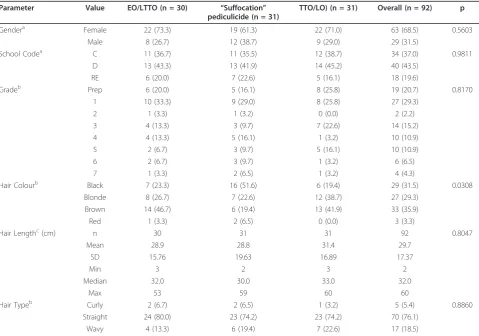
The treatment groups were not statistically different with regard to gender (p = 0.5603), school attended (p = 0.9811), school grade (p = 0.8170) or hair type (p = 0.8860) (Table 1). Neither did mean hair length differ among the treatment groups (p = 0.8047). But hair type varied from one treatment group to another (p = 0.0308): brown hair was most common in the EO/LTTO treatment group, black hair in the“suffocation”treatment group, whereas brown and blonde were most common in the TTO/LO treatment group (Table 1).
Efficacy
722 subjects were screened for live head lice eggs between 9 October 2009 and 7 December 2009. 92 of these subjects were enrolled in the trial:“suffocation” pediculicide (n = 31), TTO/LO (n = 31) and EO/LTTO (n = 30 subjects) (Figure 1). A minimum of 10 eggs and a maximum of 22 eggs were collected from each subject, pre-treatment; whereas a minimum of 10 and maximum of 41 eggs were collected from each subject, post-treat-ment. All 92 subjects enrolled in the trial completed the trial. There was, however, one protocol deviation: a Petri dish broke and 4 of the 16 eggs collected post-treatment for one subject treated with TTO/LO were lost. Thus, 12 eggs rather than 16 eggs, post-treatment, were examined for hatching for this subject.
Results of analyses with the Generalised Estimating Equations (GEE) framework
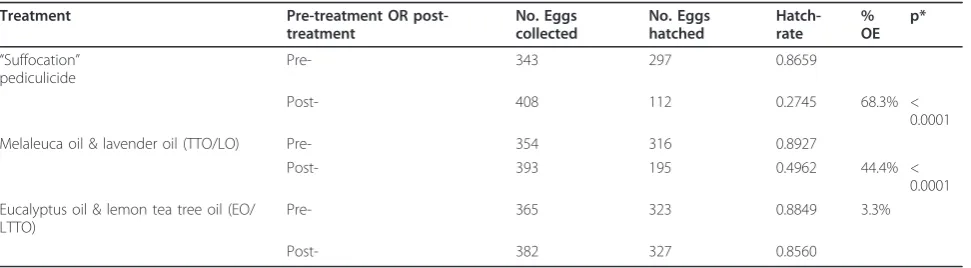
Theovicidal efficacyof the EO/LTTO was 3.3% (SD 16%) whereas theovicidal efficacyof the TTO/LO was 44.4% (SD 23%) and theovicidal efficacy of the“suffocation” pediculicide was 68.3% (SD 38%). Theovicidal efficacies of EO/LTTO and TTO/LO were statistically different (p < 0.0001) (Table 2). The ovicidal efficaciesof EO/ LTTO and the“suffocation”pediculicide were also statis-tically different (p < 0.0001) (Table 2).
Comparison of ovicidal efficacies in the subjects treated with EO/LTTO and the“suffocation”pediculicide
Hair type, hair colour, subject gender and school attended did not co-vary withovicidal efficacyin the ana-lysis of subjects treated with EO/LTTO and the“ suffoca-tion”pediculicide. Hair length, however, co-varied with ovicidal efficacyin this analysis (p = 0.0471): both treat-ments were less effective on longer hair compared to shorter hair. Also, both treatments were less effective on subjects from grades 3 (p = 0.0020), 4 (p = 0.0198) and 7 (p = 0.0173) than the other grades.
Comparison of ovicidal efficacies in the subjects treated with EO/LTTO and TTO/LO
treated with EO/LTTO and TTO/LO. Theovicidal effi-cacy of both treatments in this analysis was, however, lower in one of the three schools attended compared to the other two schools attended (p = 0.0033).
Safety (tolerance)
There were 15 Adverse Events (AEs). One of these AEs was judged by the Investigator to be“possibly”related to the study treatment whereas all the others were consid-ered“probably”related to the study treatment due to the time course of the events. Six of 30 subjects (20%) treated with EO/LTTO reported an AE whereas 4 of 31 (12.9%) treated with TTO/LO reported an AE; no AEs were reported in the “suffocation” pediculicide treatment group. These differences were statistically significant (Fisher’s Exact test p = 0.0026). All AEs were graded by the Investigator as mild in severity (rating scale: mild, moderate or severe) and there were no serious AEs. No action was required for any AEs and all resolved.
Two types of adverse events occurred in the EO/LTTO and TTO/LO treatment groups: redness and stinging. All AEs involved redness. The average duration of redness following treatment with EO/LTTO was 28.5 minutes
compared to 53.8 minutes following treatment with TTO/LO. Stinging was reported by 2 subjects who were treated with EO/LTTO (2/30 or 6.7%) and by 3 subjects treated with TTO/LO (3/31 or 9.7%). The average dura-tion of stinging following EO/LTTO was 10 minutes compared to 24 minutes following TTO/LO.
Discussion
Neither hair type nor hair colour co-varied with ovicidal efficacy in our study, despite a range of ethnic groups in the study population. Therefore data fromex vivostudies like ours in Brisbane should be indicative of efficacy in other populations in Australia i.e. be generalisable.
Ideally, pediculicides are both lousicidal (kill lice) and ovicidal (kill un-hatched nymphs in the eggs). Dodd [2] argued, that the most accurate way to compare the ovici-dal efficacy of pediculicides is to collect eggs pre-treatment from infected individuals, treat those individuals with a pediculicide, and then collect eggs from the same infected individuals, post-treatment. Thus, the proportion of eggs pre-treatment and post-treatment that hatch can then be compared precisely (hatch-rate), for each individual sub-ject and for each pediculicide. This study design has the Table 1 Subject demographics (%)
Parameter Value EO/LTTO (n = 30) “Suffocation”
pediculicide (n = 31)
TTO/LO) (n = 31) Overall (n = 92) p
Gendera Female 22 (73.3) 19 (61.3) 22 (71.0) 63 (68.5) 0.5603 Male 8 (26.7) 12 (38.7) 9 (29.0) 29 (31.5)
School Codea C 11 (36.7) 11 (35.5) 12 (38.7) 34 (37.0) 0.9811 D 13 (43.3) 13 (41.9) 14 (45.2) 40 (43.5)
RE 6 (20.0) 7 (22.6) 5 (16.1) 18 (19.6)
Gradeb Prep 6 (20.0) 5 (16.1) 8 (25.8) 19 (20.7) 0.8170
1 10 (33.3) 9 (29.0) 8 (25.8) 27 (29.3) 2 1 (3.3) 1 (3.2) 0 (0.0) 2 (2.2) 3 4 (13.3) 3 (9.7) 7 (22.6) 14 (15.2) 4 4 (13.3) 5 (16.1) 1 (3.2) 10 (10.9) 5 2 (6.7) 3 (9.7) 5 (16.1) 10 (10.9) 6 2 (6.7) 3 (9.7) 1 (3.2) 6 (6.5) 7 1 (3.3) 2 (6.5) 1 (3.2) 4 (4.3)
Hair Colourb Black 7 (23.3) 16 (51.6) 6 (19.4) 29 (31.5) 0.0308 Blonde 8 (26.7) 7 (22.6) 12 (38.7) 27 (29.3)
Brown 14 (46.7) 6 (19.4) 13 (41.9) 33 (35.9) Red 1 (3.3) 2 (6.5) 0 (0.0) 3 (3.3)
Hair Lengthc(cm) n 30 31 31 92 0.8047 Mean 28.9 28.8 31.4 29.7
SD 15.76 19.63 16.89 17.37
Min 3 2 3 2
Median 32.0 30.0 33.0 32.0
Max 53 59 60 60
Hair Typeb Curly 2 (6.7) 2 (6.5) 1 (3.2) 5 (5.4) 0.8860
Straight 24 (80.0) 23 (74.2) 23 (74.2) 70 (76.1) Wavy 4 (13.3) 6 (19.4) 7 (22.6) 17 (18.5)
advantage of using the individual subject as his/her own control. However, as Sonnberg et al pointed out, the age of the eggs on the head at time of the test are not known and rearing conditions are not standardized [6]. It will be
interesting to see whether or not the ovicidal efficacy dif-fers between tests where the eggs are treated on the scalp [our study, 3,4,5,7 & 8] compared to tests where the eggs were grownex vivooff the scalp by the continuous feeding
Randomisation 722 subjects screened for live
eggs of head lice
92 subjects qualified for the study (including criteria of at least 20 live eggs per subject)
30 subjects: EO/LTTO solution group
31 subjects: TTO/LO lotion group
31 subjects:
“Suffocation” product group
At least 10 eggs collected per subject pre-treatment & incubated. Total eggs collected pre-treatment: 365 eggs.
Subjects treated with EO/LTTO solution
Subjects treated with TTO/LO lotion
Subjects treated with “Suffocation” product
Calculate % ovicidal
efficacy for group Calculate % ovicidal efficacy for group Calculate % ovicidal efficacy for group subjects who do not qualify for the study
At least 10 eggs collected per subject pre-treatment & incubated. Total eggs collected pre-treatment: 354 eggs.
At least 10 eggs collected per subject pre-treatment & incubated. Total eggs collected pre-treatment: 343 eggs.
At least 10 eggs collected per subject post-treatment & incubated. Total eggs collected post-treatment: 382 eggs.
At least 10 eggs collected per subject post-treatment & incubated. Total eggs collected post-treatment: 393 eggs.
At least 10 eggs collected per subject post-treatment & incubated. Total eggs collected post-treatment: 408 eggs.
method (ie in a Plexiglas receptacle attached to the wrist of volunteers) [6,9].“League tables”of clinical efficacy for each country/region might be generated by these approaches.“League tables”like these would help consu-mers choose pediculicides and might encourage pharma-ceutical companies to make more efficacious pediculicides.
Conclusions
Ovicidal efficacy varied substantially among treatments, from 3.3% to 68.3%. We conclude that the“suffocation” pediculicide and TTO/LO had significant ovicidal activity (killed 68.3% and 44.4%, respectively, of live head lice eggs) following a single application to the scalp and hair according to the manufacturers’instructions whereas EO/ LTTO had virtually no ovicidal activity (3.3%) (p < 0.0001). The“suffocation”pediculicide and TTO/LO are also highly efficacious against the crawling stages [1]. Thus our ranking: 1)“Suffocation pediculicide”(68.3% efficacy against eggs); 2) TTO/LO (44.4% efficacy against eggs) 3) EO/LTTO (3.3% efficacy against eggs). The“suffocation” pediculicide and TTO/LO should be recommended as first line treatments.
Acknowledgements
Stephen Barker is a member of the academic staff of the Parasitology Section, School of Chemistry and Molecular Biosciences, University of Queensland (UQ), and of Uniquest Pty Ltd, a contract research company of UQ. The funding for the study was provided by Key Pharmaceuticals Pty Ltd to Uniquest Pty Ltd. We thank Mrs Maryam Ashrafi (MA) for expert and enthusiastic assistance. Dr Jim Stocker, Datapharm Australia Pty Ltd, was the statistician. We thank the three referees for their suggestions and corrections.
Author details 1
Parasitology Section, School of Chemistry & Molecular Biosciences, and UniQuest Pty Ltd, University of Queensland, Brisbane, QLD, Australia 4072.
2
Altman Biomedical Consulting Pty. Ltd. 20 Folly Point, Cammeray, New South Wales, Australia.
Authors’contributions
PMA and SCB designed the study. PMA drafted the protocol and the report, supervised site-staff training, managed the study and monitored the study. SCB conducted the trial and wrote the manuscript. PMA read and approved the final manuscript.
Competing interests
Stephen Barker and Dr. Phillip Altman have previously executed clinical trials for, and provided consultant advice to, Key Pharmaceuticals Pty. Ltd., the company that funded this study. The company did not have an active role in the study design, study management, data analysis or interpretation of results. Company representatives did, however, read a draft of the manuscript and make suggestions, some of which were accepted by the authors.
Received: 12 March 2011 Accepted: 24 August 2011 Published: 24 August 2011
References
1. Barker SC, Altman PM:A randomised, assessor blind, parallel group comparative efficacy trial of head lice in children - melaleuca oil and lavender oil, pyrethrins and piperonyl butoxide, and a suffocation product.BMC Dermatol2010,10(1):6.
2. Dodd CS:Interventions for treating head lice.Cochrane Database of Systematic Reviews2001,2, Art. No.: CD001165. [Note that this version of the Cochrane database has been withdrawn and that a new review is underway].
3. Taplin D, Castillero PM, Spiegel J,et al:Malathion for treatment of Pediculus humanusvarcapitisinfestation.Journal of the American Medical Association1982,247(22):3103-3105.
4. Taplin D, Meinking T, Castillero PM, Sanchez R:Permethrin 1% creme rinse for the treatment ofPediculus humanusvarcapitisinfestation.Pediatric Dermatology1986,3:344-348.
5. Meinking T, Taplin D, Kalter DC,et al:Comparative efficacy of treatments for pediculosis capitis infestations.Archives of Dermatology1986,
122:267-271.
6. Sonnberg S, Oliveira FA, Araújo de Melo IA,et al:Ex vivo development of eggs from head lice (Pediculus humanus capitis).The Open Dermatology Journal2010,4:82-89.
7. de Souza Bueno V, de Oliveira Garcia L, de Oliveira N,et al:Comparative study on the efficacy of three different fine-tooth combs to remove lice and nits.RBM Rev Bras Med2001,58(6):398-402.
8. Urcuyo GF, Zaias N:Malathion lotion as an insecticide and ovicide in head louse infestation.International Journal of Dermatology1986,25:60-62. 9. Heukelbach J, Sonnberg S, Becher H,et al:Ovicidal efficacy of high
concentration dimeticone: a new era of head lice treatment.J Am Acad Dermatol2011,64:e61-62.
Pre-publication history
The pre-publication history for this paper can be accessed here: http://www.biomedcentral.com/1471-5945/11/14/prepub
doi:10.1186/1471-5945-11-14
Cite this article as:Barker and Altman:Anex vivo, assessor blind, randomised, parallel group, comparative efficacy trial of the ovicidal activity of three pediculicides after a single application - melaleuca oil and lavender oil, eucalyptus oil and lemon tea tree oil, and a
“suffocation”pediculicide.BMC Dermatology201111:14.
Table 2 Cumulative number (No
Treatment Pre-treatment OR
post-treatment
No. Eggs collected
No. Eggs hatched
Hatch-rate
% OE
p*
“Suffocation” pediculicide
Pre- 343 297 0.8659
Post- 408 112 0.2745 68.3% < 0.0001 Melaleuca oil & lavender oil (TTO/LO) Pre- 354 316 0.8927
Post- 393 195 0.4962 44.4% < 0.0001 Eucalyptus oil & lemon tea tree oil (EO/
LTTO)
Pre- 365 323 0.8849 3.3% Post- 382 327 0.8560