Helgol~tnder wlss. Meeresunters. 27, 298-312 (1975)
The development and dynamics of a small artificial reef
community
B. C. RUSSELL
Marine Research Laboratory, University of Auckland; R. D. Leigh, New Zealand
KURZFASSUNG: Die Entwicklung und Dynamik einer kleinen k/instlichen Riffgemein- scha&. An der Nordostktiste yon Neuseeland wurde ein ktinstliches Rift durch Autoreifen, die in 20 m Tiefe deponiert worden waren, geschaffen und die Entwicklung der auf und im Bereich dieses Substrats lebenden Organismengemeinschaften w~ihrend eines Beobachtungszeitraums yon 12 Monaten verfolgt. Sessile Arten (Hydroides norvegicus, Balanus trigonus, Bryozoen, Litho- tharnnion, Plumularia) besiedelten die Auf~enfl~ichen dieses Rifles. Aul~erdem traten kleinere mobile Evertebraten (u. a. Gastropoden, Einsiedlerkrebse, Mysideen und Garnelen) sowie Fische auf. Die Intensit~it der Wasserbewegung beeinfluf~te diese Lebensgemeinscha~en in erheblichem Mai~e und schr~inkte die Entwicklung der Epifauna betr~ichtlich ein. WasserstrSmungen spielten offensichtlich fiir die Riffbesiedlung und Verbreitung der aufgefundenen Species eine wichtige Rolle. 7 Fischarten traten zumeist st~indig auf; das Artenspektrum ~inderte sich im Verlauf des Jahres nur wenig, doch schwankte die Individuendichte. Sch~itzungen der Biomasse der Fische, die im Bereich dieses ktinstlichen Riffs lebten, ergaben um das 10- bis 14fache htJhere Werte als in den nahegelegten natiirlichen Felsriffen. Insbesondere dominierte der Mullide Upeneichthys porosus, der auch die umliegenden Sandbiotope bewohnte.
I N T R O D U C T I O N
Within recent years there has been a growing interest in artificial reefs as a means of increasing productivity in impoverished areas or in areas depleted by overfishing. Extensive investigation of artificial reefs has been carried out particularly in the United States and Japan (for comprehensive bibliographies see OREN, 1968 and STE~MLE & STONE, 1973). But despite the large number of artificial reefs which have been created there have been comparatively few detailed studies of the communities associated with them. Work by RANDALL (1963) in the Virgin Islands, and by CAR- LISLE et al. (1964) and TURNER et al. (1969) in southern California provide notable exceptions. Recent studies by FAG~t~ (1971) and COUSTALIN (1972) on the develop- ment of epibenthic communities on experimental artificial substrates are also note- worthy.
Development of an artificial reef community 299 M A T E R I A l . A N D M E T H O D S
The artificial reef was sited on a sandy bottom at a depth of 20 m about 100 m off Goat Island, near Leigh, on the coast of north-eastern N e w Zealand (Fig. 1). Goat Island is generally sheltered to the south-east by the Hauraki Gulf, but to the north it is exposed to the full influence of the South Pacific Ocean and north-easterly swells prevail. Moderate swells (1-2 m wave height) occur on most days (Fig. 2) and waves
N
~
PACI
FI
C
Fig. I : Goat Island and the artificial reef site. Inset shows location of Goat Island oll the coast of north-eastern New Zealand
up to 4.5 m have been recorded (unpublished shore climate observations, Leigh Marine Laboratory 1969-1970). Sea surface temperatures range from about 13'~C in winter (August-September) to about 21 " C in summer (January-February). A general account of the sublitoral ecology of the area, with particular reference to the sessile biota, is given by AYLING (1968). The ecology of the fishes has been considered by the author (RussELL in preparation).
3 0 0
t..o
c0
0"~
o
~ .
7~
c~
3>
CO
~ o
z
E3
¢ . _
~>
~o
O
¢_-
¢ _ .
~>
% COVER
o o
! I i , i i
r- m m =m
c ~ ~-
o _ . 3
o ~ ~
¢n
N ? I N D I V I D U A L S
, 'V , 8
o o o
• • @
@
Development of an artificial reef community 301
5
E &
~=2
S
i
0 N D I J F N A i'4 J J
1969 [ 1970
A
Fig. 2: Daily wave height data for Goat Island, August 1969-August 1970. Days on which wave height was 3 m or greater have been shaded
laying was broken up by a storm. The resulting jumble of tyres covered an area of about 25 m 2. Further serious damage to the reef was prevented by stabilising it with a heavy mooring chain draped over the tyres.
Observations were made using SCUBA and a total of 35 dives were made over a 12 month period. At least one dive was made every month, and in some cases (e.g. after storms) dives were made on several consecutive days. On each survey the numbers of fishes present were noted. The abundance of mobile invertebrates was recorded as absent, rare (1-10), common (11-100), abundant ( > 100), and the percentage cover of the sessile fauna of two tyres was estimated visually. Biomass of fishes was estimated on two surveys using the method outlined by BROCK (1954). This involved estimating the lengths of the fishes, these estimates later being converted to weights using the equation W = K La; where W = wet weight, K = the species constant, based on known lengths and weights (RUSSELL, 1971b), and L = estimated length (TL).
RESULTS
Two surveys were made prior to laying the reef. The only animals recorded within a 10 m radius of the proposed site were 3 hermit crabs
(Pagurus
sp.) and mysids (Mysidacea), patchily distributed in small loose swarms close to the sand. Other dives made over similar open sandy bottoms off Goat Island have revealed little obvious animal life on the sand. The artificial reef was laid on 27-28 August 1969. Subsequent surveys showed a fairly rapid colonisation by epibenthic organisms (Fig. 3).S e s s i l e e p i f a u n a
302 B.C. RUSSELL
a few of the tyres, and overall cover was sparse. Anemones seemed little affected by the effects of surge and sand scouring and their density showed little change as a result of storms.
Serpulid worms
(Hydroides norvegicus)
settled out early in November (71 days).They reached maximum density by the end of November (87 days) and then declined.
Further light settlement of H. norvegicus occurred in March and again in August but
this cover was quickly reduced, mainly by the scouring effects of wave action.
Heavy settlement of barnacles
(Balanus trigonus) occurred in January 1970
(134 days) and they reached maximum density by the beginning of February (156 days). Barnacle cover then tended to decrease. During May and June storms caused extensive sloughing and in July there also marked evidence of predation by fishes.
Settlement of
B. trigonus again occurred in August at about the same time as the
Hydroides, but much of the barnacle cover was stripped by a severe storm only a few
days later.A few small patches of Bryozoa (notably Beania hirtissima, Chaperia cervicornis,
Escharoides excavata) also appeared in January (134 days). These persisted despite the
ensuing rapid growth and spread of barnacles, but accounted for less than 10 % of the total cover. However, with the death of many barnacles and a decrease in their density, bryozoans gradually extended over the empty shells and bare areas and by July (310 days) accounted for about 40 0/0 of the cover on the tyres. Small patches ofred coralline algae (Lithothamnion sp.) were associated with the bryozoans but occur-
red only at a low density. Hydroids
(Plumularia sp.) were likewise associated with
the polyzoans but did not appear until May (265 days). They spread rapidly and formed a dense secondary cover over all the encrusting organisms.
Small tubicolous amphipods
(Corophium
sp.) colonised the reef in May (268 days)and their tubes formed a dense secondary cover over all the tyres. They were short lived however, and wave action in early June decimated the population.
M o b i l e e p i f a u n a
Mysids (Mysidacea) occurred in dense swarms about the reef within hours of laying. They remained abundant during September and October but were seen less
frequently thereafter. About 15 hermit crabs
(Pagurus
sp.) had colonised the reef bythe end of September (33 days). Their numbers increased rapidly and by November (71 days) there were an estimated 2000 individuals. The population remained at about
this number for the rest of the survey period. Five gastropods
(Cominella adspersa)
were seen at the end of September (33 days) and were observed egg laying on the tyres. By the end of November (93 days) most of the eggs had hatched and juveniles were
present, this recruitment largely accounting for the abundance of
C. adspersa in
subsequent surveys. Small numbers of shrimps (Peneidae) were seen occasionally on
early surveys and become more common later. A small octopus (Octopus maorurn) was
Development of an artificial reef community 303
invertebrates (Coscinasterias calamaria, Plagusia chabrus, Jasus lalandii) were ob-
served only once and appeared to be transients. Squid egg clusters were also present
over the summer months and during February, 6 adult squid (Sepioteuthis bilineata)
were observed egg-laying (see LARCOMBE & RUSSELt, 1971).
F i s h p o p u l a t i o n s
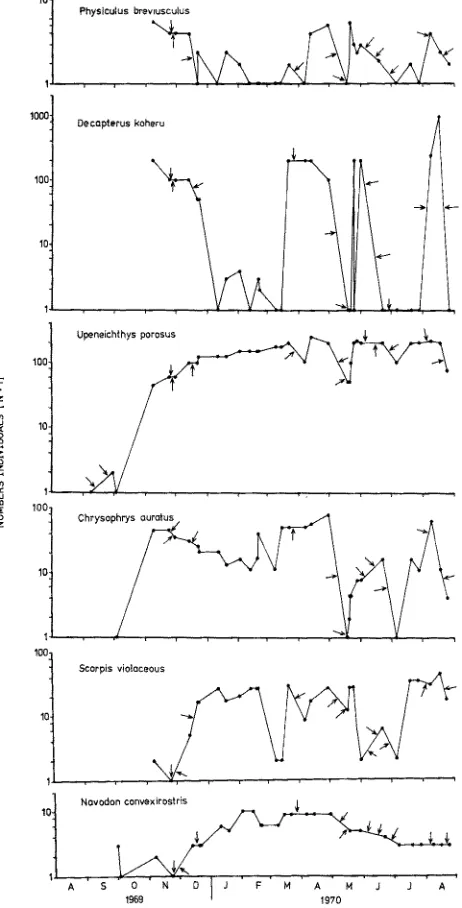
Several fishes were seen within days of laying the reef, but fishes did not become established until N o v e m b e r (71 days). These early inhabitants remained more or less as permanent residents. There was little change in species composition between surveys although the number of individuals fluctuated, mainly through the disruptive - dis- persive effects of storms (Fig. 4). Seven species of fish were classified as residents (Table 1).
Adult bastard red cod (Physieulus breviusculus) were first noted in N o v e m b e r
(71 days) living within the car tyres. However, this species m a y well have been a much earlier inhabitant as no thorough search of the inside of the tyres had been made
Tabte I
List of the resident fish species of the artificial reef
Family Species
Gadidae Carangidae Mullidae Sparidae Kyphosidae Mugiloididae BaIi~tidae
Physiculus breviusculus (RICHARDSON)
Decapterus koheru (HEcToR)
Upeneichthys porosus (CuvIER)
Chrysophrys auratus (BLOCH & SCHN~ID~:R)
Scorpis violaceous (t-IuT'rON)
Parapercis colias (Bt, ocr~ & SCt~NI~IDER)
Navodon convexirostris (GuEN'rHER)
previously. The cryptic daytime habits of this fish made it very difficult to obtain an accurate estimate of the population and numbers are likely to err on the low side.
The population of P. breviusculus (Fig. 4) appeared to decrease over the summer
months (December-Mar&) but increased again in May. Numbers therea~er tended
to decrease, rising again in August. Fluctuation in the numbers of P. breviuscMus
corresponded closely with the occurence of storms, although numbers are likely to
have been affected also by predation by the blue cod (Parapercis colias).
Juvenile koheru (Decapterus koheru) were also first seen in N o v e m b e r (71 days)
and a s&ool, usually of 100-200 individuals, of this mid-water plankton feeder was present on about half the surveys. Numbers, however, fluctuated (Fig. 4) partly due to rough weather and probably also because of observer error. At times it was apparent that the s&ool had simply ranged further from the reef and was missed in counts.
304 B.C. RUSSELL
the reef (Fig. 4). Only 45 adults were present in November (71 days) but with the recruitment of juveniles during December, numbers swelled and about 200 mixed sub- adults and adults were present by March (204 days). The U. porosus population
I hy.,cu,u b ...
1 , , ~ ,
100
I
Chrysophrys
our~us
10
I , , 1 0 0
I' l Novodon convexirost ris ~,
A S 0 N D 1 J ' F ' M ' A ' M J J A
1969 ~ 1970
Fig. 4: Fish census data. Changes in the numbers of individuals of six species with time. Note that the scale along the ordinate is Log. and all numbers are N + t. The arrows indicate storms
Development of an artificial reef community 305
remained more or less stable, although storms seemed to have a temporary dispersive effect and low numbers (50-100) were noted on several occasions.
Snapper (Chrysophrys auratus) were also early inhabitants and about 40 juveniles
(3-4 cm) had become established by November (71 days). These fishes remained and had grown to about 8 cm by August. A few adult snapper were present at various
times and have been included in the counts (Fig. 4). Numbers of C. auratus declined
over the summer months but increased again in February and Aprii, reaching a maximum (243 days). The population then declined markedly during the winter and showed wide fluctuation between surveys. Tubeworms and barnacles were fed upon
heavily by C. auratus, and changes in the snapper population reflect well the pattern
of settlement - growth - decline of these two species of sessile organism (cf. Fig. 3). Short term fluctuation in numbers were mainly the result of storms.
Blue maomao (Scorpis violaceous) aggregated above the reef and fed on plankton.
A single adult was first seen in November (71 days) but was not present on subsequent
surveys in the same month. Four adult S. violaceous were seen in mid-December (107
days) and by January (134 days) numbers had risen to 25. There was some decline in the population during May and July but this was followed by an increase later in
July and in August. Much of the fluctuation in the population of S. violaceous,
particularly decre:~sed numbers, can be attributed to the disorientating-dispersing effects of storms (Fig. 4), but on several occasions the aggregation had probably just ranged more widely and may have been missed. Juveniles were observed on several occasions sheltering close to the tyres but they were only temporary inhabitants and were not included in the census totals.
A single adult blue cod (Parapercis colias) was a relatively late arrival and did
not appear until December (114 days). This fish remained on the reef for nearly 8 months but was absent on the final survey in August 1970, following a heavy storm
just a few days before. A single juvenile P. colias was present on one survey in March
(119 days) but appeared to be only a temporary inhabitant. P. colias is a voracious
carnivore and followed the observer about during surveys, snapping at any small crustaceans and fishes which were disturbed.
Leatherjacket (Navodon convexirostris) were late colonisers. Adults were noted as
early as September (33 days) and in November (87 days) but there were no permanent residents until December (107 days) when 2 sub-adults inhabited the reef. By January (134 days) there were 5 sub-adults and by the beginning of February (156 days) numbers had risen to 9. However, 2 weeks later (173 days) only 5 leatherjacket remained. In March (197 days) these were joined by 3 more individuals which con- tinued to inhabit the reef until the end of April (243 days). Numbers then declined
and on the final survey in August 1970 only 2 sub-adult N. convexirostris remained
on the reef. In general the pattern of the population of N. convexirostris (Fig. 4) re-
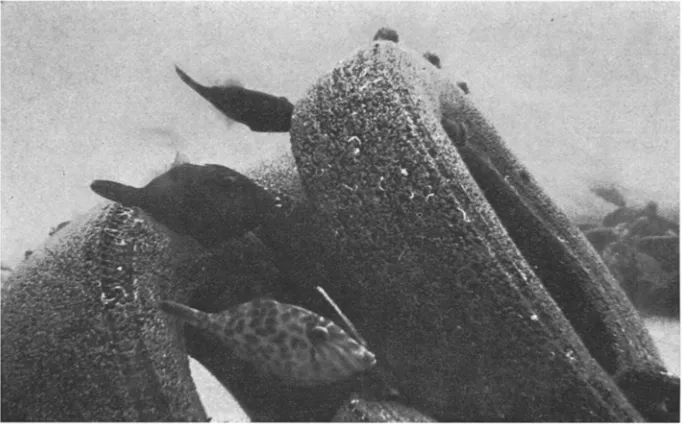
flected the pattern of growth and subsequent recession of barnacles (cf. Fig. 3). Leather- jacket fed extensively on barnacles (Fig. 5) and occasionally picked at jellyfish and ctenophores above the reef.
Non-resident fishes seen on or near the artificial reef included: Torpedo fairchildi
(Torpedinidae); Leptognathus novaezelandiae (Ophichthyidae); Zeus austratis (Zei-
306 B.C. RUSSELL
landi, Arripis trutta (Carangidae); Pernpheris adspersa (Pempheridae); Paristiopterus labiosus (Pentacerotidae); Nemadactylus douglasii (Cheilodactylidae); Genyagnus monopterygius (Uranoscopidae); Zeablennius laticlavius (Blenniidae); Forsterygion capito, Forsterygion variurn, Forsterygion sp., Notoclinops bucknilli, Gilloblennius decemdigitatus (Tripterygiidae), Scorpaena cardinalis (Scorpaenidae); and Mola mola
(Molidae). Zeus australis was a regular visitor. This roving piscivore occurred on 10
Fig. 5: A group of leatherjacket, Navodon convexirostris, feeding on recently settled Balanus
trigonus on one of the tyres of the artificial reef
of the surveys and was frequently seen stalking the school of Decapterus koheru above
the reef. Some species (Torpedo fairchildi, Leptognathus novaezelandiae, Seriola la-
landi, Arripis trutta, Paristiopterus labiosus, Nernadactylus douglasii, Genyagnus mo- nopterygius, Mola mola) were recorded only once or twice and were probably only
transients. Except for the tripterygiids and Zeablennius laticlavius, the remaining
fishes were all juveniles. They appeared to be "castaways" and were temporary inhabitants. Disorientated and dispersed from their usual rocky reef habitats by storms, they probably driRed over the barren sandy bottom, perhaps being carried along with flotsam, until they encountered the artificial reef by chance. These smaller co-
Ionisers were probably an important source of prey for the blue cod, Parapercis
col&s, and this may explain their failure to become established as permanent residents.
S t a n d i n g c r o p o f f i s h e s
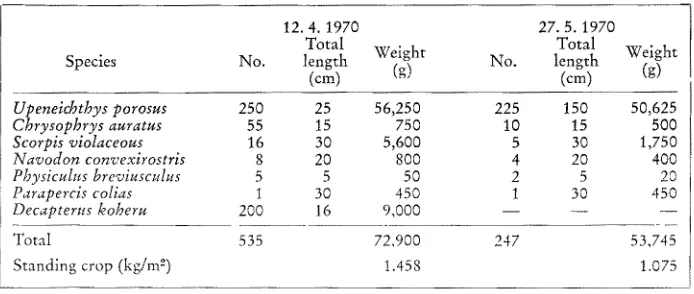
D e v d o p m e n t of an artificial reef community 307 good visibility allowed accurate censusing, and calm weather which preceded the surveys ensured that the population was stable. In computing standing crop, the bottom area was taken as 50 m 2 (this included the adjacent sand as welI as the reef itself) and only long term resident species were included in the analysis. Results of the biomass and standing crop estimates are shown in Table 2.
Table 2
Population, biomass and standing crop estimates of fishes on the artificial reef. Only resident species have been included in the analysis. Area of reef and adjacent sand surveyed taken as
50 m ~° (two surveys: 12.4. 1970 and 27. 5. 1970)
12.4. 1970 27. 5. 1970
Total Total Weight
Species No. length Weight No. length
(cm) (g) (cm) (g)
Upenelchthys porosus 250 25 56,250 225 150 50,625
Chrysophrys auratus 55 15 750 10 15 500
Scorpis violaceous 16 30 5,600 5 30 1,750
Navodon convexirostris 8 20 800 4 20 400
Physiculus breviusculus 5 5 50 2 5 20
Parapercis colias 1 30 450 t 30 450
Decapterus koheru 200 16 9,000 - - - - ---
Total 535 72,900 247 53,745
Standing crop (kg/m -~) 1.458 1.075
Fewer fishes were present on the survey made in M a y and this also accounted for the lower biomass of fishes compared with the A p r i i survey. O n both surveys, how- ever, red mullet (Upeneichthys porosus) comprised the bulk of the biomass and accounted for 77 0/0 and 94 °/0 of the total weight of fishes respectively.
D I S C U S S I O N
308 B.C. RUSSELL
a secondary cover of the hydroid Plurnularia sp. may indicate the beginning of true
biotic succession. This stage was reached near the end of the first year.
The pattern of development of the epifauna shows obvious similarities to the early stages of community development on artificial substrates described by TURNER et al. (1969) and FACER (1971). FAOER has pointed out that vectorial factors, espe- cially water movement, were important in the formation and maintenance of the communities he studied. The common pattern of settlement-growth-catastrophic mor- tality seen to varying degrees in all the sessile organisms of the car tyre reef can like- wise be largely attributed to the effects of water movement. That biotic succession beyond an early stage did not occur during the first year at least, is a result of this pattern of development and it is likely that water movement would continue to be a major factor limiting further growth of the community. The community would thus seem to be "physically controlled" (SANDERS, t968) and can be regarded as not having attained its probable real biotic potential.
Colonisation of the reef by mobile invertebrates and by fishes followed a different pattern to that of the sessile fauna, and more or less permanent populations of both components of the community had become established within two months. The number of fish species did not increase, but the number of individuals fluctuated, mainly as a
result of storms. In the case of P. breviusculus predation also is likely to have been
significant. Storms probably have two effects: severe wave action causes disorientation and dispersal and is the most probable cause of the sudden decrease in the numbers of some species. But in the same manner, storms may be important in the dispersal of organisms to the reef. A number of reef colonisers were associated with storm flotsam and other drii°c material that fouled the tyres, and in this way the early establishment of anemones, hermit crabs, gastropods and some of the smaller fishes seemed to occur. Even the larger fishes which took up residence on the reef probably arrived as refugees. This might also explain why colonisation of the reef was primarily by adult and sub-adult fishes rather than by juveniles or newly-metamorphosed larvae. It probably also explains the fairly rapid recovery of numbers following storms.
CARLISLE et al. (1964) have suggested that the presence of food and shelter "attracts" fishes to artificial reefs, but this seems unlikely. The fact that most rocky reef fishes have only a limited range of movement and rarely venture beyond visual distance from their home reef tends to argue against the possibility that a habitat some distance away could be located in the course of normal activities. Only in the case of the occasional visits by some of the more widely ranging predatory species could the presence of food per se be considered as an attractant to fishes. Food is likely to have been important though, in facilitating the establishment of colonisers. This was clear
in the case of both C. auratus and N. convexirostris which fed mainly on encrusting
Development of an artificial reef community 309 served as a refuge from predators. On one occasion the school of D. koheru was seen sheltering close to the reef when threatened by a group of kingfish Seriola lalandi. At night many diurnally active fishes seek cover or move close to the bottom (RussELL, in preparation) and the availability of shelter at this time m a y decisively affect survival (e.g. HOBSON 1968).
Perhaps the most distinctive feature of the artificial reef was the very large concentration of fishes. An average of nearly 300 fishes lived on or about the artificial reef in an area of about 50 m 2. In terms of standing crop, this was at least I0 to 14 times greater than for nearby r o & y reef areas (Table 3).
Table 3
A comparison of the standing crop of fishes on the artificial reef with standing crop estimates made on nearby natural reefs. Transient fishes have been excluded from the natural reef stand-
ing crop estimates
Area Date Depth Type of No. of Standing crop
(m) bottom species (kg/m~)
Artificial reef 12. 4. 1970 20 rubber tyres 8 1.458
27. 5. t970 7 1.075
Area B 6. 1 I. I970 12-17 broken rock, algal canopy 17 0.071
AreaB 8. 2. 1972 18 0.103
Area C 2. 2. 1972 3-20 rock face, boulders 18 0.101
These results are consistent with other studies of artificial reefs. CLARKE et al. (1967) for example, observed an increase in the biomass of fishes around the under- water habitat Sealab II of almost 35 times that of the normal sandy bottom, al°cer only 43 days. The results of work by RANDALL (t963) and FAST & PAGAN-FoNT (I973) on artificial reefs in the Caribbean are equally as striking. They reported eleven and ninefold differences respectively, in the standing crop of fishes on artificial reefs compared with nearby natural reefs. RANDALL suggested that the much greater biomass associated with his artificial reef was due largely to the proximity of the seagrass beds that surrounded the reef. These beds were fed upon at night particularly by grunts (Pomadasyidae), which sheltered on the reef by day and dominated the fish population both in number and weight.
310 B.C. RUSSELL
(i.e. 25 m 2) this gives a standing crop of 0.082 kg/m ~ and 0.055 kg/m 2 respectively, these figures being much closer to standing crop estimates obtained for nearby rocky reef areas (Table 3). The bulk of the fish biomass associated with the reef was con- tributed by fishes living and feeding about the periphery.
Peripheral-living species appear to account for the high concentrations of fishes and may explain the high angler success reported for artificial reefs in the United States (TI3RNEr, et al., 1969; BUCHANAN, 1973; STONr et al., 1974). Sand bass (Parala-
brax nebulifer), for example, a species inhabiting "sand-rock ecotones", formed a
major portion of the fish fauna of southern Californian artificial reefs (TURNER et al.) 1969). Similarly, in Hawaii, where some reefs have been fished commercially, a large part of the fish yield has comprised sand dwelling mullids (MoRRIs, 1967).The apparent predominance of peripheral-living species in these artificial reef fish populations suggests that reef food resources are less important than has been postulated by some workers (e.g. COt3STALIN, 1972) and that high fish biomasses may be dependent more on the provision of shelter than on food. However, the very high fish standing crops reported so far have been for comparatively small artificial reefs. Paradoxically it seems that small reefs have greater numbers of fish per unit area associated with them than have larger reefs, but this may be because peripheral-living species tend to be a dominant component of the fish populations of smaller reefs. With an increase in the size of the reef, the area of the peripheral habitat will be propor- tionately smaller and it is likely that the overall standing crop of fishes would be less. This suggests that there may then be an optimum size for artificial reefs whereby the standing crop of fishes would be maximised. On the basis of results of experiments with different reef structures TURNER et al. (1969) concluded that for reefs capable of sustaining sportfishing "the overall reef should cover a broad area . . . and incorporate into its configuration large open spaces . . . " . Further investigation of the relationship between reef area and fish biomass may provide a rational basis for improving fishing in so called "non-productive" inshore coastal areas.
SUMMARY
1. The development of the community of a small artificial reef built from car tyres was investigated by SCUBA diving over a 12 month period. It was sited on a sandy bottom at a depth of 20 m on the coast of north-eastern New Zealand.
2. Seasonal settlement by sessile organisms occurred in a number of well defined stages (serpulid tubeworms, barnacles, bryozoans, Lithothamnion, hydroids). The reef was colonised by small mobile invertebrates - notably gastropods, hermit crabs, mysids and shrimps - as well as by fishes.
D e v e l o p m e n t of a n artificial reef c o m m u n i t y 311
4. Seven species of fish were more or less p e r m a n e n t residents. There was little seasonal change in the n u m b e r of fish species b u t fluctuation in the n u m b e r s of i n d i v i d u a l s occurred, b r o u g h t a b o u t m a i n l y b y the effects of storms, a n d in some cases also b y p r e d a t i o n a n d the a v a i l a b i l i t y of food.
5. S t a n d i n g crop estimates of the fishes were 1,458 a n d 1.075 k g / m 2, or a b o u t 10-14 times greater t h a n that o f n e a r b y n a t u r a l reefs. T h e b u l k of the fish biomass, h o w - ever, was c o n t r i b u t e d b y a single species (Upeneichthys porosus) which i n h a b i t e d the a d j a c e n t sand a n d was n o t directly s u p p o r t e d b y the reef itself.
Acknowledgements. I am grateful to Prof. J. E. MORTOI~ under whose guidance this study
was made, and to Dr. W. J. BALLANTINE for extending to me the facilities of the Leigh Marine Laboratory. Thanks are due also to Mr. A. M. AYLINO, Mr. J. R. EvaNs, Dr. R. V. GRACE and Dr. M. F. LARCOM~E for diving assistance. Dr. F. H. TALI3OT, Dr. J. R. PaXTON and Mr. G. R. V. ANDERSON kindly criticised various dra1% of the manuscript. This work formed part of a thesis submitted for the degree of Master of Science at the University of Auckland.
L I T E R A T U R E C I T E D
AYL1NG, A. M., 1968. The ecology of sublittorai ro& surfaces in northern New Zealand. Thesis,
Univ. Au&land (unpubI.).
BROCg, V. E., 1954. A preliminary report on a method of estimating reef fish populations. J. Wildl. Mgmt 18, 197 308.
BUCHANAN, C. C., 1973. Effects of an artificial habitat oil the marine sport fishery and economy of Murrells Inlet, South Carolina. Mar. Fish. Rex'. 35 (9), 15 22.
CARLISLE, J. G., TURNEI',, C. H. & EBERT, E. E., 1964, Artificial habitat in the marine environ- went. Calif. Fish Game 124, 1-94.
CLARJ;, T. A., FI.ECHSm, A. O. & GJ~IcG, R. W., 1967. Ecological studies during project Sealab II. Science, N.Y. 157, 1381-1389.
COUSVALIN, J. B., 1972. M&hodologie exp&imentale en rue de la crdation des r&ifs artificiels. T&hys 3, 827-840.
CRIse, D. J. & RVLAND, J. S,, 1960. Influence of filming and of surface texture on the settle- ment of marine organisms. Nature, Lond. 185, 1I 9.
FAGER, E. W., 1971. Pattern in the development of a marine community. LimnoI. Oceanogr. 16, 241-253.
FAST, D. E. & PAeAN-FoNT, F. A., 1973. Observations on an artificial reef of used vehicle tyres (Abstr.). Meet. Ass. Ish mar, Labs Caribb. 10, 57.
HOBSON, E. S., i968. Predatory behaviour of some shore fishes in the Gulf of California. Res. Rep. U.S. Fish. Wildl. Serv. 73, 1-92.
LARCOMBE, M. F. & RUSSELL, B. C., 1971. Egg laying behaviour of the broad squid Sepioteu-
this bilineata. N.Z. J1 mar. Freshwat. Res. 5, 3-11.
MoRRIs, D. E., 1967. Sea sled and SCUBA reconnaissance inshore areas and studies on the effects of artificial shelters on standing crops of fishes. Job Completion Rep. t966. Div. Fish Game, Hawaii (unpubl.).
OR~N, O. H,, 1968. Artificial reefs - review and appeal. F.A.O. Fish. Circ. 305, 1-8.
RANDALL, J. E., 1963. An analysis of the fish populations of artificial and naturaI reefs in the Virgin Islands. Caribb. J. Sci. 3, 31-47.
RussElL, B. C., 1971a. Artificial reef. Dive 11 (3), 16-18.
- - 197ib. Ecological relationships of ro&y reef fishes of north-eastern New Zealand. Thesis, Univ. Auckland (unpubl.).
312 B . C . RUSSELL
STEIMLE, F. • STONE, R. B., 1973. Bibliography on artificial reefs. Publ. Coastal Plains Cent.
mar. Dev. Serv. 73 (2), 1-129.
STONE, R. B., BUCHANAN, C. C. & STrIMLE, F. W. JR., 1974. Scrap tires as artificial reefs. Suture. Rep. U.S. Environment. Prot. Ag. SW-119, 1-33.
TURNER, C. H., EBERT, E. E. & GIVEN, R. R., 1969. Man-made reef ecology. Calif. Fish Game 146, 1-221.
Author's address: B. C. Rossrrr