https://doi.org/10.5194/se-9-223-2018
© Author(s) 2018. This work is distributed under the Creative Commons Attribution 4.0 License.
Structural disorder of graphite and implications for
graphite thermometry
Martina Kirilova1, Virginia Toy1, Jeremy S. Rooney2, Carolina Giorgetti3, Keith C. Gordon2, Cristiano Collettini3, and Toru Takeshita4
1Department of Geology, University of Otago, P.O. Box 56, Dunedin 9054, New Zealand 2Department of Chemistry, University of Otago, P.O. Box 56, Dunedin 9054, New Zealand 3Dipartimento di Scienze della Terra, Università degli Studi La Sapienza, Rome, Italy 4Faculty of Science, Earth and Planetary Sciences, Hokkaido University, Sapporo, Japan
Correspondence:Martina Kirilova ([email protected]) Received: 11 July 2017 – Discussion started: 20 July 2017
Revised: 22 December 2017 – Accepted: 21 January 2018 – Published: 27 February 2018
Abstract. Graphitization, or the progressive maturation of carbonaceous material, is considered an irreversible process. Thus, the degree of graphite crystallinity, or its structural or-der, has been calibrated as an indicator of the peak metamor-phic temperatures experienced by the host rocks. However, discrepancies between temperatures indicated by graphite crystallinity versus other thermometers have been docu-mented in deformed rocks. To examine the possibility of me-chanical modifications of graphite structure and the potential impacts on graphite “thermometry”, we performed labora-tory deformation experiments. We sheared highly crystalline graphite powder at normal stresses of 5 and 25 megapas-cal (MPa) and aseismic velocities of 1, 10 and 100 µm s−1. The degree of structural order both in the starting and result-ing materials was analyzed by Raman microspectroscopy. Our results demonstrate structural disorder of graphite, man-ifested as changes in the Raman spectra. Microstructural observations show that brittle processes caused the docu-mented mechanical modifications of the aggregate graphite crystallinity. We conclude that the calibrated graphite “ther-mometer” is ambiguous in active tectonic settings.
1 Introduction
Organic matter, preserved in sedimentary rocks, can be trans-formed into crystalline graphite due to structural and compo-sitional changes during diagenesis and metamorphism, a pro-cess known as graphitization (Bonijoly et al., 1982; Wopenka
and Pasteris, 1993; Beyssac et al., 2002a, b, 2003; Buseck and Beyssac, 2014; etc.). Graphitization is thought to be an irreversible process and graphite is known to remain stable to the highest temperatures of granulite facies and the high-est pressures of coesite–eclogite facies (Buseck and Beyssac, 2014). It is generally accepted that the degree of graphite crystallinity, or its structural order, is determined mainly by the maximum temperature conditions experienced by the host rocks, whereas lithostatic pressure and shear strain are considered to have only minor influence on graphitization (Bonijoly et al., 1982; Wopenka and Pasteris, 1993; Bustin et al., 1995). Therefore, graphite crystallinity has been cali-brated as an indicator of the peak temperatures reached dur-ing progressive metamorphism (Beyssac et al., 2002a; Re-itmeijer and McKinnon, 1985). However, in strained rocks discrepancies between temperatures indicated by the crys-tallinity of graphite vs. other thermometers have been re-ported (Barzoi, 2015; Nakamura et al., 2015; Kirilova et al., 2017). Thus, numerous authors have speculated that tectonic deformation results in graphite structural modifications that challenge the validity of the existing graphite thermometers (Large et al., 1994; Bustin et al., 1995; Crespo et al., 2006; Barzoi, 2015; Nakamura et al., 2015).
2011), the Err Nappe detachment fault, Switzerland (Man-atschal, 1999), and the KTB borehole, Germany (Zulauf et al., 1990). In these intensely deformed rocks its presence is of particular interest because its low friction coefficient of
µ∼0.1 (Morrow et al., 2000) allows graphite to act as a nat-ural solid lubricant (Savage, 1948). The mechanical behavior of graphite has been broadly investigated in both natural and experimental specimens, where it manifests with the lowest µ among sheet structure minerals (Moore and Lockner, 2004; Oohashi et al., 2011, 2013; Rutter et al., 2013; Kuo et al., 2014, etc.), confirming it could have a significant impact on fault mechanics. It has been experimentally proven that even a small fraction of graphite can have a disproportionally large effect on frictional strength where graphite is concentrated by smearing into interlinked layers (Rutter et al., 2013).
However, structural changes in crystalline graphite caused by tectonic deformation have not yet been systematically ex-plored. To examine this aspect and to investigate the potential impacts of structural disordering of graphite on the graphite thermometer, we have carried out laboratory deformation ex-periments on highly crystalline graphite powder.
2 Experimental methods 2.1 Sample description
As a starting material in the current study we used synthetic (commercially synthesized) graphitic carbon to avoid com-plexities arising from a variable degree of crystallinity in nat-ural carbon materials. Initially, the material was crushed to average grain size of 100 µm in a Rocklabs swing (TEMA) mill. The resulting fine graphitic powder was annealed at 700◦C for 2 hours in a Lindberg Blue M muffle furnace to
achieve full graphitization, which is known to occur at this temperature in the absence of other variations in physical conditions (Buseck and Beyssac, 2014). This was used as the starting material for the deformation experiments.
2.2 Experimental procedure
In total, 10 deformation experiments were performed at room temperature and room humidity in the Brittle Rock deformA-tion Versatile Apparatus (BRAVA) (Collettini et al., 2014), at the INGV, Rome. For each experiment two 3 mm- thick layers of synthetic graphite gouges were placed in between three grooved forcing blocks in a double-direct shear con-figuration (Dieterich, 1972). The two side blocks are held stationary and the central forcing block is driven downward causing shearing to occur within the graphite gouge layers. Normal stress is applied by the horizontal piston in load feedback control mode and shear displacement is accom-plished when the vertical piston is in displacement-feedback control mode. Forces are measured with stainless steel load cells (±0.03 kN) and displacements are measured with lin-ear variable differential transformers(LVDT) (±0.1 µm)
at-tached to each piston. Experiments have been conducted at normal stresses of 5 or 25 MPa and aseismic sliding veloci-ties of 1, 10 and 100 µm s−1. The experiments were carried out to total displacements of 20 mm. In addition, some exper-iments were stopped at 5 and 10 mm and the specimens were then recovered to reveal graphite structural changes that took place during different amounts of total deformation. The co-efficient of friction (µ) was calculated as the ratio of mea-sured shear load to meamea-sured normal load (µ=τ/σn, where
τ is shear stress andσnis effective normal stress). The aver-age shear strain within the layer was calculated by dividing shear displacement increments by the measured layer thick-ness and summing it up. The displacement values of the ver-tical and horizontal load points were corrected for the elastic stretch of each load frame, taking into account that the ma-chine stiffness is 1283 kN mm−1on the horizontal axis and 928.5 kN mm−1on the vertical axis. In addition, we calcu-lated total frictional work for each experiment as a function of shear stress integrated over the total displacement (Beeler, 2007).
2.3 Raman microspectroscopy
Raman spectra of graphite were measured by an Alpha 300 R+ confocal Raman microscope (WITec, Ulm, Germany) with a 532 nm laser (Coherent, Santa Clara, California), lo-cated at the Department of Chemistry, University of Otago, New Zealand. The laser (3.0 mW) was focused on the sam-ples with a 50× Zeiss objective. The scattered light was dispersed with a 1200 g mm−1grating. The combination of the 50×objective and 532 nm laser wavelength produced a laser spot size of approximately 412 nm in diameter. The in-tegration time of each spectrum was 2 s with 50 co-additions (100 s in total). The spectra were calibrated using the Raman band from a silicon wafer prior to each set of measurements. The collected spectra were pre-processed in Grams AI 9.1 (Thermo Fisher Scientific Inc.), where cosmic spikes were removed and a multi-point linear baseline offset was performed. This was followed by peak fitting three Lorentzian/Gaussian functions to each spectrum with a lin-ear baseline over 1000–1700 cm−1. For each spectrum, the area ratio was calculated (R2=AD1/(AG+AD1+AD2), whereAi is the area of theith peak, G band is the main high-frequency band of graphite, and D1 and D2 bands are defect bands observed in the first-order Raman spectrum of graphite) (Wopenka and Pasteris, 1993; Beyssac et al., 2002a).
2.4 Scanning electron microscopy
(sections Y−Z), with a Zeiss Sigma field emission scan-ning electron microscope (VP FEG SEM) at the Otago Cen-tre for Electron Microscopy (OCEM), University of Otago, New Zealand. The instrument was operated in variable pres-sure mode (VP) at 15 kV using a working distance (WD) of 7–8 mm and a VP-mode secondary electron (VPSE) detec-tor. In addition, polished thin sections cut perpendicular to the surface of contact with the center and side forcing blocks (sectionsX−Z) were imaged on a JEOL JSM-6510 SEM at the University of Potsdam, Germany, where high-resolution secondary electron images were collected at 20 kV and a WD of 10 mm.
2.5 Transmission electron microscopy
Transmission electron microscopy (TEM) was used for de-tailed microstructural characterization of the shiny surfaces. High-resolution TEM images were collected by using a JEM-2010 electron microscope, located at the University of Hokkaido, Sapporo, Japan. The instrument was oper-ated at 200 kV with LaB6 filament. TEM foils (with a size of 12×5 µm and thickness of 1 µm) milled by a focused ion beam (FIB) perpendicular to the shiny surface (sections
X−Z) were placed on a carbon-coated film and examined by using a dual-axis tilting holder.
3 Results
3.1 Mechanical data
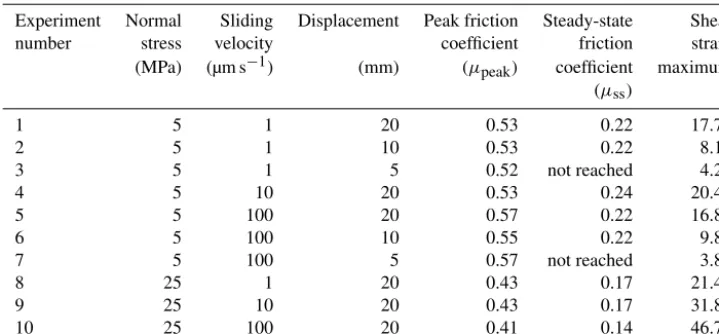
Our experiments allowed us to investigate graphite mechani-cal behavior and structural modifications under various slid-ing velocities, normal stresses and shear strain. These con-ditions are summarized in Table 1. The estimated total fric-tional work for each experiment is shown in Table 2. 3.1.1 Friction variations
Over several millimeters of displacement, the friction coef-ficient shows a similar evolution trend in all experiments. On a plot of friction coefficient vs. displacement (Fig. 1a), the friction coefficient (µ) delineates a curve characterized by a rapid increase to an initial peak friction coefficient (µpeak), followed by a subsequent exponential decay towards a steady-state friction coefficient (µss)over a slip- weakening distance. The shapes of the friction-displacement curves vary with the normal stress applied and are steeper for the experi-ments conducted at 25 MPa than the ones at 5 MPa (Fig. 1a) because the displacement required to achieve steady-state de-creases at higher normal stress. In addition, the values of both
µpeak andµss (Fig. 1a; Table 1) are significantly lower in the experiments at 25 MPa (µpeak= ∼0.4;µss= ∼0.1) than in the experiments at 5 MPa (µpeak= ∼0.5; µss= ∼0.2), whereµss values were read at the end of each experiment. Plots ofµat all sliding velocities (Fig. 1a) show subtle
vari-Figure 1.Plots of mechanical data:(a)friction coefficient (µ) vs. displacement;(b)friction coefficient (µ) vs. shear strain;(c)layer thickness vs. displacement.
ations inµpeak andµss with a change in the applied sliding velocities (Fig. 1a; Table 1).
3.1.2 Shear strain variations
Table 1.Summary of the conditions at which experiments were carried out and results.
Experiment Normal Sliding Displacement Peak friction Steady-state Shear number stress velocity coefficient friction strain (MPa) (µm s−1) (mm) (µpeak) coefficient maximum
(µss)
1 5 1 20 0.53 0.22 17.70
2 5 1 10 0.53 0.22 8.17
3 5 1 5 0.52 not reached 4.23
4 5 10 20 0.53 0.24 20.45
5 5 100 20 0.57 0.22 16.89
6 5 100 10 0.55 0.22 9.80
7 5 100 5 0.57 not reached 3.87
8 25 1 20 0.43 0.17 21.45
9 25 10 20 0.43 0.17 31.86
10 25 100 20 0.41 0.14 46.77
shear strains achieved during the 5 MPa experiments are ap-proximately half of those at 25 MPa (Fig. 1b; Table 1). In addition, the experiments at 25 MPa demonstrate a dramatic increase in shear strain with increasing slip velocity (Fig. 1b; Table 1), whereas at low normal stress we do not observe any systematic variations associated with changes in sliding velocities (Fig. 1b, c and d).
3.2 Raman spectra of graphite
All the experiments resulted in the development of shiny smooth surfaces with gentle slickenlines (macroscopic fine grooves, parallel to the slip direction as defined by Toy et al., 2017). Raman spectra obtained on the top of the surfaces that had accommodated most of the induced deformation, are compared to Raman spectra from the starting material.
Raman data from 20 spectra per sample are presented in the Supplement (S1). Representative spectra for each sample are illustrated in Fig. 2, which shows spectra displaying the least (left column) and the most (right column) disordered graphite within a sample, i.e., lowest and highestR2 values respectively. Spectra that were typical of the average for each sample are also presented (middle column). Experiments 3 and 7 were stopped at only 5 mm displacement and resulted in extremely fragile deformed surfaces, which were unable to be extracted without them breaking into pieces too small to obtain spectra from. Thus, Raman spectra were not measured in these experiments.
All the acquired spectra show typical G, D1 and D2 bands, respectively at∼1580,∼1350 and∼1620 cm−1(S1). Thus, we could calculate the area ratio R2 for each spectrum (Fig. 2; S1). Raman spectra collected from the starting mate-rial show R2 values ranging from 0 to 0.327 (Fig. 2; S1). Spectra acquired from the deformed surfaces show higher
R2 values (Fig. 2; S1). The most ordered graphite with
R2=0.330 was collected in Exp. 2 (Fig. 2; S1) while the
most disordered graphite withR2=0.661 resulted from Exp. 10 (Fig. 2; S1).
AsR2 values vary within a sample (Fig. 2; S1), we ex-amine average R2 values for each one and compare them with applied normal stress, sliding velocity, shear strain and total frictional work (Table 2). The starting material has an average ofR2pre-shear graphite=0.173, whereas all deformed samples have higher averageR2 values (Table 2). Analyz-ing the averageR2 values for deformed samples reveals that graphite is more disordered in the high normal stress exper-iments (Table 2) than in the experexper-iments at 5 MPa. Further-more, in the experiments at 25 MPa the averageR2 increases with increasing sliding velocities (Table 2). In contrast, at low normal stress, we do not observe any dependence of the degree of graphite structural order on the applied sliding ve-locities (Table 2). Overall, graphite appears as most disor-dered in the experiments where the highest shear strain was achieved (Table 2). The relationship between averageR2 and shear strain is illustrated in Fig. 3a by fitting a power func-tion with a correlafunc-tion coefficientR2=0.95. Fitting a power function to averageR2 and total frictional work did not show a consistent correlation (Fig. 3b). Experiments 2 and 6 at low normal stress, which were stopped at 10 mm displacement and accommodated the least amount of shear strain, contain the least disordered graphite (Fig. 3; Table 2).
3.3 Microstructural characteristics 3.3.1 Scanning electron microscopy (SEM)
Similar microstructural features were observed in all the formed samples. SEM images obtained from the sample de-formed during experiment 8 are presented to demonstrate our observations (Fig. 4).
Table 2.Summary of the relationship between shear strain, averageR2 and total frictional work within a sample. The conditions of each experiment are also given as follows: applied normal stress in MPa, sliding velocities in µm s−1and sliding displacement in mm. n/a – not applicable.
Sample Experimental conditions Shear AverageR2 Total frictional strain (error estimate±0.05) work
Pre-shear graphite n/a n/a 0.173
Exp. 2 5 MPa, 1 µm s−1, 10 mm 8.17 0.438 17.711 Exp. 6 5 MPa, 100 µm s−1, 10 mm 9.80 0.430 17.7506 Exp. 5 5 MPa, 100 µm s−1, 20 mm 16.89 0.454 32.0578 Exp. 1 5 MPa, 1 µm s−1, 20 mm 17.70 0.506 25.885 Exp. 4 5 MPa, 10 µm s−1, 20 mm 20.45 0.517 30.5943 Exp. 8 25 MPa, 1 µm s−1, 20 mm 21.45 0.520 96.6089 Exp. 9 25 MPa, 10 µm s−1, 20 mm 31.86 0.580 92.4834 Exp. 10 25 MPa, 100 µm s−1, 20 mm 46.77 0.604 87.703
Figure 2. Representative Raman spectra illustrating(a)the most structurally ordered graphite within a sample;(b)graphite with av-erage structural order per sample;(c)the most disordered graphite encountered in each sample. TheR2 ratio for each spectrum (with an error estimate±0.05) is noted in italic font.
Figure 3.Plot of the averageR2 ratio per sample vs.(a)the appar-ent shear strain accumulated during each experimappar-ent, and(b) the total frictional work estimated for each experiment.
Figure 4.SEM images, obtained from the deformed graphite gouge during experiment 8 (normal stress at 25 MPa with 1 µm s−1 slid-ing velocity), show the followslid-ing:(a)slickenlines ornamenting the shear surface; (b, c) a well-compacted layer of aligned graphite grains, which make up the shear surface. Bright patches due to a differential charging effect;(d)a less deformed zone with typical cataclastic fabric, underlying the shear surface;(e) dilated cleav-age planes in large graphite grains filled with smaller platy graphite grains oriented sub-perpendicular to the shear direction; (f) frac-tured graphite grains.
is observed as a thin slip-localized zone, composed of a well-compacted layer of aligned graphite grains (Fig. 4c). This localized shear surface is underlain by a zone of randomly oriented, inequigranular, irregular graphite grains (Fig. 4d). In places, most of the graphite grains are aligned with their basal (001) planes parallel to the slip direction and form com-pacted layers, defining a weakly developed fabric (Fig. 4e). There has been some dilation along these cleavage planes and the spaces thus created are filled with smaller graphite grains with their (001) planes perpendicular to the shear di-rection (Fig. 4e). Locally, intensely fractured grains are also observed (Fig. 4f).
3.3.2 Transmission electron microscopy (TEM)
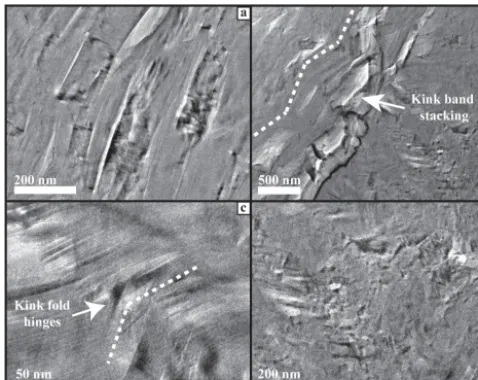
TEM was used to examine the microstructure of the mate-rial that makes up the shiny surfaces (Fig. 4c). TEM analy-ses were performed on foils cut perpendicular to this surface. Figure 5 shows characteristic TEM images obtained from the sample recovered from experiment 8.
Graphite grains in this well-compacted layer have basal planes predominantly aligned with the shear plane, as were observed in the SEM images. However, adjacent grains show slightly different orientations (Fig. 5a). In addition, kink-folded graphite grains are observed in multiple locations in the foils (Fig. 5b, c), which yields a “wavy layering” at a small angle to the shear direction (Fig. 5b). In isolated areas, there are also some smaller grain fragments with random ori-entation (Fig. 5d).
4 Discussion
4.1 Mechanical behavior
Graphite in our experiments shows mechanical behavior consistent with other mechanical studies of pure graphite gouges. Our results display lowµss values (from∼0.1 to ∼0.2; Table 1) as did the low-pressure deformation exper-iments of carbonaceous material performed by Morrow et al. (2000), Moore and Lockner (2004), Oohashi et al. (2011, 2013), Kuo et al. (2014) and Rutter et al. (2013). The low frictional strength of graphite is well known and has been at-tributed to its sheet structure composed of covalently bonded carbon atoms held together only by van der Waals forces. These weak interlayer bonds along (001) planes are eas-ily broken during the shearing process (Moore and Lock-ner, 2004; Rutter et al., 2013). Initial µpeak followed by strain weakening during deformation experiments of graphite gouges has been previously explained with the work involved in rotating the grains with their (001) planes sub-parallel to the shear surfaces, which puts them in the optimal position for shearing along the weak interlayer bonds (Morrow et al., 2000; Moore and Lockner, 2004; Rutter et al., 2013).
Figure 5.TEM images showing microstructural characteristics of the slip-localized shear surface:(a)aligned grains showing slightly different orientation;(b)kink band stacking;(c)dilated kink fold hinges;(d)fragmented grains.
4.2 Structural disorder of graphite
We evaluate the structural order of graphite by analyzing variations inR2 ratios, which depend on the increase of de-fect bands (D1 and D2) in the Raman spectrum of graphite. Previous studies have documented increases in R2 with de-creasing degree of graphite crystallinity (Wopenka and Pas-teris, 1993; Beyssac et al., 2002a, b). Therefore, our exper-imental study may demonstrate transformation of fully or highly crystalline graphite (with R2 ratios ranging from 0 to 0.327; Fig. 2; S1) into comparatively poorly organized graphitic carbon (with R2 ratios up to 0.661; Fig. 2; S1). However, we do not have direct evidence suggesting intra-granular deformation. Alternatively, the observed increase of defect bands is also likely to reflect an increase in the grain-boundary density (Tunistra and Koening, 1970; Pimenta et al., 2007). The latter is further supported by our microstruc-tural data that reveal the existence of fine graphite grains (ranging from 50 µm to nm-scale grains; Figs. 4, 5) which are significantly smaller in size than the average grain size of the starting material (100 µm). We interpret that shear de-formation caused intense grain size reduction and hence an increase in the grain-boundary density, which was reflected in the Raman spectra. This suggests a decrease in the overall aggregate crystallinity rather than intragranular deformation of individual graphite grains.
We also acknowledge that the slickenlined surfaces that were produced experimentally contain some graphite that yield spectra comparable to those acquired from the starting material, that is, there is highly ordered graphite that appears as unaffected by the deformation. However, at least some of these spectra are derived from undeformed graphite powder
that underlies the shear surfaces and could not be entirely re-moved during sample preparation due to the fragile nature of the samples. It is also possible that some non-deformed graphite powder was accidently measured through the frac-tures that are cross-cutting the accumulated shear surfaces (Fig. 4a). But even if some graphite did not undergo mechan-ical modification during the experiments, the results overall validate that structural disorder of graphite aggregates can re-sult from shear deformation subsequent to the graphitization process.
To understand the potential causes for the documented structural disorder of graphite aggregates, we compared the measured averageR2 with the parameters of the performed experiments. Our data show a good correlation between the averageR2 and the apparent shear strain at the tested aseis-mic sliding velocities (Fig. 3). However, these bulk shear strains (Table 1) are likely to be significantly lower than the shear strains accommodated within the thin shear surface and so we refer to the above relationship as a rough approxima-tion. Nevertheless, previous authors have also suspected that shear strain may play an important role for graphite modifi-cations and evidence for this has been found in graphite crys-tallinity variations in natural samples from active fault zones (Kirilova et al., 2017; Nakamura et al., 2015) and strained rocks in metamorphic terrains (Barzoi, 2015; Large et al., 1994). Thus, we speculate that deformation may control the final structural order of graphite aggregates. Consequently, the previously proposed model of progressive graphitization due to an increase in temperature does not completely reflect the graphite formation mechanisms. (Bonijoly et al., 1982).
However, crustal fault zones do not only accommodate brittle deformation. At higher temperatures and confining pressures, localized shearing can operate by crystal plas-tic mechanisms (White et al., 1980). We hypothesize that graphite structural order could be influenced by ductile defor-mation, as was also suggested in previous studies by Large et al. (1994), Bustin et al. (1995), and Barzoi et al. (2015). Fur-thermore, Kuo et al. (2014) and Oohashi et al. (2011) simu-lated fault motions in synthetic and natural carbonaceous ma-terial with a variable degree of maturity at the start of the ex-periments (ranging from amorphous carbonaceous material to crystalline graphite). Both studies reported graphitization of carbonaceous material due to localized frictional heating rather than structural disordering. These experiments reveal the impact of seismic velocities on graphite structural order. The fact that their findings differ so markedly from ours fur-ther highlights the complexity of graphite transformations in fault zones.
4.3 Implications for graphite thermometry
The structural order of graphite measured by Raman spec-troscopy has been applied as a thermometer that relies on progressive maturation of originally organic carbona-ceous material during diagenesis and metamorphism. Pre-vious studies have focused on calibrating this thermometer. The current best calibration is described by the following equation:T (◦C)= −445×R2+641±50 (Beyssac et al., 2002a) by inferring a linear correlation between the R2 ra-tio and peak metamorphic temperatures. However, this ther-mometer disregards the effects of mechanical modifications on the structure of graphite aggregates, which this study has identified as having a substantial influence on the R2 ratios in deformed graphite gouges at sub-seismic velocities.
Our experiments demonstrate an increase of theR2 ratio of initially highly crystalline graphite powder due to brittle deformation (Fig. 3a; Table 2). In natural analogues, the pre-shear graphite would yield temperatures up to 641±50◦C (S1), which is the upper limit of the calibrated thermome-ter (Beyssac et al., 2002a), whereas the sheared samples would indicate peak metamorphic temperatures as low as 347±50◦C (S1). Thus, we experimentally prove that in ac-tive tectonic settings graphite thermometers may underes-timate the peak metamorphic temperatures by < 300◦C. In cataclasites from the Alpine Fault zone, New Zealand (Kir-ilova et al., 2017) and fault zones of the Hidaka metamorphic belt, Japan (Nakamura et al., 2015), the graphite thermometer yields temperature discrepancies of more than 100◦C
com-pared to temperature estimates derived both from the sur-rounding high-grade amphibolite facies mylonites and the lower- grade equilibrium cataclastic phases (marked by chlo-rite alteration). Barzoi (2015) also described differences of ∼150◦C in graphite temperatures between strained and less strained low-grade metamorphic rocks from Parang Moun-tains, South Carpathians.
We conclude that the existing graphite thermometer is un-reliable in active tectonic settings. Furthermore, a calibra-tion of this thermometer may be impossible to achieve be-cause both structural disorder of graphite and graphitization (Oohashi et al., 2013) are likely to be encountered in fault zones.
5 Conclusions
We have experimentally demonstrated structural disorder of graphite aggregates, manifested as changes in the Raman spectra, by shearing highly organized graphite powder at aseismic sliding velocities insufficient to generate apprecia-ble frictional heat. Microstructural data presented here re-veal that this is a result of brittle processes. Our findings clearly compromise the validity of the calibrated graphite thermometer by showing it may significantly underestimate the peak metamorphic temperatures in active tectonic set-tings.
Data availability. Due to the large number of data they are avail-able upon request.
The Supplement related to this article is available online at https://doi.org/10.5194/se-9-223-2018-supplement.
Competing interests. The authors declare that they have no conflict of interest.
Acknowledgements. The research was funded by the Department of Geology, University of Otago, New Zealand and Rutherford Discovery Fellowship RDF-UOO0612 awarded to Virginia Toy. We also acknowledge the “Tectonics and Structure of Zealandia” subcontract to the University of Otago by GNS Science (under contract C05X1702 to the New Zealand Ministry of Business, In-novation and Employment). We thank our colleagues Gemma Kerr and Brent Pooley for assistance in sample preparation and Hamish Bowman for helping with data visualization. We also wish to express our gratitude to Laura Halliday for generously offering to perform grain size analysis on our samples at the Department of Geography, University of Otago, New Zealand. And last but not least, we thank Marco Scuderi for valuable discussions and assistance throughout the experimental procedures.
Edited by: Renée Heilbronner
Reviewed by: Oohashi Kiyokazu and Rüdiger Kilian
References
Parang Mountains (South Carpathians) – Implications to graphite geothermometry, Int. J. Coal Geol., 146, 179–187, 2015. Beeler, N. M.: Laboratory-observed faulting in intrinsically and
ap-parently weak materials: Strength, seismic coupling, dilatancy, and pore-fluid pressure, The Seismogenic Zone of Subduction Thrust Faults, 370–449, 2007.
Beyssac, O., Goffé, B., Chopin, C., and Rouzaud, J. N.: Ra-man spectra of carbonaceous material in metasediments: a new geothermometer, J. Metamorph. Geol., 20, 859–871, 2002a. Beyssac, O., Rouzaud, J. N., Goffé, B., Brunet, F., and Chopin, C.:
Graphitization in a high-pressure, low-temperature metamorphic gradient: a Raman microspectroscopy and HRTEM study, Con-trib. Mineral. Petr., 143, 19–31, 2002b.
Beyssac, O., Brunet, F., Petitet, J. P., Goffé, B., and Rouzand, J. N.: Experimental study of the microtextural and structural transfor-mations of carbonaceous materials under pressure and tempera-ture, Eur. J. Mineral., 15, 937–951, 2003.
Bonijoly, M., Oberlin, M., and Oberlin, A.: A possible mechanism for natural graphite formation, Int. J. Coal Geol., 1, 283–312, 1982.
Buseck, P. R. and Beyssac, O.: From organic matter to graphite: Graphitization, Elements, 10, 421–426, 2014.
Bustin, R. M., Ross, J. V., and Rouzaud, J. N.: Mechanisms of graphite formation from kerogen: experimental evidence, Int. J. Coal Geol., 28, 1–36, 1995.
Collettini, C., Di Stefano, G., Carpenter, B., Scarlato, P., Tesei, T., Mollo, S., Trippetta, F., Marone, C., Romeo, G., and Chiaraluce, L.: A novel and versatile apparatus for brittle rock deformation, Int. J. Rock Mech. Min., 66, 114–123, 2014.
Crespo, E., Luque, F. J., Barrenechea, J. F., and Rodas, M.: Influ-ence of grinding on graphite crystallinity from experimental and natural data: implications for graphite thermometry and sample preparation, Mineral. Mag., 70, 697–707, 2006.
Kirilova, M., Toy, V., Timms, N., Halfpenny, A., Menzies, C., Craw, D., Beyssac, O., Sutherland, R., Townend, J., Boulton, C., Carpenter, B., Cooper, A., Grieve, J., Little, T., Morales, L., Morgan, C., Mori, H., Sauer, K., Schleicher, A., Williams, J., and Craw, L.: Textural changes of graphitic carbon by tectonic and hydrothermal processes in an active plate boundary fault zone, Alpine Fault, New Zealand, in: Geological Society, Lon-don, Special Publication “Advances in the Characterization of Ore-Forming Systems from Geological, Geochemical and Geo-physical data”, edited by: Gessner, K., Blenkinsop, T. G., and Sorjonen-Ward, P., 453 SP453-13, 2017.
Kuo, L. W., Li, H., Smith, S. A., Di Toro, G., Suppe, J., Song, S. R., and Si, J.: Gouge graphitization and dynamic fault weakening during the 2008 Mw 7.9 Wenchuan earthquake, Geology, 42, 47– 50, 2014.
Large, D. J., Christy, A. G., and Fallick, A. E.: Poorly crystalline carbonaceous matter in high grade metasediments: implications for graphitisation and metamorphic fluid compositions, Contrib. Mineral. Petr., 116, 108–116, 1994.
Manatschal, G.: Fluid-and reaction-assisted low-angle normal fault-ing: evidence from rift-related brittle fault rocks in the Alps (Err Nappe, eastern Switzerland), J. Struct. Geol., 21, 777–793, 1999.
Moore, D. E. and Lockner, D. A.: Crystallographic controls on the frictional behavior of dry and water-saturated sheet structure minerals, J. Geophys. Res.-Sol. Ea., 109, B03401, https://doi.org/10.1029/2003JB002582, 2004.
Morrow, C. A., Moore, D. E., and Lockner, D. A.: The effect of min-eral bond strength and adsorbed water on fault gouge frictional strength, Geophys. Res. Lett., 27, 815–818, 2000.
Nakamura, Y., Oohashi, K., Toyoshima, T., Satish-Kumar, M., and Akai, J.: Strain-induced amorphization of graphite in fault zones of the Hidaka metamorphic belt, Hokkaido, Japan, J. Struct. Geol., 72, 142–161, 2015.
Oohashi, K., Hiros, T., and Shimamoto, T.: Shear-induced graphi-tization of carbonaceous materials during seismic fault motion: experiments and possible implications for fault mechanics, J. Struct. Geol., 33, 1122–1134, 2011.
Oohashi, K., Hirose, T., and Shimamoto, T.: The occurrence of graphite-bearing fault rocks in the Atotsugawa fault system, Japan: origins and implications for fault creep, J. Struct. Geol., 38, 39–50, 2012.
Oohashi, K., Hirose, T., and Shimamoto, T.: Graphite as a lubri-cating agent in fault zones: An insight from low-to high-velocity friction experiments on a mixed graphite-quartz gouge, J. Geo-phys. Res.-Sol. Ea., 118, 2067–2084, 2013.
Pimenta, M. A., Dresselhaus, G., Dresselhaus, M. S., Cancado, L. G., Jorio, A., and Saito, R.: Studying disorder in graphite-based systems by Raman spectroscopy, Phys. Chem. Chem. Phys., 9, 1276–1290, 2007.
Rietmeijer, F. J. and Mackinnon, I. D.: Poorly graphitized carbon as a new cosmothermometer for primitive extraterrestrial materials, Nature, 315, 733–736, 1985.
Rutter, E. H., Hackston, A. J., Yeatman, E., Brodie, K. H., Meck-lenburgh, J., and May, S. E.: Reduction of friction on geological faults by weak-phase smearing, J. Struct. Geol., 51, 52–60, 2013. Savage, R. H.: Graphite lubrication, J. Appl. Phys., 19, 1–10, 1948. Toy, V. G., Niemeijer, A. R., Renard, F. Wirth, R., and Morales, L.: Striation and slickenline development on quartz fault surfaces at crustal conditions: Origin and ef-fect on friction, J. Geophys. Res.-Sol. Ea., 122, 3497–3512, https://doi.org/10.1002/2016JB013498, 2017.
Tuinstra, F. and Koenig, J. L.: Raman spectrum of graphite, J. Chem. Phys., 53, 1126–1130, 1970.
White, S. H., Burrows, S. E., Carreras, J., Shaw, N. D., and Humphreys, F. J.: On mylonites in ductile shear zones, J. Struct. Geol., 2, 175–187, 1980.
Wopenka, B. and Pasteris, J. D.: Structural characterization of kero-gens to granulite-facies graphite: applicability of Raman micro-probe spectroscopy, Am. Mineral., 78, 533–557, 1993.